Section 2-4 
Deductive Reasoning
Essential Questions 
How do you use the Law of Detachment? 
How do you use the Law of Syllogism?
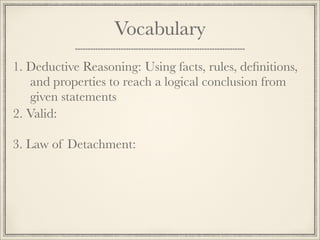
Vocabulary 
1. Deductive Reasoning: 
2. Valid: 
3. Law of Detachment:
Vocabulary 
1. D e d u c t i v e R e a s o n i n g : Using facts, rules, definitions, 
and properties to reach a logical conclusion from 
given statements 
2. Valid: 
3. Law of Detachment:
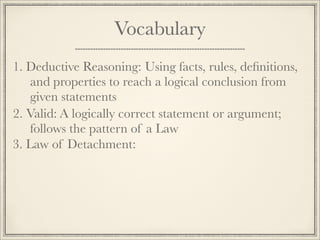
Vocabulary 
1. D e d u c t i v e R e a s o n i n g : Using facts, rules, definitions, 
and properties to reach a logical conclusion from 
given statements 
2. V a l i d : A logically correct statement or argument; 
follows the pattern of a Law 
3. Law of Detachment:
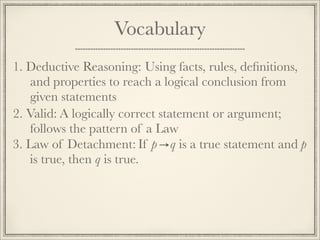
Vocabulary 
1. D e d u c t i v e R e a s o n i n g : Using facts, rules, definitions, 
and properties to reach a logical conclusion from 
given statements 
2. V a l i d : A logically correct statement or argument; 
follows the pattern of a Law 
3. L a w o f D e t a c h m e n t : If p q is a true statement and p 
is true, then q is true.
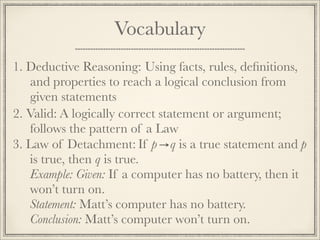
Vocabulary 
1. D e d u c t i v e R e a s o n i n g : Using facts, rules, definitions, 
and properties to reach a logical conclusion from 
given statements 
2. V a l i d : A logically correct statement or argument; 
follows the pattern of a Law 
3. L a w o f D e t a c h m e n t : If p q is a true statement and p 
is true, then q is true. 
Example: Given: If a computer has no battery, then it 
won’t turn on. 
Statement: Matt’s computer has no battery. 
Conclusion: Matt’s computer won’t turn on.
Vocabulary 
4. Law of Syllogism:
Vocabulary 
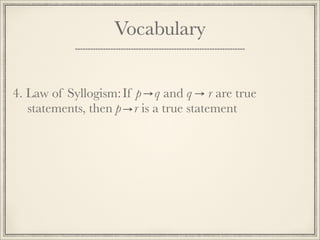
4. L a w o f S y l l o g i s m : If p q and q r are true 
statements, then p r is a true statement
Vocabulary 
4. Law of Syllogism: 
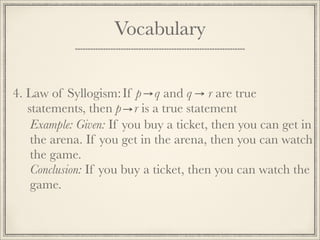
If p q and q r are true 
statements, then p r is a true statement 
Example: Given: If you buy a ticket, then you can get in 
the arena. If you get in the arena, then you can watch 
the game. 
Conclusion: If you buy a ticket, then you can watch the 
game.
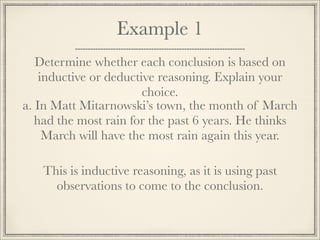
Example 1 
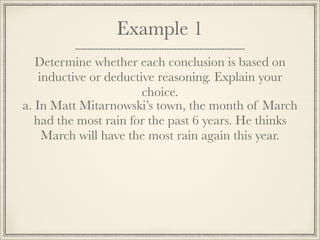
Determine whether each conclusion is based on 
inductive or deductive reasoning. Explain your 
choice. 
a. In Matt Mitarnowski’s town, the month of March 
had the most rain for the past 6 years. He thinks 
March will have the most rain again this year.
Example 1 
Determine whether each conclusion is based on 
inductive or deductive reasoning. Explain your 
choice. 
a. In Matt Mitarnowski’s town, the month of March 
had the most rain for the past 6 years. He thinks 
March will have the most rain again this year. 
This is inductive reasoning, as it is using past 
observations to come to the conclusion.
Example 1 
Determine whether each conclusion is based on 
inductive or deductive reasoning. Explain your 
choice. 
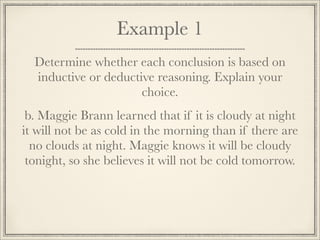
b. Maggie Brann learned that if it is cloudy at night 
it will not be as cold in the morning than if there are 
no clouds at night. Maggie knows it will be cloudy 
tonight, so she believes it will not be cold tomorrow.
Example 1 
Determine whether each conclusion is based on 
inductive or deductive reasoning. Explain your 
choice. 
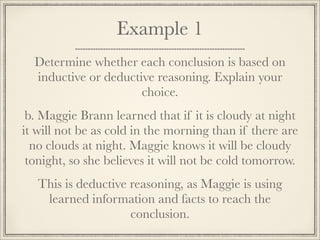
b. Maggie Brann learned that if it is cloudy at night 
it will not be as cold in the morning than if there are 
no clouds at night. Maggie knows it will be cloudy 
tonight, so she believes it will not be cold tomorrow. 
This is deductive reasoning, as Maggie is using 
learned information and facts to reach the 
conclusion.
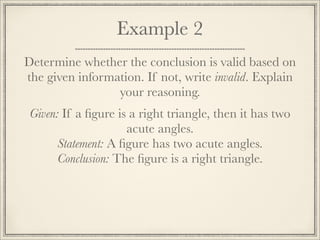
Example 2 
Determine whether the conclusion is valid based on 
the given information. If not, write invalid. Explain 
your reasoning. 
Given: If a figure is a right triangle, then it has two 
acute angles. 
Statement: A figure has two acute angles. 
Conclusion: The figure is a right triangle.
Example 2 
Determine whether the conclusion is valid based on 
the given information. If not, write invalid. Explain 
your reasoning. 
Given: If a figure is a right triangle, then it has two 
acute angles. 
Statement: A figure has two acute angles. 
Conclusion: The figure is a right triangle. 
Invalid conclusion. A quadrilateral can have two 
acute angles, but it is not a right triangle.
Example 3 
Determine whether the conclusion is valid based on 
the given information. If not, write invalid. Explain 
your reasoning with a Venn diagram. 
Given: If a figure is a square, it is also a rectangle. 
Statement: The figure is a square. 
Conclusion: The square is also a rectangle.
Example 3 
Determine whether the conclusion is valid based on 
the given information. If not, write invalid. Explain 
your reasoning with a Venn diagram. 
Given: If a figure is a square, it is also a rectangle. 
Statement: The figure is a square. 
Conclusion: The square is also a rectangle. 
A square has four right angles 
and opposite parallel sides, so 
it is also a rectangle
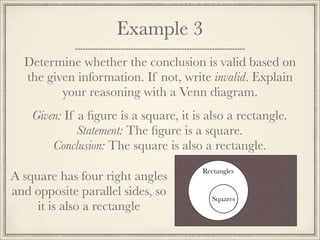
Example 3 
Determine whether the conclusion is valid based on 
the given information. If not, write invalid. Explain 
your reasoning with a Venn diagram. 
Given: If a figure is a square, it is also a rectangle. 
Statement: The figure is a square. 
Conclusion: The square is also a rectangle. 
Rectangles 
Squares 
A square has four right angles 
and opposite parallel sides, so 
it is also a rectangle
Example 4 
Draw a valid conclusion from the given statements, if 
possible. If no valid conclusion can be drawn, write 
no conclusion and explain your reasoning. 
Given: An angle bisector divides an angle into two 
congruent angles. If two angles are congruent, then 
their measures are equal. 
Statement: BD bisects ∠ABC.
Example 4 
Draw a valid conclusion from the given statements, if 
possible. If no valid conclusion can be drawn, write 
no conclusion and explain your reasoning. 
Given: An angle bisector divides an angle into two 
congruent angles. If two angles are congruent, then 
their measures are equal. 
Statement: BD bisects ∠ABC. 
Conclusion: m∠ABD = m∠DBC
Problem Set
Problem Set 
p. 119 #1-39 odd, 45 
“Success does not consist in never making blunders, 
but in never making the same one a second time.” 
- Josh Billings

Geometry Section 2-4 1112

  • 1.
  • 2.
    Essential Questions Howdo you use the Law of Detachment? How do you use the Law of Syllogism?
  • 3.
    Vocabulary 1. DeductiveReasoning: 2. Valid: 3. Law of Detachment:
  • 4.
    Vocabulary 1. De d u c t i v e R e a s o n i n g : Using facts, rules, definitions, and properties to reach a logical conclusion from given statements 2. Valid: 3. Law of Detachment:
  • 5.
    Vocabulary 1. De d u c t i v e R e a s o n i n g : Using facts, rules, definitions, and properties to reach a logical conclusion from given statements 2. V a l i d : A logically correct statement or argument; follows the pattern of a Law 3. Law of Detachment:
  • 6.
    Vocabulary 1. De d u c t i v e R e a s o n i n g : Using facts, rules, definitions, and properties to reach a logical conclusion from given statements 2. V a l i d : A logically correct statement or argument; follows the pattern of a Law 3. L a w o f D e t a c h m e n t : If p q is a true statement and p is true, then q is true.
  • 7.
    Vocabulary 1. De d u c t i v e R e a s o n i n g : Using facts, rules, definitions, and properties to reach a logical conclusion from given statements 2. V a l i d : A logically correct statement or argument; follows the pattern of a Law 3. L a w o f D e t a c h m e n t : If p q is a true statement and p is true, then q is true. Example: Given: If a computer has no battery, then it won’t turn on. Statement: Matt’s computer has no battery. Conclusion: Matt’s computer won’t turn on.
  • 8.
    Vocabulary 4. Lawof Syllogism:
  • 9.
    Vocabulary 4. La w o f S y l l o g i s m : If p q and q r are true statements, then p r is a true statement
  • 10.
    Vocabulary 4. Lawof Syllogism: If p q and q r are true statements, then p r is a true statement Example: Given: If you buy a ticket, then you can get in the arena. If you get in the arena, then you can watch the game. Conclusion: If you buy a ticket, then you can watch the game.
  • 11.
    Example 1 Determinewhether each conclusion is based on inductive or deductive reasoning. Explain your choice. a. In Matt Mitarnowski’s town, the month of March had the most rain for the past 6 years. He thinks March will have the most rain again this year.
  • 12.
    Example 1 Determinewhether each conclusion is based on inductive or deductive reasoning. Explain your choice. a. In Matt Mitarnowski’s town, the month of March had the most rain for the past 6 years. He thinks March will have the most rain again this year. This is inductive reasoning, as it is using past observations to come to the conclusion.
  • 13.
    Example 1 Determinewhether each conclusion is based on inductive or deductive reasoning. Explain your choice. b. Maggie Brann learned that if it is cloudy at night it will not be as cold in the morning than if there are no clouds at night. Maggie knows it will be cloudy tonight, so she believes it will not be cold tomorrow.
  • 14.
    Example 1 Determinewhether each conclusion is based on inductive or deductive reasoning. Explain your choice. b. Maggie Brann learned that if it is cloudy at night it will not be as cold in the morning than if there are no clouds at night. Maggie knows it will be cloudy tonight, so she believes it will not be cold tomorrow. This is deductive reasoning, as Maggie is using learned information and facts to reach the conclusion.
  • 15.
    Example 2 Determinewhether the conclusion is valid based on the given information. If not, write invalid. Explain your reasoning. Given: If a figure is a right triangle, then it has two acute angles. Statement: A figure has two acute angles. Conclusion: The figure is a right triangle.
  • 16.
    Example 2 Determinewhether the conclusion is valid based on the given information. If not, write invalid. Explain your reasoning. Given: If a figure is a right triangle, then it has two acute angles. Statement: A figure has two acute angles. Conclusion: The figure is a right triangle. Invalid conclusion. A quadrilateral can have two acute angles, but it is not a right triangle.
  • 17.
    Example 3 Determinewhether the conclusion is valid based on the given information. If not, write invalid. Explain your reasoning with a Venn diagram. Given: If a figure is a square, it is also a rectangle. Statement: The figure is a square. Conclusion: The square is also a rectangle.
  • 18.
    Example 3 Determinewhether the conclusion is valid based on the given information. If not, write invalid. Explain your reasoning with a Venn diagram. Given: If a figure is a square, it is also a rectangle. Statement: The figure is a square. Conclusion: The square is also a rectangle. A square has four right angles and opposite parallel sides, so it is also a rectangle
  • 19.
    Example 3 Determinewhether the conclusion is valid based on the given information. If not, write invalid. Explain your reasoning with a Venn diagram. Given: If a figure is a square, it is also a rectangle. Statement: The figure is a square. Conclusion: The square is also a rectangle. Rectangles Squares A square has four right angles and opposite parallel sides, so it is also a rectangle
  • 20.
    Example 4 Drawa valid conclusion from the given statements, if possible. If no valid conclusion can be drawn, write no conclusion and explain your reasoning. Given: An angle bisector divides an angle into two congruent angles. If two angles are congruent, then their measures are equal. Statement: BD bisects ∠ABC.
  • 21.
    Example 4 Drawa valid conclusion from the given statements, if possible. If no valid conclusion can be drawn, write no conclusion and explain your reasoning. Given: An angle bisector divides an angle into two congruent angles. If two angles are congruent, then their measures are equal. Statement: BD bisects ∠ABC. Conclusion: m∠ABD = m∠DBC
  • 22.
  • 23.
    Problem Set p.119 #1-39 odd, 45 “Success does not consist in never making blunders, but in never making the same one a second time.” - Josh Billings