Section 1-3
Locating Points and Midpoints
Essential Questions
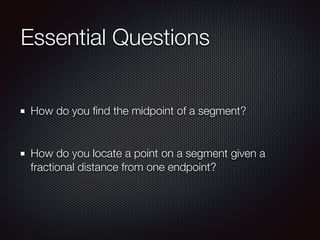
How do you find the midpoint of a segment?
How do you locate a point on a segment given a
fractional distance from one endpoint?
Vocabulary
1. Midpoint: The point on a segment that is halfway
between the endpoints
M =
x1
+ x2
2
,
y1
+ y2
2
⎛
⎝
⎜
⎞
⎠
⎟ for (x1
,y1
) and (x2
,y2
)
2. Segment Bisector: Any segment, line, or plane
that intersects another segment at its midpoint
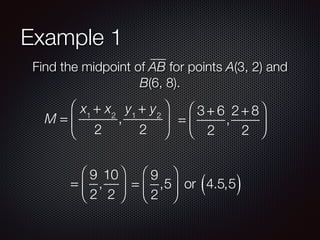
Example 1
Find the midpoint of AB for points A(3, 2) and
B(6, 8).
M =
x1
+ x2
2
,
y1
+ y2
2
⎛
⎝
⎜
⎞
⎠
⎟ =
3 + 6
2
,
2 + 8
2
⎛
⎝⎜
⎞
⎠⎟
=
9
2
,
10
2
⎛
⎝⎜
⎞
⎠⎟ =
9
2
,5
⎛
⎝⎜
⎞
⎠⎟ or 4.5,5( )
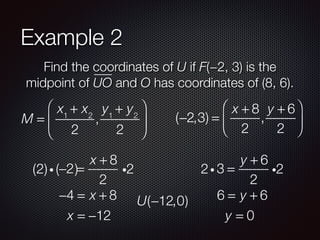
Example 2
Find the coordinates of U if F(−2, 3) is the
midpoint of UO and O has coordinates of (8, 6).
M =
x1
+ x2
2
,
y1
+ y2
2
⎛
⎝
⎜
⎞
⎠
⎟ (−2,3) =
x + 8
2
,
y + 6
2
⎛
⎝⎜
⎞
⎠⎟
−2 =
x + 8
2
i2(2)i ( )
−4 = x + 8
x = −12
3 =
y + 6
2
i22i
6 = y + 6
y = 0
U(−12,0)
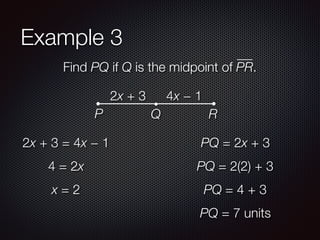
Example 3
Find PQ if Q is the midpoint of PR.
2x + 3 4x − 1
P Q R
2x + 3 = 4x − 1
4 = 2x
x = 2
PQ = 2x + 3
PQ = 2(2) + 3
PQ = 4 + 3
PQ = 7 units
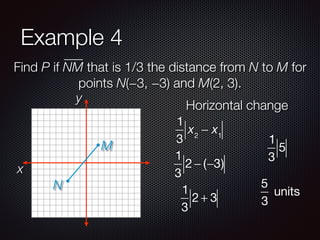
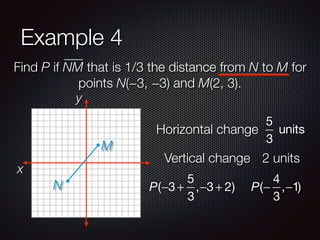
Example 4
Find P if NM that is 1/3 the distance from N to M for
points N(−3, −3) and M(2, 3).
Horizontal change
1
3
x2
− x1
1
3
2 − (−3)
1
3
2 + 3
1
3
5
5
3
units
x
y
M
N
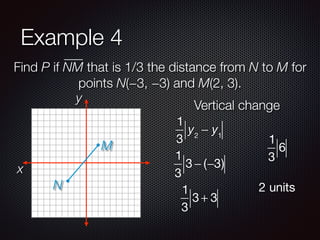
Example 4
Find P if NM that is 1/3 the distance from N to M for
points N(−3, −3) and M(2, 3).
Vertical change
1
3
y2
− y1
1
3
3 − (−3)
1
3
3 + 3
1
3
6
2 units
x
y
M
N
Example 4
Find P if NM that is 1/3 the distance from N to M for
points N(−3, −3) and M(2, 3).
Vertical change 2 units
Horizontal change
5
3
units
P(−3 +
5
3
,−3 + 2) P(−
4
3
,−1)
x
y
M
N
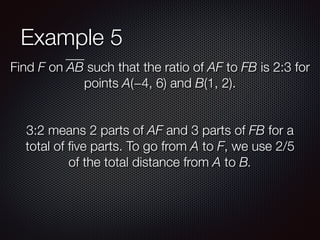
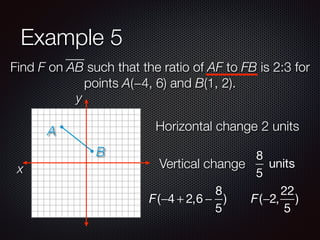
Example 5
Find F on AB such that the ratio of AF to FB is 2:3 for
points A(−4, 6) and B(1, 2).
3:2 means 2 parts of AF and 3 parts of FB for a
total of five parts. To go from A to F, we use 2/5
of the total distance from A to B.
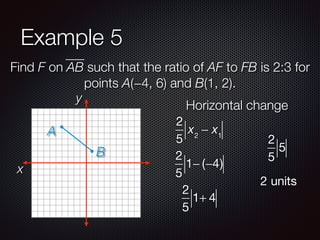
Example 5
Find F on AB such that the ratio of AF to FB is 2:3 for
points A(−4, 6) and B(1, 2).
x
y
B
A
Horizontal change
2
5
x2
− x1
2
5
1− (−4)
2
5
1+ 4
2
5
5
2 units
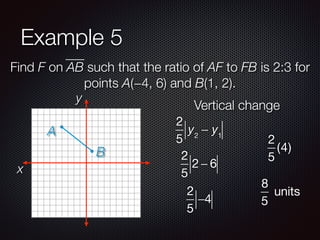
Example 5
Find F on AB such that the ratio of AF to FB is 2:3 for
points A(−4, 6) and B(1, 2).
x
y
B
A
Vertical change
2
5
y2
− y1
2
5
2 − 6
2
5
−4
2
5
(4)
8
5
units
Example 5
Find F on AB such that the ratio of AF to FB is 2:3 for
points A(−4, 6) and B(1, 2).
x
y
B
A Horizontal change 2 units
Vertical change
8
5
units
F(−4 + 2,6 −
8
5
) F(−2,
22
5
)

Geometry Section 1-3

  • 1.
  • 2.
    Essential Questions How doyou find the midpoint of a segment? How do you locate a point on a segment given a fractional distance from one endpoint?
  • 3.
    Vocabulary 1. Midpoint: Thepoint on a segment that is halfway between the endpoints M = x1 + x2 2 , y1 + y2 2 ⎛ ⎝ ⎜ ⎞ ⎠ ⎟ for (x1 ,y1 ) and (x2 ,y2 ) 2. Segment Bisector: Any segment, line, or plane that intersects another segment at its midpoint
  • 4.
    Example 1 Find themidpoint of AB for points A(3, 2) and B(6, 8). M = x1 + x2 2 , y1 + y2 2 ⎛ ⎝ ⎜ ⎞ ⎠ ⎟ = 3 + 6 2 , 2 + 8 2 ⎛ ⎝⎜ ⎞ ⎠⎟ = 9 2 , 10 2 ⎛ ⎝⎜ ⎞ ⎠⎟ = 9 2 ,5 ⎛ ⎝⎜ ⎞ ⎠⎟ or 4.5,5( )
  • 5.
    Example 2 Find thecoordinates of U if F(−2, 3) is the midpoint of UO and O has coordinates of (8, 6). M = x1 + x2 2 , y1 + y2 2 ⎛ ⎝ ⎜ ⎞ ⎠ ⎟ (−2,3) = x + 8 2 , y + 6 2 ⎛ ⎝⎜ ⎞ ⎠⎟ −2 = x + 8 2 i2(2)i ( ) −4 = x + 8 x = −12 3 = y + 6 2 i22i 6 = y + 6 y = 0 U(−12,0)
  • 6.
    Example 3 Find PQif Q is the midpoint of PR. 2x + 3 4x − 1 P Q R 2x + 3 = 4x − 1 4 = 2x x = 2 PQ = 2x + 3 PQ = 2(2) + 3 PQ = 4 + 3 PQ = 7 units
  • 7.
    Example 4 Find Pif NM that is 1/3 the distance from N to M for points N(−3, −3) and M(2, 3). Horizontal change 1 3 x2 − x1 1 3 2 − (−3) 1 3 2 + 3 1 3 5 5 3 units x y M N
  • 8.
    Example 4 Find Pif NM that is 1/3 the distance from N to M for points N(−3, −3) and M(2, 3). Vertical change 1 3 y2 − y1 1 3 3 − (−3) 1 3 3 + 3 1 3 6 2 units x y M N
  • 9.
    Example 4 Find Pif NM that is 1/3 the distance from N to M for points N(−3, −3) and M(2, 3). Vertical change 2 units Horizontal change 5 3 units P(−3 + 5 3 ,−3 + 2) P(− 4 3 ,−1) x y M N
  • 10.
    Example 5 Find Fon AB such that the ratio of AF to FB is 2:3 for points A(−4, 6) and B(1, 2). 3:2 means 2 parts of AF and 3 parts of FB for a total of five parts. To go from A to F, we use 2/5 of the total distance from A to B.
  • 11.
    Example 5 Find Fon AB such that the ratio of AF to FB is 2:3 for points A(−4, 6) and B(1, 2). x y B A Horizontal change 2 5 x2 − x1 2 5 1− (−4) 2 5 1+ 4 2 5 5 2 units
  • 12.
    Example 5 Find Fon AB such that the ratio of AF to FB is 2:3 for points A(−4, 6) and B(1, 2). x y B A Vertical change 2 5 y2 − y1 2 5 2 − 6 2 5 −4 2 5 (4) 8 5 units
  • 13.
    Example 5 Find Fon AB such that the ratio of AF to FB is 2:3 for points A(−4, 6) and B(1, 2). x y B A Horizontal change 2 units Vertical change 8 5 units F(−4 + 2,6 − 8 5 ) F(−2, 22 5 )