Chapter 11 Surface
 Area and Volume
       11.2 and 11.4


                       S
Essential Understanding


S You can analyze a 3D figure by using the relationship
  among its vertices, edges, and faces

S To find the surface area of a 3D figure, find the sum of
  the areas of all the surfaces of the figure

S You can find the volume of a prism or cylinder when you
  know its height and the area of its base
Objectives


S Students will be able to
  S recognize polyhedra and their parts
  S Visualize cross sections of space figures
  S Find the surface area of a prism and a cylinder
  S Find the volume of a prism and the volume of a cylinder
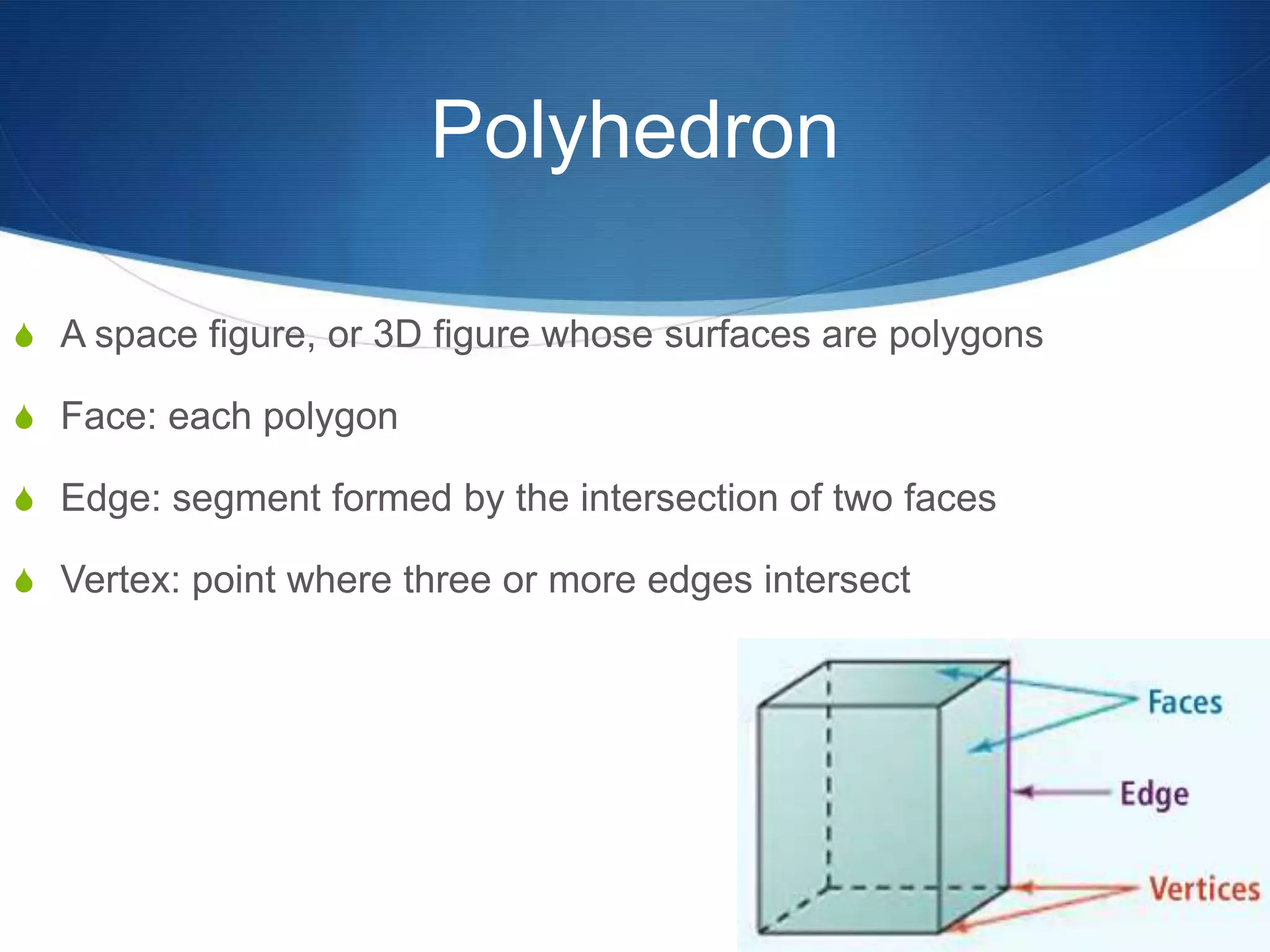
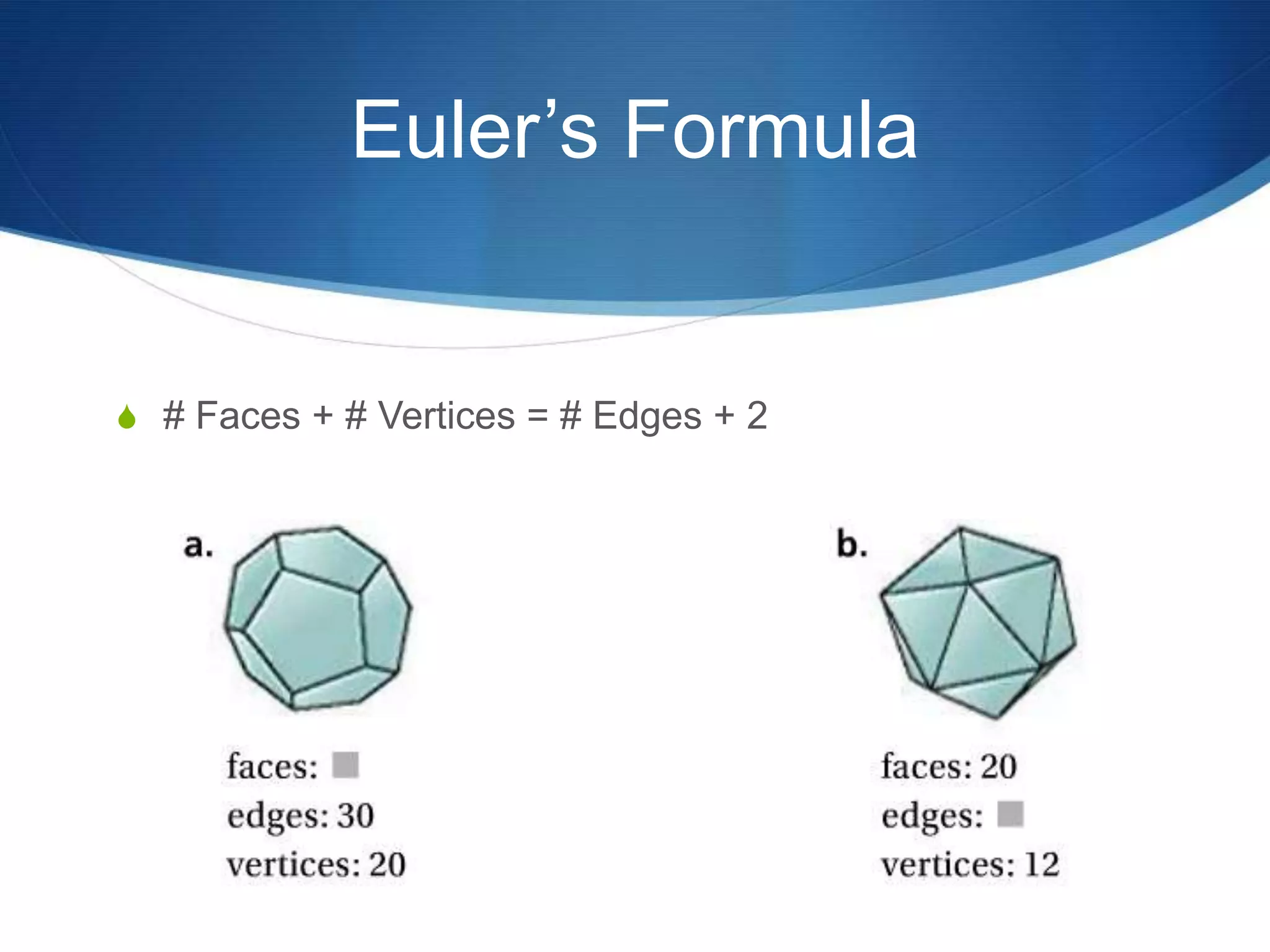
Polyhedron

S A space figure, or 3D figure whose surfaces are polygons

S Face: each polygon

S Edge: segment formed by the intersection of two faces

S Vertex: point where three or more edges intersect
Euler’s Formula


S # Faces + # Vertices = # Edges + 2
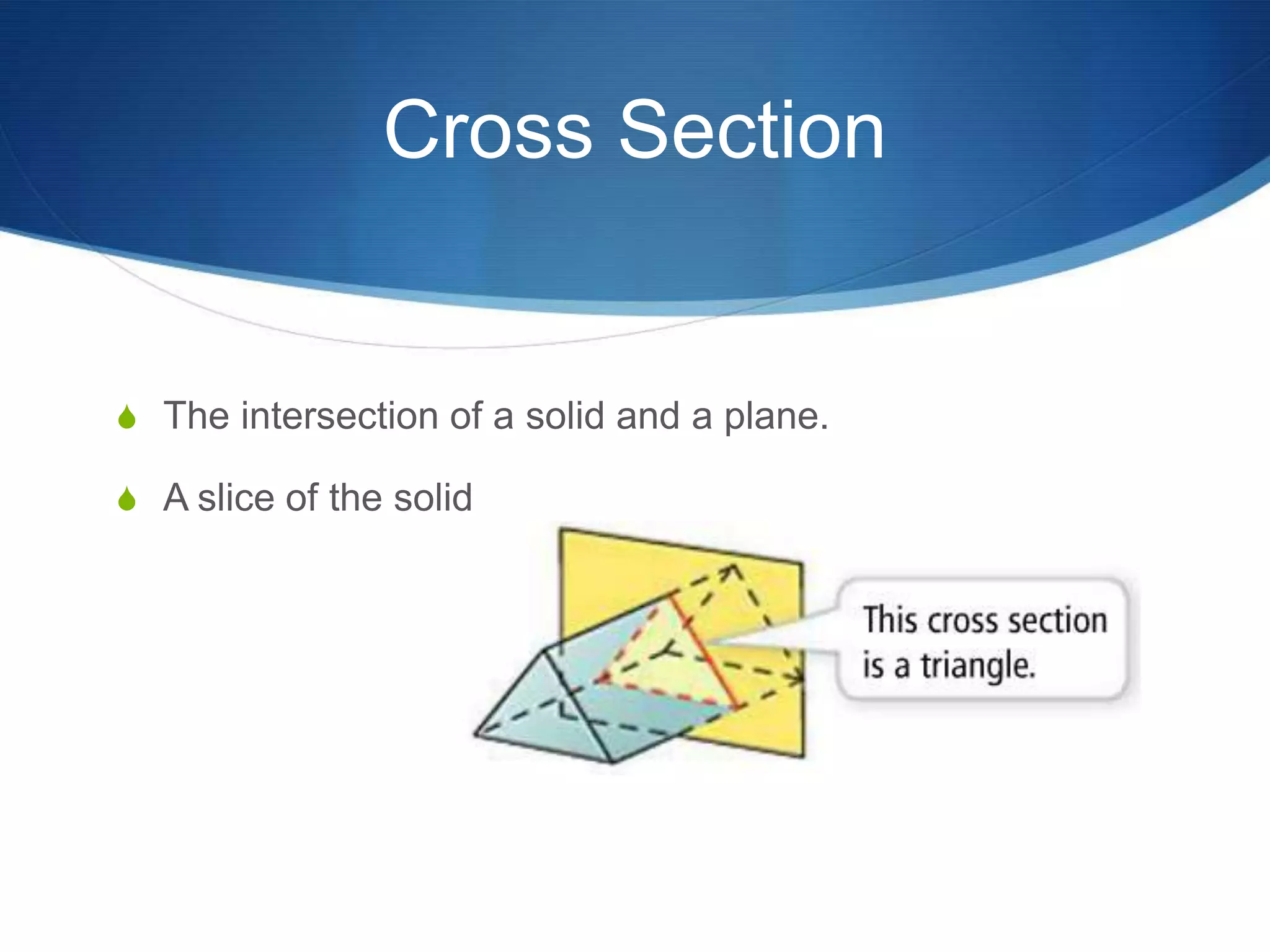
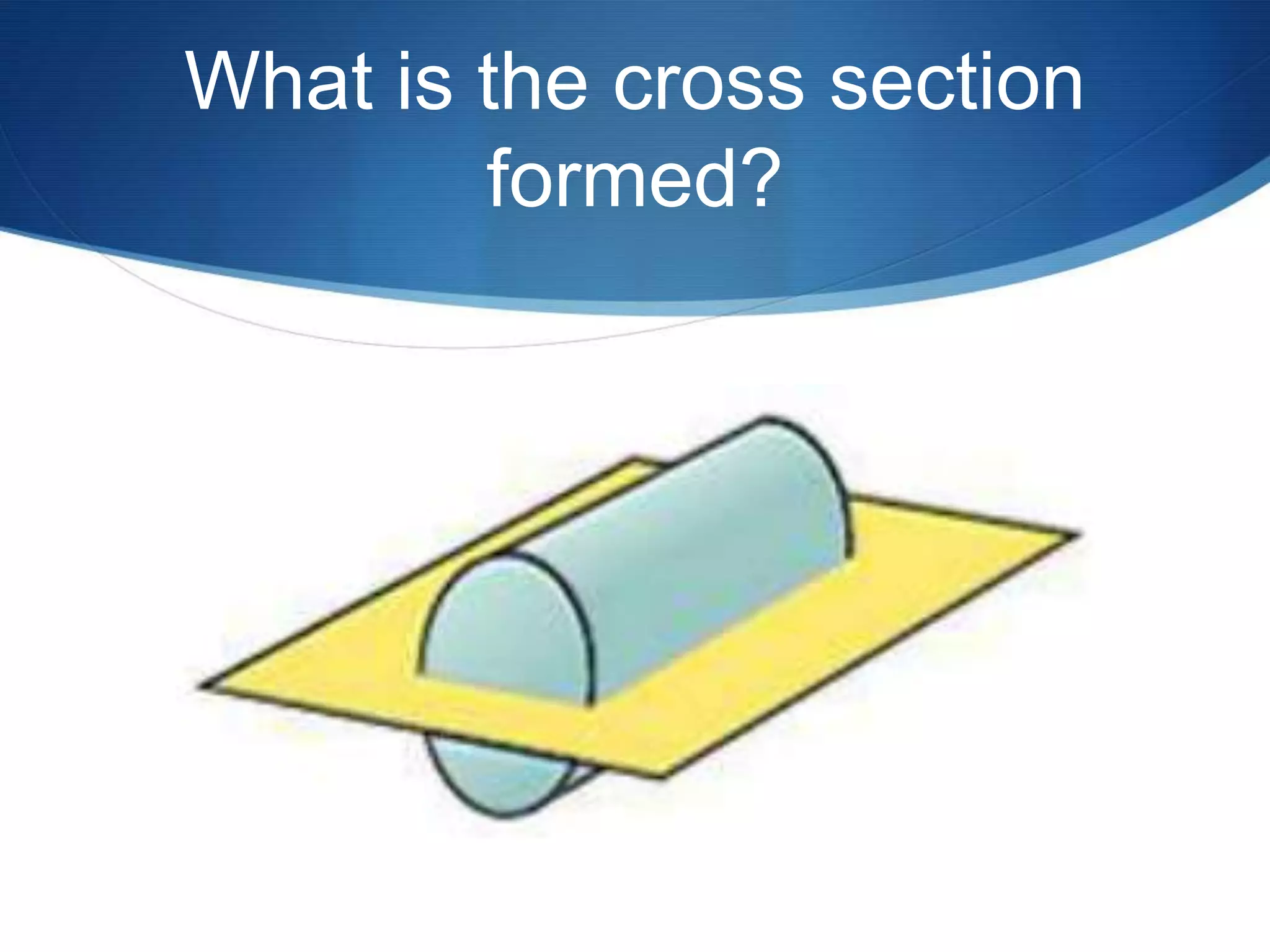
Cross Section


S The intersection of a solid and a plane.

S A slice of the solid
What is the cross section
        formed?
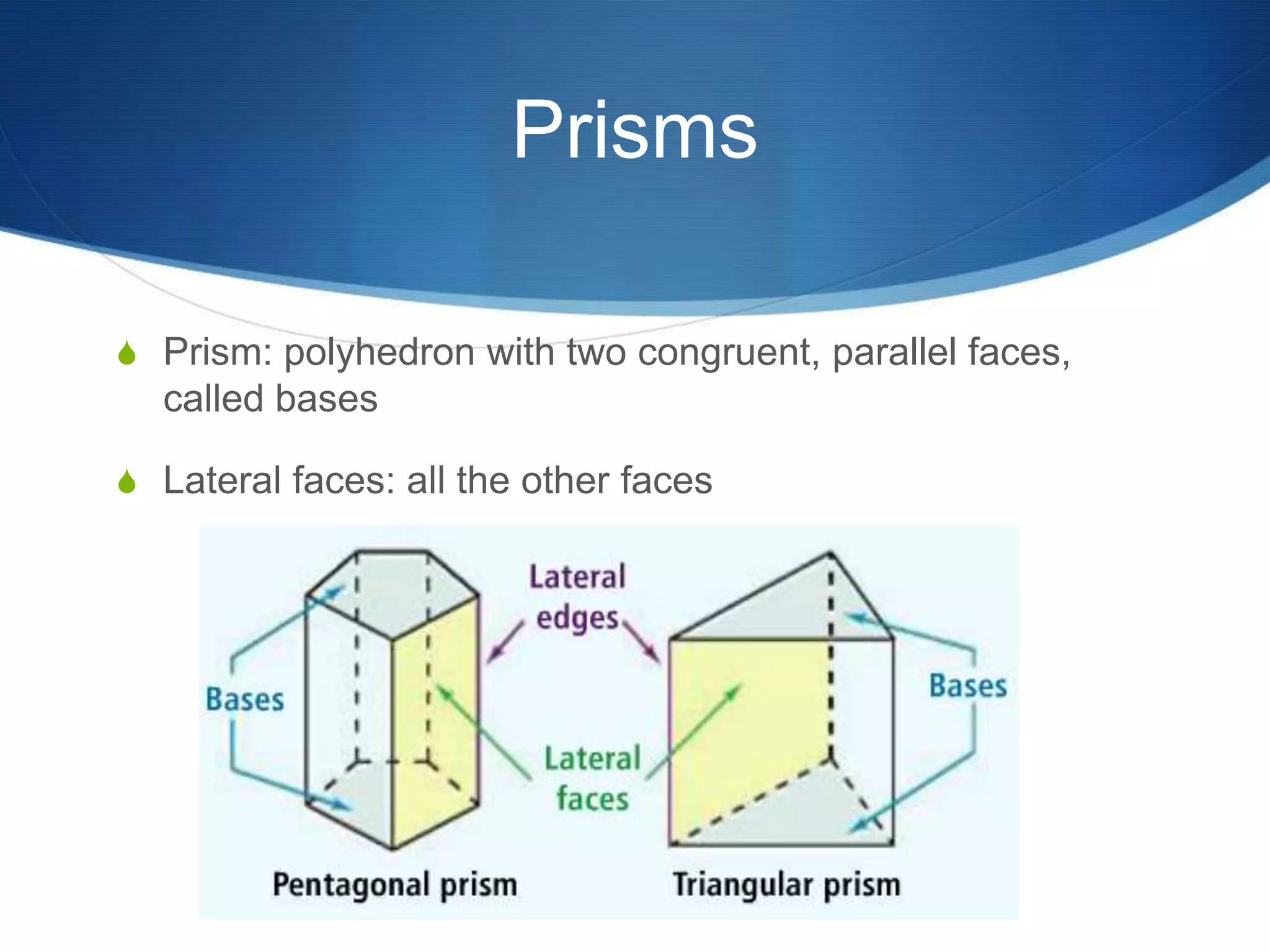
Prisms

S Prism: polyhedron with two congruent, parallel faces,
  called bases

S Lateral faces: all the other faces
Prisms…

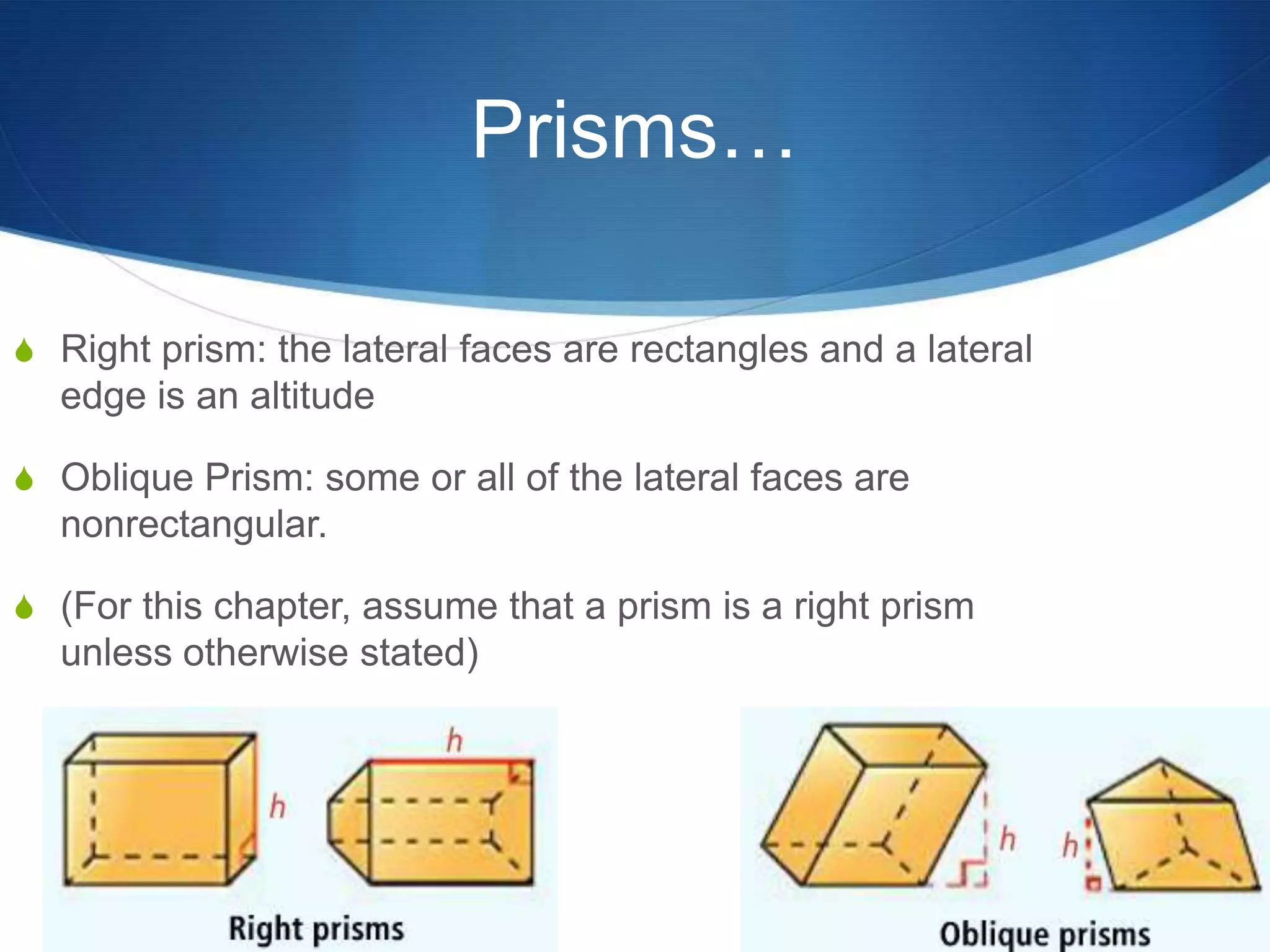
S Right prism: the lateral faces are rectangles and a lateral
  edge is an altitude

S Oblique Prism: some or all of the lateral faces are
  nonrectangular.

S (For this chapter, assume that a prism is a right prism
  unless otherwise stated)
LA and SA of a Prism


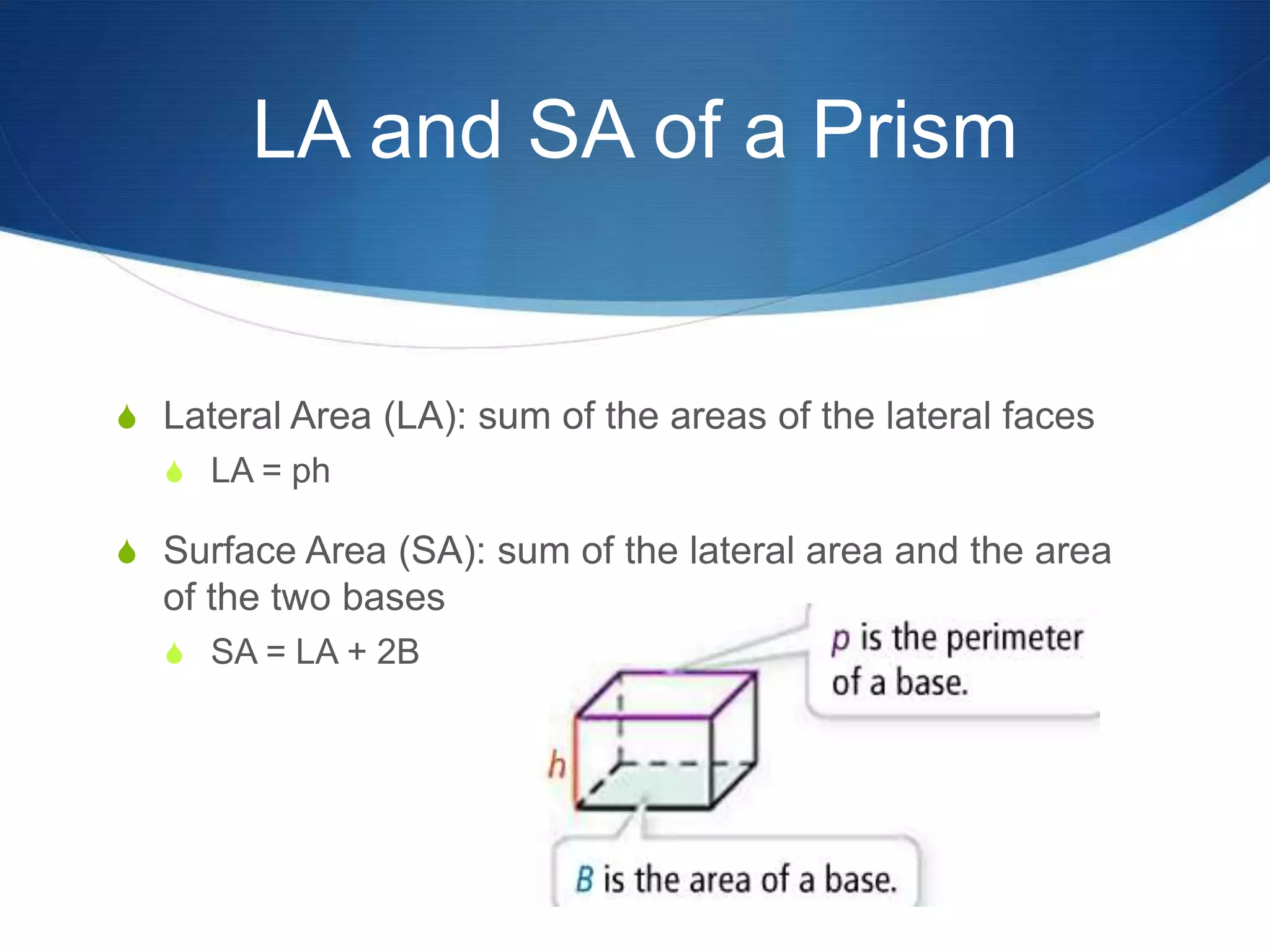
S Lateral Area (LA): sum of the areas of the lateral faces
  S LA = ph

S Surface Area (SA): sum of the lateral area and the area
  of the two bases
  S SA = LA + 2B
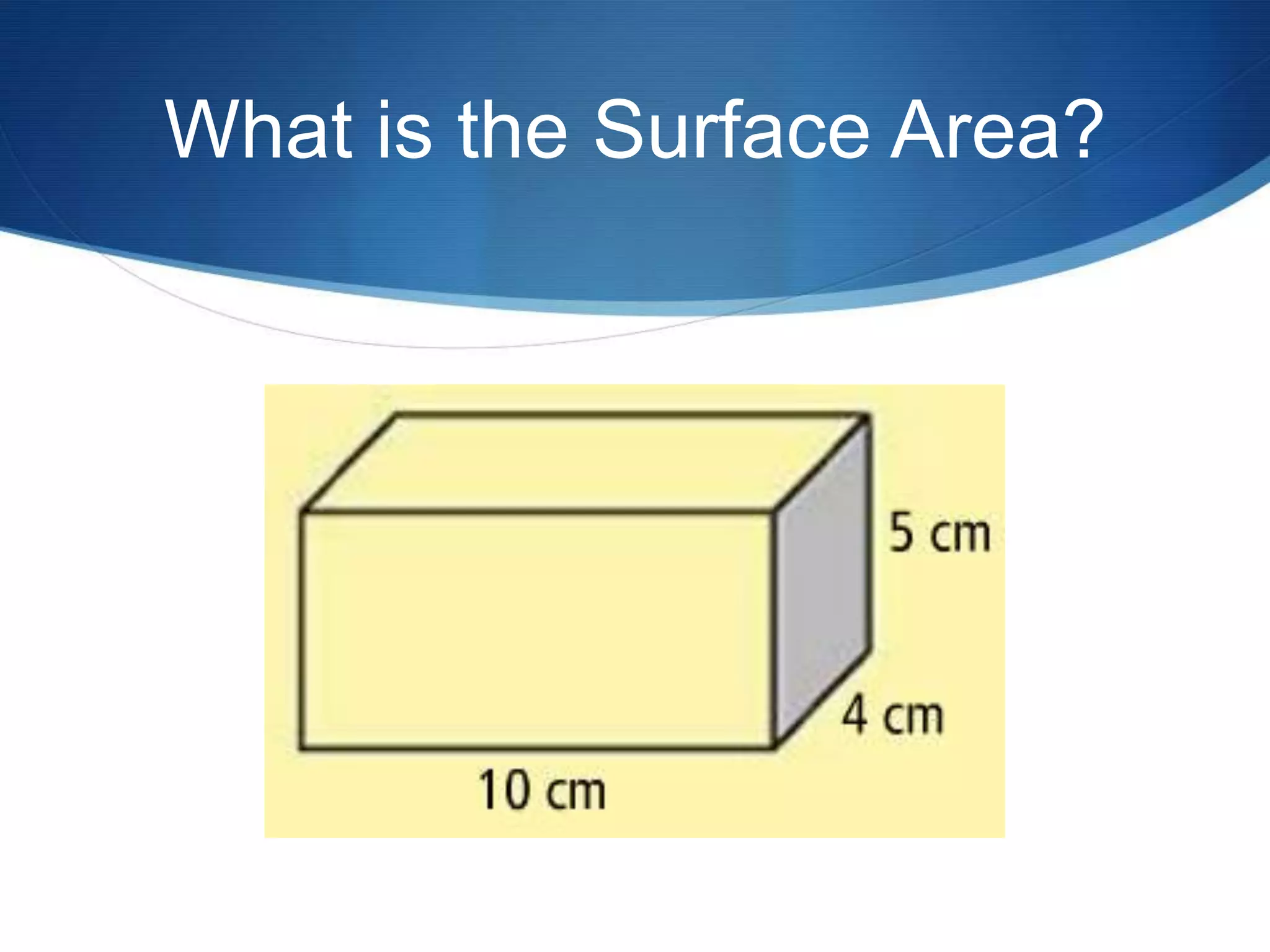
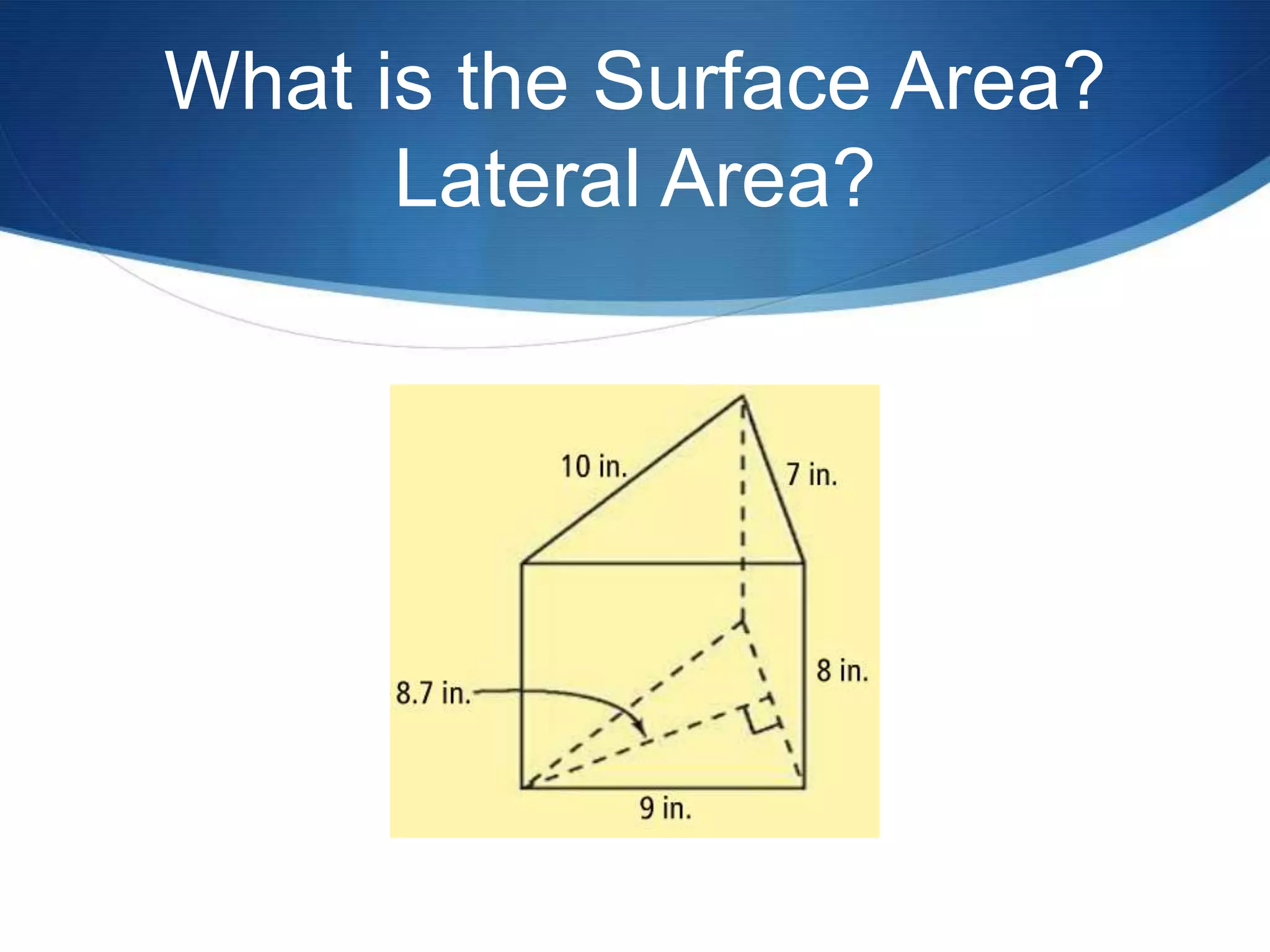
What is the Surface Area?
      Lateral Area?
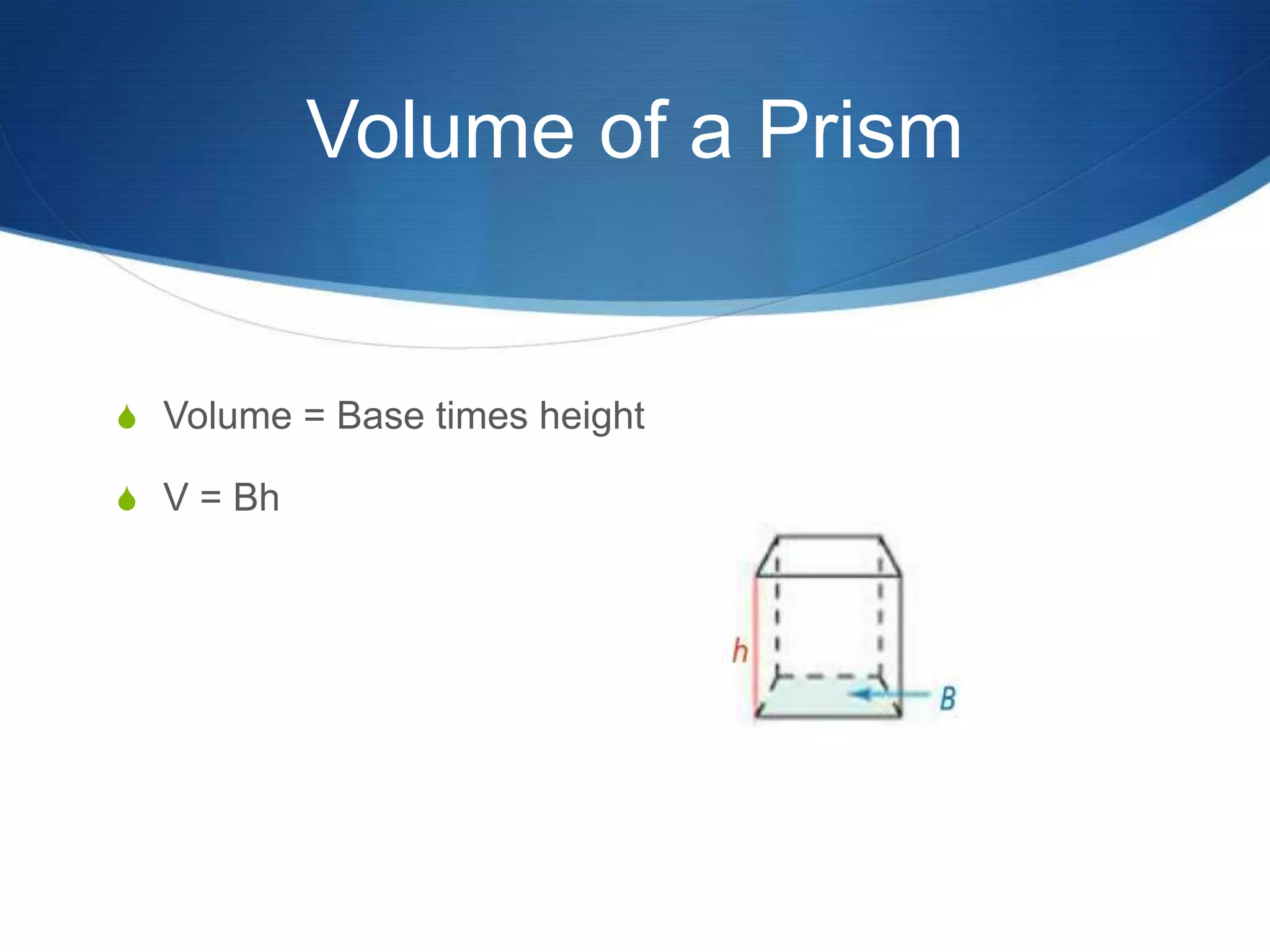
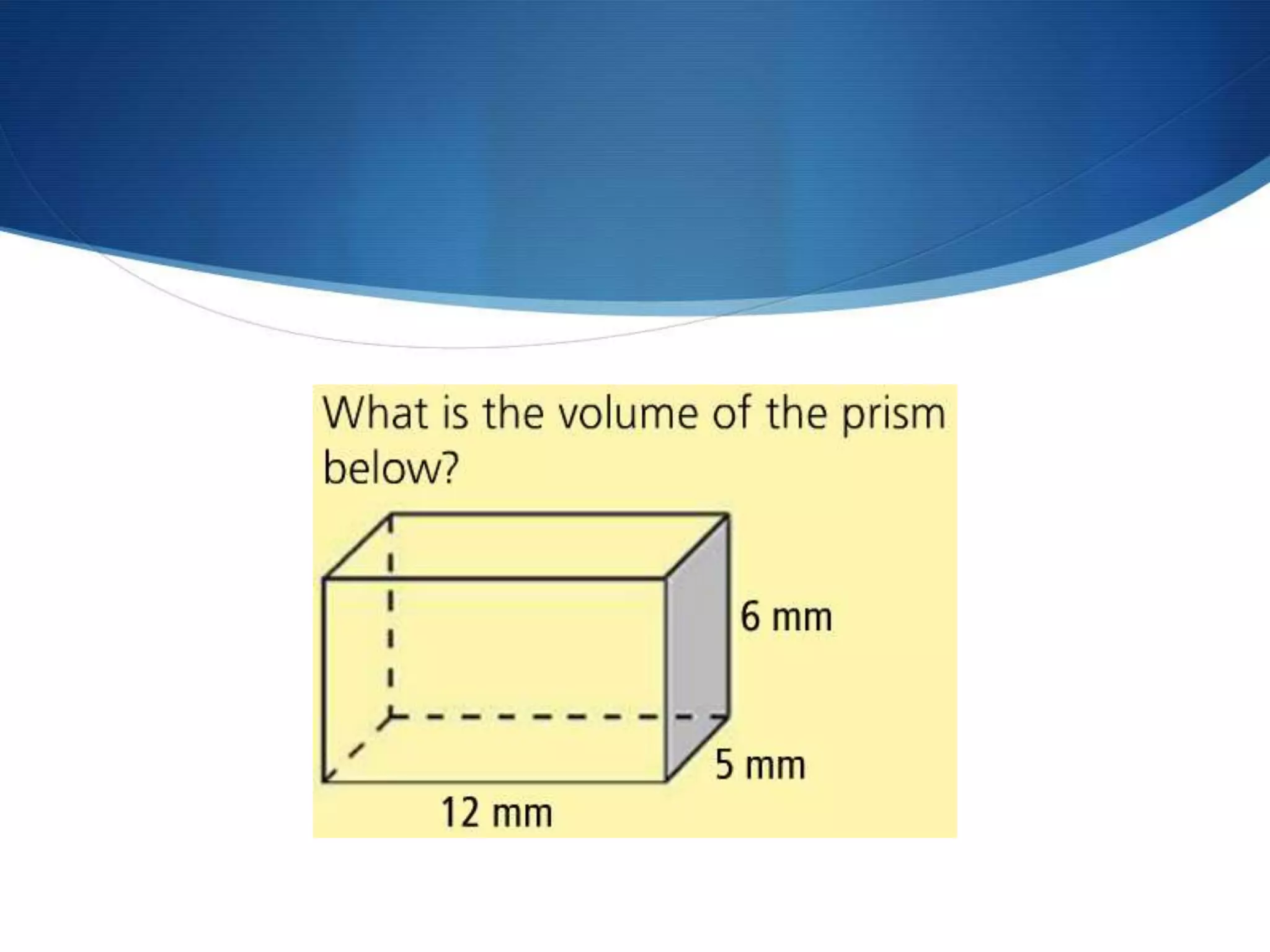
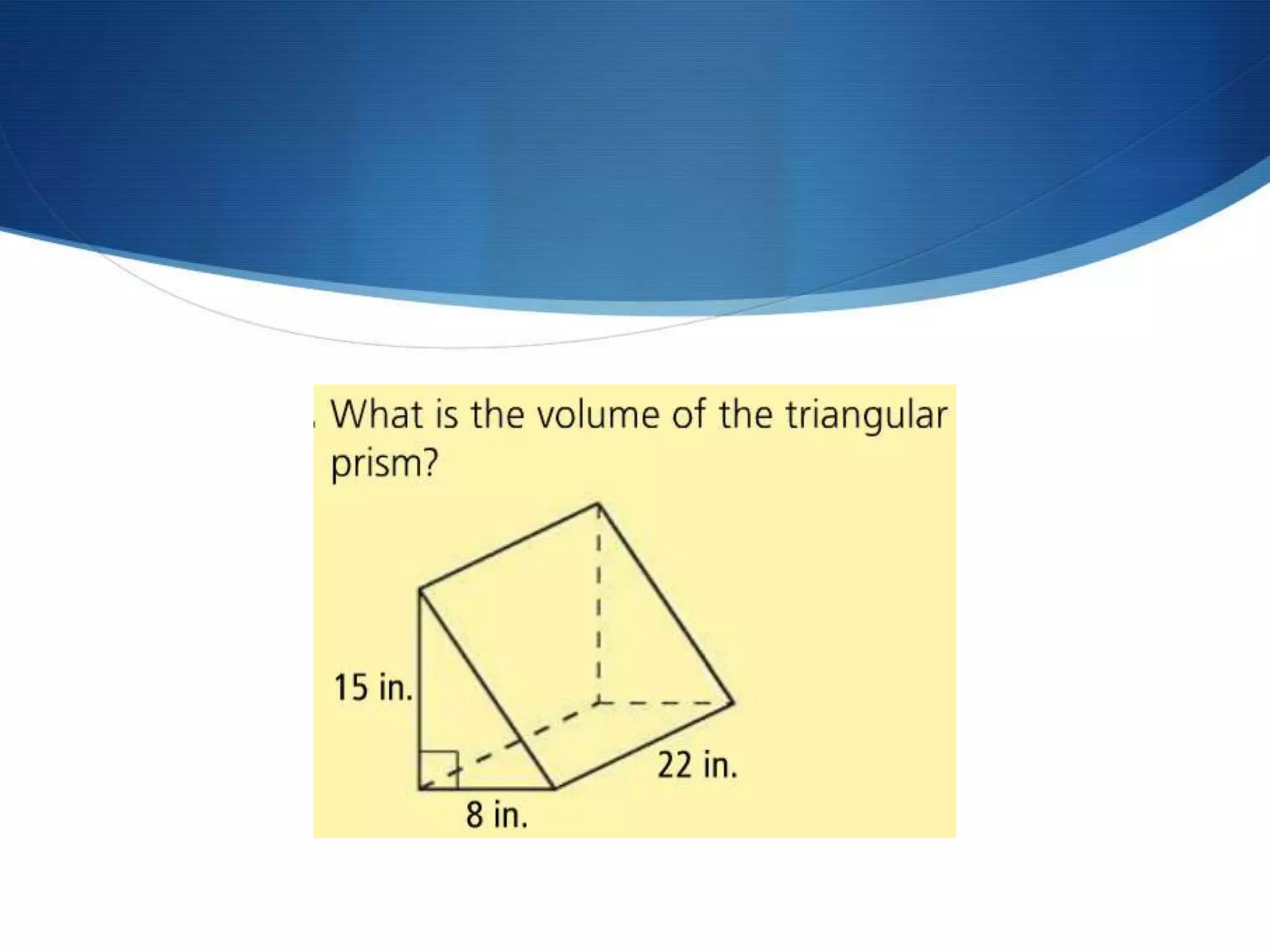
Volume of a Prism


S Volume = Base times height

S V = Bh
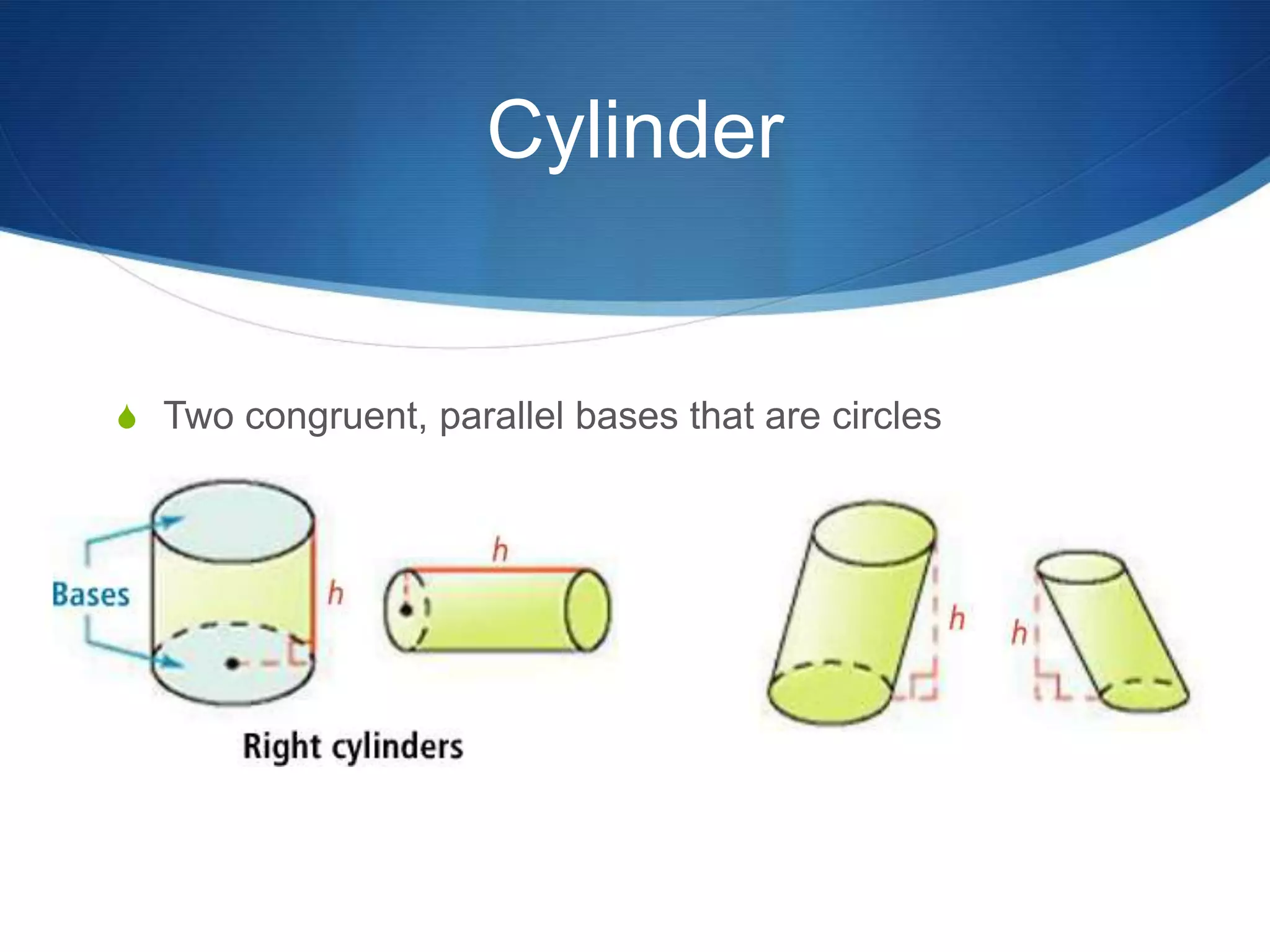
Cylinder


S Two congruent, parallel bases that are circles
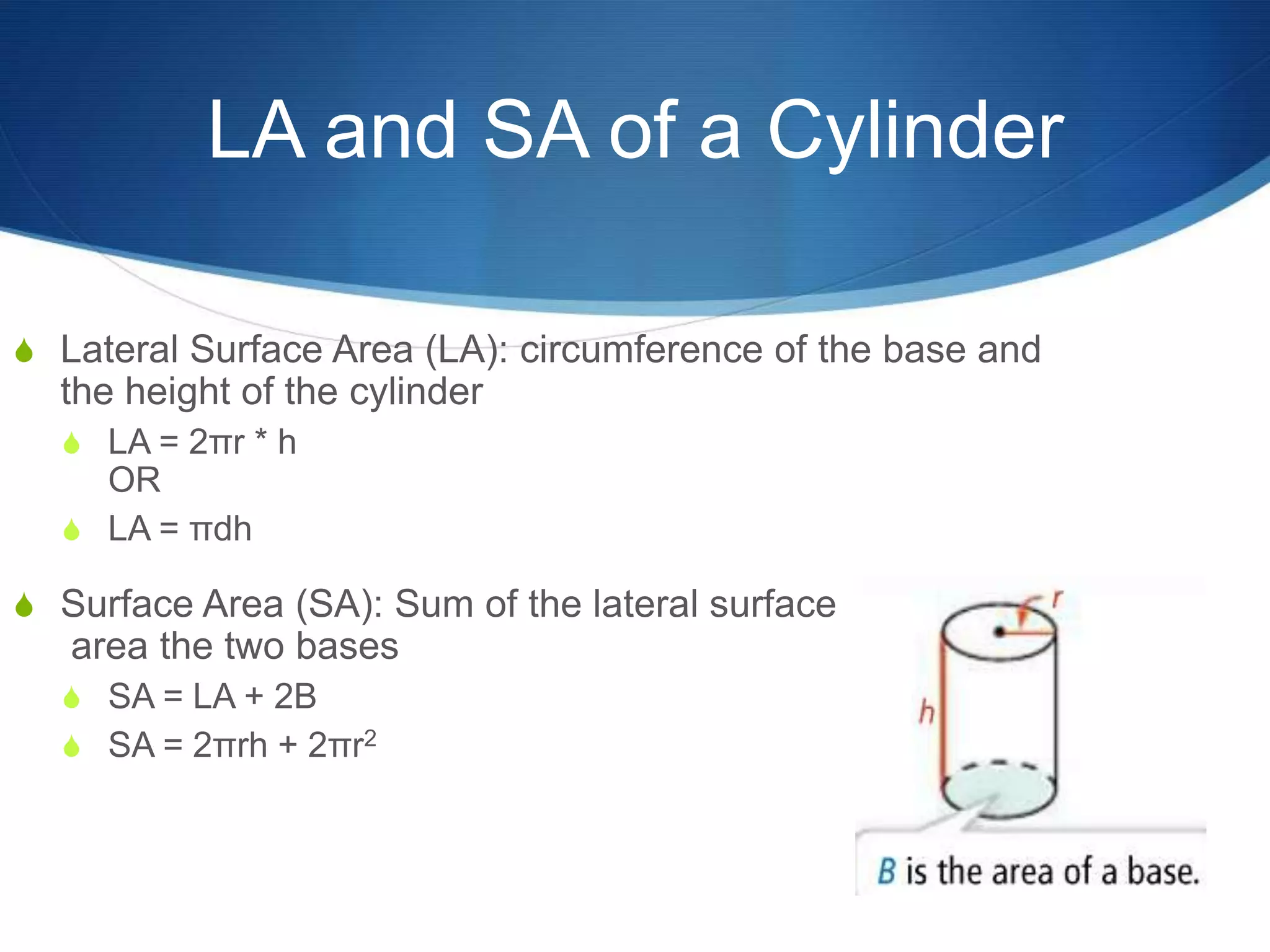
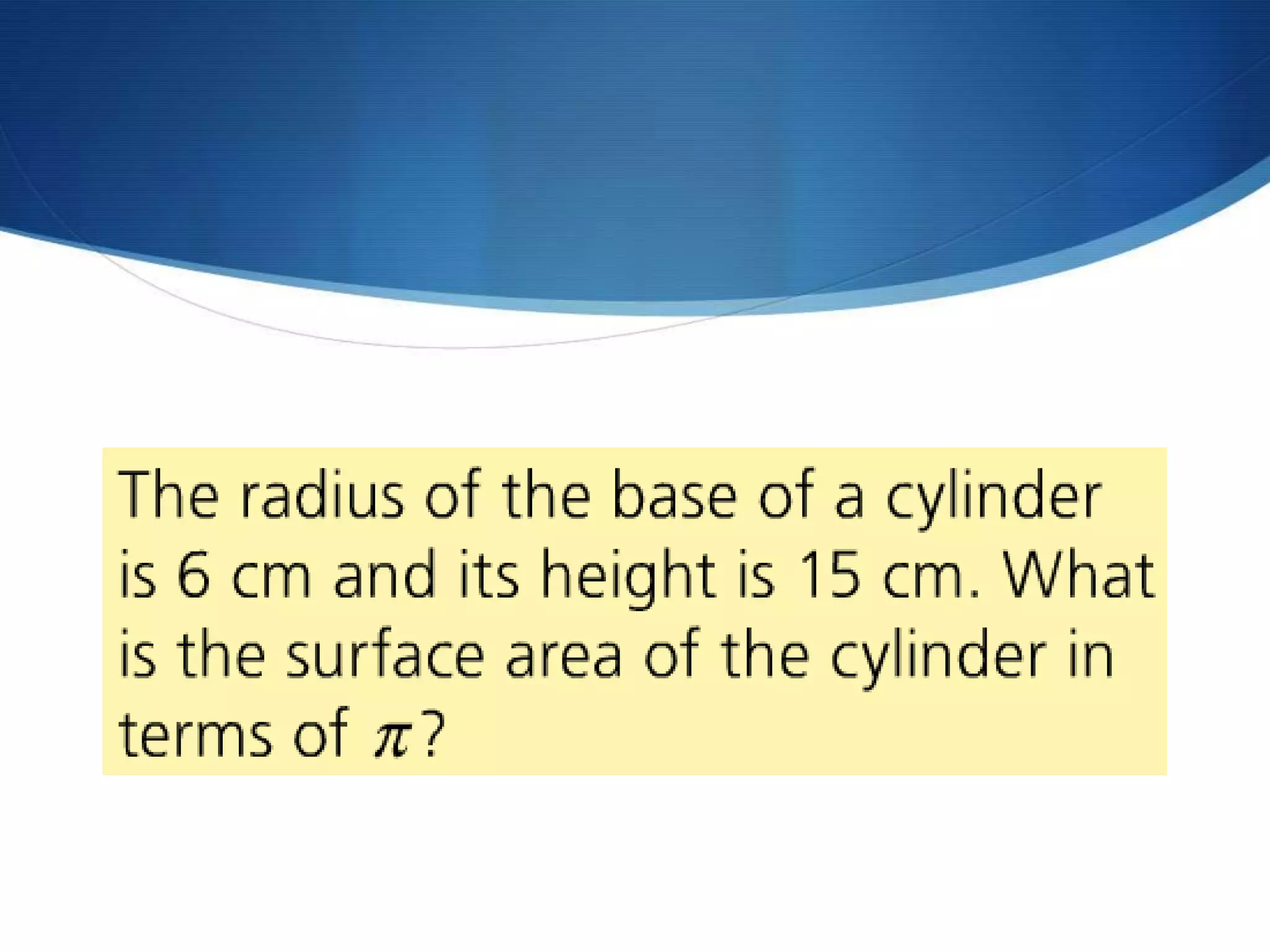
LA and SA of a Cylinder

S Lateral Surface Area (LA): circumference of the base and
  the height of the cylinder
  S LA = 2πr * h
    OR
  S LA = πdh

S Surface Area (SA): Sum of the lateral surface
   area the two bases
  S SA = LA + 2B
  S SA = 2πrh + 2πr2
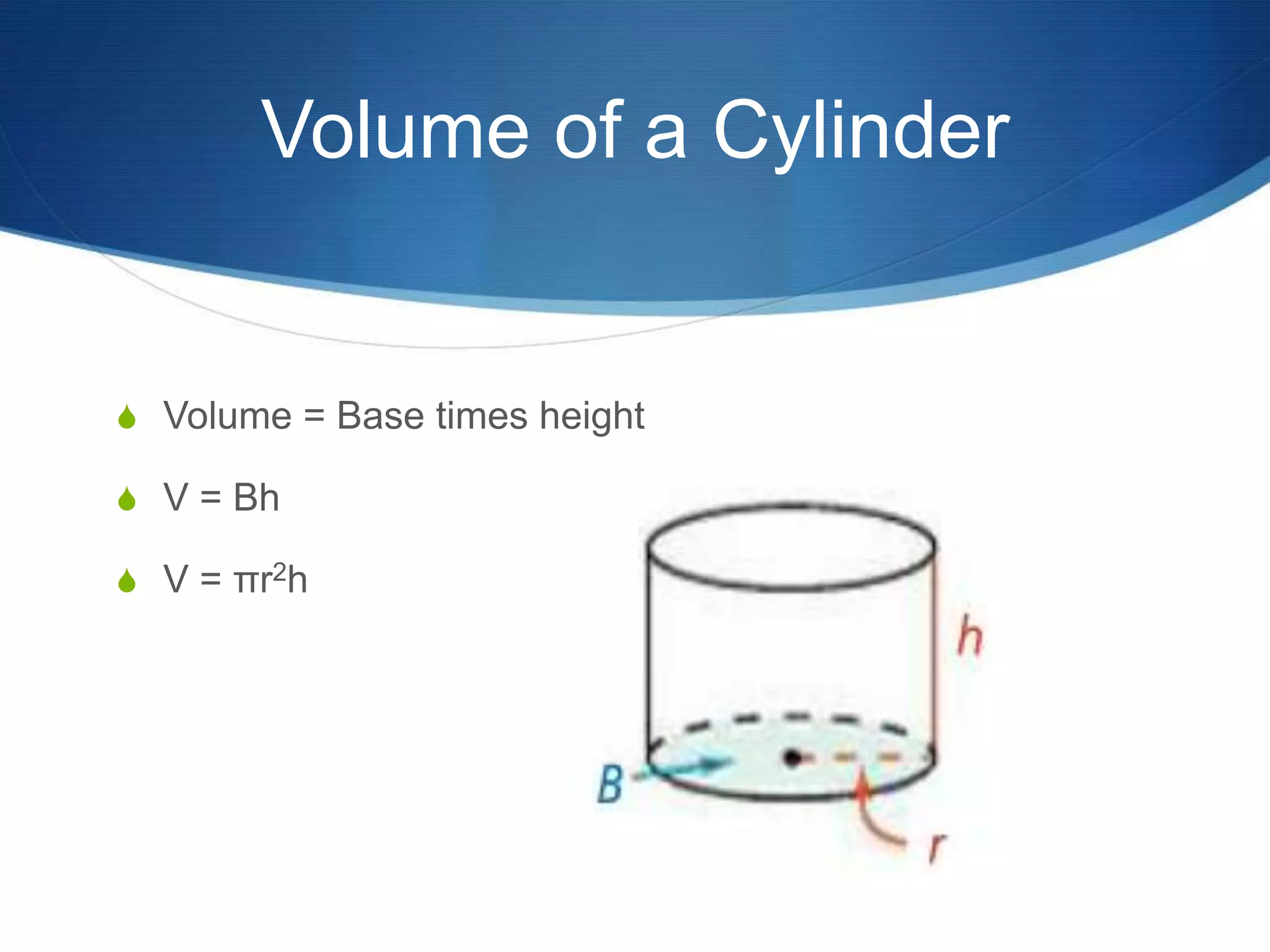
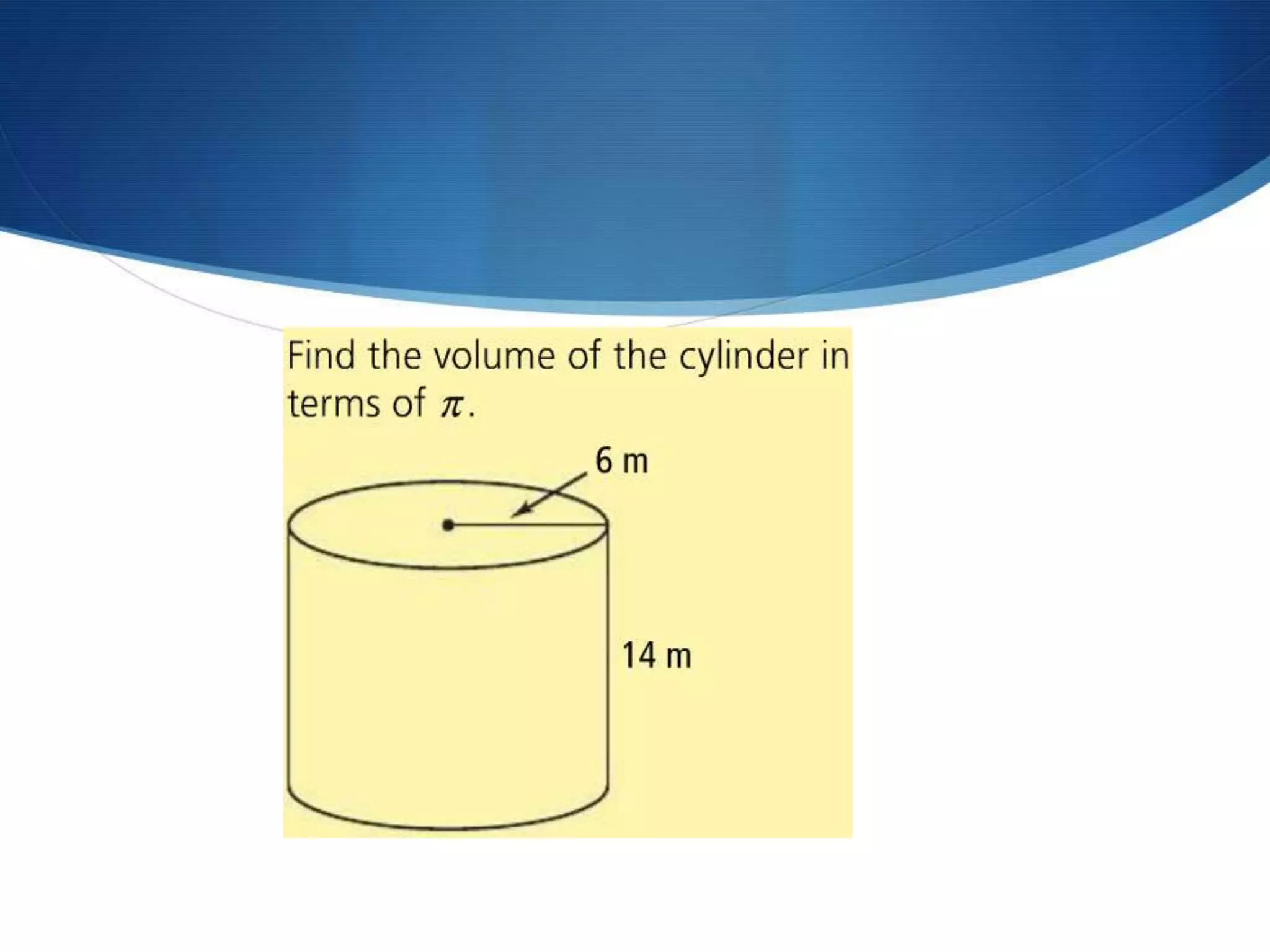
Volume of a Cylinder


S Volume = Base times height

S V = Bh

S V = πr2h
Composite Space Figure


S 3D figure that is a combination of two or more simpler
  figures

S To find the volume of a composite space figure, add the
  volumes of the figures that are combined
Homework


S Pg. 704

S #10 – 20 even, 26 (8 problems)

S Pg. 721

S #6 – 20 even, 38 (9 problems)

S 17 total problems

11.2 and11.4 Surface Area and Volume Prisms

  • 1.
    Chapter 11 Surface Area and Volume 11.2 and 11.4 S
  • 2.
    Essential Understanding S Youcan analyze a 3D figure by using the relationship among its vertices, edges, and faces S To find the surface area of a 3D figure, find the sum of the areas of all the surfaces of the figure S You can find the volume of a prism or cylinder when you know its height and the area of its base
  • 3.
    Objectives S Students willbe able to S recognize polyhedra and their parts S Visualize cross sections of space figures S Find the surface area of a prism and a cylinder S Find the volume of a prism and the volume of a cylinder
  • 4.
    Polyhedron S A spacefigure, or 3D figure whose surfaces are polygons S Face: each polygon S Edge: segment formed by the intersection of two faces S Vertex: point where three or more edges intersect
  • 5.
    Euler’s Formula S #Faces + # Vertices = # Edges + 2
  • 6.
    Cross Section S Theintersection of a solid and a plane. S A slice of the solid
  • 7.
    What is thecross section formed?
  • 8.
    Prisms S Prism: polyhedronwith two congruent, parallel faces, called bases S Lateral faces: all the other faces
  • 9.
    Prisms… S Right prism:the lateral faces are rectangles and a lateral edge is an altitude S Oblique Prism: some or all of the lateral faces are nonrectangular. S (For this chapter, assume that a prism is a right prism unless otherwise stated)
  • 10.
    LA and SAof a Prism S Lateral Area (LA): sum of the areas of the lateral faces S LA = ph S Surface Area (SA): sum of the lateral area and the area of the two bases S SA = LA + 2B
  • 11.
    What is theSurface Area?
  • 12.
    What is theSurface Area? Lateral Area?
  • 13.
    Volume of aPrism S Volume = Base times height S V = Bh
  • 16.
    Cylinder S Two congruent,parallel bases that are circles
  • 17.
    LA and SAof a Cylinder S Lateral Surface Area (LA): circumference of the base and the height of the cylinder S LA = 2πr * h OR S LA = πdh S Surface Area (SA): Sum of the lateral surface area the two bases S SA = LA + 2B S SA = 2πrh + 2πr2
  • 19.
    Volume of aCylinder S Volume = Base times height S V = Bh S V = πr2h
  • 21.
    Composite Space Figure S3D figure that is a combination of two or more simpler figures S To find the volume of a composite space figure, add the volumes of the figures that are combined
  • 23.
    Homework S Pg. 704 S#10 – 20 even, 26 (8 problems) S Pg. 721 S #6 – 20 even, 38 (9 problems) S 17 total problems