DNA Sequencing
• The term DNA sequencing refers to methods for
determining the order of the nucleotides bases
adenine, guanine, cytosine and thymine in a
molecule of DNA.
Maxam-Gilbert sequencing
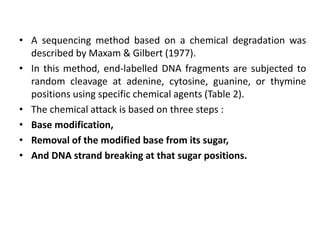
• A sequencing method based on a chemical degradation was
described by Maxam & Gilbert (1977).
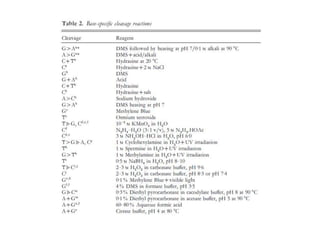
• In this method, end-labelled DNA fragments are subjected to
random cleavage at adenine, cytosine, guanine, or thymine
positions using specific chemical agents (Table 2).
• The chemical attack is based on three steps :
• Base modification,
• Removal of the modified base from its sugar,
• And DNA strand breaking at that sugar positions.
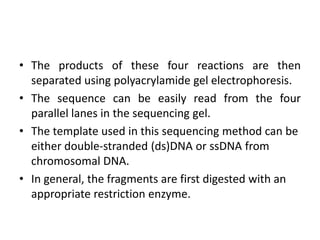
• The products of these four reactions are then
separated using polyacrylamide gel electrophoresis.
• The sequence can be easily read from the four
parallel lanes in the sequencing gel.
• The template used in this sequencing method can be
either double-stranded (ds)DNA or ssDNA from
chromosomal DNA.
• In general, the fragments are first digested with an
appropriate restriction enzyme.
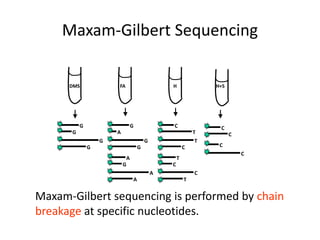
Maxam-Gilbert sequencing is performed by chain
breakage at specific nucleotides.
DMS
G
G
G
G
FA
G
A
G
G
A
G
A
A
H
C
T
T
C
T
C
C
T
H+S
C
C
C
C
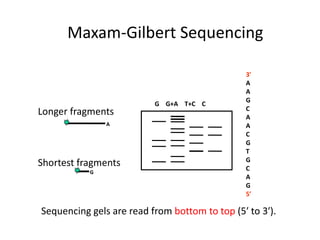
Maxam-Gilbert Sequencing
Sequencing gels are read from bottom to top (5′ to 3′).
G G+A T+C C
3′
A
A
G
C
A
A
C
G
T
G
C
A
G
5′
Longer fragments
Shortest fragments
G
A
Maxam-Gilbert Sequencing
Sanger’s sequencing
DNA sequencing by the Sanger method
The standard DNA sequencing technique is the Sanger method,
named for its developer, Frederick Sanger, who shared the 1980
Nobel Prize in Chemistry. This method begins with the use of
special enzymes to synthesize fragments of DNA that terminate
when a selected base appears in the stretch of DNA being
sequenced.
These fragments are then sorted according to size
by placing them in a slab of polymeric gel and applying an
electric field -- a technique called electrophoresis. Because of
DNA's negative charge, the fragments move across the gel toward
the positive electrode. The shorter the fragment, the faster it
moves. Typically, each of the terminating bases within the
collection of fragments is tagged with a radioactive probe for
identification.
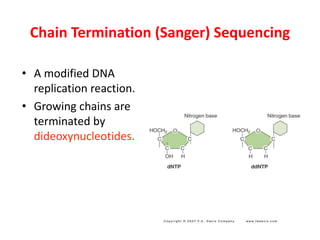
Chain Termination (Sanger) Sequencing
• A modified DNA
replication reaction.
• Growing chains are
terminated by
dideoxynucleotides.
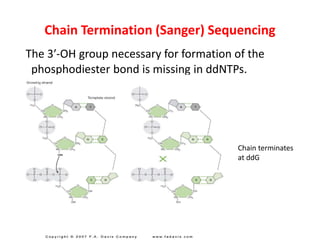
Chain terminates
at ddG
Chain Termination (Sanger) Sequencing
The 3′-OH group necessary for formation of the
phosphodiester bond is missing in ddNTPs.
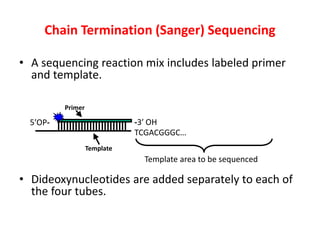
Template area to be sequenced
-3′ OH
TCGACGGGC…
5′OP-
Primer
Template
Chain Termination (Sanger) Sequencing
• A sequencing reaction mix includes labeled primer
and template.
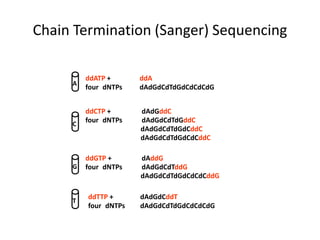
• Dideoxynucleotides are added separately to each of
the four tubes.
ddATP + ddA
four dNTPs dAdGdCdTdGdCdCdCdG
ddCTP + dAdGddC
four dNTPs dAdGdCdTdGddC
dAdGdCdTdGdCddC
dAdGdCdTdGdCdCddC
ddGTP + dAddG
four dNTPs dAdGdCdTddG
dAdGdCdTdGdCdCdCddG
ddTTP + dAdGdCddT
four dNTPs dAdGdCdTdGdCdCdCdG
A
C
G
T
Chain Termination (Sanger) Sequencing
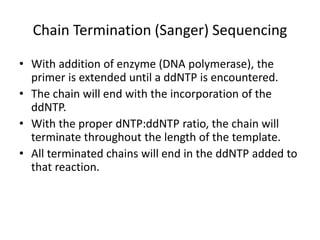
• With addition of enzyme (DNA polymerase), the
primer is extended until a ddNTP is encountered.
• The chain will end with the incorporation of the
ddNTP.
• With the proper dNTP:ddNTP ratio, the chain will
terminate throughout the length of the template.
• All terminated chains will end in the ddNTP added to
that reaction.
Chain Termination (Sanger) Sequencing
• The collection of fragments is a sequencing
ladder.
• The resulting terminated chains are resolved
by electrophoresis.
• Fragments from each of the four tubes are
placed in four separate gel lanes.
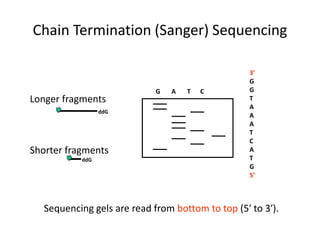
Sequencing gels are read from bottom to top (5′ to 3′).
G A T C
3′
G
G
T
A
A
A
T
C
A
T
G
5′
Longer fragments
Shorter fragments
ddG
ddG
Chain Termination (Sanger) Sequencing
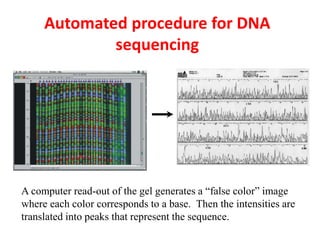
Automated procedure for DNA
sequencing
A computer read-out of the gel generates a “false color” image
where each color corresponds to a base. Then the intensities are
translated into peaks that represent the sequence.
Summary
• Genetic information is stored in the order or sequence of
nucleotides in DNA.
• Chain termination sequencing is the standard method for
the determination of nucleotide sequence.
• Dideoxy-chain termination sequencing has been
facilitated by the development of cycle sequencing and
the use of fluorescent dye detection.
• Alternative methods are used for special applications,
such as pyrosequencing (for resequencing and
polymorphism detection) or bisulfite sequencing (to
analyze methylated DNA).
If you want Word/PDF???
Soft copy of Word/PDF = 0.013$ (US dollar) (5Rs Indian rupee)
Contact :(I will share ppt via Email/WhatsApp/Telegram
Email: gnccmysore@gmail.com
Telegram:+919738137533(only for Chat)
*Once you done payment, Please intimate me.
DNA sequencing

DNA sequencing

  • 1.
  • 2.
    • The termDNA sequencing refers to methods for determining the order of the nucleotides bases adenine, guanine, cytosine and thymine in a molecule of DNA.
  • 3.
  • 4.
    • A sequencingmethod based on a chemical degradation was described by Maxam & Gilbert (1977). • In this method, end-labelled DNA fragments are subjected to random cleavage at adenine, cytosine, guanine, or thymine positions using specific chemical agents (Table 2). • The chemical attack is based on three steps : • Base modification, • Removal of the modified base from its sugar, • And DNA strand breaking at that sugar positions.
  • 6.
    • The productsof these four reactions are then separated using polyacrylamide gel electrophoresis. • The sequence can be easily read from the four parallel lanes in the sequencing gel. • The template used in this sequencing method can be either double-stranded (ds)DNA or ssDNA from chromosomal DNA. • In general, the fragments are first digested with an appropriate restriction enzyme.
  • 7.
    Maxam-Gilbert sequencing isperformed by chain breakage at specific nucleotides. DMS G G G G FA G A G G A G A A H C T T C T C C T H+S C C C C Maxam-Gilbert Sequencing
  • 8.
    Sequencing gels areread from bottom to top (5′ to 3′). G G+A T+C C 3′ A A G C A A C G T G C A G 5′ Longer fragments Shortest fragments G A Maxam-Gilbert Sequencing
  • 9.
  • 10.
    DNA sequencing bythe Sanger method The standard DNA sequencing technique is the Sanger method, named for its developer, Frederick Sanger, who shared the 1980 Nobel Prize in Chemistry. This method begins with the use of special enzymes to synthesize fragments of DNA that terminate when a selected base appears in the stretch of DNA being sequenced. These fragments are then sorted according to size by placing them in a slab of polymeric gel and applying an electric field -- a technique called electrophoresis. Because of DNA's negative charge, the fragments move across the gel toward the positive electrode. The shorter the fragment, the faster it moves. Typically, each of the terminating bases within the collection of fragments is tagged with a radioactive probe for identification.
  • 11.
    Chain Termination (Sanger)Sequencing • A modified DNA replication reaction. • Growing chains are terminated by dideoxynucleotides.
  • 12.
    Chain terminates at ddG ChainTermination (Sanger) Sequencing The 3′-OH group necessary for formation of the phosphodiester bond is missing in ddNTPs.
  • 13.
    Template area tobe sequenced -3′ OH TCGACGGGC… 5′OP- Primer Template Chain Termination (Sanger) Sequencing • A sequencing reaction mix includes labeled primer and template. • Dideoxynucleotides are added separately to each of the four tubes.
  • 14.
    ddATP + ddA fourdNTPs dAdGdCdTdGdCdCdCdG ddCTP + dAdGddC four dNTPs dAdGdCdTdGddC dAdGdCdTdGdCddC dAdGdCdTdGdCdCddC ddGTP + dAddG four dNTPs dAdGdCdTddG dAdGdCdTdGdCdCdCddG ddTTP + dAdGdCddT four dNTPs dAdGdCdTdGdCdCdCdG A C G T Chain Termination (Sanger) Sequencing
  • 15.
    Chain Termination (Sanger)Sequencing • With addition of enzyme (DNA polymerase), the primer is extended until a ddNTP is encountered. • The chain will end with the incorporation of the ddNTP. • With the proper dNTP:ddNTP ratio, the chain will terminate throughout the length of the template. • All terminated chains will end in the ddNTP added to that reaction.
  • 16.
    Chain Termination (Sanger)Sequencing • The collection of fragments is a sequencing ladder. • The resulting terminated chains are resolved by electrophoresis. • Fragments from each of the four tubes are placed in four separate gel lanes.
  • 17.
    Sequencing gels areread from bottom to top (5′ to 3′). G A T C 3′ G G T A A A T C A T G 5′ Longer fragments Shorter fragments ddG ddG Chain Termination (Sanger) Sequencing
  • 18.
    Automated procedure forDNA sequencing A computer read-out of the gel generates a “false color” image where each color corresponds to a base. Then the intensities are translated into peaks that represent the sequence.
  • 19.
    Summary • Genetic informationis stored in the order or sequence of nucleotides in DNA. • Chain termination sequencing is the standard method for the determination of nucleotide sequence. • Dideoxy-chain termination sequencing has been facilitated by the development of cycle sequencing and the use of fluorescent dye detection. • Alternative methods are used for special applications, such as pyrosequencing (for resequencing and polymorphism detection) or bisulfite sequencing (to analyze methylated DNA).
  • 20.
    If you wantWord/PDF??? Soft copy of Word/PDF = 0.013$ (US dollar) (5Rs Indian rupee) Contact :(I will share ppt via Email/WhatsApp/Telegram Email: gnccmysore@gmail.com Telegram:+919738137533(only for Chat) *Once you done payment, Please intimate me.