 DNA sequencing is the process of
determining the precise order of nucleotides
within a DNA molecule
 To analyze gene structure and its relation to
gene expression as well as protein
conformation
 can compare genes or specific sequences
to find out differences and similarities
 classify organism, make a disease diagnosis
 Through the DNA sequencing would be able
to know where exactly into genome or a
gene is the mutation
 it was the most widely used sequencing
method for approximately 25 years
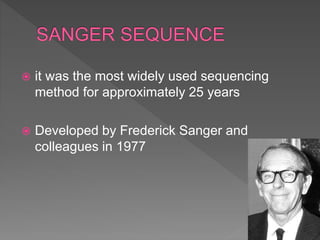
 Developed by Frederick Sanger and
colleagues in 1977
 Also termed as Chain Termination or
Dideoxy method
 method of determining the location of a
specific place on a DNA fragment, based on
where synthesis of a new DNA chain stops
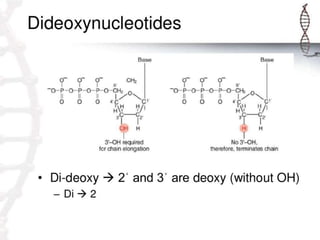
 Utililizes 2',3'-dideoxynucleotide triphosphate
(ddNTPs)
 Are different from dNTPs at the 3’carbon
 Specially designed nucleotides
 Have a hydrogen atom attached to the 3'
carbon rather than an OH group
 They terminate DNA chain elongation as
 Cannot form a phosphodiester bond with the
next deoxynucleotide
 Each ddNTP has label for different color
fluorescence
 It depends on the fact that:
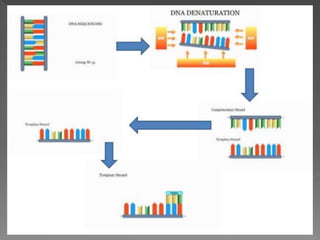
 a) Synthesis of a double-stranded DNA
segment from a single strand of DNA will be
initiated in the presence of DNA polymerase,
and;
 b) DNA synthesis will stop if the
incorporated base is in the form
dideoxynucleotide instead of
deoxynucleotide.
 Elongation of strand
 Random addition of dNTPs and ddNTPs
 When ddNTP added strand extension
terminates
 Being random - all possible lengths of the
DNA fragments are generated having a
terminal fluorescence labeled ddNTP
 Product of this reaction is subjected to gel
electrophoresis
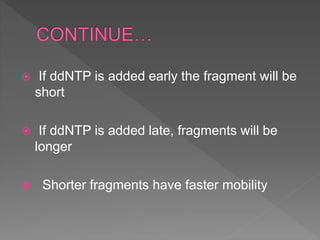
 If ddNTP is added early the fragment will be
short
 If ddNTP is added late, fragments will be
longer
 Shorter fragments have faster mobility
 dideoxynucleoadenoside (ddATP) in a
mixture that also contains
deoxynucleoadenoside (dATP), as well as
the other three deoxynucleotides, the
synthesize of the double chain will stop when
the ddATP molecule is incorporated instead
of the dATP molecule.
 some of the synthesizing DNA will be
stopped at every point that adenosine is
required.
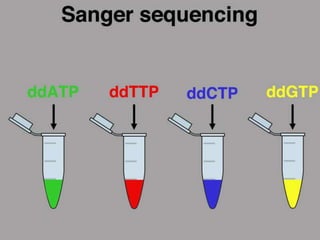
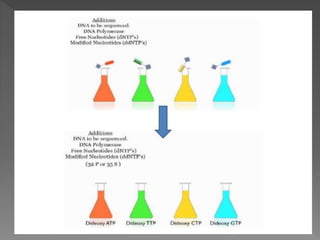
 The Sanger Technique uses the
dideoxynucleotide for all four of the required
nucleotides
 There are four batches of reagents, one
devoted to each nucleotide.
 The same single-stranded DNA molecule is
incubated in each batch with one of the
nucelotides provided in the dideoxy form as
well as its normal deoxy form
 Among the four batches, synthesis has been
arrested at every site in the DNA fragment
 You keep the batches separate and run gel
electrophoresis on all four batches.
 Because the length of the migration in the
electrophoresis fields depends on the size of
molecule, the DNA fragments should
distribute themselves in linear fashion
according to size
 After reaction the electrophoresis was run in
four different lanes and the matching was
done using radiographic reading of the
lanes
Sanger sequencing
Sanger sequencing

Sanger sequencing

  • 2.
     DNA sequencingis the process of determining the precise order of nucleotides within a DNA molecule  To analyze gene structure and its relation to gene expression as well as protein conformation
  • 3.
     can comparegenes or specific sequences to find out differences and similarities  classify organism, make a disease diagnosis  Through the DNA sequencing would be able to know where exactly into genome or a gene is the mutation
  • 4.
     it wasthe most widely used sequencing method for approximately 25 years  Developed by Frederick Sanger and colleagues in 1977
  • 5.
     Also termedas Chain Termination or Dideoxy method  method of determining the location of a specific place on a DNA fragment, based on where synthesis of a new DNA chain stops
  • 6.
     Utililizes 2',3'-dideoxynucleotidetriphosphate (ddNTPs)  Are different from dNTPs at the 3’carbon
  • 7.
     Specially designednucleotides  Have a hydrogen atom attached to the 3' carbon rather than an OH group
  • 9.
     They terminateDNA chain elongation as  Cannot form a phosphodiester bond with the next deoxynucleotide  Each ddNTP has label for different color fluorescence
  • 10.
     It dependson the fact that:  a) Synthesis of a double-stranded DNA segment from a single strand of DNA will be initiated in the presence of DNA polymerase, and;  b) DNA synthesis will stop if the incorporated base is in the form dideoxynucleotide instead of deoxynucleotide.
  • 11.
     Elongation ofstrand  Random addition of dNTPs and ddNTPs  When ddNTP added strand extension terminates  Being random - all possible lengths of the DNA fragments are generated having a terminal fluorescence labeled ddNTP  Product of this reaction is subjected to gel electrophoresis
  • 12.
     If ddNTPis added early the fragment will be short  If ddNTP is added late, fragments will be longer  Shorter fragments have faster mobility
  • 15.
     dideoxynucleoadenoside (ddATP)in a mixture that also contains deoxynucleoadenoside (dATP), as well as the other three deoxynucleotides, the synthesize of the double chain will stop when the ddATP molecule is incorporated instead of the dATP molecule.  some of the synthesizing DNA will be stopped at every point that adenosine is required.
  • 16.
     The SangerTechnique uses the dideoxynucleotide for all four of the required nucleotides  There are four batches of reagents, one devoted to each nucleotide.  The same single-stranded DNA molecule is incubated in each batch with one of the nucelotides provided in the dideoxy form as well as its normal deoxy form
  • 18.
     Among thefour batches, synthesis has been arrested at every site in the DNA fragment  You keep the batches separate and run gel electrophoresis on all four batches.
  • 19.
     Because thelength of the migration in the electrophoresis fields depends on the size of molecule, the DNA fragments should distribute themselves in linear fashion according to size  After reaction the electrophoresis was run in four different lanes and the matching was done using radiographic reading of the lanes