DNA Sequencing
Dr Ravi Kant Agrawal, MVSc, PhD
Senior Scientist (Veterinary Microbiology)
Food Microbiology Laboratory
Division of Livestock Products Technology
ICAR-Indian Veterinary Research Institute
Izatnagar 243122 (UP) India
Nucleic acid sequencing
• The term DNA sequencing refers to sequencing methods for
determining the order of the nucleotide bases -
adenine, guanine, cytosine, and thymine in a molecule of DNA.
• All the information required for the growth and development
of an organism is encoded in the DNA of its genome. So, DNA
sequencing is fundamental to genome analysis and
understanding the biological processes in general.
• The advent of DNA sequencing has significantly accelerated
biological research and discovery.
• Knowledge of DNA sequences has become indispensable for
basic biological research, and in numerous applied fields such as
diagnostics, biotechnology, forensic biology and
biological systematics.
• The rapid speed of sequencing attained with modern DNA
sequencing technology has been instrumental in the
sequencing of the human genome, in the Human Genome
Project.
Technical Breakthrough For DNA Sequencing
In 1977, two separate methods for the large-scale sequencing of
DNA were devised:
• Chemical cleavage method by A. M. Maxam and W. Gilbert
• Enzymatic chain termination method by F. Sanger et. al.
• Of these two methods, Sanger method is more popular.
• Without changing the underlying concept of both methods,
some improvements have been done over the years by
applying different strategies, by developing various
modifications and by automation. As a result, a very large scale
sequencing has become feasible, e.g. E. coli, Saccharomyces
cerevisiae, Human Genome Project etc.
Maxam–Gilbert Sequencing
• In 1976–77, Allan Maxam and Walter Gilbert developed a DNA
sequencing method based on chemical modification of DNA
and subsequent cleavage at specific bases.
• This method is sometimes called Chemical Sequencing.
• Maxam–Gilbert sequencing rapidly became more popular, since
purified DNA could be used directly, while the initial Sanger
method required that each read start be cloned for production
of single-stranded DNA.
• However, with the improvement of the chain-termination
method, Maxam-Gilbert sequencing has fallen out of favour
due to its technical complexity prohibiting its use in standard
molecular biology kits, extensive use of hazardous chemicals,
and difficulties with scale-up.
Cont…
• The method requires radioactive labelling at one end and
purification of the DNA fragment to be sequenced.
• Chemical treatment generates breaks at a small proportion of
one or two of the four nucleotide bases in each of four
reactions (G, A+G, C, C+T).
• Thus a series of labelled fragments is generated, from the
radiolabelled end to the first "cut" site in each molecule.
• The fragments in the four reactions are arranged side by side
in gel electrophoresis for size separation.
• To visualize the fragments, the gel is exposed to X-ray
film for autoradiography, yielding a series of dark bands each
corresponding to a radiolabelled DNA fragment, from which
the sequence may be inferred.
Chemical Cleavage Method
• This method uses double-stranded DNA samples.
• Involves modification of the bases in DNA followed by chemical
base-specific cleavage.
• Sequences DNA fragments containing upto ~500 nucleotides in
length.
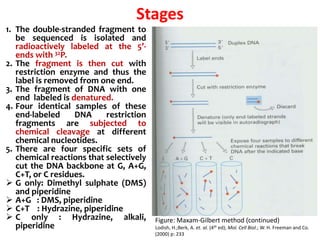
1. The double-stranded fragment to
be sequenced is isolated and
radioactively labeled at the 5’-
ends with 32P.
2. The fragment is then cut with
restriction enzyme and thus the
label is removed from one end.
3. The fragment of DNA with one
end labeled is denatured.
4. Four identical samples of these
end-labeled DNA restriction
fragments are subjected to
chemical cleavage at different
chemical nucleotides.
5. There are four specific sets of
chemical reactions that selectively
cut the DNA backbone at G, A+G,
C+T, or C residues.
 G only: Dimethyl sulphate (DMS)
and piperidine
 A+G : DMS, piperidine
 C+T : Hydrazine, piperidine
 C only : Hydrazine, alkali,
piperidine
Figure: Maxam-Gilbert method (continued)
Lodish, H.;Berk, A. et. al. (4th ed); Mol. Cell Biol.; W. H. Freeman and Co.
(2000) p: 233
Stages
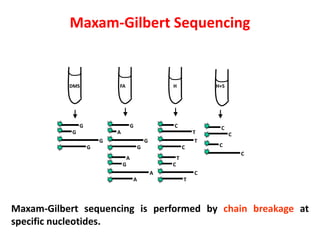
Maxam-Gilbert sequencing is performed by chain breakage at
specific nucleotides.
DMS
G
G
G
G
FA
G
A
G
G
A
G
A
A
H
C
T
T
C
T
C
C
T
H+S
C
C
C
C
Maxam-Gilbert Sequencing
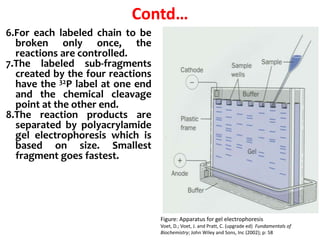
6.For each labeled chain to be
broken only once, the
reactions are controlled.
7.The labeled sub-fragments
created by the four reactions
have the 32P label at one end
and the chemical cleavage
point at the other end.
8.The reaction products are
separated by polyacrylamide
gel electrophoresis which is
based on size. Smallest
fragment goes fastest.
Figure: Apparatus for gel electrophoresis
Voet, D.; Voet, J. and Pratt, C. (upgrade ed) Fundamentals of
Biochemistry; John Wiley and Sons, Inc (2002); p: 58
Contd…
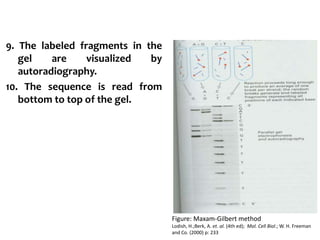
9. The labeled fragments in the
gel are visualized by
autoradiography.
10. The sequence is read from
bottom to top of the gel.
Figure: Maxam-Gilbert method
Lodish, H.;Berk, A. et. al. (4th ed); Mol. Cell Biol.; W. H. Freeman
and Co. (2000) p: 233
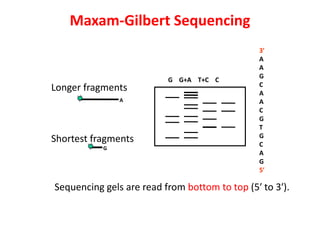
Sequencing gels are read from bottom to top (5′ to 3′).
G G+A T+C C
3′
A
A
G
C
A
A
C
G
T
G
C
A
G
5′
Longer fragments
Shortest fragments
G
A
Maxam-Gilbert Sequencing
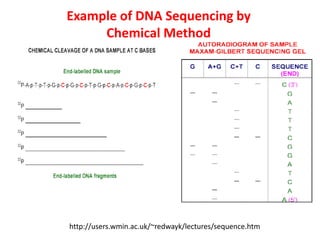
Example of DNA Sequencing by
Chemical Method
http://users.wmin.ac.uk/~redwayk/lectures/sequence.htm
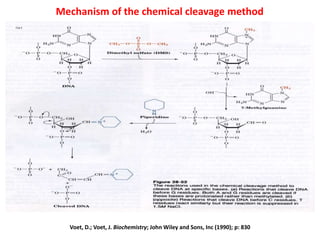
Mechanism of the chemical cleavage method
Voet, D.; Voet, J. Biochemistry; John Wiley and Sons, Inc (1990); p: 830
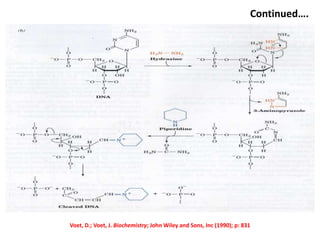
Continued….
Voet, D.; Voet, J. Biochemistry; John Wiley and Sons, Inc (1990); p: 831
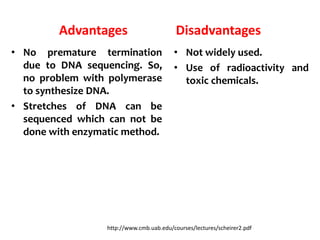
Advantages Disadvantages
• No premature termination
due to DNA sequencing. So,
no problem with polymerase
to synthesize DNA.
• Stretches of DNA can be
sequenced which can not be
done with enzymatic method.
• Not widely used.
• Use of radioactivity and
toxic chemicals.
http://www.cmb.uab.edu/courses/lectures/scheirer2.pdf
Chain-termination methods
• The chain-terminator method (or Sanger
method after its developer Frederick
Sanger) is more efficient and uses fewer
toxic chemicals and lower amounts of
radioactivity than the method of Maxam
and Gilbert, it rapidly became the method
of choice.
• The key principle of the Sanger method
was the use
of dideoxynucleotide triphosphates
(ddNTPs) as DNA chain terminators.
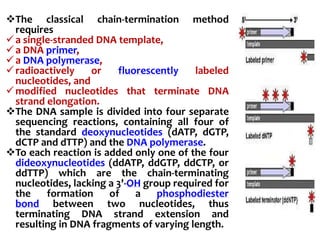
The classical chain-termination method
requires
a single-stranded DNA template,
a DNA primer,
a DNA polymerase,
radioactively or fluorescently labeled
nucleotides, and
modified nucleotides that terminate DNA
strand elongation.
The DNA sample is divided into four separate
sequencing reactions, containing all four of
the standard deoxynucleotides (dATP, dGTP,
dCTP and dTTP) and the DNA polymerase.
To each reaction is added only one of the four
dideoxynucleotides (ddATP, ddGTP, ddCTP, or
ddTTP) which are the chain-terminating
nucleotides, lacking a 3'-OH group required for
the formation of a phosphodiester
bond between two nucleotides, thus
terminating DNA strand extension and
resulting in DNA fragments of varying length.
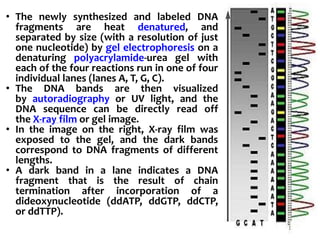
• The newly synthesized and labeled DNA
fragments are heat denatured, and
separated by size (with a resolution of just
one nucleotide) by gel electrophoresis on a
denaturing polyacrylamide-urea gel with
each of the four reactions run in one of four
individual lanes (lanes A, T, G, C).
• The DNA bands are then visualized
by autoradiography or UV light, and the
DNA sequence can be directly read off
the X-ray film or gel image.
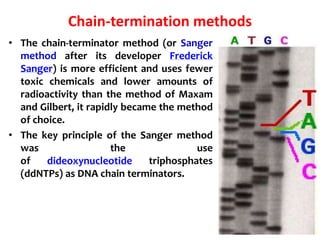
• In the image on the right, X-ray film was
exposed to the gel, and the dark bands
correspond to DNA fragments of different
lengths.
• A dark band in a lane indicates a DNA
fragment that is the result of chain
termination after incorporation of a
dideoxynucleotide (ddATP, ddGTP, ddCTP,
or ddTTP).
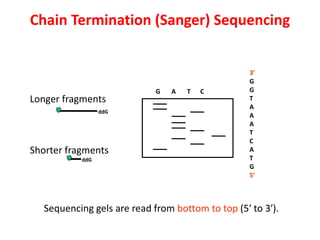
Sequencing gels are read from bottom to top (5′ to 3′).
G A T C
3′
G
G
T
A
A
A
T
C
A
T
G
5′
Longer fragments
Shorter fragments
ddG
ddG
Chain Termination (Sanger) Sequencing
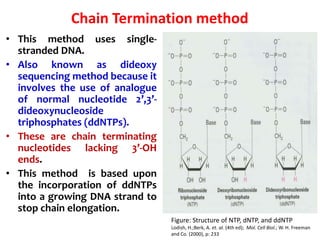
Chain Termination method
• This method uses single-
stranded DNA.
• Also known as dideoxy
sequencing method because it
involves the use of analogue
of normal nucleotide 2’,3’-
dideoxynucleoside
triphosphates (ddNTPs).
• These are chain terminating
nucleotides lacking 3’-OH
ends.
• This method is based upon
the incorporation of ddNTPs
into a growing DNA strand to
stop chain elongation.
Figure: Structure of NTP, dNTP, and ddNTP
Lodish, H.;Berk, A. et. al. (4th ed); Mol. Cell Biol.; W. H. Freeman
and Co. (2000), p: 233
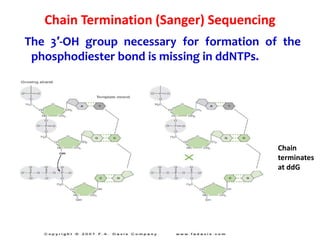
Chain
terminates
at ddG
Chain Termination (Sanger) Sequencing
The 3′-OH group necessary for formation of the
phosphodiester bond is missing in ddNTPs.
Chain Termination (Sanger) Sequencing
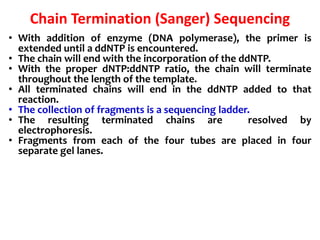
• With addition of enzyme (DNA polymerase), the primer is
extended until a ddNTP is encountered.
• The chain will end with the incorporation of the ddNTP.
• With the proper dNTP:ddNTP ratio, the chain will terminate
throughout the length of the template.
• All terminated chains will end in the ddNTP added to that
reaction.
• The collection of fragments is a sequencing ladder.
• The resulting terminated chains are resolved by
electrophoresis.
• Fragments from each of the four tubes are placed in four
separate gel lanes.
Stages:
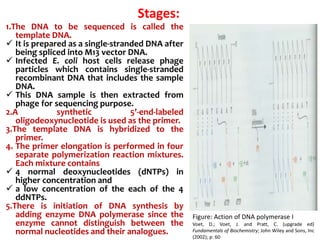
1.The DNA to be sequenced is called the
template DNA.
 It is prepared as a single-stranded DNA after
being spliced into M13 vector DNA.
 Infected E. coli host cells release phage
particles which contains single-stranded
recombinant DNA that includes the sample
DNA.
 This DNA sample is then extracted from
phage for sequencing purpose.
2.A synthetic 5’-end-labeled
oligodeoxynucleotide is used as the primer.
3.The template DNA is hybridized to the
primer.
4. The primer elongation is performed in four
separate polymerization reaction mixtures.
Each mixture contains
 4 normal deoxynucleotides (dNTPs) in
higher concentration and
 a low concentration of the each of the 4
ddNTPs.
5.There is initiation of DNA synthesis by
adding enzyme DNA polymerase since the
enzyme cannot distinguish between the
normal nucleotides and their analogues.
Figure: Action of DNA polymerase I
Voet, D.; Voet, J. and Pratt, C. (upgrade ed)
Fundamentals of Biochemistry; John Wiley and Sons, Inc
(2002); p: 60
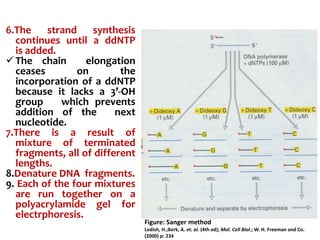
6.The strand synthesis
continues until a ddNTP
is added.
The chain elongation
ceases on the
incorporation of a ddNTP
because it lacks a 3’-OH
group which prevents
addition of the next
nucleotide.
7.There is a result of
mixture of terminated
fragments, all of different
lengths.
8.Denature DNA fragments.
9. Each of the four mixtures
are run together on a
polyacrylamide gel for
electrphoresis.
Figure: Sanger method
Lodish, H.;Berk, A. et. al. (4th ed); Mol. Cell Biol.; W. H. Freeman and Co.
(2000) p: 234
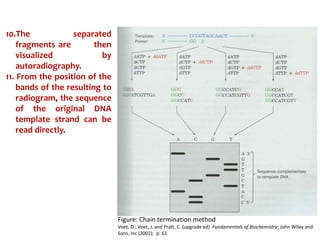
10.The separated
fragments are then
visualized by
autoradiography.
11. From the position of the
bands of the resulting to
radiogram, the sequence
of the original DNA
template strand can be
read directly.
Figure: Chain termination method
Voet, D.; Voet, J. and Pratt, C. (upgrade ed) Fundamentals of Biochemistry; John Wiley and
Sons, Inc (2002); p: 61
Advantages Disadvantages
• Most popular method.
• Simpler and quicker
allowing large output.
• Within an hour the primer-
annealing and sequencing
reactions can be completed.
• Yielding of poor results owing
to secondary structure in the
DNA as sometimes DNA
polymerases terminate chain
elongation prematurely.
• The sequence is obtained not
from the original DNA
molecule but from an
enzymatic copy. So, there is a
chance of incorporation of
wrong bases.
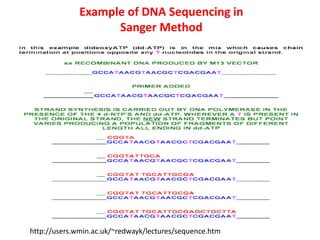
Example of DNA Sequencing in
Sanger Method
http://users.wmin.ac.uk/~redwayk/lectures/sequence.htm
Cycle Sequencing
• Cycle sequencing is chain termination sequencing performed in
a thermal cycler.
• Cycle sequencing requires a heat-stable DNA polymerase.
Fluorescent Dyes
• Fluorescent dyes are multicyclic molecules that absorb and
emit fluorescent light at specific wavelengths.
• Examples are fluorescein and rhodamine derivatives.
• For sequencing applications, these molecules can be covalently
attached to nucleotides.
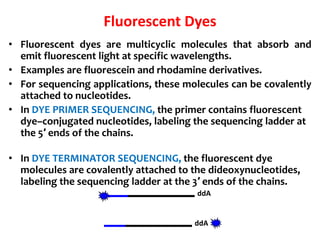
• In DYE PRIMER SEQUENCING, the primer contains fluorescent
dye–conjugated nucleotides, labeling the sequencing ladder at
the 5′ ends of the chains.
• In DYE TERMINATOR SEQUENCING, the fluorescent dye
molecules are covalently attached to the dideoxynucleotides,
labeling the sequencing ladder at the 3′ ends of the chains.
ddA
ddA
Dye-terminator sequencing
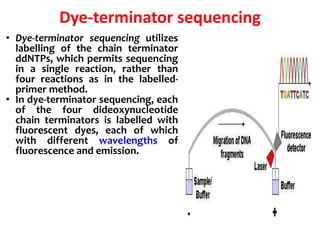
• Dye-terminator sequencing utilizes
labelling of the chain terminator
ddNTPs, which permits sequencing
in a single reaction, rather than
four reactions as in the labelled-
primer method.
• In dye-terminator sequencing, each
of the four dideoxynucleotide
chain terminators is labelled with
fluorescent dyes, each of which
with different wavelengths of
fluorescence and emission.
• Owing to its greater expediency and speed, dye-terminator
sequencing is now the mainstay in automated sequencing.
• The dye-terminator sequencing method, along with automated
high-throughput DNA sequence analyzers, is now being used
for the vast majority of sequencing projects.
• Its limitations include dye effects due to differences in the
incorporation of the dye-labelled chain terminators into the
DNA fragment, resulting in unequal peak heights and shapes in
the electronic DNA sequence trace chromatogram after
capillary electrophoresis .
• This problem has been addressed with the use of modified DNA
polymerase enzyme systems and dyes that minimize
incorporation variability, as well as methods for eliminating
"dye blobs".
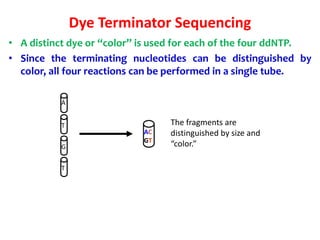
AC
GT
The fragments are
distinguished by size and
“color.”
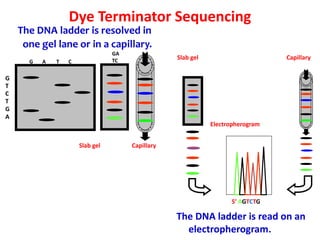
Dye Terminator Sequencing
• A distinct dye or “color” is used for each of the four ddNTP.
• Since the terminating nucleotides can be distinguished by
color, all four reactions can be performed in a single tube.
A
T
G
T
Capillary
G
T
C
T
G
A
Slab gel
GA
TCG A T C
Dye Terminator Sequencing
The DNA ladder is resolved in
one gel lane or in a capillary.
CapillarySlab gel
5′ AGTCTG
Electropherogram
The DNA ladder is read on an
electropherogram.
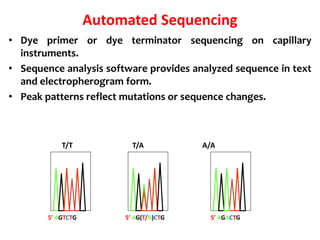
5′ AGTCTG 5′ AG(T/A)CTG 5′ AGACTG
T/T T/A A/A
Automated Sequencing
• Dye primer or dye terminator sequencing on capillary
instruments.
• Sequence analysis software provides analyzed sequence in text
and electropherogram form.
• Peak patterns reflect mutations or sequence changes.
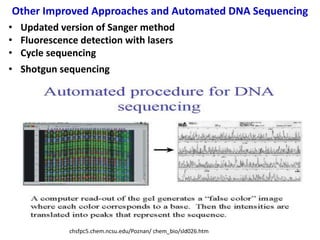
Other Improved Approaches and Automated DNA Sequencing
• Updated version of Sanger method
• Fluorescence detection with lasers
• Cycle sequencing
• Shotgun sequencing
http://www.cmb.uab.edu/courses/lectures/scheirer2.pdf
chsfpc5.chem.ncsu.edu/Poznan/ chem_bio/sld026.htm
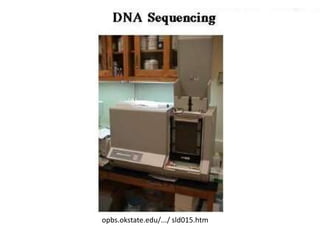
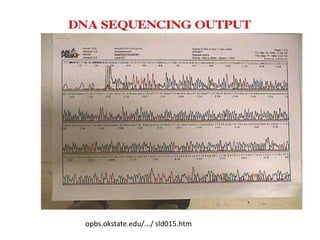
opbs.okstate.edu/.../ sld015.htm
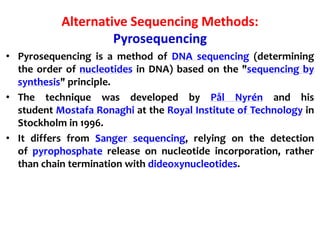
Alternative Sequencing Methods:
Pyrosequencing
• Pyrosequencing is a method of DNA sequencing (determining
the order of nucleotides in DNA) based on the "sequencing by
synthesis" principle.
• The technique was developed by Pål Nyrén and his
student Mostafa Ronaghi at the Royal Institute of Technology in
Stockholm in 1996.
• It differs from Sanger sequencing, relying on the detection
of pyrophosphate release on nucleotide incorporation, rather
than chain termination with dideoxynucleotides.
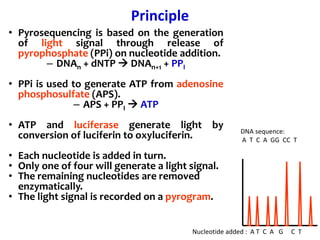
Principle
• Pyrosequencing is based on the generation
of light signal through release of
pyrophosphate (PPi) on nucleotide addition.
– DNAn + dNTP  DNAn+1 + PPI
• PPi is used to generate ATP from adenosine
phosphosulfate (APS).
– APS + PPI  ATP
• ATP and luciferase generate light by
conversion of luciferin to oxyluciferin.
• Each nucleotide is added in turn.
• Only one of four will generate a light signal.
• The remaining nucleotides are removed
enzymatically.
• The light signal is recorded on a pyrogram.
DNA sequence:
A T C A GG CC T
Nucleotide added : A T C A G C T
Procedure
• "Sequencing by synthesis" involves taking a single strand of the
DNA to be sequenced and then synthesizing its complementary
strand enzymatically.
• Essentially, the method allows sequencing of a single strand of
DNA by synthesizing the complementary strand along it, one
base pair at a time, and detected which base was actually added
at each step.
• The Pyrosequencing method is based on detecting the activity
of DNA polymerase with another chemiluminescent enzyme.
• The template DNA is immobile, and solutions of A, C, G, and
T nucleotides are added and removed after the reaction,
sequentially.
• Light is produced only when the nucleotide solution
complements the first unpaired base of the template. The
sequence of solutions which produce chemiluminescent signals
allows the determination of the sequence of the template.
Alternative Sequencing Methods:
Bisulfite Sequencing
• Bisulfite sequencing is used to detect methylation in DNA.
• Bisulfite deaminates cytosine, making uracil.
• Methylated cytosine is not changed by bisulfite treatment.
• The bisulfite-treated template is then sequenced.
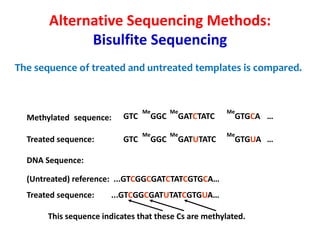
The sequence of treated and untreated templates is compared.
GTC
Methylated sequence: GTC
Me
GGC
Me
GATCTATC
Me
GTGCA …
Treated sequence:
Me
GGC
Me
GATUTATC
Me
GTGUA …
DNA Sequence:
(Untreated) reference: ...GTCGGCGATCTATCGTGCA…
Treated sequence: ...GTCGGCGATUTATCGTGUA…
This sequence indicates that these Cs are methylated.
Alternative Sequencing Methods:
Bisulfite Sequencing
Human Genome Project (HGP)
 HGP is a national effort to sequence and analyze the human
genome which is a very complex system consisting of 50,000 to
10,0000 genes.
 These genes are located on 23 pairs of chromosome.
 The draft sequence was released in 2000.
Some reasons for studying Human genome:
 Better medical practice
 High-quality diagnosis of diseases
 Understanding of evolution fully
 Improvement in biological research and forensic science
 Improvement in agriculture etc.
 The latest research on HGP are
 Pulsed electrophoresis
 Fluorescence microscopy
 2D gel electrophoresis
 gtc double-stranded subclone inserts
opbs.okstate.edu/.../ sld015.htm
Summary
• Genetic information is stored in the order or sequence of
nucleotides in DNA.
• Chain termination sequencing is the standard method for the
determination of nucleotide sequence.
• Dideoxy-chain termination sequencing has been facilitated by
the development of cycle sequencing and the use of
fluorescent dye detection.
• Alternative methods are used for special applications, such as
pyrosequencing (for resequencing and polymorphism
detection) or bisulfite sequencing (to analyze methylated
DNA).
Thanks
Acknowledgement: All the material/presentations available online on the subject
are duly acknowledged.
Disclaimer: The author bear no responsibility with regard to the source and
authenticity of the content.
Questions???

Dna sequencing

  • 1.
    DNA Sequencing Dr RaviKant Agrawal, MVSc, PhD Senior Scientist (Veterinary Microbiology) Food Microbiology Laboratory Division of Livestock Products Technology ICAR-Indian Veterinary Research Institute Izatnagar 243122 (UP) India
  • 2.
    Nucleic acid sequencing •The term DNA sequencing refers to sequencing methods for determining the order of the nucleotide bases - adenine, guanine, cytosine, and thymine in a molecule of DNA. • All the information required for the growth and development of an organism is encoded in the DNA of its genome. So, DNA sequencing is fundamental to genome analysis and understanding the biological processes in general. • The advent of DNA sequencing has significantly accelerated biological research and discovery. • Knowledge of DNA sequences has become indispensable for basic biological research, and in numerous applied fields such as diagnostics, biotechnology, forensic biology and biological systematics. • The rapid speed of sequencing attained with modern DNA sequencing technology has been instrumental in the sequencing of the human genome, in the Human Genome Project.
  • 3.
    Technical Breakthrough ForDNA Sequencing In 1977, two separate methods for the large-scale sequencing of DNA were devised: • Chemical cleavage method by A. M. Maxam and W. Gilbert • Enzymatic chain termination method by F. Sanger et. al. • Of these two methods, Sanger method is more popular. • Without changing the underlying concept of both methods, some improvements have been done over the years by applying different strategies, by developing various modifications and by automation. As a result, a very large scale sequencing has become feasible, e.g. E. coli, Saccharomyces cerevisiae, Human Genome Project etc.
  • 4.
    Maxam–Gilbert Sequencing • In1976–77, Allan Maxam and Walter Gilbert developed a DNA sequencing method based on chemical modification of DNA and subsequent cleavage at specific bases. • This method is sometimes called Chemical Sequencing. • Maxam–Gilbert sequencing rapidly became more popular, since purified DNA could be used directly, while the initial Sanger method required that each read start be cloned for production of single-stranded DNA. • However, with the improvement of the chain-termination method, Maxam-Gilbert sequencing has fallen out of favour due to its technical complexity prohibiting its use in standard molecular biology kits, extensive use of hazardous chemicals, and difficulties with scale-up.
  • 5.
    Cont… • The methodrequires radioactive labelling at one end and purification of the DNA fragment to be sequenced. • Chemical treatment generates breaks at a small proportion of one or two of the four nucleotide bases in each of four reactions (G, A+G, C, C+T). • Thus a series of labelled fragments is generated, from the radiolabelled end to the first "cut" site in each molecule. • The fragments in the four reactions are arranged side by side in gel electrophoresis for size separation. • To visualize the fragments, the gel is exposed to X-ray film for autoradiography, yielding a series of dark bands each corresponding to a radiolabelled DNA fragment, from which the sequence may be inferred.
  • 6.
    Chemical Cleavage Method •This method uses double-stranded DNA samples. • Involves modification of the bases in DNA followed by chemical base-specific cleavage. • Sequences DNA fragments containing upto ~500 nucleotides in length.
  • 7.
    1. The double-strandedfragment to be sequenced is isolated and radioactively labeled at the 5’- ends with 32P. 2. The fragment is then cut with restriction enzyme and thus the label is removed from one end. 3. The fragment of DNA with one end labeled is denatured. 4. Four identical samples of these end-labeled DNA restriction fragments are subjected to chemical cleavage at different chemical nucleotides. 5. There are four specific sets of chemical reactions that selectively cut the DNA backbone at G, A+G, C+T, or C residues.  G only: Dimethyl sulphate (DMS) and piperidine  A+G : DMS, piperidine  C+T : Hydrazine, piperidine  C only : Hydrazine, alkali, piperidine Figure: Maxam-Gilbert method (continued) Lodish, H.;Berk, A. et. al. (4th ed); Mol. Cell Biol.; W. H. Freeman and Co. (2000) p: 233 Stages
  • 8.
    Maxam-Gilbert sequencing isperformed by chain breakage at specific nucleotides. DMS G G G G FA G A G G A G A A H C T T C T C C T H+S C C C C Maxam-Gilbert Sequencing
  • 9.
    6.For each labeledchain to be broken only once, the reactions are controlled. 7.The labeled sub-fragments created by the four reactions have the 32P label at one end and the chemical cleavage point at the other end. 8.The reaction products are separated by polyacrylamide gel electrophoresis which is based on size. Smallest fragment goes fastest. Figure: Apparatus for gel electrophoresis Voet, D.; Voet, J. and Pratt, C. (upgrade ed) Fundamentals of Biochemistry; John Wiley and Sons, Inc (2002); p: 58 Contd…
  • 10.
    9. The labeledfragments in the gel are visualized by autoradiography. 10. The sequence is read from bottom to top of the gel. Figure: Maxam-Gilbert method Lodish, H.;Berk, A. et. al. (4th ed); Mol. Cell Biol.; W. H. Freeman and Co. (2000) p: 233
  • 11.
    Sequencing gels areread from bottom to top (5′ to 3′). G G+A T+C C 3′ A A G C A A C G T G C A G 5′ Longer fragments Shortest fragments G A Maxam-Gilbert Sequencing
  • 12.
    Example of DNASequencing by Chemical Method http://users.wmin.ac.uk/~redwayk/lectures/sequence.htm
  • 13.
    Mechanism of thechemical cleavage method Voet, D.; Voet, J. Biochemistry; John Wiley and Sons, Inc (1990); p: 830
  • 14.
    Continued…. Voet, D.; Voet,J. Biochemistry; John Wiley and Sons, Inc (1990); p: 831
  • 15.
    Advantages Disadvantages • Nopremature termination due to DNA sequencing. So, no problem with polymerase to synthesize DNA. • Stretches of DNA can be sequenced which can not be done with enzymatic method. • Not widely used. • Use of radioactivity and toxic chemicals. http://www.cmb.uab.edu/courses/lectures/scheirer2.pdf
  • 16.
    Chain-termination methods • Thechain-terminator method (or Sanger method after its developer Frederick Sanger) is more efficient and uses fewer toxic chemicals and lower amounts of radioactivity than the method of Maxam and Gilbert, it rapidly became the method of choice. • The key principle of the Sanger method was the use of dideoxynucleotide triphosphates (ddNTPs) as DNA chain terminators.
  • 17.
    The classical chain-terminationmethod requires a single-stranded DNA template, a DNA primer, a DNA polymerase, radioactively or fluorescently labeled nucleotides, and modified nucleotides that terminate DNA strand elongation. The DNA sample is divided into four separate sequencing reactions, containing all four of the standard deoxynucleotides (dATP, dGTP, dCTP and dTTP) and the DNA polymerase. To each reaction is added only one of the four dideoxynucleotides (ddATP, ddGTP, ddCTP, or ddTTP) which are the chain-terminating nucleotides, lacking a 3'-OH group required for the formation of a phosphodiester bond between two nucleotides, thus terminating DNA strand extension and resulting in DNA fragments of varying length.
  • 18.
    • The newlysynthesized and labeled DNA fragments are heat denatured, and separated by size (with a resolution of just one nucleotide) by gel electrophoresis on a denaturing polyacrylamide-urea gel with each of the four reactions run in one of four individual lanes (lanes A, T, G, C). • The DNA bands are then visualized by autoradiography or UV light, and the DNA sequence can be directly read off the X-ray film or gel image. • In the image on the right, X-ray film was exposed to the gel, and the dark bands correspond to DNA fragments of different lengths. • A dark band in a lane indicates a DNA fragment that is the result of chain termination after incorporation of a dideoxynucleotide (ddATP, ddGTP, ddCTP, or ddTTP).
  • 19.
    Sequencing gels areread from bottom to top (5′ to 3′). G A T C 3′ G G T A A A T C A T G 5′ Longer fragments Shorter fragments ddG ddG Chain Termination (Sanger) Sequencing
  • 20.
    Chain Termination method •This method uses single- stranded DNA. • Also known as dideoxy sequencing method because it involves the use of analogue of normal nucleotide 2’,3’- dideoxynucleoside triphosphates (ddNTPs). • These are chain terminating nucleotides lacking 3’-OH ends. • This method is based upon the incorporation of ddNTPs into a growing DNA strand to stop chain elongation. Figure: Structure of NTP, dNTP, and ddNTP Lodish, H.;Berk, A. et. al. (4th ed); Mol. Cell Biol.; W. H. Freeman and Co. (2000), p: 233
  • 21.
    Chain terminates at ddG Chain Termination(Sanger) Sequencing The 3′-OH group necessary for formation of the phosphodiester bond is missing in ddNTPs.
  • 22.
    Chain Termination (Sanger)Sequencing • With addition of enzyme (DNA polymerase), the primer is extended until a ddNTP is encountered. • The chain will end with the incorporation of the ddNTP. • With the proper dNTP:ddNTP ratio, the chain will terminate throughout the length of the template. • All terminated chains will end in the ddNTP added to that reaction. • The collection of fragments is a sequencing ladder. • The resulting terminated chains are resolved by electrophoresis. • Fragments from each of the four tubes are placed in four separate gel lanes.
  • 23.
    Stages: 1.The DNA tobe sequenced is called the template DNA.  It is prepared as a single-stranded DNA after being spliced into M13 vector DNA.  Infected E. coli host cells release phage particles which contains single-stranded recombinant DNA that includes the sample DNA.  This DNA sample is then extracted from phage for sequencing purpose. 2.A synthetic 5’-end-labeled oligodeoxynucleotide is used as the primer. 3.The template DNA is hybridized to the primer. 4. The primer elongation is performed in four separate polymerization reaction mixtures. Each mixture contains  4 normal deoxynucleotides (dNTPs) in higher concentration and  a low concentration of the each of the 4 ddNTPs. 5.There is initiation of DNA synthesis by adding enzyme DNA polymerase since the enzyme cannot distinguish between the normal nucleotides and their analogues. Figure: Action of DNA polymerase I Voet, D.; Voet, J. and Pratt, C. (upgrade ed) Fundamentals of Biochemistry; John Wiley and Sons, Inc (2002); p: 60
  • 24.
    6.The strand synthesis continuesuntil a ddNTP is added. The chain elongation ceases on the incorporation of a ddNTP because it lacks a 3’-OH group which prevents addition of the next nucleotide. 7.There is a result of mixture of terminated fragments, all of different lengths. 8.Denature DNA fragments. 9. Each of the four mixtures are run together on a polyacrylamide gel for electrphoresis. Figure: Sanger method Lodish, H.;Berk, A. et. al. (4th ed); Mol. Cell Biol.; W. H. Freeman and Co. (2000) p: 234
  • 25.
    10.The separated fragments arethen visualized by autoradiography. 11. From the position of the bands of the resulting to radiogram, the sequence of the original DNA template strand can be read directly. Figure: Chain termination method Voet, D.; Voet, J. and Pratt, C. (upgrade ed) Fundamentals of Biochemistry; John Wiley and Sons, Inc (2002); p: 61
  • 26.
    Advantages Disadvantages • Mostpopular method. • Simpler and quicker allowing large output. • Within an hour the primer- annealing and sequencing reactions can be completed. • Yielding of poor results owing to secondary structure in the DNA as sometimes DNA polymerases terminate chain elongation prematurely. • The sequence is obtained not from the original DNA molecule but from an enzymatic copy. So, there is a chance of incorporation of wrong bases.
  • 27.
    Example of DNASequencing in Sanger Method http://users.wmin.ac.uk/~redwayk/lectures/sequence.htm
  • 28.
    Cycle Sequencing • Cyclesequencing is chain termination sequencing performed in a thermal cycler. • Cycle sequencing requires a heat-stable DNA polymerase.
  • 29.
    Fluorescent Dyes • Fluorescentdyes are multicyclic molecules that absorb and emit fluorescent light at specific wavelengths. • Examples are fluorescein and rhodamine derivatives. • For sequencing applications, these molecules can be covalently attached to nucleotides. • In DYE PRIMER SEQUENCING, the primer contains fluorescent dye–conjugated nucleotides, labeling the sequencing ladder at the 5′ ends of the chains. • In DYE TERMINATOR SEQUENCING, the fluorescent dye molecules are covalently attached to the dideoxynucleotides, labeling the sequencing ladder at the 3′ ends of the chains. ddA ddA
  • 30.
    Dye-terminator sequencing • Dye-terminatorsequencing utilizes labelling of the chain terminator ddNTPs, which permits sequencing in a single reaction, rather than four reactions as in the labelled- primer method. • In dye-terminator sequencing, each of the four dideoxynucleotide chain terminators is labelled with fluorescent dyes, each of which with different wavelengths of fluorescence and emission.
  • 31.
    • Owing toits greater expediency and speed, dye-terminator sequencing is now the mainstay in automated sequencing. • The dye-terminator sequencing method, along with automated high-throughput DNA sequence analyzers, is now being used for the vast majority of sequencing projects. • Its limitations include dye effects due to differences in the incorporation of the dye-labelled chain terminators into the DNA fragment, resulting in unequal peak heights and shapes in the electronic DNA sequence trace chromatogram after capillary electrophoresis . • This problem has been addressed with the use of modified DNA polymerase enzyme systems and dyes that minimize incorporation variability, as well as methods for eliminating "dye blobs".
  • 32.
    AC GT The fragments are distinguishedby size and “color.” Dye Terminator Sequencing • A distinct dye or “color” is used for each of the four ddNTP. • Since the terminating nucleotides can be distinguished by color, all four reactions can be performed in a single tube. A T G T
  • 33.
    Capillary G T C T G A Slab gel GA TCG AT C Dye Terminator Sequencing The DNA ladder is resolved in one gel lane or in a capillary. CapillarySlab gel 5′ AGTCTG Electropherogram The DNA ladder is read on an electropherogram.
  • 34.
    5′ AGTCTG 5′AG(T/A)CTG 5′ AGACTG T/T T/A A/A Automated Sequencing • Dye primer or dye terminator sequencing on capillary instruments. • Sequence analysis software provides analyzed sequence in text and electropherogram form. • Peak patterns reflect mutations or sequence changes.
  • 35.
    Other Improved Approachesand Automated DNA Sequencing • Updated version of Sanger method • Fluorescence detection with lasers • Cycle sequencing • Shotgun sequencing http://www.cmb.uab.edu/courses/lectures/scheirer2.pdf chsfpc5.chem.ncsu.edu/Poznan/ chem_bio/sld026.htm
  • 36.
  • 37.
    Alternative Sequencing Methods: Pyrosequencing •Pyrosequencing is a method of DNA sequencing (determining the order of nucleotides in DNA) based on the "sequencing by synthesis" principle. • The technique was developed by Pål Nyrén and his student Mostafa Ronaghi at the Royal Institute of Technology in Stockholm in 1996. • It differs from Sanger sequencing, relying on the detection of pyrophosphate release on nucleotide incorporation, rather than chain termination with dideoxynucleotides.
  • 38.
    Principle • Pyrosequencing isbased on the generation of light signal through release of pyrophosphate (PPi) on nucleotide addition. – DNAn + dNTP  DNAn+1 + PPI • PPi is used to generate ATP from adenosine phosphosulfate (APS). – APS + PPI  ATP • ATP and luciferase generate light by conversion of luciferin to oxyluciferin. • Each nucleotide is added in turn. • Only one of four will generate a light signal. • The remaining nucleotides are removed enzymatically. • The light signal is recorded on a pyrogram. DNA sequence: A T C A GG CC T Nucleotide added : A T C A G C T
  • 39.
    Procedure • "Sequencing bysynthesis" involves taking a single strand of the DNA to be sequenced and then synthesizing its complementary strand enzymatically. • Essentially, the method allows sequencing of a single strand of DNA by synthesizing the complementary strand along it, one base pair at a time, and detected which base was actually added at each step. • The Pyrosequencing method is based on detecting the activity of DNA polymerase with another chemiluminescent enzyme. • The template DNA is immobile, and solutions of A, C, G, and T nucleotides are added and removed after the reaction, sequentially. • Light is produced only when the nucleotide solution complements the first unpaired base of the template. The sequence of solutions which produce chemiluminescent signals allows the determination of the sequence of the template.
  • 40.
    Alternative Sequencing Methods: BisulfiteSequencing • Bisulfite sequencing is used to detect methylation in DNA. • Bisulfite deaminates cytosine, making uracil. • Methylated cytosine is not changed by bisulfite treatment. • The bisulfite-treated template is then sequenced.
  • 41.
    The sequence oftreated and untreated templates is compared. GTC Methylated sequence: GTC Me GGC Me GATCTATC Me GTGCA … Treated sequence: Me GGC Me GATUTATC Me GTGUA … DNA Sequence: (Untreated) reference: ...GTCGGCGATCTATCGTGCA… Treated sequence: ...GTCGGCGATUTATCGTGUA… This sequence indicates that these Cs are methylated. Alternative Sequencing Methods: Bisulfite Sequencing
  • 42.
    Human Genome Project(HGP)  HGP is a national effort to sequence and analyze the human genome which is a very complex system consisting of 50,000 to 10,0000 genes.  These genes are located on 23 pairs of chromosome.  The draft sequence was released in 2000. Some reasons for studying Human genome:  Better medical practice  High-quality diagnosis of diseases  Understanding of evolution fully  Improvement in biological research and forensic science  Improvement in agriculture etc.  The latest research on HGP are  Pulsed electrophoresis  Fluorescence microscopy  2D gel electrophoresis  gtc double-stranded subclone inserts
  • 43.
  • 44.
    Summary • Genetic informationis stored in the order or sequence of nucleotides in DNA. • Chain termination sequencing is the standard method for the determination of nucleotide sequence. • Dideoxy-chain termination sequencing has been facilitated by the development of cycle sequencing and the use of fluorescent dye detection. • Alternative methods are used for special applications, such as pyrosequencing (for resequencing and polymorphism detection) or bisulfite sequencing (to analyze methylated DNA).
  • 45.
    Thanks Acknowledgement: All thematerial/presentations available online on the subject are duly acknowledged. Disclaimer: The author bear no responsibility with regard to the source and authenticity of the content. Questions???