SEMESTER – IV
BIOTECHNOLOGY
SEMINAR TOPIC : HOMOPOLYMER TAILING
SUBMITTED BY,
S. JENIFER JULIE
II M.SC MICROBIOLOGY
REG NO : 20201232516107
SUBBMITED TO,
Dr. G. RAMANADHAN
DEPARTMENT OF MICROBIOLOGY
INTRODUCTION
• A homopolymer is a polymer where all the
subunits are same.
• Tailing is the adding a series of nucleotides on to
the 3’ –OH termini of a double stranded DNA
molecule using enzyme terminal
deoxynucleotidyl transferase of calf thymus.
• In homopolymer tailing , gene of interest is tailed
with one nucleotide and vector is tailed with an
complemetary base.
• It is the method for joining DNA molecules by
annealing of complementary homopolymer
sequence.
• Oligo(dA) sequences is added to the 3’ ends of
the molecule and oligo(dA) blocks to the 3’end
of another molecule.
• This method is catalyzed by enzyme terminal
deoxynucleotidyl transferase by addition of
nucleotides to the 3’ end of a DNA fragment.
PROCESS
• They are then allowed to incubate together to
allow hydrogen bonding to bring them together .
• Homopolymer tailing is achieved by annealing.
• It is a technique by which sticky ends can be
produced on an blunt-ended DNA molcule.
• The reaction when carrid out in the presence of
on deoxynucleotide a homopolmer tail is
produced.
• For ligation of two tailed molecules the
homopolymers must be complementary.
• Poly dC tails are attached to the vector and poly
dG to the DNA to be cloned.
USES OF HOMOPOLYMER
TAILING
• This is more widely used approach for making
recombinant DNA.
• Segments of 50-100 poly A and poly G are
added to one fragment.
• Equal length segments of poly-T and poly-C are
added to the other fragment.
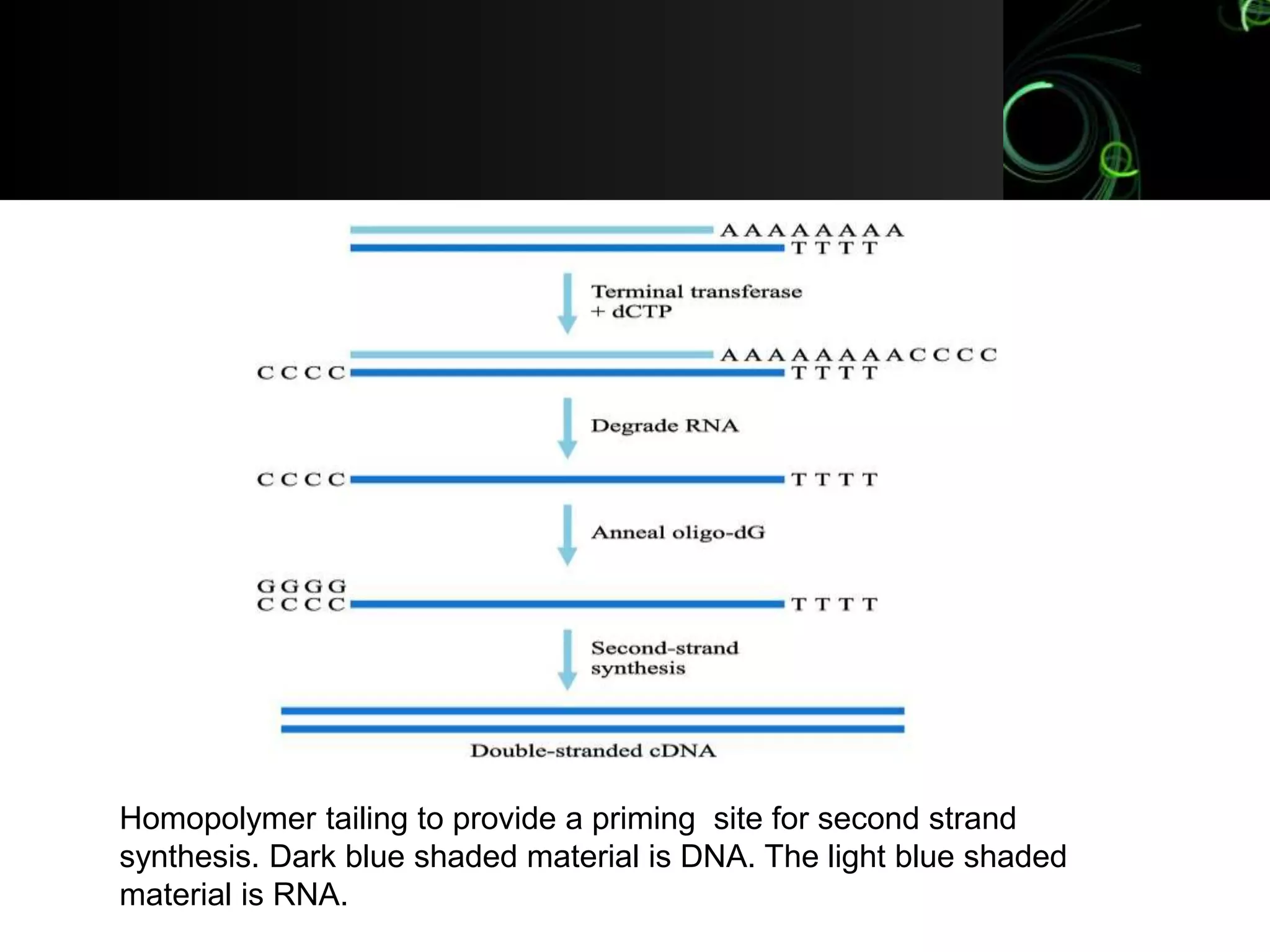
Homopolymer tailing to provide a priming site for second strand
synthesis. Dark blue shaded material is DNA. The light blue shaded
material is RNA.
Thank You.....

HOMOPOLYMER TAILING.pptx

  • 1.
    SEMESTER – IV BIOTECHNOLOGY SEMINARTOPIC : HOMOPOLYMER TAILING SUBMITTED BY, S. JENIFER JULIE II M.SC MICROBIOLOGY REG NO : 20201232516107 SUBBMITED TO, Dr. G. RAMANADHAN DEPARTMENT OF MICROBIOLOGY
  • 2.
    INTRODUCTION • A homopolymeris a polymer where all the subunits are same. • Tailing is the adding a series of nucleotides on to the 3’ –OH termini of a double stranded DNA molecule using enzyme terminal deoxynucleotidyl transferase of calf thymus. • In homopolymer tailing , gene of interest is tailed with one nucleotide and vector is tailed with an complemetary base.
  • 3.
    • It isthe method for joining DNA molecules by annealing of complementary homopolymer sequence. • Oligo(dA) sequences is added to the 3’ ends of the molecule and oligo(dA) blocks to the 3’end of another molecule. • This method is catalyzed by enzyme terminal deoxynucleotidyl transferase by addition of nucleotides to the 3’ end of a DNA fragment.
  • 6.
    PROCESS • They arethen allowed to incubate together to allow hydrogen bonding to bring them together . • Homopolymer tailing is achieved by annealing. • It is a technique by which sticky ends can be produced on an blunt-ended DNA molcule. • The reaction when carrid out in the presence of on deoxynucleotide a homopolmer tail is produced.
  • 8.
    • For ligationof two tailed molecules the homopolymers must be complementary. • Poly dC tails are attached to the vector and poly dG to the DNA to be cloned.
  • 9.
    USES OF HOMOPOLYMER TAILING •This is more widely used approach for making recombinant DNA. • Segments of 50-100 poly A and poly G are added to one fragment. • Equal length segments of poly-T and poly-C are added to the other fragment.
  • 10.
    Homopolymer tailing toprovide a priming site for second strand synthesis. Dark blue shaded material is DNA. The light blue shaded material is RNA.
  • 11.