Welcome all
Preethi S
Presentation
TOPIC
Determination of
nucleic acid sequence
Nucleic acid
A nucleic acid is a chain of nucleotides which stores
genetic information in biological systems.
 It creates DNA and RNA, which store the information
needed by cells to create proteins.
This information is stored in multiple sets of three
nucleotides, known as codons.
DNA is made of two linked strands that wind around
each other to resemble a twisted ladder : a shape known
as a double helix.
 Each strand has a backbone made of alternating sugar
(deoxyribose) and phosphate groups. Attached to each
sugar is one of four bases: adenine (A), cytosine (C),
guanine (G) or thymine (T).
Properties DNA RNA
Function
Repository of genetic
information
Involved in protein synthesis and
gene regulation; carrier of genetic
information in some viruses
Sugar Deoxyribose Ribose
Structure Double helix Usually single-stranded
Bases C, T, A, G C, U, A, G
Nucleic acid sequencing
The process of determining the order of the
nucleotide bases along a DNA strand is called
sequencing.
 In 1977, twenty-four years after the discovery of the
structure of DNA, two separate methods for sequencing
DNA were developed: the chain termination method
and the chemical degradation method.
Allan Maxam and Walter Gilbert developed Maxam-
Gilbert sequencing. This is also called chemical
sequencing.
 Their method used chemicals to break DNA into
small chunks to determine its sequence.
 Frederick Sanger and his colleagues developed
another method for sequencing DNA.
Their method was the most widely used for about
40 years. Even though there are faster and cheaper
methods today, the Sanger method is still used a lot.
 Sanger sequencing is based on the process
of DNA replication. Scientists make copies of DNA
strands. Then they observe which nucleotides are
added.
MAXAM & GILBERT PROCEDURE (Chemical
Method)
 Allan Maxam and Walter Gilbert published a DNA
sequencing method in 1977 based on chemical
modification of DNA and subsequent cleavage at
specific bases.
This method allows purified samples of double-
stranded DNA to be used without further cloning.
 Maxam-Gilbert sequencing requires radioactive
labelling at 5' end or 3’ end of the DNA followed by
purification of the DNA fragment to be sequenced.
Maxam gillbert
sequencing
Principle
1. Radioactive labelling of one end (5' end or 3’ end)
of the DNA fragment to be sequenced by a kinase
reaction using 32P.
2. Cut the DNA fragment with specific restriction
enzyme, resulting in two unequal DNA fragments.
3. Denature the double-stranded DNA to single-
stranded DNA by increasing temperature.
4.This is Cleave the DNA strand at specific positions
using chemical reactions. For example, we can use
one of the two chemicals followed by addition of
piperdine.
Dimethyl sulphate (DMS) selectively attacks purine (A
and 3 G), while hydrazine selectively attacks pyrimidines
(C and T).
modification step.
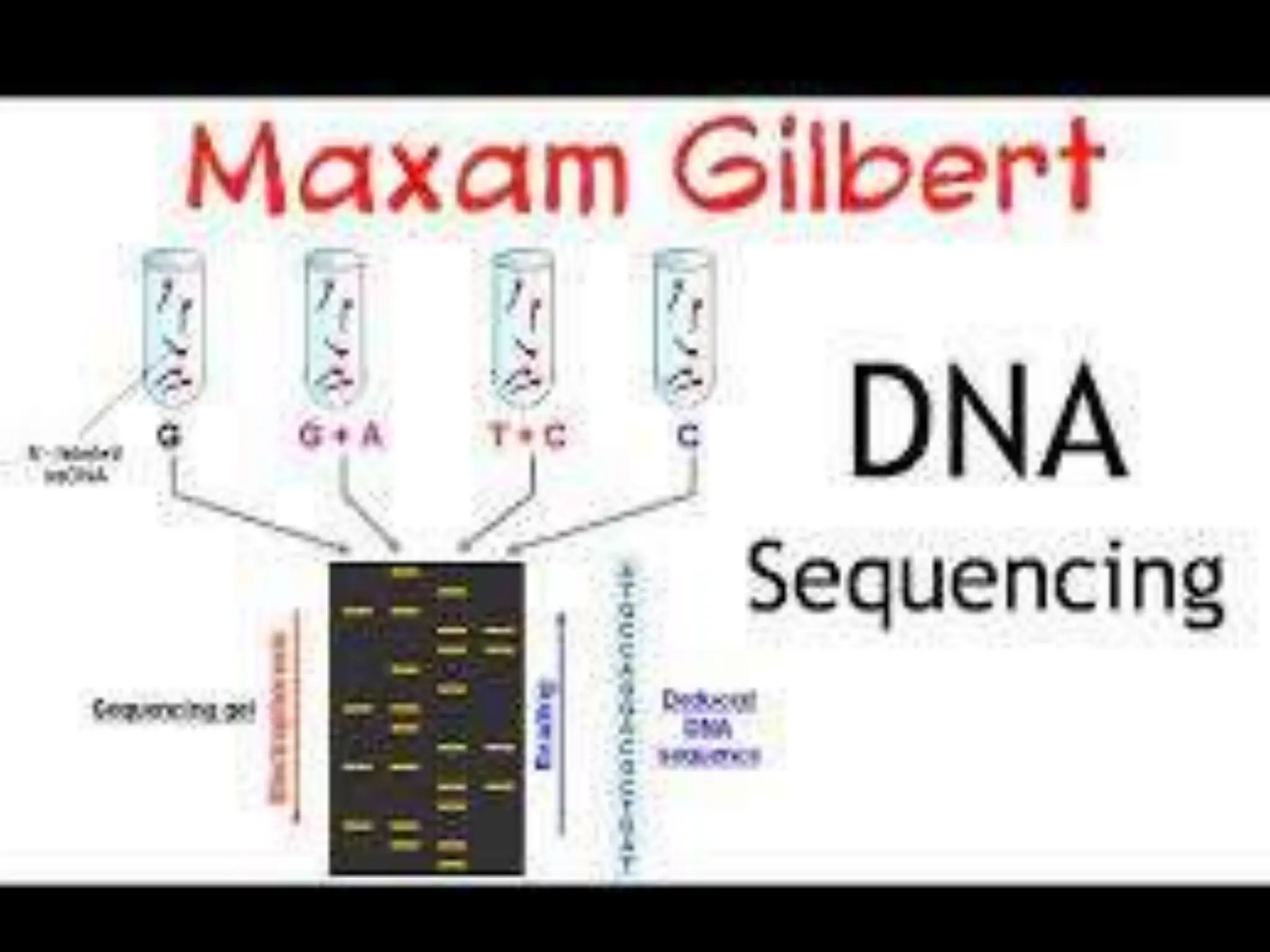
5. Chemical treatment generates breaks at the four
nucleotide bases in the four reaction mixtures (G, A+G,
C, and C+ T)
Reagent mixtures
1.Reagent G:It breaks the DNA chain before Guanine
2. Reagent A+G: It breaks the DNA chain before adenine
(A) and guanine (G) bases .
3. Reagent C: It breaks the DNA chain before cytosine
(C) base
4. Reagent C+T: It breaks the DNA chain before cytosine
(C) and guanine (G) bases Reaction proceeds long
enough to produce an average of one break per
strand; the random breaks generate end-labelled
fragments, representing all positions of each indicated
base.
Expose the four samples to different chemical
reactions that break the DNA after the indicated base
Denature the long doubled-stranded DNA strands and
proceed with end-labelled ones Cut the end-labelled
DNA strand with restriction enzyme Label the ends of
the double stranded DNA molecule Double stranded
DNA molecule Discard the short piece of DNA 4
Polyacyrlamide gel elecrophoresis
1.The gel is read from bottom to top
2. The gel has nucleotide sequence differing by only one
nucleotide; i.e. each subsequent base will be one nucleotide
longer than the previous one.
3.Each band on the gel identifies the specific nucleotide;
thus, the nucleotide sequence of the DNA fragment can be
read off the gel ‘end to end’.
Autoradiography :
Fragments are subjected to electrophoresis in high-
resolution acrylamide gels for size-based separation.
 To visualize the fragments, the gel is exposed to X-ray
film for autoradiography, which yields a series of dark
bands, each corresponding to a radiolabeled DNA
fragment, from which the nucleotide sequence may be
inferred.
 In the gel, the fragments are ordered by size and, thus,
we can deduce the sequence of the DNA molecule.
Advantages(maxam gillbert)
•Purified DNA can be read directly
•Homopolymeric DNA runs are sequenced as efficiently as
heterogeneous DNA sequences
Can be used to analyze DNA protein interactions (i.e.
footprinting)
•Can be used to analyze nucleic acid structure and
epigenetic modifications to DNA
Disadvantages
•It requires extensive use of hazardous chemicals.
•It has a relatively complex set up / technical complexity.
•It is difficult to “scale up” and cannot be used to analyze
more than 500 base pairs.
•The read length decreases from incomplete cleavage
reactions.
•It is difficult to make Maxam-Gilbert sequencing based
DNA kits.
2. ENZYMATIC PROCEDURE (Chain Termination
Method)
The enzymatic method is called as Sanger Method.
Sanger sequencing method was developed by Frederick
Sanger and his colleagues in 1977.
The development of this technique won Sanger the
Nobel Prize in Chemistry in 1980.
Principle
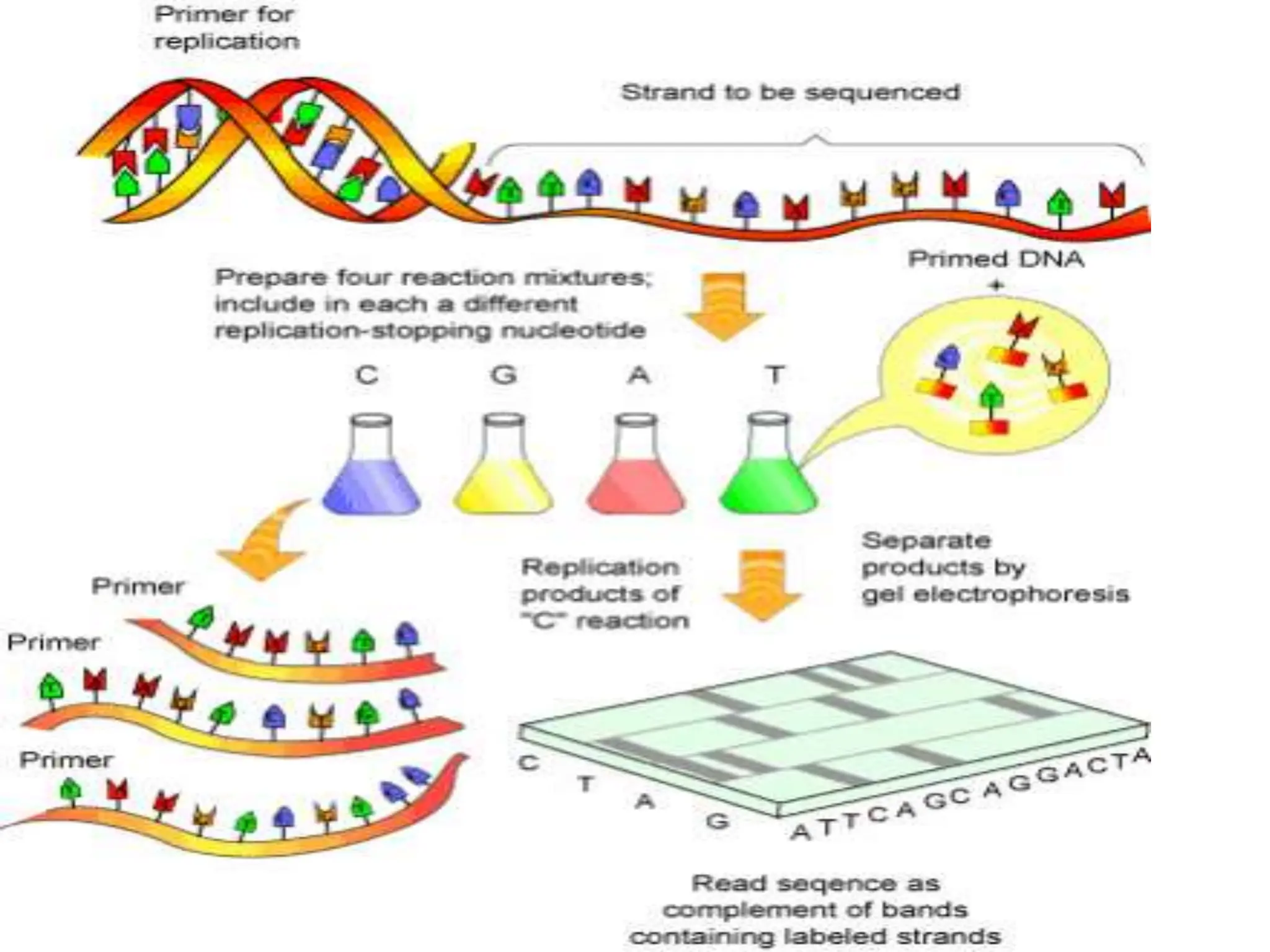
The single stranded DNA is mixed with primer and
split into four reaction mixtures.
 Each reaction mixture contains DNA polymerase,
four deoxyribonucleotide phosphates (dNTPs) and a
replication terminator (ddNTP).
 Each reaction proceeds until a replication terminating
nucleotide (ddNTP) is added.
 The mixtures are loaded into four separate lanes of
gel and the electrophoresis is used to separate the DNA
fragments
STEPS
1. Fragmentation and amplification: Fragment the DNA
and clone the fragments into vectors.
2. Denaturation: Denature the double stranded DNA (by
heat or NaOH) into single stranded DNA fragments.
3. Attach the primer: A primer is a synthetic
oligonucleotide, containing 17 to 24 nucleotides. The
primer binds to the DNA molecule and provides a 3' OH
group, which is necessary to initiate DNA synthesis. The
3'-OH group allows for DNA chain elongation.
4. Add 4 dNTPs + 1 ddNTP
5. Four different reaction vials are taken, each with the four
standard dNTPs (dATP, dGTP, dCTP and dTTP) and DNA
polymerases. Difference among the vials is because of
different type of ddNTP. Each vial will have 1 ddNTP per
100 dNTPs.
6. After the occurrence of DNA synthesis, each reaction vial
will have a unique set of single-stranded DNA molecules of
varying lengths. However, all DNA molecules will have the
same primer sequence at its 5' end 7. Find the nucleotide
sequence using gel electrophoresis: In the gel, we have
varying sequences, lined up according to size.
Agarose gel electrophoresis
1.DNA fragments are separated based on their size.
2.Larger molecule are separated slower and smaller
molecules separated faster.
Autoradiography
 In order to identify various terminated chains of
DNA (the DNA strands) the ddNTPs would have to
be radioactively or fluorescently labelled beforehand.
The DNA strands are then separated using gel
electrophoresis; then, the gel is read from top to
bottom (3' to 5') to obtain the sequence.
Charact
ers Maxam Gilbert Sanger Sequencing
Sequencin
g
technique
Maxam Gilbert
sequencing is the first
technique developed for
DNA sequencing.
Sanger sequencing method was
introduced after the Maxam
Gilbert sequencing method.
Usage This method is rarely
used.
Sanger sequencing is
routinely used for sequencing.
Use of
Hazardou
s
Chemicals
It uses hazardous
chemicals.
Use of hazardous chemicals is
limited compared to Maxam
Gilbert method.
Labeling
for
This method uses
radioactive P
32
for
labeling the ends of the
Sanger sequencing uses
radioactively or fluorescently
labeled ddNTPs.
Advantages
1. Not as toxic and less radioactivity than Maxam and
Gilbert method.
2. Highly accurate long sequence reads of about 700 base
pairs.
Thank you
FOR
listenING

DNA SEQUENCING (1).pptx

  • 1.
  • 2.
  • 3.
    Nucleic acid A nucleicacid is a chain of nucleotides which stores genetic information in biological systems.  It creates DNA and RNA, which store the information needed by cells to create proteins. This information is stored in multiple sets of three nucleotides, known as codons. DNA is made of two linked strands that wind around each other to resemble a twisted ladder : a shape known as a double helix.  Each strand has a backbone made of alternating sugar (deoxyribose) and phosphate groups. Attached to each sugar is one of four bases: adenine (A), cytosine (C), guanine (G) or thymine (T).
  • 4.
    Properties DNA RNA Function Repositoryof genetic information Involved in protein synthesis and gene regulation; carrier of genetic information in some viruses Sugar Deoxyribose Ribose Structure Double helix Usually single-stranded Bases C, T, A, G C, U, A, G
  • 5.
    Nucleic acid sequencing Theprocess of determining the order of the nucleotide bases along a DNA strand is called sequencing.  In 1977, twenty-four years after the discovery of the structure of DNA, two separate methods for sequencing DNA were developed: the chain termination method and the chemical degradation method. Allan Maxam and Walter Gilbert developed Maxam- Gilbert sequencing. This is also called chemical sequencing.  Their method used chemicals to break DNA into small chunks to determine its sequence.
  • 6.
     Frederick Sangerand his colleagues developed another method for sequencing DNA. Their method was the most widely used for about 40 years. Even though there are faster and cheaper methods today, the Sanger method is still used a lot.  Sanger sequencing is based on the process of DNA replication. Scientists make copies of DNA strands. Then they observe which nucleotides are added.
  • 7.
    MAXAM & GILBERTPROCEDURE (Chemical Method)  Allan Maxam and Walter Gilbert published a DNA sequencing method in 1977 based on chemical modification of DNA and subsequent cleavage at specific bases. This method allows purified samples of double- stranded DNA to be used without further cloning.  Maxam-Gilbert sequencing requires radioactive labelling at 5' end or 3’ end of the DNA followed by purification of the DNA fragment to be sequenced.
  • 9.
  • 10.
    Principle 1. Radioactive labellingof one end (5' end or 3’ end) of the DNA fragment to be sequenced by a kinase reaction using 32P. 2. Cut the DNA fragment with specific restriction enzyme, resulting in two unequal DNA fragments. 3. Denature the double-stranded DNA to single- stranded DNA by increasing temperature. 4.This is Cleave the DNA strand at specific positions using chemical reactions. For example, we can use one of the two chemicals followed by addition of piperdine.
  • 11.
    Dimethyl sulphate (DMS)selectively attacks purine (A and 3 G), while hydrazine selectively attacks pyrimidines (C and T). modification step. 5. Chemical treatment generates breaks at the four nucleotide bases in the four reaction mixtures (G, A+G, C, and C+ T) Reagent mixtures 1.Reagent G:It breaks the DNA chain before Guanine 2. Reagent A+G: It breaks the DNA chain before adenine (A) and guanine (G) bases . 3. Reagent C: It breaks the DNA chain before cytosine (C) base
  • 12.
    4. Reagent C+T:It breaks the DNA chain before cytosine (C) and guanine (G) bases Reaction proceeds long enough to produce an average of one break per strand; the random breaks generate end-labelled fragments, representing all positions of each indicated base. Expose the four samples to different chemical reactions that break the DNA after the indicated base Denature the long doubled-stranded DNA strands and proceed with end-labelled ones Cut the end-labelled DNA strand with restriction enzyme Label the ends of the double stranded DNA molecule Double stranded DNA molecule Discard the short piece of DNA 4
  • 13.
    Polyacyrlamide gel elecrophoresis 1.Thegel is read from bottom to top 2. The gel has nucleotide sequence differing by only one nucleotide; i.e. each subsequent base will be one nucleotide longer than the previous one. 3.Each band on the gel identifies the specific nucleotide; thus, the nucleotide sequence of the DNA fragment can be read off the gel ‘end to end’. Autoradiography : Fragments are subjected to electrophoresis in high- resolution acrylamide gels for size-based separation.
  • 14.
     To visualizethe fragments, the gel is exposed to X-ray film for autoradiography, which yields a series of dark bands, each corresponding to a radiolabeled DNA fragment, from which the nucleotide sequence may be inferred.  In the gel, the fragments are ordered by size and, thus, we can deduce the sequence of the DNA molecule. Advantages(maxam gillbert) •Purified DNA can be read directly •Homopolymeric DNA runs are sequenced as efficiently as heterogeneous DNA sequences
  • 15.
    Can be usedto analyze DNA protein interactions (i.e. footprinting) •Can be used to analyze nucleic acid structure and epigenetic modifications to DNA Disadvantages •It requires extensive use of hazardous chemicals. •It has a relatively complex set up / technical complexity. •It is difficult to “scale up” and cannot be used to analyze more than 500 base pairs. •The read length decreases from incomplete cleavage reactions. •It is difficult to make Maxam-Gilbert sequencing based DNA kits.
  • 16.
    2. ENZYMATIC PROCEDURE(Chain Termination Method) The enzymatic method is called as Sanger Method. Sanger sequencing method was developed by Frederick Sanger and his colleagues in 1977. The development of this technique won Sanger the Nobel Prize in Chemistry in 1980.
  • 20.
    Principle The single strandedDNA is mixed with primer and split into four reaction mixtures.  Each reaction mixture contains DNA polymerase, four deoxyribonucleotide phosphates (dNTPs) and a replication terminator (ddNTP).  Each reaction proceeds until a replication terminating nucleotide (ddNTP) is added.  The mixtures are loaded into four separate lanes of gel and the electrophoresis is used to separate the DNA fragments
  • 21.
    STEPS 1. Fragmentation andamplification: Fragment the DNA and clone the fragments into vectors. 2. Denaturation: Denature the double stranded DNA (by heat or NaOH) into single stranded DNA fragments. 3. Attach the primer: A primer is a synthetic oligonucleotide, containing 17 to 24 nucleotides. The primer binds to the DNA molecule and provides a 3' OH group, which is necessary to initiate DNA synthesis. The 3'-OH group allows for DNA chain elongation. 4. Add 4 dNTPs + 1 ddNTP
  • 23.
    5. Four differentreaction vials are taken, each with the four standard dNTPs (dATP, dGTP, dCTP and dTTP) and DNA polymerases. Difference among the vials is because of different type of ddNTP. Each vial will have 1 ddNTP per 100 dNTPs. 6. After the occurrence of DNA synthesis, each reaction vial will have a unique set of single-stranded DNA molecules of varying lengths. However, all DNA molecules will have the same primer sequence at its 5' end 7. Find the nucleotide sequence using gel electrophoresis: In the gel, we have varying sequences, lined up according to size.
  • 24.
    Agarose gel electrophoresis 1.DNAfragments are separated based on their size. 2.Larger molecule are separated slower and smaller molecules separated faster. Autoradiography  In order to identify various terminated chains of DNA (the DNA strands) the ddNTPs would have to be radioactively or fluorescently labelled beforehand. The DNA strands are then separated using gel electrophoresis; then, the gel is read from top to bottom (3' to 5') to obtain the sequence.
  • 25.
    Charact ers Maxam GilbertSanger Sequencing Sequencin g technique Maxam Gilbert sequencing is the first technique developed for DNA sequencing. Sanger sequencing method was introduced after the Maxam Gilbert sequencing method. Usage This method is rarely used. Sanger sequencing is routinely used for sequencing. Use of Hazardou s Chemicals It uses hazardous chemicals. Use of hazardous chemicals is limited compared to Maxam Gilbert method. Labeling for This method uses radioactive P 32 for labeling the ends of the Sanger sequencing uses radioactively or fluorescently labeled ddNTPs.
  • 26.
    Advantages 1. Not astoxic and less radioactivity than Maxam and Gilbert method. 2. Highly accurate long sequence reads of about 700 base pairs.
  • 27.