FROM RNATO cDNA
REVERSETRANSCRIPTIONOF RNA
Reverse transcription of RNA, which refers to the conversion of the RNA
template into its complimentary DNA strand (cDNA) is an essential step
in the analysis of gene transcripts.
cDNA can be sequenced, cloned and applied to estimate the copy number
of specific genes in order to characterize and to validate gene expression.
REVERSETRANSCRIPTASES
ReverseTranscriptases are RNA dependent DNA polymerases which bind
to RNA templates and convert them to their complimentary DNA
sequence in the presence of dNTPS and other essential cofactors.
REVERSETRANSCRIPTASES IN
VIRUSES
The enzyme ReverseTranscriptase was first reported by Dr. HowardTemin.
It was discovered in reverse transcribing viruses.
These viruses contain a genome which is composed of RNA but which is
reverse transcribed to DNA in the host cells.
RNATEMPLATE
The RNA template comprises the messenger RNA.
RNA is single stranded and tends to form secondary structures via Watson-
Crick base pairing.
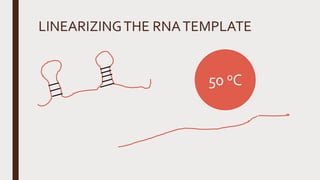
Heating the template is essential in order for it to be linearized prior to
annealing of the primers.
PRIMERS
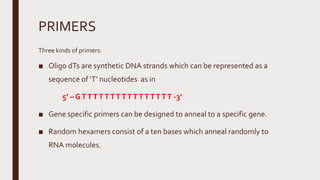
Three kinds of primers:
■ Oligo dTs are synthetic DNA strands which can be represented as a
sequence of ‘T’ nucleotides as in
5’ – GTTTTTTTTTTTTTTTT -3’
■ Gene specific primers can be designed to anneal to a specific gene.
■ Random hexamers consist of a ten bases which anneal randomly to
RNA molecules.
REVERSETRANSCRIPTASES
■ RNA dependent RNA polymerase is derived from reverse transcribing
viruses.
■ Mooloney Murine LeukemiaVirus.
■ Avian MyeblastomaVirus (AMV).
THE PROCESS
REVERSETRANSCRIPTION INVITRO
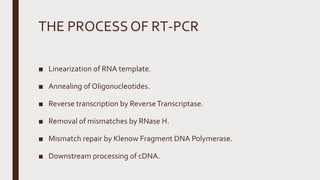
THE PROCESS OF RT-PCR
■ Linearization of RNA template.
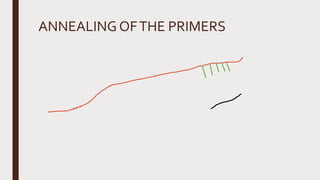
■ Annealing of Oligonucleotides.
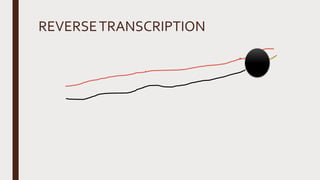
■ Reverse transcription by ReverseTranscriptase.
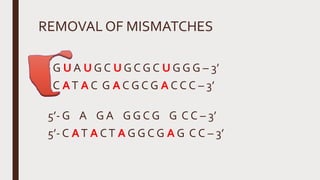
■ Removal of mismatches by RNase H.
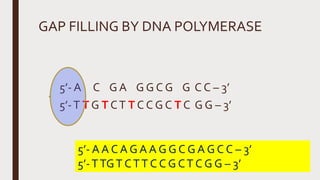
■ Mismatch repair by Klenow Fragment DNA Polymerase.
■ Downstream processing of cDNA.
LINEARIZINGTHE RNATEMPLATE
50 oC
ANNEALING OFTHE PRIMERS
REVERSETRANSCRIPTION
REMOVAL OF MISMATCHES
5’- G U A U G C U G C G C U G G G – 3’
5’- C AT A C G A C G C G A C C C – 3’
5’- G A G A G G C G G C C – 3’
5’- C AT A CT A G G C G A G C C – 3’
GAP FILLING BY DNA POLYMERASE
5’- A C G A G G C G G C C – 3’
5’-T T G T CT T C C G C T C G G – 3’
5’- A A C A G A A G G C G A G C C – 3’
5’-TTGT CTT C C G CT C G G – 3’
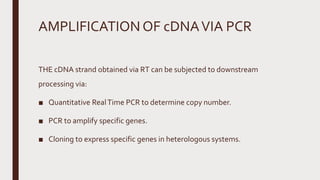
AMPLIFICATION OF cDNAVIA PCR
THE cDNA strand obtained via RT can be subjected to downstream
processing via:
■ Quantitative RealTime PCR to determine copy number.
■ PCR to amplify specific genes.
■ Cloning to express specific genes in heterologous systems.
Other kinds of Reverse Transcription
■ Random Amplification of cDNA ends or RACE-PCR can be applied to
reverse transcripts which are extremely long or which encode genes
whose complete sequences are unknown.
SUMMARY
■ ReverseTranscription.
■ In vitro reverse transcription.
■ Quantification of expression levels.
THANKYOU

Reverse Transcription

  • 1.
  • 2.
    REVERSETRANSCRIPTIONOF RNA Reverse transcriptionof RNA, which refers to the conversion of the RNA template into its complimentary DNA strand (cDNA) is an essential step in the analysis of gene transcripts. cDNA can be sequenced, cloned and applied to estimate the copy number of specific genes in order to characterize and to validate gene expression.
  • 3.
    REVERSETRANSCRIPTASES ReverseTranscriptases are RNAdependent DNA polymerases which bind to RNA templates and convert them to their complimentary DNA sequence in the presence of dNTPS and other essential cofactors.
  • 4.
    REVERSETRANSCRIPTASES IN VIRUSES The enzymeReverseTranscriptase was first reported by Dr. HowardTemin. It was discovered in reverse transcribing viruses. These viruses contain a genome which is composed of RNA but which is reverse transcribed to DNA in the host cells.
  • 5.
    RNATEMPLATE The RNA templatecomprises the messenger RNA. RNA is single stranded and tends to form secondary structures via Watson- Crick base pairing. Heating the template is essential in order for it to be linearized prior to annealing of the primers.
  • 6.
    PRIMERS Three kinds ofprimers: ■ Oligo dTs are synthetic DNA strands which can be represented as a sequence of ‘T’ nucleotides as in 5’ – GTTTTTTTTTTTTTTTT -3’ ■ Gene specific primers can be designed to anneal to a specific gene. ■ Random hexamers consist of a ten bases which anneal randomly to RNA molecules.
  • 7.
    REVERSETRANSCRIPTASES ■ RNA dependentRNA polymerase is derived from reverse transcribing viruses. ■ Mooloney Murine LeukemiaVirus. ■ Avian MyeblastomaVirus (AMV).
  • 8.
  • 9.
    THE PROCESS OFRT-PCR ■ Linearization of RNA template. ■ Annealing of Oligonucleotides. ■ Reverse transcription by ReverseTranscriptase. ■ Removal of mismatches by RNase H. ■ Mismatch repair by Klenow Fragment DNA Polymerase. ■ Downstream processing of cDNA.
  • 10.
  • 11.
  • 12.
  • 13.
    REMOVAL OF MISMATCHES 5’-G U A U G C U G C G C U G G G – 3’ 5’- C AT A C G A C G C G A C C C – 3’ 5’- G A G A G G C G G C C – 3’ 5’- C AT A CT A G G C G A G C C – 3’
  • 14.
    GAP FILLING BYDNA POLYMERASE 5’- A C G A G G C G G C C – 3’ 5’-T T G T CT T C C G C T C G G – 3’ 5’- A A C A G A A G G C G A G C C – 3’ 5’-TTGT CTT C C G CT C G G – 3’
  • 15.
    AMPLIFICATION OF cDNAVIAPCR THE cDNA strand obtained via RT can be subjected to downstream processing via: ■ Quantitative RealTime PCR to determine copy number. ■ PCR to amplify specific genes. ■ Cloning to express specific genes in heterologous systems.
  • 16.
    Other kinds ofReverse Transcription ■ Random Amplification of cDNA ends or RACE-PCR can be applied to reverse transcripts which are extremely long or which encode genes whose complete sequences are unknown.
  • 17.
    SUMMARY ■ ReverseTranscription. ■ Invitro reverse transcription. ■ Quantification of expression levels.
  • 18.