DNA sequencing
• Introduction:
• Knowledge of DNA sequences has become indispensable
for basic biological research, other research branches
utilizing DNA sequencing, and in numerous applied fields
such as diagnostic, biotechnology, forensic biology and
biological systematics. The advent of DNA sequencing has
significantly accelerated biological research and discovery.
The rapid speed of sequencing attained with modern DNA
sequencing technology has been instrumental in the
sequencing of the human genome, in the human genome
project. Related projects, often by scientific collaboration
across continents, have generated the complete DNA
sequences of many animal, plant, and microbial genomes.
• DNA sequencing includes several methods
and technologies that are used for determining
the order of the nucleotide bases—adenine,
guanine, cytosine, and thymine—in a molecule
of DNA.
Two similar methods used for determining the order of the nucleotide
sequences:
1. Maxam and Gilbert method
2. Sanger method
 They depend on the production of a mixture of oligonucleotides labeled
either radioactively or fluorescing, with one common end and differing in
length by a single nucleotide at the other end
 This mixture of oligonucleotides is separated by high resolution
electrophoresis on polyacrilamide gels and the position of the bands
determined
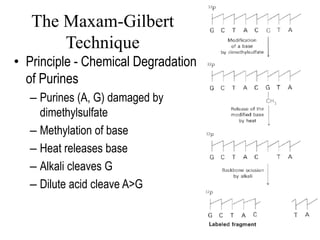
The Maxam-Gilbert
Technique
• Principle - Chemical Degradation
of Purines
– Purines (A, G) damaged by
dimethylsulfate
– Methylation of base
– Heat releases base
– Alkali cleaves G
– Dilute acid cleave A>G
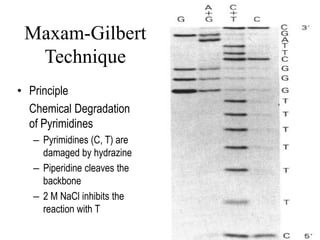
Maxam-Gilbert
Technique
• Principle
Chemical Degradation
of Pyrimidines
– Pyrimidines (C, T) are
damaged by hydrazine
– Piperidine cleaves the
backbone
– 2 M NaCl inhibits the
reaction with T
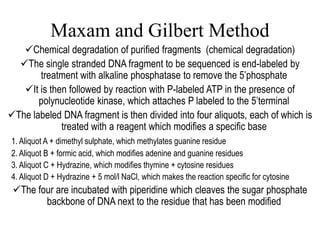
Maxam and Gilbert Method
Chemical degradation of purified fragments (chemical degradation)
The single stranded DNA fragment to be sequenced is end-labeled by
treatment with alkaline phosphatase to remove the 5’phosphate
It is then followed by reaction with P-labeled ATP in the presence of
polynucleotide kinase, which attaches P labeled to the 5’terminal
The labeled DNA fragment is then divided into four aliquots, each of which is
treated with a reagent which modifies a specific base
1. Aliquot A + dimethyl sulphate, which methylates guanine residue
2. Aliquot B + formic acid, which modifies adenine and guanine residues
3. Aliquot C + Hydrazine, which modifies thymine + cytosine residues
4. Aliquot D + Hydrazine + 5 mol/l NaCl, which makes the reaction specific for cytosine
The four are incubated with piperidine which cleaves the sugar phosphate
backbone of DNA next to the residue that has been modified
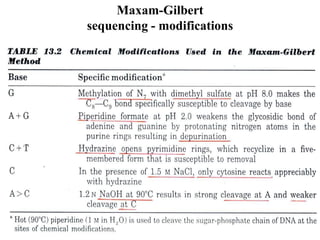
Maxam-Gilbert
sequencing - modifications
• Chain-termination methods (Sanger method)
• The key principle of the Sanger method was the use of
dideoxynucleotide triphosphates (ddNTPs) as DNA
chain terminators.
• The classical chain-termination method requires
1- single-stranded DNA template
2- DNA primer
3- DNA polymerase
4- normal deoxynucleotidephosphates (dNTPs)
5-modified nucleotides (dideoxyNTPs) that terminate
DNA strand elongation.
These ddNTPs will also be radioactively or fluorescently
labeled for detection in automated sequencing
machines.
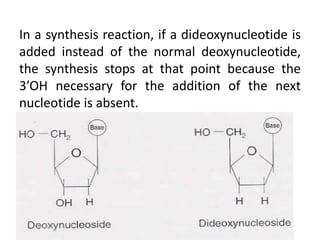
In a synthesis reaction, if a dideoxynucleotide is
added instead of the normal deoxynucleotide,
the synthesis stops at that point because the
3’OH necessary for the addition of the next
nucleotide is absent.
•In the dideoxy method of sequencing, the template DNA that is
to be sequenced is mixed with a primer complementary to the
template DNA and the four normal dNTPs, one of which is
radioactively labeled for subsequent visualization purposes.
•This mixture is then splint into four different tubes that are
labeled A, C, G, and T. Each tube is then “spiked” with a
different ddNTP (ddATP for tube A, ddCTP for tube C, ddGTT
for tube G, or ddTTP for tube T).
•DNA polymerase is added and using the DNA template and its’
complementary primer, the synthesis of new strands of DNA
complementary to the template begins.
•Occasionally a dideoxynucleotide is added instead of the normal
deoxynucleotide and synthesis of that strand is terminated at that
point.
•In the tube containing ddATP, some percentage of newly
synthesized molecules will get a ddATP in each place that there is
a T in the template DNA.
•The result is a set of new DNA molecules in tube A, each of
which ends in an A.
•A similar type of reaction occurs in the three other tubes to result
in molecules that end in C, G, and T in tubes C, G, and T
respectively.
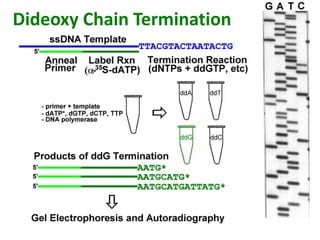
•After the synthesis reactions are complete, the products of the
four different tubes are loaded onto four adjacent lane of a
polyacrylamide gel and the different fragments are separated by
size.
•The sequencing gel is able to resolve fragments that differ in size
from each other by only one base.
•After electrophoresis to separate the fragments by size,
the fragments are visualized to exposing the gel to
photographic film (Remember that one nucleotide was
radioactively labeled).
•All fragments in lane A will end in an A, fragments in
lane C will all end in a C, fragments in lane G will all
end in a G, and fragments in lane T will all end in a T.
•The sequence of the DNA is read from the gel by
starting at the bottom and reading upward.
Dideoxy Chain Termination
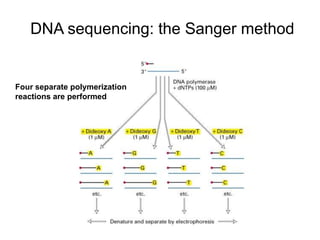
DNA sequencing: the Sanger method
Four separate polymerization
reactions are performed
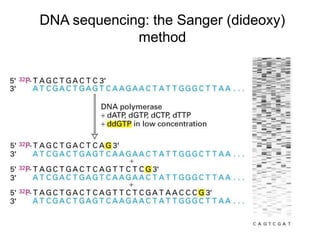
DNA sequencing: the Sanger (dideoxy)
method
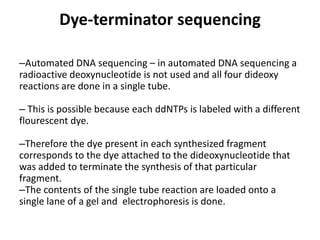
Dye-terminator sequencing
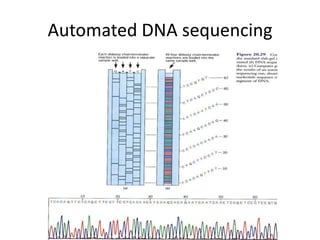
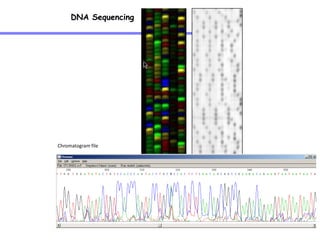
–Automated DNA sequencing – in automated DNA sequencing a
radioactive deoxynucleotide is not used and all four dideoxy
reactions are done in a single tube.
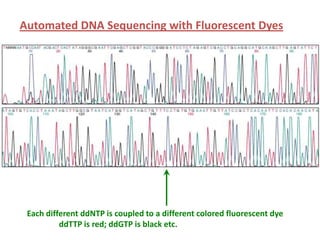
– This is possible because each ddNTPs is labeled with a different
flourescent dye.
–Therefore the dye present in each synthesized fragment
corresponds to the dye attached to the dideoxynucleotide that
was added to terminate the synthesis of that particular
fragment.
–The contents of the single tube reaction are loaded onto a
single lane of a gel and electrophoresis is done.
– A flourimeter and computer are hooked up to the
gel and they detect and record the dye attached
to the fragments as they come off the gel.
– The sequence is determined by the order of the
dyes coming off the gel.
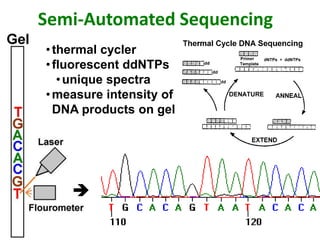
Semi-Automated Sequencing

•thermal cycler
•fluorescent ddNTPs
•unique spectra
•measure intensity of
DNA products on gel
Automated DNA sequencing
DNA Sequencing
Chromatogram file
Automated DNA Sequencing with Fluorescent Dyes
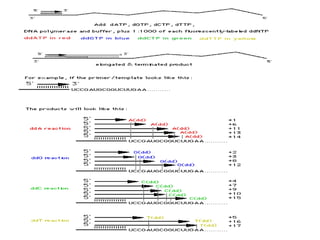
Each different ddNTP is coupled to a different colored fluorescent dye
ddTTP is red; ddGTP is black etc.

Lec 7 dna sequencing

  • 1.
    DNA sequencing • Introduction: •Knowledge of DNA sequences has become indispensable for basic biological research, other research branches utilizing DNA sequencing, and in numerous applied fields such as diagnostic, biotechnology, forensic biology and biological systematics. The advent of DNA sequencing has significantly accelerated biological research and discovery. The rapid speed of sequencing attained with modern DNA sequencing technology has been instrumental in the sequencing of the human genome, in the human genome project. Related projects, often by scientific collaboration across continents, have generated the complete DNA sequences of many animal, plant, and microbial genomes.
  • 2.
    • DNA sequencingincludes several methods and technologies that are used for determining the order of the nucleotide bases—adenine, guanine, cytosine, and thymine—in a molecule of DNA.
  • 3.
    Two similar methodsused for determining the order of the nucleotide sequences: 1. Maxam and Gilbert method 2. Sanger method  They depend on the production of a mixture of oligonucleotides labeled either radioactively or fluorescing, with one common end and differing in length by a single nucleotide at the other end  This mixture of oligonucleotides is separated by high resolution electrophoresis on polyacrilamide gels and the position of the bands determined
  • 4.
    The Maxam-Gilbert Technique • Principle- Chemical Degradation of Purines – Purines (A, G) damaged by dimethylsulfate – Methylation of base – Heat releases base – Alkali cleaves G – Dilute acid cleave A>G
  • 5.
    Maxam-Gilbert Technique • Principle Chemical Degradation ofPyrimidines – Pyrimidines (C, T) are damaged by hydrazine – Piperidine cleaves the backbone – 2 M NaCl inhibits the reaction with T
  • 6.
    Maxam and GilbertMethod Chemical degradation of purified fragments (chemical degradation) The single stranded DNA fragment to be sequenced is end-labeled by treatment with alkaline phosphatase to remove the 5’phosphate It is then followed by reaction with P-labeled ATP in the presence of polynucleotide kinase, which attaches P labeled to the 5’terminal The labeled DNA fragment is then divided into four aliquots, each of which is treated with a reagent which modifies a specific base 1. Aliquot A + dimethyl sulphate, which methylates guanine residue 2. Aliquot B + formic acid, which modifies adenine and guanine residues 3. Aliquot C + Hydrazine, which modifies thymine + cytosine residues 4. Aliquot D + Hydrazine + 5 mol/l NaCl, which makes the reaction specific for cytosine The four are incubated with piperidine which cleaves the sugar phosphate backbone of DNA next to the residue that has been modified
  • 7.
  • 8.
    • Chain-termination methods(Sanger method) • The key principle of the Sanger method was the use of dideoxynucleotide triphosphates (ddNTPs) as DNA chain terminators. • The classical chain-termination method requires 1- single-stranded DNA template 2- DNA primer 3- DNA polymerase 4- normal deoxynucleotidephosphates (dNTPs) 5-modified nucleotides (dideoxyNTPs) that terminate DNA strand elongation. These ddNTPs will also be radioactively or fluorescently labeled for detection in automated sequencing machines.
  • 9.
    In a synthesisreaction, if a dideoxynucleotide is added instead of the normal deoxynucleotide, the synthesis stops at that point because the 3’OH necessary for the addition of the next nucleotide is absent.
  • 10.
    •In the dideoxymethod of sequencing, the template DNA that is to be sequenced is mixed with a primer complementary to the template DNA and the four normal dNTPs, one of which is radioactively labeled for subsequent visualization purposes. •This mixture is then splint into four different tubes that are labeled A, C, G, and T. Each tube is then “spiked” with a different ddNTP (ddATP for tube A, ddCTP for tube C, ddGTT for tube G, or ddTTP for tube T). •DNA polymerase is added and using the DNA template and its’ complementary primer, the synthesis of new strands of DNA complementary to the template begins. •Occasionally a dideoxynucleotide is added instead of the normal deoxynucleotide and synthesis of that strand is terminated at that point.
  • 11.
    •In the tubecontaining ddATP, some percentage of newly synthesized molecules will get a ddATP in each place that there is a T in the template DNA. •The result is a set of new DNA molecules in tube A, each of which ends in an A. •A similar type of reaction occurs in the three other tubes to result in molecules that end in C, G, and T in tubes C, G, and T respectively. •After the synthesis reactions are complete, the products of the four different tubes are loaded onto four adjacent lane of a polyacrylamide gel and the different fragments are separated by size. •The sequencing gel is able to resolve fragments that differ in size from each other by only one base.
  • 12.
    •After electrophoresis toseparate the fragments by size, the fragments are visualized to exposing the gel to photographic film (Remember that one nucleotide was radioactively labeled). •All fragments in lane A will end in an A, fragments in lane C will all end in a C, fragments in lane G will all end in a G, and fragments in lane T will all end in a T. •The sequence of the DNA is read from the gel by starting at the bottom and reading upward.
  • 13.
  • 14.
    DNA sequencing: theSanger method Four separate polymerization reactions are performed
  • 15.
    DNA sequencing: theSanger (dideoxy) method
  • 17.
    Dye-terminator sequencing –Automated DNAsequencing – in automated DNA sequencing a radioactive deoxynucleotide is not used and all four dideoxy reactions are done in a single tube. – This is possible because each ddNTPs is labeled with a different flourescent dye. –Therefore the dye present in each synthesized fragment corresponds to the dye attached to the dideoxynucleotide that was added to terminate the synthesis of that particular fragment. –The contents of the single tube reaction are loaded onto a single lane of a gel and electrophoresis is done.
  • 18.
    – A flourimeterand computer are hooked up to the gel and they detect and record the dye attached to the fragments as they come off the gel. – The sequence is determined by the order of the dyes coming off the gel.
  • 19.
    Semi-Automated Sequencing  •thermal cycler •fluorescentddNTPs •unique spectra •measure intensity of DNA products on gel
  • 20.
  • 21.
  • 22.
    Automated DNA Sequencingwith Fluorescent Dyes Each different ddNTP is coupled to a different colored fluorescent dye ddTTP is red; ddGTP is black etc.