GLUCOSE TRANSPORTERS
INTRODUCTION
Metabolism occurs within cells that are separated
from their environments by plasma membranes.
Eukaryotic cells, in addition, are compartmentalized by
intercellular membranes that form the boundaries and
internal structures of their various organelles. The
nonpolar cores of biological membranes make them
highly impermeable to most ionic and polar substances,
so that these substances can pass across membranes
only through the action of specific transport proteins.
GLUCOSE TRANSPOTERS
Glucose transporters are a wide group of
membrane proteins
Facilitate the transport of glucose over a plasma
membrane.
Glucose is a vital source of energy for all life
these transporters are present in all phyla.
It accounts for 2% of erythrocyte membrane
proteins.
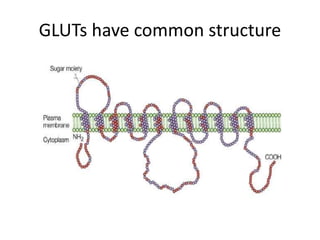
GLUTs have common structure
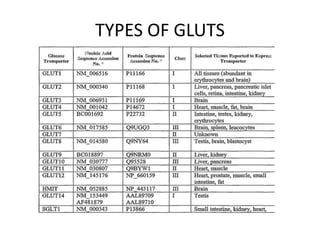
TYPES OF GLUTS
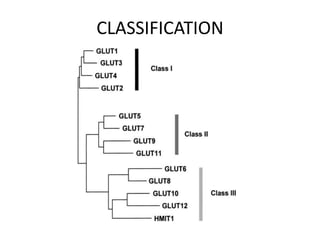
CLASSIFICATION
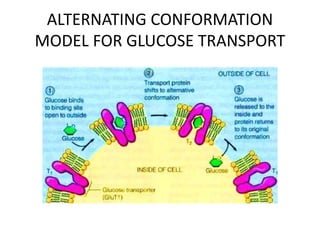
ALTERNATING CONFORMATION
MODEL FOR GLUCOSE TRANSPORT
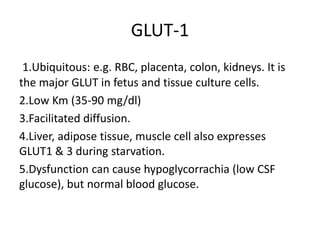
GLUT-1
1.Ubiquitous: e.g. RBC, placenta, colon, kidneys. It is
the major GLUT in fetus and tissue culture cells.
2.Low Km (35-90 mg/dl)
3.Facilitated diffusion.
4.Liver, adipose tissue, muscle cell also expresses
GLUT1 & 3 during starvation.
5.Dysfunction can cause hypoglycorrachia (low CSF
glucose), but normal blood glucose.
GLUT-2
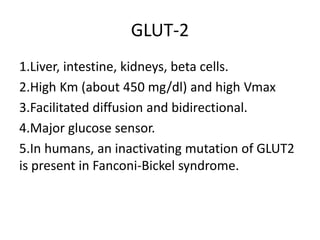
1.Liver, intestine, kidneys, beta cells.
2.High Km (about 450 mg/dl) and high Vmax
3.Facilitated diffusion and bidirectional.
4.Major glucose sensor.
5.In humans, an inactivating mutation of GLUT2
is present in Fanconi-Bickel syndrome.
GLUT-3
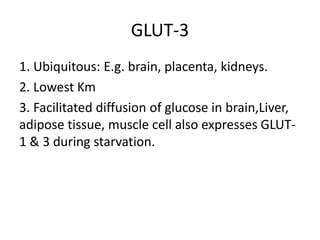
1. Ubiquitous: E.g. brain, placenta, kidneys.
2. Lowest Km
3. Facilitated diffusion of glucose in brain,Liver,
adipose tissue, muscle cell also expresses GLUT-
1 & 3 during starvation.
GLUT-4
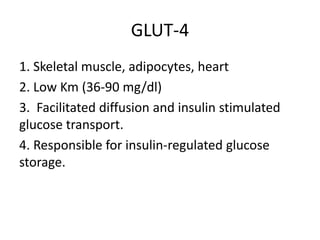
1. Skeletal muscle, adipocytes, heart
2. Low Km (36-90 mg/dl)
3. Facilitated diffusion and insulin stimulated
glucose transport.
4. Responsible for insulin-regulated glucose
storage.
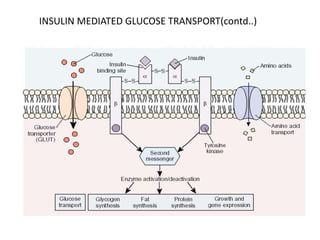
INSULIN MEDIATED GLUCOSE TRANSPORT
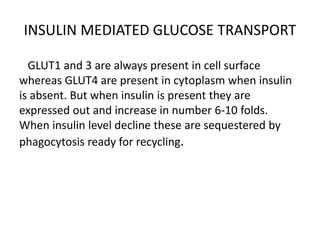
GLUT1 and 3 are always present in cell surface
whereas GLUT4 are present in cytoplasm when insulin
is absent. But when insulin is present they are
expressed out and increase in number 6-10 folds.
When insulin level decline these are sequestered by
phagocytosis ready for recycling.
INSULIN MEDIATED GLUCOSE TRANSPORT(contd..)
GLUT-4(contd…)
Insulin mediated glucose transport is the rate
limiting step for glucose metabolism. This
uptake defect is the cause of reduced insulin
sensitivity seen in T-2 diabetes. Either GLUT4 are
unresponsive to insulin or are not expressed.
The insulin sensitizing agents like metformin and
thiazolidinedione and exercise increases
expression of GLUT1, 4.
CLASS 2 AND 3 GLUTS
• GLUT5 (SLC2A5), a fructose transporter
• GLUT7 (SLC2A7), transporting glucose out of
the endoplasmic reticulum
• Several of them (GLUT6, GLUT8) are made of
motifs that to help retain them intracellularly
and therefore prevent glucose transport.
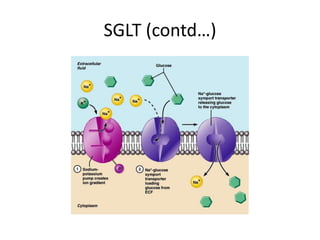
Na+-GLUCOSE
COTRANSPORTERS(SGLT family)
1. Two isoforms described SGLT1 and 2.
2. Intestine (SGLT1) responsible of dietary
uptake of glucose and galactose. Renal tubules
(SGLT2) responsible of glucose uptake from
proximal tubule.
3. Move glucose against concentration gradient
4. Actively transports glucose using Na+
gradient.
SGLT (contd…)
SGLT(contd…)
1.SGLT1 mutation is associated with glucose-
galactose malabsorption syndrome that cause
fatal infantile diarrhea.
2. Mutation in SGLT2 is associated with renal
glycosuria.
CONCLUSION
Glucose is a fundamental source of energy for all
eukaryotic cells.The energy is provided by the
breakdown of endogenous glycogen stores that are
primarily in the liver. These whole-body energy stores
are replenished from glucose in the diet, which, after
being digested and absorbed across the gut wall, is
distributed among the various tissues of the body .This
distribution process involves a family of transport
proteins — called GLUTs — which act as shuttles to
move sugar across the cell surface.
If you would like to donate us?
Scan below and donate us 0.013$ (US dollar) (5Rs Indian rupee)
Contact: If you want PPT/PDF files, please contact below.
Email: gnccmysore@gmail.com
Telegram:+919738137533(only for Chat)
Glucose Transporters.pptx

Glucose Transporters.pptx

  • 1.
  • 2.
    INTRODUCTION Metabolism occurs withincells that are separated from their environments by plasma membranes. Eukaryotic cells, in addition, are compartmentalized by intercellular membranes that form the boundaries and internal structures of their various organelles. The nonpolar cores of biological membranes make them highly impermeable to most ionic and polar substances, so that these substances can pass across membranes only through the action of specific transport proteins.
  • 3.
    GLUCOSE TRANSPOTERS Glucose transportersare a wide group of membrane proteins Facilitate the transport of glucose over a plasma membrane. Glucose is a vital source of energy for all life these transporters are present in all phyla. It accounts for 2% of erythrocyte membrane proteins.
  • 4.
  • 5.
  • 6.
  • 7.
  • 8.
    GLUT-1 1.Ubiquitous: e.g. RBC,placenta, colon, kidneys. It is the major GLUT in fetus and tissue culture cells. 2.Low Km (35-90 mg/dl) 3.Facilitated diffusion. 4.Liver, adipose tissue, muscle cell also expresses GLUT1 & 3 during starvation. 5.Dysfunction can cause hypoglycorrachia (low CSF glucose), but normal blood glucose.
  • 9.
    GLUT-2 1.Liver, intestine, kidneys,beta cells. 2.High Km (about 450 mg/dl) and high Vmax 3.Facilitated diffusion and bidirectional. 4.Major glucose sensor. 5.In humans, an inactivating mutation of GLUT2 is present in Fanconi-Bickel syndrome.
  • 10.
    GLUT-3 1. Ubiquitous: E.g.brain, placenta, kidneys. 2. Lowest Km 3. Facilitated diffusion of glucose in brain,Liver, adipose tissue, muscle cell also expresses GLUT- 1 & 3 during starvation.
  • 11.
    GLUT-4 1. Skeletal muscle,adipocytes, heart 2. Low Km (36-90 mg/dl) 3. Facilitated diffusion and insulin stimulated glucose transport. 4. Responsible for insulin-regulated glucose storage.
  • 12.
    INSULIN MEDIATED GLUCOSETRANSPORT GLUT1 and 3 are always present in cell surface whereas GLUT4 are present in cytoplasm when insulin is absent. But when insulin is present they are expressed out and increase in number 6-10 folds. When insulin level decline these are sequestered by phagocytosis ready for recycling.
  • 13.
    INSULIN MEDIATED GLUCOSETRANSPORT(contd..)
  • 14.
    GLUT-4(contd…) Insulin mediated glucosetransport is the rate limiting step for glucose metabolism. This uptake defect is the cause of reduced insulin sensitivity seen in T-2 diabetes. Either GLUT4 are unresponsive to insulin or are not expressed. The insulin sensitizing agents like metformin and thiazolidinedione and exercise increases expression of GLUT1, 4.
  • 15.
    CLASS 2 AND3 GLUTS • GLUT5 (SLC2A5), a fructose transporter • GLUT7 (SLC2A7), transporting glucose out of the endoplasmic reticulum • Several of them (GLUT6, GLUT8) are made of motifs that to help retain them intracellularly and therefore prevent glucose transport.
  • 16.
    Na+-GLUCOSE COTRANSPORTERS(SGLT family) 1. Twoisoforms described SGLT1 and 2. 2. Intestine (SGLT1) responsible of dietary uptake of glucose and galactose. Renal tubules (SGLT2) responsible of glucose uptake from proximal tubule. 3. Move glucose against concentration gradient 4. Actively transports glucose using Na+ gradient.
  • 17.
  • 18.
    SGLT(contd…) 1.SGLT1 mutation isassociated with glucose- galactose malabsorption syndrome that cause fatal infantile diarrhea. 2. Mutation in SGLT2 is associated with renal glycosuria.
  • 19.
    CONCLUSION Glucose is afundamental source of energy for all eukaryotic cells.The energy is provided by the breakdown of endogenous glycogen stores that are primarily in the liver. These whole-body energy stores are replenished from glucose in the diet, which, after being digested and absorbed across the gut wall, is distributed among the various tissues of the body .This distribution process involves a family of transport proteins — called GLUTs — which act as shuttles to move sugar across the cell surface.
  • 20.
    If you wouldlike to donate us? Scan below and donate us 0.013$ (US dollar) (5Rs Indian rupee) Contact: If you want PPT/PDF files, please contact below. Email: gnccmysore@gmail.com Telegram:+919738137533(only for Chat)