Gene sequencing methods
Deepak Kumar
Roll no. 1831
M. Pharm. 1st Sem.
Introduction
• DNA - the hereditary material written in four-letter
code of nucleotides.
• sequencing, or "reading" the genetic code has
become of increasing interest to scientists.
• RNA sequencing – earliest form of nucleotide
sequencing complete genome of Bacteriophage
MS2.
• Knowledge on genome organization was based on
reverse genetics.
Need of sequencing
• Understanding a particular DNA sequence can shed
light on a genetic condition and offer hope for the
eventual development of treatment.
• An alteration in a DNA sequence can lead to an altered
or non functional protein, and hence to a harmful
effect in a plant or animal.
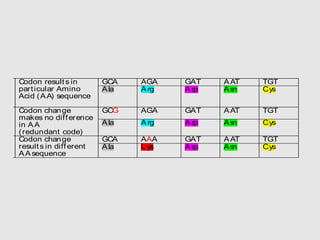
• Simple point mutations can cause altered protein shape
and function.
GCA AGA GAT AAT TGTCodon results in
particular Amino
Acid (AA) sequence
Ala Arg Asp Asn Cys
GCG AGA GAT AAT TGTCodon change
makes no difference
in AA
(redundant code)
Ala Arg Asp Asn Cys
GCA AAA GAT AAT TGTCodon change
results in different
AA sequence
Ala L ys Asp Asn Cys
• DNA
A nucleic acid, made up of four similar chemicals called bases
- A, T, C, and G that are repeated over and over in pairs.
• DNA sequencing
Determination of the order of the nucleotide bases
• Gene
Distinct portion of the DNA that codes for a type of protein or
for an RNA chain.
• Gene sequencing
Gene sequencing is a process in which the individual base
nucleotides in an organism's DNA are identified.
• Gene sequencing = DNA sequencing = nucleotide
sequencing = base sequencing
• However, not all DNA sequences are genes (i.e.
coding regions) as there may, also be promoters,
tandem repeats, introns, etc. depending on the
organism and the source of the DNA sample.
• Genome
Complete copy of chromosomal and extra chromosomal gene
insrtuctions.
• Genome sequencing:
Breaking the whole genome into small pieces, sequencing the
pieces and then reassembling them in proper order to arrive at
the sequence of the whole genome.
• Genomics:
Sequencing of genomes, determination of the complete set of
proteins encoded by an organism and functioning of genes and
metabolic path ways in an organism.
Different sequencing procedures
Wandering spot analysis: Sanger et al.(1973)
• DNA labelled with 32P at 5’ end, digested with snake venom
phosphodiesterase - sequentially removes nucleotides from 3’
end. All the fragments containing radioactive label.
• Fragments are subjected to electrophoresis, homo
chromatography is performed.
• Partial digests of DNA fragment is applied to cellulose acetate
strip at pH 3.5 buffer. Electric field is applied across the strip.
• Nucleotides G and T tend to have negative charges at this pH with T>
G; A and C tend to have positive charges with C > A.
• Fragments shorter by virtue of loss of T will move more slowly
towards the anode pole since they lost some of the attracting cathode
charge and so on.
• Result is that loss of T or G causes a mobility shift towards the left,
while loss of A or C causes a mobility shift to the right.
• Fragments are found by means of autoradiographic detection of
locations of radioactivity in form of dark spot.
• A line is drawn connecting the longest spot to the next longest and so
on. These lines indicate the increasing number of nucleotides removed
from the original fragment.
Chemical cleavage method:
The single stranded DNA fragment to be sequenced is end-labeled by
treatment with alkaline phosphatase to remove the 5’phosphate.
The labeled DNA fragment is then divided into four aliquots, each of
which is treated with a reagent which modifies a specific base
1. Aliquot A + dimethyl sulphate, which breaks at guanine
2. Aliquot B + Acid (pH 2.0) , breaks at adenine and guanine
3. Aliquot C + Hydrazine, breaks at thymine + cytosine residues
4. Aliquot D + Hydrazine in salt, at cytosine
Maxam and Gilbert 1977
• The four are incubated with piperidine which cleaves the sugar
phosphate backbone of DNA next to the residue that has been
modified.
• Load the reactions on polyacrylamide gels - exposed to X-ray
film for autoradiography.
• It yields a series of dark bands each corresponding to a
radiolaelled DNA fragment, from which the sequence may be
inferred.
• The dark autoradiographic bands on the film will represent the
5’- 3’ DNA sequence when read from bottom to top.
• Base calling - interpreting the banding pattern relative to the
four chemical reactions.
• For example, a band in the lanes corresponding to the C only
and the C + T reactions would be called a C.
• If the band was present in the C + T reaction lane but not in the
C only reaction lane it would be called a T.
• The same decision process would obtain for the G only and the
G + A reaction lanes.
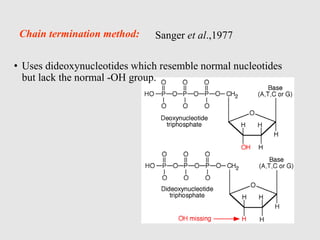
Chain termination method:
• Uses dideoxynucleotides which resemble normal nucleotides
but lack the normal -OH group.
Sanger et al.,1977
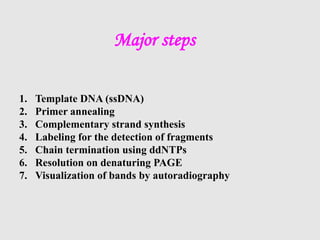
1. Template DNA (ssDNA)
2. Primer annealing
3. Complementary strand synthesis
4. Labeling for the detection of fragments
5. Chain termination using ddNTPs
6. Resolution on denaturing PAGE
7. Visualization of bands by autoradiography
Major steps
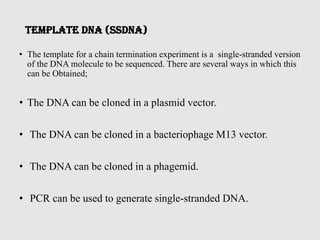
Template DNA (ssDNA)
• The template for a chain termination experiment is a single-stranded version
of the DNA molecule to be sequenced. There are several ways in which this
can be Obtained;
• The DNA can be cloned in a plasmid vector.
• The DNA can be cloned in a bacteriophage M13 vector.
• The DNA can be cloned in a phagemid.
• PCR can be used to generate single-stranded DNA.
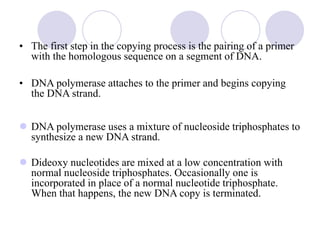
• The first step in the copying process is the pairing of a primer
with the homologous sequence on a segment of DNA.
• DNA polymerase attaches to the primer and begins copying
the DNA strand.
 DNA polymerase uses a mixture of nucleoside triphosphates to
synthesize a new DNA strand.
 Dideoxy nucleotides are mixed at a low concentration with
normal nucleoside triphosphates. Occasionally one is
incorporated in place of a normal nucleotide triphosphate.
When that happens, the new DNA copy is terminated.
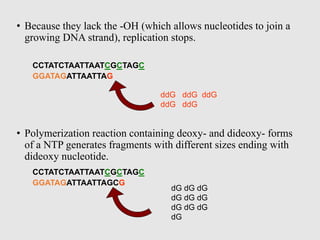
• Because they lack the -OH (which allows nucleotides to join a
growing DNA strand), replication stops.
• Polymerization reaction containing deoxy- and dideoxy- forms
of a NTP generates fragments with different sizes ending with
dideoxy nucleotide.
CCTATCTAATTAATCGCTAGC
GGATAGATTAATTAG
ddG ddG ddG
ddG ddG
CCTATCTAATTAATCGCTAGC
GGATAGATTAATTAGCG
dG dG dG
dG dG dG
dG dG dG
dG
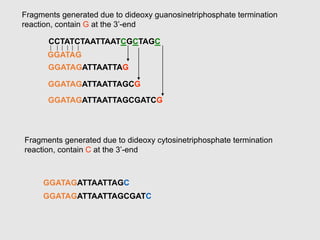
CCTATCTAATTAATCGCTAGC
GGATAG
GGATAGATTAATTAG
GGATAGATTAATTAGCG
GGATAGATTAATTAGCGATCG
Fragments generated due to dideoxy guanosinetriphosphate termination
reaction, contain G at the 3’-end
Fragments generated due to dideoxy cytosinetriphosphate termination
reaction, contain C at the 3’-end
GGATAGATTAATTAGC
GGATAGATTAATTAGCGATC
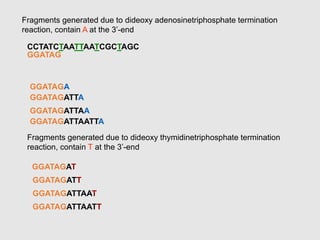
Fragments generated due to dideoxy adenosinetriphosphate termination
reaction, contain A at the 3’-end
CCTATCTAATTAATCGCTAGC
GGATAG
GGATAGA
GGATAGATTA
GGATAGATTAA
GGATAGATTAATTA
Fragments generated due to dideoxy thymidinetriphosphate termination
reaction, contain T at the 3’-end
GGATAGAT
GGATAGATT
GGATAGATTAAT
GGATAGATTAATT
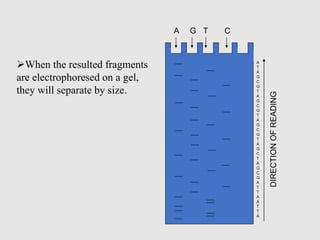
A G T C
A
T
A
G
C
G
T
A
G
C
G
T
A
G
C
G
T
A
G
C
T
A
G
C
G
A
T
T
A
A
T
T
A
DIRECTIONOFREADING
When the resulted fragments
are electrophoresed on a gel,
they will separate by size.
Reverse complement:
• The sequence that is read from the sequencing gel is the reverse
complement of the template stand. Because of complementary
base pairing and the antiparallel nature of the double helix.
• Thus the first base added to the newly synthesized strand
corresponding to the shortest fragment on the sequencing gel is
complementary to the extreme 3’- position of the template
strand immediately adjacent to the site that the primer
hybridizes to
Advantages over chemical cleavage method
1) Unlike Maxam-Gilbert method each lane would be base-
specific.
2) Autoradiography is same but base calling is easier.
3) The sequence fragments on the gel were the complement of
the actual template.
4) A major improvement ushered in by Sanger sequencing was
the elimination of some of the dangerous chemicals, like
hydrazine.
5) Efficiency is more than chemical cleavage method. When
dealing with nucleic acids, enzymatic processes are more
efficient than chemical processes.
Cycle sequencing
Cycle sequencing is a modification of the traditional Sanger
sequencing method.
The principles are the same as in Sanger sequencing;
Dideoxynucleotides are used in a polymerization reaction to create a
nested set of DNA fragments with dideoxynucleotides at the 3'
terminus of each fragment.
The key difference is that cycle sequencing employs a thermostable
DNA polymerase which can be heated to 95oC and still retain
activity.
The advantage of using such a polymerase is that the sequencing
reaction can be repeated over and over again in the same tube by
heating the mixture to denature the DNA and then allowing it to cool
to anneal the primers and polymerize new strands.
Cycle sequencing
Thus, less template DNA is needed than for conventional
sequencing reactions.
Furthermore, the repeated heating and cooling can be done in a
DNA thermal cycler.
Advantages:
•Works with ssDNA and dsDNA and thus eliminates the need for
M13 phage
•Requires only small amounts of template
•Can be set up in microtitre plates or microtubes
•Can use internal labeling with [α-32P], [α-33P],or [35S]or with 5’-
end labeled primer
•Can be adapted for rapid screening
High-throughput sequencing
• The high demand for low-cost sequencing - development of high-
throughput sequencing - parllalize the sequencing process,
producing thousands or millions of sequences at once.
• An alternative to primer labelling is labelling of the chain
terminators, a method commonly called 'dye-terminator
sequencing'.
• In 1986, Leroy Hood et al.,- radioactive labels, autoradiography,
and manual base calling were all replaced by fluorescent labels,
laser induced fluorescence detection, and computerized base
calling.
Dye-terminator sequencing
• Labelling of the chain terminator ddNTPs - permits sequencing in
a single reaction.
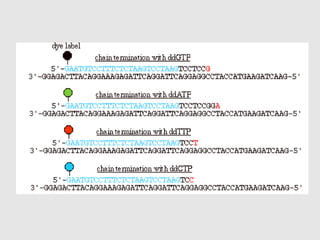
• First of all primer is labeled with one of four different fluorescent
dyes placed in a separate sequencing reaction with one of the four
dideoxynucleotides plus all four deoxynucleotides.
• each of the four ddNTP chain terminators is labelled with
fluorescent dyes, each of which with different wavelengths of
fluorescence and emission.
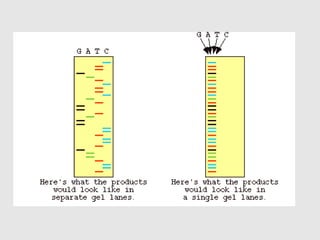
• After completion of the reactions, the four reactions were pooled
and run together in one lane of a polyacrylamide sequencing gel.
• A four-color laser induced fluorescence detector scanned the
gel as the reaction fragments migrated past.
• The fluorescence signature of each fragment was then sent to a
computer where the software was trained to perform base
calling.
• The dye-terminator sequencing method, along with automated
high-throughput DNA sequence analyzers, is now being used
for the vast majority of sequencing projects.
• set the stage for automated, high-throughput DNA sequencing.
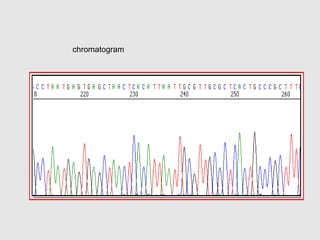
chromatogram
Capillary electrophoresis
• Swerdlow et al., 1990
• Capillaries are small, a 50μm inner diameter - dissipate heat very
efficiently. Can be run with much higher voltages thus lowering
the run times.
• Load the sequencing reaction into the capillary, apply a constant
electrical current through the capillary, and have the resolved
fragments migrate past an optical window.
• A laser would excite the dye terminator, a detector would collect
the fluorescence emission wavelengths, and software would
interpret the emission wavelengths as nucleotides.
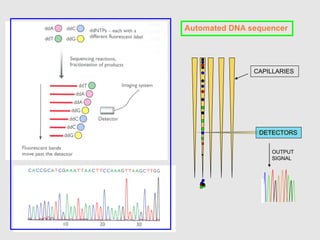
DETECTORS
CAPILLARIES
OUTPUT
SIGNAL
Automated DNA sequencer
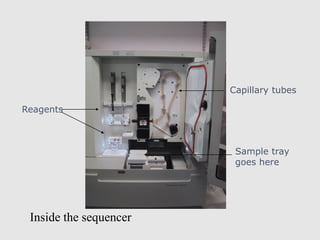
Inside the sequencer
Capillary tubes
Sample tray
goes here
Reagents
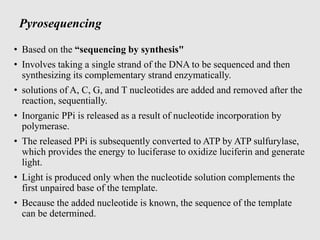
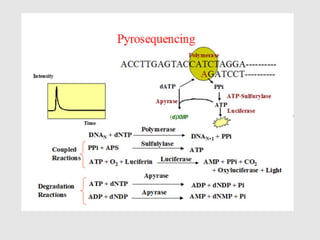
Pyrosequencing
• Based on the “sequencing by synthesis"
• Involves taking a single strand of the DNA to be sequenced and then
synthesizing its complementary strand enzymatically.
• solutions of A, C, G, and T nucleotides are added and removed after the
reaction, sequentially.
• Inorganic PPi is released as a result of nucleotide incorporation by
polymerase.
• The released PPi is subsequently converted to ATP by ATP sulfurylase,
which provides the energy to luciferase to oxidize luciferin and generate
light.
• Light is produced only when the nucleotide solution complements the
first unpaired base of the template.
• Because the added nucleotide is known, the sequence of the template
can be determined.
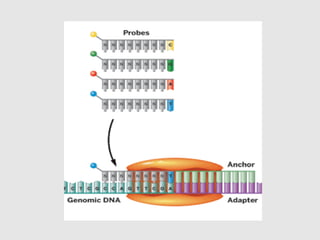
Sequencing by ligation
• DNA ligase is an enzyme that joins together ends of DNA
molecules.
• Sequencing by ligation relies upon the sensitivity of DNA
ligase for base-pairing mismatches.
• Oligonucleotides are annealed and ligated; the preferential
ligation by DNA ligase for matching sequences results in a
signal informative of the nucleotide at that position.
Sequencing by hybridization
• It is a non-enzymatic method that uses a DNA microarray.
• A single pool of DNA whose sequence is to be determined is
fluorescently labeled and hybridized to an array containing
known sequences.
• Strong hybridization signals from a given spot on the array
identifies its sequence in the DNA being sequenced.
Next generation sequencing methods
• Mass Spectrophotometric Sequences.
• Direct Visualization of Single DNA Molecules by Atomic
force Microscopy (AFM )
• Single Molecule Sequencing Techniques
• Single nucleotide Cutting
• Readout of Cellular Gene Expression
• Use of DNA chips or micro arrays
• Nano sequencing
• Some commercial sequencers
• Rochel454FLXpyrosequencer - pyrosequencing
• Illumina genome analyzer – sequencing by synthesis
• Applied biosystems SOLiD sequencer – sequencing by
ligation.
• Helicos Heliscope
• Pacific Biosciences SMRT – zeromode waveguide
Gene sequencing methods

Gene sequencing methods

  • 1.
    Gene sequencing methods DeepakKumar Roll no. 1831 M. Pharm. 1st Sem.
  • 2.
    Introduction • DNA -the hereditary material written in four-letter code of nucleotides. • sequencing, or "reading" the genetic code has become of increasing interest to scientists. • RNA sequencing – earliest form of nucleotide sequencing complete genome of Bacteriophage MS2. • Knowledge on genome organization was based on reverse genetics.
  • 3.
    Need of sequencing •Understanding a particular DNA sequence can shed light on a genetic condition and offer hope for the eventual development of treatment. • An alteration in a DNA sequence can lead to an altered or non functional protein, and hence to a harmful effect in a plant or animal. • Simple point mutations can cause altered protein shape and function.
  • 4.
    GCA AGA GATAAT TGTCodon results in particular Amino Acid (AA) sequence Ala Arg Asp Asn Cys GCG AGA GAT AAT TGTCodon change makes no difference in AA (redundant code) Ala Arg Asp Asn Cys GCA AAA GAT AAT TGTCodon change results in different AA sequence Ala L ys Asp Asn Cys
  • 5.
    • DNA A nucleicacid, made up of four similar chemicals called bases - A, T, C, and G that are repeated over and over in pairs. • DNA sequencing Determination of the order of the nucleotide bases • Gene Distinct portion of the DNA that codes for a type of protein or for an RNA chain. • Gene sequencing Gene sequencing is a process in which the individual base nucleotides in an organism's DNA are identified.
  • 6.
    • Gene sequencing= DNA sequencing = nucleotide sequencing = base sequencing • However, not all DNA sequences are genes (i.e. coding regions) as there may, also be promoters, tandem repeats, introns, etc. depending on the organism and the source of the DNA sample.
  • 7.
    • Genome Complete copyof chromosomal and extra chromosomal gene insrtuctions. • Genome sequencing: Breaking the whole genome into small pieces, sequencing the pieces and then reassembling them in proper order to arrive at the sequence of the whole genome. • Genomics: Sequencing of genomes, determination of the complete set of proteins encoded by an organism and functioning of genes and metabolic path ways in an organism.
  • 8.
    Different sequencing procedures Wanderingspot analysis: Sanger et al.(1973) • DNA labelled with 32P at 5’ end, digested with snake venom phosphodiesterase - sequentially removes nucleotides from 3’ end. All the fragments containing radioactive label. • Fragments are subjected to electrophoresis, homo chromatography is performed. • Partial digests of DNA fragment is applied to cellulose acetate strip at pH 3.5 buffer. Electric field is applied across the strip.
  • 9.
    • Nucleotides Gand T tend to have negative charges at this pH with T> G; A and C tend to have positive charges with C > A. • Fragments shorter by virtue of loss of T will move more slowly towards the anode pole since they lost some of the attracting cathode charge and so on. • Result is that loss of T or G causes a mobility shift towards the left, while loss of A or C causes a mobility shift to the right. • Fragments are found by means of autoradiographic detection of locations of radioactivity in form of dark spot. • A line is drawn connecting the longest spot to the next longest and so on. These lines indicate the increasing number of nucleotides removed from the original fragment.
  • 10.
    Chemical cleavage method: Thesingle stranded DNA fragment to be sequenced is end-labeled by treatment with alkaline phosphatase to remove the 5’phosphate. The labeled DNA fragment is then divided into four aliquots, each of which is treated with a reagent which modifies a specific base 1. Aliquot A + dimethyl sulphate, which breaks at guanine 2. Aliquot B + Acid (pH 2.0) , breaks at adenine and guanine 3. Aliquot C + Hydrazine, breaks at thymine + cytosine residues 4. Aliquot D + Hydrazine in salt, at cytosine Maxam and Gilbert 1977
  • 11.
    • The fourare incubated with piperidine which cleaves the sugar phosphate backbone of DNA next to the residue that has been modified. • Load the reactions on polyacrylamide gels - exposed to X-ray film for autoradiography. • It yields a series of dark bands each corresponding to a radiolaelled DNA fragment, from which the sequence may be inferred. • The dark autoradiographic bands on the film will represent the 5’- 3’ DNA sequence when read from bottom to top.
  • 12.
    • Base calling- interpreting the banding pattern relative to the four chemical reactions. • For example, a band in the lanes corresponding to the C only and the C + T reactions would be called a C. • If the band was present in the C + T reaction lane but not in the C only reaction lane it would be called a T. • The same decision process would obtain for the G only and the G + A reaction lanes.
  • 13.
    Chain termination method: •Uses dideoxynucleotides which resemble normal nucleotides but lack the normal -OH group. Sanger et al.,1977
  • 14.
    1. Template DNA(ssDNA) 2. Primer annealing 3. Complementary strand synthesis 4. Labeling for the detection of fragments 5. Chain termination using ddNTPs 6. Resolution on denaturing PAGE 7. Visualization of bands by autoradiography Major steps
  • 15.
    Template DNA (ssDNA) •The template for a chain termination experiment is a single-stranded version of the DNA molecule to be sequenced. There are several ways in which this can be Obtained; • The DNA can be cloned in a plasmid vector. • The DNA can be cloned in a bacteriophage M13 vector. • The DNA can be cloned in a phagemid. • PCR can be used to generate single-stranded DNA.
  • 16.
    • The firststep in the copying process is the pairing of a primer with the homologous sequence on a segment of DNA. • DNA polymerase attaches to the primer and begins copying the DNA strand.  DNA polymerase uses a mixture of nucleoside triphosphates to synthesize a new DNA strand.  Dideoxy nucleotides are mixed at a low concentration with normal nucleoside triphosphates. Occasionally one is incorporated in place of a normal nucleotide triphosphate. When that happens, the new DNA copy is terminated.
  • 17.
    • Because theylack the -OH (which allows nucleotides to join a growing DNA strand), replication stops. • Polymerization reaction containing deoxy- and dideoxy- forms of a NTP generates fragments with different sizes ending with dideoxy nucleotide. CCTATCTAATTAATCGCTAGC GGATAGATTAATTAG ddG ddG ddG ddG ddG CCTATCTAATTAATCGCTAGC GGATAGATTAATTAGCG dG dG dG dG dG dG dG dG dG dG
  • 18.
    CCTATCTAATTAATCGCTAGC GGATAG GGATAGATTAATTAG GGATAGATTAATTAGCG GGATAGATTAATTAGCGATCG Fragments generated dueto dideoxy guanosinetriphosphate termination reaction, contain G at the 3’-end Fragments generated due to dideoxy cytosinetriphosphate termination reaction, contain C at the 3’-end GGATAGATTAATTAGC GGATAGATTAATTAGCGATC
  • 19.
    Fragments generated dueto dideoxy adenosinetriphosphate termination reaction, contain A at the 3’-end CCTATCTAATTAATCGCTAGC GGATAG GGATAGA GGATAGATTA GGATAGATTAA GGATAGATTAATTA Fragments generated due to dideoxy thymidinetriphosphate termination reaction, contain T at the 3’-end GGATAGAT GGATAGATT GGATAGATTAAT GGATAGATTAATT
  • 20.
    A G TC A T A G C G T A G C G T A G C G T A G C T A G C G A T T A A T T A DIRECTIONOFREADING When the resulted fragments are electrophoresed on a gel, they will separate by size.
  • 21.
    Reverse complement: • Thesequence that is read from the sequencing gel is the reverse complement of the template stand. Because of complementary base pairing and the antiparallel nature of the double helix. • Thus the first base added to the newly synthesized strand corresponding to the shortest fragment on the sequencing gel is complementary to the extreme 3’- position of the template strand immediately adjacent to the site that the primer hybridizes to
  • 22.
    Advantages over chemicalcleavage method 1) Unlike Maxam-Gilbert method each lane would be base- specific. 2) Autoradiography is same but base calling is easier. 3) The sequence fragments on the gel were the complement of the actual template. 4) A major improvement ushered in by Sanger sequencing was the elimination of some of the dangerous chemicals, like hydrazine. 5) Efficiency is more than chemical cleavage method. When dealing with nucleic acids, enzymatic processes are more efficient than chemical processes.
  • 23.
    Cycle sequencing Cycle sequencingis a modification of the traditional Sanger sequencing method. The principles are the same as in Sanger sequencing; Dideoxynucleotides are used in a polymerization reaction to create a nested set of DNA fragments with dideoxynucleotides at the 3' terminus of each fragment. The key difference is that cycle sequencing employs a thermostable DNA polymerase which can be heated to 95oC and still retain activity. The advantage of using such a polymerase is that the sequencing reaction can be repeated over and over again in the same tube by heating the mixture to denature the DNA and then allowing it to cool to anneal the primers and polymerize new strands.
  • 24.
    Cycle sequencing Thus, lesstemplate DNA is needed than for conventional sequencing reactions. Furthermore, the repeated heating and cooling can be done in a DNA thermal cycler. Advantages: •Works with ssDNA and dsDNA and thus eliminates the need for M13 phage •Requires only small amounts of template •Can be set up in microtitre plates or microtubes •Can use internal labeling with [α-32P], [α-33P],or [35S]or with 5’- end labeled primer •Can be adapted for rapid screening
  • 25.
    High-throughput sequencing • Thehigh demand for low-cost sequencing - development of high- throughput sequencing - parllalize the sequencing process, producing thousands or millions of sequences at once. • An alternative to primer labelling is labelling of the chain terminators, a method commonly called 'dye-terminator sequencing'. • In 1986, Leroy Hood et al.,- radioactive labels, autoradiography, and manual base calling were all replaced by fluorescent labels, laser induced fluorescence detection, and computerized base calling.
  • 26.
    Dye-terminator sequencing • Labellingof the chain terminator ddNTPs - permits sequencing in a single reaction. • First of all primer is labeled with one of four different fluorescent dyes placed in a separate sequencing reaction with one of the four dideoxynucleotides plus all four deoxynucleotides. • each of the four ddNTP chain terminators is labelled with fluorescent dyes, each of which with different wavelengths of fluorescence and emission. • After completion of the reactions, the four reactions were pooled and run together in one lane of a polyacrylamide sequencing gel.
  • 27.
    • A four-colorlaser induced fluorescence detector scanned the gel as the reaction fragments migrated past. • The fluorescence signature of each fragment was then sent to a computer where the software was trained to perform base calling. • The dye-terminator sequencing method, along with automated high-throughput DNA sequence analyzers, is now being used for the vast majority of sequencing projects. • set the stage for automated, high-throughput DNA sequencing.
  • 30.
  • 31.
    Capillary electrophoresis • Swerdlowet al., 1990 • Capillaries are small, a 50μm inner diameter - dissipate heat very efficiently. Can be run with much higher voltages thus lowering the run times. • Load the sequencing reaction into the capillary, apply a constant electrical current through the capillary, and have the resolved fragments migrate past an optical window. • A laser would excite the dye terminator, a detector would collect the fluorescence emission wavelengths, and software would interpret the emission wavelengths as nucleotides.
  • 32.
  • 33.
    Inside the sequencer Capillarytubes Sample tray goes here Reagents
  • 34.
    Pyrosequencing • Based onthe “sequencing by synthesis" • Involves taking a single strand of the DNA to be sequenced and then synthesizing its complementary strand enzymatically. • solutions of A, C, G, and T nucleotides are added and removed after the reaction, sequentially. • Inorganic PPi is released as a result of nucleotide incorporation by polymerase. • The released PPi is subsequently converted to ATP by ATP sulfurylase, which provides the energy to luciferase to oxidize luciferin and generate light. • Light is produced only when the nucleotide solution complements the first unpaired base of the template. • Because the added nucleotide is known, the sequence of the template can be determined.
  • 36.
    Sequencing by ligation •DNA ligase is an enzyme that joins together ends of DNA molecules. • Sequencing by ligation relies upon the sensitivity of DNA ligase for base-pairing mismatches. • Oligonucleotides are annealed and ligated; the preferential ligation by DNA ligase for matching sequences results in a signal informative of the nucleotide at that position.
  • 38.
    Sequencing by hybridization •It is a non-enzymatic method that uses a DNA microarray. • A single pool of DNA whose sequence is to be determined is fluorescently labeled and hybridized to an array containing known sequences. • Strong hybridization signals from a given spot on the array identifies its sequence in the DNA being sequenced.
  • 39.
    Next generation sequencingmethods • Mass Spectrophotometric Sequences. • Direct Visualization of Single DNA Molecules by Atomic force Microscopy (AFM ) • Single Molecule Sequencing Techniques • Single nucleotide Cutting • Readout of Cellular Gene Expression • Use of DNA chips or micro arrays • Nano sequencing
  • 40.
    • Some commercialsequencers • Rochel454FLXpyrosequencer - pyrosequencing • Illumina genome analyzer – sequencing by synthesis • Applied biosystems SOLiD sequencer – sequencing by ligation. • Helicos Heliscope • Pacific Biosciences SMRT – zeromode waveguide