PAS-STAINING
PERIODIC ACID-SCHIFF
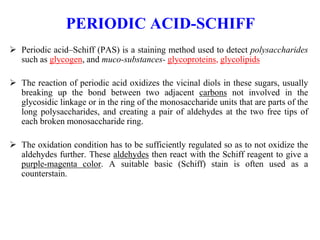
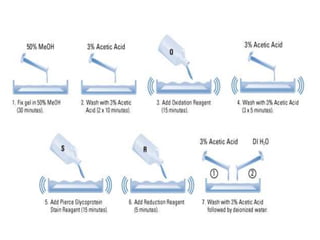
 Periodic acid–Schiff (PAS) is a staining method used to detect polysaccharides
such as glycogen, and muco-substances- glycoproteins, glycolipids
 The reaction of periodic acid oxidizes the vicinal diols in these sugars, usually
breaking up the bond between two adjacent carbons not involved in the
glycosidic linkage or in the ring of the monosaccharide units that are parts of the
long polysaccharides, and creating a pair of aldehydes at the two free tips of
each broken monosaccharide ring.
 The oxidation condition has to be sufficiently regulated so as to not oxidize the
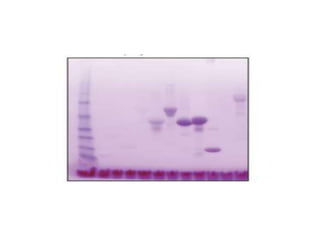
aldehydes further. These aldehydes then react with the Schiff reagent to give a
purple-magenta color. A suitable basic (Schiff) stain is often used as a
counterstain.
FLORESCENCE STAINING
FLUORESCENT STAINING
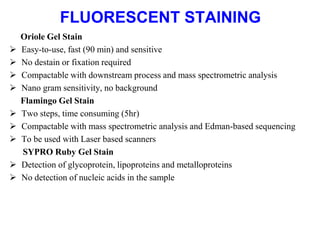
Oriole Gel Stain
 Easy-to-use, fast (90 min) and sensitive
 No destain or fixation required
 Compactable with downstream process and mass spectrometric analysis
 Nano gram sensitivity, no background
Flamingo Gel Stain
 Two steps, time consuming (5hr)
 Compactable with mass spectrometric analysis and Edman-based sequencing
 To be used with Laser based scanners
SYPRO Ruby Gel Stain
 Detection of glycoprotein, lipoproteins and metalloproteins
 No detection of nucleic acids in the sample
ZYMOGRAPHY
ZYMOGRAPHY
 Zymography is an electrophoretic method for studying/detection of enzymes
or proteolytic activity.
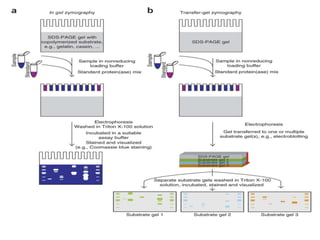
 Method is based on SDS gel impregnated with a protein substrate which is
degraded by the proteases resolved during the incubation period.
 The technique is particularly useful for analyzing the proteinase composition
of complex biological samples.
 Coomassie blue staining of the gel reveals sites of proteolysis as white bands
on a dark blue background.
 Zymography is also widely used to study various aspects of Matrix
Metalloproteinase (MMP) function.
MATRIX METALLOPROTEINASE
 MMPs were discovered in 1962
-was first observed during tadpole tail development
 It is capable of degrading all kinds of extracellular matrix proteins, also can
process a number of bioactive molecules
 Physiological processes:- Embryogenesis, Angiogenesis, Activation of cell
surface receptors
 Pathological processes:- Tumour metastasis Inflammation, Arthritis,
Cardiovascular diseases
TYPES OF ZYMOGRAPHY
Types of Zymography
– Substrate Zymography :
- Gelatin Zymography
- Casein Zymography
- Collagen Zymography
- Heparin-Enhanced Zymography
– Reverse Zymography
– In Situ Zymography
SUBSTRATE ZYMOGRAPHY
 When specific substrate is co-polymerized with the acrylamide
 In zymography, the proteins are separated by electrophoresis under denaturing
conditions- SDS (sodium dodecyl sulfate) with non-reducing sample buffer
 The separation occurs in a polyacrylamide gel containing a specific substrate
that is co-polymerized with the acrylamide
SUBSTRATE ZYMOGRAPHY
Gelatin Zymography– Gelatin zymography is mainly used for the detection of the
Gelatinases, MMP-2 and MMP-9
Casein Zymography– suitable for the detection of MMP-1, MMP-7, MMP-12, and MMP-
13
Collagen Zymography– used for the detection of MMP-1 and MMP-13, but MMP-2 and
MMP-9 can also be detected
-The incorporation of native collagen fibers in polyacrylamide gels appears unsuitable
for zymography because of their complicated structure, but SDS disrupts most of the
fibrillar organization of the collagen, allowing proteins to run into the gel.
SUBSTRATE ZYMOGRAPHY
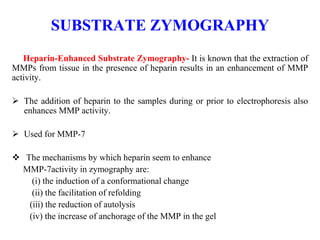
Heparin-Enhanced Substrate Zymography- It is known that the extraction of
MMPs from tissue in the presence of heparin results in an enhancement of MMP
activity.
 The addition of heparin to the samples during or prior to electrophoresis also
enhances MMP activity.
 Used for MMP-7
 The mechanisms by which heparin seem to enhance
MMP-7activity in zymography are:
(i) the induction of a conformational change
(ii) the facilitation of refolding
(iii) the reduction of autolysis
(iv) the increase of anchorage of the MMP in the gel
REVERSE ZYMOGRAPHY
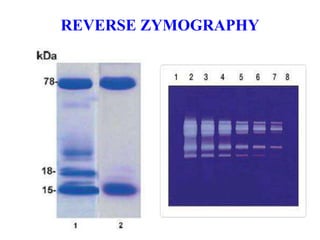
Reverse zymography
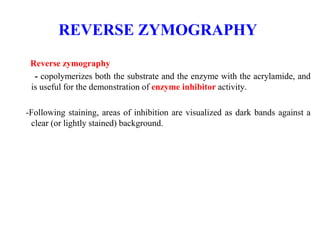
- copolymerizes both the substrate and the enzyme with the acrylamide, and
is useful for the demonstration of enzyme inhibitor activity.
-Following staining, areas of inhibition are visualized as dark bands against a
clear (or lightly stained) background.
REVERSE ZYMOGRAPHY
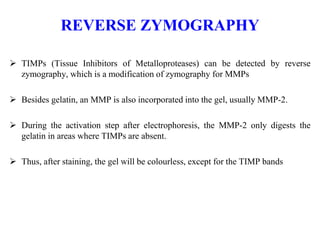
 TIMPs (Tissue Inhibitors of Metalloproteases) can be detected by reverse
zymography, which is a modification of zymography for MMPs
 Besides gelatin, an MMP is also incorporated into the gel, usually MMP-2.
 During the activation step after electrophoresis, the MMP-2 only digests the
gelatin in areas where TIMPs are absent.
 Thus, after staining, the gel will be colourless, except for the TIMP bands
REVERSE ZYMOGRAPHY
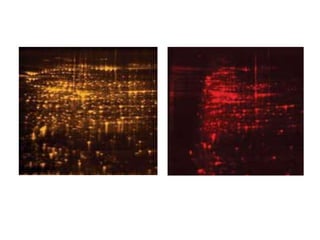
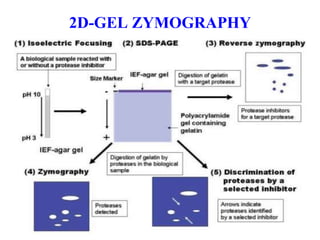
2D-GEL ZYMOGRAPHY
In situ ZYMOGRAPHY
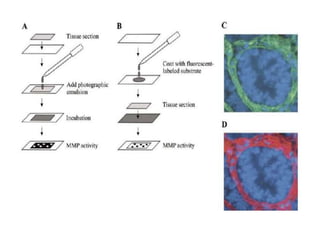
 It is a unique laboratory technique that enables the localisation of matrix-
degrading metalloproteinase (MMP) activity in histological sections.
 Frozen sections are placed on glass slides coated with fluorescently labelled
matrix proteins
 After incubation MMP activity can be observed as black holes in the
fluorescent background due to proteolysis of the matrix protein.
 This technique can be combined with immunohistochemistry to enable co-
location of proteins such as cell type markers or other proteins of interest.
 Additionally, this technique can be adapted for use with cell cultures,
permitting precise location of MMP activity within cells,
ADVANTAGES OF ZYMOGRAPHY
 Expensive materials are not required (e.g., antibodies)
 Proteases with different molecular weights showing activity towards the same
substrate can be detected and quantified on a single gel.
 MMPs in solution are often associated with endogenous tissue inhibitors of
metalloproteases (TIMPs). During electrophoresis the inhibitors dissociate
from the MMP and do not interfere with detection of the enzymatic activity.
 On the basis of molecular weight markers, the molecular weight of the
proteolytic band can be determined, and by comparison with recombinant
proteins and the use of specific protease inhibitors the type of protease can be
established
If you would like to donate us?
Scan below and donate us 0.013$ (US dollar) (5Rs Indian rupee)
Contact: If you want PPT/PDF files, please contact below.
Email: gnccmysore@gmail.com
Telegram:+919738137533(only for Chat)
Zymography_Pas staining

Zymography_Pas staining

  • 1.
  • 2.
    PERIODIC ACID-SCHIFF  Periodicacid–Schiff (PAS) is a staining method used to detect polysaccharides such as glycogen, and muco-substances- glycoproteins, glycolipids  The reaction of periodic acid oxidizes the vicinal diols in these sugars, usually breaking up the bond between two adjacent carbons not involved in the glycosidic linkage or in the ring of the monosaccharide units that are parts of the long polysaccharides, and creating a pair of aldehydes at the two free tips of each broken monosaccharide ring.  The oxidation condition has to be sufficiently regulated so as to not oxidize the aldehydes further. These aldehydes then react with the Schiff reagent to give a purple-magenta color. A suitable basic (Schiff) stain is often used as a counterstain.
  • 5.
  • 6.
    FLUORESCENT STAINING Oriole GelStain  Easy-to-use, fast (90 min) and sensitive  No destain or fixation required  Compactable with downstream process and mass spectrometric analysis  Nano gram sensitivity, no background Flamingo Gel Stain  Two steps, time consuming (5hr)  Compactable with mass spectrometric analysis and Edman-based sequencing  To be used with Laser based scanners SYPRO Ruby Gel Stain  Detection of glycoprotein, lipoproteins and metalloproteins  No detection of nucleic acids in the sample
  • 8.
  • 9.
    ZYMOGRAPHY  Zymography isan electrophoretic method for studying/detection of enzymes or proteolytic activity.  Method is based on SDS gel impregnated with a protein substrate which is degraded by the proteases resolved during the incubation period.  The technique is particularly useful for analyzing the proteinase composition of complex biological samples.  Coomassie blue staining of the gel reveals sites of proteolysis as white bands on a dark blue background.  Zymography is also widely used to study various aspects of Matrix Metalloproteinase (MMP) function.
  • 10.
    MATRIX METALLOPROTEINASE  MMPswere discovered in 1962 -was first observed during tadpole tail development  It is capable of degrading all kinds of extracellular matrix proteins, also can process a number of bioactive molecules  Physiological processes:- Embryogenesis, Angiogenesis, Activation of cell surface receptors  Pathological processes:- Tumour metastasis Inflammation, Arthritis, Cardiovascular diseases
  • 11.
    TYPES OF ZYMOGRAPHY Typesof Zymography – Substrate Zymography : - Gelatin Zymography - Casein Zymography - Collagen Zymography - Heparin-Enhanced Zymography – Reverse Zymography – In Situ Zymography
  • 12.
    SUBSTRATE ZYMOGRAPHY  Whenspecific substrate is co-polymerized with the acrylamide  In zymography, the proteins are separated by electrophoresis under denaturing conditions- SDS (sodium dodecyl sulfate) with non-reducing sample buffer  The separation occurs in a polyacrylamide gel containing a specific substrate that is co-polymerized with the acrylamide
  • 13.
    SUBSTRATE ZYMOGRAPHY Gelatin Zymography–Gelatin zymography is mainly used for the detection of the Gelatinases, MMP-2 and MMP-9 Casein Zymography– suitable for the detection of MMP-1, MMP-7, MMP-12, and MMP- 13 Collagen Zymography– used for the detection of MMP-1 and MMP-13, but MMP-2 and MMP-9 can also be detected -The incorporation of native collagen fibers in polyacrylamide gels appears unsuitable for zymography because of their complicated structure, but SDS disrupts most of the fibrillar organization of the collagen, allowing proteins to run into the gel.
  • 14.
    SUBSTRATE ZYMOGRAPHY Heparin-Enhanced SubstrateZymography- It is known that the extraction of MMPs from tissue in the presence of heparin results in an enhancement of MMP activity.  The addition of heparin to the samples during or prior to electrophoresis also enhances MMP activity.  Used for MMP-7  The mechanisms by which heparin seem to enhance MMP-7activity in zymography are: (i) the induction of a conformational change (ii) the facilitation of refolding (iii) the reduction of autolysis (iv) the increase of anchorage of the MMP in the gel
  • 16.
    REVERSE ZYMOGRAPHY Reverse zymography -copolymerizes both the substrate and the enzyme with the acrylamide, and is useful for the demonstration of enzyme inhibitor activity. -Following staining, areas of inhibition are visualized as dark bands against a clear (or lightly stained) background.
  • 17.
    REVERSE ZYMOGRAPHY  TIMPs(Tissue Inhibitors of Metalloproteases) can be detected by reverse zymography, which is a modification of zymography for MMPs  Besides gelatin, an MMP is also incorporated into the gel, usually MMP-2.  During the activation step after electrophoresis, the MMP-2 only digests the gelatin in areas where TIMPs are absent.  Thus, after staining, the gel will be colourless, except for the TIMP bands
  • 18.
  • 19.
  • 20.
    In situ ZYMOGRAPHY It is a unique laboratory technique that enables the localisation of matrix- degrading metalloproteinase (MMP) activity in histological sections.  Frozen sections are placed on glass slides coated with fluorescently labelled matrix proteins  After incubation MMP activity can be observed as black holes in the fluorescent background due to proteolysis of the matrix protein.  This technique can be combined with immunohistochemistry to enable co- location of proteins such as cell type markers or other proteins of interest.  Additionally, this technique can be adapted for use with cell cultures, permitting precise location of MMP activity within cells,
  • 22.
    ADVANTAGES OF ZYMOGRAPHY Expensive materials are not required (e.g., antibodies)  Proteases with different molecular weights showing activity towards the same substrate can be detected and quantified on a single gel.  MMPs in solution are often associated with endogenous tissue inhibitors of metalloproteases (TIMPs). During electrophoresis the inhibitors dissociate from the MMP and do not interfere with detection of the enzymatic activity.  On the basis of molecular weight markers, the molecular weight of the proteolytic band can be determined, and by comparison with recombinant proteins and the use of specific protease inhibitors the type of protease can be established
  • 23.
    If you wouldlike to donate us? Scan below and donate us 0.013$ (US dollar) (5Rs Indian rupee) Contact: If you want PPT/PDF files, please contact below. Email: gnccmysore@gmail.com Telegram:+919738137533(only for Chat)