
PRESENTED BY MARIAM RAZI BS medical technology 6 th  semester DNA  SEQUENCING
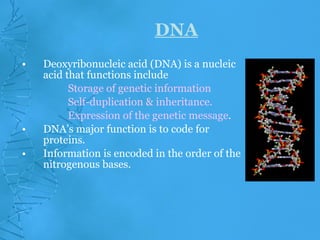
DNA Deoxyribonucleic acid (DNA) is a nucleic acid that functions include Storage of genetic information  Self-duplication & inheritance.  Expression of the genetic message .  DNA’s major function is to code for proteins.  Information is encoded in the order of the nitrogenous bases.
Watson & Crick Model   DNA  is composed of 2 chains of nucleotides that form a double helix shape.  The two strands are antiparallel.  The backbone of the  DNA  molecule is composed of alternating phosphate groups and sugars.  The complimentary nitrogenous bases form hydrogen bonds between the strands.  A is complimentary to T and G is complimentary to C.
DNA SEQUENCING Determining the order of bases in a section of  DNA
PURPOSE Deciphering “code of life” Detecting mutations Typing microorganisms Identifying human halotypes Designating polymorphisms
DNA SEQUENCING METHODS Historically there are two main methods of DNA sequencing:   1.Maxam and Gilbert method  2.Sanger method Modern sequencing equipment uses the principles of the Sanger technique.
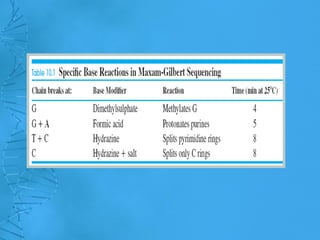
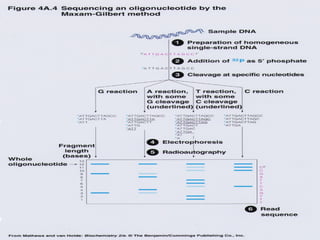
MAXAM & GILBERT METHOD A. M. Maxam and W.Gilbert-1977 The sequence of a double-stranded or single-stranded DNA molecule is determined by treatment with chemicals that cut the molecule at specific nucleotide positions.
PRINCIPLE : Chemical degradation Reaction in two stages: Chemical modification of the bases Modified base is removed from its sugar, pyperidin cleaves phosphodiester bonds 5’ and 3’ and base is released
 
 
SANGER METHOD Most common approach used to sequencing DNA.  Invented by Frederick Sanger - 1977 Nobel prize - 1980 Also termed as chain termination or dideoxy method
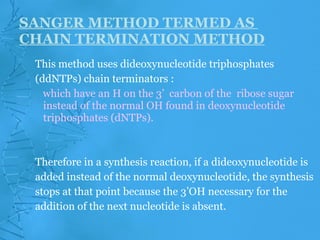
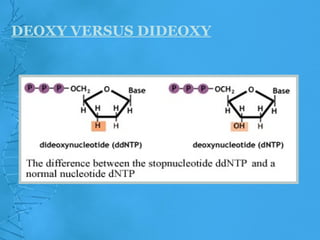
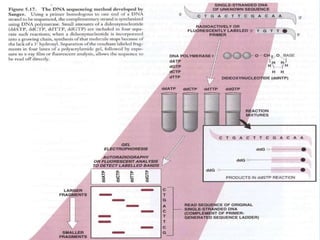
SANGER METHOD TERMED AS  CHAIN TERMINATION METHOD This method uses dideoxynucleotide triphosphates (ddNTPs) chain terminators : which have an H on the 3’  carbon of the  ribose sugar instead of the normal OH found in deoxynucleotide triphosphates (dNTPs).   Therefore in a synthesis reaction, if a dideoxynucleotide is added instead of the normal deoxynucleotide, the synthesis stops at that point because the 3’OH necessary for the addition of the next nucleotide is absent.
DEOXY VERSUS DIDEOXY
PRINCIPLE : The sequence of a single-stranded DNA molecule is determined by enzymatic synthesis of complementary  polynucleotide chains. These chains terminating at specific nucleotide positions.  Separate by gel electrophoresis Read DNA sequence
REQIREMENTS DNA sequencing is performed in four separate tubes,  each containing           i.    Single stranded DNA to be sequenced            ii.   DNA polymerase            iii.   Primers            iv.   The four dNTPs (dATP, dCTP, dTTP and dGTP)            v.    Small amount of one of the four ddNTPs  (ddATP or ddCTP or ddTTP or ddGTP) Either the primers or the dNTPs are radiolabeled with 32P
HOW DOES THE DNA TEMPLATE OBTAINED? The DNA can be cloned in a plasmid vector. The DNA can be cloned in a bacteriophage M13  vector. PCR can be used to generate single-stranded  DNA.
 
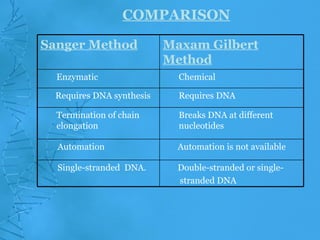
COMPARISON Automation is not available Automation Double-stranded or single- stranded DNA Single-stranded  DNA.  Breaks DNA at different nucleotides Termination of chain  elongation Requires DNA Requires DNA synthesis Chemical Enzymatic Maxam Gilbert Method Sanger Method
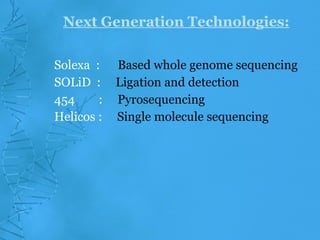
Next Generation Technologies: Solexa  :  Based whole genome sequencing SOLiD  :  Ligation and detection 454  :  Pyrosequencing Helicos :  Single molecule sequencing
THANK YOU