I.P COLLEGE,CAMPUS II
A Presentation on topic
DNA Sequencing
Submitted by-
Meenu sharma
M.Sc. biotechnology (II SEM)
1
WHAT IS DNA ?
A.DNA stands for Deoxyribo nucleic
acids.
B. DNA is a molecule that carries most
of the genetic instructions used in the
growth, development, functioning and
reproduction of all known living
organisms and many viruses.
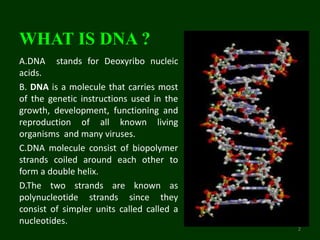
C.DNA molecule consist of biopolymer
strands coiled around each other to
form a double helix.
D.The two strands are known as
polynucleotide strands since they
consist of simpler units called called a
nucleotides.
2
STRUCTURE OF A
DNA NUCLEOTIDE-
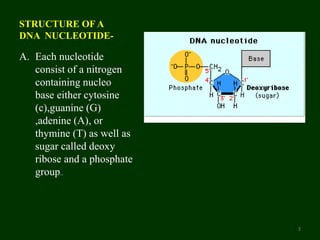
A. Each nucleotide
consist of a nitrogen
containing nucleo
base either cytosine
(c),guanine (G)
,adenine (A), or
thymine (T) as well as
sugar called deoxy
ribose and a phosphate
group..
3
WHAT IS DNA SEQUENCING ?
• The process of determining the order of bases adenine (A),
thymine (T), cytosine (C), and guanine (G) along a DNA
strand.
• All the information required for the growth and
development of an organism is encoded in the DNA of its
genome.
• So, DNA sequencing is fundamental to genome analysis and
understanding the biological processes in general.
4
METHODS OF DNA SEQUENCING –
5
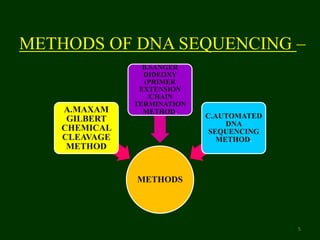
METHODS
A.MAXAM
GILBERT
CHEMICAL
CLEAVAGE
METHOD
B.SANGER
DIDEOXY
(PRIMER
EXTENSION
/CHAIN
TERMINATION
METHOD.
C.AUTOMATED
DNA
SEQUENCING
METHOD.
A. CHEMICAL CLEAVAGE METHOD BY
ALLAN MAXAM AND WALTER GILBERT
(1976-1977)-
• Sequences DNA fragments containing upto ~500 nucleotides in
length.
• This method uses double-stranded DNA samples.
• Maxam -Gilbert sequencing was the first widely used method for
DNA sequencing.
• Involves modification of the bases in DNA followed by chemical
base-specific cleavage.
6
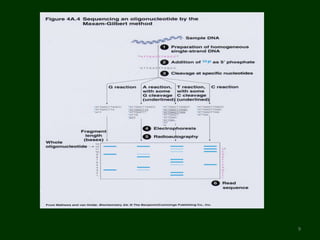
STAGES-
1. The double-stranded fragment to be sequenced is isolated and
radioactively labeled at the 5’-ends with 32P.
2. The fragment is then cut with restriction enzyme and thus the label is
removed from one end.
3. The fragment of DNA with one end labeled is denatured.
4. Four identical samples of these end-labeled DNA restriction
fragments are subjected to chemical cleavage at different chemical
nucleotides.
5.There are four specific sets of chemical reactions that selectively cut
the DNA backbone at G, A+G, C+T, or C residues.
– G only: Dimethyl sulphate(DMS)
and piperidine
– A+G : DMS, piperidine
– C+T : Hydrazine, piperidine
– C only : Hydrazine, alkali,
piperidine
7
6. For each labeled chain to be broken only once, the reactions are
controlled.
7. The labeled sub-fragments created by the four reactions have the
32P label at one end and the chemical cleavage point at the other end.
8. The reaction products are separated by poly acryl amide gel
electrophoresis which h is based on size. Smallest fragment goes
fastest
9. The labeled fragments in the gel are visualized by
autoradiography.
10. The sequence is read from bottom to top of the gel.
8
9
B.The Enzymatic method /Sanger dideoxy
(Primer extension/chain termination
method)
• The enzymatic procedure is commonly refered to as sanger-
coulson method since it was developed by F.sanger and
coworkers.
• Sanger sequencing is a method of DNA sequencing based on
the selective incorporation of chain terminating dideoxy
nucleotides by DNA polymerase during invitro DNA
Replication.
• The classical chain- termination method requires –
• 1.A single stranded DNA template.
• 2.A DNA polymerase.
• 3.Normal dideoxynucleotide triphosphates (ddNTP’s).
10
STAGES-
1.The DNA to be sequenced is called the template DNA. It is
prepared as a single-stranded DNA after being spliced into M13
vector DNA. Infected E. coli host cells release phage particles which
contains single-stranded recombinant DNA that includes the sample
DNA. This DNA sample is then extracted from phage for
sequencing purpose.
2. A synthetic 5’-end-labeled oligo deoxynucleotide is used as the
primer.
3. The template DNA is hybridized to the primer.
4. The primer elongation is performed in four separate
polymerization reaction mixtures. Each mixture contains
- 4 normal deoxynucleotides (dNTPs)
in higher concentration and
- a low concentration of the each of
the 4 ddNTPs.
5.There is initiation of DNA synthesis by adding enzyme DNA
polymeras since the enzyme cannot distinguish between the normal
nucleotides and their analogues.
11
6. The strand synthesis continues until a ddNTP is added. The
chain elongation ceases on the incorporation of a ddNTP because
it lacks a 3’-OH group which prevents addition of the next
nucleotide.
7. There is a result of mixture of terminated fragments, all of
different lengths.
8. Denature DNA fragments.
9. Each of the four mixtures are run together on a polyacrylamide
gel for electrphoresis.
10. The separated fragments are then visualized by
autoradiography.
11. From the position of the bands of the resulting autoradiogram,
the sequence of the original DNA template strand can be read
directly
12
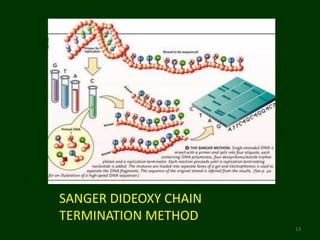
SANGER DIDEOXY CHAIN
TERMINATION METHOD
13
APPLICATIONS OF DNA
SEQUENCING-
• DNA sequencing may be used to determine the
sequence of individual genes , larger genetic regions
(i.e, cluster of genes or operons ),full chromosome or
entire genomes.
•IN FORENSIC SCIENCE-DNA Sequencing has
been used in forensic science-to identify particular
individual because every individual has unique
sequence of his/ her DNA.
-to identify criminals by finding some proof from the
crime scene in the form of hair,nail,skin or blood
samples.
-to determine paternity of the child .
14
•IN MEDICAL RESEARCH-a.DNA sequencing can
be used to detect the genes which are associated with
some heredity or acquired diseases.
-scientists use different techniques like gene therapy
to identify the defected gene and replace them with
the healthy one.
•IN AGRICULTURE- DNA sequencing has played a
vital role in the field of agriculture. The mapping and
sequencing of the whole genome of microorganisms
has allowed the agriculturists to make them useful for
the crops and food plants.
15
16

Presentation on dna sequencing

  • 1.
    I.P COLLEGE,CAMPUS II APresentation on topic DNA Sequencing Submitted by- Meenu sharma M.Sc. biotechnology (II SEM) 1
  • 2.
    WHAT IS DNA? A.DNA stands for Deoxyribo nucleic acids. B. DNA is a molecule that carries most of the genetic instructions used in the growth, development, functioning and reproduction of all known living organisms and many viruses. C.DNA molecule consist of biopolymer strands coiled around each other to form a double helix. D.The two strands are known as polynucleotide strands since they consist of simpler units called called a nucleotides. 2
  • 3.
    STRUCTURE OF A DNANUCLEOTIDE- A. Each nucleotide consist of a nitrogen containing nucleo base either cytosine (c),guanine (G) ,adenine (A), or thymine (T) as well as sugar called deoxy ribose and a phosphate group.. 3
  • 4.
    WHAT IS DNASEQUENCING ? • The process of determining the order of bases adenine (A), thymine (T), cytosine (C), and guanine (G) along a DNA strand. • All the information required for the growth and development of an organism is encoded in the DNA of its genome. • So, DNA sequencing is fundamental to genome analysis and understanding the biological processes in general. 4
  • 5.
    METHODS OF DNASEQUENCING – 5 METHODS A.MAXAM GILBERT CHEMICAL CLEAVAGE METHOD B.SANGER DIDEOXY (PRIMER EXTENSION /CHAIN TERMINATION METHOD. C.AUTOMATED DNA SEQUENCING METHOD.
  • 6.
    A. CHEMICAL CLEAVAGEMETHOD BY ALLAN MAXAM AND WALTER GILBERT (1976-1977)- • Sequences DNA fragments containing upto ~500 nucleotides in length. • This method uses double-stranded DNA samples. • Maxam -Gilbert sequencing was the first widely used method for DNA sequencing. • Involves modification of the bases in DNA followed by chemical base-specific cleavage. 6
  • 7.
    STAGES- 1. The double-strandedfragment to be sequenced is isolated and radioactively labeled at the 5’-ends with 32P. 2. The fragment is then cut with restriction enzyme and thus the label is removed from one end. 3. The fragment of DNA with one end labeled is denatured. 4. Four identical samples of these end-labeled DNA restriction fragments are subjected to chemical cleavage at different chemical nucleotides. 5.There are four specific sets of chemical reactions that selectively cut the DNA backbone at G, A+G, C+T, or C residues. – G only: Dimethyl sulphate(DMS) and piperidine – A+G : DMS, piperidine – C+T : Hydrazine, piperidine – C only : Hydrazine, alkali, piperidine 7
  • 8.
    6. For eachlabeled chain to be broken only once, the reactions are controlled. 7. The labeled sub-fragments created by the four reactions have the 32P label at one end and the chemical cleavage point at the other end. 8. The reaction products are separated by poly acryl amide gel electrophoresis which h is based on size. Smallest fragment goes fastest 9. The labeled fragments in the gel are visualized by autoradiography. 10. The sequence is read from bottom to top of the gel. 8
  • 9.
  • 10.
    B.The Enzymatic method/Sanger dideoxy (Primer extension/chain termination method) • The enzymatic procedure is commonly refered to as sanger- coulson method since it was developed by F.sanger and coworkers. • Sanger sequencing is a method of DNA sequencing based on the selective incorporation of chain terminating dideoxy nucleotides by DNA polymerase during invitro DNA Replication. • The classical chain- termination method requires – • 1.A single stranded DNA template. • 2.A DNA polymerase. • 3.Normal dideoxynucleotide triphosphates (ddNTP’s). 10
  • 11.
    STAGES- 1.The DNA tobe sequenced is called the template DNA. It is prepared as a single-stranded DNA after being spliced into M13 vector DNA. Infected E. coli host cells release phage particles which contains single-stranded recombinant DNA that includes the sample DNA. This DNA sample is then extracted from phage for sequencing purpose. 2. A synthetic 5’-end-labeled oligo deoxynucleotide is used as the primer. 3. The template DNA is hybridized to the primer. 4. The primer elongation is performed in four separate polymerization reaction mixtures. Each mixture contains - 4 normal deoxynucleotides (dNTPs) in higher concentration and - a low concentration of the each of the 4 ddNTPs. 5.There is initiation of DNA synthesis by adding enzyme DNA polymeras since the enzyme cannot distinguish between the normal nucleotides and their analogues. 11
  • 12.
    6. The strandsynthesis continues until a ddNTP is added. The chain elongation ceases on the incorporation of a ddNTP because it lacks a 3’-OH group which prevents addition of the next nucleotide. 7. There is a result of mixture of terminated fragments, all of different lengths. 8. Denature DNA fragments. 9. Each of the four mixtures are run together on a polyacrylamide gel for electrphoresis. 10. The separated fragments are then visualized by autoradiography. 11. From the position of the bands of the resulting autoradiogram, the sequence of the original DNA template strand can be read directly 12
  • 13.
  • 14.
    APPLICATIONS OF DNA SEQUENCING- •DNA sequencing may be used to determine the sequence of individual genes , larger genetic regions (i.e, cluster of genes or operons ),full chromosome or entire genomes. •IN FORENSIC SCIENCE-DNA Sequencing has been used in forensic science-to identify particular individual because every individual has unique sequence of his/ her DNA. -to identify criminals by finding some proof from the crime scene in the form of hair,nail,skin or blood samples. -to determine paternity of the child . 14
  • 15.
    •IN MEDICAL RESEARCH-a.DNAsequencing can be used to detect the genes which are associated with some heredity or acquired diseases. -scientists use different techniques like gene therapy to identify the defected gene and replace them with the healthy one. •IN AGRICULTURE- DNA sequencing has played a vital role in the field of agriculture. The mapping and sequencing of the whole genome of microorganisms has allowed the agriculturists to make them useful for the crops and food plants. 15
  • 16.