DNA Sequencing
23/11/2020 DNA Sequencing 1
Presented to:
Dr.Asma Aziz
Presented by:
M.Adeel Akram
DNA Sequencing
• Determining the precise order of nucleotides in a piece of DNA is called as the DNA
sequencing.
• DNA sequence is useful in studying fundamental biological processes and in applied
fields such as diagnostic or forensic research.
• DNA sequencing methods have been developed since the mid-1970s.
• Before that no method was exist for the DNA sequencing.
• Sequencing is done by the mean of the reverse genetic in which amino acid sequence of
the gene product is translated back into the nucleotide sequence base upon codons.
• In the mid of the 1970s two method were developed.
a) Maxam Gilbert method (chemical cleavage)
b) Sanger method (chain termination)
23/11/2020 DNA Sequencing 2
Maxam Gilbert method (chemical cleavage)
• The sequence of a double-stranded or single-stranded DNA molecule is determined by
treatment with chemicals that cut the molecule at specific nucleotide positions.
Reaction in two stages
• Chemical modification of the bases
• Modified base is removed from its sugar, piperidin cleaves phosphodiester bonds 5’ and
3’ and base is released
• Maxam use specific chemicals to break the DNA at specific site.
23/11/2020 DNA Sequencing 3
G G+A C+T C
Dimethyl sulphate Formic acid Hydrazine Hydrazine+2M Nacl
Piperidin Piperidin Piperidin Piperidin
Procedure
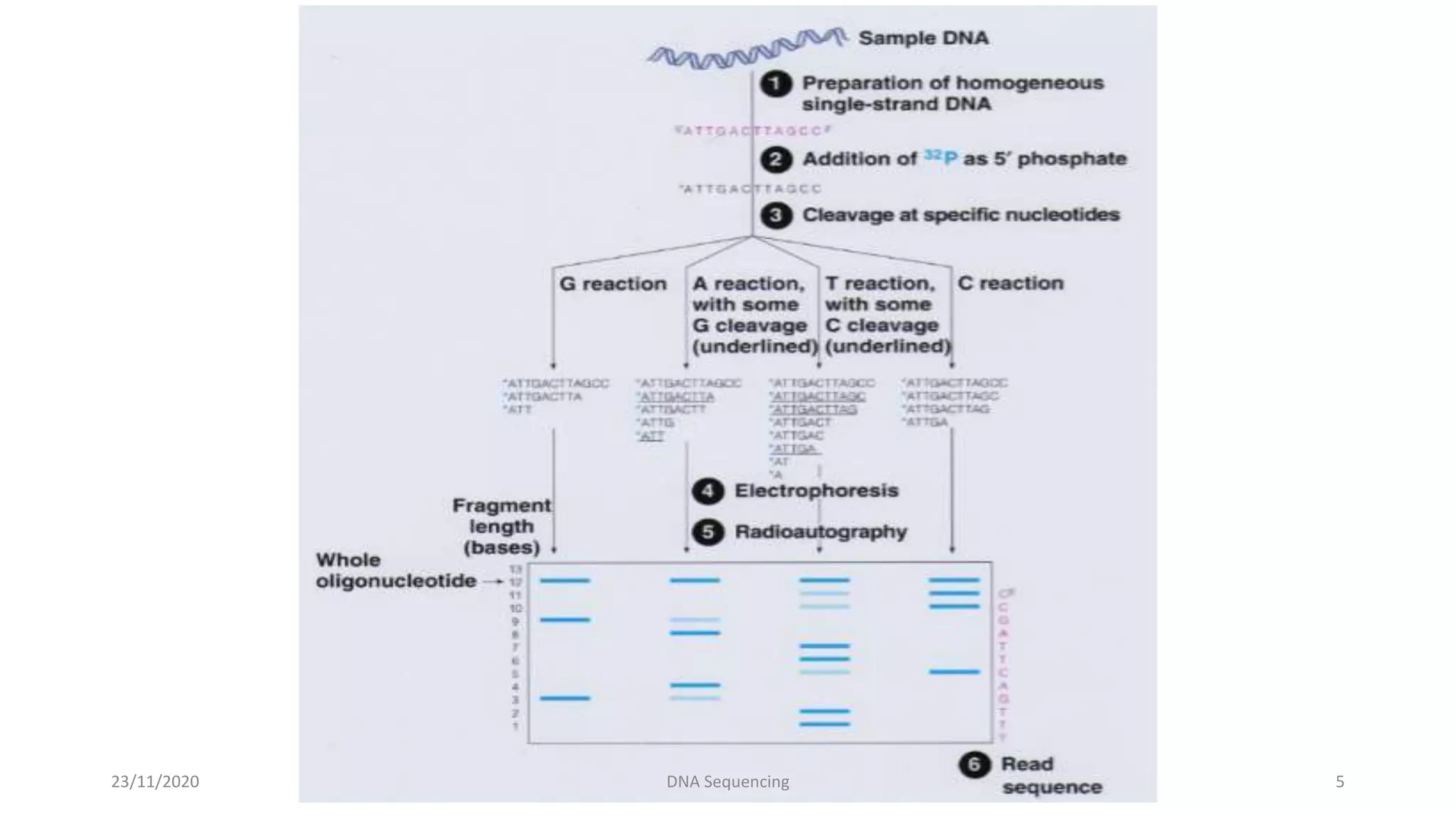
• The method requires radioactive labelling at 5` end and purification of the DNA fragment
to be sequenced.
• Chemical treatment generates breaks at a small proportion of one or two of the four
nucleotide bases in each of four reactions (G, A+G, C, C+T).
• Thus a series of labelled fragments is generated, from the radiolabeled end to the first 'cut'
site in each molecule.
• The fragments in the four reactions are arranged side by side in gel electrophoresis for size
separation.
• To visualize the fragments, the gel is exposed to X-ray film for autoradiography, yielding a
series of dark bands each corresponding to a radiolabeled DNA fragment, from which the
sequence may be inferred.
23/11/2020 DNA Sequencing 4
23/11/2020 DNA Sequencing 5
Sanger method (chain termination)
• Most common approach used to sequencing DNA.
• Invented by Frederick Sanger - 1977
• Nobel prize – 1980
• Uses dideoxy nucleotides ddNTPs to terminate DNA synthesis.
• A labelled primer is used to initiate DNA synthesis.
•
23/11/2020 DNA Sequencing 6
Also termed as chain termination or dideoxy method
Principle
• The sequence of a single-stranded DNA molecule is determined by enzymatic synthesis of
complementary polynucleotide chains.
• These chains terminating at specific nucleotide positions.
• Separate by gel electrophoresis & read DNA sequence.
Reagents
• dNTPs (dATP, dGTP, dCTP & dTTP)
• ddNTPs (ddATP, ddGTP, ddCTP, & ddTTP)
• DNA polymerase
• Primers
• Test tubes
• sample
23/11/2020 DNA Sequencing 7
Procedure
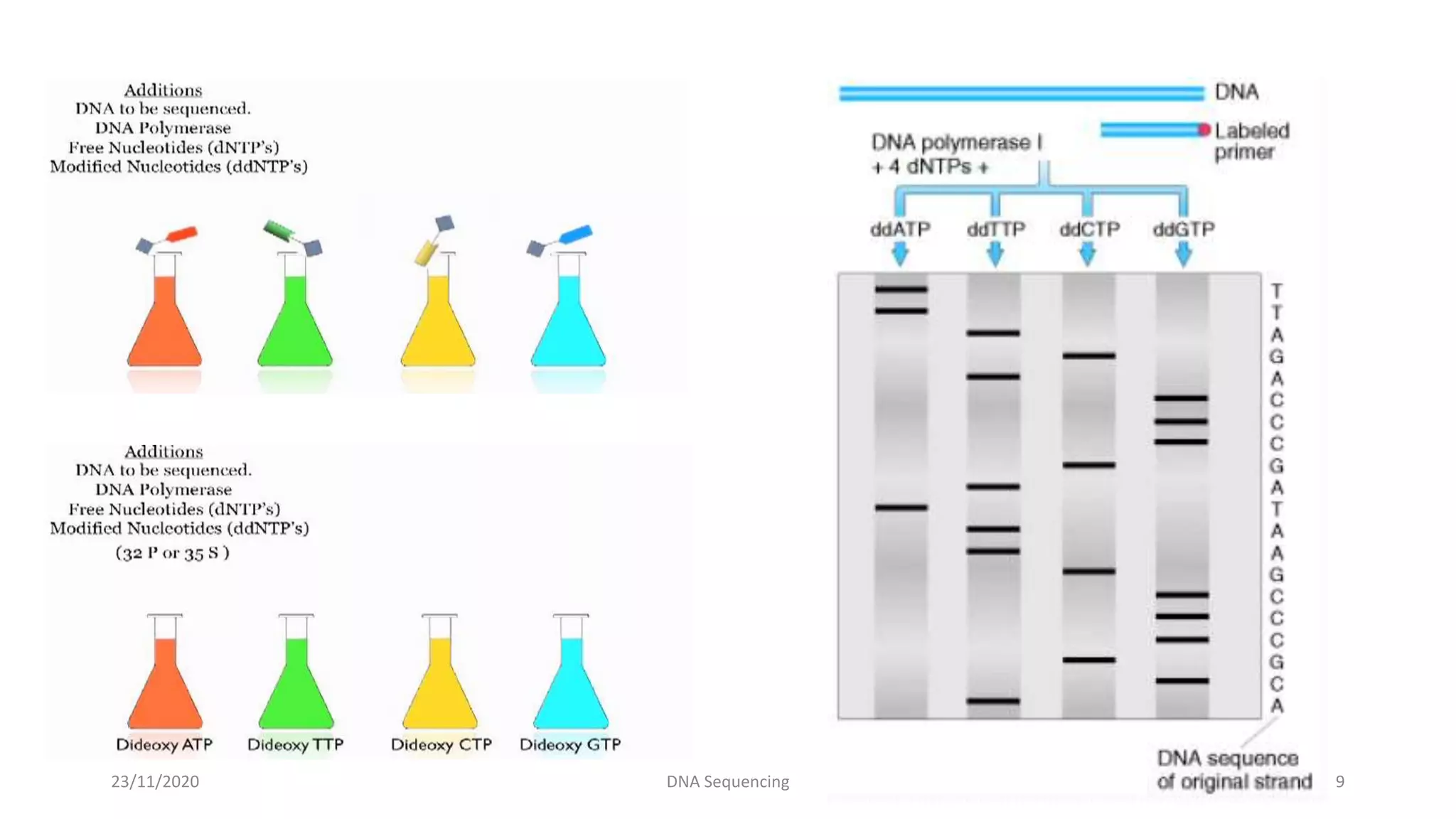
• In the Sanger method, the DNA strand to be analyzed is used as template and DNA
polymerase is used, in a PCR reaction, to generate complimentary strands using primers.
• Four different PCR reaction mixtures are prepared, each containing a certain percentage
of dideoxynucleotide triphosphate (ddNTP) analogs to one of the four nucleotides (ATP,
CTP, GTP or TTP).
• Synthesis of the new DNA strand continues until one of these analogs is incorporated, at
which time the strand is prematurely truncated.
• Each PCR reaction will end up containing a mixture of different lengths of DNA strands,
all ending with the nucleotide that was dideoxy labeled for that reaction.
• Gel electrophoresis is then used to separate the strands of the four reactions, in four
separate lanes, and determine the sequence of the original template based on what lengths
of strands end with what nucleotide.
23/11/2020 DNA Sequencing 8
23/11/2020 DNA Sequencing 9
Comparison
23/11/2020 DNA Sequencing 10
Sanger Method Maxam Gilbert Method
Enzymatic Chemical
Requires DNA synthesis Requires DNA
Termination of chain elongation Breaks DNA at different nucleotides
Automation Automation is not available
Single-stranded DNA. Double-stranded or single-
stranded DNA
Computer automated sequencing
• Whole process is similar to the sanger method except.
• Automated DNA sequencing utilized a fluorescent dye instead of the radioactively
labelled isotopes.
• This method use capillary gel instead of the gel electrophoresis.
• Sample is injected in the capillary which is long and thin.
• DNA fragments are separated on the base of the size.
• Computer give information about the genome in the form of the graph.
23/11/2020 DNA Sequencing 11
23/11/2020 DNA Sequencing 12
NGS (Next generation sequencing)
• It is versatile technology of DNA sequencing that permit high-throuput adaptable whole genome
with high accuracy.
• By the help of NGS entire human genome is sequenced within a single day.
• Also known as high-throuput sequencing.
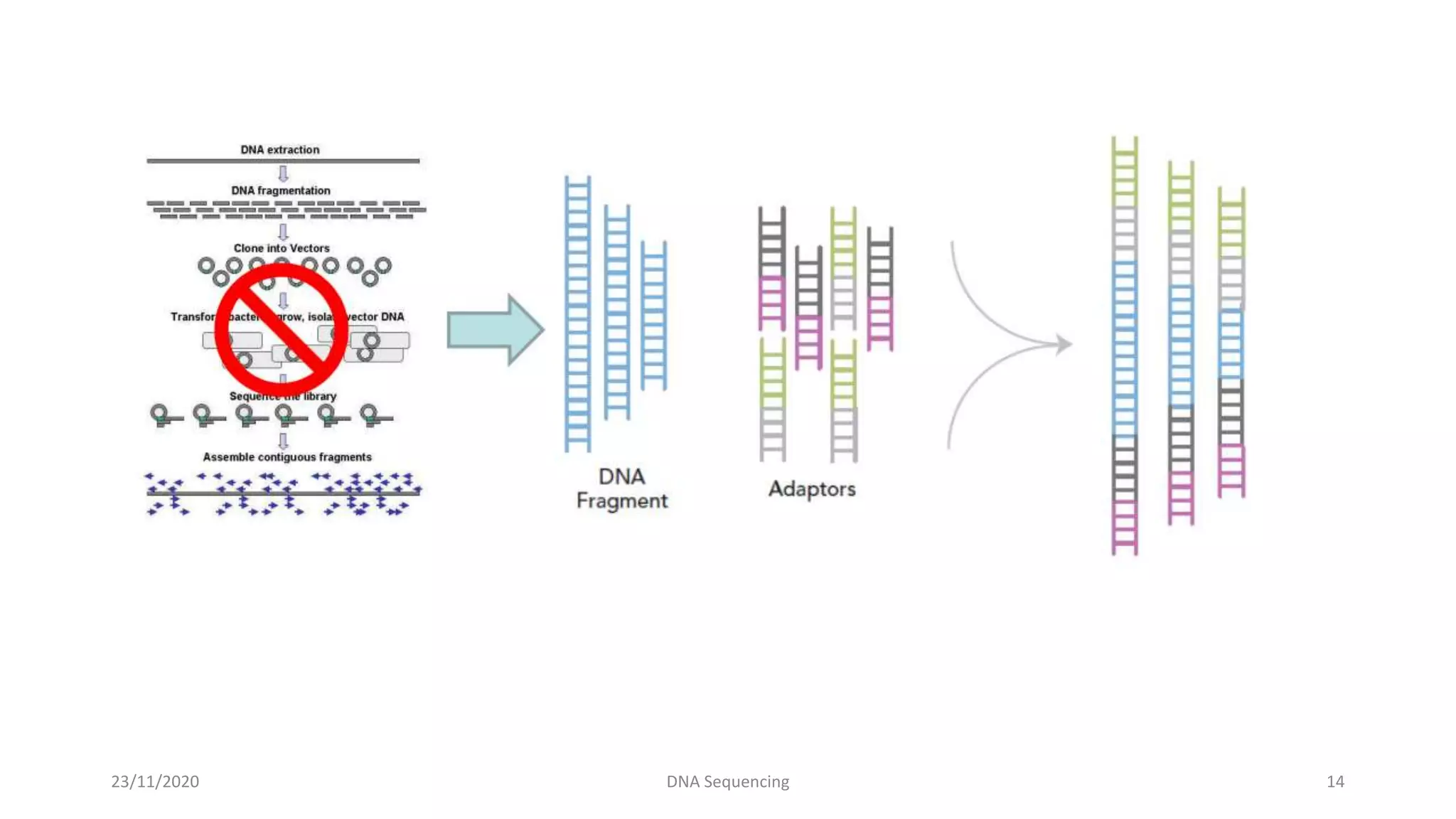
• It is more advance and use the adaptor molecules.
• Those molecules whose sequence is already known and attached at the one end of the genome is
called as adaptor molecules.
• Current NGS platforms utilize clonal amplification on solid supports via two
main methods:
– emulsion PCR (emPCR)
– bridge amplification (DNA cluster generation)
23/11/2020 DNA Sequencing 13
23/11/2020 DNA Sequencing 14
Emulsion PCR (emPCR)
• Emulsion PCR is a method of clonal amplification which allows for millions of unique
PCRs to be performed at once through the generation of micro-reactors.
23/11/2020 DNA Sequencing 15
Pyrosequencing
• It is method of sequencing in which incorporated nucleotide is detected.
• Pyrophosphate is released that undergoes the cascade of reactions and produce light that
light is detected.
• In this method dNTPs are used on by one instead of the all four types of the dNTPs.
• Here dATP is used in form of the dATPaS (deoxyadenosine alpha theotriphosphate) due
to the presence of luciferase that use ATP to produce light.#
• DNA polymerase
• Sulphurylase
• Adenosine Phospho sulfate (APS)
• Apyrase
• Luciferin (oxidized by luciferase)
23/11/2020 DNA Sequencing 16
23/11/2020 17
Applications of DNA sequencing
• Identify individuals
• Determine the paternity of a child
• Detect genes that are hereditary or cause diseases
• Map the genome of microorganisms
• Identification of gene mutation
23/11/2020 DNA Sequencing 18
23/11/2020 DNA Sequencing 19

Dna sequencing methods

  • 1.
    DNA Sequencing 23/11/2020 DNASequencing 1 Presented to: Dr.Asma Aziz Presented by: M.Adeel Akram
  • 2.
    DNA Sequencing • Determiningthe precise order of nucleotides in a piece of DNA is called as the DNA sequencing. • DNA sequence is useful in studying fundamental biological processes and in applied fields such as diagnostic or forensic research. • DNA sequencing methods have been developed since the mid-1970s. • Before that no method was exist for the DNA sequencing. • Sequencing is done by the mean of the reverse genetic in which amino acid sequence of the gene product is translated back into the nucleotide sequence base upon codons. • In the mid of the 1970s two method were developed. a) Maxam Gilbert method (chemical cleavage) b) Sanger method (chain termination) 23/11/2020 DNA Sequencing 2
  • 3.
    Maxam Gilbert method(chemical cleavage) • The sequence of a double-stranded or single-stranded DNA molecule is determined by treatment with chemicals that cut the molecule at specific nucleotide positions. Reaction in two stages • Chemical modification of the bases • Modified base is removed from its sugar, piperidin cleaves phosphodiester bonds 5’ and 3’ and base is released • Maxam use specific chemicals to break the DNA at specific site. 23/11/2020 DNA Sequencing 3 G G+A C+T C Dimethyl sulphate Formic acid Hydrazine Hydrazine+2M Nacl Piperidin Piperidin Piperidin Piperidin
  • 4.
    Procedure • The methodrequires radioactive labelling at 5` end and purification of the DNA fragment to be sequenced. • Chemical treatment generates breaks at a small proportion of one or two of the four nucleotide bases in each of four reactions (G, A+G, C, C+T). • Thus a series of labelled fragments is generated, from the radiolabeled end to the first 'cut' site in each molecule. • The fragments in the four reactions are arranged side by side in gel electrophoresis for size separation. • To visualize the fragments, the gel is exposed to X-ray film for autoradiography, yielding a series of dark bands each corresponding to a radiolabeled DNA fragment, from which the sequence may be inferred. 23/11/2020 DNA Sequencing 4
  • 5.
  • 6.
    Sanger method (chaintermination) • Most common approach used to sequencing DNA. • Invented by Frederick Sanger - 1977 • Nobel prize – 1980 • Uses dideoxy nucleotides ddNTPs to terminate DNA synthesis. • A labelled primer is used to initiate DNA synthesis. • 23/11/2020 DNA Sequencing 6 Also termed as chain termination or dideoxy method
  • 7.
    Principle • The sequenceof a single-stranded DNA molecule is determined by enzymatic synthesis of complementary polynucleotide chains. • These chains terminating at specific nucleotide positions. • Separate by gel electrophoresis & read DNA sequence. Reagents • dNTPs (dATP, dGTP, dCTP & dTTP) • ddNTPs (ddATP, ddGTP, ddCTP, & ddTTP) • DNA polymerase • Primers • Test tubes • sample 23/11/2020 DNA Sequencing 7
  • 8.
    Procedure • In theSanger method, the DNA strand to be analyzed is used as template and DNA polymerase is used, in a PCR reaction, to generate complimentary strands using primers. • Four different PCR reaction mixtures are prepared, each containing a certain percentage of dideoxynucleotide triphosphate (ddNTP) analogs to one of the four nucleotides (ATP, CTP, GTP or TTP). • Synthesis of the new DNA strand continues until one of these analogs is incorporated, at which time the strand is prematurely truncated. • Each PCR reaction will end up containing a mixture of different lengths of DNA strands, all ending with the nucleotide that was dideoxy labeled for that reaction. • Gel electrophoresis is then used to separate the strands of the four reactions, in four separate lanes, and determine the sequence of the original template based on what lengths of strands end with what nucleotide. 23/11/2020 DNA Sequencing 8
  • 9.
  • 10.
    Comparison 23/11/2020 DNA Sequencing10 Sanger Method Maxam Gilbert Method Enzymatic Chemical Requires DNA synthesis Requires DNA Termination of chain elongation Breaks DNA at different nucleotides Automation Automation is not available Single-stranded DNA. Double-stranded or single- stranded DNA
  • 11.
    Computer automated sequencing •Whole process is similar to the sanger method except. • Automated DNA sequencing utilized a fluorescent dye instead of the radioactively labelled isotopes. • This method use capillary gel instead of the gel electrophoresis. • Sample is injected in the capillary which is long and thin. • DNA fragments are separated on the base of the size. • Computer give information about the genome in the form of the graph. 23/11/2020 DNA Sequencing 11
  • 12.
  • 13.
    NGS (Next generationsequencing) • It is versatile technology of DNA sequencing that permit high-throuput adaptable whole genome with high accuracy. • By the help of NGS entire human genome is sequenced within a single day. • Also known as high-throuput sequencing. • It is more advance and use the adaptor molecules. • Those molecules whose sequence is already known and attached at the one end of the genome is called as adaptor molecules. • Current NGS platforms utilize clonal amplification on solid supports via two main methods: – emulsion PCR (emPCR) – bridge amplification (DNA cluster generation) 23/11/2020 DNA Sequencing 13
  • 14.
  • 15.
    Emulsion PCR (emPCR) •Emulsion PCR is a method of clonal amplification which allows for millions of unique PCRs to be performed at once through the generation of micro-reactors. 23/11/2020 DNA Sequencing 15
  • 16.
    Pyrosequencing • It ismethod of sequencing in which incorporated nucleotide is detected. • Pyrophosphate is released that undergoes the cascade of reactions and produce light that light is detected. • In this method dNTPs are used on by one instead of the all four types of the dNTPs. • Here dATP is used in form of the dATPaS (deoxyadenosine alpha theotriphosphate) due to the presence of luciferase that use ATP to produce light.# • DNA polymerase • Sulphurylase • Adenosine Phospho sulfate (APS) • Apyrase • Luciferin (oxidized by luciferase) 23/11/2020 DNA Sequencing 16
  • 17.
  • 18.
    Applications of DNAsequencing • Identify individuals • Determine the paternity of a child • Detect genes that are hereditary or cause diseases • Map the genome of microorganisms • Identification of gene mutation 23/11/2020 DNA Sequencing 18
  • 19.