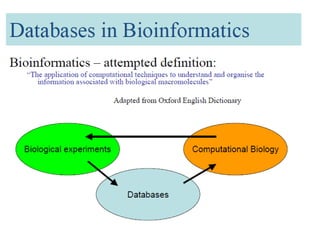
Data Base in Bioinformatics
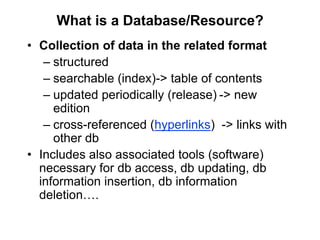
What is a Database/Resource?
• Collection of data in the related format
– structured
– searchable (index)-> table of contents
– updated periodically (release) -> new
edition
– cross-referenced (hyperlinks) -> links with
other db
• Includes also associated tools (software)
necessary for db access, db updating, db
information insertion, db information
deletion….
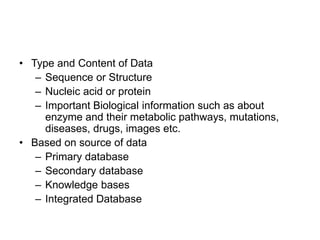
• Type and Content of Data
– Sequence or Structure
– Nucleic acid or protein
– Important Biological information such as about
enzyme and their metabolic pathways, mutations,
diseases, drugs, images etc.
• Based on source of data
– Primary database
– Secondary database
– Knowledge bases
– Integrated Database
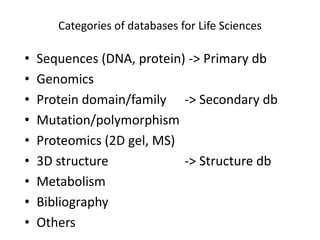
Categories of databases for Life Sciences
• Sequences (DNA, protein) -> Primary db
• Genomics
• Protein domain/family -> Secondary db
• Mutation/polymorphism
• Proteomics (2D gel, MS)
• 3D structure -> Structure db
• Metabolism
• Bibliography
• Others
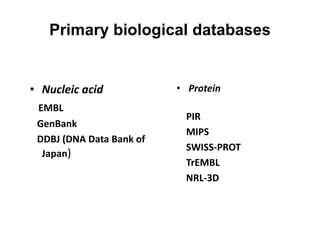
Primary biological databases
• Nucleic acid
EMBL
GenBank
DDBJ (DNA Data Bank of
Japan)
• Protein
PIR
MIPS
SWISS-PROT
TrEMBL
NRL-3D
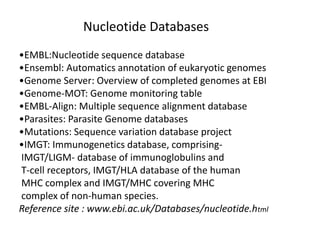
Nucleotide Databases
•EMBL:Nucleotide sequence database
•Ensembl: Automatics annotation of eukaryotic genomes
•Genome Server: Overview of completed genomes at EBI
•Genome-MOT: Genome monitoring table
•EMBL-Align: Multiple sequence alignment database
•Parasites: Parasite Genome databases
•Mutations: Sequence variation database project
•IMGT: Immunogenetics database, comprising-
IMGT/LIGM- database of immunoglobulins and
T-cell receptors, IMGT/HLA database of the human
MHC complex and IMGT/MHC covering MHC
complex of non-human species.
Reference site : www.ebi.ac.uk/Databases/nucleotide.html
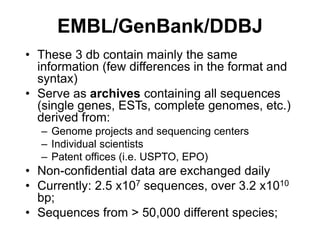
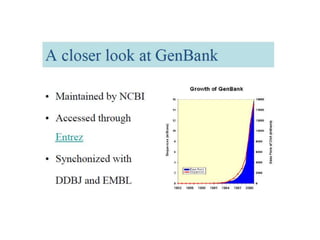
EMBL/GenBank/DDBJ
• These 3 db contain mainly the same
information (few differences in the format and
syntax)
• Serve as archives containing all sequences
(single genes, ESTs, complete genomes, etc.)
derived from:
– Genome projects and sequencing centers
– Individual scientists
– Patent offices (i.e. USPTO, EPO)
• Non-confidential data are exchanged daily
• Currently: 2.5 x10⁷ sequences, over 3.2 x10¹⁰
bp;
• Sequences from > 50,000 different species;
Databases related to Genomics
• Contain information on genes, gene location
(mapping), gene nomenclature and links to
sequence databases;
• Exist for most organisms important for life
science research;
• Examples: MIM, GDB (human), MGD
(mouse), FlyBase (Drosophila), SGD (yeast),
MaizeDB (maize), SubtiList (B.subtilis), etc.
• Format: generally relational (Oracle, SyBase
or AceDb).
Ensembl
• Contains all the human genome DNA
sequences currently available in the public
domain.
• Automated annotation: by using different
software tools, features are identified in the
DNA sequences:
– Genes (known or predicted)
– Single nucleotide polymorphisms (SNPs)
– Repeats
– Homologies
• Created and maintained by the EBI and the
Sanger Center (UK)
• www.ensembl.org
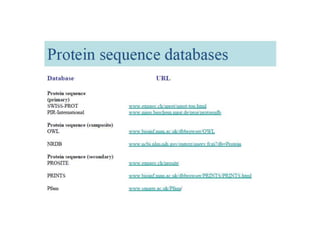
Protein Databases
•SWISS-PROT: Annotated Sequence Database
•TrEMBL: Database of EMBL nucleotide translated sequences
•InterPro:Integrated resource for protein families, domains
and functional sites.
•CluSTr:Offers an automatic classification of SWISS-PROT
and TrEMBL.
•IPI: A non-redundant human proteome set constructed from
SWISS-PROT, TrEMBL, Ensembl and RefSeq.
•GOA: Provides assignments of gene products to the Gene
Ontology (GO) resource.
•Proteome Analysis: Statistical and comparative analysis of
the predicted proteomes of fully sequenced organisms
•Protein Profiles: Tables of SWISS-PROT and TrEMBL entries
and alignments for the protein families of the Protein Profile.
•IntEnz: The Integrated relational Enzyme database (IntEnz) will
contain enzyme data approved by the Nomenclature Committee.
Reference site : www.ebi.ac.uk/Databases/protein.html
Swiss-Prot
• Annotated protein sequence database established in
1986 and maintained collaboratively since 1987, by
the Department of Medical Biochemistry of the
University of Geneva and EBI
• Complete, Curated, Non-redundant and cross-
referenced with 34 other databases
• Highly cross-referenced
• Available from a variety of servers and through
sequence analysis software tools
• More than 8,000 different species
• First 20 species represent about 42% of all sequences
in the database
• More than 1,29,000 entries with 4.7 X 10¹⁰ amino
acids
• More than 6,22,000 entries in TrEMBL
TrEMBL (Translation of EMBL)
• Computer-annotated supplement to SWISS-
PROT, as it is impossible to cope with the flow
of data…
• Well-structure SWISS-PROT-like resource
• Derived from automated EMBL CDS
translation maintained at the EBI, UK.
• TrEMBL is automatically generated and
annotated using software tools (incompatible
with the SWISS-PROT in terms of quality)
• TrEMBL contains all what is not yet in
SWISS-PROT
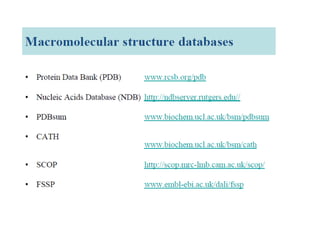
Structure Databases
•MSD:The Macromolecular Structure Database –
A relational database representation of clean Protein Data
Bank (PDB)
•3DSeq: 3D sequence alignment server- Annotation of the
alignments between sequence database and the PDB
•FSSP: Based on exhaustive all-against-all 3D structure
comparison of protein structures currently in the
Protein Data Bank (PDB)
•DALI: Fold Classification based on Structure-Structure
Assignments
•3Dee: Database of protein domain definitions wherein
the domains have been clustered on sequence and
structural similarity
•NDB: Nucleic Acid Structure Database
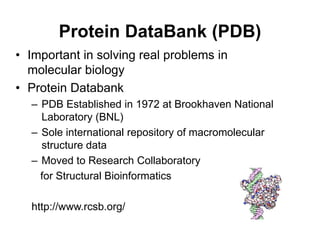
Protein DataBank (PDB)
• Important in solving real problems in
molecular biology
• Protein Databank
– PDB Established in 1972 at Brookhaven National
Laboratory (BNL)
– Sole international repository of macromolecular
structure data
– Moved to Research Collaboratory
for Structural Bioinformatics
http://www.rcsb.org/
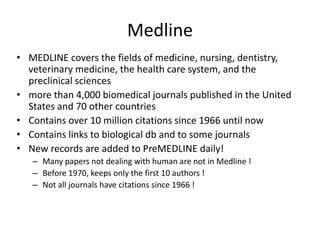
Medline
• MEDLINE covers the fields of medicine, nursing, dentistry,
veterinary medicine, the health care system, and the
preclinical sciences
• more than 4,000 biomedical journals published in the United
States and 70 other countries
• Contains over 10 million citations since 1966 until now
• Contains links to biological db and to some journals
• New records are added to PreMEDLINE daily!
– Many papers not dealing with human are not in Medline !
– Before 1970, keeps only the first 10 authors !
– Not all journals have citations since 1966 !
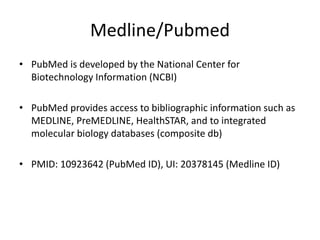
Medline/Pubmed
• PubMed is developed by the National Center for
Biotechnology Information (NCBI)
• PubMed provides access to bibliographic information such as
MEDLINE, PreMEDLINE, HealthSTAR, and to integrated
molecular biology databases (composite db)
• PMID: 10923642 (PubMed ID), UI: 20378145 (Medline ID)
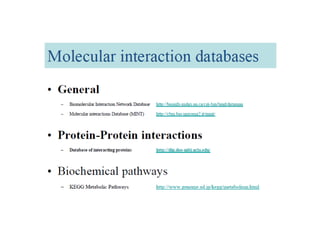
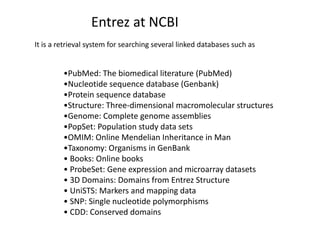
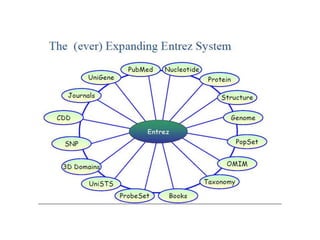
•PubMed: The biomedical literature (PubMed)
•Nucleotide sequence database (Genbank)
•Protein sequence database
•Structure: Three-dimensional macromolecular structures
•Genome: Complete genome assemblies
•PopSet: Population study data sets
•OMIM: Online Mendelian Inheritance in Man
•Taxonomy: Organisms in GenBank
• Books: Online books
• ProbeSet: Gene expression and microarray datasets
• 3D Domains: Domains from Entrez Structure
• UniSTS: Markers and mapping data
• SNP: Single nucleotide polymorphisms
• CDD: Conserved domains
Entrez at NCBI
It is a retrieval system for searching several linked databases such as
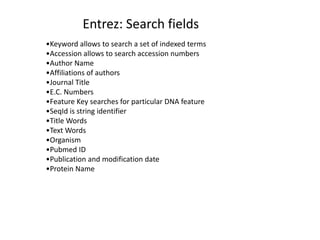
Entrez: Search fields
•Keyword allows to search a set of indexed terms
•Accession allows to search accession numbers
•Author Name
•Affiliations of authors
•Journal Title
•E.C. Numbers
•Feature Key searches for particular DNA feature
•SeqId is string identifier
•Title Words
•Text Words
•Organism
•Pubmed ID
•Publication and modification date
•Protein Name
If you would like to donate us?
Scan below and donate us 0.013$ (US dollar) (5Rs Indian rupee)
Contact: If you want PPT/PDF files, please contact below.
Email: gnccmysore@gmail.com
Telegram:+919738137533(only for Chat)
Data Base in Bioinformatics.ppt

Data Base in Bioinformatics.ppt

  • 1.
    Data Base inBioinformatics
  • 3.
    What is aDatabase/Resource? • Collection of data in the related format – structured – searchable (index)-> table of contents – updated periodically (release) -> new edition – cross-referenced (hyperlinks) -> links with other db • Includes also associated tools (software) necessary for db access, db updating, db information insertion, db information deletion….
  • 4.
    • Type andContent of Data – Sequence or Structure – Nucleic acid or protein – Important Biological information such as about enzyme and their metabolic pathways, mutations, diseases, drugs, images etc. • Based on source of data – Primary database – Secondary database – Knowledge bases – Integrated Database
  • 5.
    Categories of databasesfor Life Sciences • Sequences (DNA, protein) -> Primary db • Genomics • Protein domain/family -> Secondary db • Mutation/polymorphism • Proteomics (2D gel, MS) • 3D structure -> Structure db • Metabolism • Bibliography • Others
  • 6.
    Primary biological databases •Nucleic acid EMBL GenBank DDBJ (DNA Data Bank of Japan) • Protein PIR MIPS SWISS-PROT TrEMBL NRL-3D
  • 7.
    Nucleotide Databases •EMBL:Nucleotide sequencedatabase •Ensembl: Automatics annotation of eukaryotic genomes •Genome Server: Overview of completed genomes at EBI •Genome-MOT: Genome monitoring table •EMBL-Align: Multiple sequence alignment database •Parasites: Parasite Genome databases •Mutations: Sequence variation database project •IMGT: Immunogenetics database, comprising- IMGT/LIGM- database of immunoglobulins and T-cell receptors, IMGT/HLA database of the human MHC complex and IMGT/MHC covering MHC complex of non-human species. Reference site : www.ebi.ac.uk/Databases/nucleotide.html
  • 8.
    EMBL/GenBank/DDBJ • These 3db contain mainly the same information (few differences in the format and syntax) • Serve as archives containing all sequences (single genes, ESTs, complete genomes, etc.) derived from: – Genome projects and sequencing centers – Individual scientists – Patent offices (i.e. USPTO, EPO) • Non-confidential data are exchanged daily • Currently: 2.5 x10⁷ sequences, over 3.2 x10¹⁰ bp; • Sequences from > 50,000 different species;
  • 9.
    Databases related toGenomics • Contain information on genes, gene location (mapping), gene nomenclature and links to sequence databases; • Exist for most organisms important for life science research; • Examples: MIM, GDB (human), MGD (mouse), FlyBase (Drosophila), SGD (yeast), MaizeDB (maize), SubtiList (B.subtilis), etc. • Format: generally relational (Oracle, SyBase or AceDb).
  • 10.
    Ensembl • Contains allthe human genome DNA sequences currently available in the public domain. • Automated annotation: by using different software tools, features are identified in the DNA sequences: – Genes (known or predicted) – Single nucleotide polymorphisms (SNPs) – Repeats – Homologies • Created and maintained by the EBI and the Sanger Center (UK) • www.ensembl.org
  • 11.
    Protein Databases •SWISS-PROT: AnnotatedSequence Database •TrEMBL: Database of EMBL nucleotide translated sequences •InterPro:Integrated resource for protein families, domains and functional sites. •CluSTr:Offers an automatic classification of SWISS-PROT and TrEMBL. •IPI: A non-redundant human proteome set constructed from SWISS-PROT, TrEMBL, Ensembl and RefSeq. •GOA: Provides assignments of gene products to the Gene Ontology (GO) resource. •Proteome Analysis: Statistical and comparative analysis of the predicted proteomes of fully sequenced organisms •Protein Profiles: Tables of SWISS-PROT and TrEMBL entries and alignments for the protein families of the Protein Profile. •IntEnz: The Integrated relational Enzyme database (IntEnz) will contain enzyme data approved by the Nomenclature Committee. Reference site : www.ebi.ac.uk/Databases/protein.html
  • 12.
    Swiss-Prot • Annotated proteinsequence database established in 1986 and maintained collaboratively since 1987, by the Department of Medical Biochemistry of the University of Geneva and EBI • Complete, Curated, Non-redundant and cross- referenced with 34 other databases • Highly cross-referenced • Available from a variety of servers and through sequence analysis software tools • More than 8,000 different species • First 20 species represent about 42% of all sequences in the database • More than 1,29,000 entries with 4.7 X 10¹⁰ amino acids • More than 6,22,000 entries in TrEMBL
  • 13.
    TrEMBL (Translation ofEMBL) • Computer-annotated supplement to SWISS- PROT, as it is impossible to cope with the flow of data… • Well-structure SWISS-PROT-like resource • Derived from automated EMBL CDS translation maintained at the EBI, UK. • TrEMBL is automatically generated and annotated using software tools (incompatible with the SWISS-PROT in terms of quality) • TrEMBL contains all what is not yet in SWISS-PROT
  • 14.
    Structure Databases •MSD:The MacromolecularStructure Database – A relational database representation of clean Protein Data Bank (PDB) •3DSeq: 3D sequence alignment server- Annotation of the alignments between sequence database and the PDB •FSSP: Based on exhaustive all-against-all 3D structure comparison of protein structures currently in the Protein Data Bank (PDB) •DALI: Fold Classification based on Structure-Structure Assignments •3Dee: Database of protein domain definitions wherein the domains have been clustered on sequence and structural similarity •NDB: Nucleic Acid Structure Database
  • 15.
    Protein DataBank (PDB) •Important in solving real problems in molecular biology • Protein Databank – PDB Established in 1972 at Brookhaven National Laboratory (BNL) – Sole international repository of macromolecular structure data – Moved to Research Collaboratory for Structural Bioinformatics http://www.rcsb.org/
  • 22.
    Medline • MEDLINE coversthe fields of medicine, nursing, dentistry, veterinary medicine, the health care system, and the preclinical sciences • more than 4,000 biomedical journals published in the United States and 70 other countries • Contains over 10 million citations since 1966 until now • Contains links to biological db and to some journals • New records are added to PreMEDLINE daily! – Many papers not dealing with human are not in Medline ! – Before 1970, keeps only the first 10 authors ! – Not all journals have citations since 1966 !
  • 23.
    Medline/Pubmed • PubMed isdeveloped by the National Center for Biotechnology Information (NCBI) • PubMed provides access to bibliographic information such as MEDLINE, PreMEDLINE, HealthSTAR, and to integrated molecular biology databases (composite db) • PMID: 10923642 (PubMed ID), UI: 20378145 (Medline ID)
  • 24.
    •PubMed: The biomedicalliterature (PubMed) •Nucleotide sequence database (Genbank) •Protein sequence database •Structure: Three-dimensional macromolecular structures •Genome: Complete genome assemblies •PopSet: Population study data sets •OMIM: Online Mendelian Inheritance in Man •Taxonomy: Organisms in GenBank • Books: Online books • ProbeSet: Gene expression and microarray datasets • 3D Domains: Domains from Entrez Structure • UniSTS: Markers and mapping data • SNP: Single nucleotide polymorphisms • CDD: Conserved domains Entrez at NCBI It is a retrieval system for searching several linked databases such as
  • 26.
    Entrez: Search fields •Keywordallows to search a set of indexed terms •Accession allows to search accession numbers •Author Name •Affiliations of authors •Journal Title •E.C. Numbers •Feature Key searches for particular DNA feature •SeqId is string identifier •Title Words •Text Words •Organism •Pubmed ID •Publication and modification date •Protein Name
  • 29.
    If you wouldlike to donate us? Scan below and donate us 0.013$ (US dollar) (5Rs Indian rupee) Contact: If you want PPT/PDF files, please contact below. Email: gnccmysore@gmail.com Telegram:+919738137533(only for Chat)