z
PYROSEQUENCING
zWHAT IS PYROSEQUENCING??
“Pyrosequencing is a method of
sequencing that relies on light
emitted in an enzymatic reaction
set in motion by the release of
pyrophosphate when a base is
added during the sequencing
process”.
z
HISTORY
 The technique was developed by Mostafa Ronaghi and Pål Nyrén at
the Royal Institute of Technology in Stockholm in 1996.
 A second solution-based method for Pyrosequencing was described
in 1998 (In this alternative method, an additional enzyme apyrase is
introduced.
 A third microfluidic variant of the Pyrosequencing method was
described in 2005[5] by Jonathan Rothberg.
 This allowed for high-throughput DNA sequencing and an
automated instrument was introduced to the market. This became
the first next generation sequencing instrument starting a new era
in genomics research
zVARIANTS OF PYROSEQUENCING
There are two different pyrosequencing strategies that are currently
available:
Solid-phase pyrosequencing: Utilizes
immobilized DNA in the three-enzyme system described previously. In this
system a washing step is performed to remove the excess substrate after
each nucleotide addition.
z
Liquid-phase pyrosequencing: In liquid-
phase pyrosequencing (apyrase, a nucleotide-degrading enzyme from
potato, is introduced to make a four-enzyme system. Addition of this
enzyme has eliminated the need for solid support and intermediate washing
thereby enabling the pyrosequencing reaction to be performed in a single
tube
z
FOR METHOD
Reaction mixture contains
 DNA sample to be sequenced
 Primers
 Deoxynucleotides
 DNA polymerase
 Sulfurylase
z
z
1. ENZYME COCKTAIL. { DNA polymerase, ATP-
Sulfurylase, }
2. Single dNTPs.
3. APS (Adenosine 5’-phosphosulfate).
.
5. DNA Adaptors.
z
Which is then cut
into 300-800 bp
fragments
We Start with Double
Stranded Genomic DNA
(Our Sample)…
z
Then we add
small
to our
fragments…
Then our double stranded
DNA is denatured to a
single strand.
z
Then we take tiny
micro beads
coated with DNA
primers
complementary to
one of the adaptors
on the DNA
strand…
Then single stranded DNA
binds complementarily
with the primer on bead.
Under conditions that
favour one DNA strand
per bead
z
PCR is run for
amplification, so
that enough
identical DNA
strands are
available to
analyse.
z
Then beads are loaded
into tiny wells with room
for a single bead per well.
Each well consists of a
different amplified DNA
fragment.
z
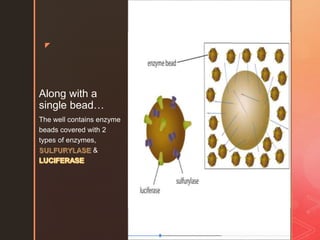
Along with a
single bead…
The well contains enzyme
beads covered with 2
types of enzymes,
&
z
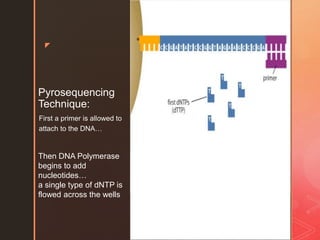
Pyrosequencing
Technique:
First a primer is allowed to
attach to the DNA…
Then DNA Polymerase
begins to add
nucleotides…
a single type of dNTP is
flowed across the wells
z
The Thymine can
base pair with
Adenine allowing
the DNA
Polymerase to
attach thymine on
the DNA strand…
In the process phosphate
groups are snipped off the
dNTPs in the form of a
pyrophosphate ion
One of the enzyme on
the bead uses this
pyrophosphate ion to
generate ATP molecule
and the other enzyme
uses energy in ATP to
produce a flash of light
z
The light is
detected by a
camera and
recorded. And the
nucleotides are
washed out of the
wells…
And a new nucleotide set
is added into the wells.
But because Adenine
doesn’t pair with Guanine
so no nucleotide will be
added thus no light is
emitted.
The next set of
nucleotides bears a
cytosine which is
incorporated, after
which light is emitted
too.
z
The next step
involves a set of
dGTPs which are
incorporated…
3 nucleotides are incorporated
and each pyrophosphate ion
results in emission of a
photon.
3 times as much as light is
emitted from this
incorporation, indicating that 3
Cytosine bases appear
consecutively in the template
strand.
z
The 4 dNTPs are
flowed
sequentially in
the wells.
This grid represents a
moment of time in which a
single set of dNTPs has
been flowed across the
wells.
z
The data from a
single well can be
depicted on a
chart, showing the
level of light
emitted from
incorporation of
each nucleotide.
Then Software packages
assemble these fragments
of sequences into longer
pieces.
And in this way determine
the overall sequence of
the genome.

Pyrosequencing

  • 1.
  • 2.
    zWHAT IS PYROSEQUENCING?? “Pyrosequencingis a method of sequencing that relies on light emitted in an enzymatic reaction set in motion by the release of pyrophosphate when a base is added during the sequencing process”.
  • 3.
    z HISTORY  The techniquewas developed by Mostafa Ronaghi and Pål Nyrén at the Royal Institute of Technology in Stockholm in 1996.  A second solution-based method for Pyrosequencing was described in 1998 (In this alternative method, an additional enzyme apyrase is introduced.  A third microfluidic variant of the Pyrosequencing method was described in 2005[5] by Jonathan Rothberg.  This allowed for high-throughput DNA sequencing and an automated instrument was introduced to the market. This became the first next generation sequencing instrument starting a new era in genomics research
  • 4.
    zVARIANTS OF PYROSEQUENCING Thereare two different pyrosequencing strategies that are currently available: Solid-phase pyrosequencing: Utilizes immobilized DNA in the three-enzyme system described previously. In this system a washing step is performed to remove the excess substrate after each nucleotide addition.
  • 5.
    z Liquid-phase pyrosequencing: Inliquid- phase pyrosequencing (apyrase, a nucleotide-degrading enzyme from potato, is introduced to make a four-enzyme system. Addition of this enzyme has eliminated the need for solid support and intermediate washing thereby enabling the pyrosequencing reaction to be performed in a single tube
  • 6.
    z FOR METHOD Reaction mixturecontains  DNA sample to be sequenced  Primers  Deoxynucleotides  DNA polymerase  Sulfurylase
  • 7.
  • 8.
    z 1. ENZYME COCKTAIL.{ DNA polymerase, ATP- Sulfurylase, } 2. Single dNTPs. 3. APS (Adenosine 5’-phosphosulfate). . 5. DNA Adaptors.
  • 9.
    z Which is thencut into 300-800 bp fragments We Start with Double Stranded Genomic DNA (Our Sample)…
  • 10.
    z Then we add small toour fragments… Then our double stranded DNA is denatured to a single strand.
  • 11.
    z Then we taketiny micro beads coated with DNA primers complementary to one of the adaptors on the DNA strand… Then single stranded DNA binds complementarily with the primer on bead. Under conditions that favour one DNA strand per bead
  • 12.
    z PCR is runfor amplification, so that enough identical DNA strands are available to analyse.
  • 13.
    z Then beads areloaded into tiny wells with room for a single bead per well. Each well consists of a different amplified DNA fragment.
  • 14.
    z Along with a singlebead… The well contains enzyme beads covered with 2 types of enzymes, &
  • 15.
    z Pyrosequencing Technique: First a primeris allowed to attach to the DNA… Then DNA Polymerase begins to add nucleotides… a single type of dNTP is flowed across the wells
  • 16.
    z The Thymine can basepair with Adenine allowing the DNA Polymerase to attach thymine on the DNA strand… In the process phosphate groups are snipped off the dNTPs in the form of a pyrophosphate ion One of the enzyme on the bead uses this pyrophosphate ion to generate ATP molecule and the other enzyme uses energy in ATP to produce a flash of light
  • 17.
    z The light is detectedby a camera and recorded. And the nucleotides are washed out of the wells… And a new nucleotide set is added into the wells. But because Adenine doesn’t pair with Guanine so no nucleotide will be added thus no light is emitted. The next set of nucleotides bears a cytosine which is incorporated, after which light is emitted too.
  • 18.
    z The next step involvesa set of dGTPs which are incorporated… 3 nucleotides are incorporated and each pyrophosphate ion results in emission of a photon. 3 times as much as light is emitted from this incorporation, indicating that 3 Cytosine bases appear consecutively in the template strand.
  • 19.
    z The 4 dNTPsare flowed sequentially in the wells. This grid represents a moment of time in which a single set of dNTPs has been flowed across the wells.
  • 20.
    z The data froma single well can be depicted on a chart, showing the level of light emitted from incorporation of each nucleotide. Then Software packages assemble these fragments of sequences into longer pieces. And in this way determine the overall sequence of the genome.

Editor's Notes

  • #17 The enzyme producing ATP is called ATP-SULFURYLASE And the One producing Light is LUCIFERASE.