Topic -Aldehydes , Ketones & Carboxylic acid
Session – 2017-18
Guided By
Mr. M.K. Modak
Principal
Mr. Ram Chandran
Submitted by – Shivam
Jaiswal
Roll No. ________
Class- 12th Science
CERTIFICATE
This is to certify that Harsh Tiwari and of class XI
has successfully completed this chemistry projec
on the topic “ALDEHYDE, KETONES AND
CARBOXYLIC ACID prescribed by Mr .M.K.
Modak Sir, during academic session 2017-18 as
per the guidelines issues by CBSE
Class Teacher
Mr. M.K. Modak
Principal
Mr. Ram Chandran
ACKNOWLEDGEMENT
In the accomplishment of this project successfully, many people
have best owned upon me their blessings and the heart
pledged support, this time I am utilizing to thank all the people
who have been concerned with the project.
Primarily I would thank ALLONS PUBLIC SCHOOL for being
able to complete this project with success. Then I would like to
thank my principal Mr RAMCHANDRAN and my CHEMISTRY
teacher Mr. M.K MODAK, whose valuable guidance has been
the ones that helped me patch this project and make it full
proof success her suggestions and her instructions has
served as the major contributor towards the completion of the
project.
Then I would like to thank my parents and friends who have
helped me with their valuable suggestions and guidance has
been helpful in various phases of the completion of the
project.
Last but not the least I would like to thank my classmates who
have helped me a lot.
INDEX
Sr. No. Contents Pg No.
1 Introduction 1 - 1
2 Nomenclature 2 - 3
3 Preparing of Aldehydes and
ketones
4 - 7
4 Reactions of Aldehydes and
Ketones
8- 8
5
Inductive effect and Greek letter
assignment 9-9
Introduction
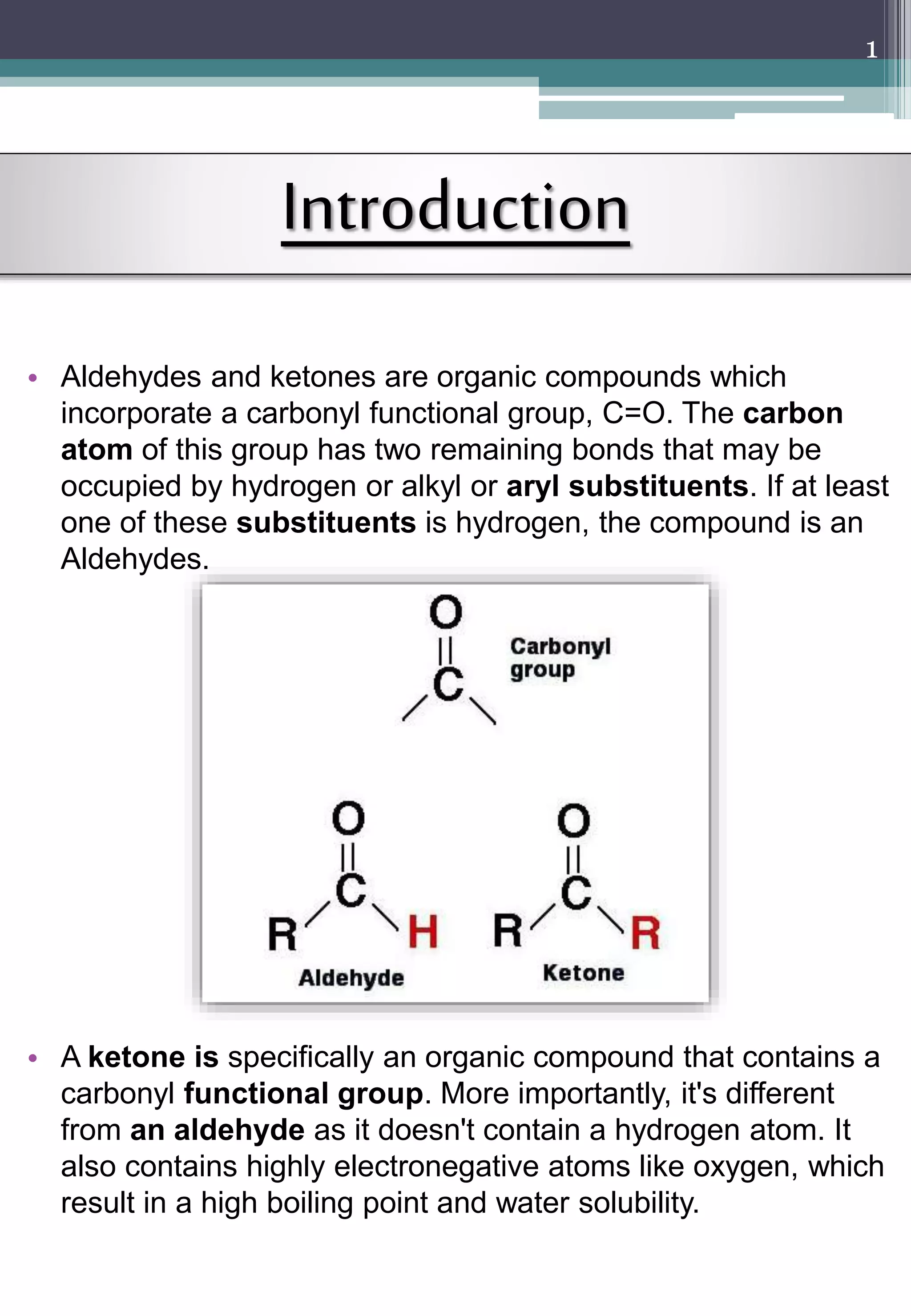
• Aldehydes and ketones are organic compounds which
incorporate a carbonyl functional group, C=O. The carbon
atom of this group has two remaining bonds that may be
occupied by hydrogen or alkyl or aryl substituents. If at least
one of these substituents is hydrogen, the compound is an
Aldehydes.
• A ketone is specifically an organic compound that contains a
carbonyl functional group. More importantly, it's different
from an aldehyde as it doesn't contain a hydrogen atom. It
also contains highly electronegative atoms like oxygen, which
result in a high boiling point and water solubility.
1
Nomenclature
• Aldehydes and ketones Aldehydes and ketones are the
simplest and most important carbonyl compounds. There are
two systems of nomenclature of aldehydes and ketones.
(a) Common names
Aldehydes and ketones are often called by their
common names instead of IUPAC names. The common names
of most aldehydes are derived from the common names of the
corresponding carboxylic acids by replacing the ending –ic of
acid with aldehyde. At the same time, the names reflect the
Latin or Greek term for the original source of the acid or
aldehyde. The location of the substituent in the carbon chain is
indicated by Greek letters α, β, γ, δ, etc.
2
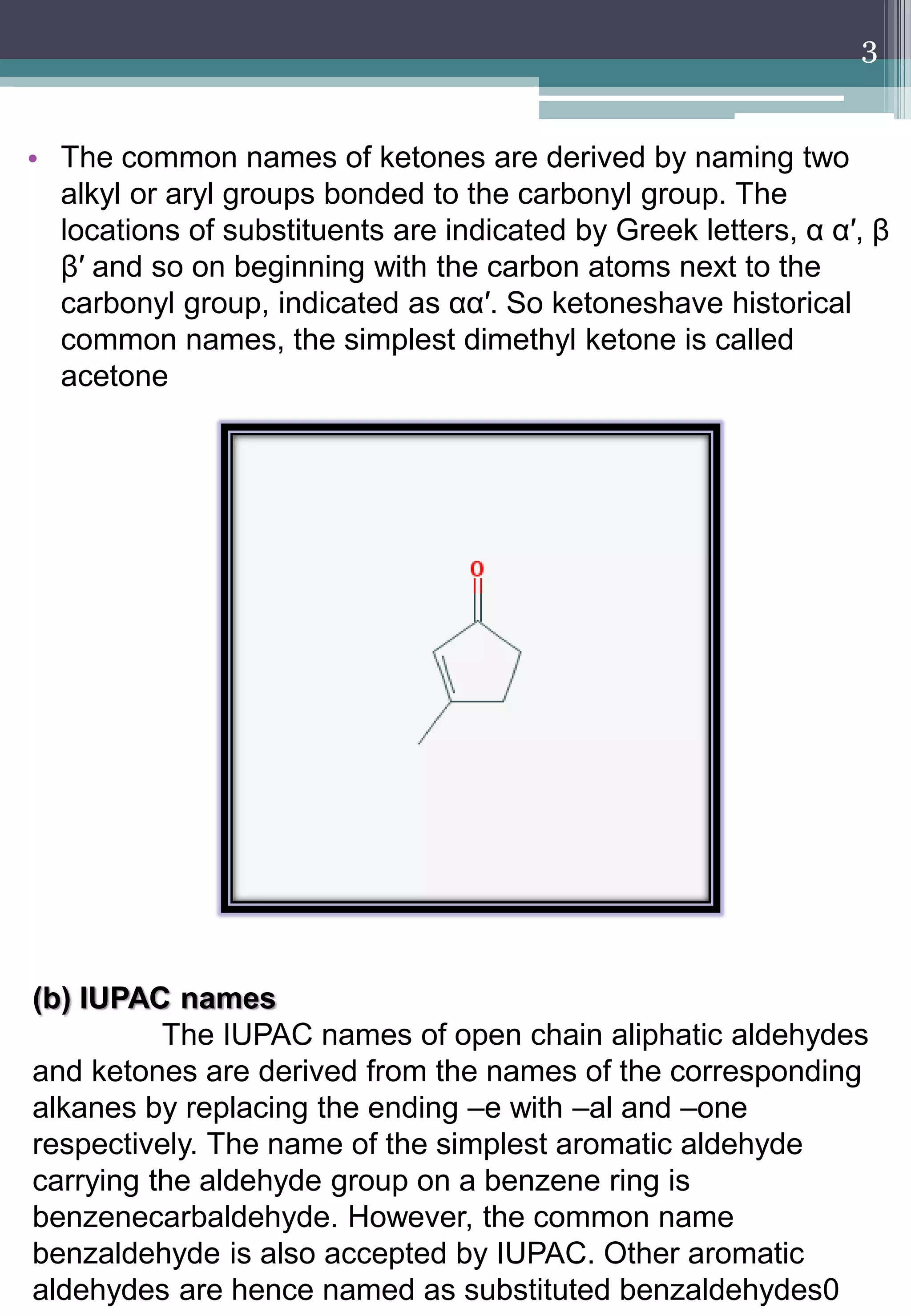
• The common names of ketones are derived by naming two
alkyl or aryl groups bonded to the carbonyl group. The
locations of substituents are indicated by Greek letters, α α′, β
β′ and so on beginning with the carbon atoms next to the
carbonyl group, indicated as αα′. So ketoneshave historical
common names, the simplest dimethyl ketone is called
acetone
(b) IUPAC names
The IUPAC names of open chain aliphatic aldehydes
and ketones are derived from the names of the corresponding
alkanes by replacing the ending –e with –al and –one
respectively. The name of the simplest aromatic aldehyde
carrying the aldehyde group on a benzene ring is
benzenecarbaldehyde. However, the common name
benzaldehyde is also accepted by IUPAC. Other aromatic
aldehydes are hence named as substituted benzaldehydes0
3
Preparing Aldehydes and Ketones
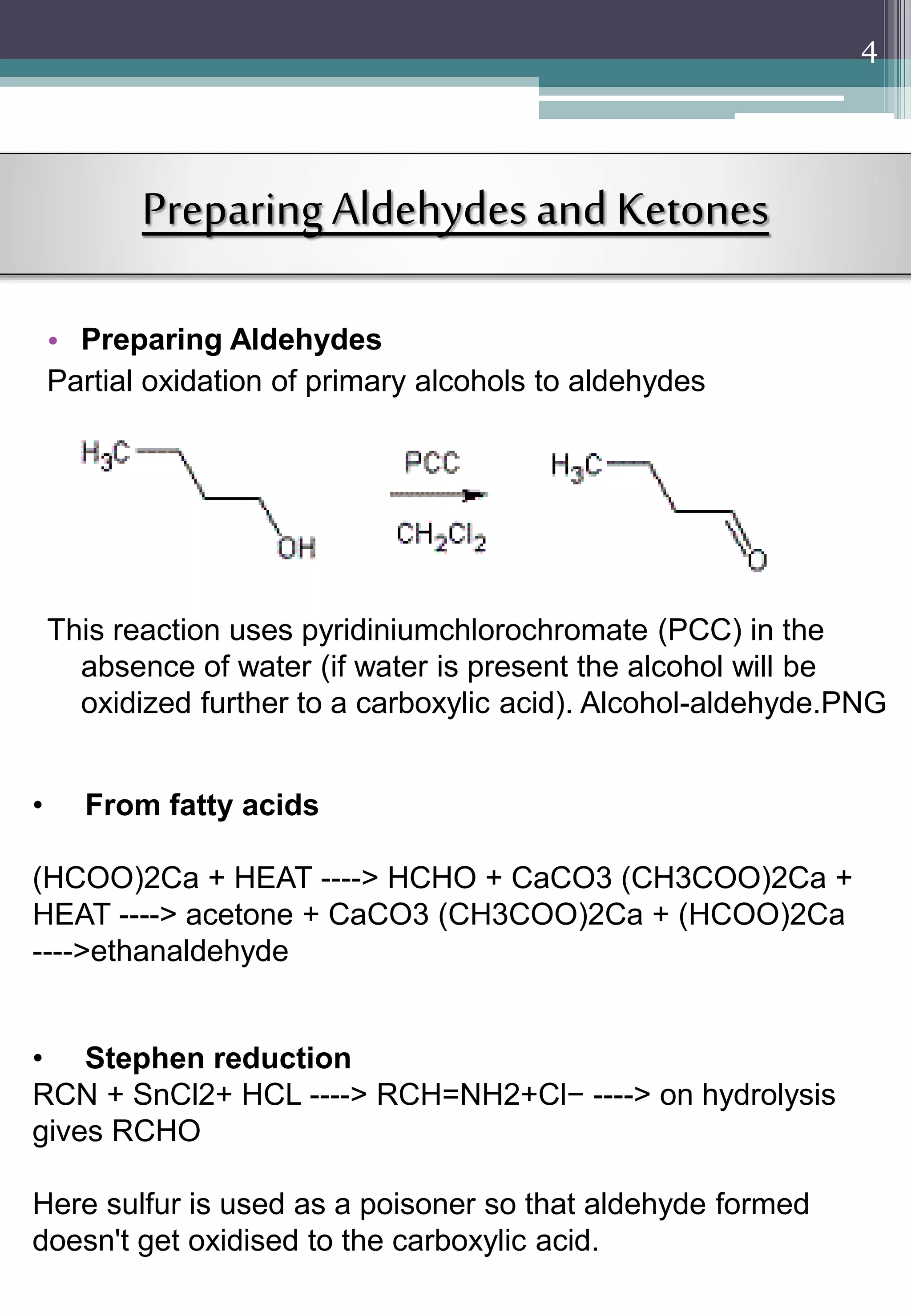
• Preparing Aldehydes
Partial oxidation of primary alcohols to aldehydes
This reaction uses pyridiniumchlorochromate (PCC) in the
absence of water (if water is present the alcohol will be
oxidized further to a carboxylic acid). Alcohol-aldehyde.PNG
• From fatty acids
(HCOO)2Ca + HEAT ----> HCHO + CaCO3 (CH3COO)2Ca +
HEAT ----> acetone + CaCO3 (CH3COO)2Ca + (HCOO)2Ca
---->ethanaldehyde
• Stephen reduction
RCN + SnCl2+ HCL ----> RCH=NH2+Cl− ----> on hydrolysis
gives RCHO
Here sulfur is used as a poisoner so that aldehyde formed
doesn't get oxidised to the carboxylic acid.
4
• Rosenmund reaction
RCOCl + Pd + BaSO4 + S ---->RCHO for solvent xylene is
used Preparing Ketones
• From Grignard reagents
RCOOR' + R'MgX ---->RCOR + R'OH
R' R' OH
| | |
RC=O + R'-MgX ---->R-C-OMgX----->R-C-OH + Mg-X
| | |
O-R' OR' OR‘
• From nitriles
RCN + R'MgX ----> RCOR'(after hydrolysis) HCN does not react
with RMgX as HCN has acidic hydrogen which results in RH
being formed.
•From gem dihalides
RCCl2R + strong base ----> RCOR
Oppenaur oxidation
Reagent is Aluminiumtert. butoxide solvent is acetone
ROH + ACETONE ----> Ketone + isopropyl alcohol this oxidation
does not affect double bonds in this oxidation ketone act as a
oxidizing agent this is exact opposite to merrwinepondroff
reduction1
5
• Friedel-Crafts acylation of aromatic compounds
An aromatic ring reacts with a carboxylic acid chlorine
(RCOCl) in the presence of AlCl3 to form an aryl ketone of the
form ArCOR.
• Oxidation of secondary alcohols to ketones
A secondary alcohol can be oxidised into a ketone using
acidified potassium dichromate(VI) and heating under reflux.
The orange dichromate(VI) ion, Cr2O72-, is reduced to
the green Cr3+(aq) ion.
• Ozonolysis of alkenes
It is a reaction in which the double bond is completely broken
and the alkene molecule converted into two smaller
molecules.
A generalized scheme of ozonolysis
Ozonolysis (cleavage "by ozone) is carried out in two stages:
first, addition of ozone to the double bond to form an ozonide ;
and second, hydrolysis of the ozonide to yield the cleavage
products.
6
Ozone gas is passed into a solution of the alkene in some inert
solvent like carbon tetrachloride; evaporation of the solvent
leaves the ozonide as a viscous oil. This unstable, explosive
compound is not purified, but is treated directly with water,
generally in the presence of a reducing agent. If oxidsing
reagent is used, aldehyde or ketone if oxidisable can further
oxidise into carboxylic acid which is not the case with reducing
agents
• Mechanism
The alkene and ozone form an intermediate molozonide in a
1,3-dipolar cycloaddition. Next, the molozonide reverts to its
corresponding carbonyl oxide (also called the Criegee
intermediate or Criegee zwitterion) and aldehyde or ketone in
a retro-1,3-dipolar cycloaddition. The oxide and aldehyde or
ketone react again in a 1,3-dipolar cycloaddition or produce a
relatively stable ozonideintermideate.
7
Reactionof Aldehydes andKetones
• Reactions with the carbonyl carbon
Since aldehydes and ketones contain a polar carbonyl group,
the partially positive carbon atom can act as an electrophile.
Strong and weak nucleophiles are able to attack this carbonyl
carbon, resulting in a net addition to the molecule.
• Nucleophilic addition
With cyanide, nucleophilicaddition occur to give a
hydroxynitrile:
RR'C=O + CN- + H+ → RR'COHCN
e.g. propanone → 2-hydroxymethylpropanonitrile
• Reactions with the carbonyl oxygen
The partially negative oxygen can act as a nucleophile, or be
attacked by electrophiles.
• Oxidation
Using a strong oxidizing agent such as the Tollens' Reagent
(Ag2O in aqueous ammonia) acidified dichromate,
Benedict's/Fehling's reagent (essentially alkaline Cu+2);
aldehydes but not ketones may be oxidized into carboxylic
acids. This is one way to test for the presence of an aldehyde
in a sample compound: an aldehyde will become a carboxylic
acid when reacted with Tollens' reagent, but a ketone will not
react. when aldehydes react with fehling solution a red
precipitate is obtained (due to formation of Cu2O) .
8
Inductive effect and Greek letter assignment
• The carbonyl group is very electron withdrawing, and adjacent
carbons are effected by induction. Using the carbonyl group
as a reference, adjacent carbons are named using Greek
letters in order of closeness to the carbonyl group. Alpha (α)
carbons are directly attached to the carbonyl group, beta (β)
carbons are connected to alpha carbons, gamma (γ) to beta
(β), and so on.
• Due to the inductive effect of the partial positive charge on the
carbonyl carbon of a ketone or aldehyde, as well as the
stabilizing resonance of the double bond between the
hydroxyl group and conjugated carbons to the carbonyl group,
the alpha (α) hydrogens are especially acidic, meaning they
are especially prone to removal.
9
Bibilography
• NCERT TextBook
• Wikipedia
• References

Aldehydes and Ketones

  • 1.
    Topic -Aldehydes ,Ketones & Carboxylic acid Session – 2017-18 Guided By Mr. M.K. Modak Principal Mr. Ram Chandran Submitted by – Shivam Jaiswal Roll No. ________ Class- 12th Science
  • 2.
    CERTIFICATE This is tocertify that Harsh Tiwari and of class XI has successfully completed this chemistry projec on the topic “ALDEHYDE, KETONES AND CARBOXYLIC ACID prescribed by Mr .M.K. Modak Sir, during academic session 2017-18 as per the guidelines issues by CBSE Class Teacher Mr. M.K. Modak Principal Mr. Ram Chandran
  • 3.
    ACKNOWLEDGEMENT In the accomplishmentof this project successfully, many people have best owned upon me their blessings and the heart pledged support, this time I am utilizing to thank all the people who have been concerned with the project. Primarily I would thank ALLONS PUBLIC SCHOOL for being able to complete this project with success. Then I would like to thank my principal Mr RAMCHANDRAN and my CHEMISTRY teacher Mr. M.K MODAK, whose valuable guidance has been the ones that helped me patch this project and make it full proof success her suggestions and her instructions has served as the major contributor towards the completion of the project. Then I would like to thank my parents and friends who have helped me with their valuable suggestions and guidance has been helpful in various phases of the completion of the project. Last but not the least I would like to thank my classmates who have helped me a lot.
  • 4.
    INDEX Sr. No. ContentsPg No. 1 Introduction 1 - 1 2 Nomenclature 2 - 3 3 Preparing of Aldehydes and ketones 4 - 7 4 Reactions of Aldehydes and Ketones 8- 8 5 Inductive effect and Greek letter assignment 9-9
  • 5.
    Introduction • Aldehydes andketones are organic compounds which incorporate a carbonyl functional group, C=O. The carbon atom of this group has two remaining bonds that may be occupied by hydrogen or alkyl or aryl substituents. If at least one of these substituents is hydrogen, the compound is an Aldehydes. • A ketone is specifically an organic compound that contains a carbonyl functional group. More importantly, it's different from an aldehyde as it doesn't contain a hydrogen atom. It also contains highly electronegative atoms like oxygen, which result in a high boiling point and water solubility. 1
  • 6.
    Nomenclature • Aldehydes andketones Aldehydes and ketones are the simplest and most important carbonyl compounds. There are two systems of nomenclature of aldehydes and ketones. (a) Common names Aldehydes and ketones are often called by their common names instead of IUPAC names. The common names of most aldehydes are derived from the common names of the corresponding carboxylic acids by replacing the ending –ic of acid with aldehyde. At the same time, the names reflect the Latin or Greek term for the original source of the acid or aldehyde. The location of the substituent in the carbon chain is indicated by Greek letters α, β, γ, δ, etc. 2
  • 7.
    • The commonnames of ketones are derived by naming two alkyl or aryl groups bonded to the carbonyl group. The locations of substituents are indicated by Greek letters, α α′, β β′ and so on beginning with the carbon atoms next to the carbonyl group, indicated as αα′. So ketoneshave historical common names, the simplest dimethyl ketone is called acetone (b) IUPAC names The IUPAC names of open chain aliphatic aldehydes and ketones are derived from the names of the corresponding alkanes by replacing the ending –e with –al and –one respectively. The name of the simplest aromatic aldehyde carrying the aldehyde group on a benzene ring is benzenecarbaldehyde. However, the common name benzaldehyde is also accepted by IUPAC. Other aromatic aldehydes are hence named as substituted benzaldehydes0 3
  • 8.
    Preparing Aldehydes andKetones • Preparing Aldehydes Partial oxidation of primary alcohols to aldehydes This reaction uses pyridiniumchlorochromate (PCC) in the absence of water (if water is present the alcohol will be oxidized further to a carboxylic acid). Alcohol-aldehyde.PNG • From fatty acids (HCOO)2Ca + HEAT ----> HCHO + CaCO3 (CH3COO)2Ca + HEAT ----> acetone + CaCO3 (CH3COO)2Ca + (HCOO)2Ca ---->ethanaldehyde • Stephen reduction RCN + SnCl2+ HCL ----> RCH=NH2+Cl− ----> on hydrolysis gives RCHO Here sulfur is used as a poisoner so that aldehyde formed doesn't get oxidised to the carboxylic acid. 4
  • 9.
    • Rosenmund reaction RCOCl+ Pd + BaSO4 + S ---->RCHO for solvent xylene is used Preparing Ketones • From Grignard reagents RCOOR' + R'MgX ---->RCOR + R'OH R' R' OH | | | RC=O + R'-MgX ---->R-C-OMgX----->R-C-OH + Mg-X | | | O-R' OR' OR‘ • From nitriles RCN + R'MgX ----> RCOR'(after hydrolysis) HCN does not react with RMgX as HCN has acidic hydrogen which results in RH being formed. •From gem dihalides RCCl2R + strong base ----> RCOR Oppenaur oxidation Reagent is Aluminiumtert. butoxide solvent is acetone ROH + ACETONE ----> Ketone + isopropyl alcohol this oxidation does not affect double bonds in this oxidation ketone act as a oxidizing agent this is exact opposite to merrwinepondroff reduction1 5
  • 10.
    • Friedel-Crafts acylationof aromatic compounds An aromatic ring reacts with a carboxylic acid chlorine (RCOCl) in the presence of AlCl3 to form an aryl ketone of the form ArCOR. • Oxidation of secondary alcohols to ketones A secondary alcohol can be oxidised into a ketone using acidified potassium dichromate(VI) and heating under reflux. The orange dichromate(VI) ion, Cr2O72-, is reduced to the green Cr3+(aq) ion. • Ozonolysis of alkenes It is a reaction in which the double bond is completely broken and the alkene molecule converted into two smaller molecules. A generalized scheme of ozonolysis Ozonolysis (cleavage "by ozone) is carried out in two stages: first, addition of ozone to the double bond to form an ozonide ; and second, hydrolysis of the ozonide to yield the cleavage products. 6
  • 11.
    Ozone gas ispassed into a solution of the alkene in some inert solvent like carbon tetrachloride; evaporation of the solvent leaves the ozonide as a viscous oil. This unstable, explosive compound is not purified, but is treated directly with water, generally in the presence of a reducing agent. If oxidsing reagent is used, aldehyde or ketone if oxidisable can further oxidise into carboxylic acid which is not the case with reducing agents • Mechanism The alkene and ozone form an intermediate molozonide in a 1,3-dipolar cycloaddition. Next, the molozonide reverts to its corresponding carbonyl oxide (also called the Criegee intermediate or Criegee zwitterion) and aldehyde or ketone in a retro-1,3-dipolar cycloaddition. The oxide and aldehyde or ketone react again in a 1,3-dipolar cycloaddition or produce a relatively stable ozonideintermideate. 7
  • 12.
    Reactionof Aldehydes andKetones •Reactions with the carbonyl carbon Since aldehydes and ketones contain a polar carbonyl group, the partially positive carbon atom can act as an electrophile. Strong and weak nucleophiles are able to attack this carbonyl carbon, resulting in a net addition to the molecule. • Nucleophilic addition With cyanide, nucleophilicaddition occur to give a hydroxynitrile: RR'C=O + CN- + H+ → RR'COHCN e.g. propanone → 2-hydroxymethylpropanonitrile • Reactions with the carbonyl oxygen The partially negative oxygen can act as a nucleophile, or be attacked by electrophiles. • Oxidation Using a strong oxidizing agent such as the Tollens' Reagent (Ag2O in aqueous ammonia) acidified dichromate, Benedict's/Fehling's reagent (essentially alkaline Cu+2); aldehydes but not ketones may be oxidized into carboxylic acids. This is one way to test for the presence of an aldehyde in a sample compound: an aldehyde will become a carboxylic acid when reacted with Tollens' reagent, but a ketone will not react. when aldehydes react with fehling solution a red precipitate is obtained (due to formation of Cu2O) . 8
  • 13.
    Inductive effect andGreek letter assignment • The carbonyl group is very electron withdrawing, and adjacent carbons are effected by induction. Using the carbonyl group as a reference, adjacent carbons are named using Greek letters in order of closeness to the carbonyl group. Alpha (α) carbons are directly attached to the carbonyl group, beta (β) carbons are connected to alpha carbons, gamma (γ) to beta (β), and so on. • Due to the inductive effect of the partial positive charge on the carbonyl carbon of a ketone or aldehyde, as well as the stabilizing resonance of the double bond between the hydroxyl group and conjugated carbons to the carbonyl group, the alpha (α) hydrogens are especially acidic, meaning they are especially prone to removal. 9
  • 14.
    Bibilography • NCERT TextBook •Wikipedia • References