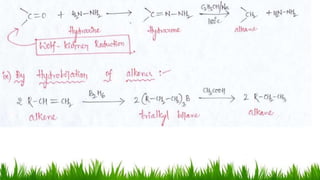

BY
VANA JAGAN MOHAN RAO M.S.Pharm, MED.CHEM
NIPER-KOLKATA
Asst.Professor, MIPER-KURNOOL
Email: jaganvana6@gmail.com
INTRODUCTION
 Alkanes are a homologous series of saturated
hydrocarbons that contain only
carbon-carbon single covalent bonds.
 In an alkane molecule, all the outer electrons of each carbon
are used in forming single covalent bonds with four other
atoms, hence, alkanes are said to be saturated.
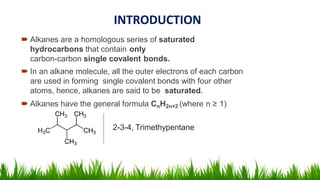
 Alkanes have the general formula CnH2n+2 (where n ≥ 1)
2-3-4, Trimethypentane
NOMENCLATURE
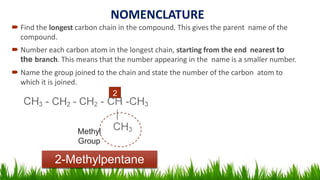
 Find the longest carbon chain in the compound. This gives the parent name of the
compound.
 Number each carbon atom in the longest chain, starting from the end nearest to
the branch. This means that the number appearing in the name is a smaller number.
 Name the group joined to the chain and state the number of the carbon atom to
which it is joined.
Methyl
Group
2
2-Methylpentane
Continue . . .
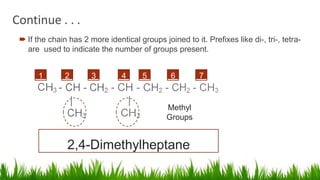
 If the chain has 2 more identical groups joined to it. Prefixes like di-, tri-, tetra-
are used to indicate the number of groups present.
1 2 3 4 5 6 7
Methyl
Groups
2,4-Dimethylheptane
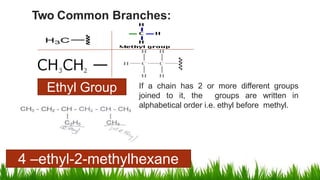
Two Common Branches:
Ethyl Group If a chain has 2 or more different groups
joined to it, the groups are written in
alphabetical order i.e. ethyl before methyl.
4 –ethyl-2-methylhexane
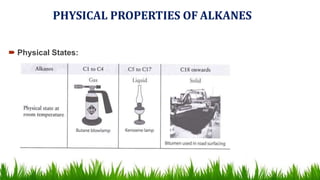
PHYSICAL PROPERTIES OF ALKANES
 Physical States:
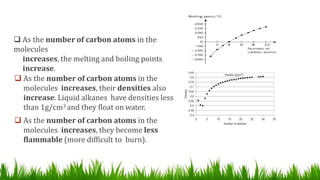
 As the number of carbon atoms in the
molecules
increases, the melting and boiling points
increase.
 As the number of carbon atoms in the
molecules increases, their densities also
increase. Liquid alkanes have densities less
than 1g/cm3 and they float on water.
 As the number of carbon atoms in the
molecules increases, they become less
flammable (more difficult to burn).
 Generally, alkanes have low melting and boiling points. This is due to the
weak intermolecular forces of attraction (van der Waals’ forces) which
can be overcome by a small amount of heat energy.
 As the alkane molecules become larger (increase in the number of carbon
atoms in the molecules, the intermolecular forces of attraction become
stronger.
 More heat energy is needed to overcome the intermolecular forces of
attraction to separate the molecules and the melting and boiling points
increase.
 As the number of carbon atoms in the molecules increases, they become
less viscous (flow less easily). This is due to the stronger intermolecular
forces of attraction and Larger molecules get tangled together easily.
CHEMICAL PROPERTIES OF ALKANES
 Alkanes are generally unreactive.
 This is because alkane molecules contain single carbon-carbon covalent bonds (C-C) and single carbon-
hydrogen covalent bonds (C-H) which are strong and require a lot of energy to break.
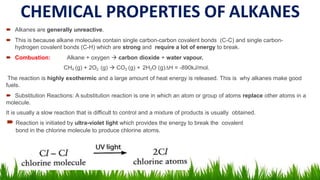
 Combustion: Alkane + oxygen  carbon dioxide + water vapour.
CH4 (g) + 2O2 (g)  CO2 (g) + 2H2O (g)∆H = -890kJ/mol.
The reaction is highly exothermic and a large amount of heat energy is released. This is why alkanes make good
fuels.
 Substitution Reactions: A substitution reaction is one in which an atom or group of atoms replace other atoms in a
molecule.
It is usually a slow reaction that is difficult to control and a mixture of products is usually obtained.
 Reaction is initiated by ultra-violet light which provides the energy to break the covalent
bond in the chlorine molecule to produce chlorine atoms.
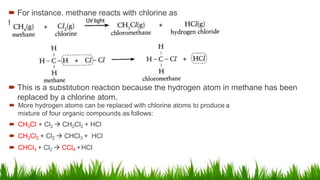
 For instance, methane reacts with chlorine as
follows:
 This is a substitution reaction because the hydrogen atom in methane has been
replaced by a chlorine atom.
 More hydrogen atoms can be replaced with chlorine atoms to produce a
mixture of four organic compounds as follows:
 CH3Cl + Cl2  CH2Cl2 + HCl
 CH2Cl2 + Cl2  CHCl3 + HCl
 CHCl3 + Cl2  CCl4 +HCl
REACTIONS OF ALKANES
COMBUSTION
 Alkanes are unreactive as a family because of the strong C–C and C–H bonds as
well as them being nonpolar compounds.
 At room temperature alkanes do not react with acids, bases, or strong
oxidizing agents.
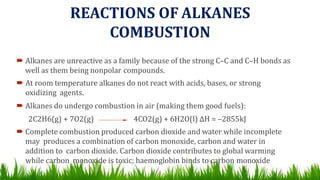
 Alkanes do undergo combustion in air (making them good fuels):
2C2H6(g) + 7O2(g) 4CO2(g) + 6H2O(l) ∆H = –2855kJ
 Complete combustion produced carbon dioxide and water while incomplete
may produces a combination of carbon monoxide, carbon and water in
addition to carbon dioxide. Carbon dioxide contributes to global warming
while carbon monoxide is toxic; haemoglobin binds to carbon monoxide
PRODUCTS OF COMBUSTION
Complete combustion produces:
 carbon dioxide
 water vapour
while incomplete may produces a combination of :
 carbon monoxide
 carbon
 water vapour
 carbon dioxide.
Carbon dioxide contributes to global warming.
Carbon monoxide is toxic; haemoglobin binds to carbon monoxide in preference to oxygen causing
suffocation and even death.
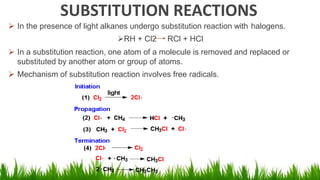
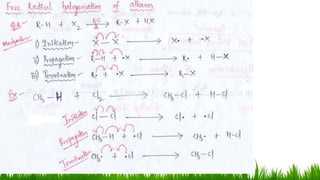
SUBSTITUTION REACTIONS
 In the presence of light alkanes undergo substitution reaction with halogens.
RH + Cl2 RCl + HCl
 In a substitution reaction, one atom of a molecule is removed and replaced or
substituted by another atom or group of atoms.
 Mechanism of substitution reaction involves free radicals.
APPLICATIONS AND USES OF ALKANES
 The first four alkanes are used for heating ,cooking and electricity generation. The main
components of natural gas are methane and ethane.
 Propane and Butane are used as LPG(liquified pterolium gas). Propane is also used in the propane
gas burner, butane in disposable cigarette lighters. they are also used as propellants in Aerosol
sprays.
 Alkane having carbon number 5-8 are volatile liquids. They are used as fuels and as good solvents
for nonpolar substances.
 Alkanes from having carbon 9-16 form the major part of Diesel and aviation fuel.
 Alkanes from 17 carbon upwards form the most important components of Fuel oil and lubricating
oil also used as anti-corrosive agents.
 Alkanes with 35 or more carbon atoms are used for road surfacing.
Alkanes

Alkanes

  • 1.
    BY VANA JAGAN MOHANRAO M.S.Pharm, MED.CHEM NIPER-KOLKATA Asst.Professor, MIPER-KURNOOL Email: jaganvana6@gmail.com
  • 2.
    INTRODUCTION  Alkanes area homologous series of saturated hydrocarbons that contain only carbon-carbon single covalent bonds.  In an alkane molecule, all the outer electrons of each carbon are used in forming single covalent bonds with four other atoms, hence, alkanes are said to be saturated.  Alkanes have the general formula CnH2n+2 (where n ≥ 1) 2-3-4, Trimethypentane
  • 3.
    NOMENCLATURE  Find thelongest carbon chain in the compound. This gives the parent name of the compound.  Number each carbon atom in the longest chain, starting from the end nearest to the branch. This means that the number appearing in the name is a smaller number.  Name the group joined to the chain and state the number of the carbon atom to which it is joined. Methyl Group 2 2-Methylpentane
  • 4.
    Continue . ..  If the chain has 2 more identical groups joined to it. Prefixes like di-, tri-, tetra- are used to indicate the number of groups present. 1 2 3 4 5 6 7 Methyl Groups 2,4-Dimethylheptane
  • 5.
    Two Common Branches: EthylGroup If a chain has 2 or more different groups joined to it, the groups are written in alphabetical order i.e. ethyl before methyl. 4 –ethyl-2-methylhexane
  • 6.
    PHYSICAL PROPERTIES OFALKANES  Physical States:
  • 7.
     As thenumber of carbon atoms in the molecules increases, the melting and boiling points increase.  As the number of carbon atoms in the molecules increases, their densities also increase. Liquid alkanes have densities less than 1g/cm3 and they float on water.  As the number of carbon atoms in the molecules increases, they become less flammable (more difficult to burn).
  • 8.
     Generally, alkaneshave low melting and boiling points. This is due to the weak intermolecular forces of attraction (van der Waals’ forces) which can be overcome by a small amount of heat energy.  As the alkane molecules become larger (increase in the number of carbon atoms in the molecules, the intermolecular forces of attraction become stronger.  More heat energy is needed to overcome the intermolecular forces of attraction to separate the molecules and the melting and boiling points increase.  As the number of carbon atoms in the molecules increases, they become less viscous (flow less easily). This is due to the stronger intermolecular forces of attraction and Larger molecules get tangled together easily.
  • 14.
    CHEMICAL PROPERTIES OFALKANES  Alkanes are generally unreactive.  This is because alkane molecules contain single carbon-carbon covalent bonds (C-C) and single carbon- hydrogen covalent bonds (C-H) which are strong and require a lot of energy to break.  Combustion: Alkane + oxygen  carbon dioxide + water vapour. CH4 (g) + 2O2 (g)  CO2 (g) + 2H2O (g)∆H = -890kJ/mol. The reaction is highly exothermic and a large amount of heat energy is released. This is why alkanes make good fuels.  Substitution Reactions: A substitution reaction is one in which an atom or group of atoms replace other atoms in a molecule. It is usually a slow reaction that is difficult to control and a mixture of products is usually obtained.  Reaction is initiated by ultra-violet light which provides the energy to break the covalent bond in the chlorine molecule to produce chlorine atoms.
  • 15.
     For instance,methane reacts with chlorine as follows:  This is a substitution reaction because the hydrogen atom in methane has been replaced by a chlorine atom.  More hydrogen atoms can be replaced with chlorine atoms to produce a mixture of four organic compounds as follows:  CH3Cl + Cl2  CH2Cl2 + HCl  CH2Cl2 + Cl2  CHCl3 + HCl  CHCl3 + Cl2  CCl4 +HCl
  • 16.
    REACTIONS OF ALKANES COMBUSTION Alkanes are unreactive as a family because of the strong C–C and C–H bonds as well as them being nonpolar compounds.  At room temperature alkanes do not react with acids, bases, or strong oxidizing agents.  Alkanes do undergo combustion in air (making them good fuels): 2C2H6(g) + 7O2(g) 4CO2(g) + 6H2O(l) ∆H = –2855kJ  Complete combustion produced carbon dioxide and water while incomplete may produces a combination of carbon monoxide, carbon and water in addition to carbon dioxide. Carbon dioxide contributes to global warming while carbon monoxide is toxic; haemoglobin binds to carbon monoxide
  • 17.
    PRODUCTS OF COMBUSTION Completecombustion produces:  carbon dioxide  water vapour while incomplete may produces a combination of :  carbon monoxide  carbon  water vapour  carbon dioxide. Carbon dioxide contributes to global warming. Carbon monoxide is toxic; haemoglobin binds to carbon monoxide in preference to oxygen causing suffocation and even death.
  • 18.
    SUBSTITUTION REACTIONS  Inthe presence of light alkanes undergo substitution reaction with halogens. RH + Cl2 RCl + HCl  In a substitution reaction, one atom of a molecule is removed and replaced or substituted by another atom or group of atoms.  Mechanism of substitution reaction involves free radicals.
  • 20.
    APPLICATIONS AND USESOF ALKANES  The first four alkanes are used for heating ,cooking and electricity generation. The main components of natural gas are methane and ethane.  Propane and Butane are used as LPG(liquified pterolium gas). Propane is also used in the propane gas burner, butane in disposable cigarette lighters. they are also used as propellants in Aerosol sprays.  Alkane having carbon number 5-8 are volatile liquids. They are used as fuels and as good solvents for nonpolar substances.  Alkanes from having carbon 9-16 form the major part of Diesel and aviation fuel.  Alkanes from 17 carbon upwards form the most important components of Fuel oil and lubricating oil also used as anti-corrosive agents.  Alkanes with 35 or more carbon atoms are used for road surfacing.