ALDEHYDES, KETONES,
AND CARBOXYLIC ACIDS
INTRODUCTION
• In aldehydes, the carbonyl group is bonded to a carbon and
hydrogen.
• In ketones, it is bonded to two carbon atoms.
• The carbonyl compounds in which carbonyl group is bonded to
oxygen are known as carboxylic acids, and their derivatives (e.g.
esters, anhydrides) while in compounds where carbon is attached
to nitrogen and to halogens are called amides and acyl halides
respectively.
Nomenclature and Structure of Carbonyl Group
• Aldehydes and ketones
(a) Common names
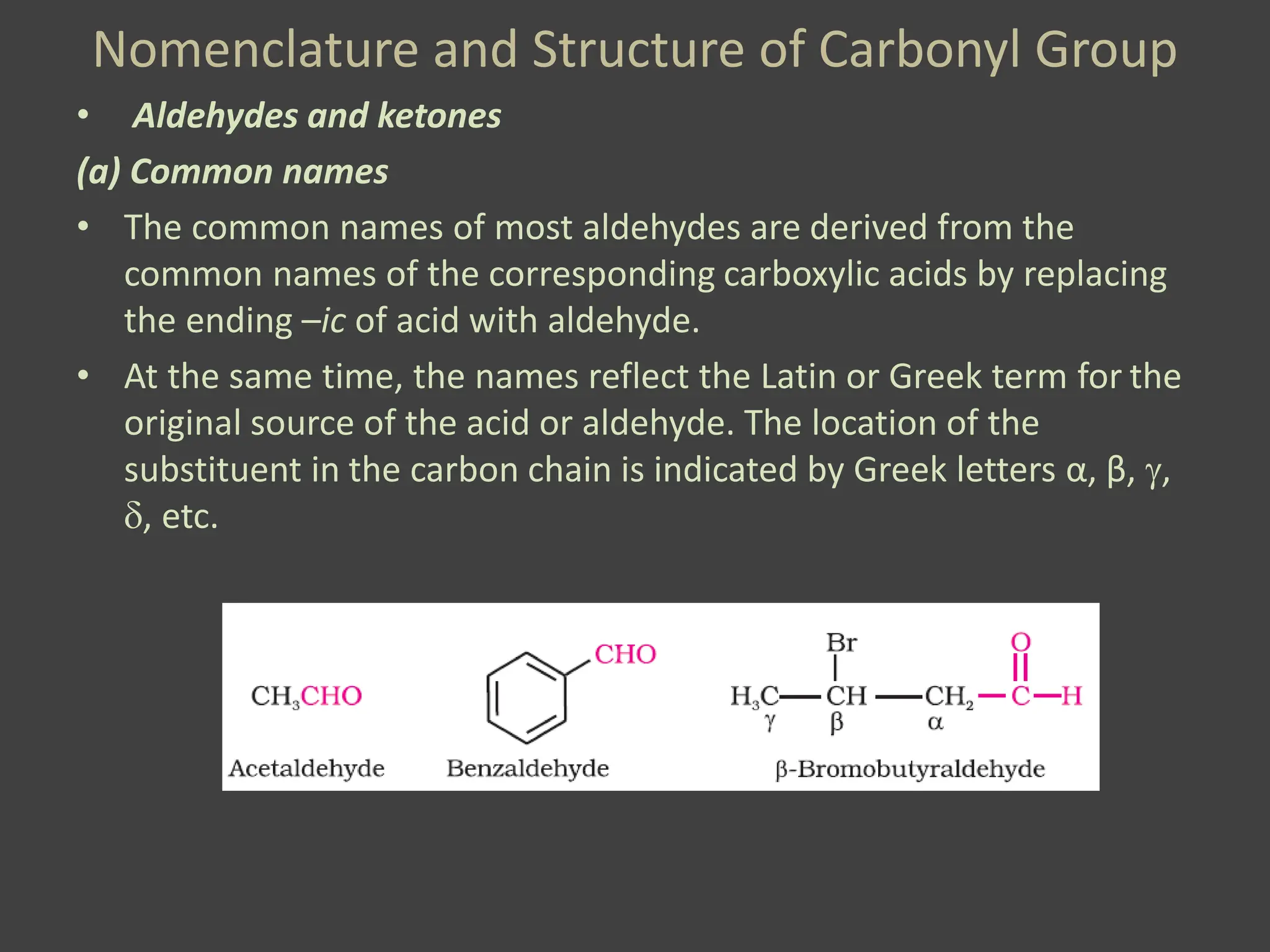
• The common names of most aldehydes are derived from the
common names of the corresponding carboxylic acids by replacing
the ending –ic of acid with aldehyde.
• At the same time, the names reflect the Latin or Greek term for the
original source of the acid or aldehyde. The location of the
substituent in the carbon chain is indicated by Greek letters α, β, ,
, etc.
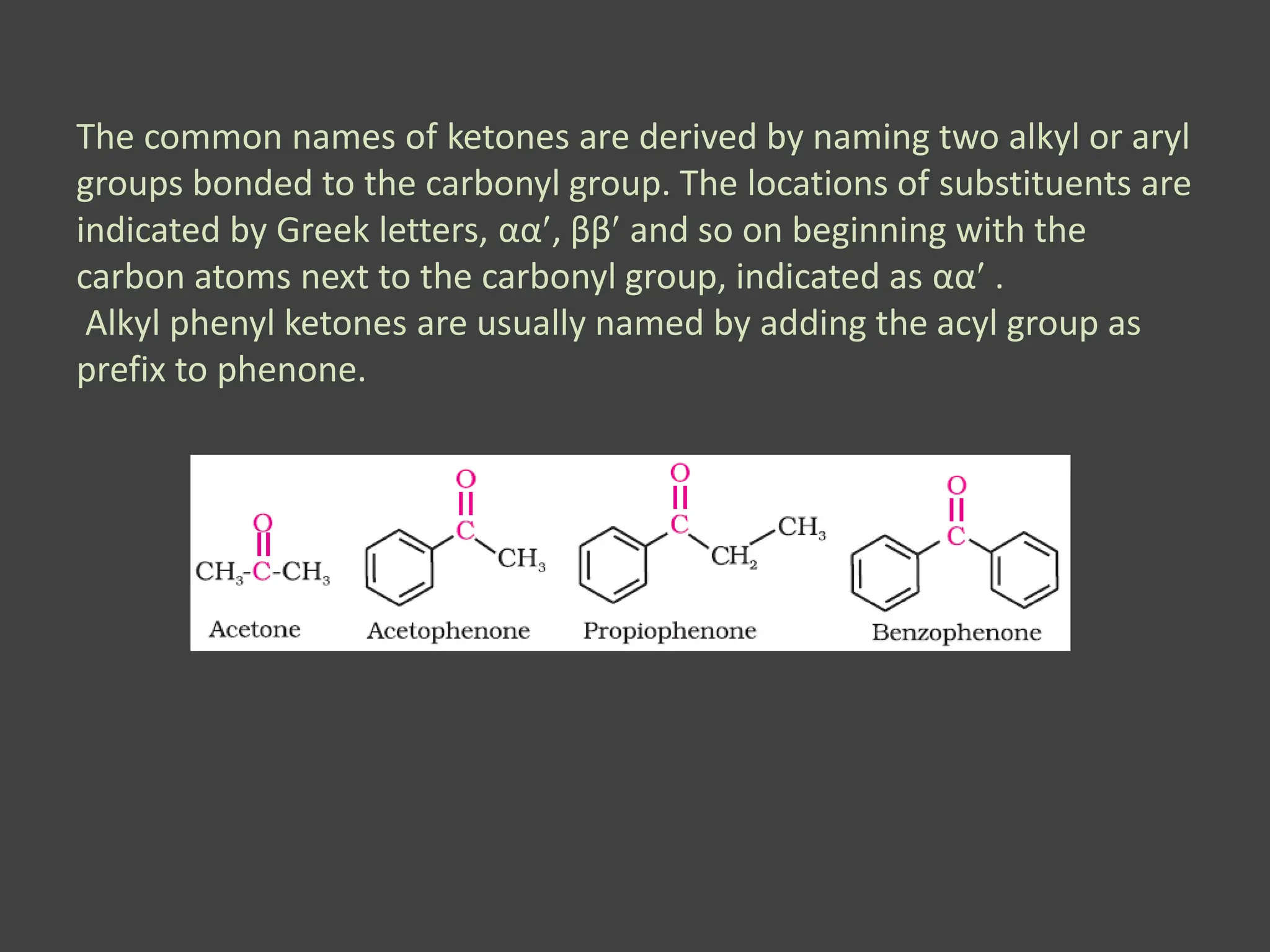
The common names of ketones are derived by naming two alkyl or aryl
groups bonded to the carbonyl group. The locations of substituents are
indicated by Greek letters, αα, ββ and so on beginning with the
carbon atoms next to the carbonyl group, indicated as αα .
Alkyl phenyl ketones are usually named by adding the acyl group as
prefix to phenone.
(b) IUPAC names
• The IUPAC names of open chain aliphatic aldehydes and ketones are
derived from the names of the corresponding alkanes by replacing
the ending –e with –al and –one respectively.
• The substituents are prefixed in alphabetical order along with
numerals indicating their positions in the carbon chain. The same
applies to cyclic ketones. When the aldehyde group is attached to a
ring, the suffix carbaldehyde is added after the full name of the
cycloalkane.
• The name of the simplest aromatic aldehyde carrying the aldehyde
group on a benzene ring is benzenecarbaldehyde.
Structure of the Carbonyl Group
• The carbonyl carbon atom is sp2-hybridised and forms three sigma
bonds. The fourth valence electron of carbon remains in its p-
orbital and forms a π-bond with oxygen by overlap with p-orbital of
an oxygen.
• In addition, the oxygen atom also has two non bonding electron
pairs.
• Thus, the carbonyl carbon and the three atoms attached to it lie in
the same plane and the π-electron cloud is above and below this
plane. The bond angles are approximately 120° as expected of a
trigonal coplanar structure
Preparation of Aldehydes and Ketones
1.By oxidation of alcohols
• Aldehydes and ketones are generally prepared by oxidation of
primary and secondary alcohols, respectively.
2. By dehydrogenation of alcohols
• This method is suitable for volatile alcohols and is of industrial
application. In this method alcohol vapours are passed over heavy
metal catalysts (Ag or Cu). Primary and secondary alcohols give
aldehydes and ketones, respectively.
3. From hydrocarbons
• (i) By ozonolysis of alkenes: As we know, ozonolysis of alkenes
followed by reaction with zinc dust and water gives aldehydes,
ketones or a mixture of both depending on the substitution pattern
of the alkene.
• (ii) By hydration of alkynes: Addition of water to ethyne in the
presence of H2SO4 and HgSO4 gives acetaldehyde. All other
alkynes give ketones in this reaction.
Preparation of Aldehydes
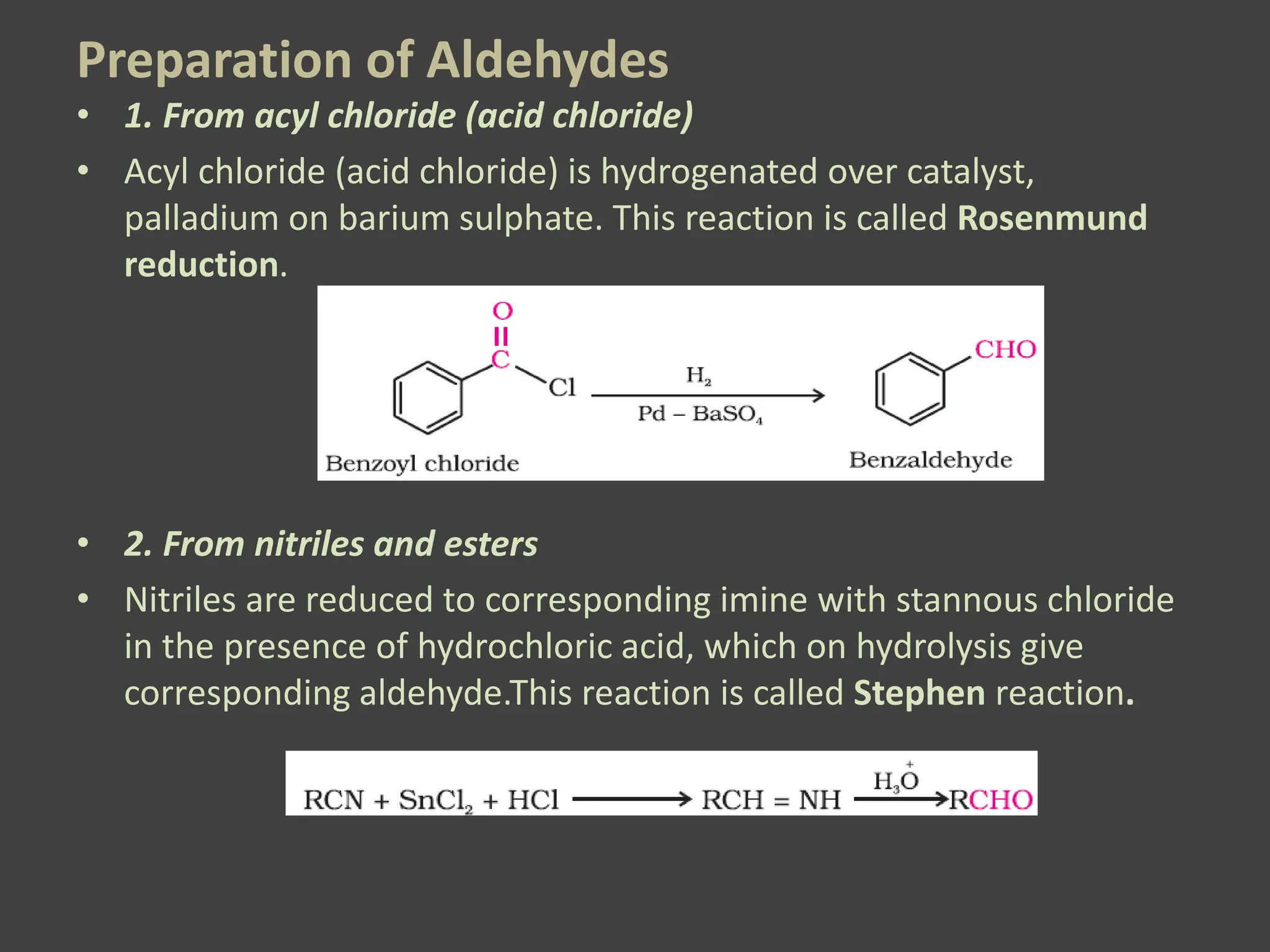
• 1. From acyl chloride (acid chloride)
• Acyl chloride (acid chloride) is hydrogenated over catalyst,
palladium on barium sulphate. This reaction is called Rosenmund
reduction.
• 2. From nitriles and esters
• Nitriles are reduced to corresponding imine with stannous chloride
in the presence of hydrochloric acid, which on hydrolysis give
corresponding aldehyde.This reaction is called Stephen reaction.
3. From hydrocarbons
Aromatic aldehydes (benzaldehyde and its derivatives) are prepared
from aromatic hydrocarbons by the following methods:
(i) By oxidation of methylbenzene
Strong oxidising agents oxidise toluene and its derivatives to benzoic acids.
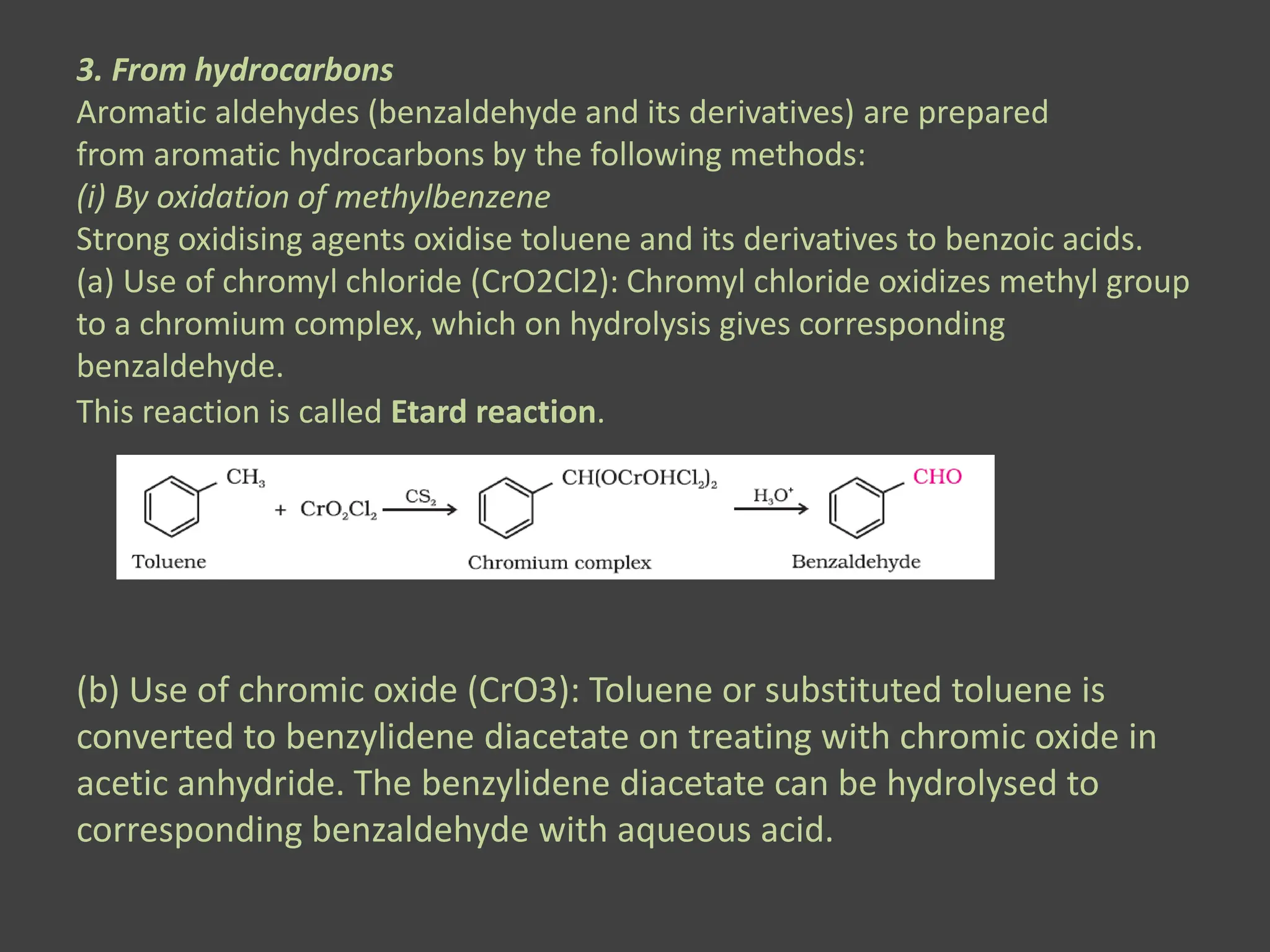
(a) Use of chromyl chloride (CrO2Cl2): Chromyl chloride oxidizes methyl group
to a chromium complex, which on hydrolysis gives corresponding
benzaldehyde.
This reaction is called Etard reaction.
(b) Use of chromic oxide (CrO3): Toluene or substituted toluene is
converted to benzylidene diacetate on treating with chromic oxide in
acetic anhydride. The benzylidene diacetate can be hydrolysed to
corresponding benzaldehyde with aqueous acid.
(ii) By side chain chlorination followed by hydrolysis
Side chain chlorination of toluene gives benzal chloride, which on hydrolysis
gives benzaldehyde. This is a commercial method of manufacture of
benzaldehyde. This reaction is known as Gatterman-Koch reaction.
(iii) By Gatterman – Koch reaction
When benzene or its derivative is treated with carbon monoxide and
hydrogen chloride in the presence of anhydrous aluminium chloride or
cuprous chloride, it gives benzaldehyde or substituted benzaldehyde.
3 Preparation of Ketones
1. From acyl chlorides
• Treatment of acyl chlorides with dialkylcadmium, prepared by the
reaction of cadmium chloride with Grignard reagent, gives ketones.
2. From nitriles
• Treating a nitrile with Grignard reagent followed by hydrolysis yields a
ketone.
3. From benzene or substituted benzenes
• When benzene is treated with acid chloride in the presence of
anhydrous aluminium chloride, it goves corresponding ketone. This
reaction is known as Friedel-Crafts acylation reaction.
Physical Properties
• Methanal is a gas at room temperature. Ethanal is a volatile liquid.
• Other aldehydes and ketones are liquid or solid at room
temperature.
• The boiling points of aldehydes and ketones are higher than
hydrocarbons and ethers. It is due to weak molecular association in
aldehydes and ketones arising out of the dipole-dipole interactions.
• Also, their boiling points are lower than those of alcohols due to
absence of intermolecular hydrogen bonding.
• The lower members of aldehydes and ketones such as methanal,
ethanal and propanone are miscible with water in all proportions,
because they form hydrogen bond with water.
• The solubility of aldehydes and ketones decreases rapidly on
increasing the length of alkyl chain. All aldehydes and ketones are
fairly soluble in organic solvents like benzene, ether, methanol,
chloroform, etc.
• The lower aldehydes have sharp pungent odours. As the size of the
molecule increases, the odour becomes less pungent and more
fragrant
Chemical Reactions
1. Nucleophilic addition reactions
• (i) Mechanism of nucleophilic addition reactions
• A nucleophile attacks the electrophilic carbon atom of the polar
carbonyl group from a direction approximately perpendicular to the
plane of sp2 hybridised orbitals of carbonyl carbon.
• The hybridisation of carbon changes from sp2 to sp3 in this process,
and a tetrahedral alkoxide intermediate is produced. This
intermediate captures a proton from the reaction medium to give
the electrically neutral product. The net result is addition of Nu–
and H+ across the carbon oxygen double bond.
• (ii) Reactivity
• Aldehydes are generally more reactive than ketones in nucleophilic
addition reactions due to steric and electronic reasons.
Electronically, aldehydes are more reactive than ketones because
two alkyl groups reduce the electrophilicity of the carbonyl more
effectively than in former.
(iii) Some important examples of nucleophilic addition and
nucleophilic addition-elimination reactions:
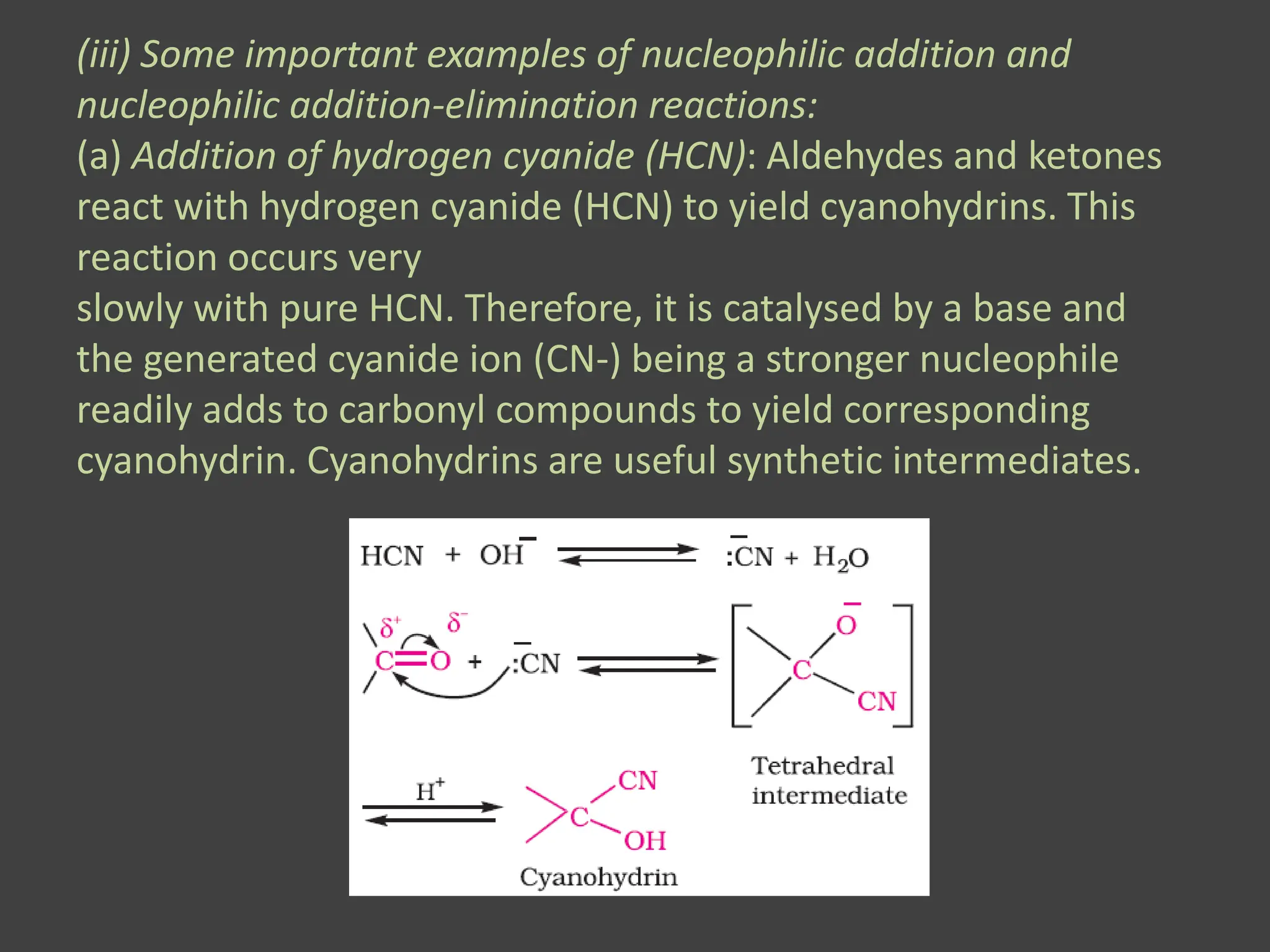
(a) Addition of hydrogen cyanide (HCN): Aldehydes and ketones
react with hydrogen cyanide (HCN) to yield cyanohydrins. This
reaction occurs very
slowly with pure HCN. Therefore, it is catalysed by a base and
the generated cyanide ion (CN-) being a stronger nucleophile
readily adds to carbonyl compounds to yield corresponding
cyanohydrin. Cyanohydrins are useful synthetic intermediates.
(b) Addition of sodium hydrogensulphite: Sodium hydrogensulphite adds to
aldehydes and ketones to form the addition products. The position ofthe
equilibrium lies largely to the right hand side for most aldehydes and to
the left for most ketones due to steric reasons.
The hydrogensulphite addition compound is water soluble and can be
converted back to the original carbonyl compound by treating it with
dilute mineral acid or alkali. Therefore, these are useful for separation
and purification of aldehydes.
(c) Addition of Grignard reagents:
(d) Addition of alcohols: Aldehydes react with one equivalent of
monohydric alcohol in the presence of dry hydrogen chloride to yield
alkoxyalcohol intermediate, known as hemiacetals, which further react
with one more molecule of alcohol to give a gem-dialkoxy compound
known as acetal.
Ketones react with ethylene glycol under similar conditions to form
cyclic products known as ethylene glycol ketals. Acetals and ketals are
hydrolysed with aqueous mineral acids to yield corresponding
aldehydes and ketones respectively.
(e) Addition of ammonia and its derivatives: Nucleophiles, such as
ammonia and its derivatives H2N-Z add to the carbonyl group of
aldehydes and ketones. The reaction is reversible and catalysed by
acid. The equilibrium favours the product formation due to rapid
dehydration of the intermediate to form
>C=N-Z.
Z = Alkyl, aryl, OH, NH2, C6H5NH, NHCONH2, etc.
2. Reduction
• (i) Reduction to alcohols: Aldehydes and ketones are reduced to
primary and secondary alcohols respectively by sodium borohydride
(NaBH4) or lithium aluminium hydride (LiAlH4) as well as by
catalytic hydrogenation.
• (ii) Reduction to hydrocarbons: The carbonyl group of aldehydes and
ketones is reduced to CH2 group on treatment with zincamalgam
and concentrated hydrochloric acid [Clemmensen hydrazine
hydrazone reduction] or with hydrazine followed by heating with
sodium or potassium hydroxide in high boiling solvent such as
ethylene glycol (Wolff-Kishner reduction).
3. Oxidation
• (i) Tollens’ test: On warming an aldehyde with freshly prepared
ammoniacal silver nitrate solution (Tollens’ reagent), a bright silver
mirror is produced due to the formation of silver metal. The aldehydes
are oxidised to corresponding carboxylate anion. The reaction occurs in
alkaline medium.
• (ii) Fehling’s test: Fehling reagent comprises of two solutions, Fehling
solution A and Fehling solution B.
• Fehling solution A is aqueous copper sulphate and Fehling solution B is
alkaline sodium potassium tartarate (Rochelle salt). These two
solutions are mixed in equal amounts before test. On heating an
aldehyde with Fehling’s reagent, a reddish brown precipitate is
obtained. Aldehydes are oxidised to corresponding carboxylate anion.
Aromatic aldehydes do not respond to this test.
(iii) Oxidation of methyl ketones by haloform reaction:
• Aldehydes and ketones having at least one methyl group linked to
the carbonyl carbon atom (methyl ketones) are oxidised by sodium
hypohalite to sodium salts of corresponding carboxylic acids having
one carbon atom less than that of carbonyl compound. The methyl
group is converted to haloform. This oxidation does not affect a
carbon-carbon double bond, if present in the molecule. Iodoform
reaction with sodium hypoiodite is also used for detection of
CH3CO group or CH3CH(OH) group which produces CH3CO group
on oxidation.
4. Reactions due to a-hydrogen
Acidity of α-hydrogens of aldehydes and ketones:
• The acidity of α-hydrogen atoms of carbonyl compounds is due to
the strong electron withdrawing effect of the carbonyl group and
resonance stabilisation of the conjugate base.
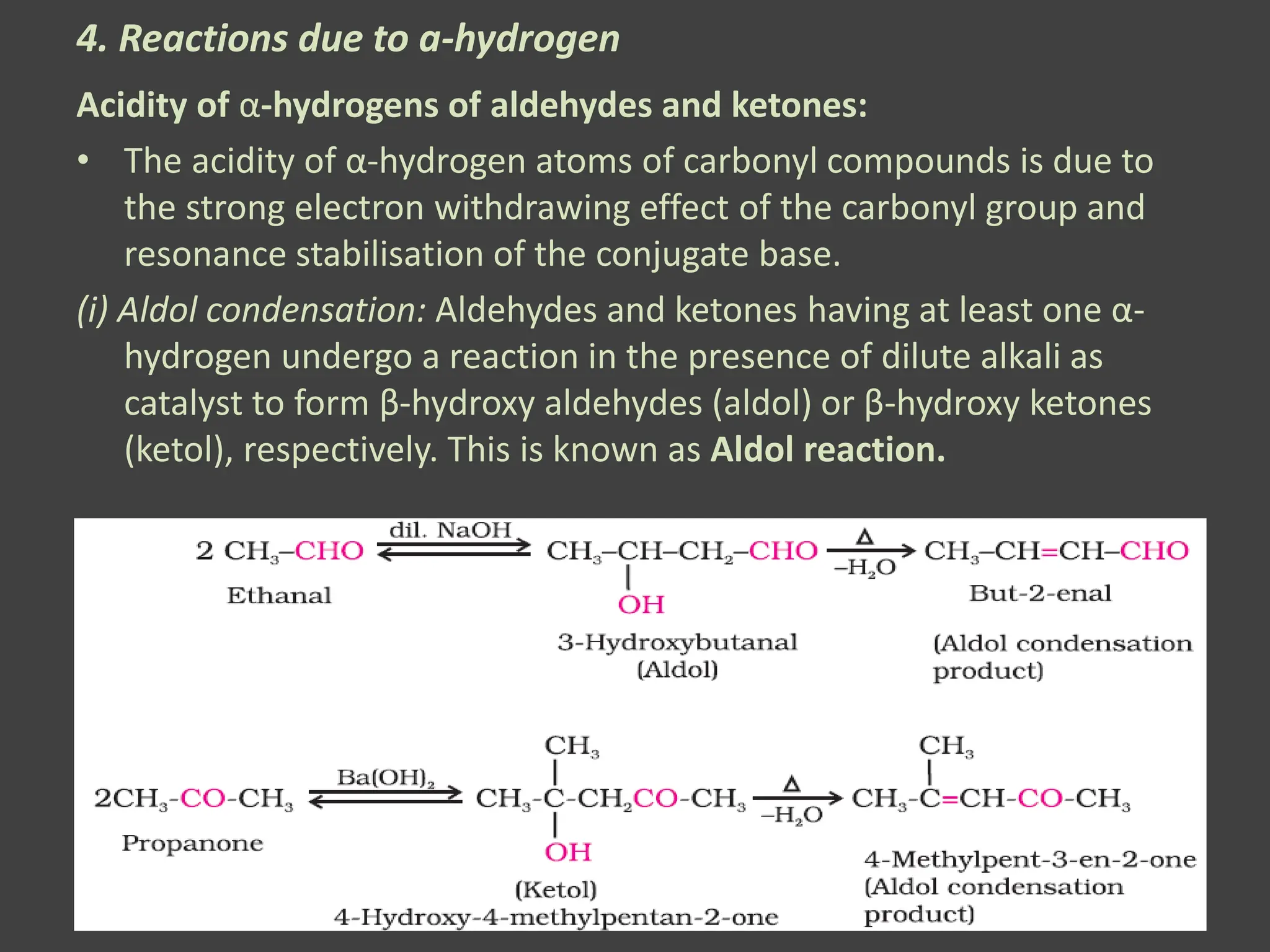
(i) Aldol condensation: Aldehydes and ketones having at least one α-
hydrogen undergo a reaction in the presence of dilute alkali as
catalyst to form β-hydroxy aldehydes (aldol) or β-hydroxy ketones
(ketol), respectively. This is known as Aldol reaction.
(ii) Cross aldol condensation: When aldol condensation is carried
out between two different aldehydes and / or ketones, it is called
cross aldol condensation. If both of them contain α-hydrogen
atoms, it gives a mixture of four products. This is illustrated
below by aldol reaction of a mixture of ethanal and propanal.
5. Other reactions
• (i) Cannizzaro reaction: Aldehydes which do not have an α-hydrogen
atom, undergo self oxidation and reduction (disproportionation)
reaction on treatment with concentrated alkali. In this reaction, one
molecule of the aldehyde is reduced to alcohol while another is
oxidised to carboxylic acid salt.
• (ii) Electrophilic substitution reaction: Aromatic aldehydes and
ketones undergo electrophilic substitution at the ring in which the
carbonyl group acts as a deactivating and meta-directing group.
Uses of Aldehydes and Ketones
• In chemical industry aldehydes and ketones are used as solvents,
starting materials and reagents for the synthesis of other products.
• Formaldehyde is well known as formalin (40%) solution used to
preserve biological specimens and to prepare bakelite (a phenol-
formaldehyde resin), urea-formaldehyde glues and other polymeric
products.
• Acetaldehyde is used primarily as a starting material in the
manufacture of acetic acid, ethyl acetate, vinyl acetate, polymers
and drugs.
• Benzaldehyde is used in perfumery and in dye industries. Acetone
and ethyl methyl ketone are common industrial solvents. Many
aldehydes and ketones, e.g., butyraldehyde, vanillin, acetophenone,
camphor, etc. are well known for their odours and flavours.
Carboxylic Acids
• Carbon compounds containing a carboxyl functional group, –COOH
are called carboxylic acids. The carboxyl group, consists of a
carbonyl group attached to a hydroxyl group, hence its name
carboxyl. Carboxylic acids may be aliphatic (RCOOH) or aromatic
(ArCOOH) depending on the group, alkyl or aryl, attached to
carboxylic carbon. Large number of carboxylic acids are found in
nature. Some higher members of aliphatic carboxylic acids (C12 –
C18) known as fatty acids, occur in natural fats as esters of glycerol.
Carboxylic acids serve as starting material for several other
important organic compounds such as anhydrides, esters, acid
chlorides, amides, etc.
Nomenclature and Structure of Carboxyl Group
• The common names end with the suffix –ic acid.
• For example, formic acid (HCOOH) was first obtained from red ants
(Latin: formica means ant), acetic acid (CH3COOH) from vinegar
(Latin: acetum, means vinegar), butyric acid (CH3CH2CH2COOH)
from rancid butter (Latin: butyrum, means butter).
• In the IUPAC system, aliphatic carboxylic acids are named by
replacing the ending –e in the name of the corresponding alkane
with – oic acid.
• In numbering the carbon chain, the carboxylic carbon is numbered
one. For naming compounds containing more than one carboxyl
group, the ending –e of the alkane is retained. The number of
carboxyl groups are indicated by adding the multiplicative prefix, di,
tri, etc. to the term oic. The position of –COOH groups are indicated
by the arabic numeral before the multiplicative prefix.
Structure of Carboxyl Group
• In carboxylic acids, the bonds to the carboxyl carbon lie in one
plane and are separated by about 120°. The carboxylic carbon is less
electrophilic than carbonyl carbon because of the possible
resonance structure .
Methods of Preparation of Carboxylic Acids
• 1. From primary alcohols and aldehydes
• Primary alcohols are readily oxidised to carboxylic acids with
common oxidising agents such as potassium permanganate
(KMnO4) in neutral, acidic or alkaline media or by potassium
dichromate (K2Cr2O7) and chromium trioxide (CrO3) in acidic
media. Carboxylic acids are also prepared from aldehydes by the
use of mild oxidising agents
2. From alkylbenzenes
• Aromatic carboxylic acids can be prepared by vigorous oxidation of
alkyl benzenes with chromic acid or acidic or alkaline potassium
permanganate. Primary and secondary alkyl groups are oxidised in
this manner while tertiary group is not affected.
• 3. From nitriles and amides
• Nitriles are hydrolysed to amides and then to acids in the presence
of H+ or OH- as catalyst. Mild reaction conditions are used to stop
the reaction at the amide stage.
4. From Grignard reagents
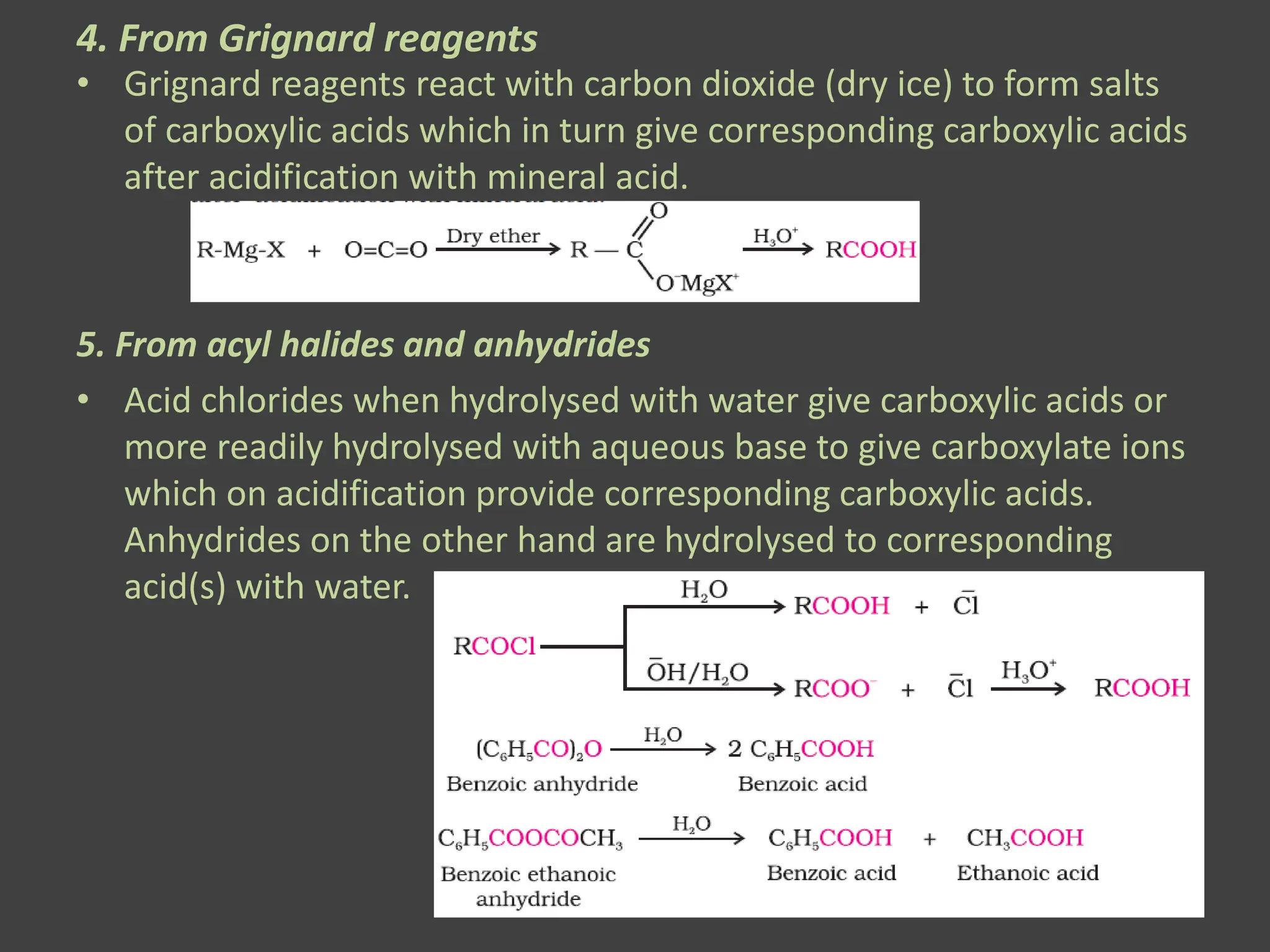
• Grignard reagents react with carbon dioxide (dry ice) to form salts
of carboxylic acids which in turn give corresponding carboxylic acids
after acidification with mineral acid.
5. From acyl halides and anhydrides
• Acid chlorides when hydrolysed with water give carboxylic acids or
more readily hydrolysed with aqueous base to give carboxylate ions
which on acidification provide corresponding carboxylic acids.
Anhydrides on the other hand are hydrolysed to corresponding
acid(s) with water.
6. From esters
• Acidic hydrolysis of esters gives directly carboxylic acids while basic
hydrolysis gives carboxylates, which on acidification give
corresponding carboxylic acids.
Physical Properties
• Aliphatic carboxylic acids upto nine carbon atoms are colourless
liquids at room temperature with unpleasant odours.
• The higher acids are wax like solids and are practically odourless
due to their low volatility. Carboxylic acids are higher boiling liquids
than aldehydes, ketones and even alcohols of comparable
molecular masses. This is due to more extensive association of
carboxylic acid molecules through intermolecular hydrogen
bonding. The hydrogen bonds are not broken completely even in
the vapour phase. In fact, most carboxylic acids exist as dimer in the
vapour phase or in the aprotic solvents.
• Simple aliphatic carboxylic acids having upto four carbon atoms are
miscible in water due to the formation of hydrogen bonds with
water. The solubility decreases with increasing number of carbon
atoms. Higher carboxylic acids are practically insoluble in water due
to the increased hydrophobic interaction of hydrocarbon part.
Benzoic acid, the simplest aromatic carboxylic acid is nearly
insoluble in cold water. Carboxylic acids are also soluble in less polar
organic solvents like benzene, ether, alcohol, chloroform, etc.
Chemical Reactions
Reactions Involving Cleavage of O–H Bond
• Acidity
• Reactions with metals and alkalies
• The carboxylic acids like alcohols evolve hydrogen with
electropositive metals and form salts with alkalies similar to
phenols. However, unlike phenols they react with weaker bases
such as carbonates and hydrogencarbonates to evolve carbon
dioxide. This reaction is used to detect the presence of carboxyl
group in an organic compound.
Effect of substituents on the acidity of carboxylic acids:
• Substituents may affect the stability of the conjugate base and thus,
also affect the acidity of the carboxylic acids. Electron withdrawing
groups increase the acidity of carboxylic acids by stabilising the
conjugate base through delocalisation of the negative charge by
inductive and/or resonance effects.
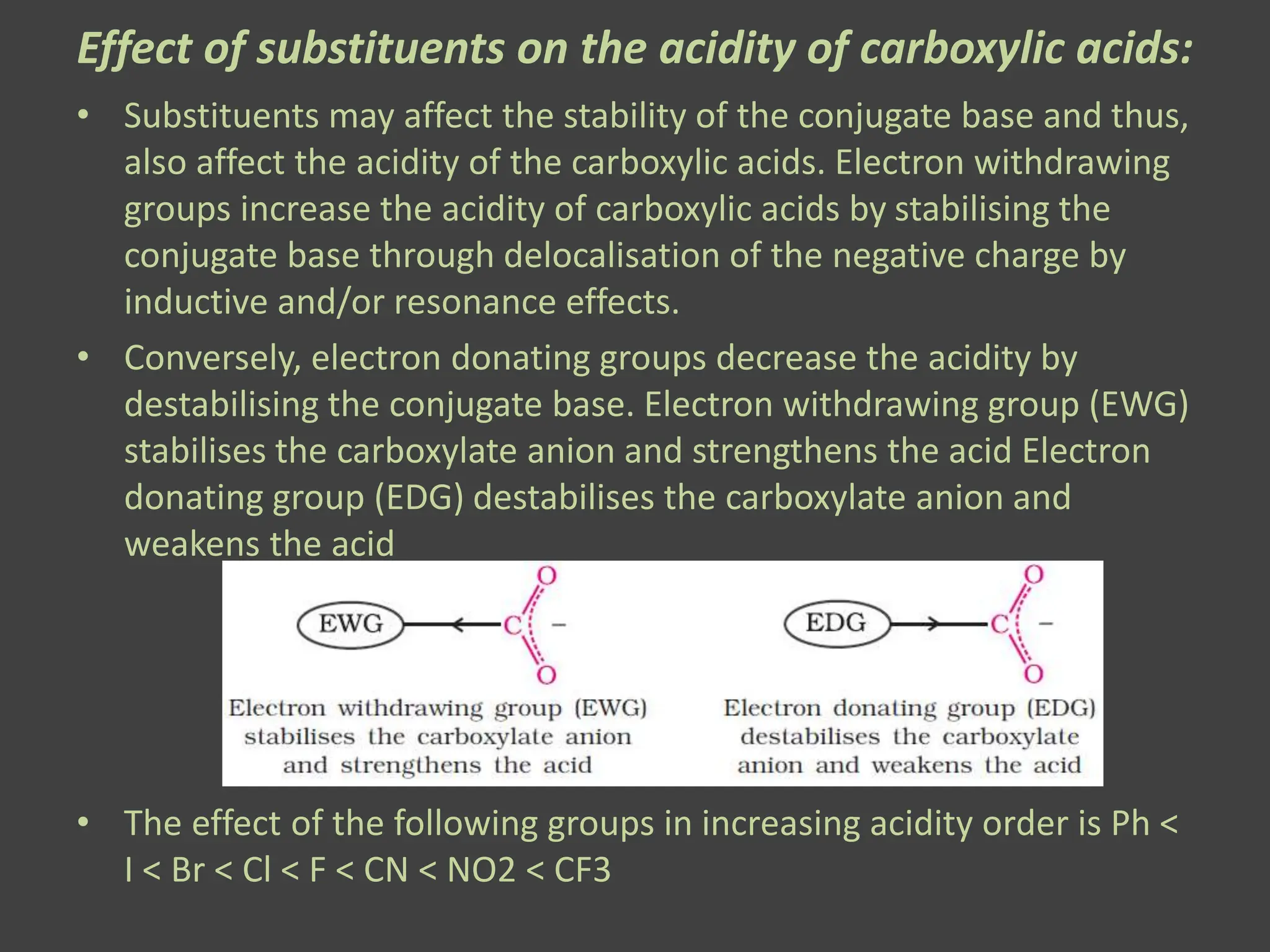
• Conversely, electron donating groups decrease the acidity by
destabilising the conjugate base. Electron withdrawing group (EWG)
stabilises the carboxylate anion and strengthens the acid Electron
donating group (EDG) destabilises the carboxylate anion and
weakens the acid
• The effect of the following groups in increasing acidity order is Ph <
I < Br < Cl < F < CN < NO2 < CF3
Reactions Involving Cleavage of C–OH Bond
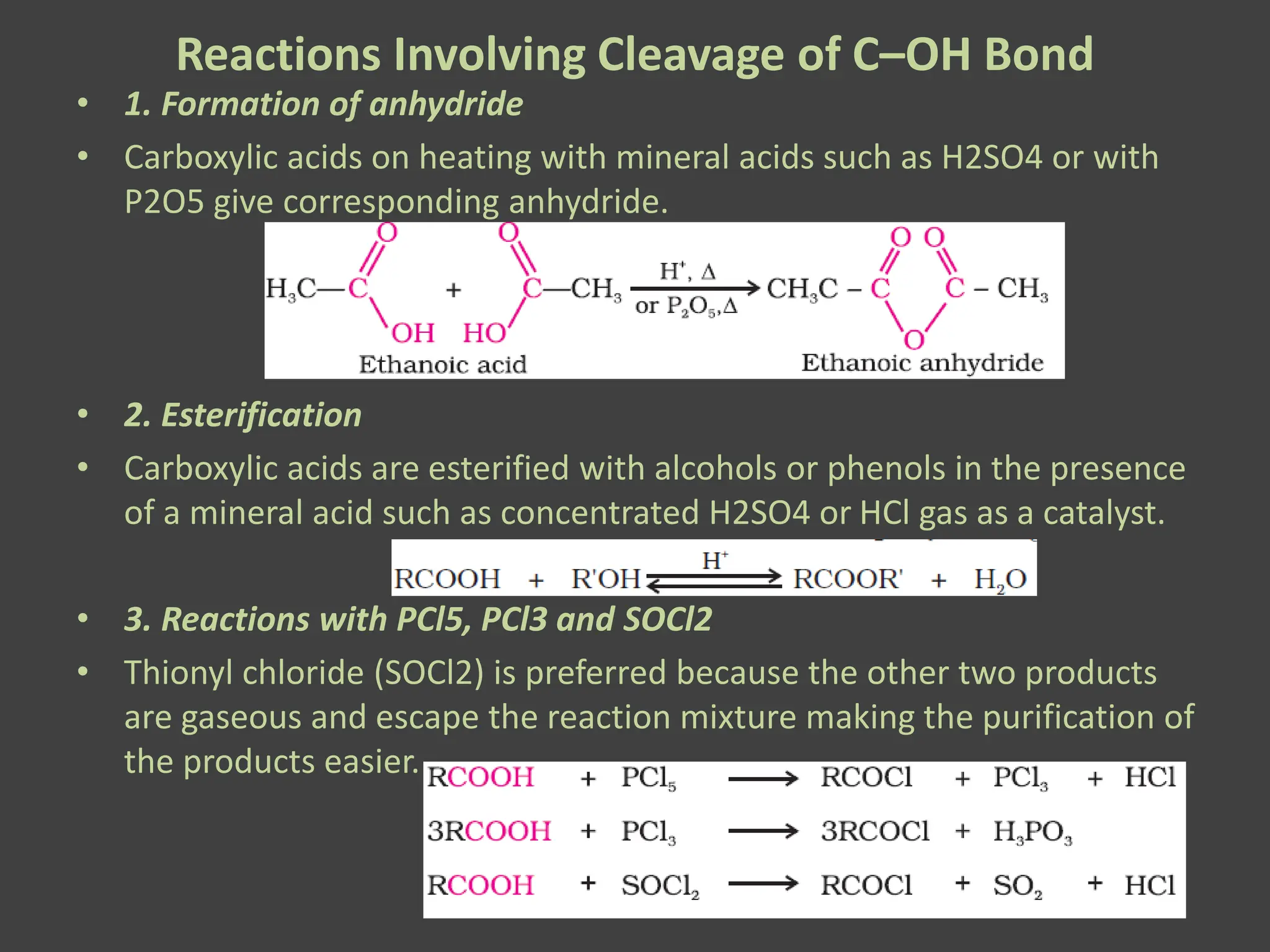
• 1. Formation of anhydride
• Carboxylic acids on heating with mineral acids such as H2SO4 or with
P2O5 give corresponding anhydride.
• 2. Esterification
• Carboxylic acids are esterified with alcohols or phenols in the presence
of a mineral acid such as concentrated H2SO4 or HCl gas as a catalyst.
• 3. Reactions with PCl5, PCl3 and SOCl2
• Thionyl chloride (SOCl2) is preferred because the other two products
are gaseous and escape the reaction mixture making the purification of
the products easier.
• 4. Reaction with ammonia
• Carboxylic acids react with ammonia to give ammonium salt which
on further heating at high temperature give amides.
Reactions Involving –COOH Group
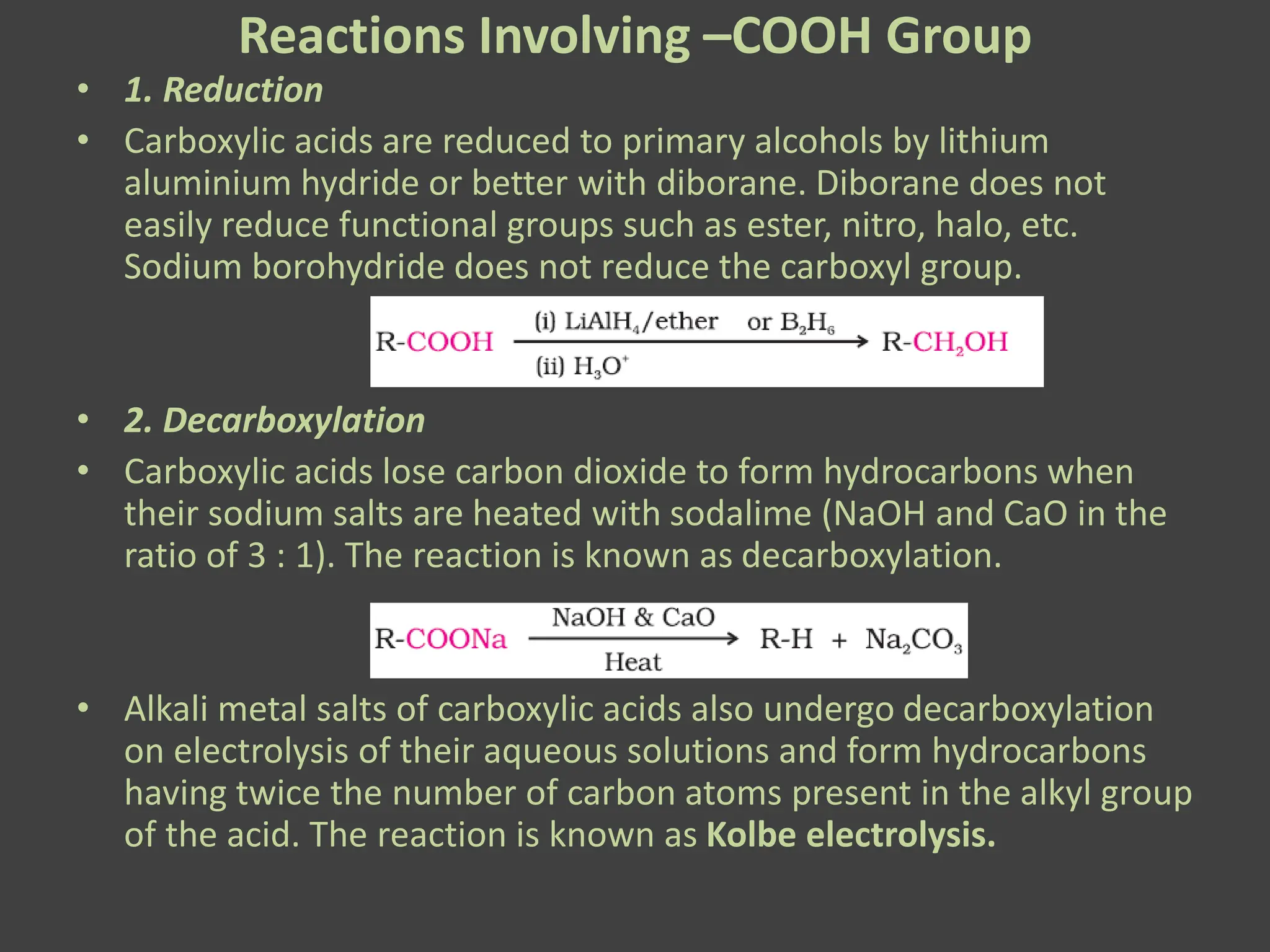
• 1. Reduction
• Carboxylic acids are reduced to primary alcohols by lithium
aluminium hydride or better with diborane. Diborane does not
easily reduce functional groups such as ester, nitro, halo, etc.
Sodium borohydride does not reduce the carboxyl group.
• 2. Decarboxylation
• Carboxylic acids lose carbon dioxide to form hydrocarbons when
their sodium salts are heated with sodalime (NaOH and CaO in the
ratio of 3 : 1). The reaction is known as decarboxylation.
• Alkali metal salts of carboxylic acids also undergo decarboxylation
on electrolysis of their aqueous solutions and form hydrocarbons
having twice the number of carbon atoms present in the alkyl group
of the acid. The reaction is known as Kolbe electrolysis.
Substitution Reactions in the Hydrocarbon Part
• 1. Halogenation
• Carboxylic acids having an á-hydrogen are halogenated at the α-
position on treatment with chlorine or bromine in the presence of
small amount of red phosphorus to give α-halocarboxylic acids. The
reaction is known as Hell-Volhard-Zelinsky reaction.
• 2. Ring substitution
• Aromatic carboxylic acids undergo electrophilic substitution
reactions in which the carboxyl group acts as a deactivating and
meta-directing group.
Uses of carboxylic acids
• Methanoic acid is used in rubber, textile, dyeing, leather and
electroplating industries. Ethanoic acid is used as solvent and as
vinegar in food industry.
• Hexanedioic acid is used in the manufacture of nylon-6, 6. Esters of
benzoic acid are used in perfumery. Sodium benzoate is used as a
food preservative.
• Higher fatty acids are used for the manufacture of soaps and
detergents.
Thank
you

ALDEHYDES, KETONES, AND CARBOXYLIC ACIDS (2).pptx

  • 1.
  • 2.
    INTRODUCTION • In aldehydes,the carbonyl group is bonded to a carbon and hydrogen. • In ketones, it is bonded to two carbon atoms. • The carbonyl compounds in which carbonyl group is bonded to oxygen are known as carboxylic acids, and their derivatives (e.g. esters, anhydrides) while in compounds where carbon is attached to nitrogen and to halogens are called amides and acyl halides respectively.
  • 3.
    Nomenclature and Structureof Carbonyl Group • Aldehydes and ketones (a) Common names • The common names of most aldehydes are derived from the common names of the corresponding carboxylic acids by replacing the ending –ic of acid with aldehyde. • At the same time, the names reflect the Latin or Greek term for the original source of the acid or aldehyde. The location of the substituent in the carbon chain is indicated by Greek letters α, β, , , etc.
  • 4.
    The common namesof ketones are derived by naming two alkyl or aryl groups bonded to the carbonyl group. The locations of substituents are indicated by Greek letters, αα, ββ and so on beginning with the carbon atoms next to the carbonyl group, indicated as αα . Alkyl phenyl ketones are usually named by adding the acyl group as prefix to phenone.
  • 5.
    (b) IUPAC names •The IUPAC names of open chain aliphatic aldehydes and ketones are derived from the names of the corresponding alkanes by replacing the ending –e with –al and –one respectively. • The substituents are prefixed in alphabetical order along with numerals indicating their positions in the carbon chain. The same applies to cyclic ketones. When the aldehyde group is attached to a ring, the suffix carbaldehyde is added after the full name of the cycloalkane. • The name of the simplest aromatic aldehyde carrying the aldehyde group on a benzene ring is benzenecarbaldehyde.
  • 6.
    Structure of theCarbonyl Group • The carbonyl carbon atom is sp2-hybridised and forms three sigma bonds. The fourth valence electron of carbon remains in its p- orbital and forms a π-bond with oxygen by overlap with p-orbital of an oxygen. • In addition, the oxygen atom also has two non bonding electron pairs. • Thus, the carbonyl carbon and the three atoms attached to it lie in the same plane and the π-electron cloud is above and below this plane. The bond angles are approximately 120° as expected of a trigonal coplanar structure
  • 7.
    Preparation of Aldehydesand Ketones 1.By oxidation of alcohols • Aldehydes and ketones are generally prepared by oxidation of primary and secondary alcohols, respectively. 2. By dehydrogenation of alcohols • This method is suitable for volatile alcohols and is of industrial application. In this method alcohol vapours are passed over heavy metal catalysts (Ag or Cu). Primary and secondary alcohols give aldehydes and ketones, respectively. 3. From hydrocarbons • (i) By ozonolysis of alkenes: As we know, ozonolysis of alkenes followed by reaction with zinc dust and water gives aldehydes, ketones or a mixture of both depending on the substitution pattern of the alkene. • (ii) By hydration of alkynes: Addition of water to ethyne in the presence of H2SO4 and HgSO4 gives acetaldehyde. All other alkynes give ketones in this reaction.
  • 8.
    Preparation of Aldehydes •1. From acyl chloride (acid chloride) • Acyl chloride (acid chloride) is hydrogenated over catalyst, palladium on barium sulphate. This reaction is called Rosenmund reduction. • 2. From nitriles and esters • Nitriles are reduced to corresponding imine with stannous chloride in the presence of hydrochloric acid, which on hydrolysis give corresponding aldehyde.This reaction is called Stephen reaction.
  • 9.
    3. From hydrocarbons Aromaticaldehydes (benzaldehyde and its derivatives) are prepared from aromatic hydrocarbons by the following methods: (i) By oxidation of methylbenzene Strong oxidising agents oxidise toluene and its derivatives to benzoic acids. (a) Use of chromyl chloride (CrO2Cl2): Chromyl chloride oxidizes methyl group to a chromium complex, which on hydrolysis gives corresponding benzaldehyde. This reaction is called Etard reaction. (b) Use of chromic oxide (CrO3): Toluene or substituted toluene is converted to benzylidene diacetate on treating with chromic oxide in acetic anhydride. The benzylidene diacetate can be hydrolysed to corresponding benzaldehyde with aqueous acid.
  • 10.
    (ii) By sidechain chlorination followed by hydrolysis Side chain chlorination of toluene gives benzal chloride, which on hydrolysis gives benzaldehyde. This is a commercial method of manufacture of benzaldehyde. This reaction is known as Gatterman-Koch reaction. (iii) By Gatterman – Koch reaction When benzene or its derivative is treated with carbon monoxide and hydrogen chloride in the presence of anhydrous aluminium chloride or cuprous chloride, it gives benzaldehyde or substituted benzaldehyde.
  • 11.
    3 Preparation ofKetones 1. From acyl chlorides • Treatment of acyl chlorides with dialkylcadmium, prepared by the reaction of cadmium chloride with Grignard reagent, gives ketones. 2. From nitriles • Treating a nitrile with Grignard reagent followed by hydrolysis yields a ketone. 3. From benzene or substituted benzenes • When benzene is treated with acid chloride in the presence of anhydrous aluminium chloride, it goves corresponding ketone. This reaction is known as Friedel-Crafts acylation reaction.
  • 12.
    Physical Properties • Methanalis a gas at room temperature. Ethanal is a volatile liquid. • Other aldehydes and ketones are liquid or solid at room temperature. • The boiling points of aldehydes and ketones are higher than hydrocarbons and ethers. It is due to weak molecular association in aldehydes and ketones arising out of the dipole-dipole interactions. • Also, their boiling points are lower than those of alcohols due to absence of intermolecular hydrogen bonding. • The lower members of aldehydes and ketones such as methanal, ethanal and propanone are miscible with water in all proportions, because they form hydrogen bond with water. • The solubility of aldehydes and ketones decreases rapidly on increasing the length of alkyl chain. All aldehydes and ketones are fairly soluble in organic solvents like benzene, ether, methanol, chloroform, etc. • The lower aldehydes have sharp pungent odours. As the size of the molecule increases, the odour becomes less pungent and more fragrant
  • 13.
    Chemical Reactions 1. Nucleophilicaddition reactions • (i) Mechanism of nucleophilic addition reactions • A nucleophile attacks the electrophilic carbon atom of the polar carbonyl group from a direction approximately perpendicular to the plane of sp2 hybridised orbitals of carbonyl carbon. • The hybridisation of carbon changes from sp2 to sp3 in this process, and a tetrahedral alkoxide intermediate is produced. This intermediate captures a proton from the reaction medium to give the electrically neutral product. The net result is addition of Nu– and H+ across the carbon oxygen double bond. • (ii) Reactivity • Aldehydes are generally more reactive than ketones in nucleophilic addition reactions due to steric and electronic reasons. Electronically, aldehydes are more reactive than ketones because two alkyl groups reduce the electrophilicity of the carbonyl more effectively than in former.
  • 14.
    (iii) Some importantexamples of nucleophilic addition and nucleophilic addition-elimination reactions: (a) Addition of hydrogen cyanide (HCN): Aldehydes and ketones react with hydrogen cyanide (HCN) to yield cyanohydrins. This reaction occurs very slowly with pure HCN. Therefore, it is catalysed by a base and the generated cyanide ion (CN-) being a stronger nucleophile readily adds to carbonyl compounds to yield corresponding cyanohydrin. Cyanohydrins are useful synthetic intermediates.
  • 15.
    (b) Addition ofsodium hydrogensulphite: Sodium hydrogensulphite adds to aldehydes and ketones to form the addition products. The position ofthe equilibrium lies largely to the right hand side for most aldehydes and to the left for most ketones due to steric reasons. The hydrogensulphite addition compound is water soluble and can be converted back to the original carbonyl compound by treating it with dilute mineral acid or alkali. Therefore, these are useful for separation and purification of aldehydes. (c) Addition of Grignard reagents: (d) Addition of alcohols: Aldehydes react with one equivalent of monohydric alcohol in the presence of dry hydrogen chloride to yield alkoxyalcohol intermediate, known as hemiacetals, which further react with one more molecule of alcohol to give a gem-dialkoxy compound known as acetal.
  • 16.
    Ketones react withethylene glycol under similar conditions to form cyclic products known as ethylene glycol ketals. Acetals and ketals are hydrolysed with aqueous mineral acids to yield corresponding aldehydes and ketones respectively. (e) Addition of ammonia and its derivatives: Nucleophiles, such as ammonia and its derivatives H2N-Z add to the carbonyl group of aldehydes and ketones. The reaction is reversible and catalysed by acid. The equilibrium favours the product formation due to rapid dehydration of the intermediate to form >C=N-Z. Z = Alkyl, aryl, OH, NH2, C6H5NH, NHCONH2, etc.
  • 17.
    2. Reduction • (i)Reduction to alcohols: Aldehydes and ketones are reduced to primary and secondary alcohols respectively by sodium borohydride (NaBH4) or lithium aluminium hydride (LiAlH4) as well as by catalytic hydrogenation. • (ii) Reduction to hydrocarbons: The carbonyl group of aldehydes and ketones is reduced to CH2 group on treatment with zincamalgam and concentrated hydrochloric acid [Clemmensen hydrazine hydrazone reduction] or with hydrazine followed by heating with sodium or potassium hydroxide in high boiling solvent such as ethylene glycol (Wolff-Kishner reduction).
  • 18.
    3. Oxidation • (i)Tollens’ test: On warming an aldehyde with freshly prepared ammoniacal silver nitrate solution (Tollens’ reagent), a bright silver mirror is produced due to the formation of silver metal. The aldehydes are oxidised to corresponding carboxylate anion. The reaction occurs in alkaline medium. • (ii) Fehling’s test: Fehling reagent comprises of two solutions, Fehling solution A and Fehling solution B. • Fehling solution A is aqueous copper sulphate and Fehling solution B is alkaline sodium potassium tartarate (Rochelle salt). These two solutions are mixed in equal amounts before test. On heating an aldehyde with Fehling’s reagent, a reddish brown precipitate is obtained. Aldehydes are oxidised to corresponding carboxylate anion. Aromatic aldehydes do not respond to this test.
  • 19.
    (iii) Oxidation ofmethyl ketones by haloform reaction: • Aldehydes and ketones having at least one methyl group linked to the carbonyl carbon atom (methyl ketones) are oxidised by sodium hypohalite to sodium salts of corresponding carboxylic acids having one carbon atom less than that of carbonyl compound. The methyl group is converted to haloform. This oxidation does not affect a carbon-carbon double bond, if present in the molecule. Iodoform reaction with sodium hypoiodite is also used for detection of CH3CO group or CH3CH(OH) group which produces CH3CO group on oxidation.
  • 20.
    4. Reactions dueto a-hydrogen Acidity of α-hydrogens of aldehydes and ketones: • The acidity of α-hydrogen atoms of carbonyl compounds is due to the strong electron withdrawing effect of the carbonyl group and resonance stabilisation of the conjugate base. (i) Aldol condensation: Aldehydes and ketones having at least one α- hydrogen undergo a reaction in the presence of dilute alkali as catalyst to form β-hydroxy aldehydes (aldol) or β-hydroxy ketones (ketol), respectively. This is known as Aldol reaction.
  • 21.
    (ii) Cross aldolcondensation: When aldol condensation is carried out between two different aldehydes and / or ketones, it is called cross aldol condensation. If both of them contain α-hydrogen atoms, it gives a mixture of four products. This is illustrated below by aldol reaction of a mixture of ethanal and propanal.
  • 22.
    5. Other reactions •(i) Cannizzaro reaction: Aldehydes which do not have an α-hydrogen atom, undergo self oxidation and reduction (disproportionation) reaction on treatment with concentrated alkali. In this reaction, one molecule of the aldehyde is reduced to alcohol while another is oxidised to carboxylic acid salt. • (ii) Electrophilic substitution reaction: Aromatic aldehydes and ketones undergo electrophilic substitution at the ring in which the carbonyl group acts as a deactivating and meta-directing group.
  • 23.
    Uses of Aldehydesand Ketones • In chemical industry aldehydes and ketones are used as solvents, starting materials and reagents for the synthesis of other products. • Formaldehyde is well known as formalin (40%) solution used to preserve biological specimens and to prepare bakelite (a phenol- formaldehyde resin), urea-formaldehyde glues and other polymeric products. • Acetaldehyde is used primarily as a starting material in the manufacture of acetic acid, ethyl acetate, vinyl acetate, polymers and drugs. • Benzaldehyde is used in perfumery and in dye industries. Acetone and ethyl methyl ketone are common industrial solvents. Many aldehydes and ketones, e.g., butyraldehyde, vanillin, acetophenone, camphor, etc. are well known for their odours and flavours.
  • 24.
    Carboxylic Acids • Carboncompounds containing a carboxyl functional group, –COOH are called carboxylic acids. The carboxyl group, consists of a carbonyl group attached to a hydroxyl group, hence its name carboxyl. Carboxylic acids may be aliphatic (RCOOH) or aromatic (ArCOOH) depending on the group, alkyl or aryl, attached to carboxylic carbon. Large number of carboxylic acids are found in nature. Some higher members of aliphatic carboxylic acids (C12 – C18) known as fatty acids, occur in natural fats as esters of glycerol. Carboxylic acids serve as starting material for several other important organic compounds such as anhydrides, esters, acid chlorides, amides, etc.
  • 25.
    Nomenclature and Structureof Carboxyl Group • The common names end with the suffix –ic acid. • For example, formic acid (HCOOH) was first obtained from red ants (Latin: formica means ant), acetic acid (CH3COOH) from vinegar (Latin: acetum, means vinegar), butyric acid (CH3CH2CH2COOH) from rancid butter (Latin: butyrum, means butter). • In the IUPAC system, aliphatic carboxylic acids are named by replacing the ending –e in the name of the corresponding alkane with – oic acid. • In numbering the carbon chain, the carboxylic carbon is numbered one. For naming compounds containing more than one carboxyl group, the ending –e of the alkane is retained. The number of carboxyl groups are indicated by adding the multiplicative prefix, di, tri, etc. to the term oic. The position of –COOH groups are indicated by the arabic numeral before the multiplicative prefix.
  • 26.
    Structure of CarboxylGroup • In carboxylic acids, the bonds to the carboxyl carbon lie in one plane and are separated by about 120°. The carboxylic carbon is less electrophilic than carbonyl carbon because of the possible resonance structure .
  • 27.
    Methods of Preparationof Carboxylic Acids • 1. From primary alcohols and aldehydes • Primary alcohols are readily oxidised to carboxylic acids with common oxidising agents such as potassium permanganate (KMnO4) in neutral, acidic or alkaline media or by potassium dichromate (K2Cr2O7) and chromium trioxide (CrO3) in acidic media. Carboxylic acids are also prepared from aldehydes by the use of mild oxidising agents
  • 28.
    2. From alkylbenzenes •Aromatic carboxylic acids can be prepared by vigorous oxidation of alkyl benzenes with chromic acid or acidic or alkaline potassium permanganate. Primary and secondary alkyl groups are oxidised in this manner while tertiary group is not affected. • 3. From nitriles and amides • Nitriles are hydrolysed to amides and then to acids in the presence of H+ or OH- as catalyst. Mild reaction conditions are used to stop the reaction at the amide stage.
  • 29.
    4. From Grignardreagents • Grignard reagents react with carbon dioxide (dry ice) to form salts of carboxylic acids which in turn give corresponding carboxylic acids after acidification with mineral acid. 5. From acyl halides and anhydrides • Acid chlorides when hydrolysed with water give carboxylic acids or more readily hydrolysed with aqueous base to give carboxylate ions which on acidification provide corresponding carboxylic acids. Anhydrides on the other hand are hydrolysed to corresponding acid(s) with water.
  • 30.
    6. From esters •Acidic hydrolysis of esters gives directly carboxylic acids while basic hydrolysis gives carboxylates, which on acidification give corresponding carboxylic acids.
  • 31.
    Physical Properties • Aliphaticcarboxylic acids upto nine carbon atoms are colourless liquids at room temperature with unpleasant odours. • The higher acids are wax like solids and are practically odourless due to their low volatility. Carboxylic acids are higher boiling liquids than aldehydes, ketones and even alcohols of comparable molecular masses. This is due to more extensive association of carboxylic acid molecules through intermolecular hydrogen bonding. The hydrogen bonds are not broken completely even in the vapour phase. In fact, most carboxylic acids exist as dimer in the vapour phase or in the aprotic solvents. • Simple aliphatic carboxylic acids having upto four carbon atoms are miscible in water due to the formation of hydrogen bonds with water. The solubility decreases with increasing number of carbon atoms. Higher carboxylic acids are practically insoluble in water due to the increased hydrophobic interaction of hydrocarbon part. Benzoic acid, the simplest aromatic carboxylic acid is nearly insoluble in cold water. Carboxylic acids are also soluble in less polar organic solvents like benzene, ether, alcohol, chloroform, etc.
  • 32.
    Chemical Reactions Reactions InvolvingCleavage of O–H Bond • Acidity • Reactions with metals and alkalies • The carboxylic acids like alcohols evolve hydrogen with electropositive metals and form salts with alkalies similar to phenols. However, unlike phenols they react with weaker bases such as carbonates and hydrogencarbonates to evolve carbon dioxide. This reaction is used to detect the presence of carboxyl group in an organic compound.
  • 33.
    Effect of substituentson the acidity of carboxylic acids: • Substituents may affect the stability of the conjugate base and thus, also affect the acidity of the carboxylic acids. Electron withdrawing groups increase the acidity of carboxylic acids by stabilising the conjugate base through delocalisation of the negative charge by inductive and/or resonance effects. • Conversely, electron donating groups decrease the acidity by destabilising the conjugate base. Electron withdrawing group (EWG) stabilises the carboxylate anion and strengthens the acid Electron donating group (EDG) destabilises the carboxylate anion and weakens the acid • The effect of the following groups in increasing acidity order is Ph < I < Br < Cl < F < CN < NO2 < CF3
  • 34.
    Reactions Involving Cleavageof C–OH Bond • 1. Formation of anhydride • Carboxylic acids on heating with mineral acids such as H2SO4 or with P2O5 give corresponding anhydride. • 2. Esterification • Carboxylic acids are esterified with alcohols or phenols in the presence of a mineral acid such as concentrated H2SO4 or HCl gas as a catalyst. • 3. Reactions with PCl5, PCl3 and SOCl2 • Thionyl chloride (SOCl2) is preferred because the other two products are gaseous and escape the reaction mixture making the purification of the products easier.
  • 35.
    • 4. Reactionwith ammonia • Carboxylic acids react with ammonia to give ammonium salt which on further heating at high temperature give amides.
  • 36.
    Reactions Involving –COOHGroup • 1. Reduction • Carboxylic acids are reduced to primary alcohols by lithium aluminium hydride or better with diborane. Diborane does not easily reduce functional groups such as ester, nitro, halo, etc. Sodium borohydride does not reduce the carboxyl group. • 2. Decarboxylation • Carboxylic acids lose carbon dioxide to form hydrocarbons when their sodium salts are heated with sodalime (NaOH and CaO in the ratio of 3 : 1). The reaction is known as decarboxylation. • Alkali metal salts of carboxylic acids also undergo decarboxylation on electrolysis of their aqueous solutions and form hydrocarbons having twice the number of carbon atoms present in the alkyl group of the acid. The reaction is known as Kolbe electrolysis.
  • 37.
    Substitution Reactions inthe Hydrocarbon Part • 1. Halogenation • Carboxylic acids having an á-hydrogen are halogenated at the α- position on treatment with chlorine or bromine in the presence of small amount of red phosphorus to give α-halocarboxylic acids. The reaction is known as Hell-Volhard-Zelinsky reaction. • 2. Ring substitution • Aromatic carboxylic acids undergo electrophilic substitution reactions in which the carboxyl group acts as a deactivating and meta-directing group.
  • 38.
    Uses of carboxylicacids • Methanoic acid is used in rubber, textile, dyeing, leather and electroplating industries. Ethanoic acid is used as solvent and as vinegar in food industry. • Hexanedioic acid is used in the manufacture of nylon-6, 6. Esters of benzoic acid are used in perfumery. Sodium benzoate is used as a food preservative. • Higher fatty acids are used for the manufacture of soaps and detergents.
  • 39.