CONTENT ;
TNTRODUCTION
STRUCTURE
NOMEMCLATURE
PREPARATIONS
PHYSICAL PROPERTIES
CHEMICAL PROPERTIES
PHARMACEUTICAL USES
INTRODUCTION
Organic compounds which contain
CAROXLY GROUP (_COOH).
Name CARBOXYL → CARBonyl
(_C=O) & hydrOXYL (_OH) because in
carboxyl group these 2 groups are
directly bonded to each other .
STRUCTURE ;
They are represented (GENERAL STRUCTURE
FORMULA)as:
CARBONYL GROUP O
║ HYDROXYLIC GROUP
R—C—OHR may be H or ALKYL group
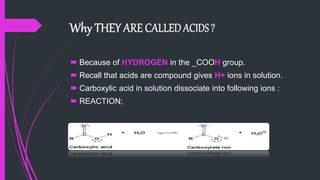
 Because of HYDROGEN in the _COOH group.
 Recall that acids are compound gives H+ ions in solution.
 Carboxylic acid in solution dissociate into following ions :
 REACTION;
NOMENCLATURE ;
Two system for naming:
1.Trivial names.
2.IUPAC names.
TRIVIAL NAMES
 Derived from Latin & Greek words → indicate their natural origin .
 Example;
 Formic acid(HCOOH)→Latin word →formic → ANT → secreted by ant.
 Acetic acid (CH3COOH) → Latin word → Acetum →Vinegar →present in vinegar.
 In the common system, position of subsitutants on the chain are labeled with
Greek letters.
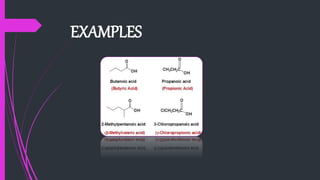
EXAMPLES
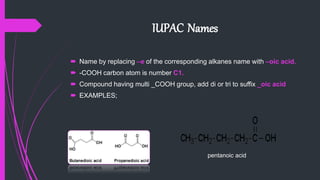
IUPAC Names
 Name by replacing –e of the corresponding alkanes name with –oic acid.
 -COOH carbon atom is number C1.
 Compound having multi _COOH group, add di or tri to suffix _oic acid
 EXAMPLES;
pentanoic acid
PREPARATIONS OF CARBOXYLICACIDS
OXIDATION OF ;
ALKYL BENZENE.
UNSATURATED HYDROCARBON.
1°ALCOHOLS & ALDEHYDES.
CARBOXYLATION OF GRIGNARD REAGENT.
HYDROLYSIS OF NITRILE.
HYDROLYSIS OF ESTER.
CARBOXYLATION OF ALKENE .
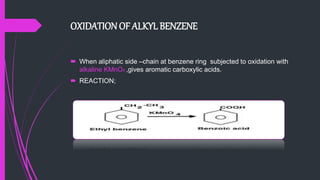
OXIDATION OF ALKYL BENZENE
 When aliphatic side –chain at benzene ring subjected to oxidation with
alkaline KMnO4 ,gives aromatic carboxylic acids.
 REACTION;
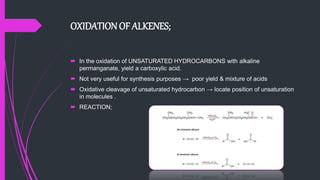
OXIDATION OF ALKENES;
 In the oxidation of UNSATURATED HYDROCARBONS with alkaline
permanganate, yield a carboxylic acid.
 Not very useful for synthesis purposes → poor yield & mixture of acids
 Oxidative cleavage of unsaturated hydrocarbon → locate position of unsaturation
in molecules .
 REACTION;
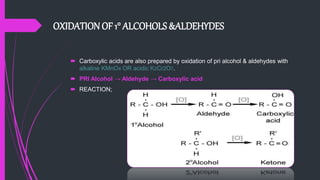
OXIDATION OF 1° ALCOHOLS &ALDEHYDES
 Carboxylic acids are also prepared by oxidation of pri alcohol & aldehydes with
alkaline KMnO4 OR acidic K2Cr2O7.
 PRI Alcohol → Aldehyde → Carboxylic acid
 REACTION;
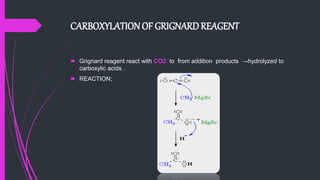
CARBOXYLATIONOF GRIGNARDREAGENT
 Grignard reagent react with CO2 to from addition products →hydrolyzed to
carboxylic acids .
 REACTION;
HYDROLYSIS OF NITRILES
 Nitrile is treated with hot H2O →HYDROLYSIS→ Carboxylic acids &
ammonium.
 REACTION;
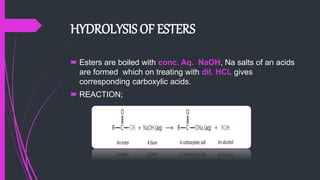
HYDROLYSIS OF ESTERS
 Esters are boiled with conc. Aq. NaOH, Na salts of an acids
are formed which on treating with dil. HCL gives
corresponding carboxylic acids.
 REACTION;
PHYSICAL PROPERTIES OF CARBOXYLIC ACIDS
 Odour
 Have strong odours, especially those that are volatile. Common odours can be
found in vinegar, which contains ethanoic acids.
 Boiling point;
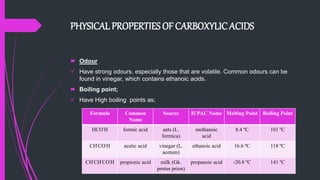
 Have High boiling points as;
Formula Common
Name
Source IUPAC Name Melting Point Boiling Point
HCO2
H formic acid ants (L.
formica)
methanoic
acid
8.4 ºC 101 ºC
CH3
CO2
H acetic acid vinegar (L.
acetum)
ethanoic acid 16.6 ºC 118 ºC
CH3
CH2
CO2
H propionic acid milk (Gk.
protus prion)
propanoic acid -20.8 ºC 141 ºC
CONTD
 REASON → H-bonding b/w 2 molecules → DIMERS→ ↑ the strength of
the van der Waals dispersion forces → high boiling points of carboxylic
acids.
 Melting point;
follow saw-tooth rule →irregular increase of M.P.
 Carboxylic acids are weak acids.
 Are polar →solubility ↓ as no. of carbon atoms of carboxylic acids↑
.
CHEMICAL PROPERTIES OF CARBOXYLICACIDS
SALT FORMATION.
NUCLEOPHILIC ACYL SUBSTITUTION.
REDUCTION.
a- Halogenations.
Hunsdiecker reaction.
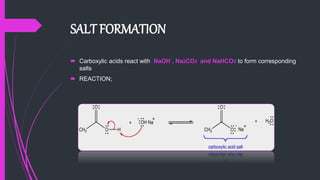
SALT FORMATION
 Carboxylic acids react with NaOH , Na2CO3 and NaHCO3 to form corresponding
salts
 REACTION;
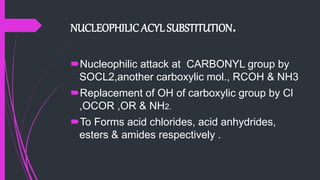
NUCLEOPHILIC ACYL SUBSTITUTION.
Nucleophilic attack at CARBONYL group by
SOCL2,another carboxylic mol., RCOH & NH3
Replacement of OH of carboxylic group by Cl
,OCOR ,OR & NH2.
To Forms acid chlorides, acid anhydrides,
esters & amides respectively .
NUCLEOPHILICACYLSUBSTITUTION.
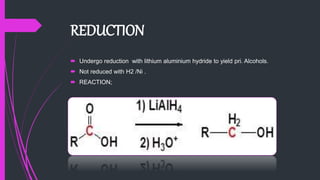
REDUCTION
 Undergo reduction with lithium aluminium hydride to yield pri. Alcohols.
 Not reduced with H2 /Ni .
 REACTION;
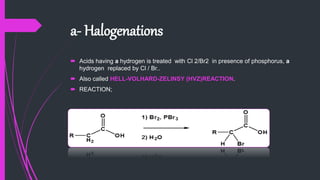
a- Halogenations
 Acids having a hydrogen is treated with Cl 2/Br2 in presence of phosphorus, a
hydrogen replaced by Cl / Br..
 Also called HELL-VOLHARD-ZELINSY (HVZ)REACTION.
 REACTION;
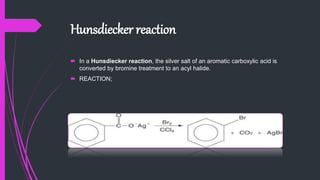
Hunsdiecker reaction
 In a Hunsdiecker reaction, the silver salt of an aromatic carboxylic acid is
converted by bromine treatment to an acyl halide.
 REACTION;
FORMIC ACID
Used in ;
 Textile dyeing & finishing.
 As coagulating agent for rubber
latex.
 In laboratory preparation of carbon
molecules.
 As an antiseptic uses.
 In cure of gout .
CONTD
ACETIC ACIDS
Used in manufacturing of ;
 White vinegar
 Cellulose acetate ,polyvinyl acetate
 Acetone and esters are used in perfumes, dyes , plastics.
 used as preservative e.g.; in pickle
CONTD
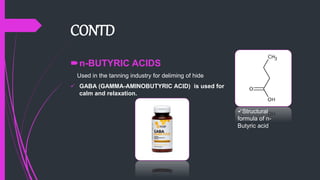
n-BUTYRIC ACIDS
Used in the tanning industry for deliming of hide
 GABA (GAMMA-AMINOBUTYRIC ACID) is used for
calm and relaxation.
Structural
formula of n-
Butyric acid
Others uses
As drugs, such as
ASPIRIN
Manufacturing of soap.
For production of soft
drinks , food production.
DERIVATIVES OF CARBOXYLIC ACIDS
ESTERS.
AMIDES.
ACYL CHORIDES.
ACID ANHYDRIDES.
TNTRODUCTION
The word 'ester' was coined in 1848 by a
German chemist Leopold Gmelin, probably as a
contraction of the German Essigäther, "acetic
ether".
Chemical compound derived from an acid
(organic or inorganic) in which at least one –OH
(hydroxyl) group is replaced by an –O–alkyl
(alkoxy) group.
CARBOXYLIC ACIDS + ALCOHOL→ESTERS
STRUCTURE
 Generally written as ‘RCOOR’ or RCO2R’.
 Structure formula as follow;
NOMENCLATURE ;
Two system for naming:
1.Trivial names.
2.IUPAC names.
TRIVIAL NAMES
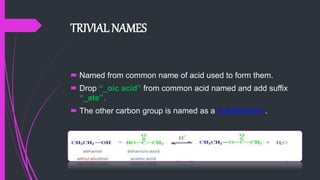
 Named from common name of acid used to form them.
 Drop “_oic acid” from common acid named and add suffix
“_ate”.
 The other carbon group is named as a substitution .
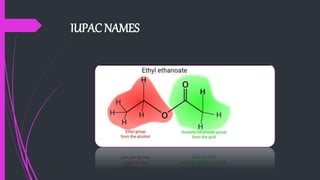
IUPAC NAMES
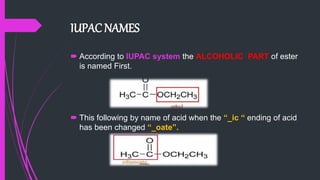
 According to IUPAC system the ALCOHOLIC PART of ester
is named First.
 This following by name of acid when the “_ic “ ending of acid
has been changed “_oate”.
IUPAC NAMES
EXAMPLES
PREPARATIONS OF ESTERS
FROM CARBOXYLIC ACID
FROM ACYL CHLORIDES
FROM ACID ANHYDRIDES
FROM DIAZOMETHANE
TRANS-ESTERIFICATION
FROM CARBOXYLIC SALTS & ALKYL
HALIDES
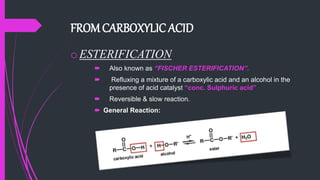
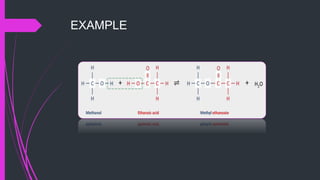
FROMCARBOXYLIC ACID
oESTERIFICATION
 Also known as “FISCHER ESTERIFICATION”.
 Refluxing a mixture of a carboxylic acid and an alcohol in the
presence of acid catalyst “conc. Sulphuric acid”
 Reversible & slow reaction.
 General Reaction:
EXAMPLE
FROM ACYL CHLORIDES
 Also prepared by the reaction of acid chlorides with alcohols .
 Acid chlorides →more reactive toward Nucleophilic substitution reaction → occur
rapidly.
 Does not require a catalyst.
 Pyridine is used to react with HCL that is formed in the reaction.
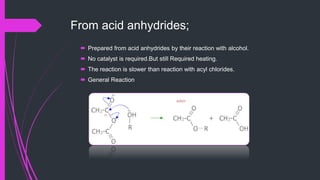
From acid anhydrides;
 Prepared from acid anhydrides by their reaction with alcohol.
 No catalyst is required.But still Required heating.
 The reaction is slower than reaction with acyl chlorides.
 General Reaction
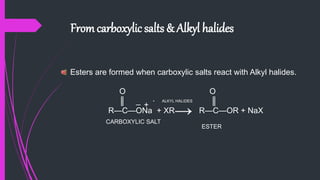
Fromcarboxylic salts & Alkyl halides
Esters are formed when carboxylic salts react with Alkyl halides.
O O
║ _ ║
R—C—ONa + XR R—C—OR + NaX
+
→CARBOXYLIC SALT
• ALKYL HALIDES
ESTER
From Diazomethane
Methyl esters can be prepared by the reaction of
carboxylic acid with Diazomethane in etheral
solution .
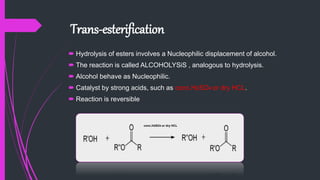
Trans-esterification
 Hydrolysis of esters involves a Nucleophilic displacement of alcohol.
 The reaction is called ALCOHOLYSiS , analogous to hydrolysis.
 Alcohol behave as Nucleophilic.
 Catalyst by strong acids, such as conc.H2SO4 or dry HCL.
 Reaction is reversible
conc.H2SO4 or dry HCL
Reactions of esters
CONVERSION OF ESTER ONTO CARBOXYLIC ACID
→HYDROLSIS
CONVERSION OF ESTER INTO AMIDE
→AMMONOLYSIS
CONVERSION OF ESTERS INTO ALCOHOL
→REDUCTION
→FROM GRIGNARD REACTION
TRANS-ESTERIFICATION
Hydrolysis
An ester is hydrolyzed slowly → carboxylic
acid and an alcohol on heating with water.
However, hydrolysis can be catalyzed by
either a strong acid ,mineral acid ,or a strong
alkali ,such as NaOH.
CONTD;
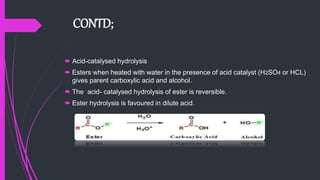
 Acid-catalysed hydrolysis
 Esters when heated with water in the presence of acid catalyst (H2SO4 or HCL)
gives parent carboxylic acid and alcohol.
 The acid- catalysed hydrolysis of ester is reversible.
 Ester hydrolysis is favoured in dilute acid.
CONTD;
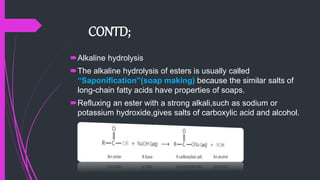
Alkaline hydrolysis
The alkaline hydrolysis of esters is usually called
“Saponification”(soap making) because the similar salts of
long-chain fatty acids have properties of soaps.
Refluxing an ester with a strong alkali,such as sodium or
potassium hydroxide,gives salts of carboxylic acid and alcohol.
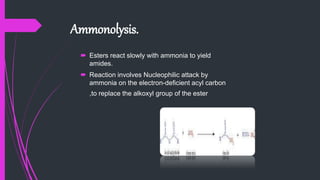
Ammonolysis.
 Esters react slowly with ammonia to yield
amides.
 Reaction involves Nucleophilic attack by
ammonia on the electron-deficient acyl carbon
,to replace the alkoxyl group of the ester.
Chemical reduction
Esters also reduced by the use of Na metal and alcohol or more
commonly by the use of LiAlH4 in etheral solution.
REACTION;
.
REDUCTION OF ESTERS
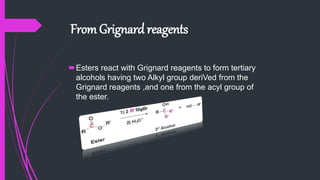
From Grignard reagents
Esters react with Grignard reagents to form tertiary
alcohols having two Alkyl group deriVed from the
Grignard reagents ,and one from the acyl group of
the ester.
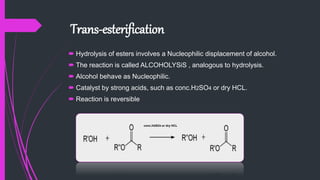
Trans-esterification
 Hydrolysis of esters involves a Nucleophilic displacement of alcohol.
 The reaction is called ALCOHOLYSiS , analogous to hydrolysis.
 Alcohol behave as Nucleophilic.
 Catalyst by strong acids, such as conc.H2SO4 or dry HCL.
 Reaction is reversible
conc.H2SO4 or dry HCL
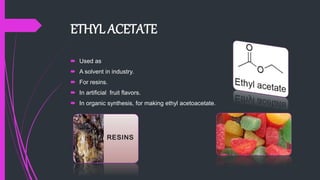
ETHYL ACETATE
 Used as
 A solvent in industry.
 For resins.
 In artificial fruit flavors.
 In organic synthesis, for making ethyl acetoacetate.
Ethyl propionate
 Used in ;
 perfumery and fragrance.
 to manufacture various propionates which used in
the reduction of pharmaceuticals,
 anti-fungal agents, agrochemicals, plastics, rubber
chemicals, dyes, artificial flavors and perfumery
synthetics.
glyceryl trinitrate
(Nitrate esters)
Medication used for heart
failure, high blood
pressure, and to treat and
prevent chest pain from not
enough blood flow to the
heart (angina) or due to
cocaine.
Reference;
Text book of organic chemistry by Bs.Bhal.
Text book of organic chemistry by M.Younas.
Punjab text book of Organic for fsc 2nd year.
Carboxylic acids and ester

Carboxylic acids and ester

  • 3.
  • 5.
    INTRODUCTION Organic compounds whichcontain CAROXLY GROUP (_COOH). Name CARBOXYL → CARBonyl (_C=O) & hydrOXYL (_OH) because in carboxyl group these 2 groups are directly bonded to each other .
  • 6.
    STRUCTURE ; They arerepresented (GENERAL STRUCTURE FORMULA)as: CARBONYL GROUP O ║ HYDROXYLIC GROUP R—C—OHR may be H or ALKYL group
  • 7.
     Because ofHYDROGEN in the _COOH group.  Recall that acids are compound gives H+ ions in solution.  Carboxylic acid in solution dissociate into following ions :  REACTION;
  • 8.
    NOMENCLATURE ; Two systemfor naming: 1.Trivial names. 2.IUPAC names.
  • 9.
    TRIVIAL NAMES  Derivedfrom Latin & Greek words → indicate their natural origin .  Example;  Formic acid(HCOOH)→Latin word →formic → ANT → secreted by ant.  Acetic acid (CH3COOH) → Latin word → Acetum →Vinegar →present in vinegar.  In the common system, position of subsitutants on the chain are labeled with Greek letters.
  • 10.
  • 11.
    IUPAC Names  Nameby replacing –e of the corresponding alkanes name with –oic acid.  -COOH carbon atom is number C1.  Compound having multi _COOH group, add di or tri to suffix _oic acid  EXAMPLES; pentanoic acid
  • 12.
    PREPARATIONS OF CARBOXYLICACIDS OXIDATIONOF ; ALKYL BENZENE. UNSATURATED HYDROCARBON. 1°ALCOHOLS & ALDEHYDES. CARBOXYLATION OF GRIGNARD REAGENT. HYDROLYSIS OF NITRILE. HYDROLYSIS OF ESTER. CARBOXYLATION OF ALKENE .
  • 13.
    OXIDATION OF ALKYLBENZENE  When aliphatic side –chain at benzene ring subjected to oxidation with alkaline KMnO4 ,gives aromatic carboxylic acids.  REACTION;
  • 14.
    OXIDATION OF ALKENES; In the oxidation of UNSATURATED HYDROCARBONS with alkaline permanganate, yield a carboxylic acid.  Not very useful for synthesis purposes → poor yield & mixture of acids  Oxidative cleavage of unsaturated hydrocarbon → locate position of unsaturation in molecules .  REACTION;
  • 15.
    OXIDATION OF 1°ALCOHOLS &ALDEHYDES  Carboxylic acids are also prepared by oxidation of pri alcohol & aldehydes with alkaline KMnO4 OR acidic K2Cr2O7.  PRI Alcohol → Aldehyde → Carboxylic acid  REACTION;
  • 16.
    CARBOXYLATIONOF GRIGNARDREAGENT  Grignardreagent react with CO2 to from addition products →hydrolyzed to carboxylic acids .  REACTION;
  • 17.
    HYDROLYSIS OF NITRILES Nitrile is treated with hot H2O →HYDROLYSIS→ Carboxylic acids & ammonium.  REACTION;
  • 18.
    HYDROLYSIS OF ESTERS Esters are boiled with conc. Aq. NaOH, Na salts of an acids are formed which on treating with dil. HCL gives corresponding carboxylic acids.  REACTION;
  • 19.
    PHYSICAL PROPERTIES OFCARBOXYLIC ACIDS  Odour  Have strong odours, especially those that are volatile. Common odours can be found in vinegar, which contains ethanoic acids.  Boiling point;  Have High boiling points as; Formula Common Name Source IUPAC Name Melting Point Boiling Point HCO2 H formic acid ants (L. formica) methanoic acid 8.4 ºC 101 ºC CH3 CO2 H acetic acid vinegar (L. acetum) ethanoic acid 16.6 ºC 118 ºC CH3 CH2 CO2 H propionic acid milk (Gk. protus prion) propanoic acid -20.8 ºC 141 ºC
  • 20.
    CONTD  REASON →H-bonding b/w 2 molecules → DIMERS→ ↑ the strength of the van der Waals dispersion forces → high boiling points of carboxylic acids.  Melting point; follow saw-tooth rule →irregular increase of M.P.  Carboxylic acids are weak acids.  Are polar →solubility ↓ as no. of carbon atoms of carboxylic acids↑ .
  • 21.
    CHEMICAL PROPERTIES OFCARBOXYLICACIDS SALT FORMATION. NUCLEOPHILIC ACYL SUBSTITUTION. REDUCTION. a- Halogenations. Hunsdiecker reaction.
  • 22.
    SALT FORMATION  Carboxylicacids react with NaOH , Na2CO3 and NaHCO3 to form corresponding salts  REACTION;
  • 23.
    NUCLEOPHILIC ACYL SUBSTITUTION. Nucleophilicattack at CARBONYL group by SOCL2,another carboxylic mol., RCOH & NH3 Replacement of OH of carboxylic group by Cl ,OCOR ,OR & NH2. To Forms acid chlorides, acid anhydrides, esters & amides respectively .
  • 24.
  • 25.
    REDUCTION  Undergo reductionwith lithium aluminium hydride to yield pri. Alcohols.  Not reduced with H2 /Ni .  REACTION;
  • 26.
    a- Halogenations  Acidshaving a hydrogen is treated with Cl 2/Br2 in presence of phosphorus, a hydrogen replaced by Cl / Br..  Also called HELL-VOLHARD-ZELINSY (HVZ)REACTION.  REACTION;
  • 27.
    Hunsdiecker reaction  Ina Hunsdiecker reaction, the silver salt of an aromatic carboxylic acid is converted by bromine treatment to an acyl halide.  REACTION;
  • 29.
    FORMIC ACID Used in;  Textile dyeing & finishing.  As coagulating agent for rubber latex.  In laboratory preparation of carbon molecules.  As an antiseptic uses.  In cure of gout .
  • 30.
    CONTD ACETIC ACIDS Used inmanufacturing of ;  White vinegar  Cellulose acetate ,polyvinyl acetate  Acetone and esters are used in perfumes, dyes , plastics.  used as preservative e.g.; in pickle
  • 31.
    CONTD n-BUTYRIC ACIDS Used inthe tanning industry for deliming of hide  GABA (GAMMA-AMINOBUTYRIC ACID) is used for calm and relaxation. Structural formula of n- Butyric acid
  • 32.
    Others uses As drugs,such as ASPIRIN Manufacturing of soap. For production of soft drinks , food production.
  • 33.
    DERIVATIVES OF CARBOXYLICACIDS ESTERS. AMIDES. ACYL CHORIDES. ACID ANHYDRIDES.
  • 35.
    TNTRODUCTION The word 'ester'was coined in 1848 by a German chemist Leopold Gmelin, probably as a contraction of the German Essigäther, "acetic ether". Chemical compound derived from an acid (organic or inorganic) in which at least one –OH (hydroxyl) group is replaced by an –O–alkyl (alkoxy) group. CARBOXYLIC ACIDS + ALCOHOL→ESTERS
  • 36.
    STRUCTURE  Generally writtenas ‘RCOOR’ or RCO2R’.  Structure formula as follow;
  • 37.
    NOMENCLATURE ; Two systemfor naming: 1.Trivial names. 2.IUPAC names.
  • 38.
    TRIVIAL NAMES  Namedfrom common name of acid used to form them.  Drop “_oic acid” from common acid named and add suffix “_ate”.  The other carbon group is named as a substitution .
  • 39.
    IUPAC NAMES  Accordingto IUPAC system the ALCOHOLIC PART of ester is named First.  This following by name of acid when the “_ic “ ending of acid has been changed “_oate”.
  • 40.
  • 41.
  • 42.
    PREPARATIONS OF ESTERS FROMCARBOXYLIC ACID FROM ACYL CHLORIDES FROM ACID ANHYDRIDES FROM DIAZOMETHANE TRANS-ESTERIFICATION FROM CARBOXYLIC SALTS & ALKYL HALIDES
  • 43.
    FROMCARBOXYLIC ACID oESTERIFICATION  Alsoknown as “FISCHER ESTERIFICATION”.  Refluxing a mixture of a carboxylic acid and an alcohol in the presence of acid catalyst “conc. Sulphuric acid”  Reversible & slow reaction.  General Reaction:
  • 44.
  • 45.
    FROM ACYL CHLORIDES Also prepared by the reaction of acid chlorides with alcohols .  Acid chlorides →more reactive toward Nucleophilic substitution reaction → occur rapidly.  Does not require a catalyst.  Pyridine is used to react with HCL that is formed in the reaction.
  • 46.
    From acid anhydrides; Prepared from acid anhydrides by their reaction with alcohol.  No catalyst is required.But still Required heating.  The reaction is slower than reaction with acyl chlorides.  General Reaction
  • 47.
    Fromcarboxylic salts &Alkyl halides Esters are formed when carboxylic salts react with Alkyl halides. O O ║ _ ║ R—C—ONa + XR R—C—OR + NaX + →CARBOXYLIC SALT • ALKYL HALIDES ESTER
  • 48.
    From Diazomethane Methyl esterscan be prepared by the reaction of carboxylic acid with Diazomethane in etheral solution .
  • 49.
    Trans-esterification  Hydrolysis ofesters involves a Nucleophilic displacement of alcohol.  The reaction is called ALCOHOLYSiS , analogous to hydrolysis.  Alcohol behave as Nucleophilic.  Catalyst by strong acids, such as conc.H2SO4 or dry HCL.  Reaction is reversible conc.H2SO4 or dry HCL
  • 50.
    Reactions of esters CONVERSIONOF ESTER ONTO CARBOXYLIC ACID →HYDROLSIS CONVERSION OF ESTER INTO AMIDE →AMMONOLYSIS CONVERSION OF ESTERS INTO ALCOHOL →REDUCTION →FROM GRIGNARD REACTION TRANS-ESTERIFICATION
  • 51.
    Hydrolysis An ester ishydrolyzed slowly → carboxylic acid and an alcohol on heating with water. However, hydrolysis can be catalyzed by either a strong acid ,mineral acid ,or a strong alkali ,such as NaOH.
  • 52.
    CONTD;  Acid-catalysed hydrolysis Esters when heated with water in the presence of acid catalyst (H2SO4 or HCL) gives parent carboxylic acid and alcohol.  The acid- catalysed hydrolysis of ester is reversible.  Ester hydrolysis is favoured in dilute acid.
  • 53.
    CONTD; Alkaline hydrolysis The alkalinehydrolysis of esters is usually called “Saponification”(soap making) because the similar salts of long-chain fatty acids have properties of soaps. Refluxing an ester with a strong alkali,such as sodium or potassium hydroxide,gives salts of carboxylic acid and alcohol.
  • 54.
    Ammonolysis.  Esters reactslowly with ammonia to yield amides.  Reaction involves Nucleophilic attack by ammonia on the electron-deficient acyl carbon ,to replace the alkoxyl group of the ester.
  • 55.
    Chemical reduction Esters alsoreduced by the use of Na metal and alcohol or more commonly by the use of LiAlH4 in etheral solution. REACTION; . REDUCTION OF ESTERS
  • 56.
    From Grignard reagents Estersreact with Grignard reagents to form tertiary alcohols having two Alkyl group deriVed from the Grignard reagents ,and one from the acyl group of the ester.
  • 57.
    Trans-esterification  Hydrolysis ofesters involves a Nucleophilic displacement of alcohol.  The reaction is called ALCOHOLYSiS , analogous to hydrolysis.  Alcohol behave as Nucleophilic.  Catalyst by strong acids, such as conc.H2SO4 or dry HCL.  Reaction is reversible conc.H2SO4 or dry HCL
  • 59.
    ETHYL ACETATE  Usedas  A solvent in industry.  For resins.  In artificial fruit flavors.  In organic synthesis, for making ethyl acetoacetate.
  • 60.
    Ethyl propionate  Usedin ;  perfumery and fragrance.  to manufacture various propionates which used in the reduction of pharmaceuticals,  anti-fungal agents, agrochemicals, plastics, rubber chemicals, dyes, artificial flavors and perfumery synthetics.
  • 61.
    glyceryl trinitrate (Nitrate esters) Medicationused for heart failure, high blood pressure, and to treat and prevent chest pain from not enough blood flow to the heart (angina) or due to cocaine.
  • 62.
    Reference; Text book oforganic chemistry by Bs.Bhal. Text book of organic chemistry by M.Younas. Punjab text book of Organic for fsc 2nd year.