BRAGG’S LAW
Gulfam Hussain
BRAGG’S LAW
 Bragg's law gives the angles for coherent
and incoherent scattering from a crystal
lattice. When X-rays are incident on
an atom, they make the electronic cloud
move as does any electromagnetic wave.
The movement of these charges re-
radiates waves with the same frequency
this phenomenon is known as Rayleigh
scattering (or elastic scattering).
 A similar process occurs
upon scattering neutron waves from
the nuclei. These re-emitted wave
fields interfere with each other either
constructively or destructively producing a
diffraction pattern on a detector or film.
The resulting wave interference pattern is
the basis of diffraction analysis. This
analysis is called Bragg diffraction.
Bragg diffraction (also referred to as the Bragg formulation of X-ray
diffraction) was first proposed by William Lawrence Bragg and William
Henry Braggin 1913 in response to their discovery that crystalline solids
produced surprising patterns of reflected X-rays.The concept of Bragg
diffraction applies equally to neutron diffraction and electron
diffraction processes.
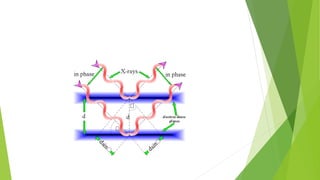
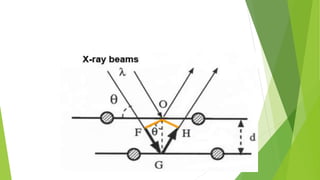
 W. L. Bragg explained this result by
modeling the crystal as a set of discrete
parallel planes separated by a constant
parameter d. It was proposed that the
incident X-ray radiation would produce a
Bragg peak if their reflections off the
various planes interfered constructively.
The interference is constructive when the
phase shift is a multiple of 2π;
 So Bragg’s law given as
 Where n is an integer,
 Lambda is a wavelength of incident wave,
 d is the space between the plane in atomic lattice,
is the angle between incident ray and the scattering plane.
 Bragg's Law was derived by physicist Sir William Lawrence Bragg in 1912 and
first presented on 11 November 1912 to theCambridge Philosophical Society.
Although simple, Bragg's law confirmed the existence of real particles at the
atomic scale, as well as providing a powerful new tool for studying crystals in
the form of X-ray and neutron diffraction.
 William Lawrence Bragg and his father, Sir
William Henry Bragg, were awarded
the Nobel Prize in physics in 1915 for their
work in determining crystal structures
beginning with NaCl, ZnS, and diamond.
 Bragg diffraction occurs when electromagnetic radiation or subatomic particle
waves with wavelength comparable to atomic spacing's are incident upon a
crystalline sample, are scattered in a specular fashion by the atoms in the
system, and undergo constructive interference in accordance to Bragg's law.
For a crystalline solid, the waves are scattered from lattice planes separated
by the interplanar distance d. Where the scattered waves interfere
constructively, they remain in phase since the path length of each wave is
equal to an integer multiple of the wavelength. The path difference between
two waves undergoing constructive interference is given by 2dsinθ, where θ is
the scattering angle. This leads to Bragg's law, which describes the condition
for constructive interference from successive crystallographic planes.
THANK YOY

Bragg's law

  • 1.
  • 2.
    BRAGG’S LAW  Bragg'slaw gives the angles for coherent and incoherent scattering from a crystal lattice. When X-rays are incident on an atom, they make the electronic cloud move as does any electromagnetic wave. The movement of these charges re- radiates waves with the same frequency this phenomenon is known as Rayleigh scattering (or elastic scattering).
  • 4.
     A similarprocess occurs upon scattering neutron waves from the nuclei. These re-emitted wave fields interfere with each other either constructively or destructively producing a diffraction pattern on a detector or film. The resulting wave interference pattern is the basis of diffraction analysis. This analysis is called Bragg diffraction.
  • 6.
    Bragg diffraction (alsoreferred to as the Bragg formulation of X-ray diffraction) was first proposed by William Lawrence Bragg and William Henry Braggin 1913 in response to their discovery that crystalline solids produced surprising patterns of reflected X-rays.The concept of Bragg diffraction applies equally to neutron diffraction and electron diffraction processes.
  • 8.
     W. L.Bragg explained this result by modeling the crystal as a set of discrete parallel planes separated by a constant parameter d. It was proposed that the incident X-ray radiation would produce a Bragg peak if their reflections off the various planes interfered constructively. The interference is constructive when the phase shift is a multiple of 2π;
  • 9.
     So Bragg’slaw given as  Where n is an integer,  Lambda is a wavelength of incident wave,  d is the space between the plane in atomic lattice, is the angle between incident ray and the scattering plane.
  • 10.
     Bragg's Lawwas derived by physicist Sir William Lawrence Bragg in 1912 and first presented on 11 November 1912 to theCambridge Philosophical Society. Although simple, Bragg's law confirmed the existence of real particles at the atomic scale, as well as providing a powerful new tool for studying crystals in the form of X-ray and neutron diffraction.
  • 11.
     William LawrenceBragg and his father, Sir William Henry Bragg, were awarded the Nobel Prize in physics in 1915 for their work in determining crystal structures beginning with NaCl, ZnS, and diamond.
  • 12.
     Bragg diffractionoccurs when electromagnetic radiation or subatomic particle waves with wavelength comparable to atomic spacing's are incident upon a crystalline sample, are scattered in a specular fashion by the atoms in the system, and undergo constructive interference in accordance to Bragg's law. For a crystalline solid, the waves are scattered from lattice planes separated by the interplanar distance d. Where the scattered waves interfere constructively, they remain in phase since the path length of each wave is equal to an integer multiple of the wavelength. The path difference between two waves undergoing constructive interference is given by 2dsinθ, where θ is the scattering angle. This leads to Bragg's law, which describes the condition for constructive interference from successive crystallographic planes.
  • 13.