
Mustafa
AL-doori
THE MAIN AXES:
1- Introduction
2-Bragg's Law
3-Prove Bragg's Law
4-Generating x-ray
5- x-ray tube
6- Debye Scherrer camera
7-X-ray Diffractometer
8-Conclusion
Introduction
 X-Rays are electromagnetic radiations
with wave lengths of the order of 0.1nm.
 X-rays are produced when electrons from
a heated filament strike the metal target.
 In 1912 physicist Max Von Laue
discovered that a crystalline solid ,
consisting as it does of regular array of
atoms ,might form a natural three -
dimensional diffraction grating for x-rays.
 Question:
So if all electromagnetic radiation can diffract,
why are X-rays used in crystallography?
Ans….
 X-rays have wavelengths on the order of a
few angstroms (1 Angstrom = 0.1nm). This
is the typical inter-atomic distance in
crystalline solids, making X-rays the correct
order of magnitude for diffraction of atoms
of crystalline materials.
Introduction
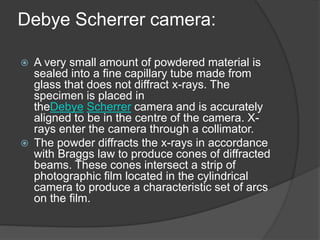
 A grating with d= wavelength is desirable
for x-ray diffraction.
 diffraction occurs when a wave encounters
a series of regularly spaced obstacles that
are;
 Capable of scattering the wave.
 Have spacing that are comparable in
magnitude to the wavelength
Bragg’s law
 In 1914 W.H Bragg and W.L Bragg study the
atomic structure of crystal by using X-rays
 Consider the two parallel planes of atoms A-A´
And B-B‛ which are separated by interplanar
spacing d.
 Now assume that a parallel , monochromatic
beam of x-rays of wavelength ⋏ is incident
on these two planes at an angle ⏀.
 two rays in this beam , labeled 1 and 2 are
scattered by atoms P and Q.
 ray 2 covered some extra path as
compared to ray 1
 this extra path is called path difference .
 Constructive interference of scattered
rays 1‘ and 2‘ at an angle ⏀ to the plane,
if the path difference between 1- P-1’ and
2-Q-2‘ ,is equal to whole number , n , of
wavelength;
 so
It will prove Bragg's Law
There will be a path difference between the ray that gets reflected along AC' and the ray
that gets transmitted, then reflected, along AB and BC respectively. This path difference
is
The two separate waves will arrive at a point with the
same phase, and hence undergo constructive
interference, if and only if this path difference is equal
to any integer value of the wavelength, i.e.
where the same definition of and apply as above.
Therefore,
from which it follows that
Putting everything together,
which simplifies to
Generating x-ray
X-ray tube
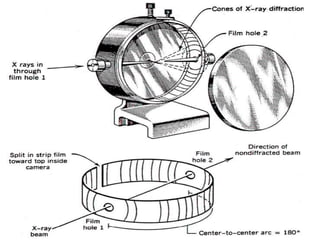
Debye Scherrer camera:
 A very small amount of powdered material is
sealed into a fine capillary tube made from
glass that does not diffract x-rays. The
specimen is placed in
theDebye Scherrer camera and is accurately
aligned to be in the centre of the camera. X-
rays enter the camera through a collimator.
 The powder diffracts the x-rays in accordance
with Braggs law to produce cones of diffracted
beams. These cones intersect a strip of
photographic film located in the cylindrical
camera to produce a characteristic set of arcs
on the film.
X-ray Diffractometer
Some images x-ray
Conclusion
:
1- solid-state physics
2- biophysics
3- medical physics
4- chemistry and biochemistry

Mustafa x ray

  • 1.
  • 2.
    THE MAIN AXES: 1-Introduction 2-Bragg's Law 3-Prove Bragg's Law 4-Generating x-ray 5- x-ray tube 6- Debye Scherrer camera 7-X-ray Diffractometer 8-Conclusion
  • 3.
    Introduction  X-Rays areelectromagnetic radiations with wave lengths of the order of 0.1nm.  X-rays are produced when electrons from a heated filament strike the metal target.  In 1912 physicist Max Von Laue discovered that a crystalline solid , consisting as it does of regular array of atoms ,might form a natural three - dimensional diffraction grating for x-rays.
  • 4.
     Question: So ifall electromagnetic radiation can diffract, why are X-rays used in crystallography? Ans….  X-rays have wavelengths on the order of a few angstroms (1 Angstrom = 0.1nm). This is the typical inter-atomic distance in crystalline solids, making X-rays the correct order of magnitude for diffraction of atoms of crystalline materials.
  • 5.
    Introduction  A gratingwith d= wavelength is desirable for x-ray diffraction.  diffraction occurs when a wave encounters a series of regularly spaced obstacles that are;  Capable of scattering the wave.  Have spacing that are comparable in magnitude to the wavelength
  • 6.
    Bragg’s law  In1914 W.H Bragg and W.L Bragg study the atomic structure of crystal by using X-rays  Consider the two parallel planes of atoms A-A´ And B-B‛ which are separated by interplanar spacing d.  Now assume that a parallel , monochromatic beam of x-rays of wavelength ⋏ is incident on these two planes at an angle ⏀.  two rays in this beam , labeled 1 and 2 are scattered by atoms P and Q.
  • 7.
     ray 2covered some extra path as compared to ray 1  this extra path is called path difference .  Constructive interference of scattered rays 1‘ and 2‘ at an angle ⏀ to the plane, if the path difference between 1- P-1’ and 2-Q-2‘ ,is equal to whole number , n , of wavelength;  so
  • 9.
    It will proveBragg's Law There will be a path difference between the ray that gets reflected along AC' and the ray that gets transmitted, then reflected, along AB and BC respectively. This path difference is
  • 10.
    The two separatewaves will arrive at a point with the same phase, and hence undergo constructive interference, if and only if this path difference is equal to any integer value of the wavelength, i.e. where the same definition of and apply as above. Therefore,
  • 11.
    from which itfollows that Putting everything together,
  • 12.
  • 13.
  • 14.
  • 17.
    Debye Scherrer camera: A very small amount of powdered material is sealed into a fine capillary tube made from glass that does not diffract x-rays. The specimen is placed in theDebye Scherrer camera and is accurately aligned to be in the centre of the camera. X- rays enter the camera through a collimator.  The powder diffracts the x-rays in accordance with Braggs law to produce cones of diffracted beams. These cones intersect a strip of photographic film located in the cylindrical camera to produce a characteristic set of arcs on the film.
  • 20.
  • 22.
  • 23.
    Conclusion : 1- solid-state physics 2-biophysics 3- medical physics 4- chemistry and biochemistry

Editor's Notes