Downloaded 31 times
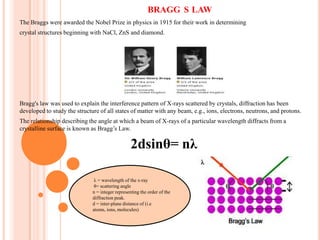
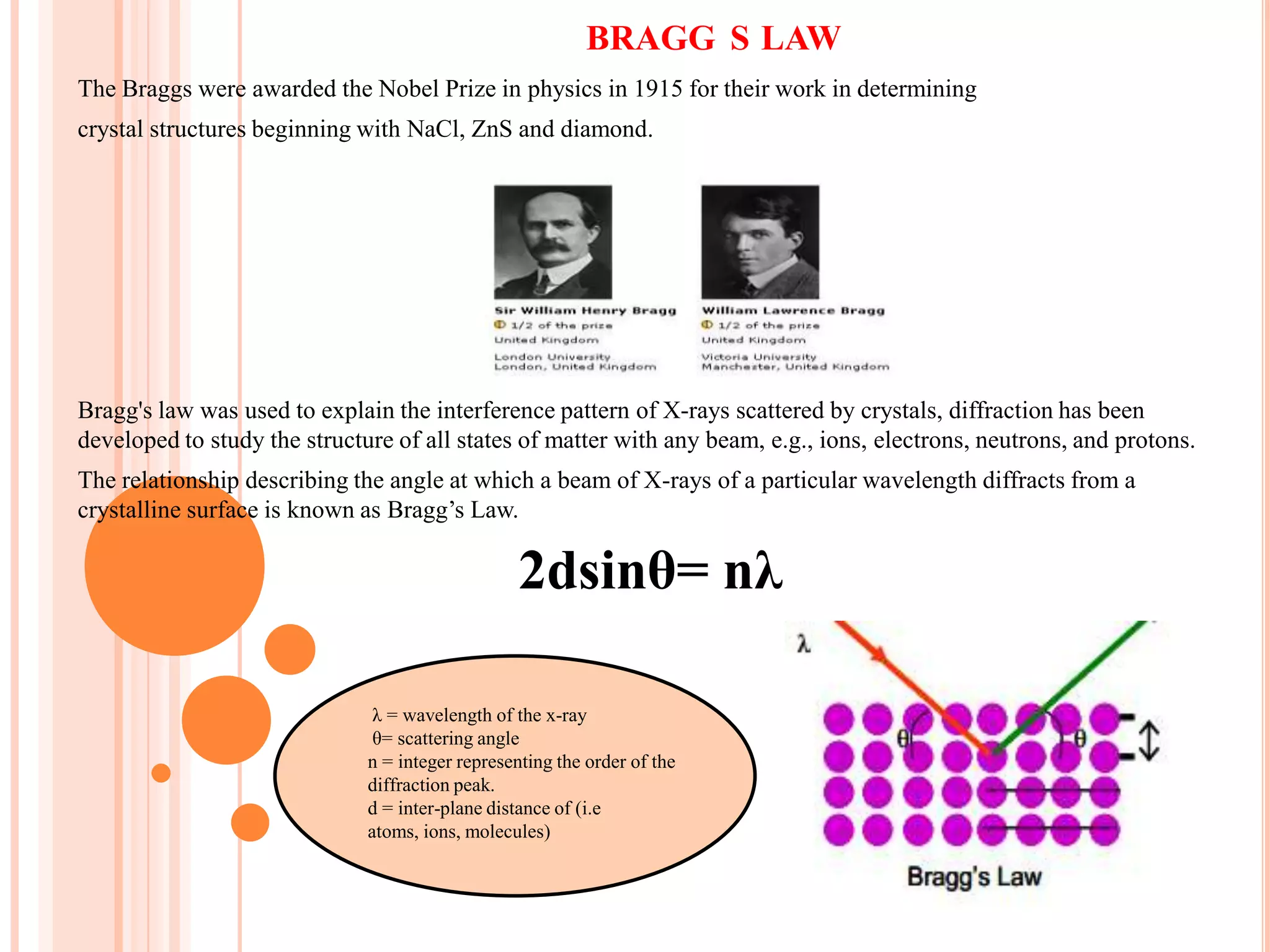
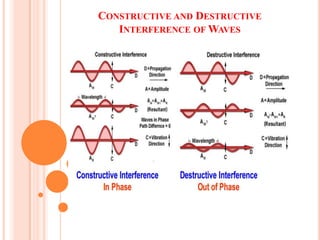
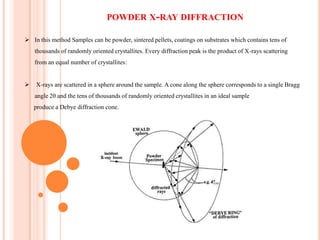
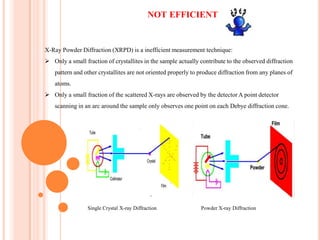

The Braggs were awarded the Nobel Prize in 1915 for determining crystal structures including NaCl, ZnS, and diamond using X-ray diffraction. Bragg's law describes the angle at which X-rays of a particular wavelength diffract from a crystalline surface as 2dsinθ=nλ, relating inter-plane distance (d), wavelength (λ), diffraction order (n), and scattering angle (θ). Powder X-ray diffraction works by scattering X-rays in a sphere around a sample containing many randomly oriented crystallites, producing a Debye diffraction cone at each Bragg angle.


![Xrd presentation [autosaved] [autosaved] copy (2)](https://cdn.slidesharecdn.com/ss_thumbnails/xrdpresentationautosavedautosaved-copy2-190813130515-thumbnail.jpg?width=640&height=640&fit=bounds)


