Optical Components
Ajmal Muhammad, Robert Forchheimer
Information Coding Group
ISY Department
Outline
 Types of optical components
 Passive (reciprocal & non-reciprocal)
Lens, couplers, isolators, circulators, filters, multiplexer, demultiplexer
 Active
Modulator, switch, optical amplifier, wavelength converter, gain
equalizer
 Wavelength Selectivity
 Fixed
 Tunable
 Parameters
Temperature dependency, insertion loss (inputoutput loss)
inter-channel cross-talks, fast tunability, stability and polarization
dependency
Requirements
 Bandwidth
 Low insertion loss (inputoutput loss)
 High return loss (outputinput loss)
 Polarization insensitivity
 Low crosstalk
 High extinction ratio
 Temperature insensitivity
 Low control power
 Small size
 Cost
Optical Component Platform
 Micro-optic components
The assembly of discrete elements are placed together in an optical
component. The elements require precise optical alignment to maximize
the performance.
 Integrated optics components
Uses planar manufacturing techniques to develop devices such as Array
Waveguide Grating (AWG), Variable Optical Attenuators (VOA), Electro-
optic Modulators, etc.
 Fiber based optical components
Devices made of fibers such as fused optical couplers, fused WDMs, Fiber-
Bragg gratings (FBG), etc.
 Hybrid type
Passive Components
 Coupler: versatile device used as a building block for
several other optical devices
 Isolator: used in systems at the output of amplifiers and
lasers to prevent reflections
 Filter: to multiplex and demultiplex wavelengths in a
WDM system, and to provide equalization of the gain
and filtering of noise in optical amplifier
 MUX & DEMUX: MUX combines signals at different
wavelengths on its input ports onto a common output
port, DEMUX performs the opposite function
Couplers
 Structure
 NxN (e.g., 2x2)
 α is proportional to l (α is coupling ratio, l is coupling length)
 Parameters of interest
 Coupling ratio
 Coupling length
 Excess loss (beyond α)
 Type
 Wavelength dependent (α has wavelength-dependency)
 Wavelength independent (wavelength flat)
 Splitting ratio
 3dB (splitting the power evenly) - α=0.5
 Taps (e.g., α 1∼ – thus, a very small portion is dropped)
Couplers
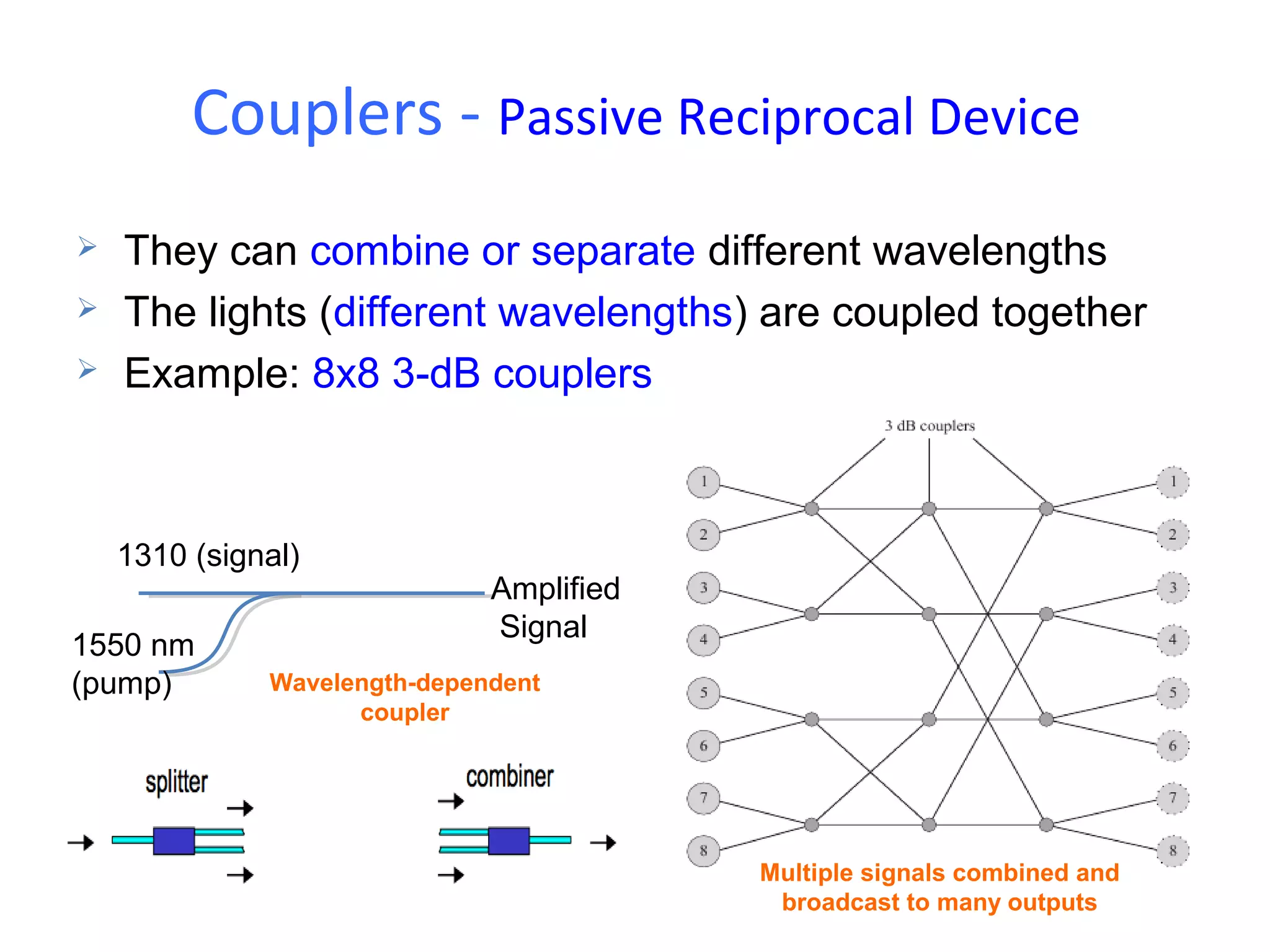
Couplers - Passive Reciprocal Device
 They can combine or separate different wavelengths
 The lights (different wavelengths) are coupled together
 Example: 8x8 3-dB couplers
1310 (signal)
1550 nm
(pump)
Amplified
Signal
Wavelength-dependent
coupler
Multiple signals combined and
broadcast to many outputs
Couplers
6x6 coupler1x2 coupler
Isolators - Passive Non-Reciprocal Device
 Transmit in one direction only
 Avoid reflection of laser – or any reflection
 One input, one output or multiple ports
 Key parameters are insertion loss and excess loss
 Example: circulator
Operation of Isolators
Isolators
Passive Components
 Coupler: versatile device used as a building block for
several other optical devices
 Isolator: used in systems at the output of amplifiers and
lasers to prevent reflections
 Filter: Variety of technologies are available
Gratings
Describe a device involving interference among multiple
optical signals coming from the same source but having
difference phase shift
There are a number of gratings
 Reflective
 Transmission
 Diffraction
 Stimax (same as reflection but integrate with concave
mirrors)
Gratings
Transmission gratings
The incident light is transmitted through the
slits
Due to diffraction (narrow slits) the light is
transmitted in all direction
Each slit becomes a secondary source of
light
A constructive interference will be created
on the image plane only for specific WLs that
are in phase  high light intensity
Narrow slits are placed next to each other
The spacing determines the pitch of the
gratings
Angles are due to phase shift
Transmission
gratings
Reflective
gratings
Diffraction
gratings
Fiber Bragg Gratings
Any periodic perturbation in the propagation medium serves as a
Bragg gratings
Diffractive optical
element
Optical Add/Drop Using Fiber
Bragg Grating
Fabry-Perot Filters
A cavity with highly reflective mirrors parallel to each other
(Bragg structure)
 Acts like a resonator
 Also called FP Interferometer
 Used in lasers
Tunability of Fabry-Perot
 Changing the cavity length (l)
 Varying the refractive index (n) within the cavity
 Mechanical placement of mirrors
Not very reliable
 Using piezoelectric material within the cavity
Thermal instability
Multilayer Dielectric Thin Film
Filters
 Dielectric thin-film (DTF) interference filters consist of
alternating quarter-wavelength thick layers of high
refractive index and low refractive index
each layer is a quarter-wavelength thick.
 The primary considerations in DTF design are:

Low-pass-band loss (« 0.3 dB)
Good channel spacing (> 10 nm)
Low inter-channel cross-talk (> -28 dB)
MUX/DEMUX using DTF filtersDTF filters
Mach-Zehnder
Interferometer
 Uses two couplers
 The coupling ratio can be different
 A phase difference between two optical paths may be artificially induced
 Adjusting ΔL changes the phase of the received signal
 Because of the path difference, the two waves arrive at coupler 2
with a phase difference
 At coupler 2, the two waves recombine and are directed to two
output ports
 each output port supports the one of the two wavelengths that satisfies a certain
phase condition
 Note:
 Δf=C/2nΔL
 ΔΦ=2πf.ΔL.(n/c)
Tunability
Can be achieved by altering n or L
Arrayed Waveguide Grating (AWG)
AWG is a generalization of the Mach-Zehnder interferometer
AWG as DEMUX and Cross-
Connect
Input coupler Arrayed guides Output coupler
Static Wavelength
Cross-connect
Multiplexer/Demultiplexer
Active Components
 Modulator, switch, and router
 Optical amplifier (fiber amplifier, semiconductor amplifier)
 Wavelength converter
 Gain equalizer
Optical switch can be used for:
1) Light modulation(phase & intensity)
2) Routing optical data
Type of Optical Modulators/Switches
Micro-Electro-Mechanical
(MEMS) Switch
Electro-Optic Modulator
Need material with high electro-optic effect
Electro-optic: refractive index change is proportional to applied electric
field
Wavelength Converter
Different types of Wavelength
Converter
 OE/EO regeneration
 SOA-based
Cross-gain modulation
Cross-phase modulation
Four-Wave mixing
 Fiber-based
Cross-phase modulation
Four-Wave mixing
Cross-gain
Cross-phase
Four-Wave
mixing
OE/EO
Gain Equalizers
Gain/Power Equalizers
Optical components

Optical components

  • 1.
    Optical Components Ajmal Muhammad,Robert Forchheimer Information Coding Group ISY Department
  • 2.
    Outline  Types ofoptical components  Passive (reciprocal & non-reciprocal) Lens, couplers, isolators, circulators, filters, multiplexer, demultiplexer  Active Modulator, switch, optical amplifier, wavelength converter, gain equalizer  Wavelength Selectivity  Fixed  Tunable  Parameters Temperature dependency, insertion loss (inputoutput loss) inter-channel cross-talks, fast tunability, stability and polarization dependency
  • 3.
    Requirements  Bandwidth  Lowinsertion loss (inputoutput loss)  High return loss (outputinput loss)  Polarization insensitivity  Low crosstalk  High extinction ratio  Temperature insensitivity  Low control power  Small size  Cost
  • 4.
    Optical Component Platform Micro-optic components The assembly of discrete elements are placed together in an optical component. The elements require precise optical alignment to maximize the performance.  Integrated optics components Uses planar manufacturing techniques to develop devices such as Array Waveguide Grating (AWG), Variable Optical Attenuators (VOA), Electro- optic Modulators, etc.  Fiber based optical components Devices made of fibers such as fused optical couplers, fused WDMs, Fiber- Bragg gratings (FBG), etc.  Hybrid type
  • 5.
    Passive Components  Coupler:versatile device used as a building block for several other optical devices  Isolator: used in systems at the output of amplifiers and lasers to prevent reflections  Filter: to multiplex and demultiplex wavelengths in a WDM system, and to provide equalization of the gain and filtering of noise in optical amplifier  MUX & DEMUX: MUX combines signals at different wavelengths on its input ports onto a common output port, DEMUX performs the opposite function
  • 6.
    Couplers  Structure  NxN(e.g., 2x2)  α is proportional to l (α is coupling ratio, l is coupling length)  Parameters of interest  Coupling ratio  Coupling length  Excess loss (beyond α)  Type  Wavelength dependent (α has wavelength-dependency)  Wavelength independent (wavelength flat)  Splitting ratio  3dB (splitting the power evenly) - α=0.5  Taps (e.g., α 1∼ – thus, a very small portion is dropped) Couplers
  • 7.
    Couplers - PassiveReciprocal Device  They can combine or separate different wavelengths  The lights (different wavelengths) are coupled together  Example: 8x8 3-dB couplers 1310 (signal) 1550 nm (pump) Amplified Signal Wavelength-dependent coupler Multiple signals combined and broadcast to many outputs
  • 8.
  • 9.
    Isolators - PassiveNon-Reciprocal Device  Transmit in one direction only  Avoid reflection of laser – or any reflection  One input, one output or multiple ports  Key parameters are insertion loss and excess loss  Example: circulator
  • 10.
  • 11.
  • 12.
    Passive Components  Coupler:versatile device used as a building block for several other optical devices  Isolator: used in systems at the output of amplifiers and lasers to prevent reflections  Filter: Variety of technologies are available
  • 13.
    Gratings Describe a deviceinvolving interference among multiple optical signals coming from the same source but having difference phase shift There are a number of gratings  Reflective  Transmission  Diffraction  Stimax (same as reflection but integrate with concave mirrors)
  • 14.
    Gratings Transmission gratings The incidentlight is transmitted through the slits Due to diffraction (narrow slits) the light is transmitted in all direction Each slit becomes a secondary source of light A constructive interference will be created on the image plane only for specific WLs that are in phase  high light intensity Narrow slits are placed next to each other The spacing determines the pitch of the gratings Angles are due to phase shift Transmission gratings Reflective gratings Diffraction gratings
  • 15.
    Fiber Bragg Gratings Anyperiodic perturbation in the propagation medium serves as a Bragg gratings Diffractive optical element
  • 16.
    Optical Add/Drop UsingFiber Bragg Grating
  • 17.
    Fabry-Perot Filters A cavitywith highly reflective mirrors parallel to each other (Bragg structure)  Acts like a resonator  Also called FP Interferometer  Used in lasers
  • 18.
    Tunability of Fabry-Perot Changing the cavity length (l)  Varying the refractive index (n) within the cavity  Mechanical placement of mirrors Not very reliable  Using piezoelectric material within the cavity Thermal instability
  • 19.
    Multilayer Dielectric ThinFilm Filters  Dielectric thin-film (DTF) interference filters consist of alternating quarter-wavelength thick layers of high refractive index and low refractive index each layer is a quarter-wavelength thick.  The primary considerations in DTF design are:  Low-pass-band loss (« 0.3 dB) Good channel spacing (> 10 nm) Low inter-channel cross-talk (> -28 dB) MUX/DEMUX using DTF filtersDTF filters
  • 20.
    Mach-Zehnder Interferometer  Uses twocouplers  The coupling ratio can be different  A phase difference between two optical paths may be artificially induced  Adjusting ΔL changes the phase of the received signal  Because of the path difference, the two waves arrive at coupler 2 with a phase difference  At coupler 2, the two waves recombine and are directed to two output ports  each output port supports the one of the two wavelengths that satisfies a certain phase condition  Note:  Δf=C/2nΔL  ΔΦ=2πf.ΔL.(n/c)
  • 21.
    Tunability Can be achievedby altering n or L
  • 22.
    Arrayed Waveguide Grating(AWG) AWG is a generalization of the Mach-Zehnder interferometer
  • 23.
    AWG as DEMUXand Cross- Connect Input coupler Arrayed guides Output coupler Static Wavelength Cross-connect
  • 24.
  • 25.
  • 26.
    Active Components  Modulator,switch, and router  Optical amplifier (fiber amplifier, semiconductor amplifier)  Wavelength converter  Gain equalizer Optical switch can be used for: 1) Light modulation(phase & intensity) 2) Routing optical data
  • 27.
    Type of OpticalModulators/Switches
  • 28.
  • 29.
    Electro-Optic Modulator Need materialwith high electro-optic effect Electro-optic: refractive index change is proportional to applied electric field
  • 30.
  • 31.
    Different types ofWavelength Converter  OE/EO regeneration  SOA-based Cross-gain modulation Cross-phase modulation Four-Wave mixing  Fiber-based Cross-phase modulation Four-Wave mixing Cross-gain Cross-phase Four-Wave mixing OE/EO
  • 32.
  • 33.
  • 34.