Fiber Bragg Gratings
Presented by
Hrudya
Review








Fiber Bragg Grating (FBG) is a simple and low-cost
filter built into the core of a wavelength-specific fiber
cable.
FBGs are used as inline optical filters to block
certain wavelengths, or as wavelength-specific
reflectors.
FBGs improve optical signal quality and are key to
fiber optic construction.
FBGs also may be used to stabilize laser output.
Uniform FBG: Uniform grating periods are used.
Fiber Bragg Gratings


The grating parameters






Length of grating
Strength of grating
Refractive index.

manipulated to produce desired grating
characteristics
The different types of FBGs are






Chirped FBGS
Blazed FBGs
Phase shifted FBGs
Long-Period In-Fiber FBGs
Chirped FBGs





The chirp of an optical pulse is the time
dependence of its instantaneous frequency.
Specifically, an up-chirp means that the
instantaneous frequency rises with time.
A down-chirp means that the instantaneous
frequency decreases with time.
Continue....
Working Principle



Chirped FBG: Variable grating periods are written
into the core.
Chirped fiber gratings can be designed and made by






axially varying either the period of the grating
the effective index of refraction of the fiber.

This causes a gradual change in the grating period.
Thus when a signal enters the chirped FBG


Different wavelengths are reflected from different parts of
the grating.



Here grating imposes a wavelength dependent
delay on the signal.
Some wave lengths are delayed more than others.


Continue....
Features

Applications

•Chirped FBG operates as a
wavelength dependent dispersion
compensator and light reflector.

•Gain Flattening Filter for EDFA .

•Chirped fiber Bragg gratings show
a wide transmission band width.

•Distributed sensing.

•The power reflectivity and the
group delay characteristics can be
made more stable by applying
apodization to fiber grating.
(apodization function is used to
purposely change the intensity
profile of an optical system )

The reflection bandwidth increases
with increasing chirp parameter
(dλD/dz)but in this case the
reflection power decreases.

•Wideband filter for CWDM system.

•Chromatic dispersion
compensation.
Continue....
Continue....



By applying apodization the ripples will be removed .
As chirping increases bandwidth increases.
Multiple FBGs in Same Fiber Section







We can write many different FBGs into the same
section of fiber – one on top of the fiber .
Each grating will then respond quiet separately and
independently to light of its own resonant
wavelength.
This will exhibit only very little interaction between
the wavelengths.
Thus we don't need to have lots of gratings
concatenated on one after the other.
This is very useful when using a dispersion
compensated WDM systems.
Blazed FBGs





Blazed FBG: Constructed when grating is written at
an oblique angle to the core's centre axis.
The selected wavelength is reflected out of the fiber.
if we use a number of blazed gratings we can reflect
out unwanted wave lengths.
Thus we can construct a filter to pass only the
wavelengths we want.
Continue.....
Features
•Bragg grating planes are tilted at
an angle to the fiber axis..

Applications
•Fiber Bragg grating sensors
•Fiber Optic Filters

The bandwidth of the trapped out
light is dependent on the tilt angle
of the grating planes and the
strength of the index modulation.
•Transmission spectrum of TFBG
posses many resonant peaks.
•Transmission characteristics of
TFBGs are temperature sensitive
•Fiber bending causes the
transmission spectrum to be more
complex.

•To flatten the response of an
EDFA.
Continue....
.
Continue...
Phase shifted In-Fiber Bragg Gratings


In Phase shifted In-Fiber Bragg Gratings





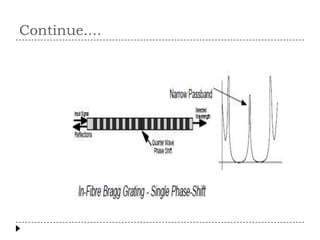
Transmission spectrum of a fiber Bragg grating is
varied.
This is achieved by incorporating single or multiple
phase shifted regions during the fabrication process.
Phase shifts open up narrow transmission windows
inside the stop band of the Bragg grating.
Transmitted wave length can be changed by changing
the amount of phase shift.
Continue....
Continue.....
Features

Applications

•Phase shifted Bragg gratings show •Highly accurate wavelength
a very narrow transmission band
references
width.
•Filters
•Using special structures even
multiple transmission bands are
•Spectroscopy
possible.
•Optical CDMA
•Central pass band has excellent
characteristics.
•Operational Systems
•Its width can be controlled
precisely.
•It varies from almost total reflection
to almost total transmission.
• It can be used for selecting a
single wavelength from among
many in a WDM system.
Long-Period In-Fiber Bragg Gratings


Long-period grating is one in which the grating
period is many hundred or thousand times the
resonant wave length.
Working


In a long period grating






Light is coupled forward rather than backward in the
fiber .
But in a single mode fiber there is no forward bound
mode available into which the light may couple.
Therefore it couples forward into the cladding mode.
After a while the coupled light leaves the system and is
lost.
Thus resonant wavelengths are removed from the
system.
Features

Applications

•Periodicity of the long-period
•Used for flattening the response
grating is typically several hundred of an EDFA
times greater than that of the
Bragg grating
•Band reject filters
•The bandwidth of the long-period
grating is relatively large.

•Used for fiber-optic sensing.

•Optical Sensors
• The physical length (typically a
few centimetres) of the long-period
grating is much longer than that of
the FBG.
•Long-period grating is extremely
sensitive to bends in the fibre,
long-period grating may
experience a significant nonuniform strain field along a grating
length of a few centimetres;
Thank You !

Fiber bragg gratings

  • 1.
  • 2.
    Review      Fiber Bragg Grating(FBG) is a simple and low-cost filter built into the core of a wavelength-specific fiber cable. FBGs are used as inline optical filters to block certain wavelengths, or as wavelength-specific reflectors. FBGs improve optical signal quality and are key to fiber optic construction. FBGs also may be used to stabilize laser output. Uniform FBG: Uniform grating periods are used.
  • 3.
    Fiber Bragg Gratings  Thegrating parameters     Length of grating Strength of grating Refractive index. manipulated to produce desired grating characteristics The different types of FBGs are     Chirped FBGS Blazed FBGs Phase shifted FBGs Long-Period In-Fiber FBGs
  • 4.
    Chirped FBGs    The chirpof an optical pulse is the time dependence of its instantaneous frequency. Specifically, an up-chirp means that the instantaneous frequency rises with time. A down-chirp means that the instantaneous frequency decreases with time.
  • 5.
  • 6.
    Working Principle   Chirped FBG:Variable grating periods are written into the core. Chirped fiber gratings can be designed and made by     axially varying either the period of the grating the effective index of refraction of the fiber. This causes a gradual change in the grating period. Thus when a signal enters the chirped FBG  Different wavelengths are reflected from different parts of the grating.  Here grating imposes a wavelength dependent delay on the signal. Some wave lengths are delayed more than others. 
  • 7.
  • 8.
    Features Applications •Chirped FBG operatesas a wavelength dependent dispersion compensator and light reflector. •Gain Flattening Filter for EDFA . •Chirped fiber Bragg gratings show a wide transmission band width. •Distributed sensing. •The power reflectivity and the group delay characteristics can be made more stable by applying apodization to fiber grating. (apodization function is used to purposely change the intensity profile of an optical system ) The reflection bandwidth increases with increasing chirp parameter (dλD/dz)but in this case the reflection power decreases. •Wideband filter for CWDM system. •Chromatic dispersion compensation.
  • 9.
  • 10.
    Continue....   By applying apodizationthe ripples will be removed . As chirping increases bandwidth increases.
  • 11.
    Multiple FBGs inSame Fiber Section      We can write many different FBGs into the same section of fiber – one on top of the fiber . Each grating will then respond quiet separately and independently to light of its own resonant wavelength. This will exhibit only very little interaction between the wavelengths. Thus we don't need to have lots of gratings concatenated on one after the other. This is very useful when using a dispersion compensated WDM systems.
  • 12.
    Blazed FBGs     Blazed FBG:Constructed when grating is written at an oblique angle to the core's centre axis. The selected wavelength is reflected out of the fiber. if we use a number of blazed gratings we can reflect out unwanted wave lengths. Thus we can construct a filter to pass only the wavelengths we want.
  • 13.
  • 14.
    Features •Bragg grating planesare tilted at an angle to the fiber axis.. Applications •Fiber Bragg grating sensors •Fiber Optic Filters The bandwidth of the trapped out light is dependent on the tilt angle of the grating planes and the strength of the index modulation. •Transmission spectrum of TFBG posses many resonant peaks. •Transmission characteristics of TFBGs are temperature sensitive •Fiber bending causes the transmission spectrum to be more complex. •To flatten the response of an EDFA.
  • 15.
  • 16.
  • 17.
    Phase shifted In-FiberBragg Gratings  In Phase shifted In-Fiber Bragg Gratings     Transmission spectrum of a fiber Bragg grating is varied. This is achieved by incorporating single or multiple phase shifted regions during the fabrication process. Phase shifts open up narrow transmission windows inside the stop band of the Bragg grating. Transmitted wave length can be changed by changing the amount of phase shift.
  • 18.
  • 19.
  • 20.
    Features Applications •Phase shifted Bragggratings show •Highly accurate wavelength a very narrow transmission band references width. •Filters •Using special structures even multiple transmission bands are •Spectroscopy possible. •Optical CDMA •Central pass band has excellent characteristics. •Operational Systems •Its width can be controlled precisely. •It varies from almost total reflection to almost total transmission. • It can be used for selecting a single wavelength from among many in a WDM system.
  • 21.
    Long-Period In-Fiber BraggGratings  Long-period grating is one in which the grating period is many hundred or thousand times the resonant wave length.
  • 22.
    Working  In a longperiod grating      Light is coupled forward rather than backward in the fiber . But in a single mode fiber there is no forward bound mode available into which the light may couple. Therefore it couples forward into the cladding mode. After a while the coupled light leaves the system and is lost. Thus resonant wavelengths are removed from the system.
  • 23.
    Features Applications •Periodicity of thelong-period •Used for flattening the response grating is typically several hundred of an EDFA times greater than that of the Bragg grating •Band reject filters •The bandwidth of the long-period grating is relatively large. •Used for fiber-optic sensing. •Optical Sensors • The physical length (typically a few centimetres) of the long-period grating is much longer than that of the FBG. •Long-period grating is extremely sensitive to bends in the fibre, long-period grating may experience a significant nonuniform strain field along a grating length of a few centimetres;
  • 24.