Intergranular Corrosion
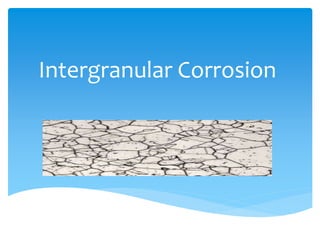
 Localized attack adjacent to grain boundaries with
relatively little corrosion of grains.
 It is form of surface corrosion preferentially along the grain
boundaries of metal.
 Intergranuler corrosion takes place due to higher rate of
corrosion of grain boundary area of an alloy than that of
grain interior .
 If a metal corrode uniform attack usually results because
grain boundaries are slightly more reactive than matrix .
Intr0duction
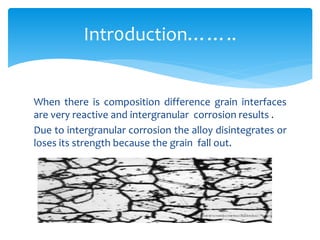
When there is composition difference grain interfaces
are very reactive and intergranular corrosion results .
Due to intergranular corrosion the alloy disintegrates or
loses its strength because the grain fall out.
Intr0duction……..
 Intermetallic compound such as Mg5 AL8,formation
at the grain boundaries form a galvanic cell with a
alloy matrix and in chloride environment severe
intergranular type of corrosion occur.
 Intergranular corrosion can occur in many alloys
systems such as stainless steel, nickel base and
aluminum base alloys.
Examples
 Intergranular corrosion of an alloy may be caused by
 Impurities at the grain boundaries
 Enrichment of one of the alloying elements
 Depletion of one of the elements that affects its corrosion
resistance in grain boundary areas.
 Small amounts of iron in aluminum, wherein solubility of
iron is low, have been shown to segregate in the grain
boundaries and cause Intergranular corrosion.
 Depletion of chromium in the grain boundary region
results in Intergranular corrosion of SS.
Causes Of Intergranular Corrosion
 The potential difference between the grain boundary
regions and any precipitate, intermetallic phases, or
impurities that form at the grain boundaries is
responsible for higher dissolution rates at these
regions.
Causes ……..
 The actual mechanism differ from one alloy system to
another.
 Some precipitates form preferentially at grain boundaries
as a result of production, fabrication and welding at
elevated temperature.
 If these precipitates are rich in alloying elements which are
essential for corrosion resistance the regions adjacent to
grain boundaries are depleted of these elements.
 Thus the metal is said to be sensitized and it suffers from
Intergranular attack in a corrosion environment.
Mechanism
 Segregation of impurities at grain boundaries may
give rise to galvanic corrosion.
 Now we consider Austenitic stainless steel of type
304.
 The universally accepted theory is the depletion of
chromium in the grain boundary areas.
 Chromium increase the corrosion resistance of the
steel. If chromium is less than 10% then relatively low
corrosion resistance is approached.
Mechanism ……..
 This steel is sensitized to corrosion when heated
approximately from 950-1450 ̊F.
 In this range chromium carbide is virtually insoluble and
precipitates out if carbon content is higher than o.o2%
 So Cr, come out of solid solution results in metal with low
chromium contents in the area adjacent to the grain
boundaries.
 The chromium carbide in the grain boundaries is not
attacked.
Mechanism ……..
Mechanism ……..
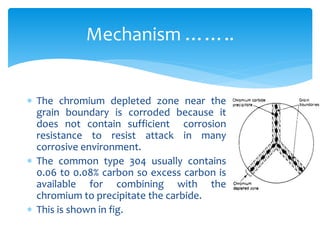
 The chromium depleted zone near the
grain boundary is corroded because it
does not contain sufficient corrosion
resistance to resist attack in many
corrosive environment.
 The common type 304 usually contains
0.06 t0 0.08% carbon so excess carbon is
available for combining with the
chromium to precipitate the carbide.
 This is shown in fig.
Mechanism ……..
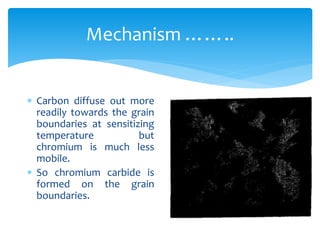
 Carbon diffuse out more
readily towards the grain
boundaries at sensitizing
temperature but
chromium is much less
mobile.
 So chromium carbide is
formed on the grain
boundaries.
Mechanism ……..
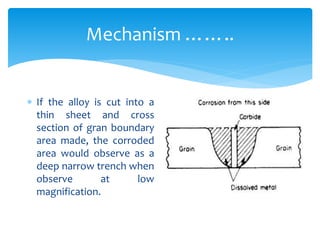
 If the alloy is cut into a
thin sheet and cross
section of gran boundary
area made, the corroded
area would observe as a
deep narrow trench when
observe at low
magnification.
 There are two types of Intergranular corrosion:
 Knife line attack
 Weld Decay
Types Of Intergranular Corrosion
 Stabilized austenitic stainless steel may become more
susceptible to intergranular attack during welding.
 The zone immediately adjacent to the fusion line is heated
to temperature high enough to dissolve the stabilizing
carbide, but the rate of cooling is so rapid that carbide
precipitation is prevented.
 The narrow area is reheated during subsequent welding
passes into the temperature range in which both
stabilizing carbides (Nb and Ti carbide) and the chromium
carbides (CrFe)23C6 co precipitate .
Knife Line Attack
 This narrow band near to the fusion line become
susceptible to intergranular cracking due to the
precipitated chromium rich carbides.
 This is also known as weld decay because both are
almost same with little difference. .
KLA……….
 Segregation of impurities at grain boundaries may give rise
to galvanic corrosion.
 This condition happens when the material is heated to
temperature around 700 °C for too long time
 Often happens in the heat affected Zones (HAZ) of metal
during welding operations or an improper heat treatment.
 Weld decay is a corrosion process that mainly occurs as a
result of sensitization (regions susceptible to corrosion) in
the heat affected Zones (HAZ) of metal during welding
operations.
Weld Decay
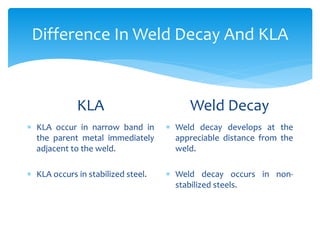
Difference In Weld Decay And KLA
KLA
 KLA occur in narrow band in
the parent metal immediately
adjacent to the weld.
 KLA occurs in stabilized steel.
Weld Decay
 Weld decay develops at the
appreciable distance from the
weld.
 Weld decay occurs in non-
stabilized steels.
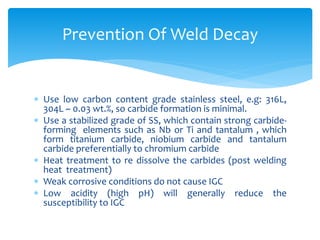
 Use low carbon content grade stainless steel, e.g: 316L,
304L ~ 0.03 wt.%, so carbide formation is minimal.
 Use a stabilized grade of SS, which contain strong carbide-
forming elements such as Nb or Ti and tantalum , which
form titanium carbide, niobium carbide and tantalum
carbide preferentially to chromium carbide
 Heat treatment to re dissolve the carbides (post welding
heat treatment)
 Weak corrosive conditions do not cause IGC
 Low acidity (high pH) will generally reduce the
susceptibility to IGC
Prevention Of Weld Decay
 Knife line attack can be avoided
 By the proper choice of welding variable
 By the proper choice of welding materials
 By the use of stabilizing heat treatment.
Prevention of KLA

Intergranular Corrosion

  • 1.
  • 2.
     Localized attackadjacent to grain boundaries with relatively little corrosion of grains.  It is form of surface corrosion preferentially along the grain boundaries of metal.  Intergranuler corrosion takes place due to higher rate of corrosion of grain boundary area of an alloy than that of grain interior .  If a metal corrode uniform attack usually results because grain boundaries are slightly more reactive than matrix . Intr0duction
  • 3.
    When there iscomposition difference grain interfaces are very reactive and intergranular corrosion results . Due to intergranular corrosion the alloy disintegrates or loses its strength because the grain fall out. Intr0duction……..
  • 4.
     Intermetallic compoundsuch as Mg5 AL8,formation at the grain boundaries form a galvanic cell with a alloy matrix and in chloride environment severe intergranular type of corrosion occur.  Intergranular corrosion can occur in many alloys systems such as stainless steel, nickel base and aluminum base alloys. Examples
  • 5.
     Intergranular corrosionof an alloy may be caused by  Impurities at the grain boundaries  Enrichment of one of the alloying elements  Depletion of one of the elements that affects its corrosion resistance in grain boundary areas.  Small amounts of iron in aluminum, wherein solubility of iron is low, have been shown to segregate in the grain boundaries and cause Intergranular corrosion.  Depletion of chromium in the grain boundary region results in Intergranular corrosion of SS. Causes Of Intergranular Corrosion
  • 6.
     The potentialdifference between the grain boundary regions and any precipitate, intermetallic phases, or impurities that form at the grain boundaries is responsible for higher dissolution rates at these regions. Causes ……..
  • 7.
     The actualmechanism differ from one alloy system to another.  Some precipitates form preferentially at grain boundaries as a result of production, fabrication and welding at elevated temperature.  If these precipitates are rich in alloying elements which are essential for corrosion resistance the regions adjacent to grain boundaries are depleted of these elements.  Thus the metal is said to be sensitized and it suffers from Intergranular attack in a corrosion environment. Mechanism
  • 8.
     Segregation ofimpurities at grain boundaries may give rise to galvanic corrosion.  Now we consider Austenitic stainless steel of type 304.  The universally accepted theory is the depletion of chromium in the grain boundary areas.  Chromium increase the corrosion resistance of the steel. If chromium is less than 10% then relatively low corrosion resistance is approached. Mechanism ……..
  • 9.
     This steelis sensitized to corrosion when heated approximately from 950-1450 ̊F.  In this range chromium carbide is virtually insoluble and precipitates out if carbon content is higher than o.o2%  So Cr, come out of solid solution results in metal with low chromium contents in the area adjacent to the grain boundaries.  The chromium carbide in the grain boundaries is not attacked. Mechanism ……..
  • 10.
    Mechanism ……..  Thechromium depleted zone near the grain boundary is corroded because it does not contain sufficient corrosion resistance to resist attack in many corrosive environment.  The common type 304 usually contains 0.06 t0 0.08% carbon so excess carbon is available for combining with the chromium to precipitate the carbide.  This is shown in fig.
  • 11.
    Mechanism ……..  Carbondiffuse out more readily towards the grain boundaries at sensitizing temperature but chromium is much less mobile.  So chromium carbide is formed on the grain boundaries.
  • 12.
    Mechanism ……..  Ifthe alloy is cut into a thin sheet and cross section of gran boundary area made, the corroded area would observe as a deep narrow trench when observe at low magnification.
  • 13.
     There aretwo types of Intergranular corrosion:  Knife line attack  Weld Decay Types Of Intergranular Corrosion
  • 14.
     Stabilized austeniticstainless steel may become more susceptible to intergranular attack during welding.  The zone immediately adjacent to the fusion line is heated to temperature high enough to dissolve the stabilizing carbide, but the rate of cooling is so rapid that carbide precipitation is prevented.  The narrow area is reheated during subsequent welding passes into the temperature range in which both stabilizing carbides (Nb and Ti carbide) and the chromium carbides (CrFe)23C6 co precipitate . Knife Line Attack
  • 15.
     This narrowband near to the fusion line become susceptible to intergranular cracking due to the precipitated chromium rich carbides.  This is also known as weld decay because both are almost same with little difference. . KLA……….
  • 16.
     Segregation ofimpurities at grain boundaries may give rise to galvanic corrosion.  This condition happens when the material is heated to temperature around 700 °C for too long time  Often happens in the heat affected Zones (HAZ) of metal during welding operations or an improper heat treatment.  Weld decay is a corrosion process that mainly occurs as a result of sensitization (regions susceptible to corrosion) in the heat affected Zones (HAZ) of metal during welding operations. Weld Decay
  • 17.
    Difference In WeldDecay And KLA KLA  KLA occur in narrow band in the parent metal immediately adjacent to the weld.  KLA occurs in stabilized steel. Weld Decay  Weld decay develops at the appreciable distance from the weld.  Weld decay occurs in non- stabilized steels.
  • 18.
     Use lowcarbon content grade stainless steel, e.g: 316L, 304L ~ 0.03 wt.%, so carbide formation is minimal.  Use a stabilized grade of SS, which contain strong carbide- forming elements such as Nb or Ti and tantalum , which form titanium carbide, niobium carbide and tantalum carbide preferentially to chromium carbide  Heat treatment to re dissolve the carbides (post welding heat treatment)  Weak corrosive conditions do not cause IGC  Low acidity (high pH) will generally reduce the susceptibility to IGC Prevention Of Weld Decay
  • 19.
     Knife lineattack can be avoided  By the proper choice of welding variable  By the proper choice of welding materials  By the use of stabilizing heat treatment. Prevention of KLA