ELECTRICAL PROPERTIES MATERIALS
AHSANULLAH UNIVERSITY OF
SCIENCE AND TECHNOLOGY
EEE 3113
INTRODUCTION TO X-RAY DIFFRACTION :
• Definition
The atomic planes of a crystal cause an incident beam of X-rays to interfere with one another as they
leave the crystal. The phenomenon is called X-ray diffraction.
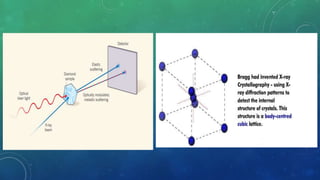
• The X-ray diffraction pattern is based on the scattering of x-rays by crystals.
RANGE OF X-RAY
DIFFRACTION :
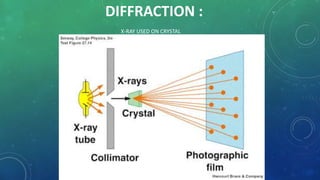
X-RAY USED ON CRYSTAL
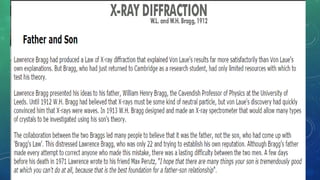
WHO WAS
W.L.BRAGG ?
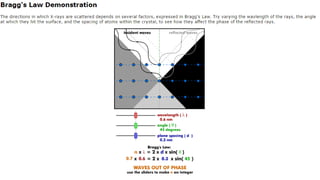
BRAGG’S LAW EQUATION AT A GLANCE :
NOW LET’S WATCH A VIDEO ON BRAGG’S LAW
Applications of Braggs Law:
1. Solving Bragg's Equation gives the d-spacing between the crystal lattice planes of
atoms that produce the constructive interference. A given unknown crystal is expected to have many rational
planes of atoms in its structure. In X-ray diffraction (XRD) the inter-planar spacing (d-spacing) of a crystal is used for
Identification and characterization purposes
2. Computed Tomography (CT) uses many X-ray slices at different angles to build up three dimensional images inside the body
with the help of Bragg’s law .
3. Ultrasound uses echoes from sound waves to locate different organs inside the body,
and can be used to monitor the growth of unborn babies.
4. Magnetic Resonance Imaging (MRI, or NMR) uses powerful magnets to measure the water content of
different types of body tissue. It is a slow process, but generates incredibly detailed images of the body.
5. Positron Emission Tomography (PET) detects radioactive tracers that are injected into the body
and Electroencephalography (EEG) detects electrical activity in the brain.
DISCOVERIES AND ACHIEVEMENTS
1. Using X-ray diffraction the Braggs found that the sodium and chloride ions were arranged in a simple cubic lattice,
and were not bonded into molecules. This discovery was very important in chemistry , where the principles of
and ionic bonding were being developed .
2. The Braggs also discovered the crystal structure of diamond. The X-ray diffraction pattern of
diamond showed that atoms of carbon must lie on a face- centred cube. So the structure of diamond had to be
two overlapping face-centred cubic lattices. The Braggs worked out their relative positions by
investigating the interference of the diffracted X-rays.
In 1915, the Braggs were jointly awarded the Nobel Prize in Physics for their
‘‘services in the analysis of crystal structure by means of X-rays’’.
Lawrence Bragg was only twenty-five years old, the youngest Laureate ever to receive a Nobel Prize.
Bragg's Law of Diffraction

Bragg's Law of Diffraction

  • 1.
    ELECTRICAL PROPERTIES MATERIALS AHSANULLAHUNIVERSITY OF SCIENCE AND TECHNOLOGY EEE 3113
  • 3.
    INTRODUCTION TO X-RAYDIFFRACTION : • Definition The atomic planes of a crystal cause an incident beam of X-rays to interfere with one another as they leave the crystal. The phenomenon is called X-ray diffraction. • The X-ray diffraction pattern is based on the scattering of x-rays by crystals.
  • 4.
  • 5.
  • 6.
  • 10.
  • 12.
    NOW LET’S WATCHA VIDEO ON BRAGG’S LAW
  • 13.
    Applications of BraggsLaw: 1. Solving Bragg's Equation gives the d-spacing between the crystal lattice planes of atoms that produce the constructive interference. A given unknown crystal is expected to have many rational planes of atoms in its structure. In X-ray diffraction (XRD) the inter-planar spacing (d-spacing) of a crystal is used for Identification and characterization purposes 2. Computed Tomography (CT) uses many X-ray slices at different angles to build up three dimensional images inside the body with the help of Bragg’s law . 3. Ultrasound uses echoes from sound waves to locate different organs inside the body, and can be used to monitor the growth of unborn babies. 4. Magnetic Resonance Imaging (MRI, or NMR) uses powerful magnets to measure the water content of different types of body tissue. It is a slow process, but generates incredibly detailed images of the body. 5. Positron Emission Tomography (PET) detects radioactive tracers that are injected into the body and Electroencephalography (EEG) detects electrical activity in the brain.
  • 14.
    DISCOVERIES AND ACHIEVEMENTS 1.Using X-ray diffraction the Braggs found that the sodium and chloride ions were arranged in a simple cubic lattice, and were not bonded into molecules. This discovery was very important in chemistry , where the principles of and ionic bonding were being developed . 2. The Braggs also discovered the crystal structure of diamond. The X-ray diffraction pattern of diamond showed that atoms of carbon must lie on a face- centred cube. So the structure of diamond had to be two overlapping face-centred cubic lattices. The Braggs worked out their relative positions by investigating the interference of the diffracted X-rays. In 1915, the Braggs were jointly awarded the Nobel Prize in Physics for their ‘‘services in the analysis of crystal structure by means of X-rays’’. Lawrence Bragg was only twenty-five years old, the youngest Laureate ever to receive a Nobel Prize.