CRYSTALLOGRAPHIC POINTS,
  DIRECTIONS & PLANES
For more help contact me

Muhammad Umair Bukhari

       Engr.umair.bukhari@gmail.com

          www.bzuiam.webs.com
             03136050151
CRYSTALLOGRAPHIC POINTS, DIRECTIONS &
PLANES

        In crystalline materials, often necessary to specify points,
         directions and planes within unit cell and in crystal lattice
        Three numbers (or indices) used to designate points, directions
         (lines) or planes, based on basic geometric notions
        The three indices are determined by placing the origin at one of
         the corners of the unit cell, and the coordinate axes along the unit
         cell edges
POINT COORDINATES
Any point within a unit cell specified as fractional multiples
 of the unit cell edge lengths
Position P specified as q r s; convention: coordinates not
 separated by commas or punctuation marks
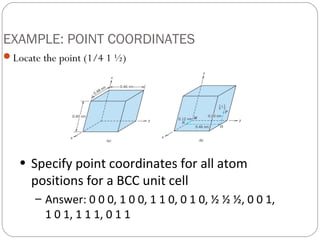
EXAMPLE: POINT COORDINATES
Locate the point (1/4 1 ½)


   • Specify point coordinates for all atom
     positions for a BCC unit cell
       – Answer: 0 0 0, 1 0 0, 1 1 0, 0 1 0, ½ ½ ½, 0 0 1,
         1 0 1, 1 1 1, 0 1 1
CRYSTALLOGRAPHIC DIRECTIONS

 Defined as line between two points: a vector
 Steps for finding the 3 indices denoting a direction
   Determine the point positions of a beginning point (X1 Y1 Z1) and a ending
    point (X2 Y2 Z2) for direction, in terms of unit cell edges
   Calculate difference between ending and starting point
   Multiply the differences by a common constant to convert them to the smallest
    possible integers u, v, w
   The three indices are not separated by commas and are enclosed in square
    brackets: [uvw]
   If any of the indices is negative, a bar is placed in top of that index
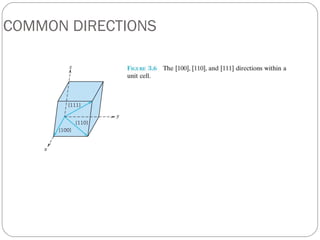
COMMON DIRECTIONS
EXAMPLES: DIRECTIONS
Draw a [1,-1,0] direction within a cubic unit cell


   • Determine the indices for this direction
       – Answer: [120]
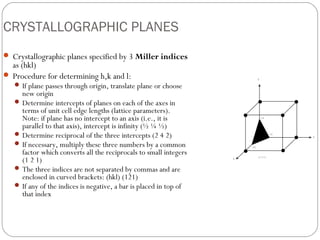
CRYSTALLOGRAPHIC PLANES
 Crystallographic planes specified by 3 Miller indices
  as (hkl)
 Procedure for determining h,k and l:                                         Z

    If plane passes through origin, translate plane or choose
     new origin
    Determine intercepts of planes on each of the axes in
     terms of unit cell edge lengths (lattice parameters).
     Note: if plane has no intercept to an axis (i.e., it is                         1 /2


     parallel to that axis), intercept is infinity (½ ¼ ½)
    Determine reciprocal of the three intercepts (2 4 2)                                     1 /4
                                                                                                     Y


    If necessary, multiply these three numbers by a common             1 /2

     factor which converts all the reciprocals to small integers
     (1 2 1)
                                                                                   (1 2 1 )
                                                                    X


    The three indices are not separated by commas and are
     enclosed in curved brackets: (hkl) (121)
    If any of the indices is negative, a bar is placed in top of
     that index
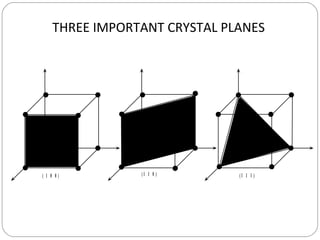
THREE IMPORTANT CRYSTAL PLANES


( 1 0 0)        (1 1 0 )      (1 1 1 )
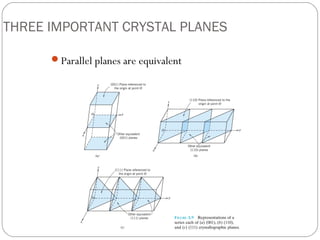
THREE IMPORTANT CRYSTAL PLANES

      Parallel planes are equivalent
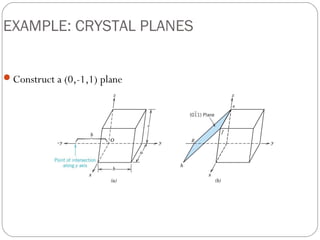
EXAMPLE: CRYSTAL PLANES


Construct a (0,-1,1) plane
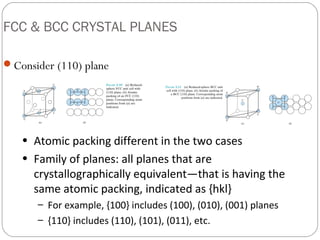
FCC & BCC CRYSTAL PLANES

Consider (110) plane


   • Atomic packing different in the two cases
   • Family of planes: all planes that are
     crystallographically equivalent—that is having the
     same atomic packing, indicated as {hkl}
      – For example, {100} includes (100), (010), (001) planes
      – {110} includes (110), (101), (011), etc.

Crystallographic points, directions & planes

  • 1.
    CRYSTALLOGRAPHIC POINTS, DIRECTIONS & PLANES
  • 2.
    For more helpcontact me Muhammad Umair Bukhari Engr.umair.bukhari@gmail.com www.bzuiam.webs.com 03136050151
  • 3.
    CRYSTALLOGRAPHIC POINTS, DIRECTIONS& PLANES  In crystalline materials, often necessary to specify points, directions and planes within unit cell and in crystal lattice  Three numbers (or indices) used to designate points, directions (lines) or planes, based on basic geometric notions  The three indices are determined by placing the origin at one of the corners of the unit cell, and the coordinate axes along the unit cell edges
  • 4.
    POINT COORDINATES Any pointwithin a unit cell specified as fractional multiples of the unit cell edge lengths Position P specified as q r s; convention: coordinates not separated by commas or punctuation marks
  • 5.
    EXAMPLE: POINT COORDINATES Locatethe point (1/4 1 ½) • Specify point coordinates for all atom positions for a BCC unit cell – Answer: 0 0 0, 1 0 0, 1 1 0, 0 1 0, ½ ½ ½, 0 0 1, 1 0 1, 1 1 1, 0 1 1
  • 6.
    CRYSTALLOGRAPHIC DIRECTIONS  Definedas line between two points: a vector  Steps for finding the 3 indices denoting a direction  Determine the point positions of a beginning point (X1 Y1 Z1) and a ending point (X2 Y2 Z2) for direction, in terms of unit cell edges  Calculate difference between ending and starting point  Multiply the differences by a common constant to convert them to the smallest possible integers u, v, w  The three indices are not separated by commas and are enclosed in square brackets: [uvw]  If any of the indices is negative, a bar is placed in top of that index
  • 7.
  • 8.
    EXAMPLES: DIRECTIONS Draw a[1,-1,0] direction within a cubic unit cell • Determine the indices for this direction – Answer: [120]
  • 9.
    CRYSTALLOGRAPHIC PLANES  Crystallographicplanes specified by 3 Miller indices as (hkl)  Procedure for determining h,k and l: Z  If plane passes through origin, translate plane or choose new origin  Determine intercepts of planes on each of the axes in terms of unit cell edge lengths (lattice parameters). Note: if plane has no intercept to an axis (i.e., it is 1 /2 parallel to that axis), intercept is infinity (½ ¼ ½)  Determine reciprocal of the three intercepts (2 4 2) 1 /4 Y  If necessary, multiply these three numbers by a common 1 /2 factor which converts all the reciprocals to small integers (1 2 1) (1 2 1 ) X  The three indices are not separated by commas and are enclosed in curved brackets: (hkl) (121)  If any of the indices is negative, a bar is placed in top of that index
  • 10.
    THREE IMPORTANT CRYSTALPLANES ( 1 0 0) (1 1 0 ) (1 1 1 )
  • 11.
    THREE IMPORTANT CRYSTALPLANES Parallel planes are equivalent
  • 12.
  • 13.
    FCC & BCCCRYSTAL PLANES Consider (110) plane • Atomic packing different in the two cases • Family of planes: all planes that are crystallographically equivalent—that is having the same atomic packing, indicated as {hkl} – For example, {100} includes (100), (010), (001) planes – {110} includes (110), (101), (011), etc.