Page 1
X-RAY
CRYSTALLOGRAPHY
Presented by
Mahfooz Alam
M.Tech. ( Materials Engineering)
Reg No:- 17ETMM10
Page 2
WALK OF THE TALK
E.M Spectrum
Production of X-rays?
Crystallography
Bragg’s Equation
Experimental Methods
Conclusion
Page 3
ELECTROMAGNETIC
SPECTRUM
Discovery of X-rays: Roentgen, 1895 (Nobel Prize 1901)
Page 4
Motivation
 For electromagnetic radiation to be diffracted the spacing in the
grating ( grating refers to a series of obstacles or a series of scatters)
should be of the same order as the wavelength.
 In crystals the typical interatomic spacing ~ 2-3 Å**  so the
suitable radiation for the diffraction study of crystals is X-rays.
 Hence, X-rays are used for the investigation of crystal structure.
** If the wavelength is of the order of the lattice spacing, then diffraction effects will be
prominent.
 Three possibilities (regimes) exist based on the wavelength () and the spacing
between the scatters .
  < a  transmission dominated.
  ~ a  diffraction dominated.
  > a  reflection dominated.
Page 5
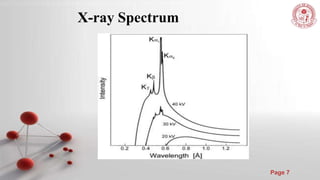
Generation of X-rays
X-rays can be generated by decelerating electrons.
Hence, X-rays are generated by bombarding a target (say Cu) with an electron
beam.
The resultant spectrum of X-rays generated (i.e. X-rays versus Intensity plot) is
shown in the next slide. The pattern shows intense peaks on a ‘broad’ background.
The intense peaks can be ‘thought of’ as monochromatic radiation and be used
for X-ray diffraction studies.
Target
Metal
 Of K
radiation (Å)
Mo 0.71
Cu 1.54
Co 1.79
Fe 1.94
Cr 2.29
Page 6
Cont.…
Characteristic X-ray
Continuous Spectrum
Page 7
X-ray Spectrum
Page 8
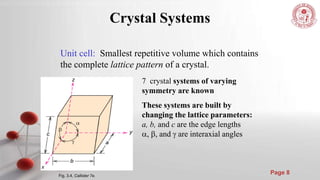
Crystal Systems
7 crystal systems of varying
symmetry are known
These systems are built by
changing the lattice parameters:
a, b, and c are the edge lengths
, , and  are interaxial angles
Fig. 3.4, Callister 7e.
Unit cell: Smallest repetitive volume which contains
the complete lattice pattern of a crystal.
Page 9
Crystal Systems
Crystal structures are divided
into groups according to unit
cell geometry (symmetry).
Cont....
Page 10
BRAVAIS LATTICE
Page 11
Specimen
Incident X-rays
Transmitted beam
Fluorescent X-rays Electrons
Compton recoil Photoelectrons
Scattered X-rays
Coherent
From bound charges
• When X-rays hit a specimen, the interaction can
result in various signals/emissions/effects.
• The coherently scattered X-rays are the ones
important from a XRD perspective.
Incoherent
From loosely bound charges
Interaction of X-ray with Specimen
11
Page 12
 A beam of X-rays directed at a crystal interacts with the electrons of the atoms in the crystal.
 The electrons oscillate under the influence of the incoming X-Rays and become secondary sources
of EM radiation.
 The secondary radiation is in all directions.
 The waves emitted by the electrons have the same frequency as the incoming X-rays  coherent.
 The emission can undergo constructive or destructive interference.
Incoming X-rays
Secondary
emission
Cont.…
Page 13
 Ray-2 travels an extra path as compared to Ray-1 (= ABC). The path difference between
Ray-1 and Ray-2 = ABC = (d Sin + d Sin) = (2d.Sin).
 For constructive interference, this path difference should be an integral multiple of :
n = 2d Sin  the Bragg’s equation..
Bragg’s Equation
Braggs Law
The diffracted beam appears to be reflected from a set of crystal lattice planes.
Angle of incidence = Angle of reflection.
Diffraction laws: Bragg & Bragg, 1912-1913 (Nobel Prize 1915)
Page 14
2 sinhkl hkln d 
λ= 2
dhkl
n
sin θ
n n n n n n2 sinh k l h k ld 
1nhnk nl
hkl
d
d n

300
100
1
3
d
d

200
100
1
2
d
d

Hence, (100) planes are a subset of (200) planes
Order of Reflection
 is the angle between the incident x-rays and the set of parallel atomic planes (which have
a spacing dhkl). Which is 10
It is NOT the angle between the x-rays and the sample surface (note: specimens could be
spherical or could have a rough surface).
Page 15
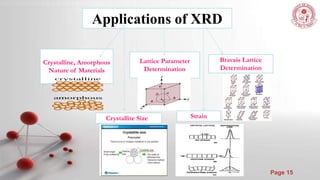
Bravais Lattice
Determination
Lattice Parameter
Determination
Strain
Applications of XRD
Crystallite Size
Crystalline, Amorphous
Nature of Materials
Page 16
Crystal Structure Determination
Monochromatic X-rays
Panchromatic X-rays
Monochromatic X-rays
Many s (orientations)
Powder specimen
Powder
Method
Single 
Laue
Technique
 Varied by rotation
Rotating Crystal
Method
λ fixed
θ variable


λ fixed
θ rotated


λ variable
θ fixed


 As diffraction occurs only at specific Bragg angles, the chance that a reflection is observed
when a crystal is irradiated with monochromatic X-rays at a particular angle is small (added to this
the diffracted intensity is a small fraction of the beam used for irradiation).
 The probability to get a diffracted beam (with sufficient intensity) is increased by either varying
the wavelength () or having many orientations (rotating the crystal or having multiple
crystallites in many orientations).
 The three methods used to achieve high probability of diffraction are shown below.
Only the powder method is commonly used in materials science.
Page 17
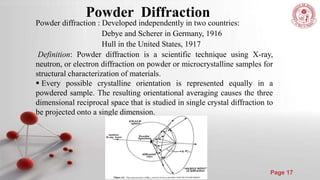
Powder diffraction : Developed independently in two countries:
Debye and Scherer in Germany, 1916
Hull in the United States, 1917
Definition: Powder diffraction is a scientific technique using X-ray,
neutron, or electron diffraction on powder or microcrystalline samples for
structural characterization of materials.
 Every possible crystalline orientation is represented equally in a
powdered sample. The resulting orientational averaging causes the three
dimensional reciprocal space that is studied in single crystal diffraction to
be projected onto a single dimension.
Powder Diffraction
Page 18
Powder Diffraction is more aptly named polycrystalline diffraction
Samples can be powder, sintered pellets, coatings on substrates,
engine blocks, …
If the crystallites are randomly oriented, and there are enough of
them, then they will produce a continuous Debye cone.
In a linear diffraction pattern, the detector scans through an arc that
intersects each Debye cone at a single point; thus giving the
appearance of a discrete diffraction peak.
Cont..
Page 19
 In the power diffraction method a 2 versus intensity (I) plot is obtained from the
diffractometer (and associated instrumentation).
 The ‘intensity’ is the area under the peak in such a plot (NOT the height of the peak).
Powder diffraction pattern from Al
Radiation: Cu K,  = 1.54 Å
Increasing 
Increasing d
Usually in degrees ()
Intensity versus 2 Data in
Powder Method
Page 20
Structure Allowed Reflections
SC All
BCC (h + k + l) even
FCC h, k and l unmixed
DC
Either,  h, k and l are all odd or
 all are even & (h + k + l) divisible by 4
Selection / Extinction Rules
Page 21
2→  Sin Sin2 
Ratios
of Sin2
Dividing Sin2 by
0.134/3 = 0.044667
Whole
number
ratios
Index
1 21.5 0.366 0.134 1 3 111
2 25 0.422 0.178 1.33 3.99 4 200
3 37 0.60 0.362 2.70 8.10 8 220
4 45 0.707 0.500 3.73 11.19 11 311
5 47 0.731 0.535 4 11.98 12 222
6 58 0.848 0.719 5.37 16.10 16 400
7 68 0.927 0.859 6.41 19.23 19 331
 FCC lattice
E.g.:-
Given the positions of the Bragg peaks we find the lattice type
Page 22
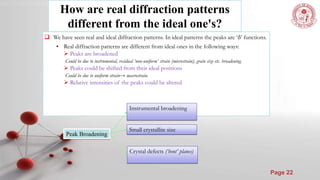
How are real diffraction patterns
different from the ideal one's?
 We have seen real and ideal diffraction patterns. In ideal patterns the peaks are ‘’ functions.
• Real diffraction patterns are different from ideal ones in the following ways:
 Peaks are broadened
Could be due to instrumental, residual ‘non-uniform’ strain (microstrain), grain size etc. broadening.
 Peaks could be shifted from their ideal positions
Could be due to uniform strain→ macrostrain.
 Relative intensities of the peaks could be altered
Instrumental broadening
Crystal defects (‘bent’ planes)
Peak Broadening
Small crystallite size
Page 23
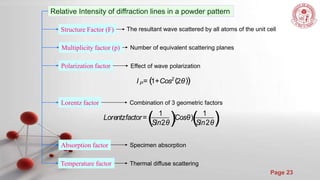
Structure Factor (F)
Multiplicity factor (p)
Polarization factor
Lorentz factor
Relative Intensity of diffraction lines in a powder pattern
Absorption factor
Temperature factor
The resultant wave scattered by all atoms of the unit cell
Number of equivalent scattering planes
Effect of wave polarization
Combination of 3 geometric factors
Specimen absorption
Thermal diffuse scattering
Lorentzfactor=( 1
Sin2θ)(Cosθ)( 1
Sin2θ)
I P= (1+Cos2
(2θ))
Page 24
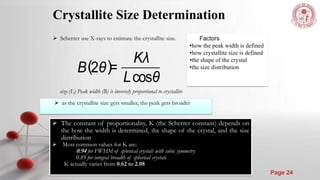
Crystallite Size Determination
 Scherrer use X-rays to estimate the crystallite size.
B(2θ)=
Kλ
Lcosθ
size (L) Peak width (B) is inversely proportional to crystallite
 as the crystallite size gets smaller, the peak gets broader
 The constant of proportionality, K (the Scherrer constant) depends on
the how the width is determined, the shape of the crystal, and the size
distribution
 Most common values for K are:
0.94 for FWHM of spherical crystals with cubic symmetry
0.89 for integral breadth of spherical crystals
K actually varies from 0.62 to 2.08
Factors
•how the peak width is defined
•how crystallite size is defined
•the shape of the crystal
•the size distribution
Page 25
Broadeing 2 2 tan 

   
d
b
d
Non-uniform Strain
Uniform Strain
No Strain
do
2
2
2
  d  strain
Lattice Strain
Page 26
Diffraction angle (2) →
Intensity→
90 1800
Crystal
90 1800
Diffraction angle (2) →
Intensity→
Liquid / Amorphous solid
90
1800
Diffraction angle (2) →
Intensity→
Monoatomic gas
Diffractogram of various
phases
Sharp peaks
Diffuse Peak
No peak
Page 27
Conclusion
• Two types of X-ray are produced using Cathode Ray Tube
1) Continuous X-ray
2) Characteristics X-ray
• X-ray is be used in different characterization technique
technique to characterize the materials.
• X-ray Crystallography has a wide range of application in
chemical,physical,biological, material and biochemical sciences.
• The real diffractogram obtained is different from ideal ones.
Page 28
References
1) Elements of X-Ray Diffraction
B.D. Cullity & S.R. Stock
Prentice Hall, Upper Saddle River (2001)
2) An Introduction to Material Science and Engineering
by :- William D Callister
3) Nptel Lecture by Bala Subramaniam
4)Website
 www.matter.org.uk/diffraction/
www.ngsr.netfirms.com/englishhtm/Diffraction
Page 29
I would like to thank Dr.-Ing Vadali V.S.S Srikanth and Dr.Jai
Prakash Gautam for motivating and guiding us throughout the
course.
I would like to thank Dr. Swati Ghosh Acharya for teaching X-ray
diffraction in material characterization course.
I would like to thank all my friends.
I am highly obliged to all non-teaching staff of SEST.
I would like to thank AICTE for providing me the scholarship to
pursue my M.Tech.
Acknowledgment
Page 30
Thank You

Xrd mahfooz

  • 1.
    Page 1 X-RAY CRYSTALLOGRAPHY Presented by MahfoozAlam M.Tech. ( Materials Engineering) Reg No:- 17ETMM10
  • 2.
    Page 2 WALK OFTHE TALK E.M Spectrum Production of X-rays? Crystallography Bragg’s Equation Experimental Methods Conclusion
  • 3.
    Page 3 ELECTROMAGNETIC SPECTRUM Discovery ofX-rays: Roentgen, 1895 (Nobel Prize 1901)
  • 4.
    Page 4 Motivation  Forelectromagnetic radiation to be diffracted the spacing in the grating ( grating refers to a series of obstacles or a series of scatters) should be of the same order as the wavelength.  In crystals the typical interatomic spacing ~ 2-3 Å**  so the suitable radiation for the diffraction study of crystals is X-rays.  Hence, X-rays are used for the investigation of crystal structure. ** If the wavelength is of the order of the lattice spacing, then diffraction effects will be prominent.  Three possibilities (regimes) exist based on the wavelength () and the spacing between the scatters .   < a  transmission dominated.   ~ a  diffraction dominated.   > a  reflection dominated.
  • 5.
    Page 5 Generation ofX-rays X-rays can be generated by decelerating electrons. Hence, X-rays are generated by bombarding a target (say Cu) with an electron beam. The resultant spectrum of X-rays generated (i.e. X-rays versus Intensity plot) is shown in the next slide. The pattern shows intense peaks on a ‘broad’ background. The intense peaks can be ‘thought of’ as monochromatic radiation and be used for X-ray diffraction studies. Target Metal  Of K radiation (Å) Mo 0.71 Cu 1.54 Co 1.79 Fe 1.94 Cr 2.29
  • 6.
  • 7.
  • 8.
    Page 8 Crystal Systems 7crystal systems of varying symmetry are known These systems are built by changing the lattice parameters: a, b, and c are the edge lengths , , and  are interaxial angles Fig. 3.4, Callister 7e. Unit cell: Smallest repetitive volume which contains the complete lattice pattern of a crystal.
  • 9.
    Page 9 Crystal Systems Crystalstructures are divided into groups according to unit cell geometry (symmetry). Cont....
  • 10.
  • 11.
    Page 11 Specimen Incident X-rays Transmittedbeam Fluorescent X-rays Electrons Compton recoil Photoelectrons Scattered X-rays Coherent From bound charges • When X-rays hit a specimen, the interaction can result in various signals/emissions/effects. • The coherently scattered X-rays are the ones important from a XRD perspective. Incoherent From loosely bound charges Interaction of X-ray with Specimen 11
  • 12.
    Page 12  Abeam of X-rays directed at a crystal interacts with the electrons of the atoms in the crystal.  The electrons oscillate under the influence of the incoming X-Rays and become secondary sources of EM radiation.  The secondary radiation is in all directions.  The waves emitted by the electrons have the same frequency as the incoming X-rays  coherent.  The emission can undergo constructive or destructive interference. Incoming X-rays Secondary emission Cont.…
  • 13.
    Page 13  Ray-2travels an extra path as compared to Ray-1 (= ABC). The path difference between Ray-1 and Ray-2 = ABC = (d Sin + d Sin) = (2d.Sin).  For constructive interference, this path difference should be an integral multiple of : n = 2d Sin  the Bragg’s equation.. Bragg’s Equation Braggs Law The diffracted beam appears to be reflected from a set of crystal lattice planes. Angle of incidence = Angle of reflection. Diffraction laws: Bragg & Bragg, 1912-1913 (Nobel Prize 1915)
  • 14.
    Page 14 2 sinhklhkln d  λ= 2 dhkl n sin θ n n n n n n2 sinh k l h k ld  1nhnk nl hkl d d n  300 100 1 3 d d  200 100 1 2 d d  Hence, (100) planes are a subset of (200) planes Order of Reflection  is the angle between the incident x-rays and the set of parallel atomic planes (which have a spacing dhkl). Which is 10 It is NOT the angle between the x-rays and the sample surface (note: specimens could be spherical or could have a rough surface).
  • 15.
    Page 15 Bravais Lattice Determination LatticeParameter Determination Strain Applications of XRD Crystallite Size Crystalline, Amorphous Nature of Materials
  • 16.
    Page 16 Crystal StructureDetermination Monochromatic X-rays Panchromatic X-rays Monochromatic X-rays Many s (orientations) Powder specimen Powder Method Single  Laue Technique  Varied by rotation Rotating Crystal Method λ fixed θ variable   λ fixed θ rotated   λ variable θ fixed    As diffraction occurs only at specific Bragg angles, the chance that a reflection is observed when a crystal is irradiated with monochromatic X-rays at a particular angle is small (added to this the diffracted intensity is a small fraction of the beam used for irradiation).  The probability to get a diffracted beam (with sufficient intensity) is increased by either varying the wavelength () or having many orientations (rotating the crystal or having multiple crystallites in many orientations).  The three methods used to achieve high probability of diffraction are shown below. Only the powder method is commonly used in materials science.
  • 17.
    Page 17 Powder diffraction: Developed independently in two countries: Debye and Scherer in Germany, 1916 Hull in the United States, 1917 Definition: Powder diffraction is a scientific technique using X-ray, neutron, or electron diffraction on powder or microcrystalline samples for structural characterization of materials.  Every possible crystalline orientation is represented equally in a powdered sample. The resulting orientational averaging causes the three dimensional reciprocal space that is studied in single crystal diffraction to be projected onto a single dimension. Powder Diffraction
  • 18.
    Page 18 Powder Diffractionis more aptly named polycrystalline diffraction Samples can be powder, sintered pellets, coatings on substrates, engine blocks, … If the crystallites are randomly oriented, and there are enough of them, then they will produce a continuous Debye cone. In a linear diffraction pattern, the detector scans through an arc that intersects each Debye cone at a single point; thus giving the appearance of a discrete diffraction peak. Cont..
  • 19.
    Page 19  Inthe power diffraction method a 2 versus intensity (I) plot is obtained from the diffractometer (and associated instrumentation).  The ‘intensity’ is the area under the peak in such a plot (NOT the height of the peak). Powder diffraction pattern from Al Radiation: Cu K,  = 1.54 Å Increasing  Increasing d Usually in degrees () Intensity versus 2 Data in Powder Method
  • 20.
    Page 20 Structure AllowedReflections SC All BCC (h + k + l) even FCC h, k and l unmixed DC Either,  h, k and l are all odd or  all are even & (h + k + l) divisible by 4 Selection / Extinction Rules
  • 21.
    Page 21 2→ Sin Sin2  Ratios of Sin2 Dividing Sin2 by 0.134/3 = 0.044667 Whole number ratios Index 1 21.5 0.366 0.134 1 3 111 2 25 0.422 0.178 1.33 3.99 4 200 3 37 0.60 0.362 2.70 8.10 8 220 4 45 0.707 0.500 3.73 11.19 11 311 5 47 0.731 0.535 4 11.98 12 222 6 58 0.848 0.719 5.37 16.10 16 400 7 68 0.927 0.859 6.41 19.23 19 331  FCC lattice E.g.:- Given the positions of the Bragg peaks we find the lattice type
  • 22.
    Page 22 How arereal diffraction patterns different from the ideal one's?  We have seen real and ideal diffraction patterns. In ideal patterns the peaks are ‘’ functions. • Real diffraction patterns are different from ideal ones in the following ways:  Peaks are broadened Could be due to instrumental, residual ‘non-uniform’ strain (microstrain), grain size etc. broadening.  Peaks could be shifted from their ideal positions Could be due to uniform strain→ macrostrain.  Relative intensities of the peaks could be altered Instrumental broadening Crystal defects (‘bent’ planes) Peak Broadening Small crystallite size
  • 23.
    Page 23 Structure Factor(F) Multiplicity factor (p) Polarization factor Lorentz factor Relative Intensity of diffraction lines in a powder pattern Absorption factor Temperature factor The resultant wave scattered by all atoms of the unit cell Number of equivalent scattering planes Effect of wave polarization Combination of 3 geometric factors Specimen absorption Thermal diffuse scattering Lorentzfactor=( 1 Sin2θ)(Cosθ)( 1 Sin2θ) I P= (1+Cos2 (2θ))
  • 24.
    Page 24 Crystallite SizeDetermination  Scherrer use X-rays to estimate the crystallite size. B(2θ)= Kλ Lcosθ size (L) Peak width (B) is inversely proportional to crystallite  as the crystallite size gets smaller, the peak gets broader  The constant of proportionality, K (the Scherrer constant) depends on the how the width is determined, the shape of the crystal, and the size distribution  Most common values for K are: 0.94 for FWHM of spherical crystals with cubic symmetry 0.89 for integral breadth of spherical crystals K actually varies from 0.62 to 2.08 Factors •how the peak width is defined •how crystallite size is defined •the shape of the crystal •the size distribution
  • 25.
    Page 25 Broadeing 22 tan       d b d Non-uniform Strain Uniform Strain No Strain do 2 2 2   d  strain Lattice Strain
  • 26.
    Page 26 Diffraction angle(2) → Intensity→ 90 1800 Crystal 90 1800 Diffraction angle (2) → Intensity→ Liquid / Amorphous solid 90 1800 Diffraction angle (2) → Intensity→ Monoatomic gas Diffractogram of various phases Sharp peaks Diffuse Peak No peak
  • 27.
    Page 27 Conclusion • Twotypes of X-ray are produced using Cathode Ray Tube 1) Continuous X-ray 2) Characteristics X-ray • X-ray is be used in different characterization technique technique to characterize the materials. • X-ray Crystallography has a wide range of application in chemical,physical,biological, material and biochemical sciences. • The real diffractogram obtained is different from ideal ones.
  • 28.
    Page 28 References 1) Elementsof X-Ray Diffraction B.D. Cullity & S.R. Stock Prentice Hall, Upper Saddle River (2001) 2) An Introduction to Material Science and Engineering by :- William D Callister 3) Nptel Lecture by Bala Subramaniam 4)Website  www.matter.org.uk/diffraction/ www.ngsr.netfirms.com/englishhtm/Diffraction
  • 29.
    Page 29 I wouldlike to thank Dr.-Ing Vadali V.S.S Srikanth and Dr.Jai Prakash Gautam for motivating and guiding us throughout the course. I would like to thank Dr. Swati Ghosh Acharya for teaching X-ray diffraction in material characterization course. I would like to thank all my friends. I am highly obliged to all non-teaching staff of SEST. I would like to thank AICTE for providing me the scholarship to pursue my M.Tech. Acknowledgment
  • 30.