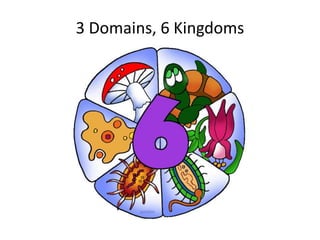
3 Domains, 6 Kingdoms
Largest
Smallest
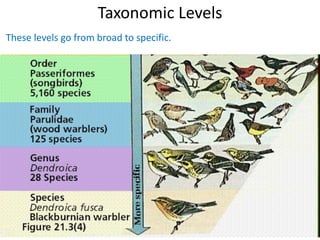
Taxonomic Levels
Organisms can be classified animals beyond just genus and species.
There are 8 levels of classification (taxa):
Domain
Kingdom
Phylum
Class
Order
Family
Genus
Species
(the "domain" taxon
is somewhat new and
doesn't appear in all
texts)
Taxonomic Levels
These levels go from broad to specific.
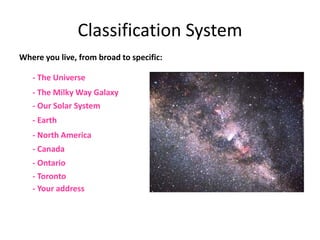
Classification System
Where you live, from broad to specific:
- The Universe
- The Milky Way Galaxy
- Our Solar System
- Earth
- North America
- Canada
- Ontario
- Toronto
- Your address
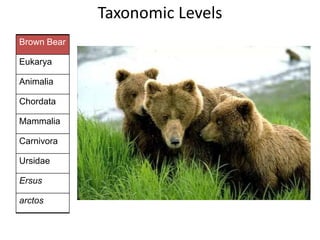
Brown Bear
Eukarya
Animalia
Chordata
Mammalia
Carnivora
Ursidae
Ersus
arctos
Taxonomic Levels
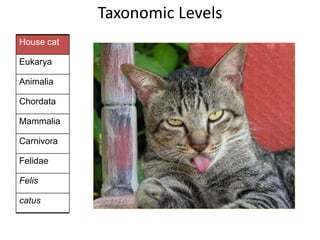
House cat
Eukarya
Animalia
Chordata
Mammalia
Carnivora
Felidae
Felis
catus
Taxonomic Levels
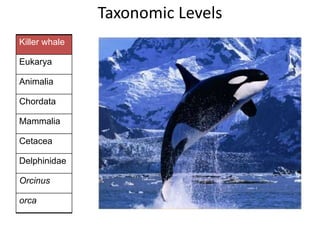
Killer whale
Eukarya
Animalia
Chordata
Mammalia
Cetacea
Delphinidae
Orcinus
orca
Taxonomic Levels
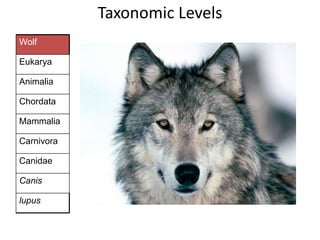
Wolf
Eukarya
Animalia
Chordata
Mammalia
Carnivora
Canidae
Canis
lupus
Taxonomic Levels
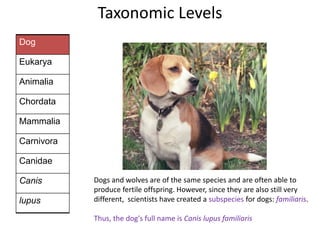
Dog
Eukarya
Animalia
Chordata
Mammalia
Carnivora
Canidae
Canis
lupus
Taxonomic Levels
Dogs and wolves are of the same species and are often able to
produce fertile offspring. However, since they are also still very
different, scientists have created a subspecies for dogs: familiaris.
Thus, the dog's full name is Canis lupus familiaris
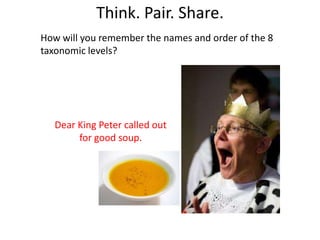
Think. Pair. Share.
How will you remember the names and order of the 8
taxonomic levels?
Dear King Peter called out
for good soup.
Think. Pair. Share.
There are 6 Kingdoms.
If you had to separate all life on Earth into 6 major categories,
how would you do it?
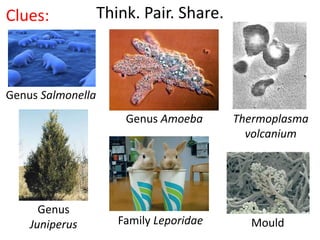
Think. Pair. Share.Clues:
Genus Salmonella
Thermoplasma
volcanium
Genus
Juniperus Family Leporidae Mould
Genus Amoeba
The 6 Kingdoms:
Eubacteria (Bacteria)
Archaebacteria (Archaea)
Protista
Fungi
Plants
Animals
Review - Before We Go Further:
What do these terms mean?
Organic (biology definition)
- Living or once-living matter.
Autotroph
- Makes its own food from inorganic sources.
Heterotroph
- Eats other organic matter.
Eukaryote
- Cells have a nucleus and other membranous organelles.
Prokaryote
- Cells have no nucleus and no membranous organelles.
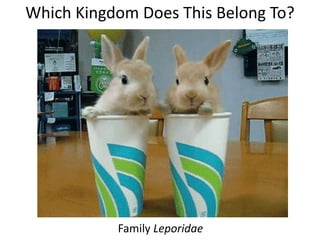
Which Kingdom Does This Belong To?
Family Leporidae
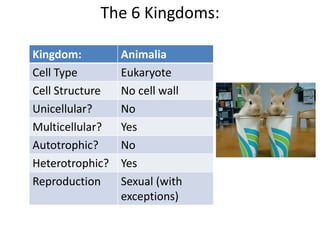
The 6 Kingdoms:
Kingdom: Animalia
Cell Type Eukaryote
Cell Structure No cell wall
Unicellular? No
Multicellular? Yes
Autotrophic? No
Heterotrophic? Yes
Reproduction Sexual (with
exceptions)
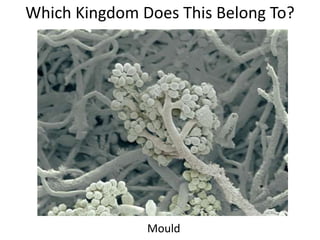
Which Kingdom Does This Belong To?
Mould
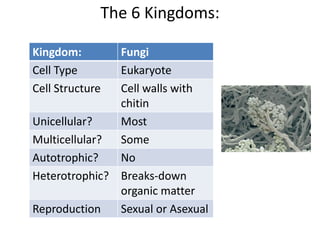
The 6 Kingdoms:
Kingdom: Fungi
Cell Type Eukaryote
Cell Structure Cell walls with
chitin
Unicellular? Most
Multicellular? Some
Autotrophic? No
Heterotrophic? Breaks-down
organic matter
Reproduction Sexual or Asexual
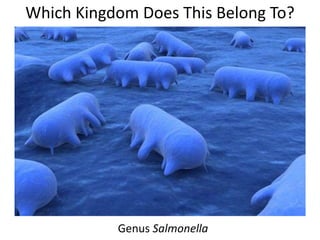
Which Kingdom Does This Belong To?
Genus Salmonella
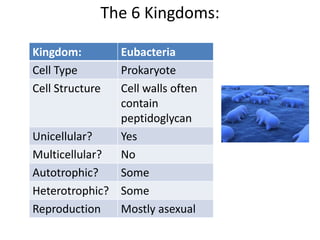
The 6 Kingdoms:
Kingdom: Eubacteria
Cell Type Prokaryote
Cell Structure Cell walls often
contain
peptidoglycan
Unicellular? Yes
Multicellular? No
Autotrophic? Some
Heterotrophic? Some
Reproduction Mostly asexual
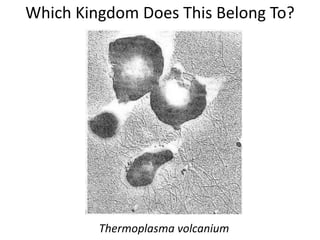
Which Kingdom Does This Belong To?
Thermoplasma volcanium
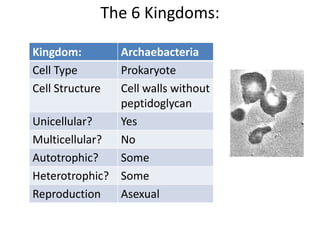
The 6 Kingdoms:
Kingdom: Archaebacteria
Cell Type Prokaryote
Cell Structure Cell walls without
peptidoglycan
Unicellular? Yes
Multicellular? No
Autotrophic? Some
Heterotrophic? Some
Reproduction Asexual
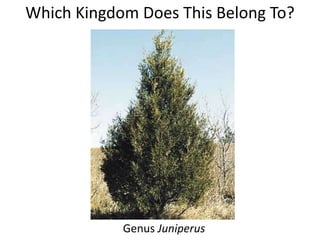
Which Kingdom Does This Belong To?
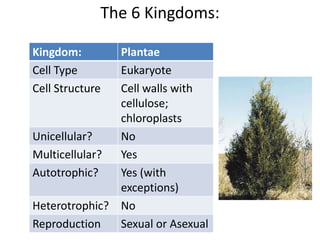
Genus Juniperus
The 6 Kingdoms:
Kingdom: Plantae
Cell Type Eukaryote
Cell Structure Cell walls with
cellulose;
chloroplasts
Unicellular? No
Multicellular? Yes
Autotrophic? Yes (with
exceptions)
Heterotrophic? No
Reproduction Sexual or Asexual
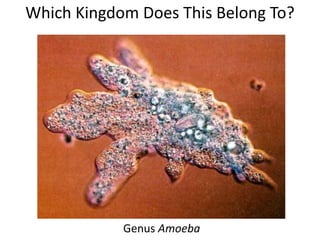
Which Kingdom Does This Belong To?
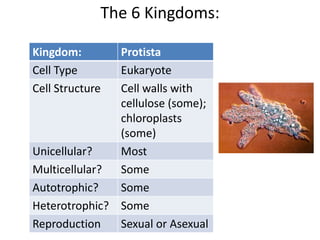
Genus Amoeba
The 6 Kingdoms:
Kingdom: Protista
Cell Type Eukaryote
Cell Structure Cell walls with
cellulose (some);
chloroplasts
(some)
Unicellular? Most
Multicellular? Some
Autotrophic? Some
Heterotrophic? Some
Reproduction Sexual or Asexual
Think. Pair. Share.
Eubacteria
Archaea
Protista
Fungi
Plants
Animals
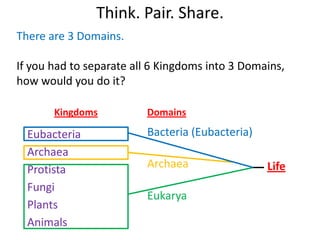
There are 3 Domains.
If you had to separate all 6 Kingdoms into 3 Domains,
how would you do it?
Life
Eukarya
Archaea
Bacteria (Eubacteria)
Kingdoms Domains
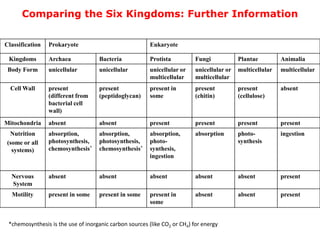
Classification Prokaryote Eukaryote
Kingdoms Archaea Bacteria Protista Fungi Plantae Animalia
Body Form unicellular unicellular unicellular or
multicellular
unicellular or
multicellular
multicellular multicellular
Cell Wall present
(different from
bacterial cell
wall)
present
(peptidoglycan)
present in
some
present
(chitin)
present
(cellulose)
absent
Mitochondria absent absent present present present present
Nutrition
(some or all
systems)
absorption,
photosynthesis,
chemosynthesis*
absorption,
photosynthesis,
chemosynthesis*
absorption,
photo-
synthesis,
ingestion
absorption photo-
synthesis
ingestion
Nervous
System
absent absent absent absent absent present
Motility present in some present in some present in
some
absent absent present
Comparing the Six Kingdoms: Further Information
*chemosynthesis is the use of inorganic carbon sources (like CO2 or CH4) for energy

06 6 kingdoms and 3 domains