Classification
Systems
DOMAINS & KINGDOMS
Wk
9
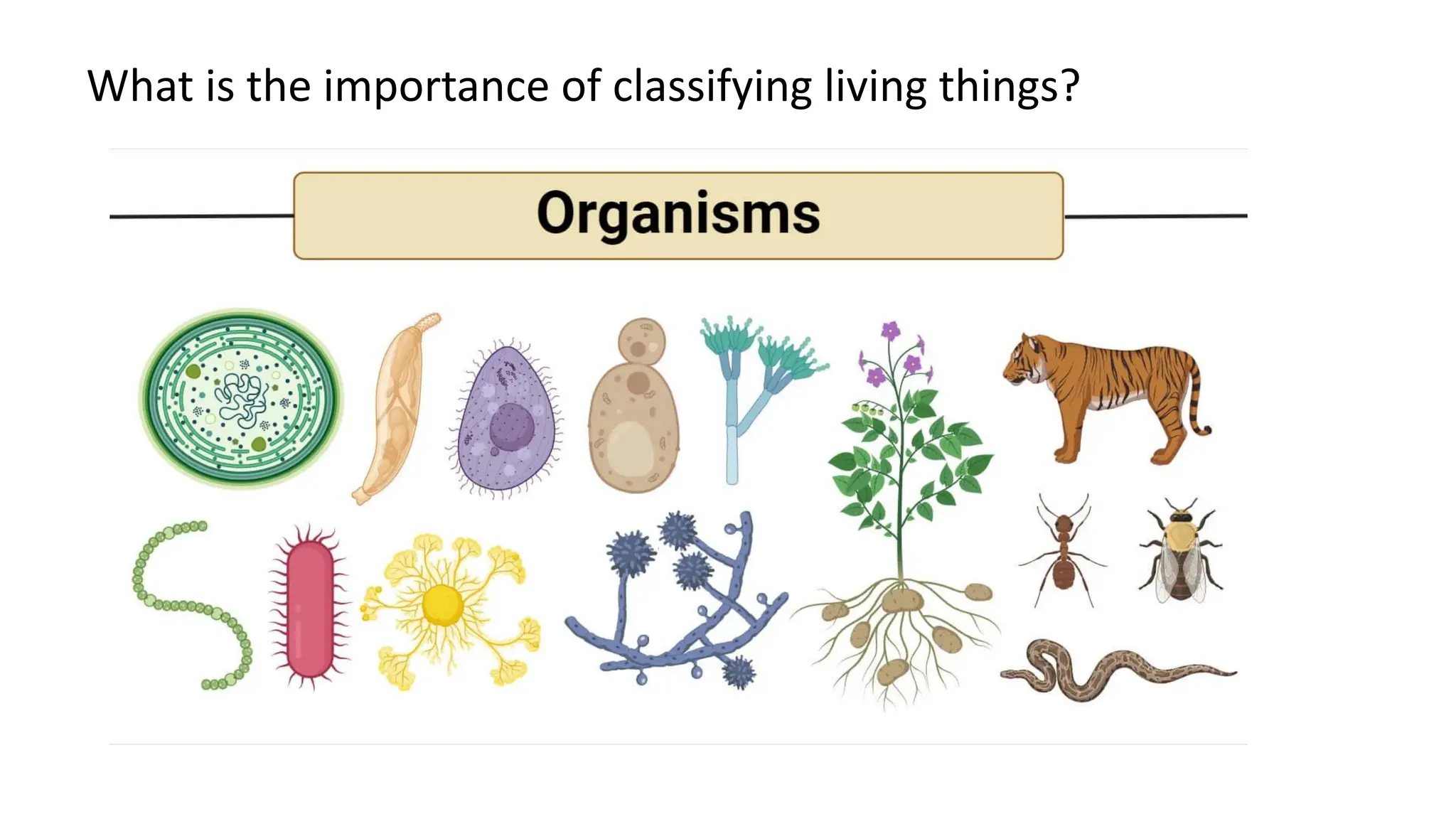
What is the importance of classifying living things?
is the science of classifying living organisms based on
shared characteristics. It helps scientists organize and
understand the vast diversity of life by grouping
organisms in a hierarchical system. This classification
makes it easier to study relationships and evolutionary
history.
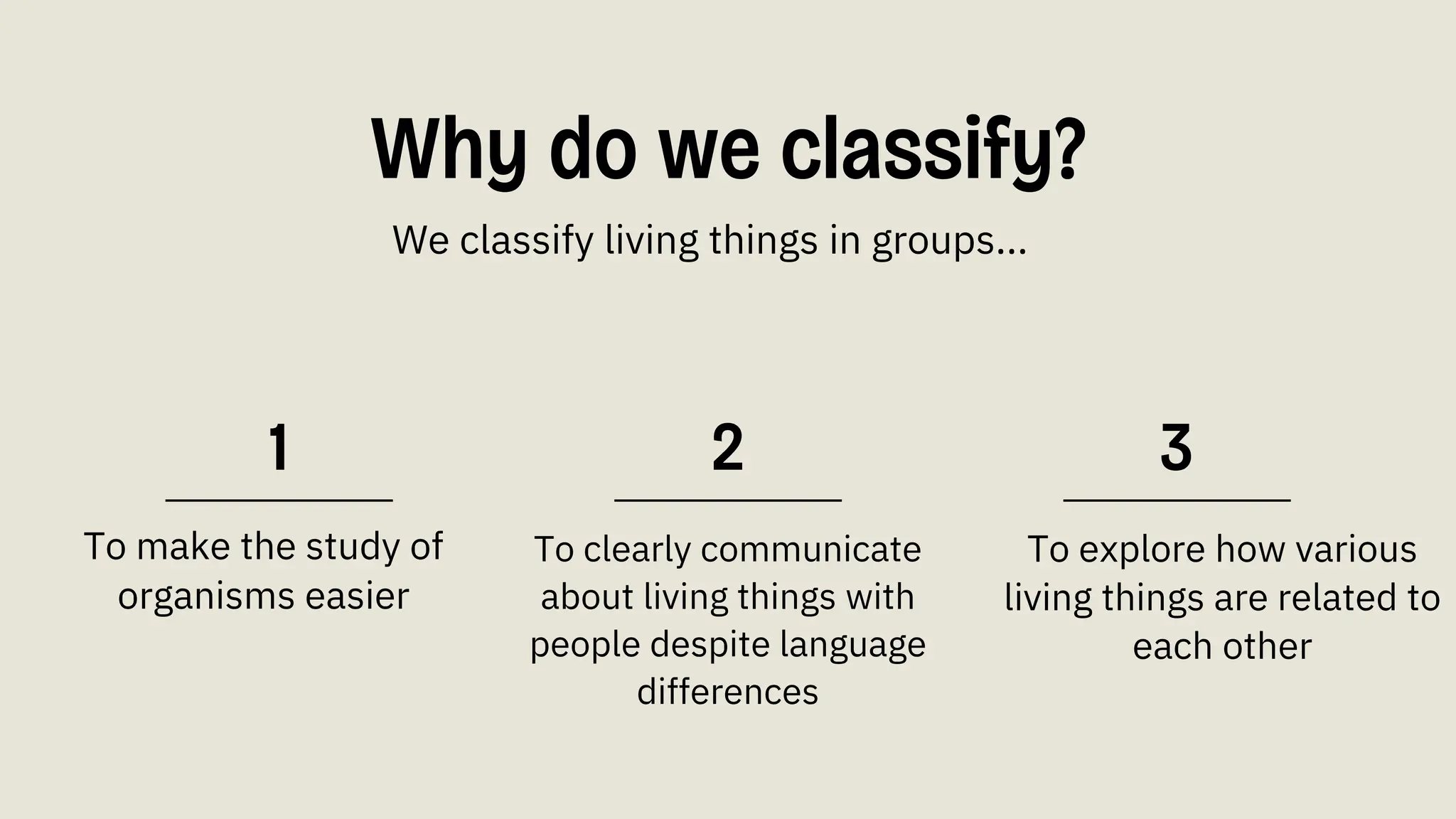
1
To make the study of
organisms easier
2
To clearly communicate
about living things with
people despite language
differences
3
To explore how various
living things are related to
each other
We classify living things in groups...
Why do we classify?
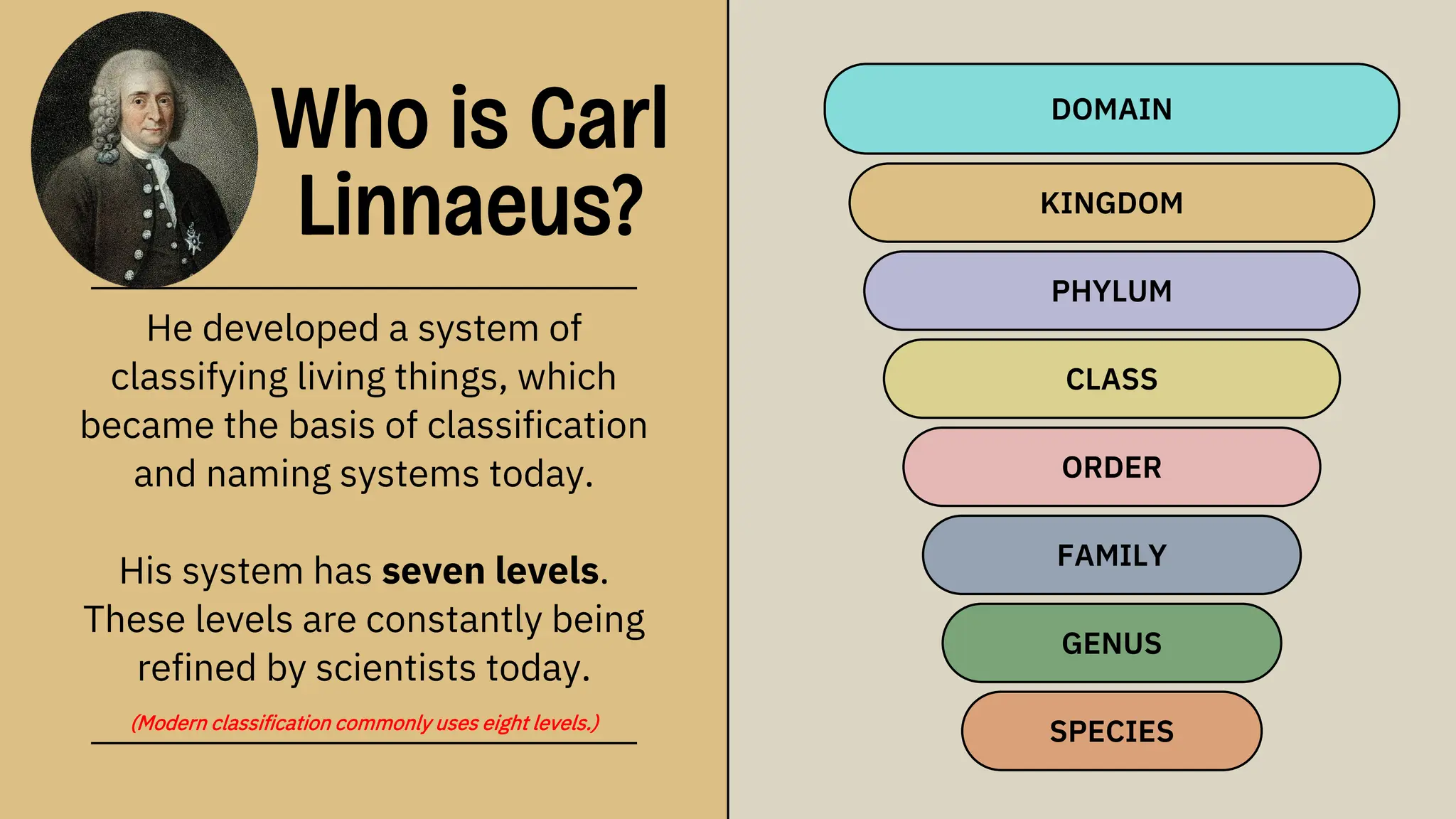
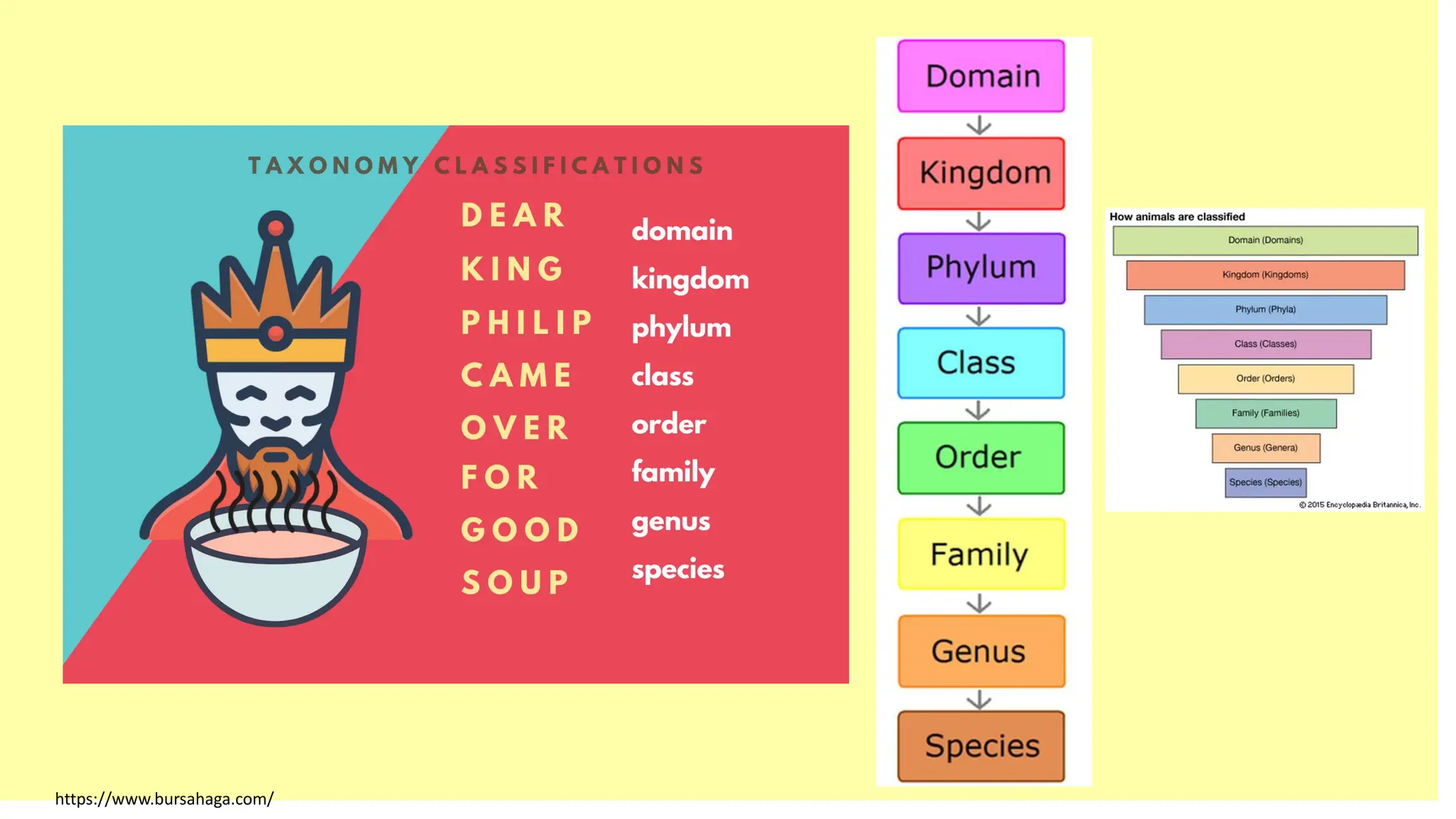
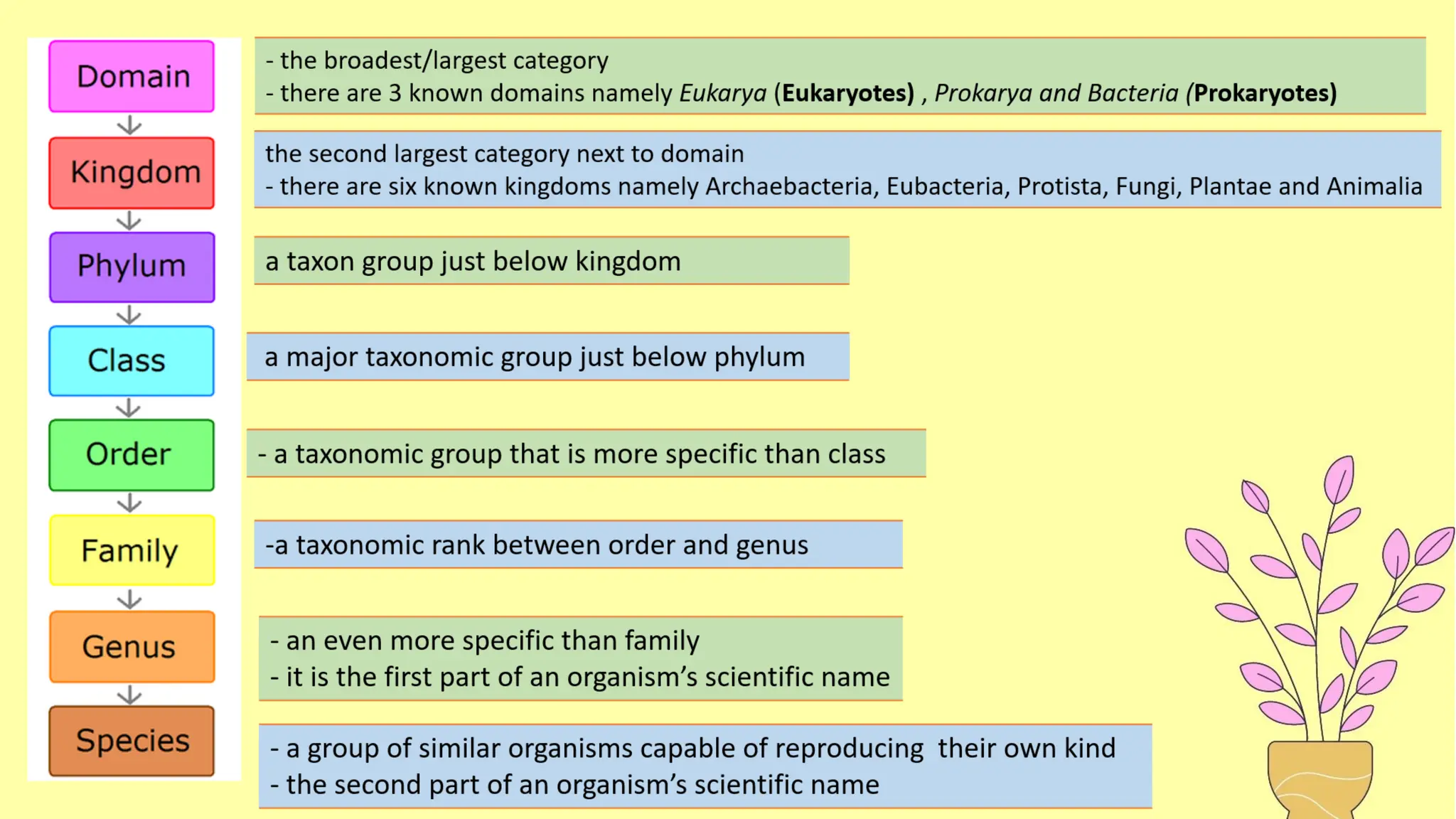
KINGDOM
PHYLUM
CLASS
ORDER
FAMILY
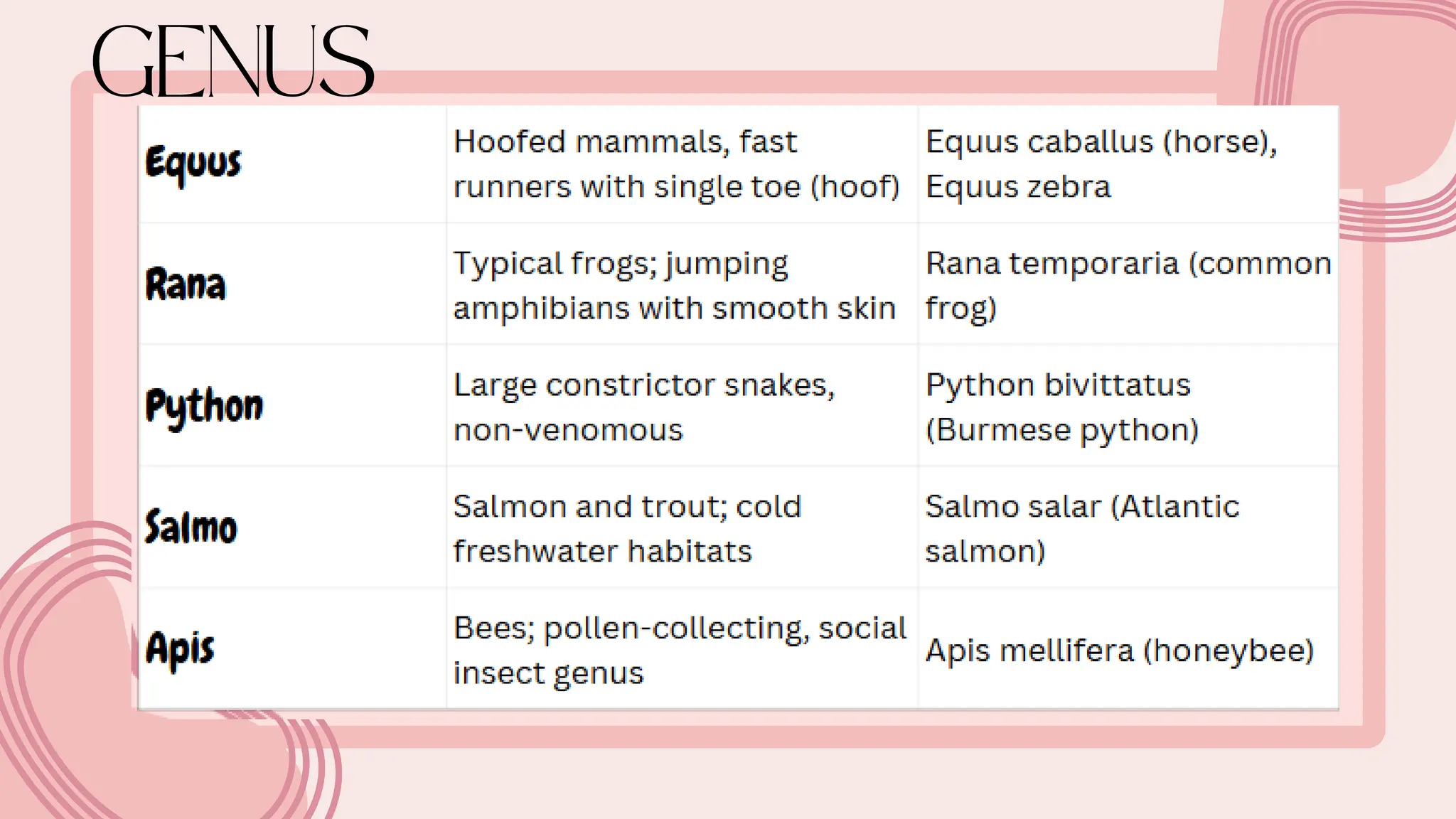
GENUS
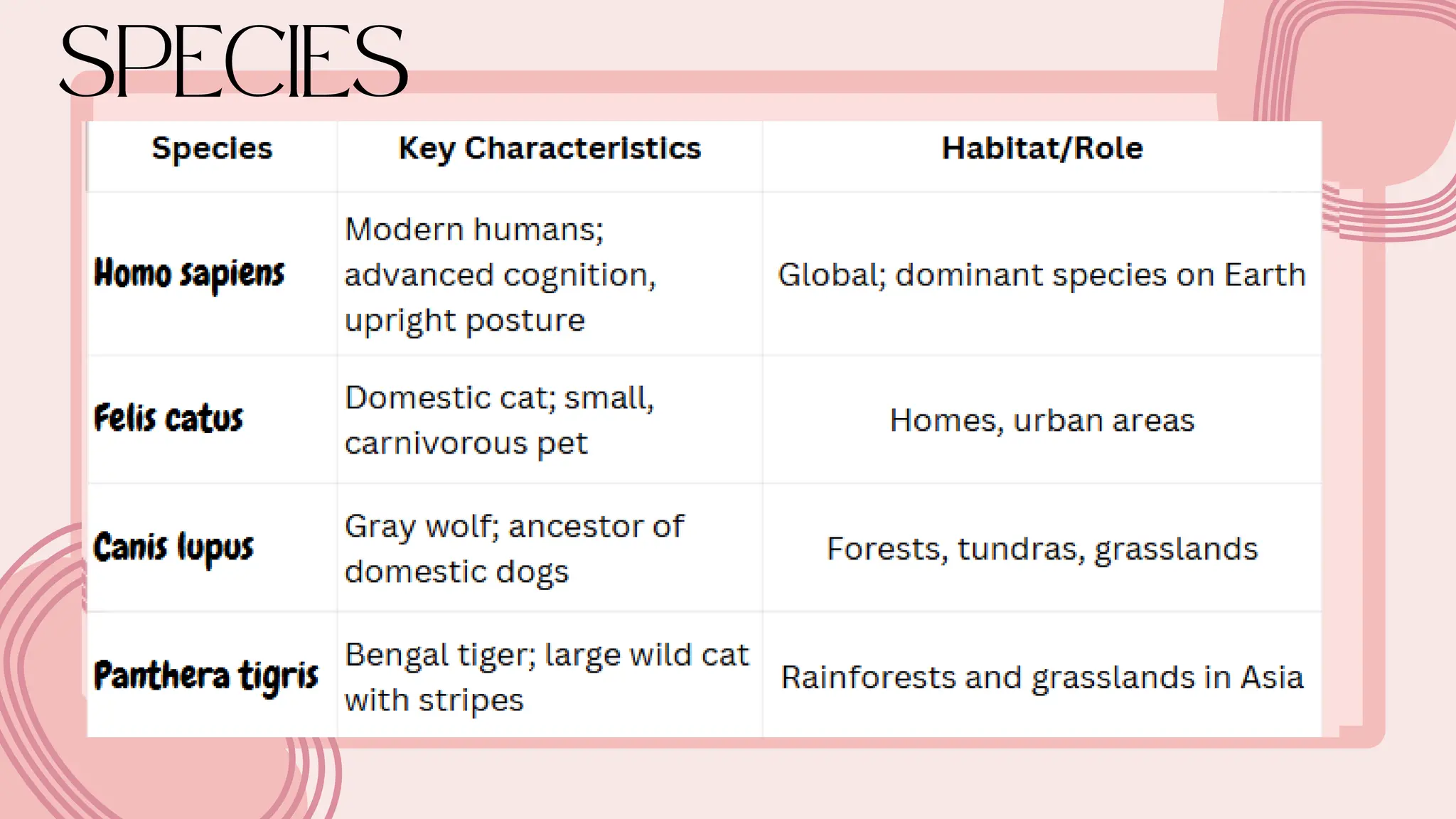
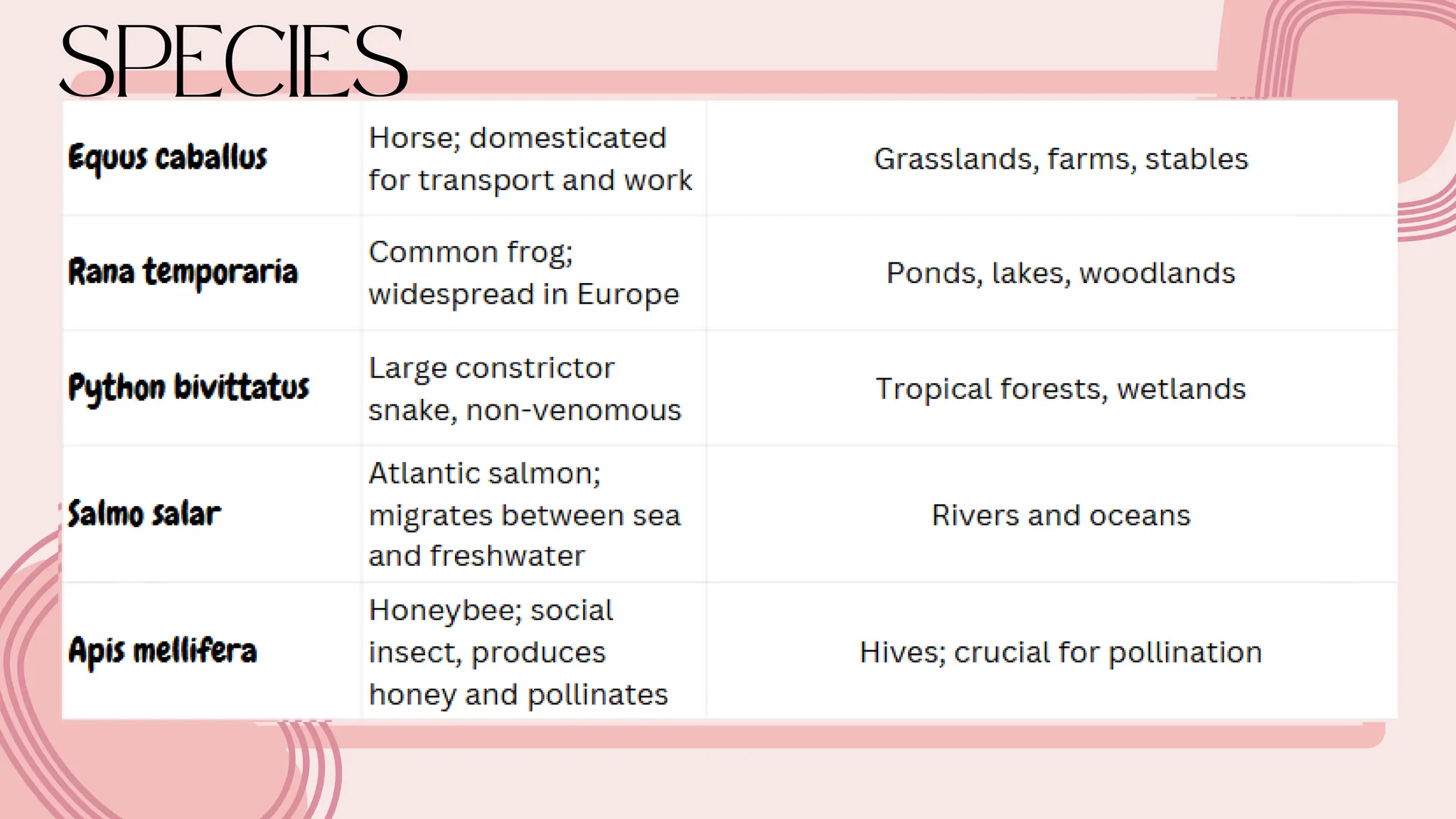
SPECIES
DOMAIN
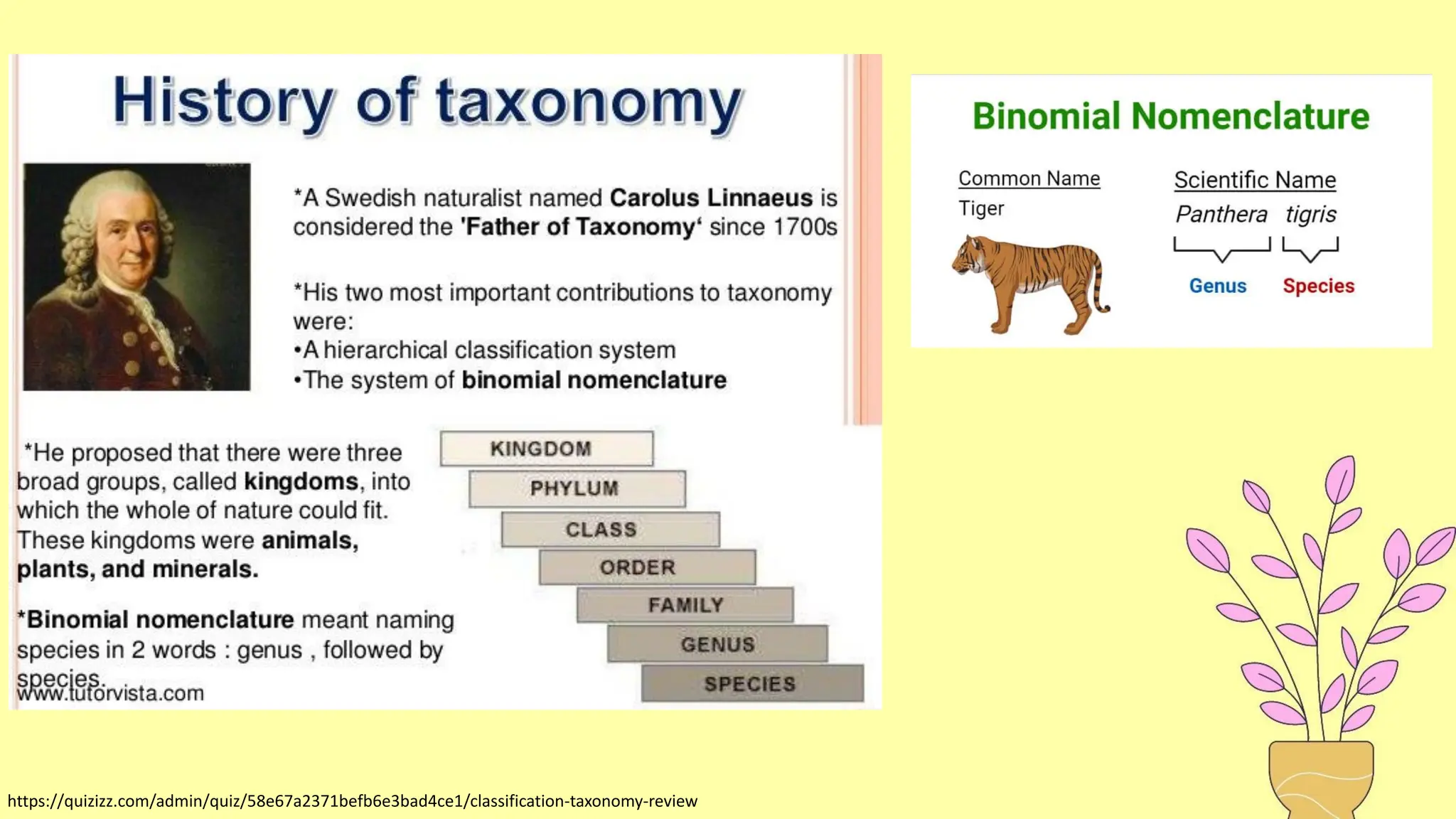
He developed a system of
classifying living things, which
became the basis of classification
and naming systems today.
His system has seven levels.
These levels are constantly being
refined by scientists today.
(Modern classification commonly uses eight levels.)
Who is Carl
Linnaeus?
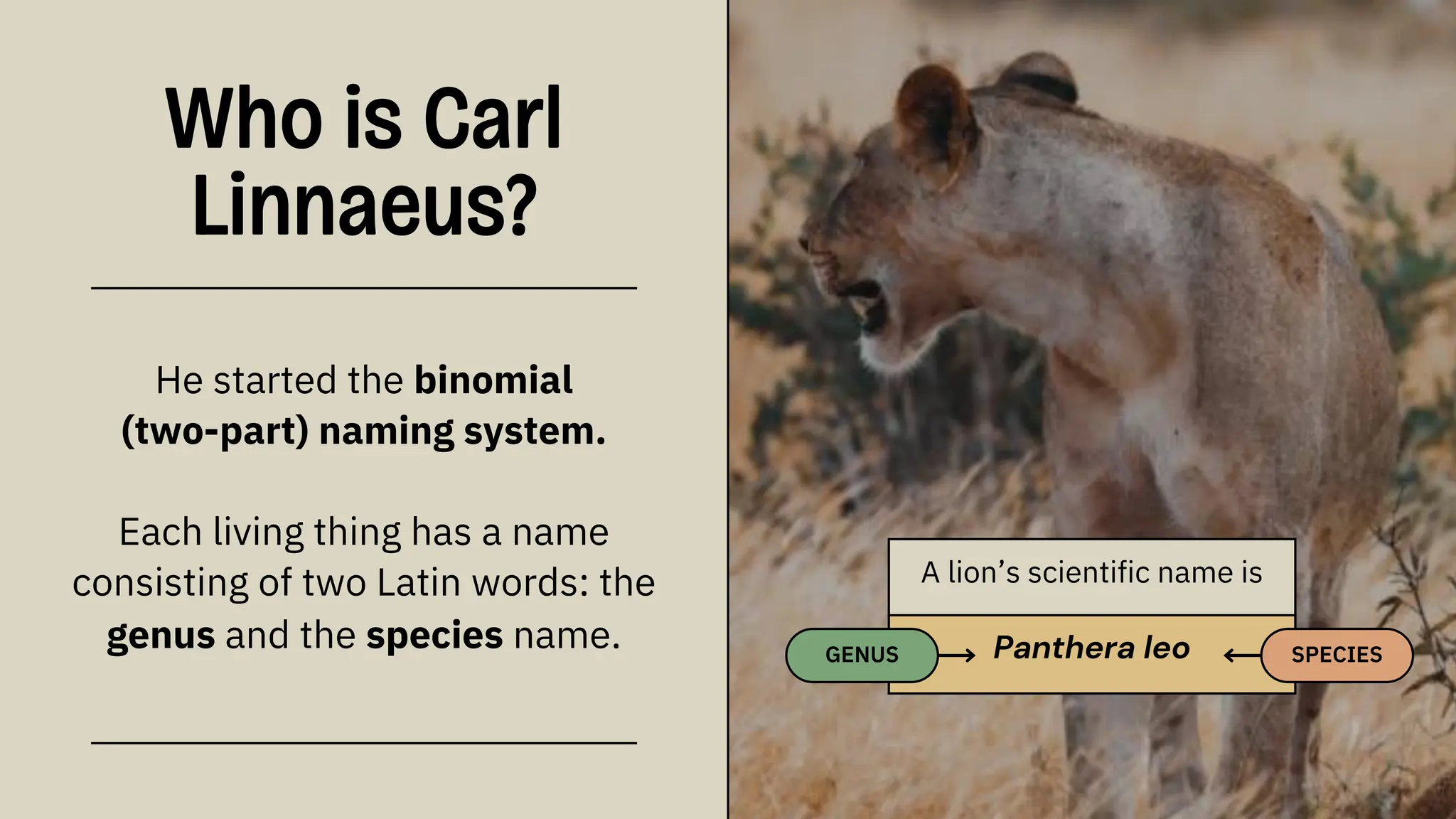
A lion’s scientific name is
Panthera leo
GENUS SPECIES
He started the binomial
(two-part) naming system.
Each living thing has a name
consisting of two Latin words: the
genus and the species name.
Who is Carl
Linnaeus?
https://quizizz.com/admin/quiz/58e67a2371befb6e3bad4ce1/classification-taxonomy-review
https://www.bursahaga.com/
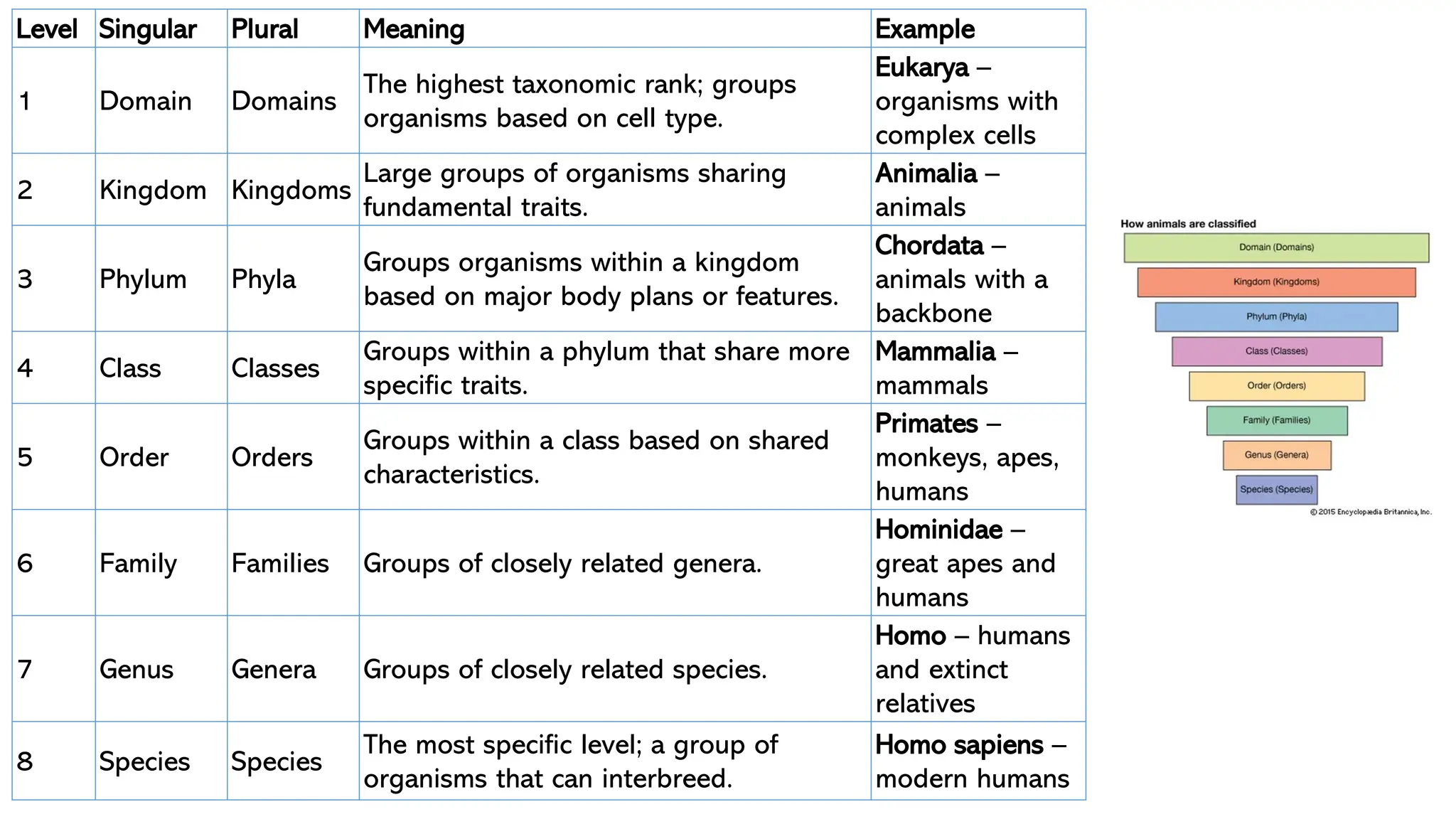
Level Singular Plural Meaning Example
1 Domain Domains
The highest taxonomic rank; groups
organisms based on cell type.
Eukarya –
organisms with
complex cells
2 Kingdom Kingdoms
Large groups of organisms sharing
fundamental traits.
Animalia –
animals
3 Phylum Phyla
Groups organisms within a kingdom
based on major body plans or features.
Chordata –
animals with a
backbone
4 Class Classes
Groups within a phylum that share more
specific traits.
Mammalia –
mammals
5 Order Orders
Groups within a class based on shared
characteristics.
Primates –
monkeys, apes,
humans
6 Family Families Groups of closely related genera.
Hominidae –
great apes and
humans
7 Genus Genera Groups of closely related species.
Homo – humans
and extinct
relatives
8 Species Species
The most specific level; a group of
organisms that can interbreed.
Homo sapiens –
modern humans
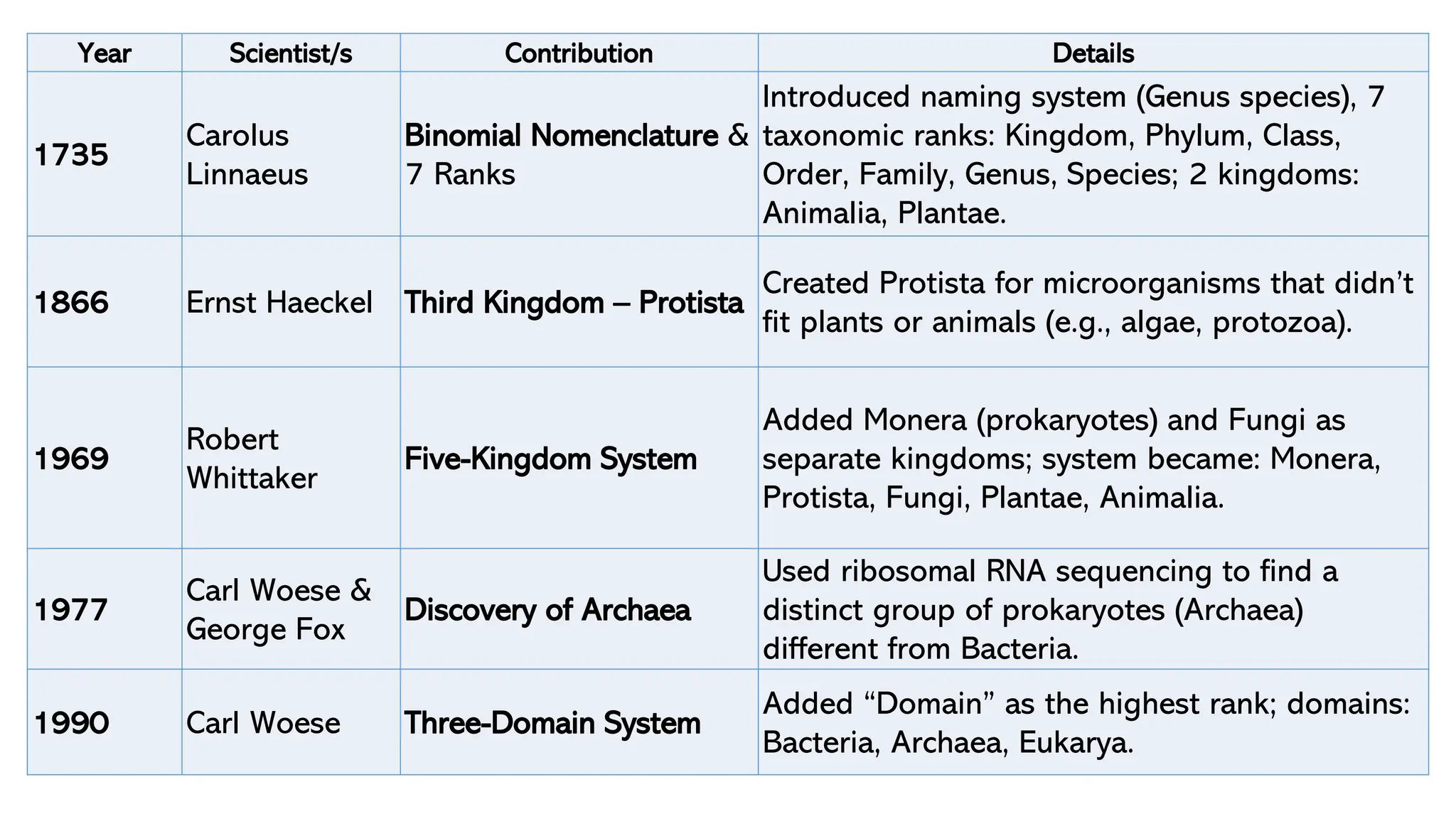
Year Scientist/s Contribution Details
1735
Carolus
Linnaeus
Binomial Nomenclature &
7 Ranks
Introduced naming system (Genus species), 7
taxonomic ranks: Kingdom, Phylum, Class,
Order, Family, Genus, Species; 2 kingdoms:
Animalia, Plantae.
1866 Ernst Haeckel Third Kingdom – Protista
Created Protista for microorganisms that didn’t
fit plants or animals (e.g., algae, protozoa).
1969
Robert
Whittaker
Five-Kingdom System
Added Monera (prokaryotes) and Fungi as
separate kingdoms; system became: Monera,
Protista, Fungi, Plantae, Animalia.
1977
Carl Woese &
George Fox
Discovery of Archaea
Used ribosomal RNA sequencing to find a
distinct group of prokaryotes (Archaea)
different from Bacteria.
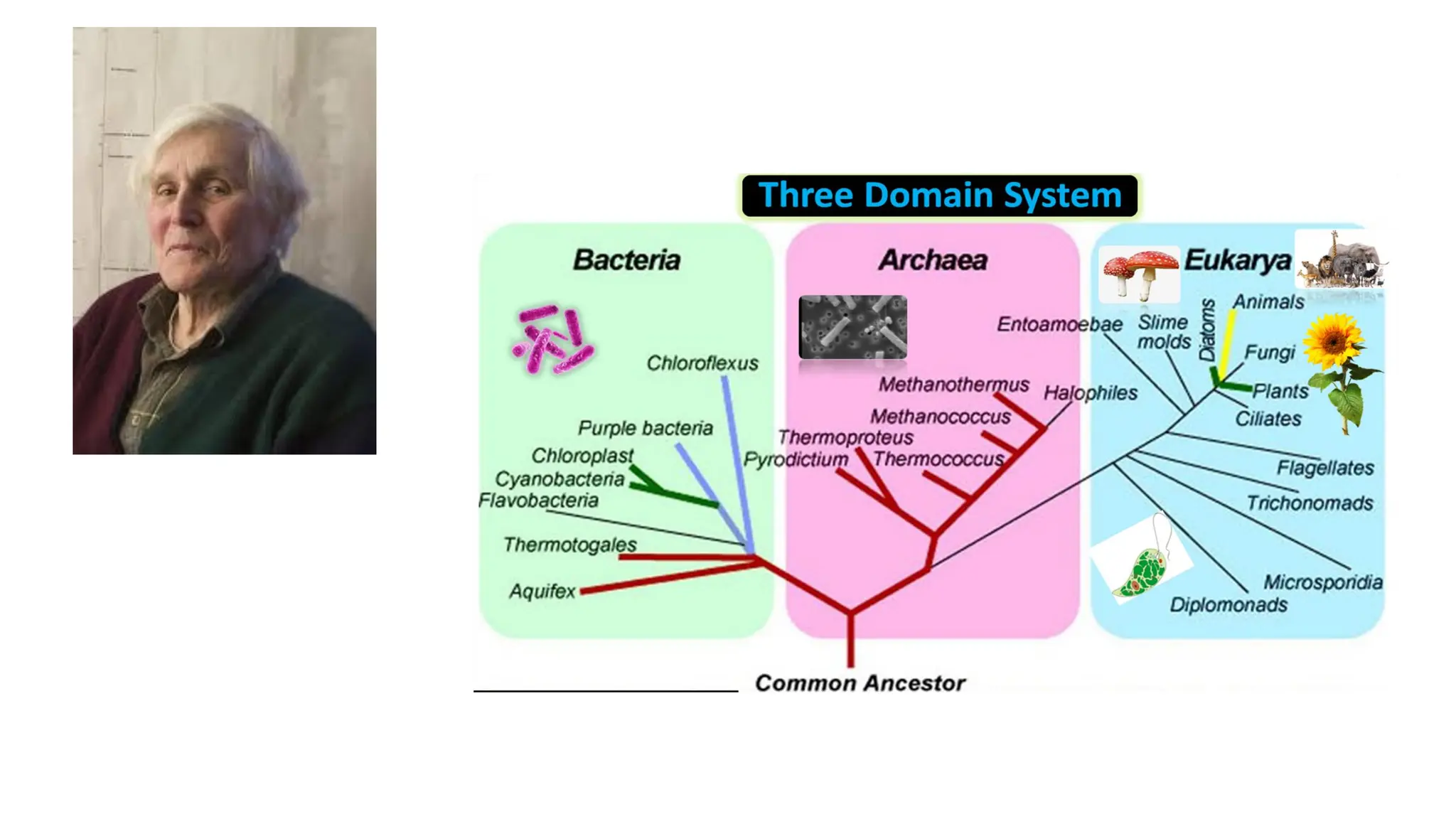
1990 Carl Woese Three-Domain System
Added “Domain” as the highest rank; domains:
Bacteria, Archaea, Eukarya.
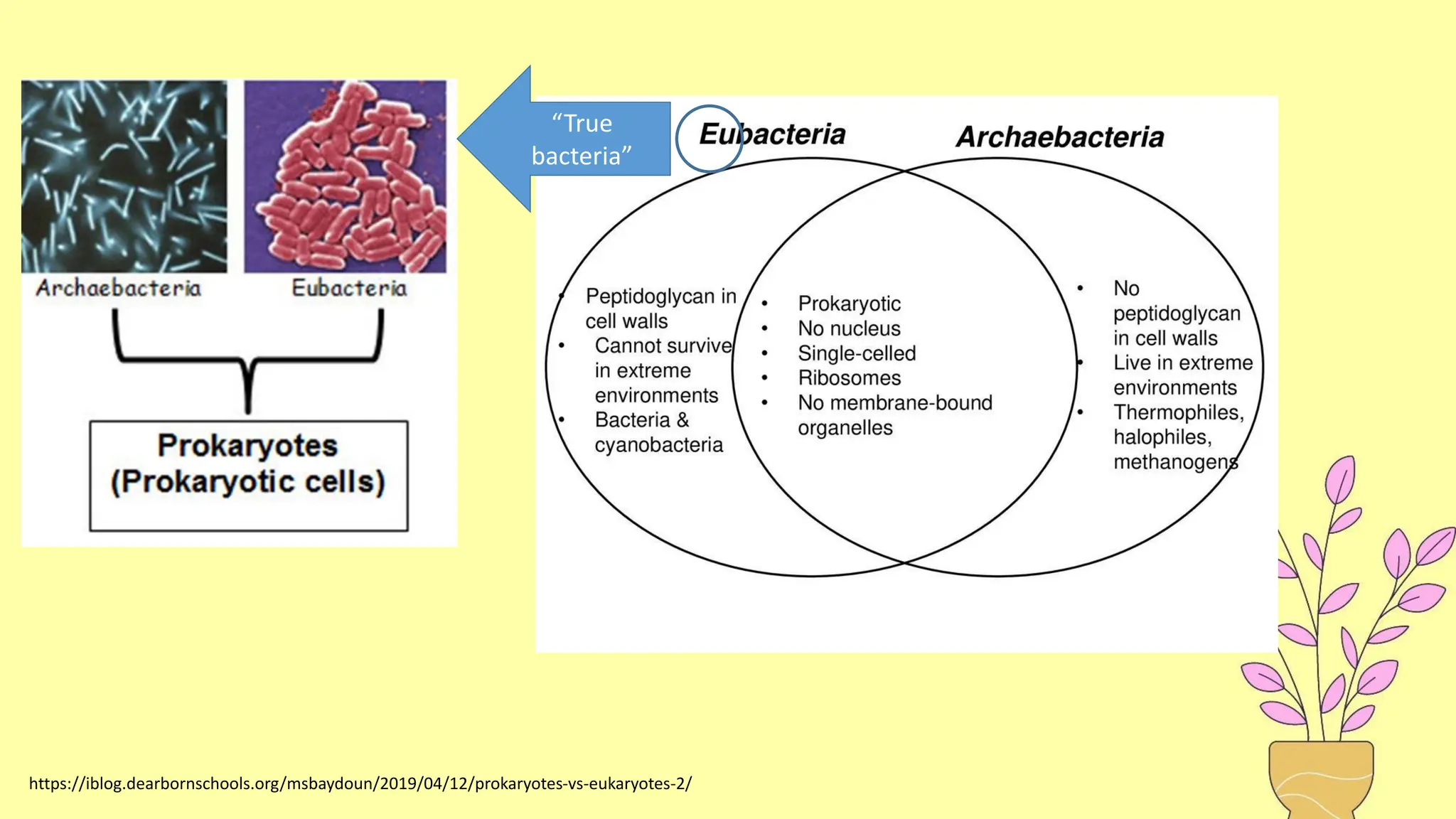
https://iblog.dearbornschools.org/msbaydoun/2019/04/12/prokaryotes-vs-eukaryotes-2/
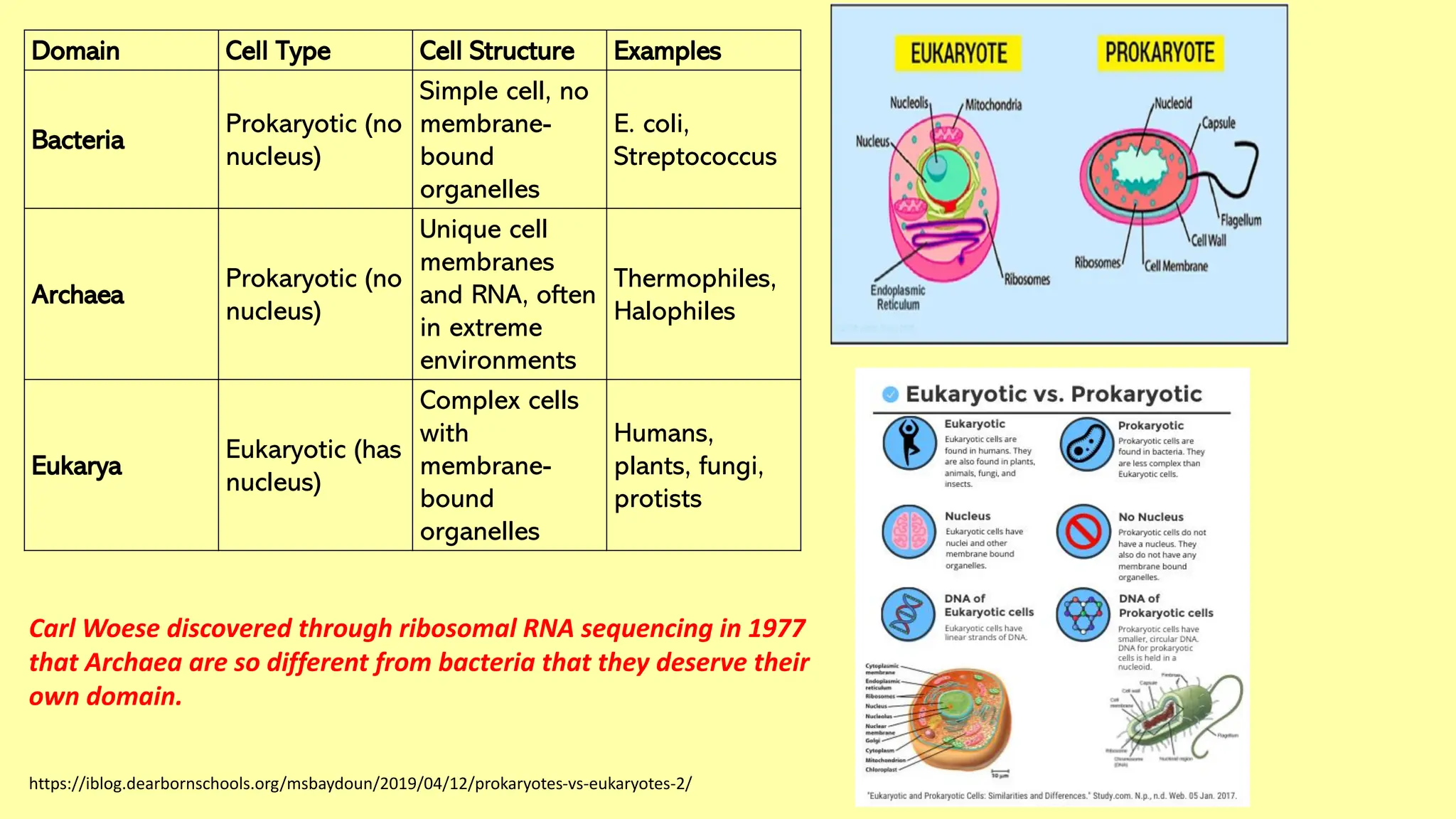
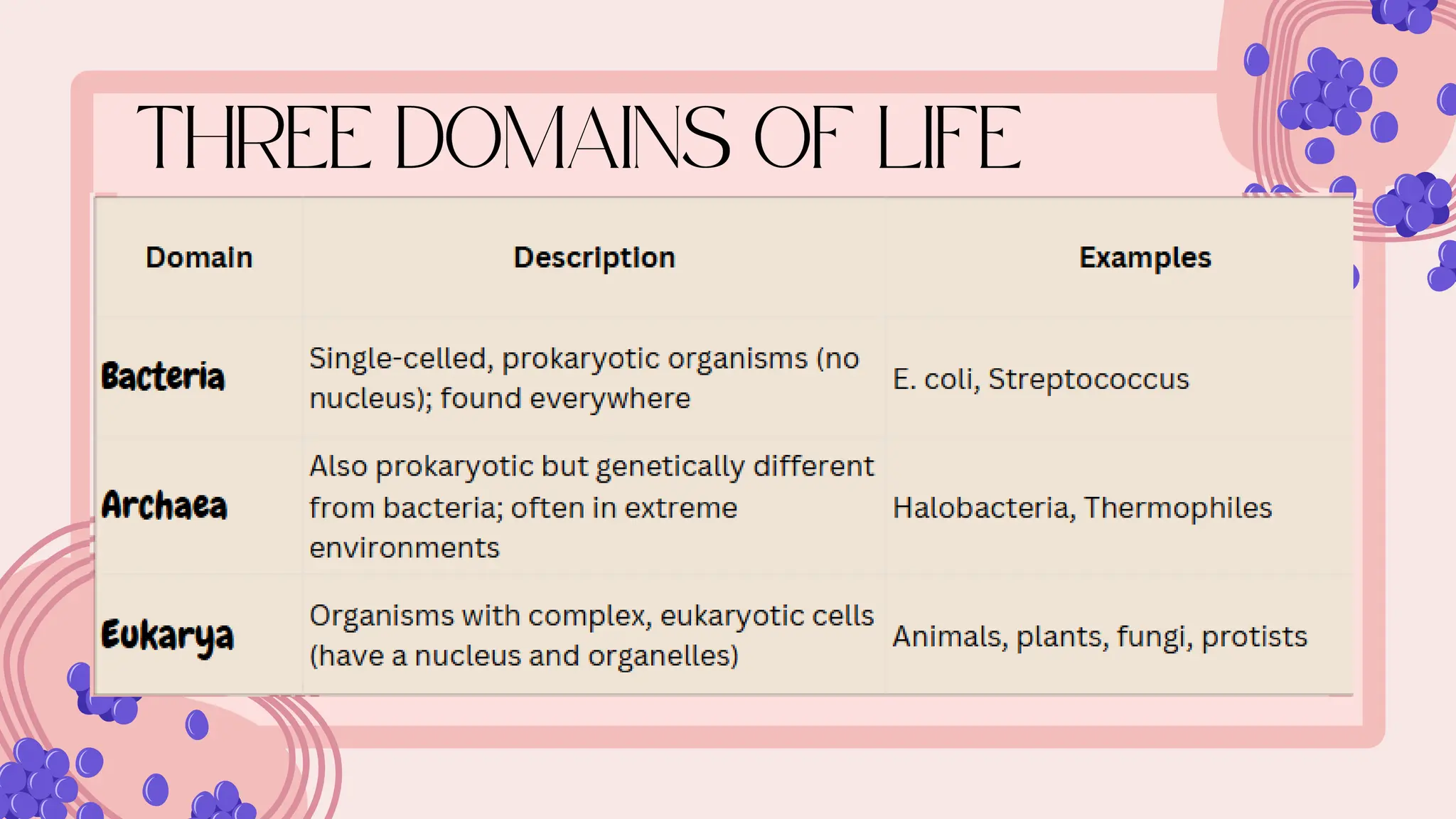
Domain Cell Type Cell Structure Examples
Bacteria
Prokaryotic (no
nucleus)
Simple cell, no
membrane-
bound
organelles
E. coli,
Streptococcus
Archaea
Prokaryotic (no
nucleus)
Unique cell
membranes
and RNA, often
in extreme
environments
Thermophiles,
Halophiles
Eukarya
Eukaryotic (has
nucleus)
Complex cells
with
membrane-
bound
organelles
Humans,
plants, fungi,
protists
Carl Woese discovered through ribosomal RNA sequencing in 1977
that Archaea are so different from bacteria that they deserve their
own domain.
https://ontrack-media.net/gateway/science6/g_s6m4l2s4.html
KINGDOM
https://iblog.dearbornschools.org/msbaydoun/2019/04/12/prokaryotes-vs-eukaryotes-2/
“True
bacteria”
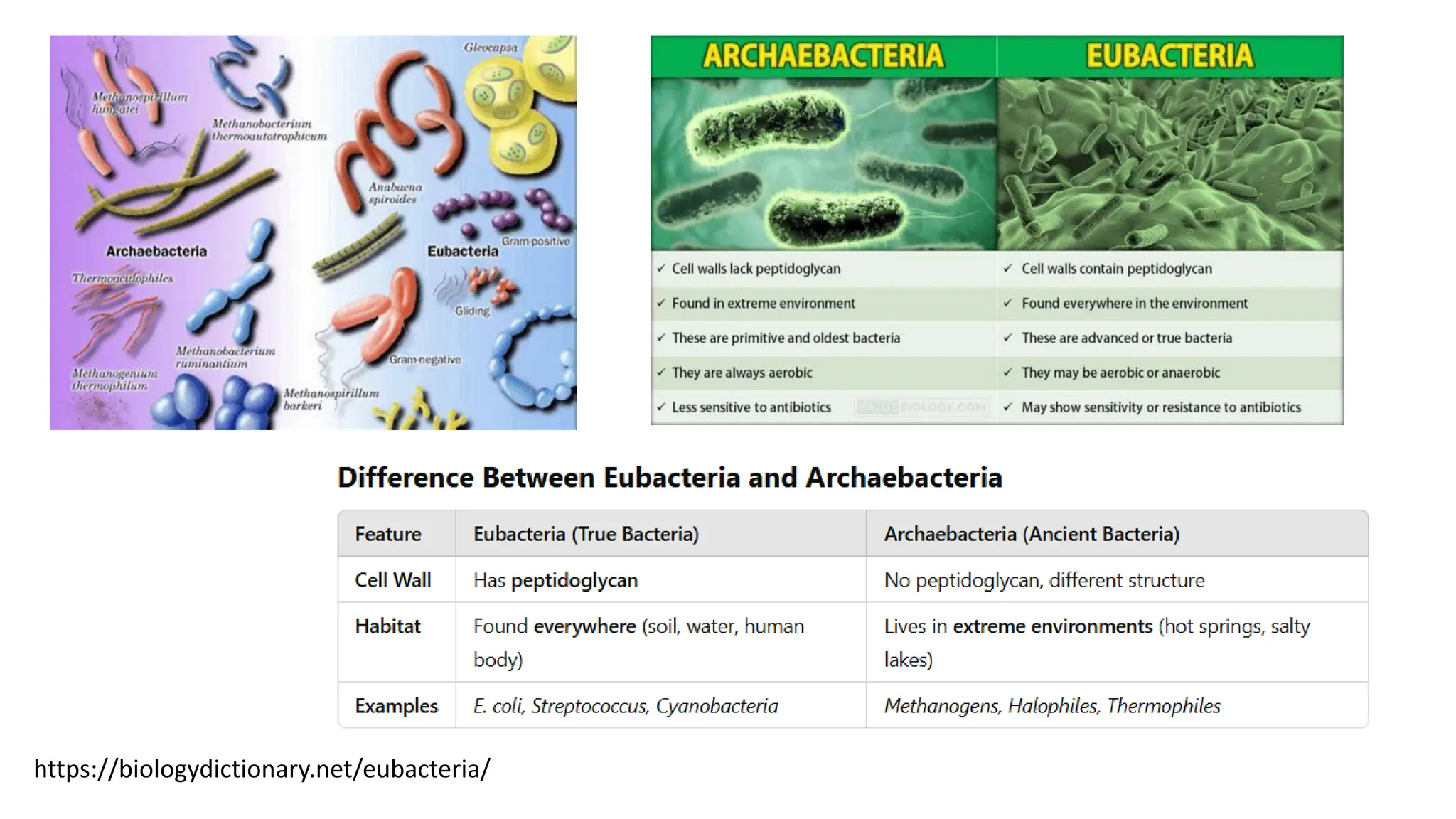
https://biologydictionary.net/eubacteria/
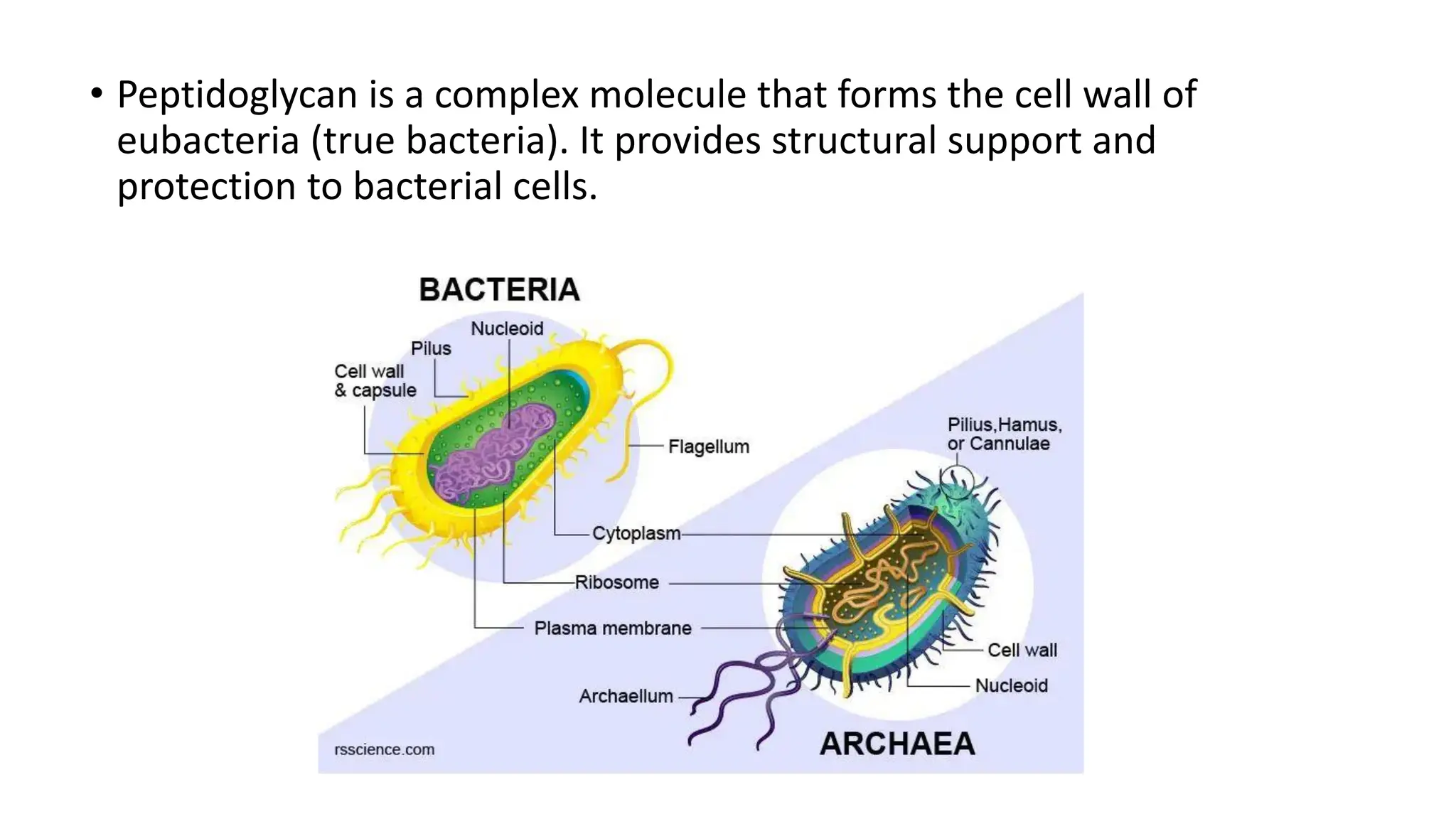
• Peptidoglycan is a complex molecule that forms the cell wall of
eubacteria (true bacteria). It provides structural support and
protection to bacterial cells.
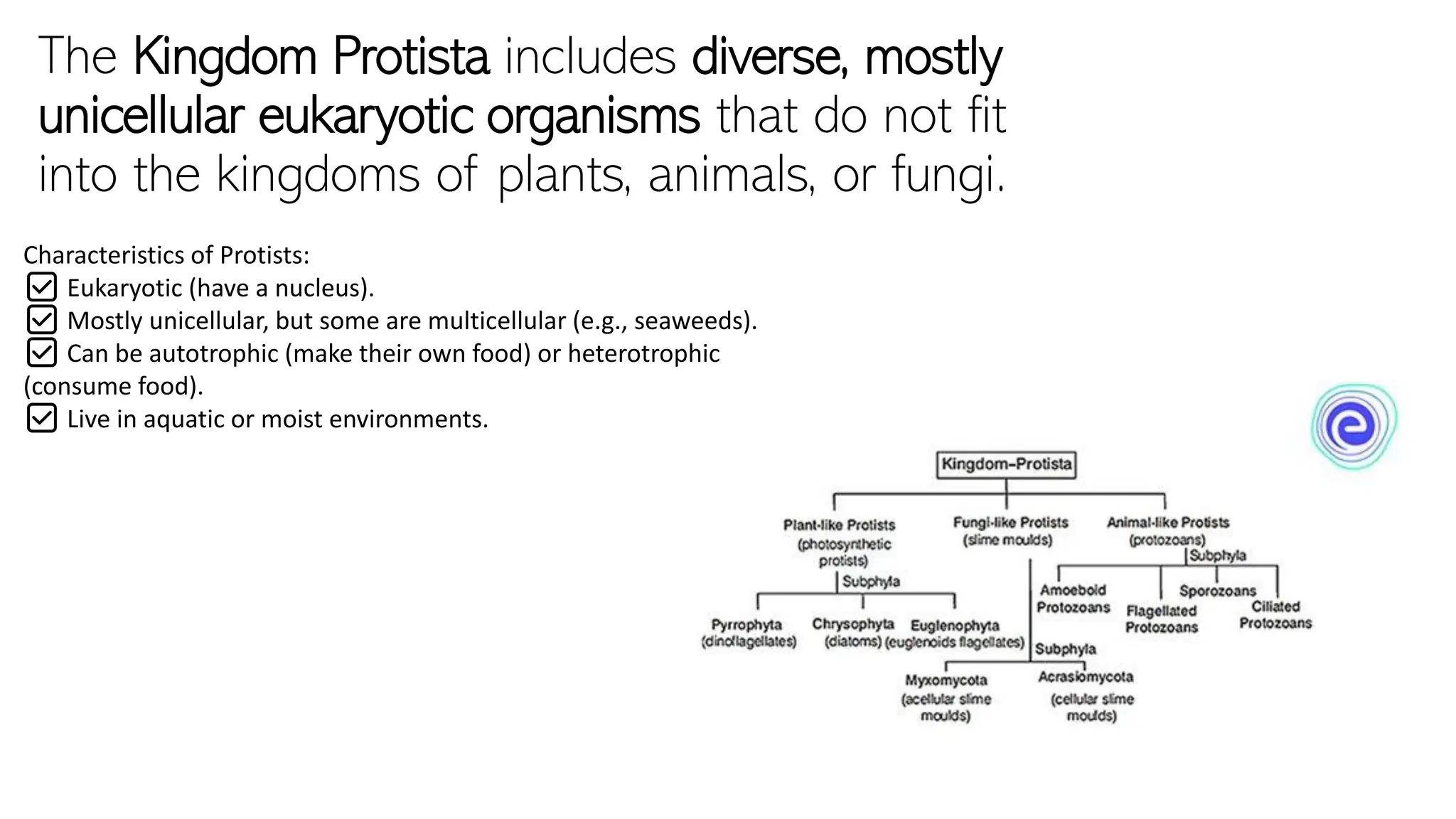
The Kingdom Protista includes diverse, mostly
unicellular eukaryotic organisms that do not fit
into the kingdoms of plants, animals, or fungi.
Characteristics of Protists:
✅ Eukaryotic (have a nucleus).
✅ Mostly unicellular, but some are multicellular (e.g., seaweeds).
✅ Can be autotrophic (make their own food) or heterotrophic
(consume food).
✅ Live in aquatic or moist environments.
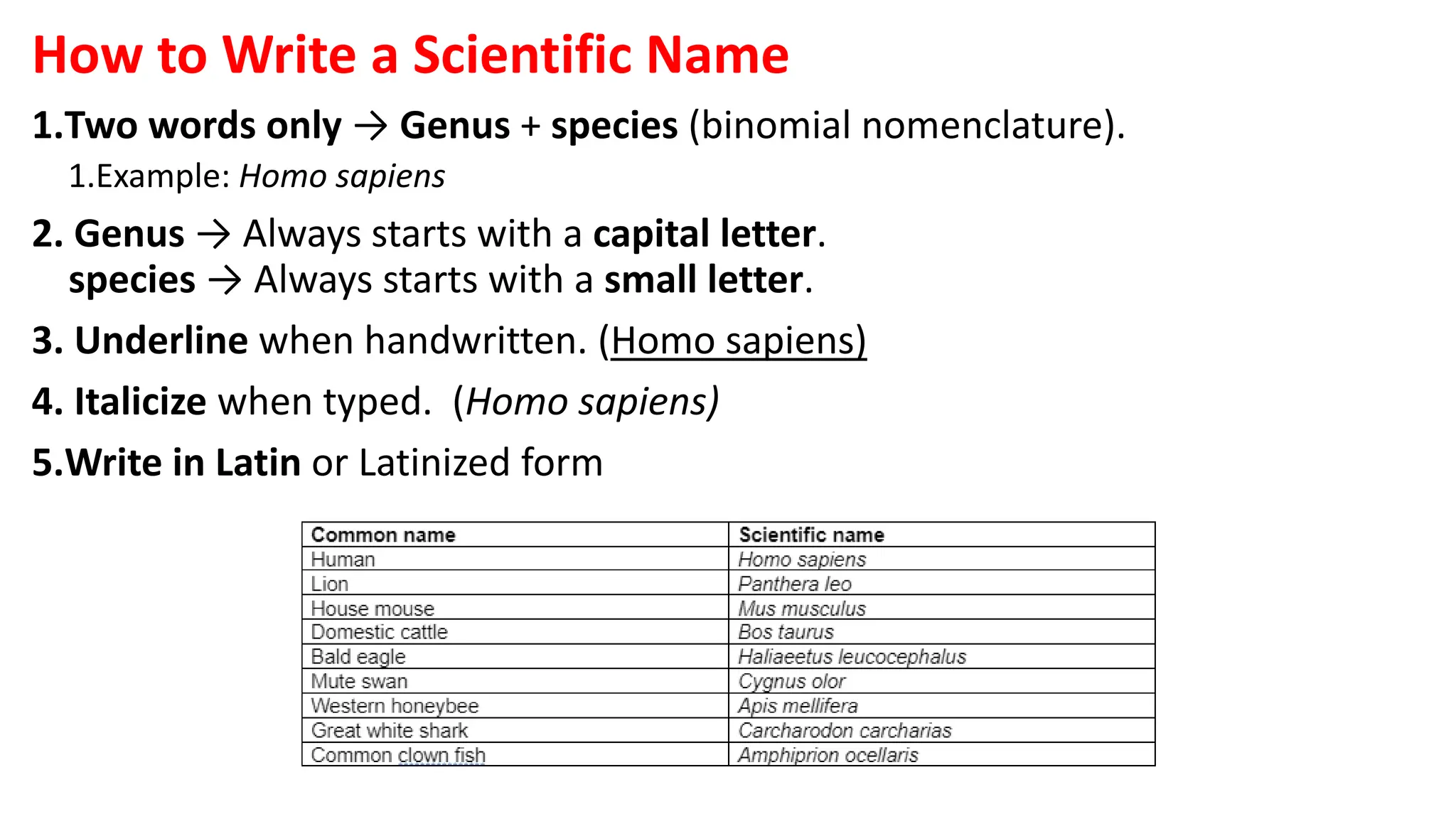
How to Write a Scientific Name
1.Two words only → Genus + species (binomial nomenclature).
1.Example: Homo sapiens
2. Genus → Always starts with a capital letter.
species → Always starts with a small letter.
3. Underline when handwritten. (Homo sapiens)
4. Italicize when typed. (Homo sapiens)
5.Write in Latin or Latinized form
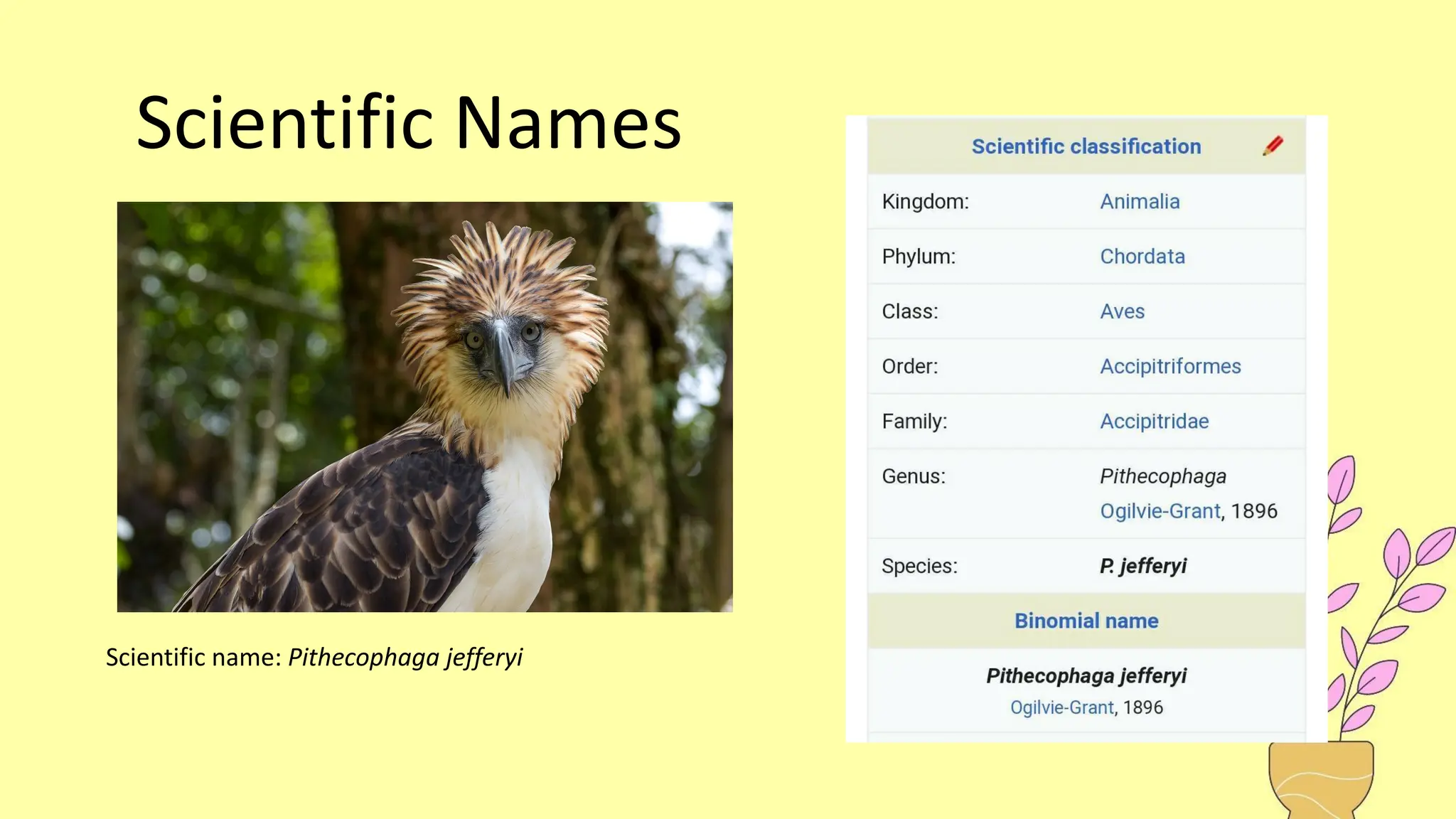
Scientific Names
Scientific name: Pithecophaga jefferyi
of the Linnaean system of biological
classification
A domain in biological classification is the highest
taxonomic rank, which groups organisms based
on fundamental differences in their cellular and
genetic structure.
A biological classification is one of the highest
taxonomic ranks, just below the domain, used to
group together all forms of life that share
fundamental structural and functional
characteristics.
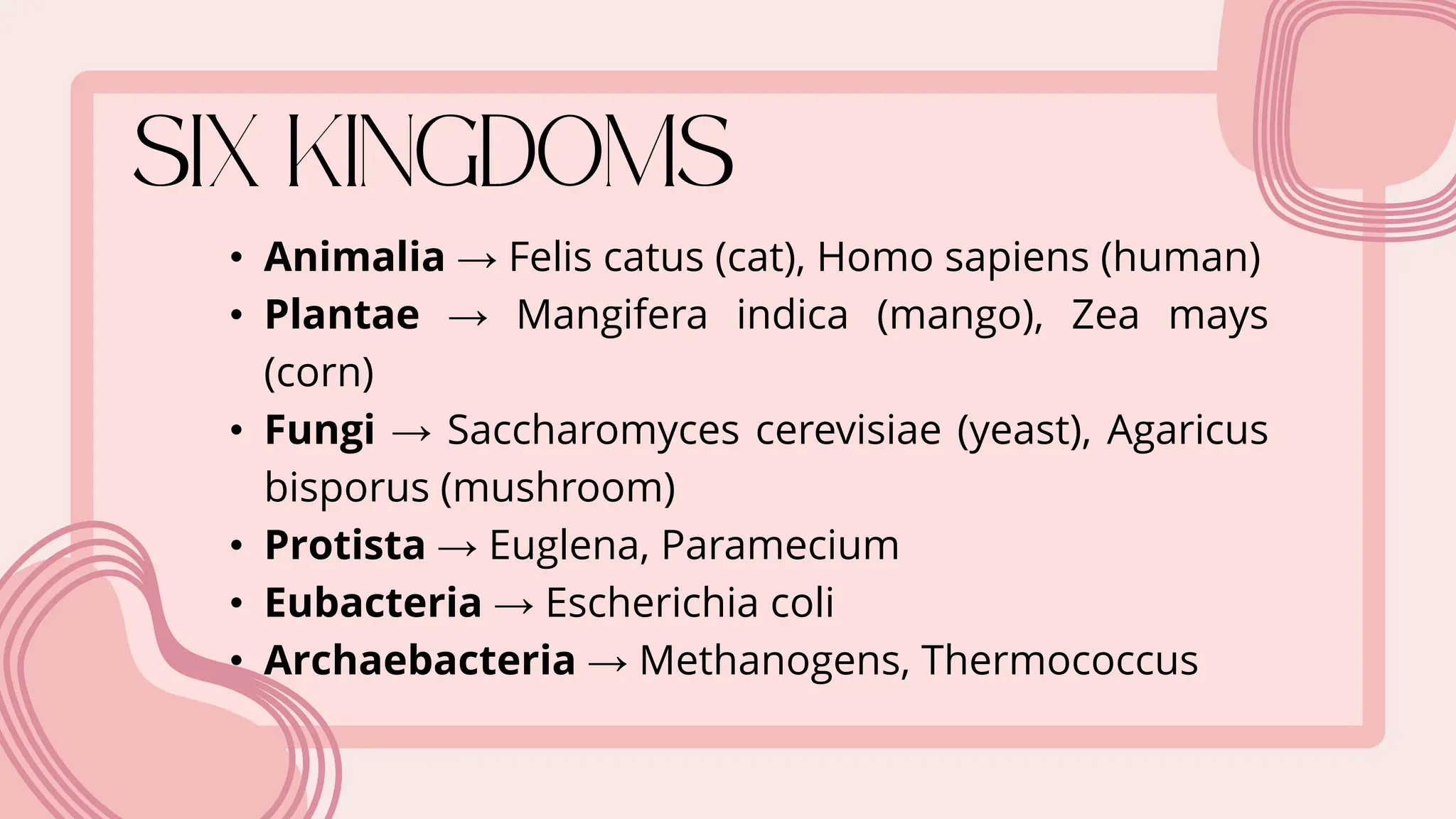
• Animalia → Felis catus (cat), Homo sapiens (human)
• Plantae → Mangifera indica (mango), Zea mays
(corn)
• Fungi → Saccharomyces cerevisiae (yeast), Agaricus
bisporus (mushroom)
• Protista → Euglena, Paramecium
• Eubacteria → Escherichia coli
• Archaebacteria → Methanogens, Thermococcus
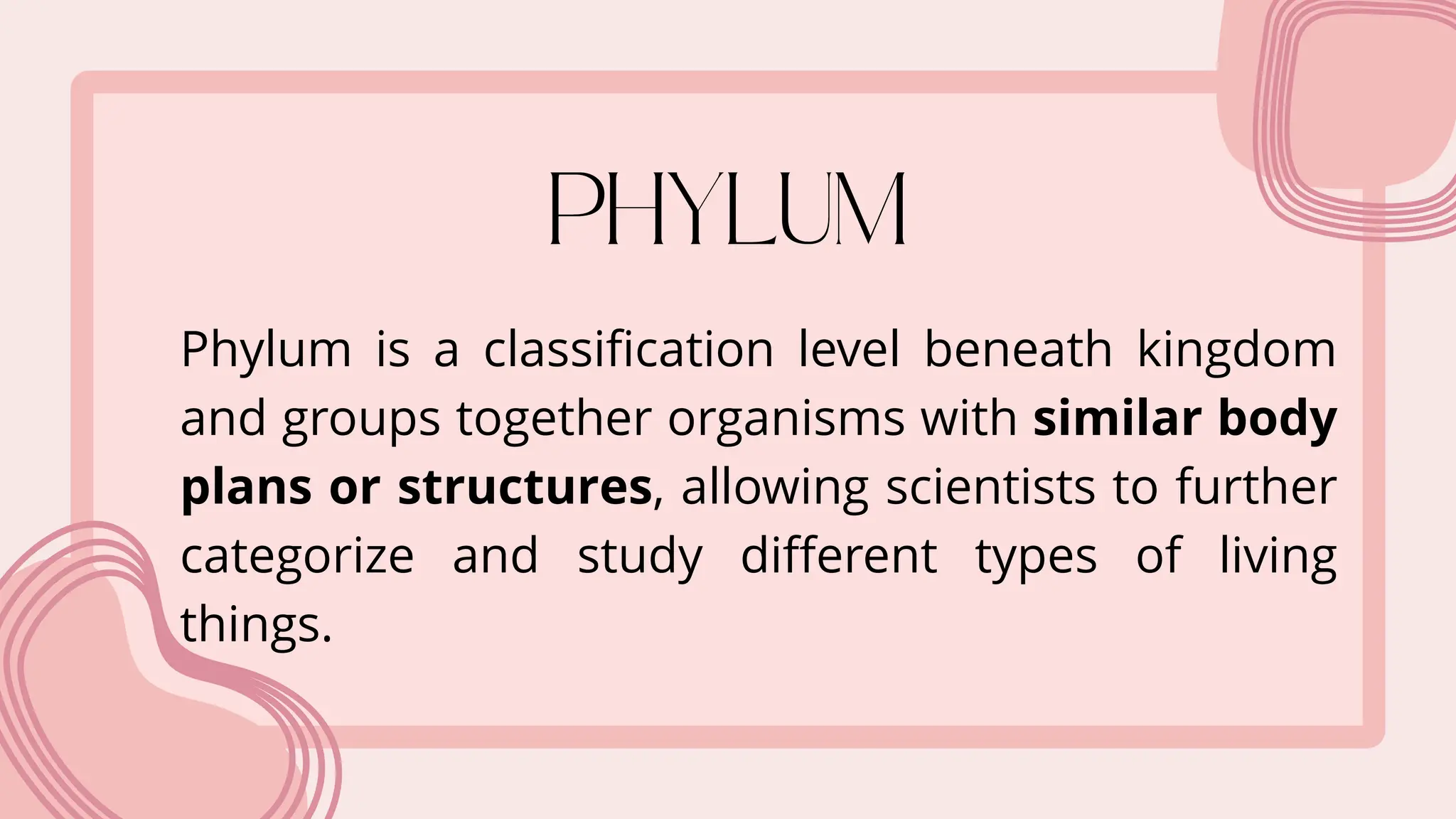
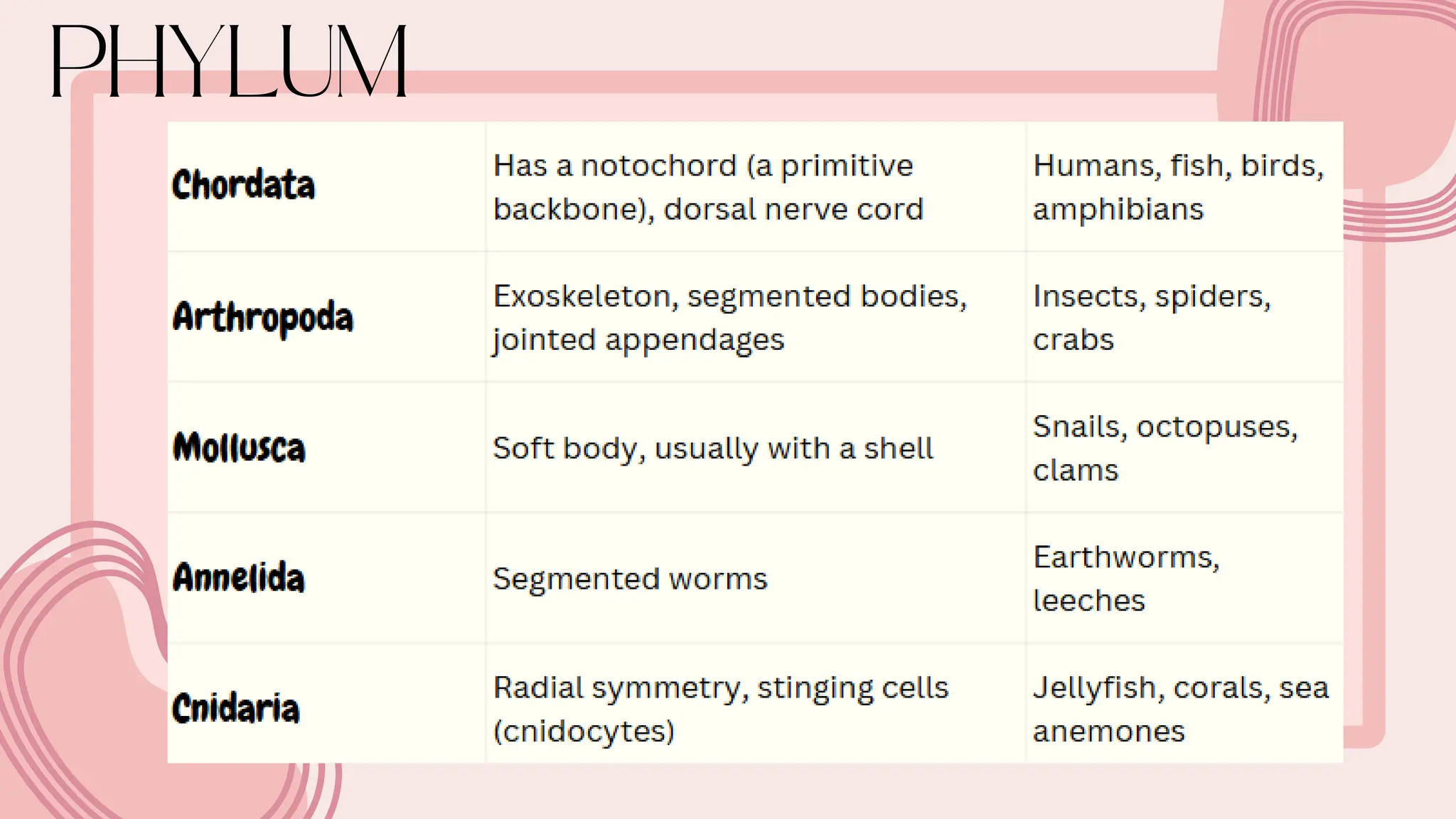
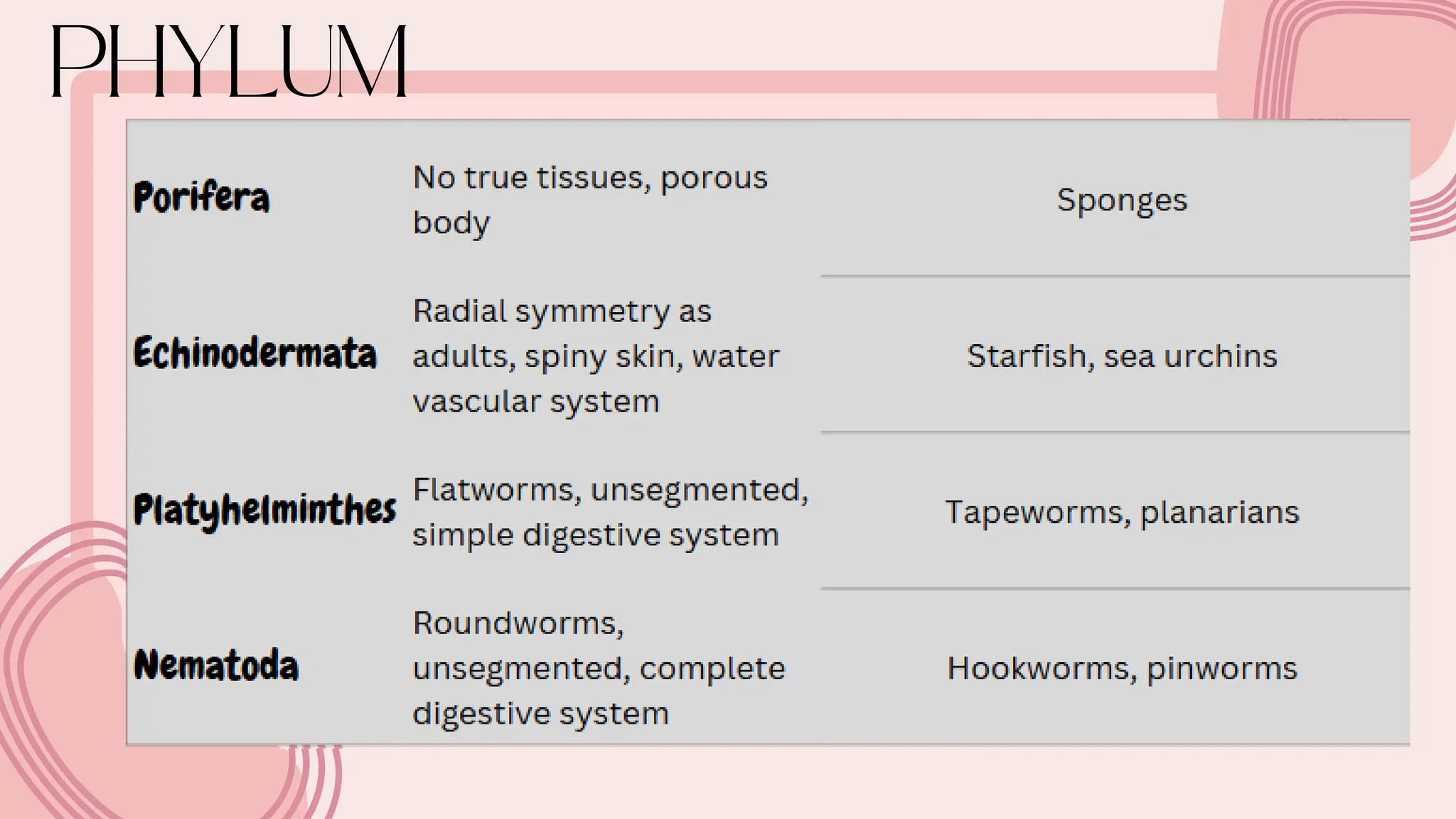
Phylum is a classification level beneath kingdom
and groups together organisms with similar body
plans or structures, allowing scientists to further
categorize and study different types of living
things.
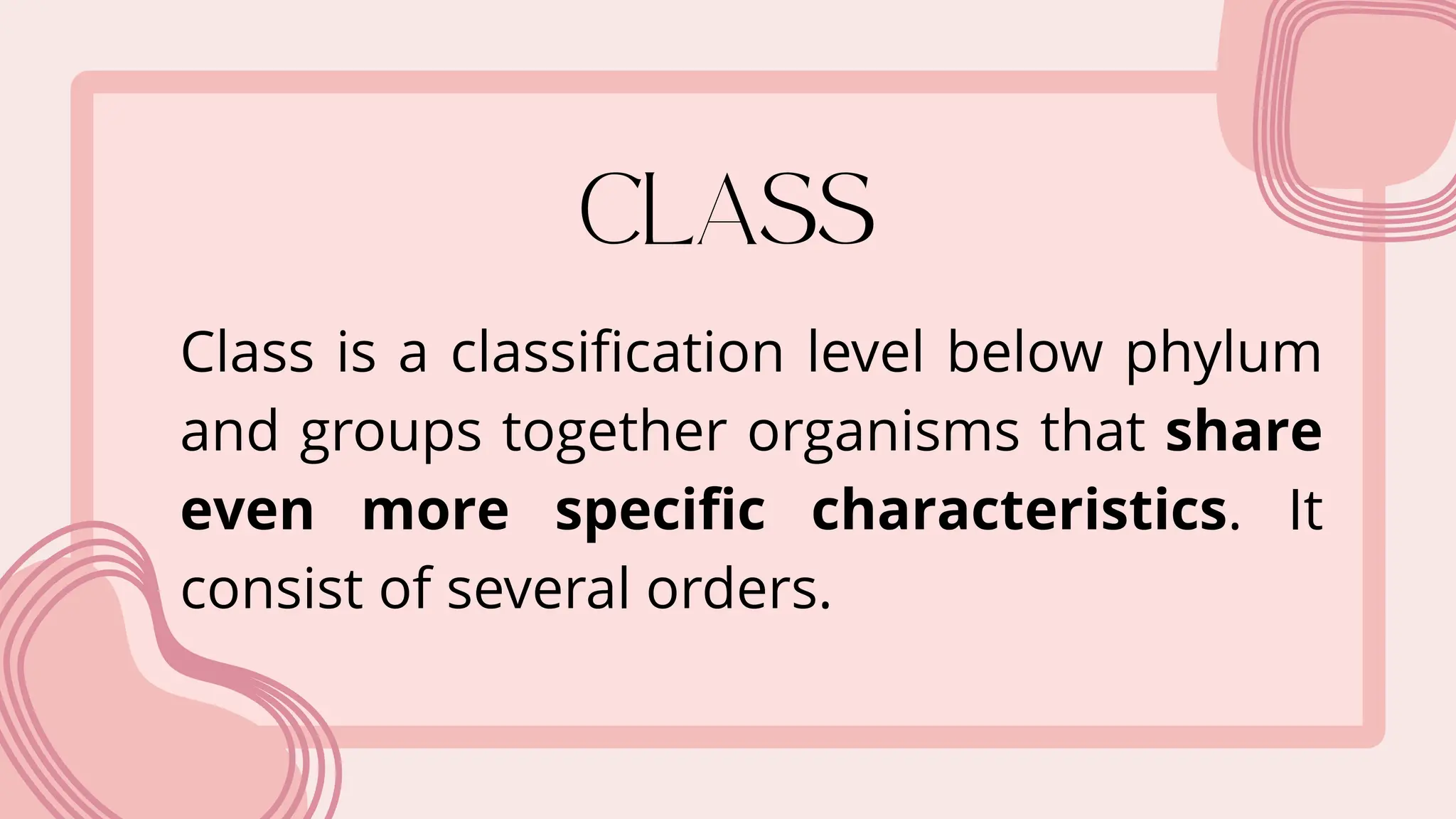
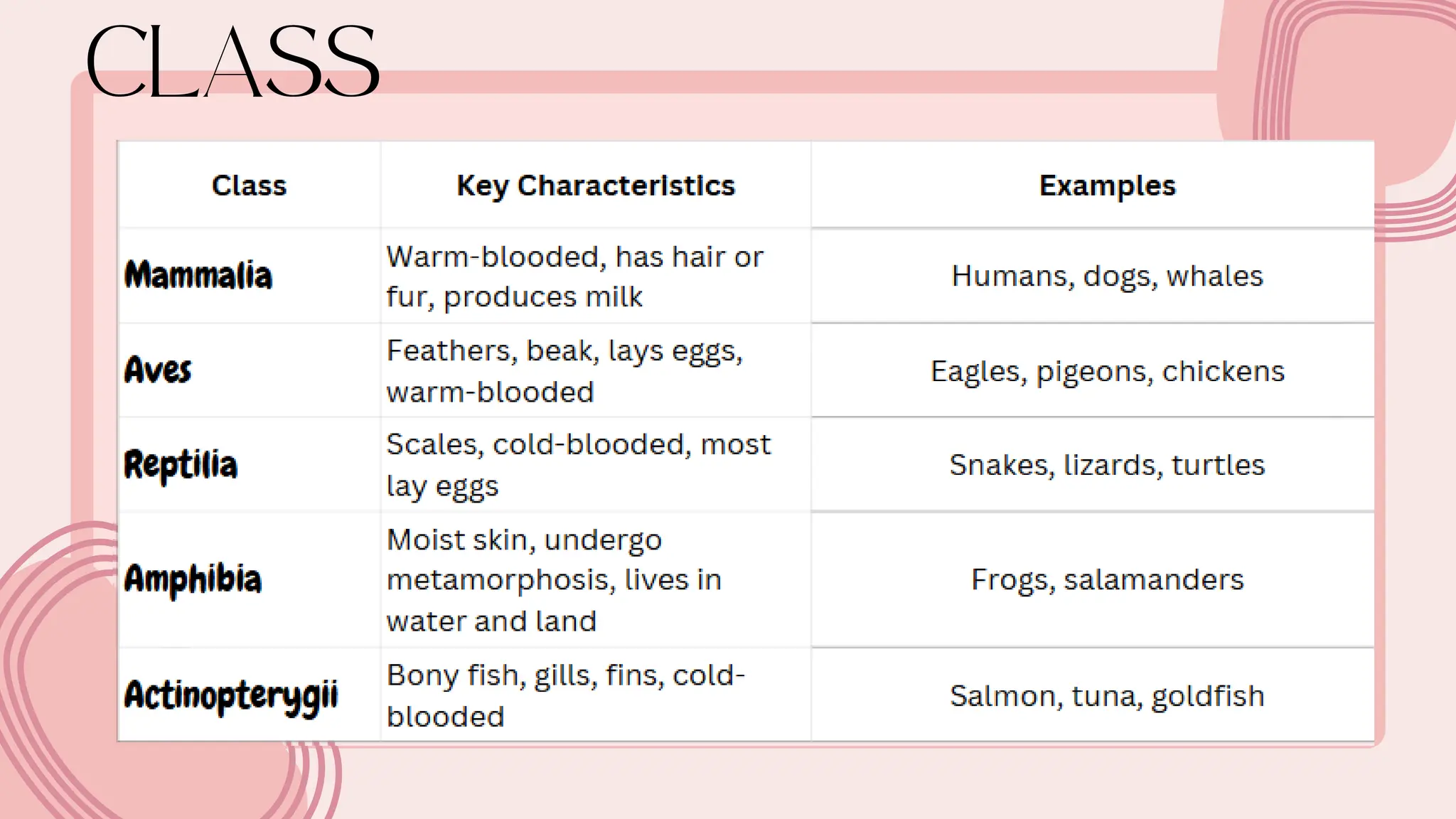
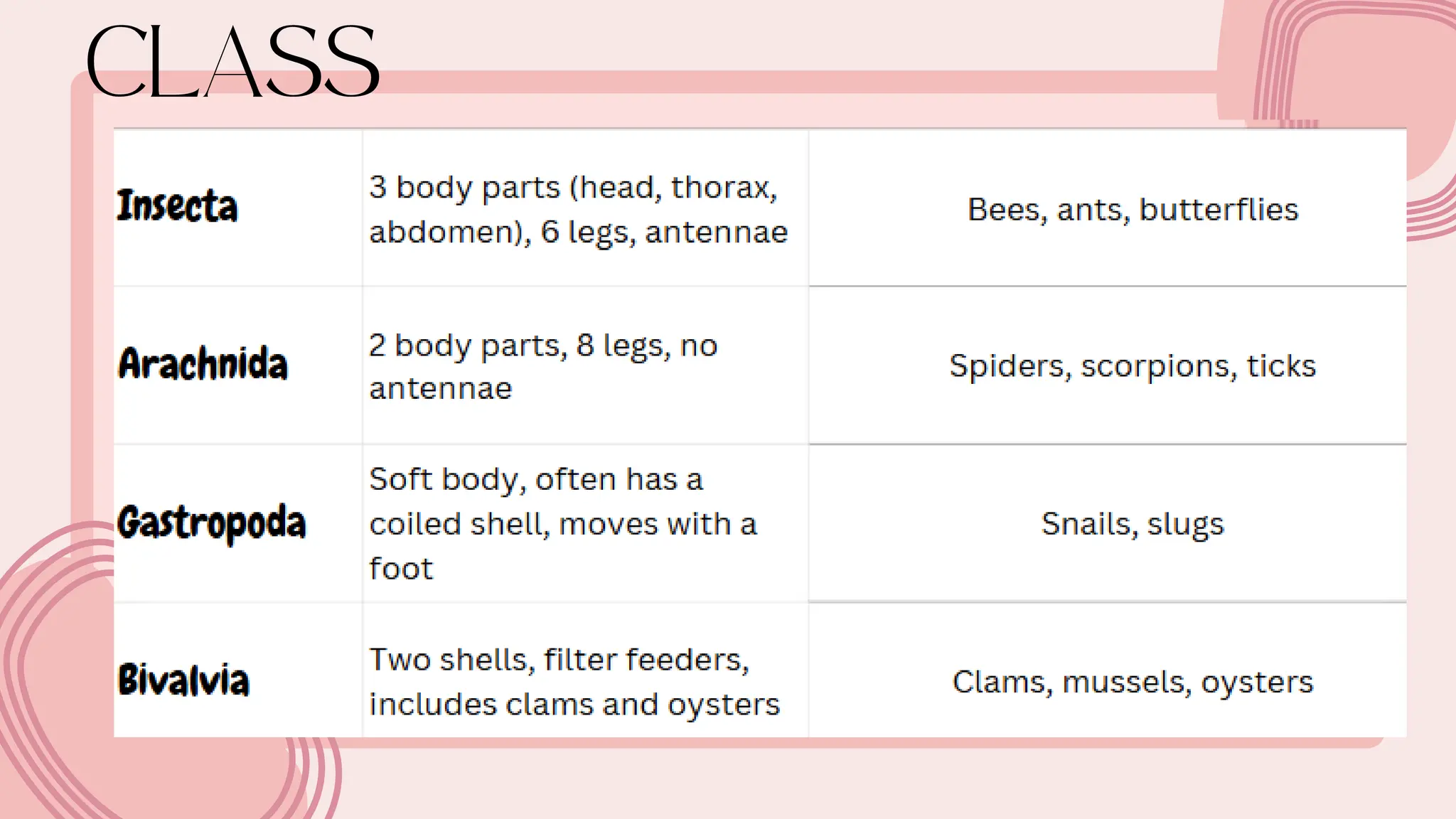
Class is a classification level below phylum
and groups together organisms that share
even more specific characteristics. It
consist of several orders.
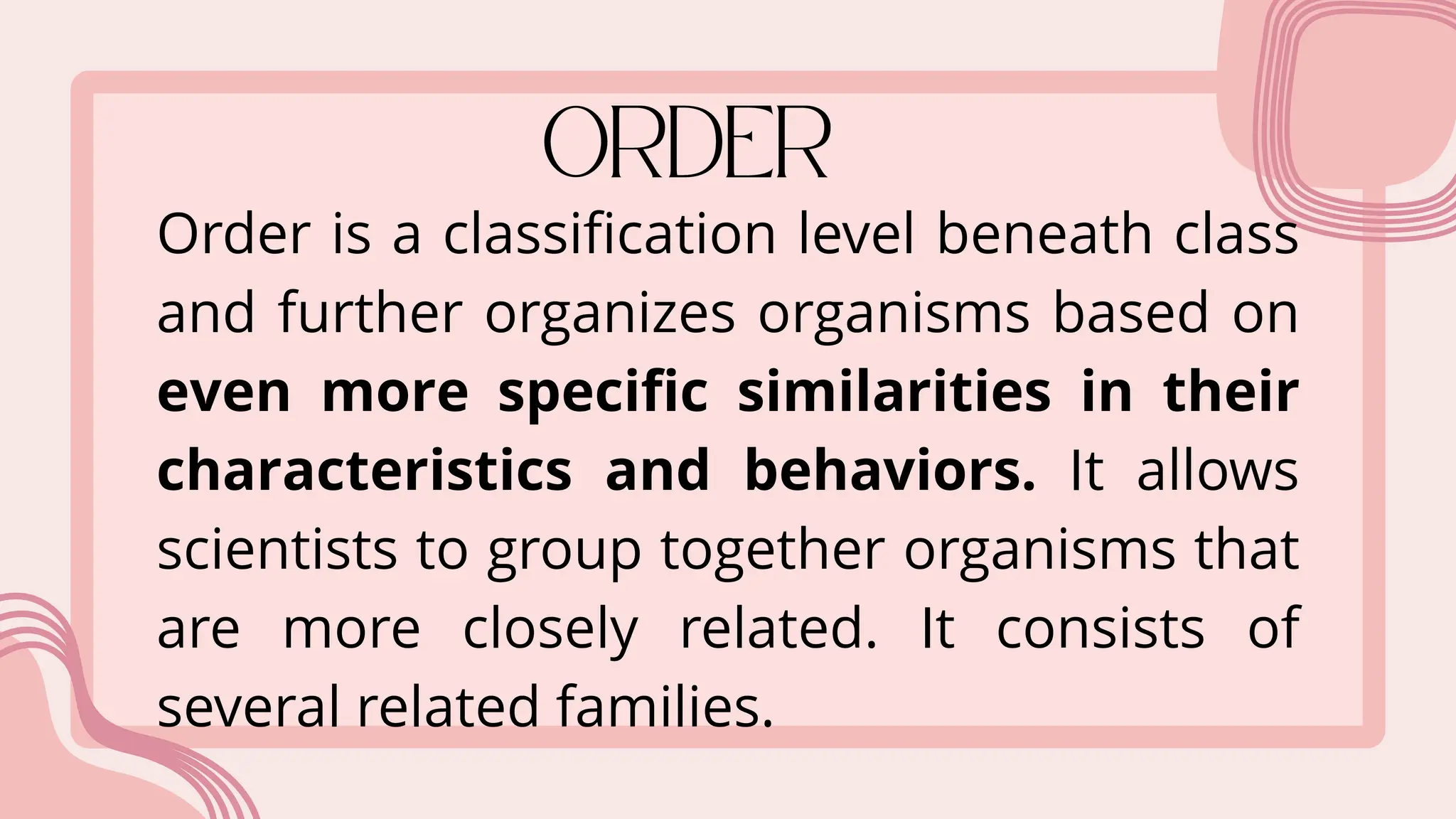
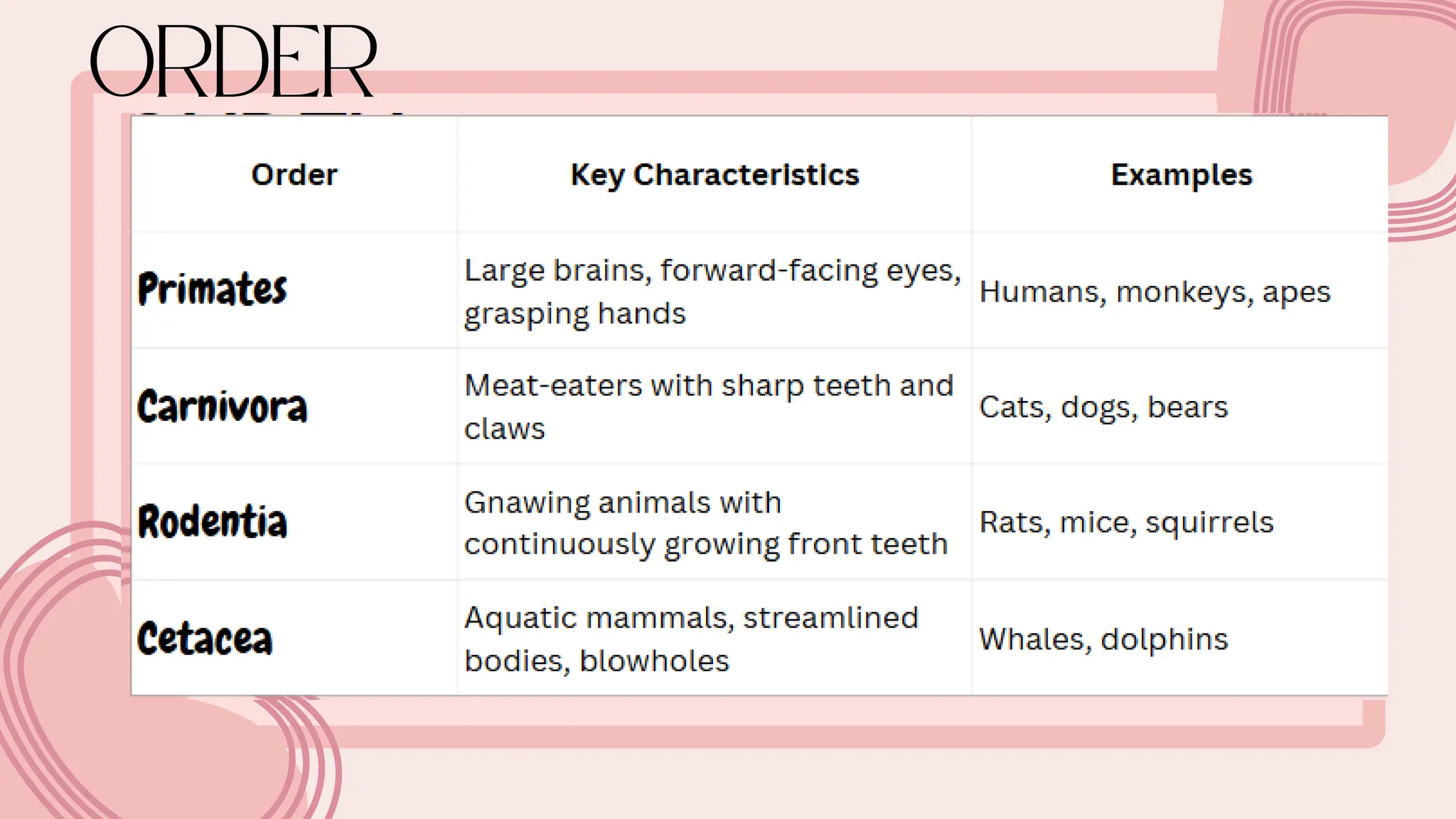
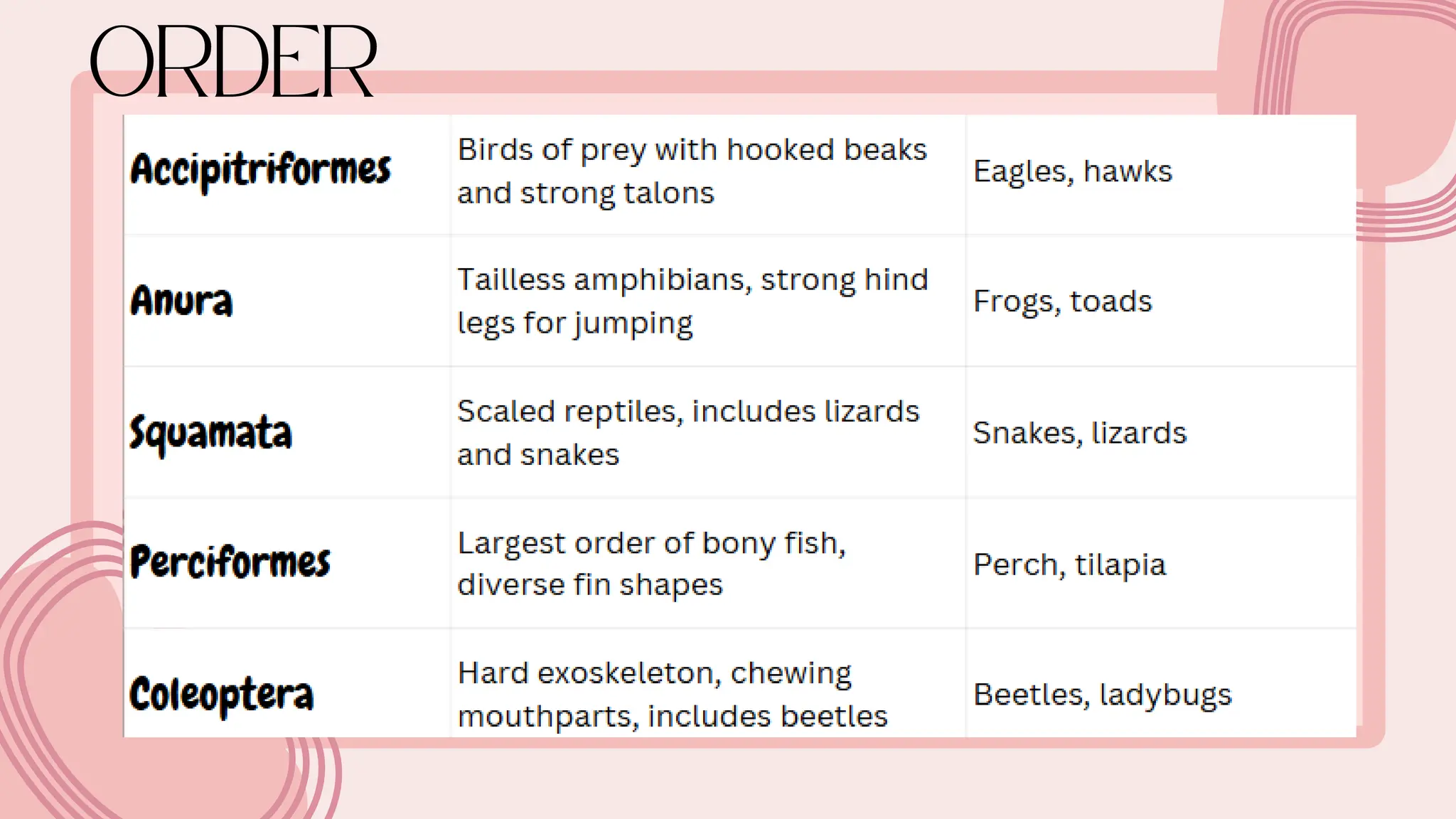
Order is a classification level beneath class
and further organizes organisms based on
even more specific similarities in their
characteristics and behaviors. It allows
scientists to group together organisms that
are more closely related. It consists of
several related families.
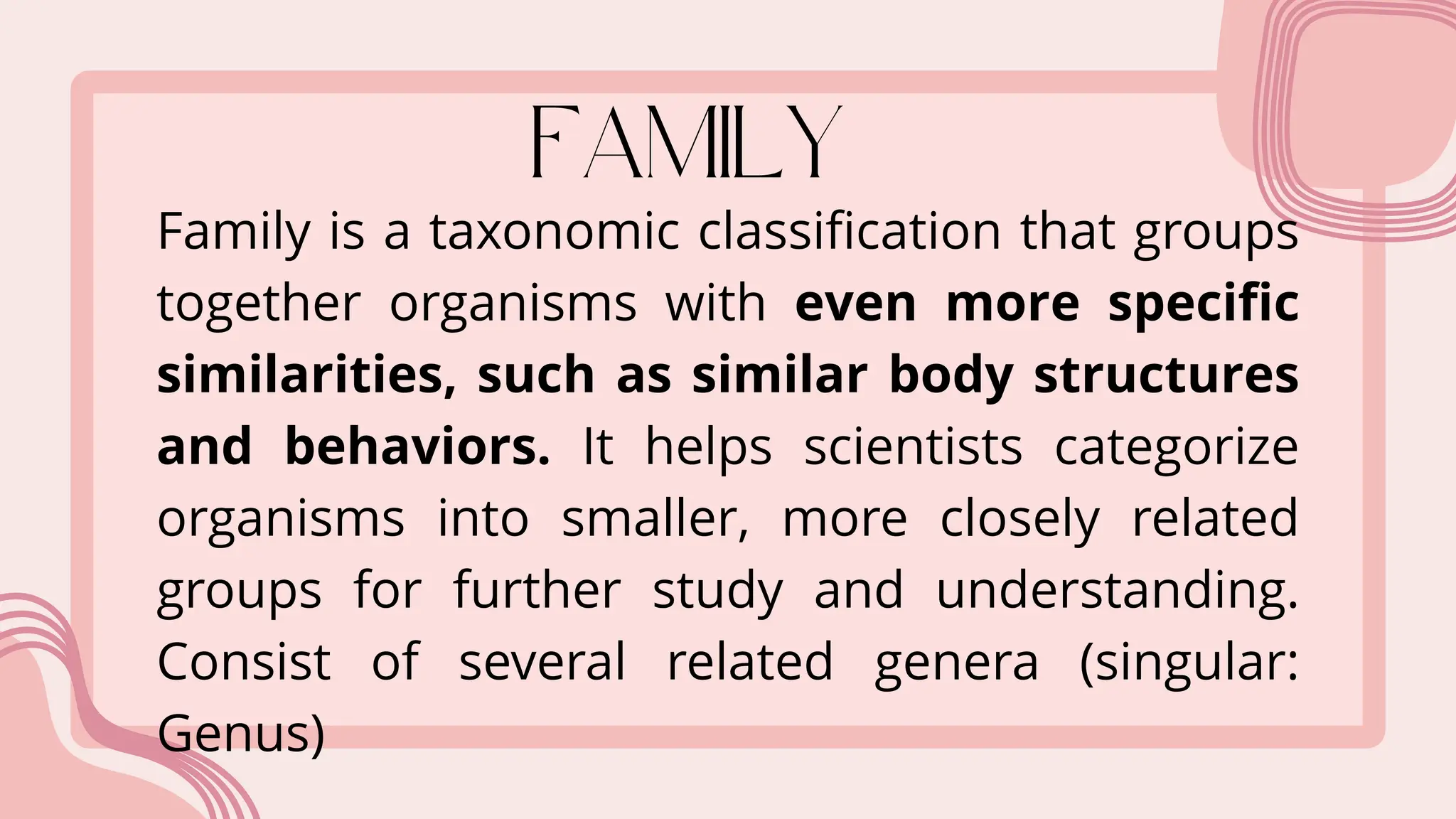
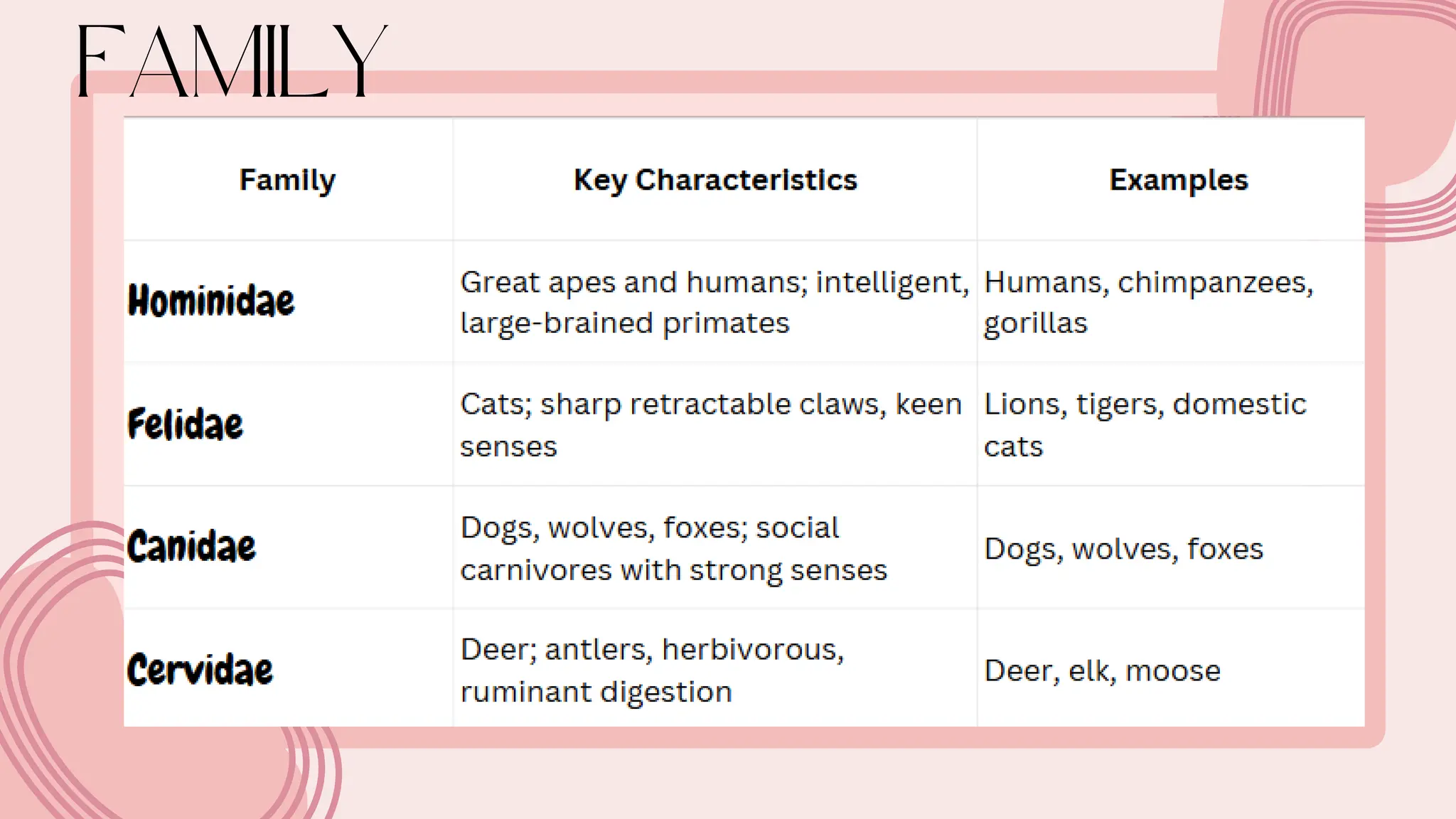
Family is a taxonomic classification that groups
together organisms with even more specific
similarities, such as similar body structures
and behaviors. It helps scientists categorize
organisms into smaller, more closely related
groups for further study and understanding.
Consist of several related genera (singular:
Genus)
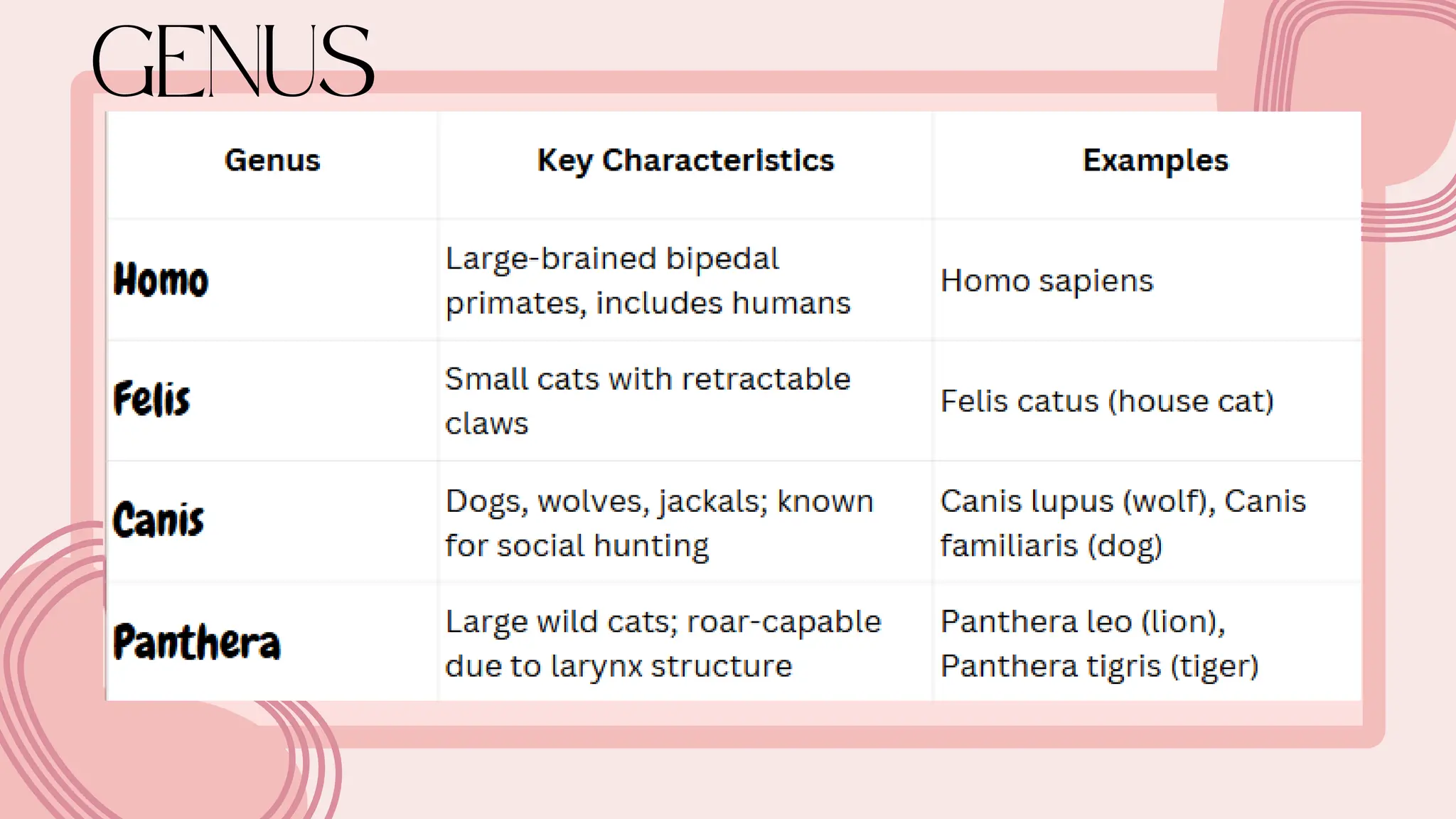
Genus consists of several related
species
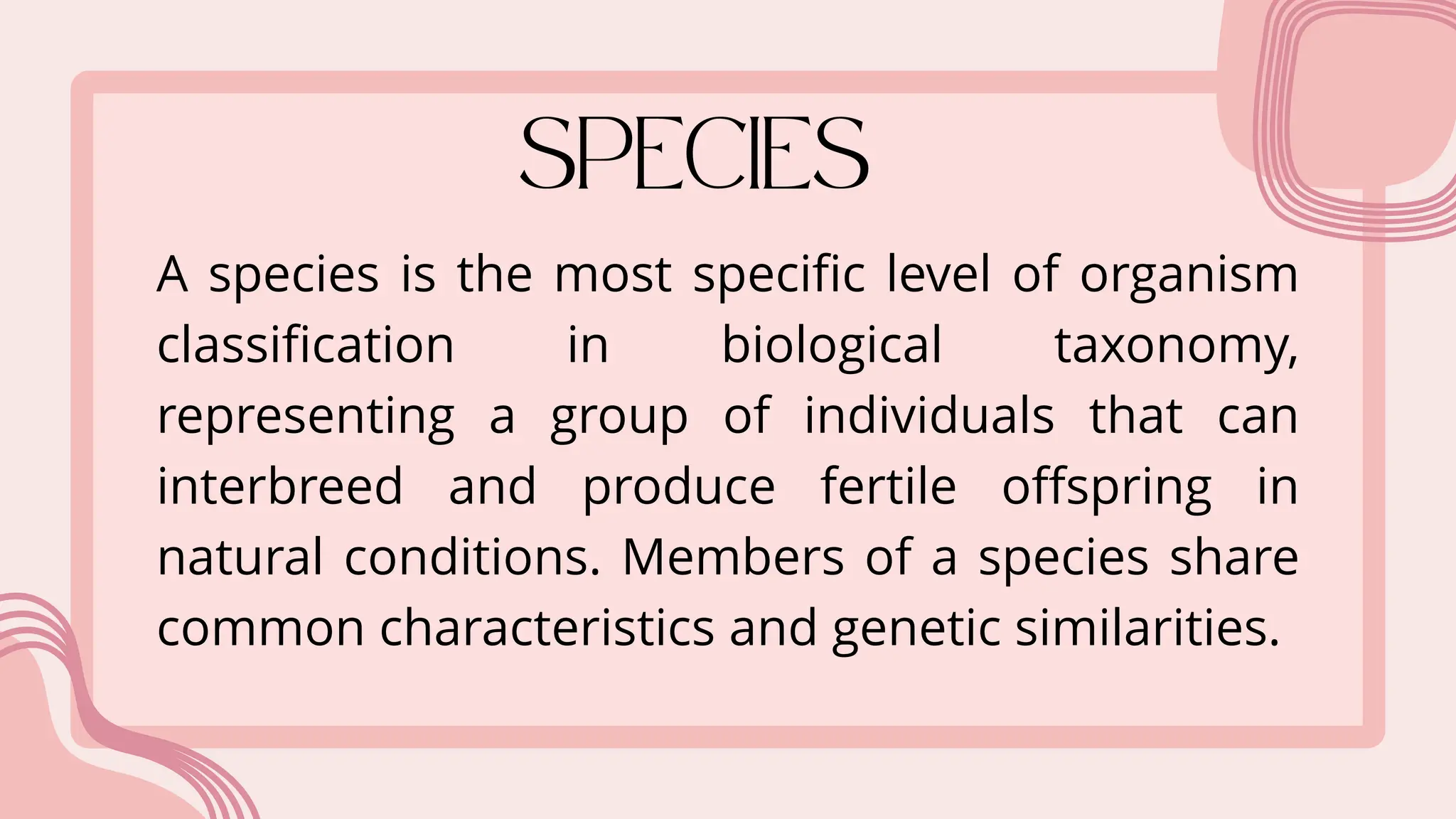
A species is the most specific level of organism
classification in biological taxonomy,
representing a group of individuals that can
interbreed and produce fertile offspring in
natural conditions. Members of a species share
common characteristics and genetic similarities.
a unique, two-part name given to each species of
organism. It consists of the genus name (the first part)
the first letter is written in capital letter and the species
name (the second part) this is written in lowercase
letter, both written in Latin and italicized. This naming
system,
known as binomial nomenclature, allows scientists
worldwide to communicate effectively about specific
organisms.
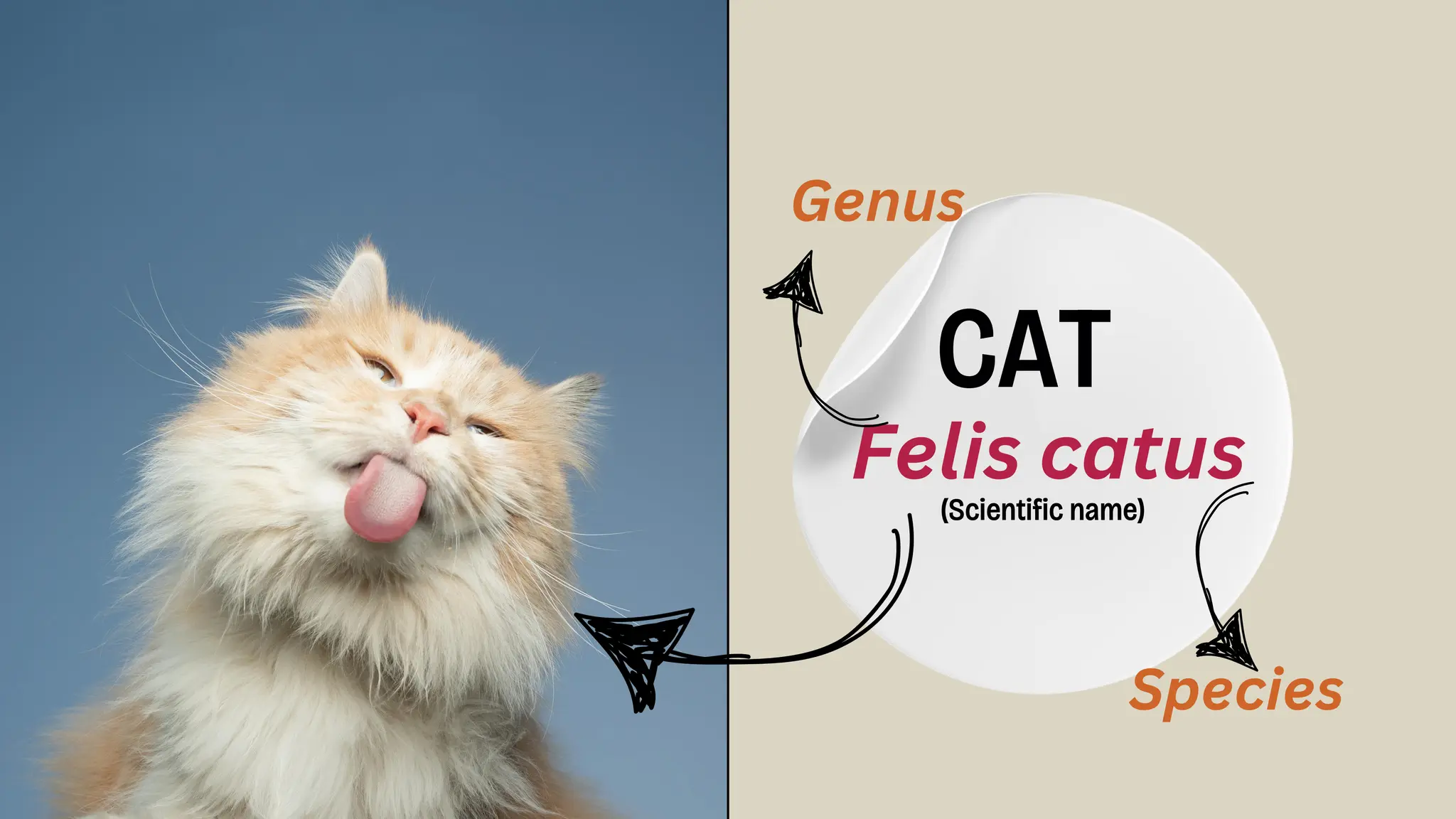
CAT
Felis catus
Species
Genus
(Scientific name)
Classification systems are used to organize and
categorize living organisms based on their
characteristics, relationships, and evolutionary history.
The most widely used classification system is the
Linnaean system, which categorizes organisms into a
hierarchical structure of seven levels: kingdom, phylum,
class, order, family, genus, and species.
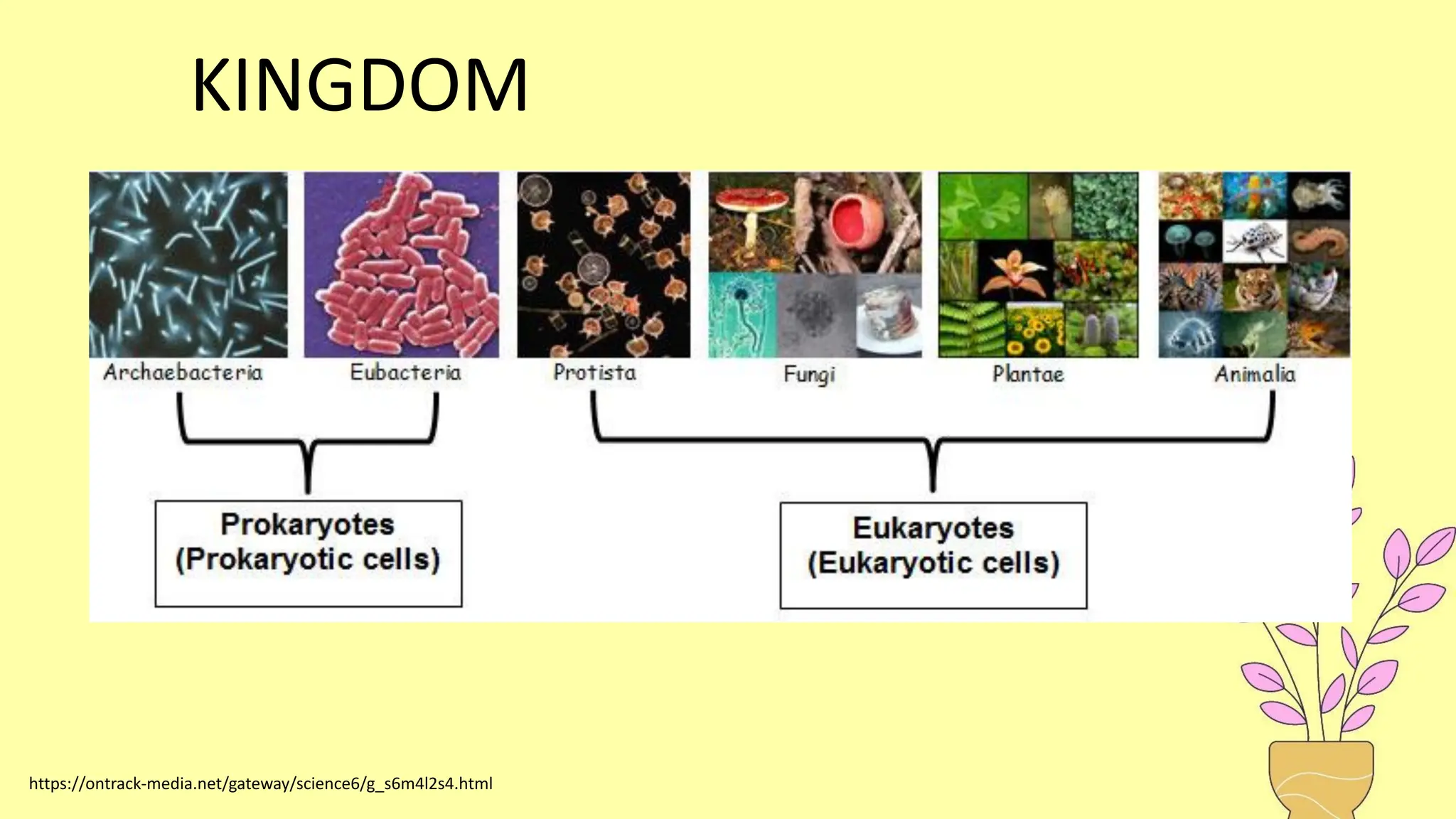
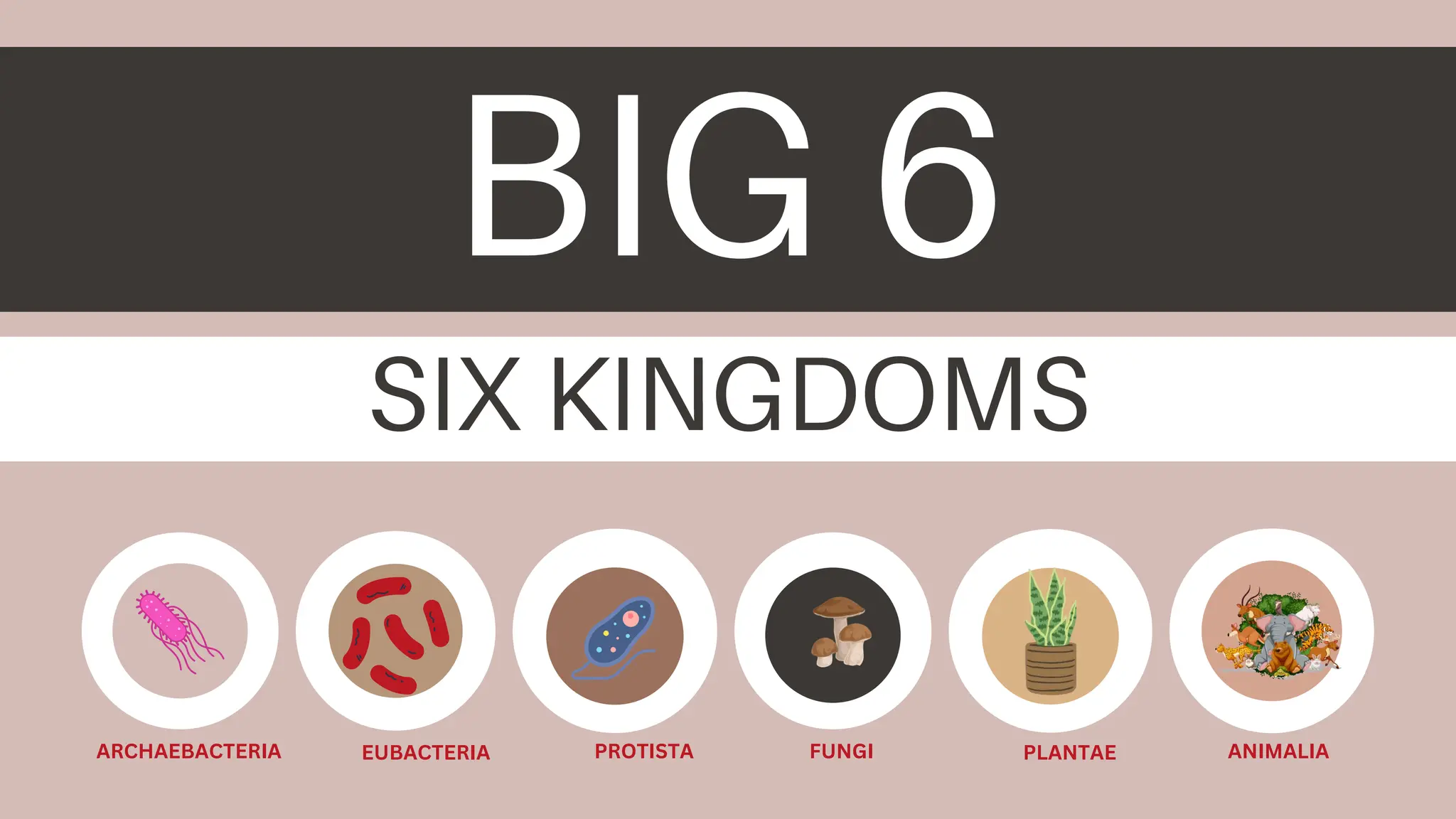
ARCHAEBACTERIA EUBACTERIA PROTISTA FUNGI PLANTAE ANIMALIA
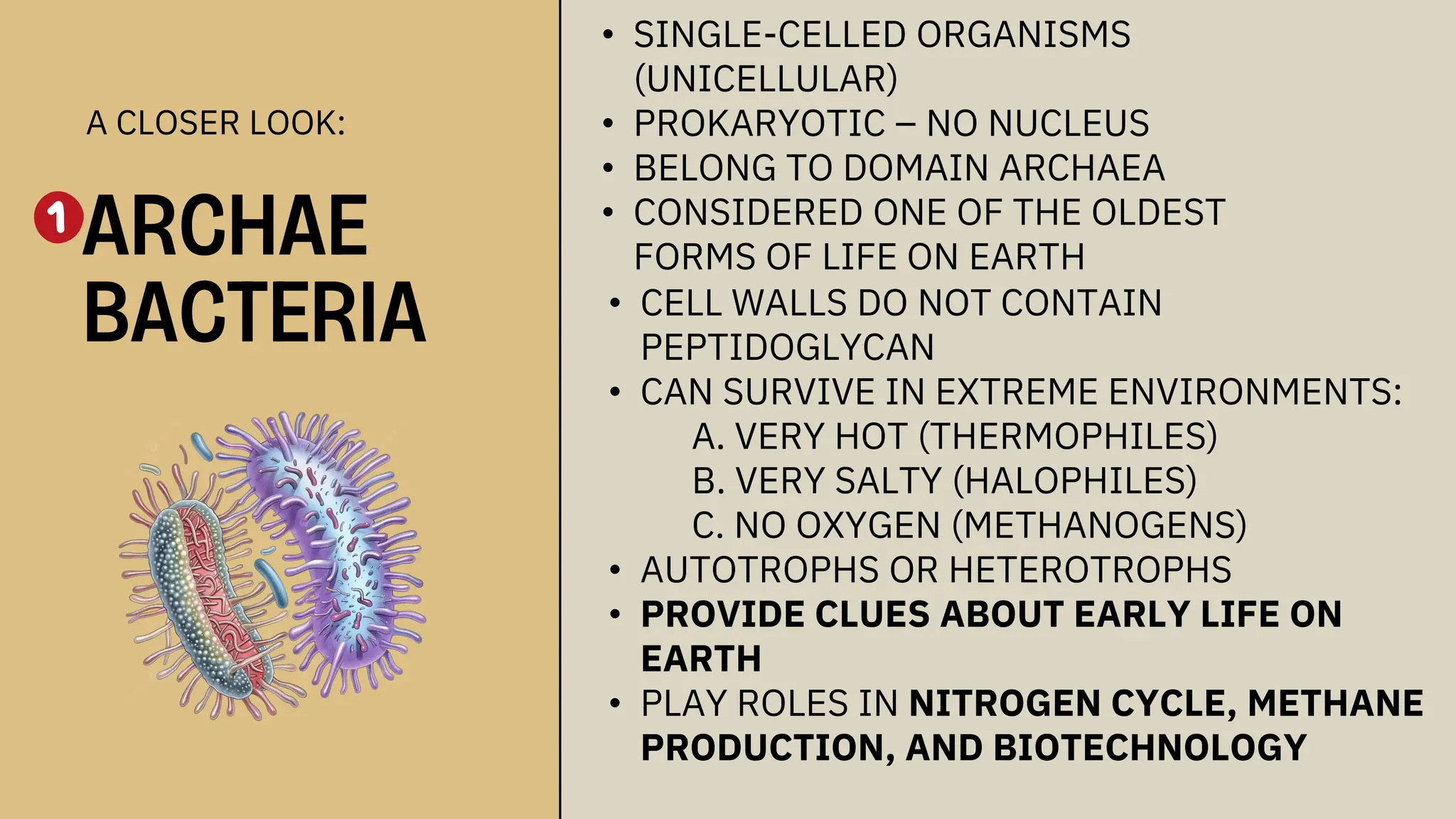
A CLOSER LOOK:
ARCHAE
BACTERIA
• SINGLE-CELLED ORGANISMS
(UNICELLULAR)
• PROKARYOTIC – NO NUCLEUS
• BELONG TO DOMAIN ARCHAEA
• CONSIDERED ONE OF THE OLDEST
FORMS OF LIFE ON EARTH
• CELL WALLS DO NOT CONTAIN
PEPTIDOGLYCAN
• CAN SURVIVE IN EXTREME ENVIRONMENTS:
A. VERY HOT (THERMOPHILES)
B. VERY SALTY (HALOPHILES)
C. NO OXYGEN (METHANOGENS)
• AUTOTROPHS OR HETEROTROPHS
• PROVIDE CLUES ABOUT EARLY LIFE ON
EARTH
• PLAY ROLES IN NITROGEN CYCLE, METHANE
PRODUCTION, AND BIOTECHNOLOGY
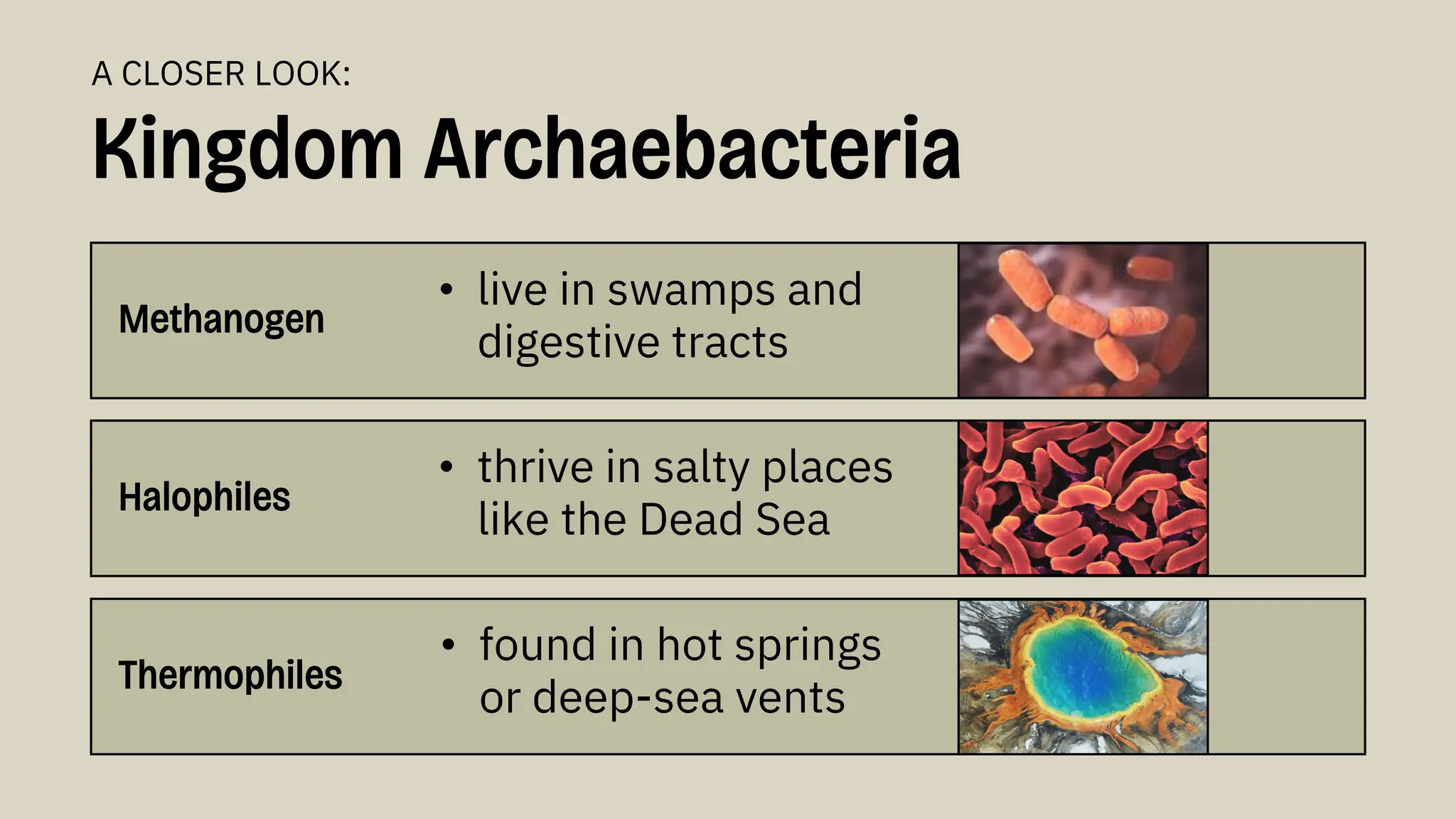
Kingdom Archaebacteria
Methanogen
• live in swamps and
digestive tracts
A CLOSER LOOK:
Halophiles
Thermophiles
• thrive in salty places
like the Dead Sea
• found in hot springs
or deep-sea vents
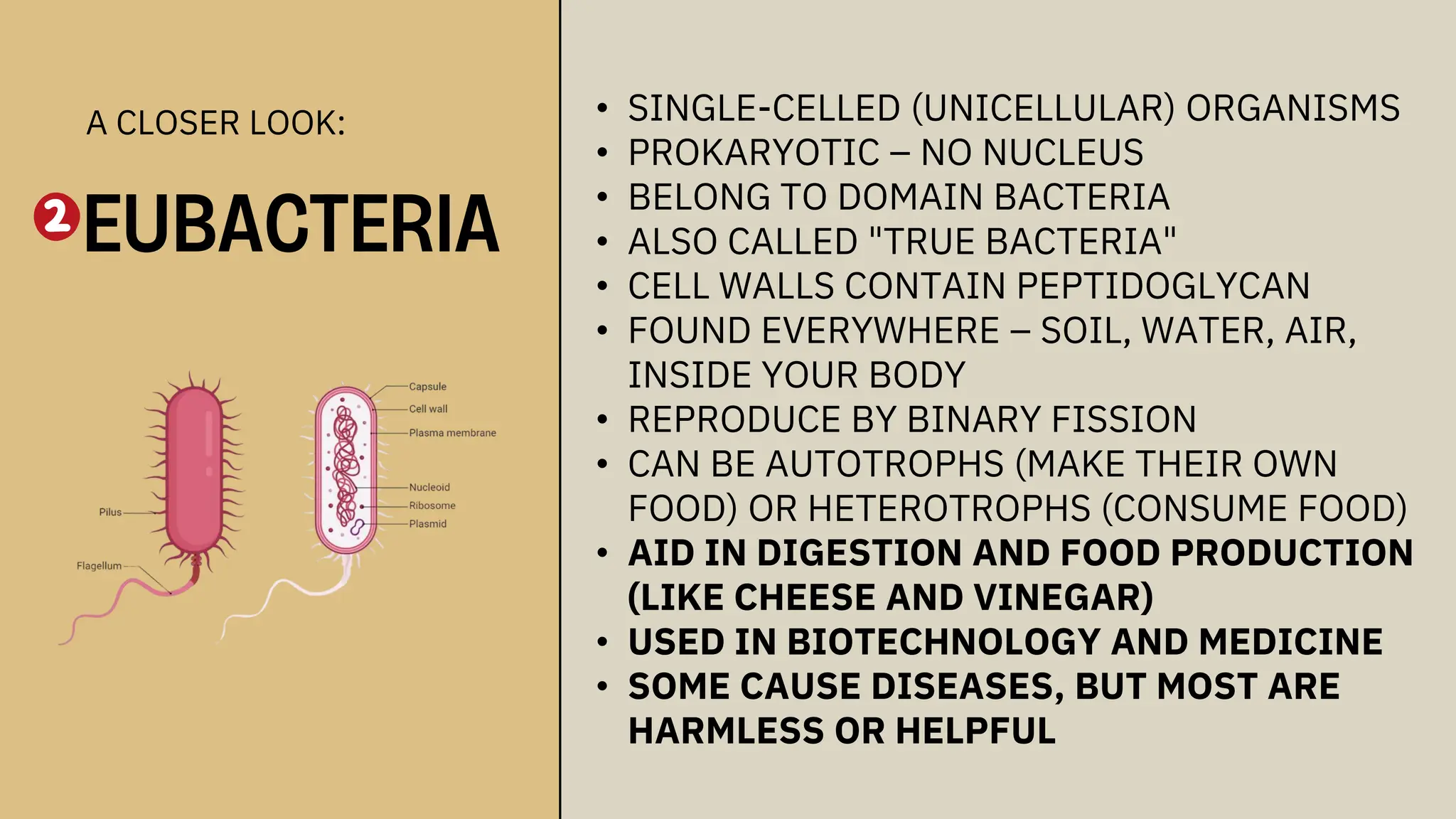
• SINGLE-CELLED (UNICELLULAR) ORGANISMS
• PROKARYOTIC – NO NUCLEUS
• BELONG TO DOMAIN BACTERIA
• ALSO CALLED "TRUE BACTERIA"
• CELL WALLS CONTAIN PEPTIDOGLYCAN
• FOUND EVERYWHERE – SOIL, WATER, AIR,
INSIDE YOUR BODY
• REPRODUCE BY BINARY FISSION
• CAN BE AUTOTROPHS (MAKE THEIR OWN
FOOD) OR HETEROTROPHS (CONSUME FOOD)
• AID IN DIGESTION AND FOOD PRODUCTION
(LIKE CHEESE AND VINEGAR)
• USED IN BIOTECHNOLOGY AND MEDICINE
• SOME CAUSE DISEASES, BUT MOST ARE
HARMLESS OR HELPFUL
A CLOSER LOOK:
EUBACTERIA
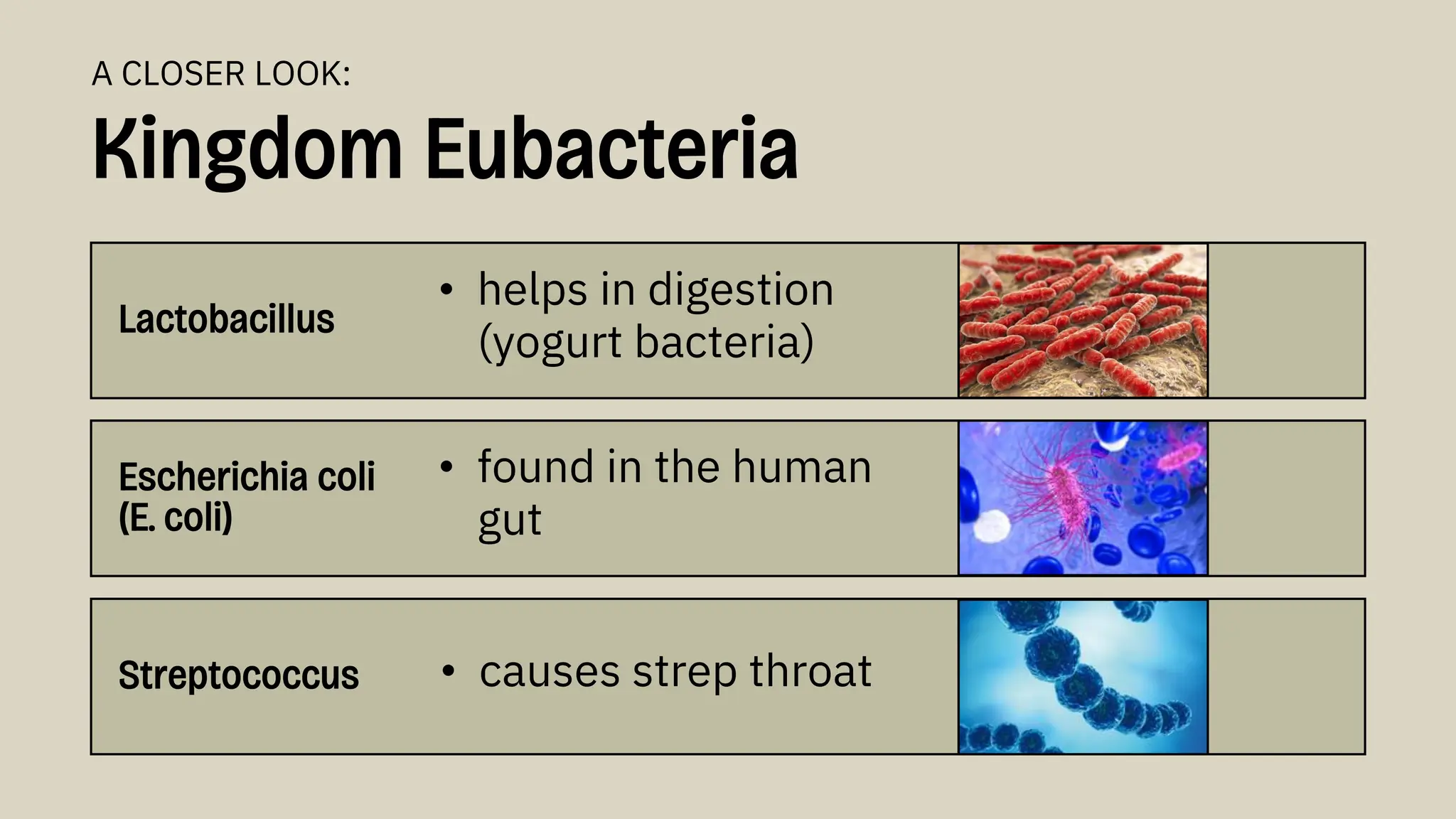
Kingdom Eubacteria
Lactobacillus
• helps in digestion
(yogurt bacteria)
A CLOSER LOOK:
Escherichia coli
(E. coli)
Streptococcus
• found in the human
gut
• causes strep throat
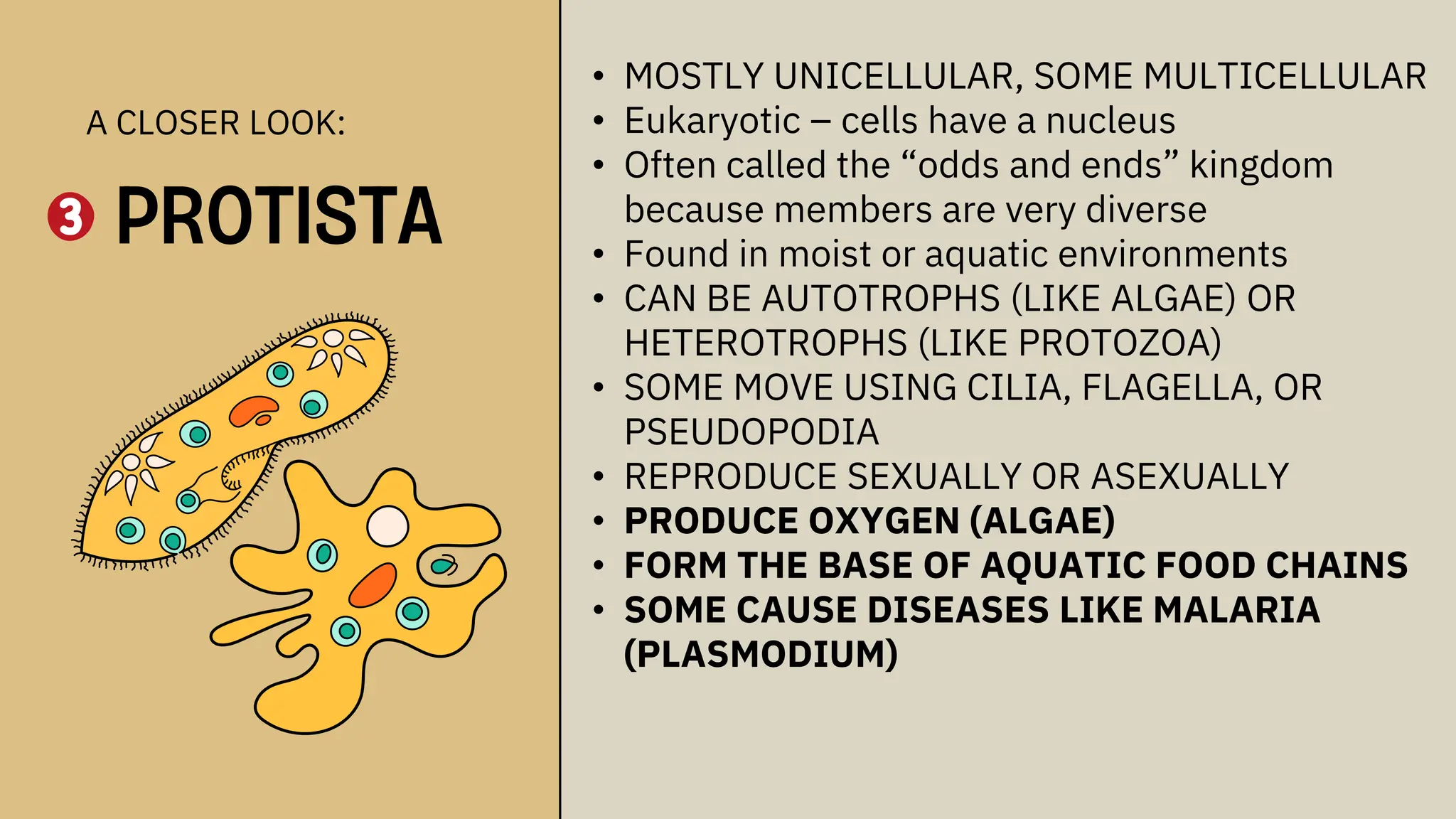
• MOSTLY UNICELLULAR, SOME MULTICELLULAR
• Eukaryotic – cells have a nucleus
• Often called the “odds and ends” kingdom
because members are very diverse
• Found in moist or aquatic environments
• CAN BE AUTOTROPHS (LIKE ALGAE) OR
HETEROTROPHS (LIKE PROTOZOA)
• SOME MOVE USING CILIA, FLAGELLA, OR
PSEUDOPODIA
• REPRODUCE SEXUALLY OR ASEXUALLY
• PRODUCE OXYGEN (ALGAE)
• FORM THE BASE OF AQUATIC FOOD CHAINS
• SOME CAUSE DISEASES LIKE MALARIA
(PLASMODIUM)
A CLOSER LOOK:
PROTISTA
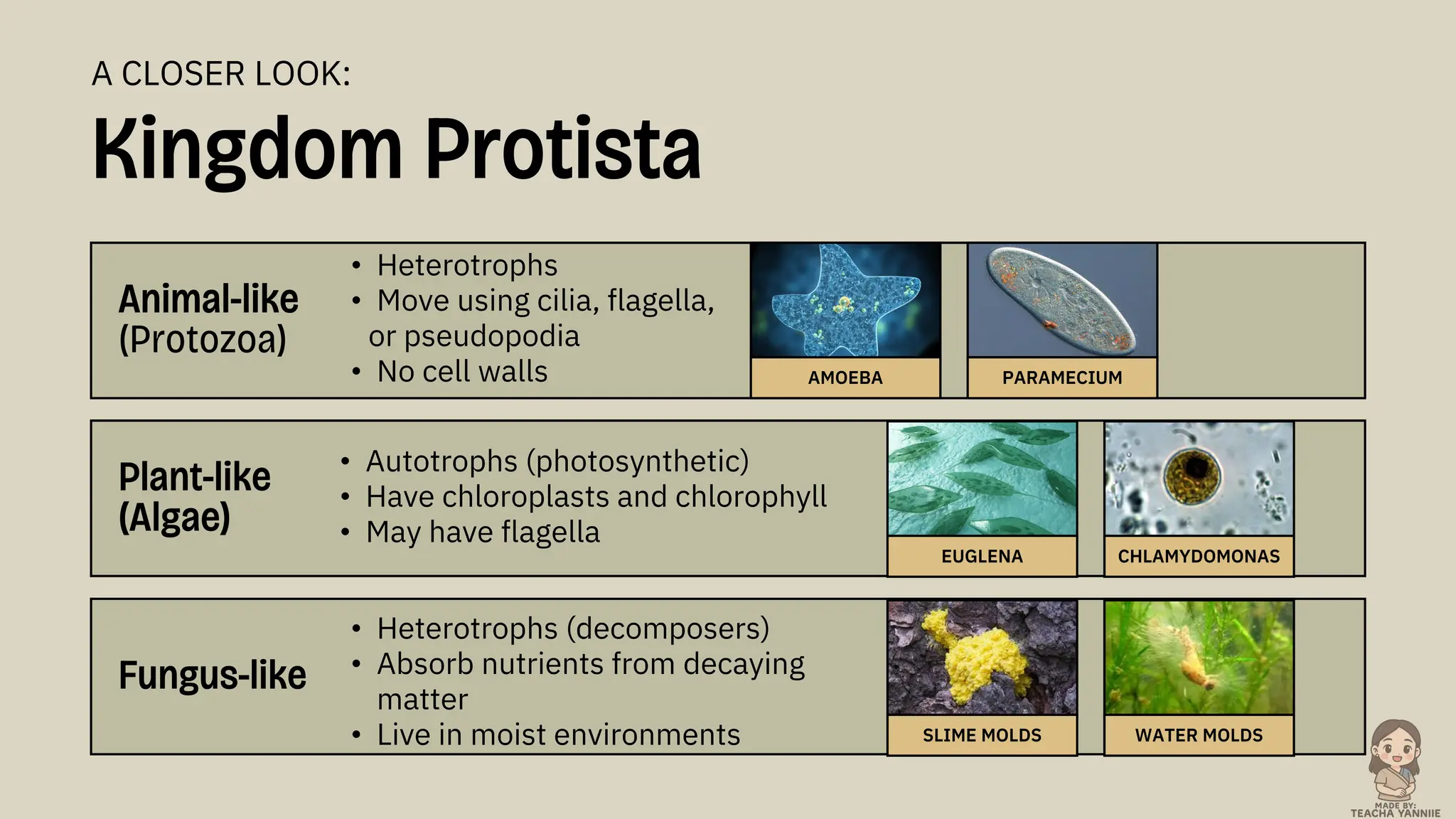
Animal-like
(Protozoa)
• Heterotrophs
• Move using cilia, flagella,
or pseudopodia
• No cell walls AMOEBA PARAMECIUM
EUGLENA CHLAMYDOMONAS
SLIME MOLDS WATER MOLDS
Kingdom Protista
A CLOSER LOOK:
Plant-like
(Algae)
Fungus-like
• Autotrophs (photosynthetic)
• Have chloroplasts and chlorophyll
• May have flagella
• Heterotrophs (decomposers)
• Absorb nutrients from decaying
matter
• Live in moist environments
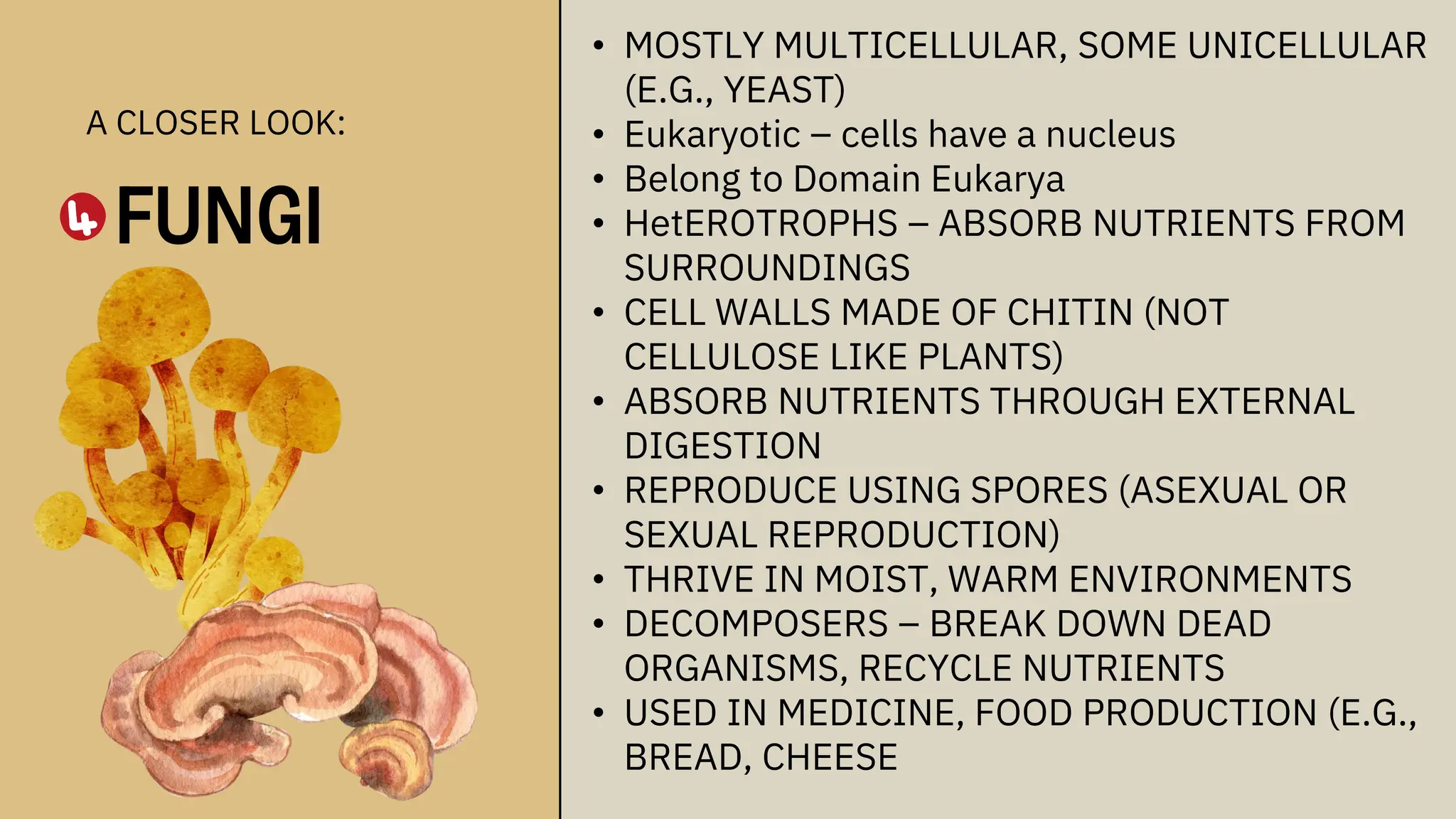
• MOSTLY MULTICELLULAR, SOME UNICELLULAR
(E.G., YEAST)
• Eukaryotic – cells have a nucleus
• Belong to Domain Eukarya
• HetEROTROPHS – ABSORB NUTRIENTS FROM
SURROUNDINGS
• CELL WALLS MADE OF CHITIN (NOT
CELLULOSE LIKE PLANTS)
• ABSORB NUTRIENTS THROUGH EXTERNAL
DIGESTION
• REPRODUCE USING SPORES (ASEXUAL OR
SEXUAL REPRODUCTION)
• THRIVE IN MOIST, WARM ENVIRONMENTS
• DECOMPOSERS – BREAK DOWN DEAD
ORGANISMS, RECYCLE NUTRIENTS
• USED IN MEDICINE, FOOD PRODUCTION (E.G.,
BREAD, CHEESE
A CLOSER LOOK:
FUNGI
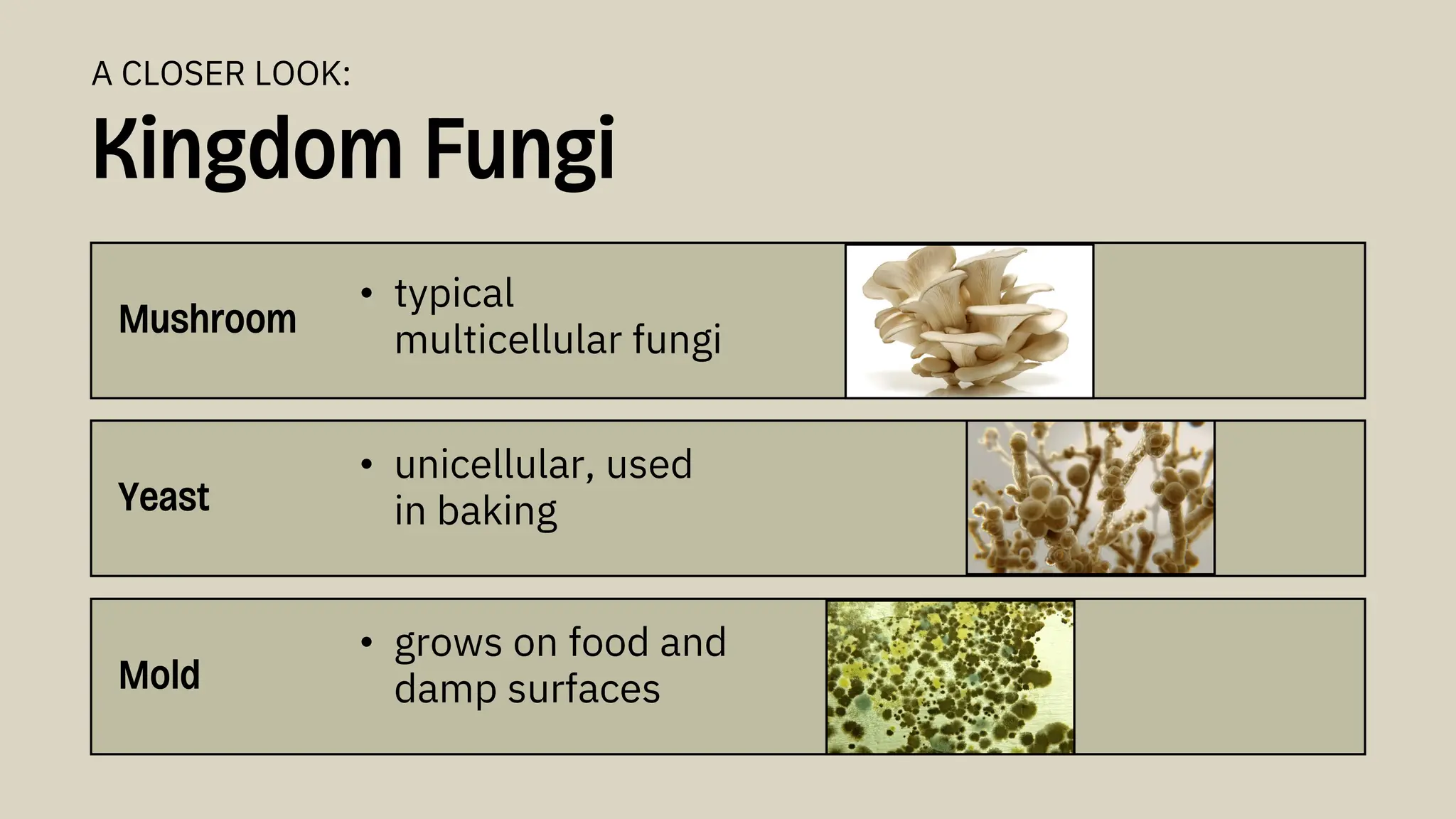
Mushroom
• typical
multicellular fungi
Kingdom Fungi
A CLOSER LOOK:
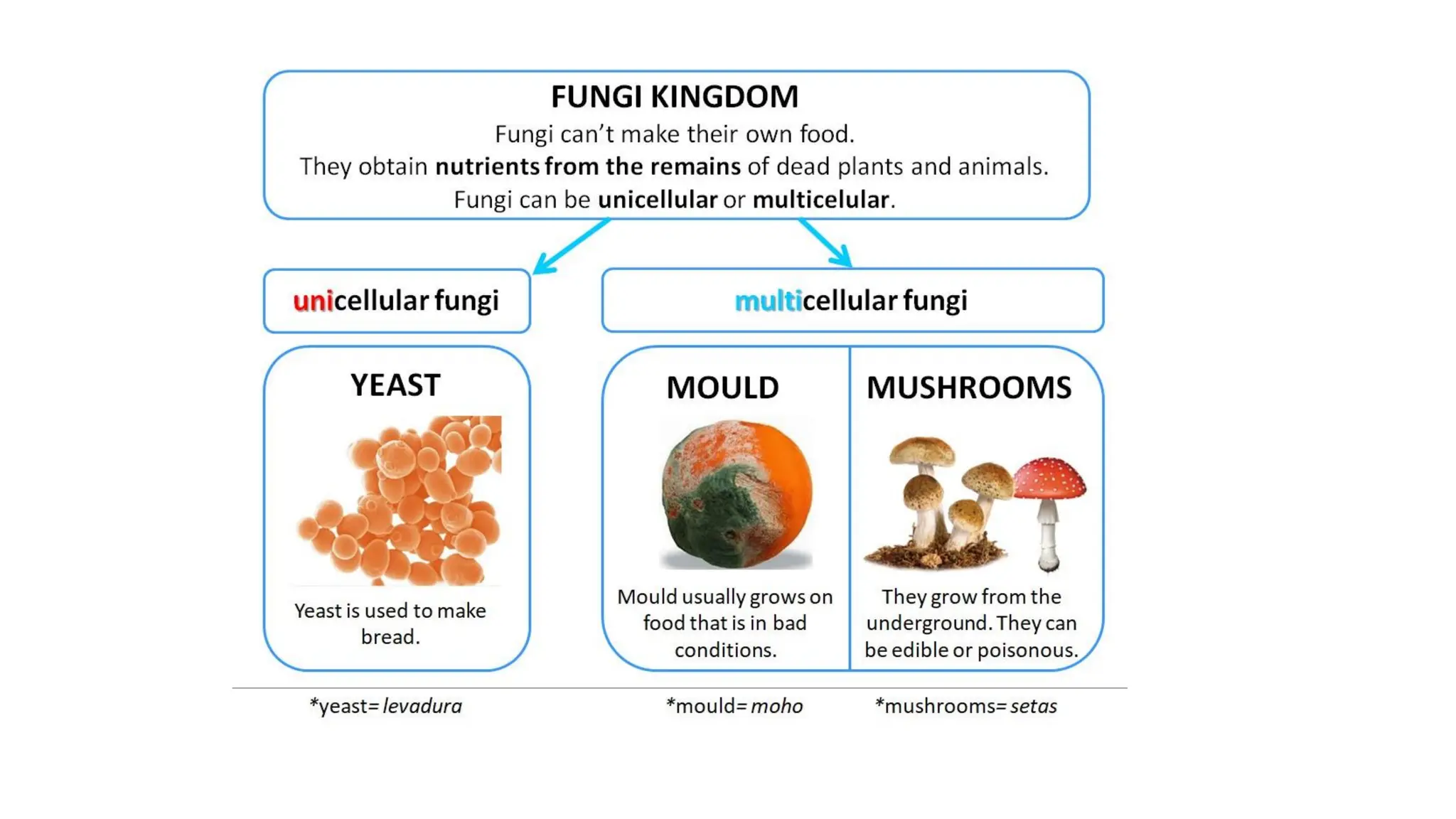
Yeast
Mold
• unicellular, used
in baking
• grows on food and
damp surfaces
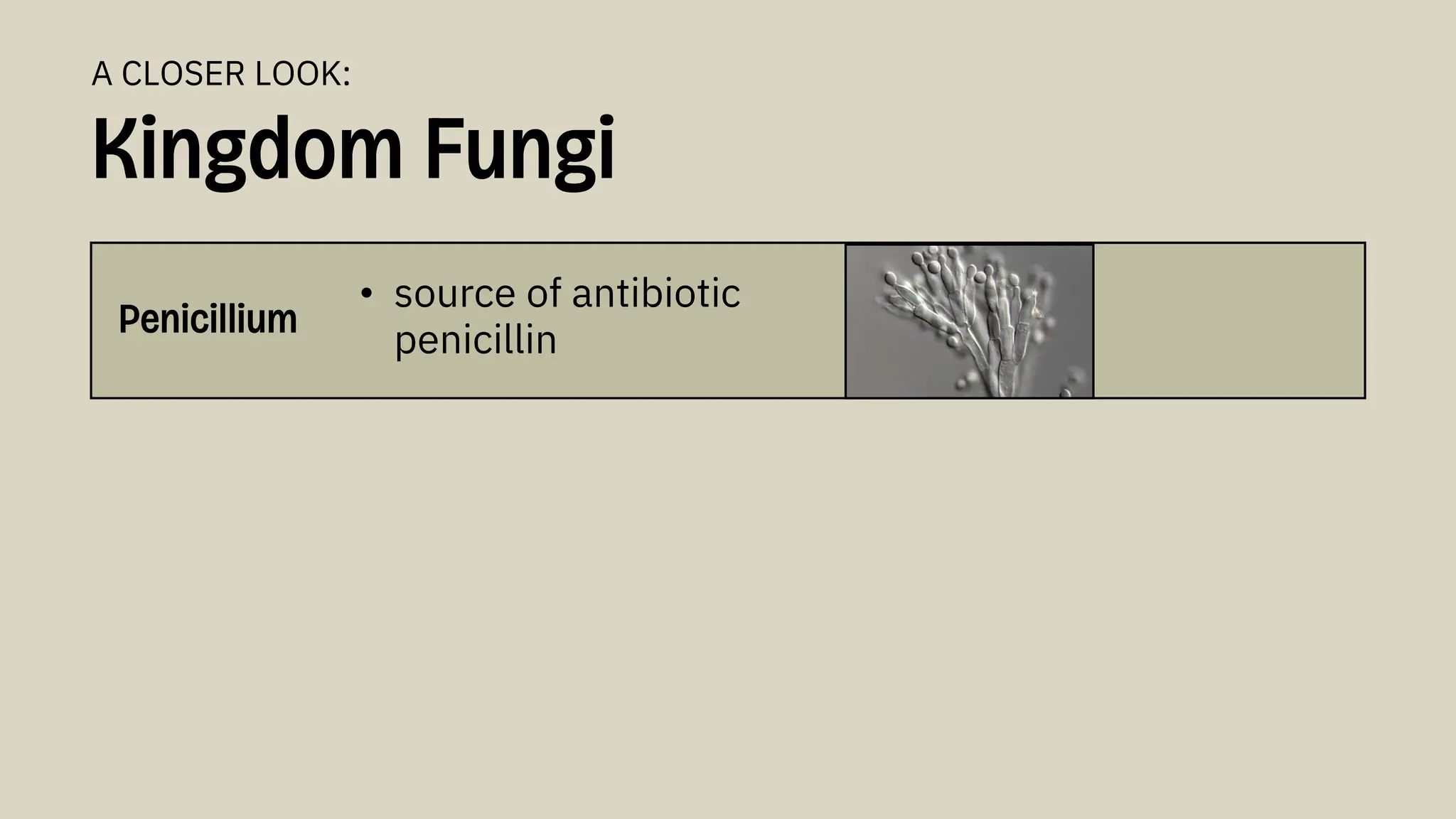
Penicillium
• source of antibiotic
penicillin
Kingdom Fungi
A CLOSER LOOK:
• MULTICELLULAR ORGANISMS
• Eukaryotic – cells have a nucleus
• Belong to Domain Eukarya
• Autotrophs – make their own food through
photosynthesis
• HAVE CELL WALLS MADE OF CELLULOSE
• CONTAIN CHLOROPLASTS WITH
CHLOROPHYLL
• MOST ARE NON-MOTILE (DON'T MOVE)
• REPRODUCE SEXUALLY OR ASEXUALLY (E.G.,
SPORES, SEEDS)
• PRODUCE OXYGEN THROUGH
PHOTOSYNTHESIS
• BASE OF MOST FOOD CHAINS
• PROVIDE FOOD, SHELTER, AND MEDICINE
FOR OTHER ORGANISMS
A CLOSER LOOK:
PLANTAE
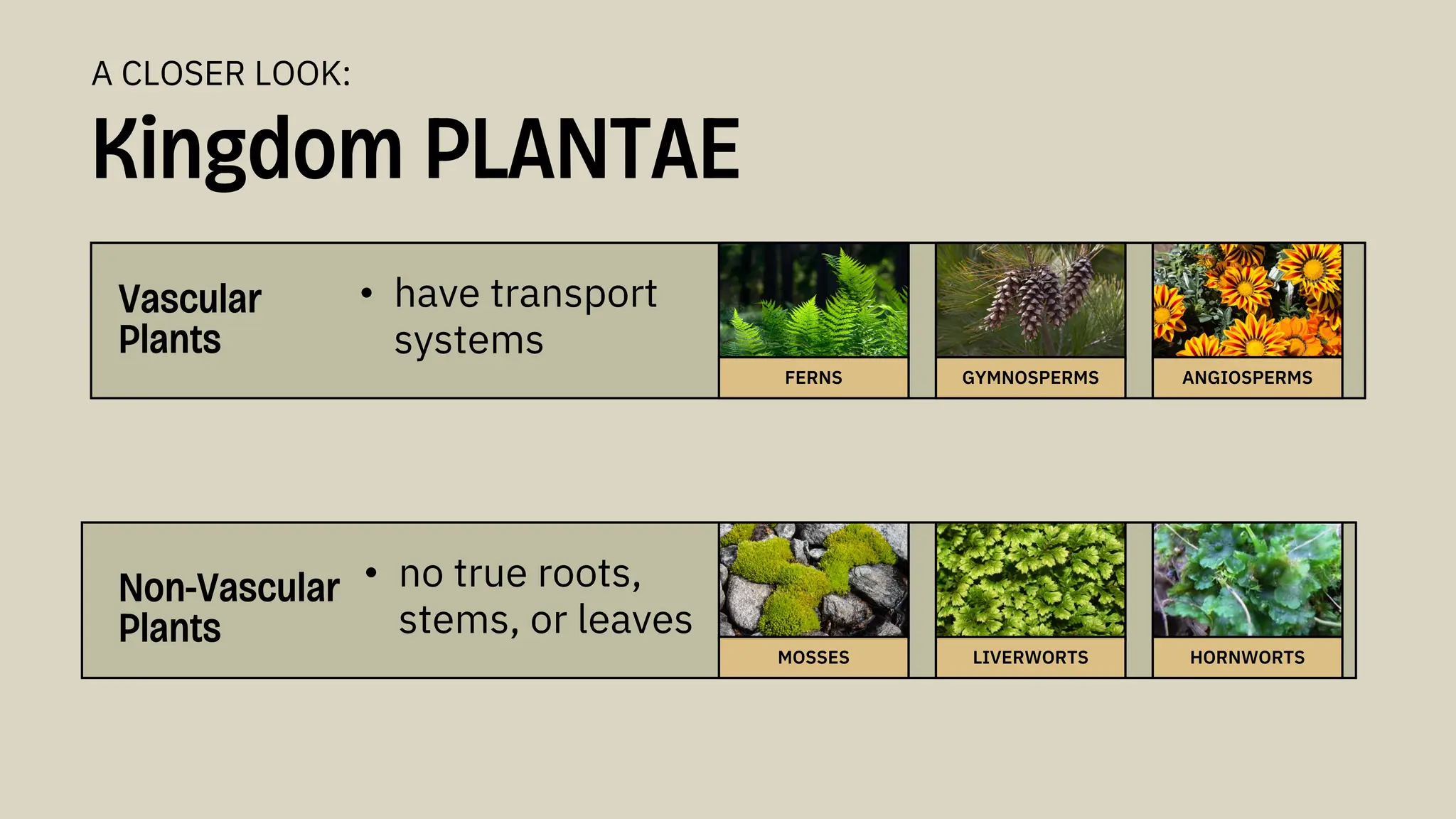
Vascular
Plants
• have transport
systems
Non-Vascular
Plants
• no true roots,
stems, or leaves
FERNS GYMNOSPERMS ANGIOSPERMS
MOSSES LIVERWORTS HORNWORTS
Kingdom PLANTAE
A CLOSER LOOK:
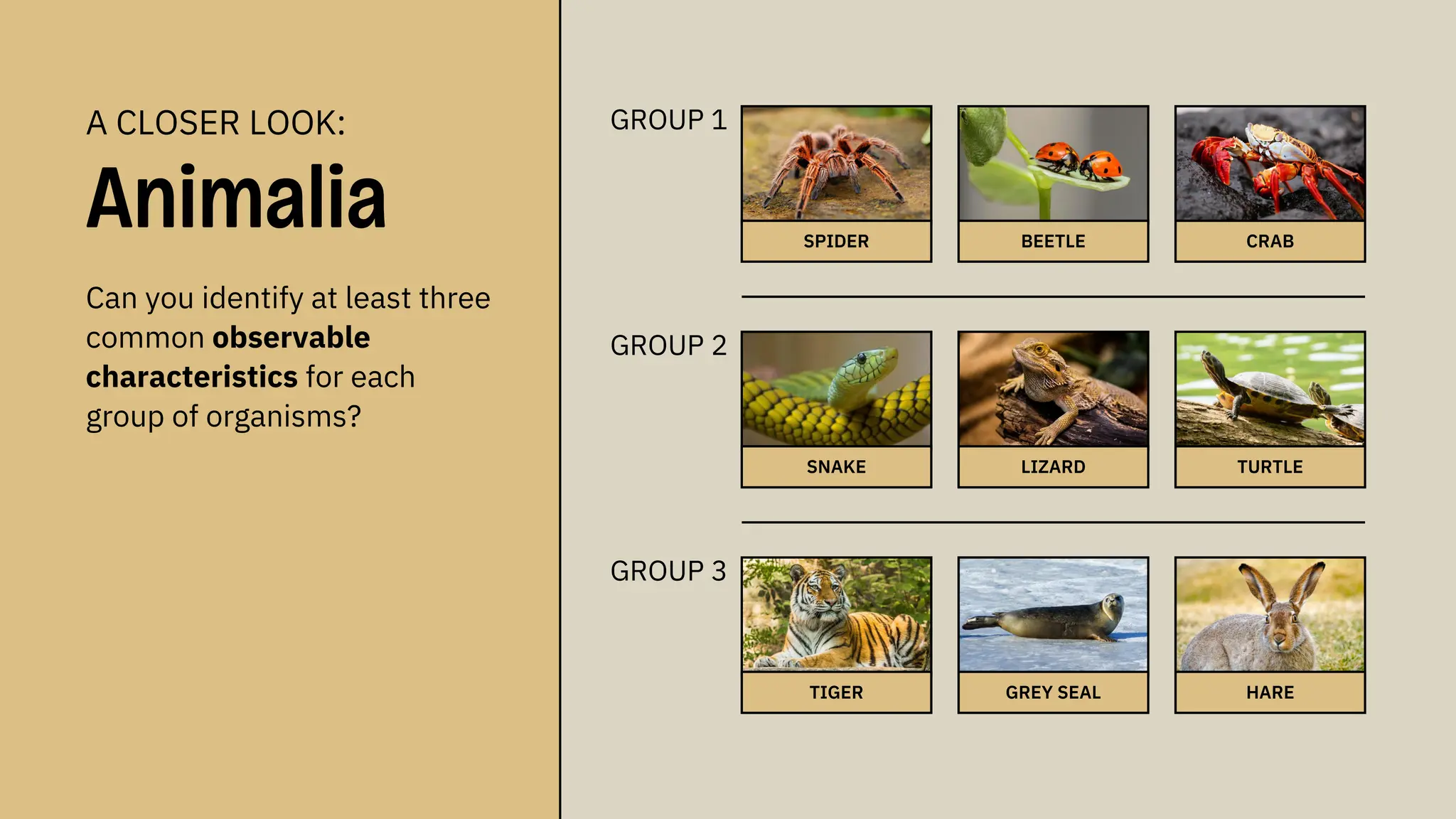
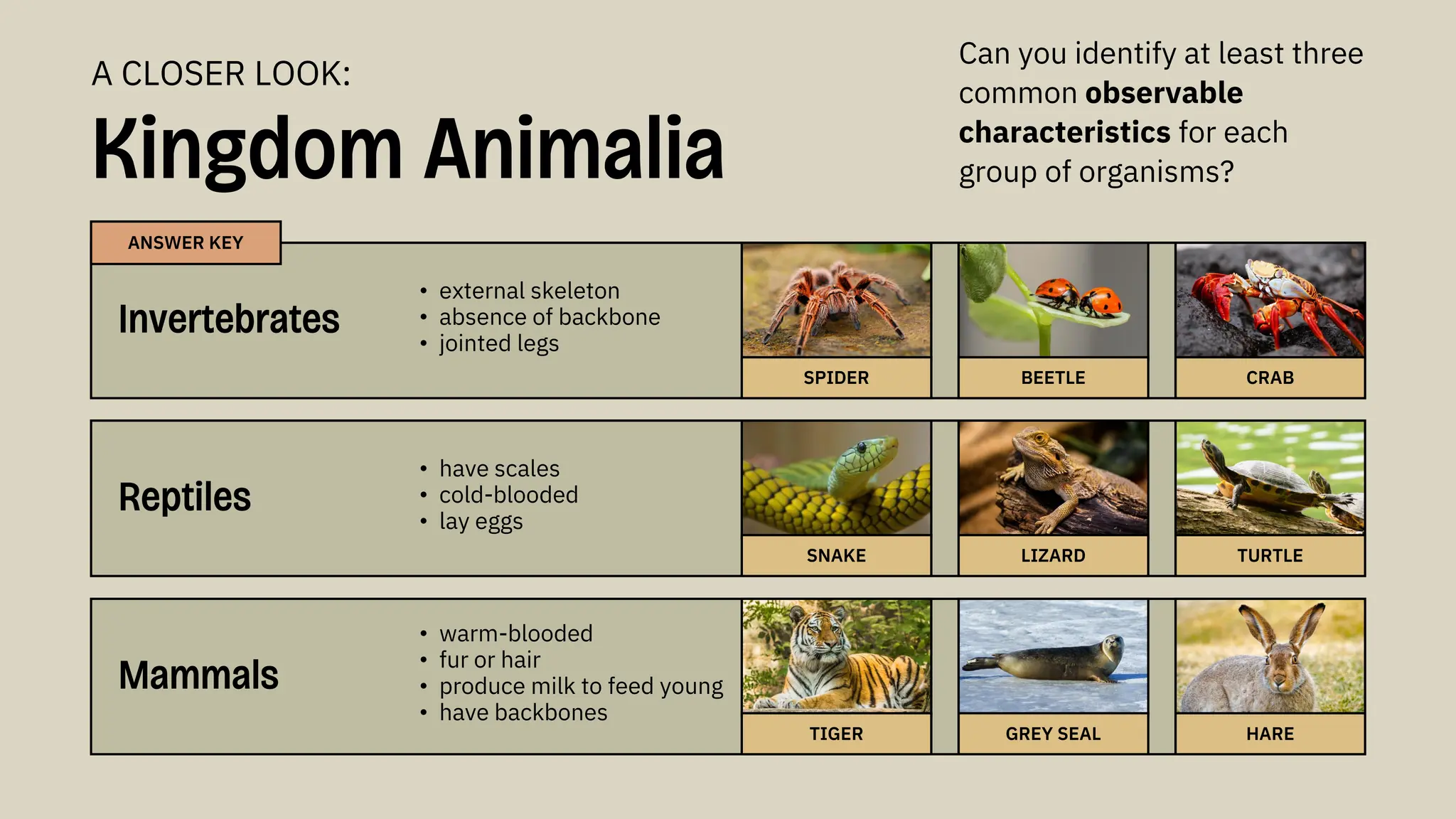
TIGER GREY SEAL HARE
TURTLE
SNAKE LIZARD
SPIDER BEETLE CRAB
A CLOSER LOOK:
Animalia
Can you identify at least three
common observable
characteristics for each
group of organisms?
GROUP 1
GROUP 2
GROUP 3
Kingdom Animalia
ANSWER KEY
Invertebrates
• external skeleton
• absence of backbone
• jointed legs
Can you identify at least three
common observable
characteristics for each
group of organisms?
A CLOSER LOOK:
Reptiles
• have scales
• cold-blooded
• lay eggs
Mammals
• warm-blooded
• fur or hair
• produce milk to feed young
• have backbones
TIGER GREY SEAL HARE
SNAKE LIZARD TURTLE
SPIDER BEETLE CRAB
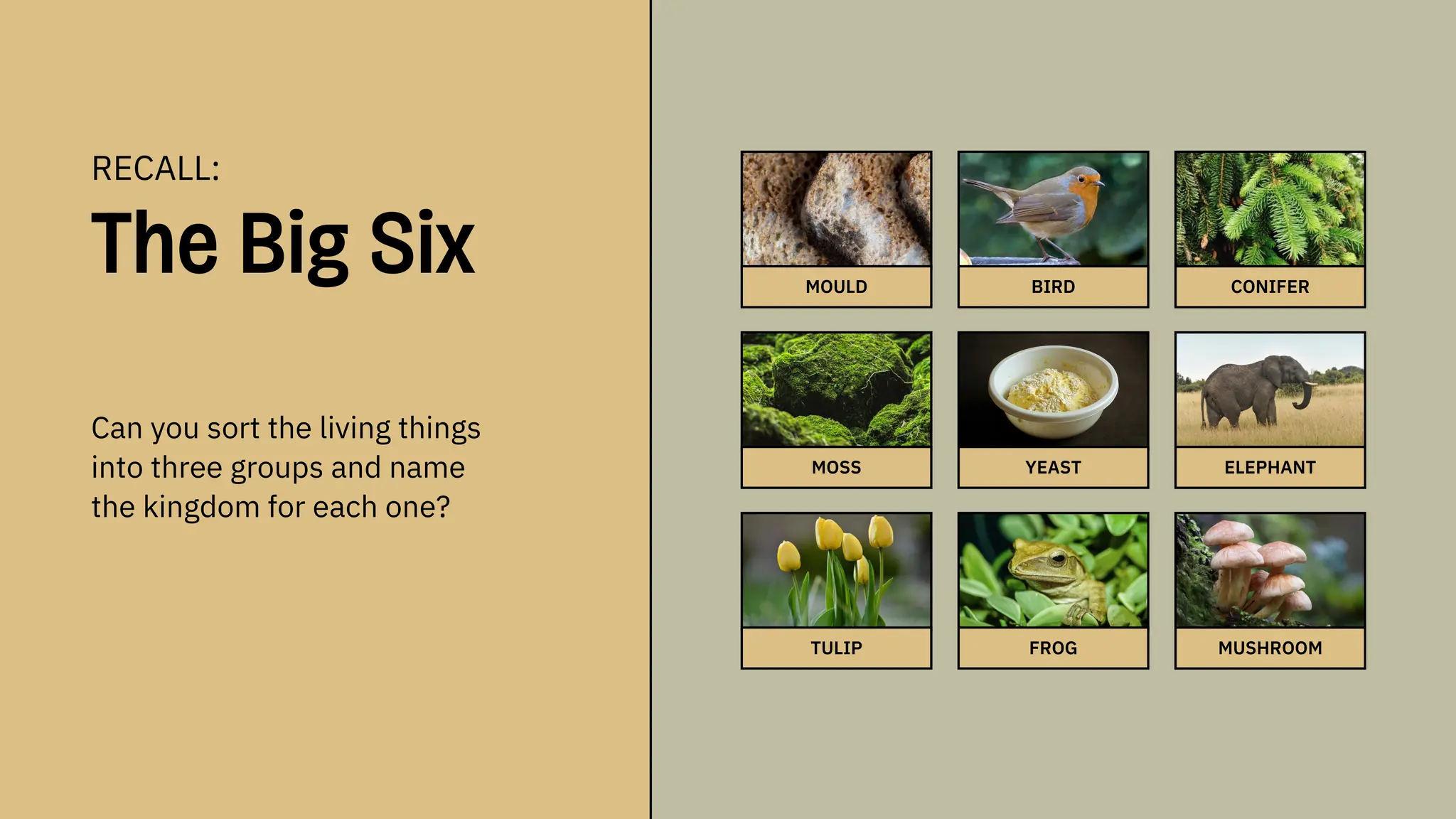
CONIFER
MOULD BIRD
MOSS YEAST ELEPHANT
TULIP FROG MUSHROOM
RECALL:
The Big Six
Can you sort the living things
into three groups and name
the kingdom for each one?
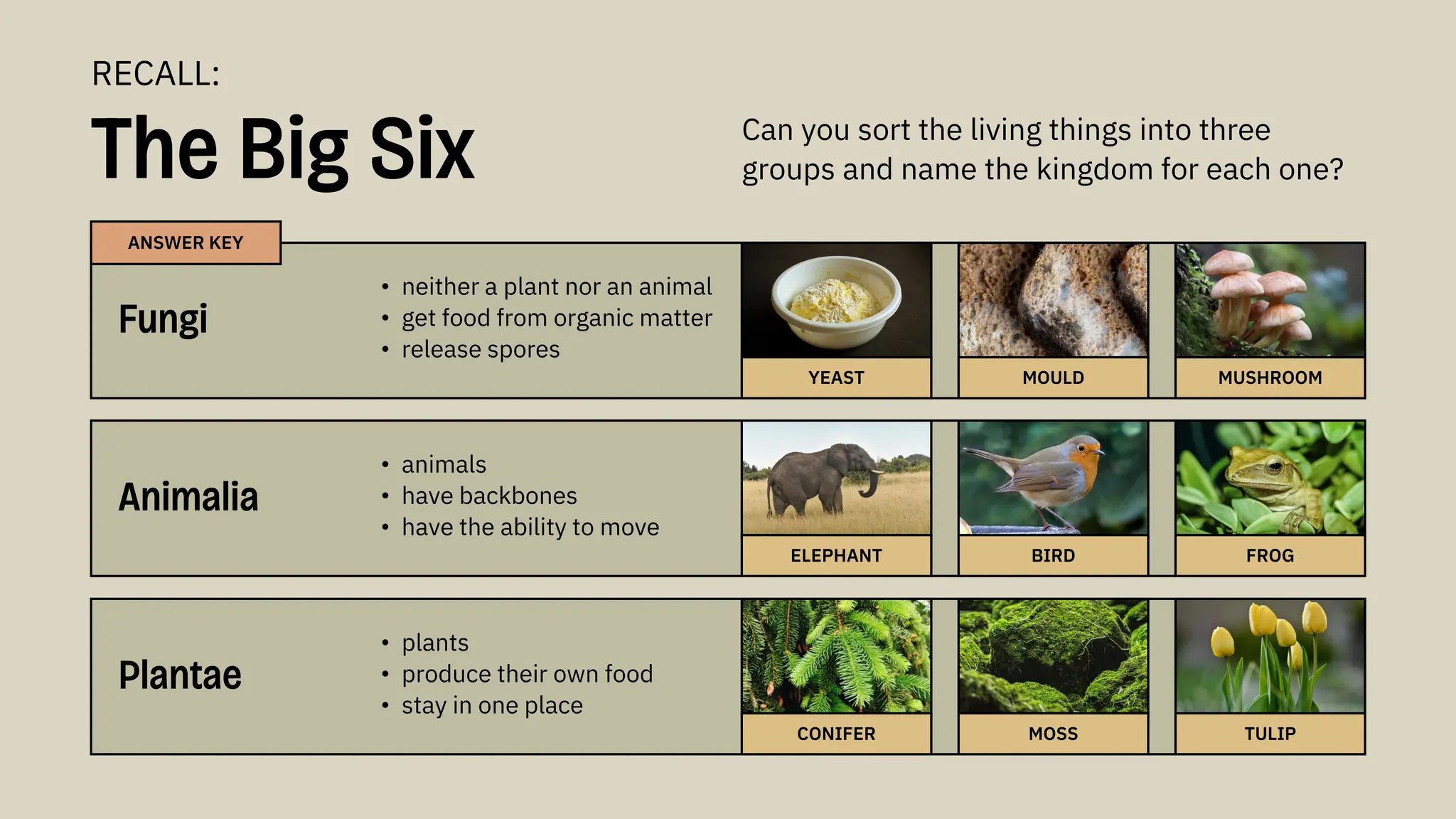
The Big Six
Fungi
• neither a plant nor an animal
• get food from organic matter
• release spores
Can you sort the living things into three
groups and name the kingdom for each one?
RECALL:
Animalia
• animals
• have backbones
• have the ability to move
Plantae
• plants
• produce their own food
• stay in one place
ANSWER KEY
CONIFER MOSS TULIP
ELEPHANT BIRD FROG
YEAST MOULD MUSHROOM
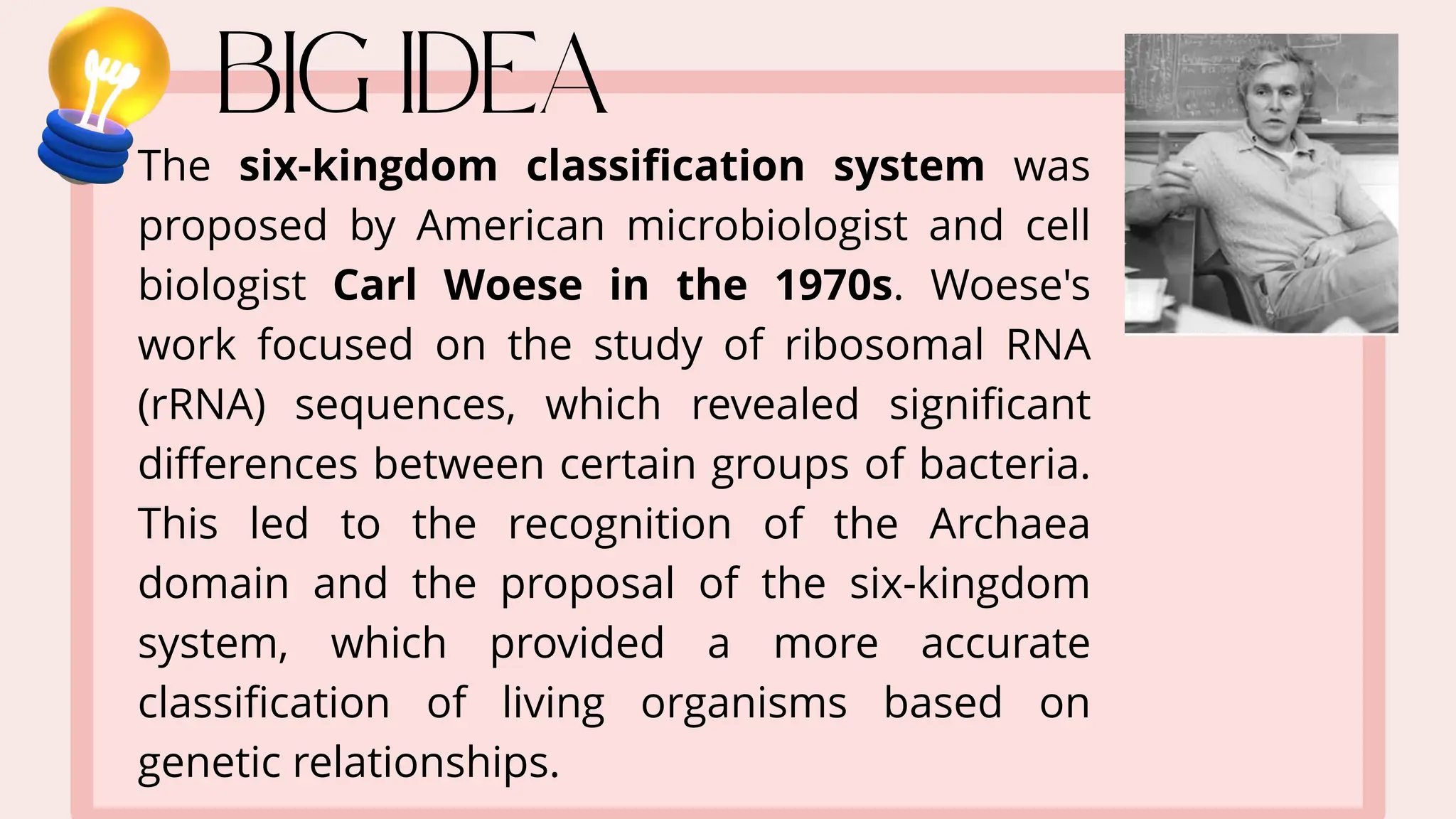
The six-kingdom classification system was
proposed by American microbiologist and cell
biologist Carl Woese in the 1970s. Woese's
work focused on the study of ribosomal RNA
(rRNA) sequences, which revealed significant
differences between certain groups of bacteria.
This led to the recognition of the Archaea
domain and the proposal of the six-kingdom
system, which provided a more accurate
classification of living organisms based on
genetic relationships.
The three-domain classification system was
proposed by American microbiologist and
molecular biologist Carl Woese in the late 20th
century. The three-domain system is a
biological classification system that categorizes
all living organisms into three major domains
based on molecular data, primarily ribosomal
RNA (rRNA) sequences.
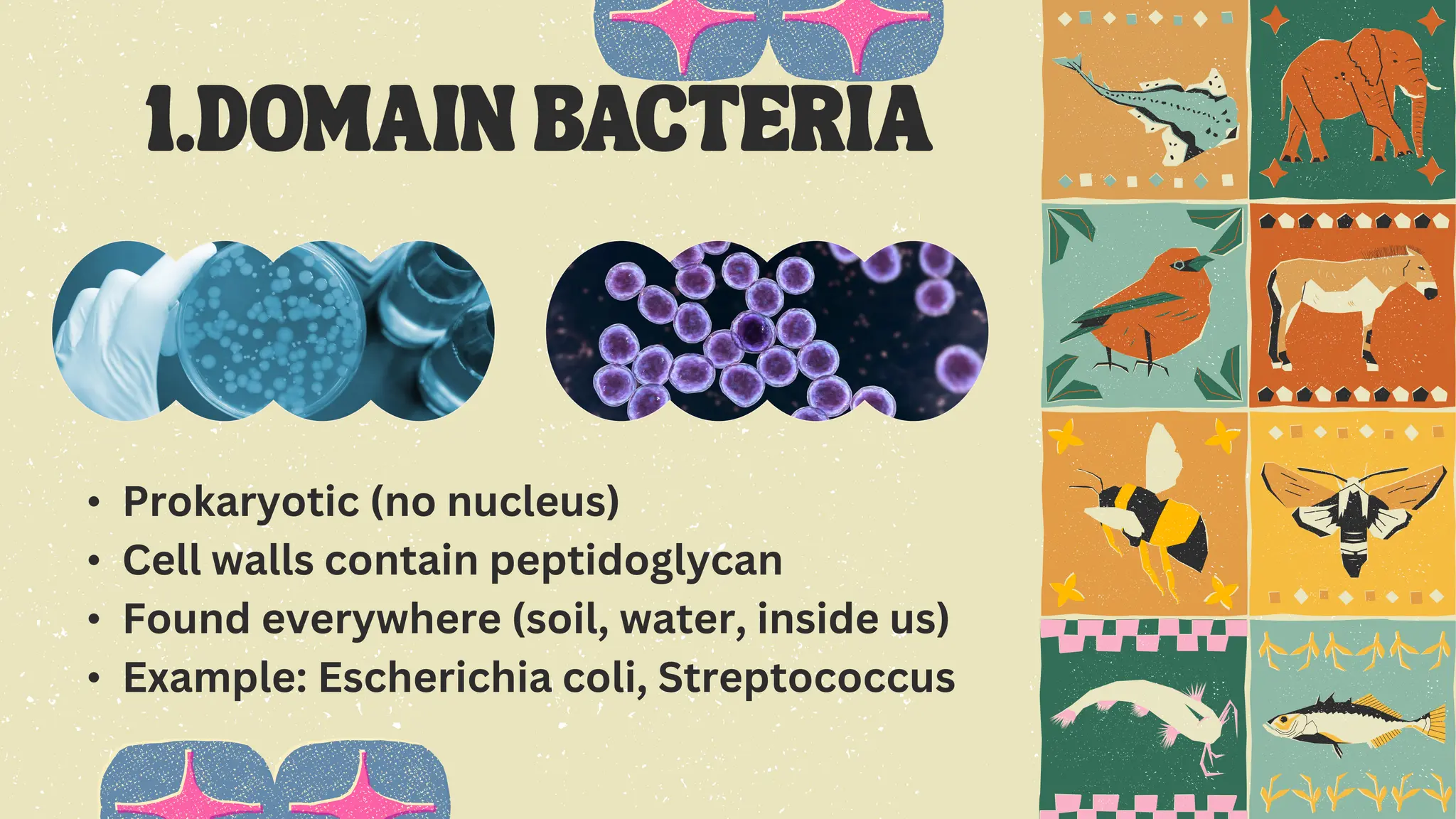
• Prokaryotic (no nucleus)
• Cell walls contain peptidoglycan
• Found everywhere (soil, water, inside us)
• Example: Escherichia coli, Streptococcus
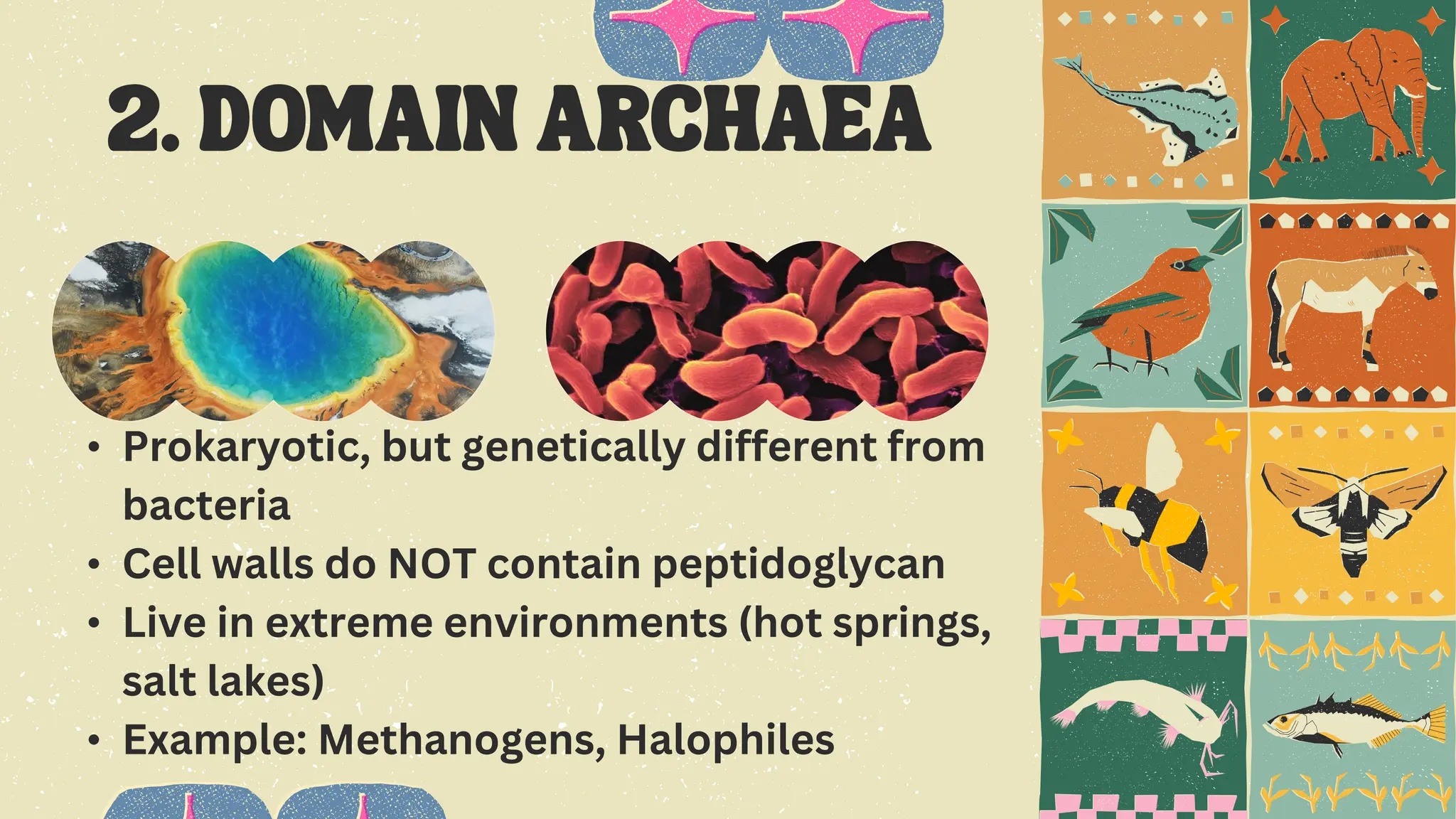
• Prokaryotic, but genetically different from
bacteria
• Cell walls do NOT contain peptidoglycan
• Live in extreme environments (hot springs,
salt lakes)
• Example: Methanogens, Halophiles
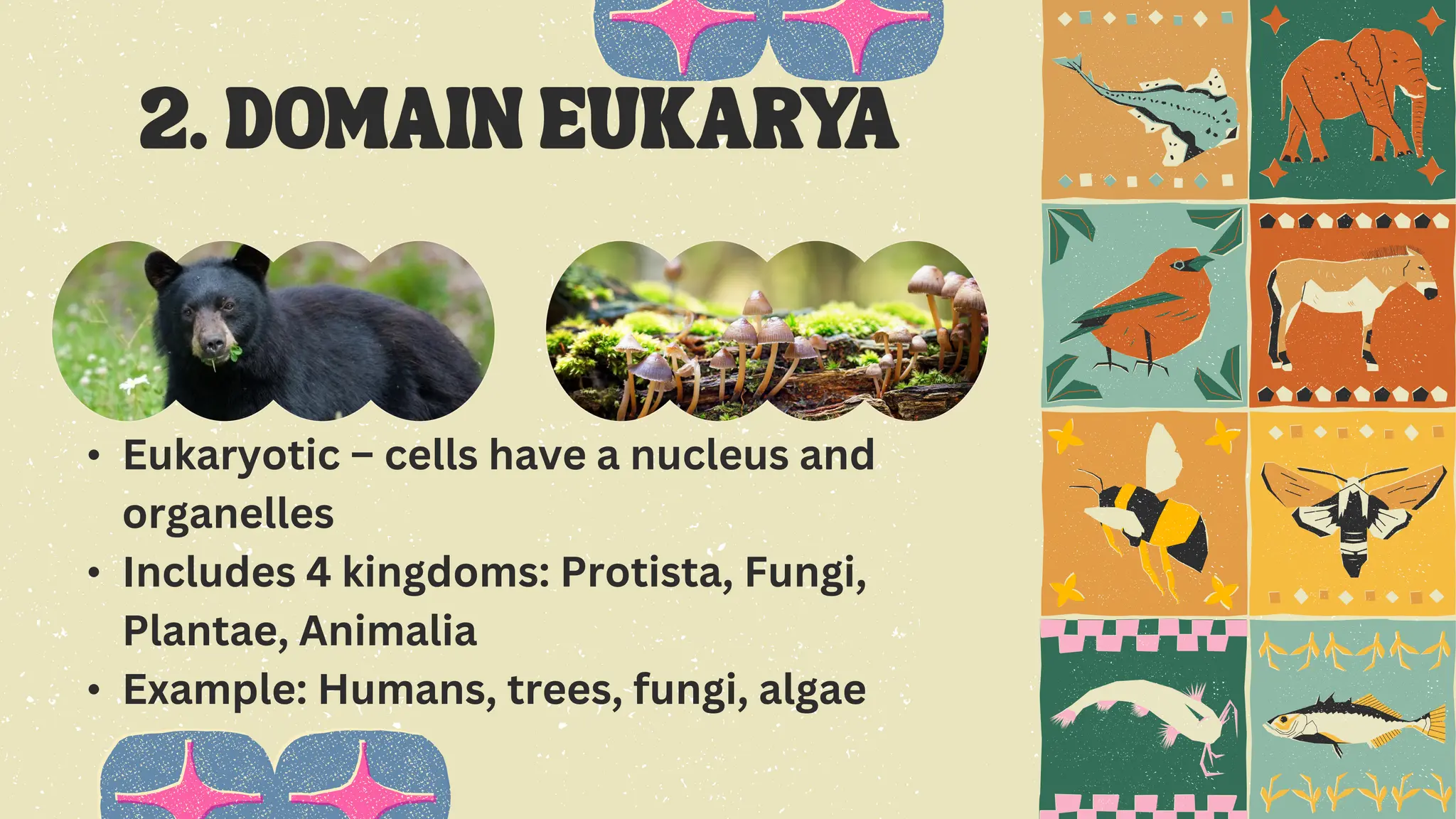
• Eukaryotic – cells have a nucleus and
organelles
• Includes 4 kingdoms: Protista, Fungi,
Plantae, Animalia
• Example: Humans, trees, fungi, algae
LESSON 15 Classification SyYREWCTFGHUBTHVGCstems DOMAINS & KINGDOMS.pdf

  • 1.
  • 2.
    What is theimportance of classifying living things?
  • 3.
    is the scienceof classifying living organisms based on shared characteristics. It helps scientists organize and understand the vast diversity of life by grouping organisms in a hierarchical system. This classification makes it easier to study relationships and evolutionary history.
  • 4.
    1 To make thestudy of organisms easier 2 To clearly communicate about living things with people despite language differences 3 To explore how various living things are related to each other We classify living things in groups... Why do we classify?
  • 5.
    KINGDOM PHYLUM CLASS ORDER FAMILY GENUS SPECIES DOMAIN He developed asystem of classifying living things, which became the basis of classification and naming systems today. His system has seven levels. These levels are constantly being refined by scientists today. (Modern classification commonly uses eight levels.) Who is Carl Linnaeus?
  • 6.
    A lion’s scientificname is Panthera leo GENUS SPECIES He started the binomial (two-part) naming system. Each living thing has a name consisting of two Latin words: the genus and the species name. Who is Carl Linnaeus?
  • 7.
  • 9.
  • 10.
    Level Singular PluralMeaning Example 1 Domain Domains The highest taxonomic rank; groups organisms based on cell type. Eukarya – organisms with complex cells 2 Kingdom Kingdoms Large groups of organisms sharing fundamental traits. Animalia – animals 3 Phylum Phyla Groups organisms within a kingdom based on major body plans or features. Chordata – animals with a backbone 4 Class Classes Groups within a phylum that share more specific traits. Mammalia – mammals 5 Order Orders Groups within a class based on shared characteristics. Primates – monkeys, apes, humans 6 Family Families Groups of closely related genera. Hominidae – great apes and humans 7 Genus Genera Groups of closely related species. Homo – humans and extinct relatives 8 Species Species The most specific level; a group of organisms that can interbreed. Homo sapiens – modern humans
  • 11.
    Year Scientist/s ContributionDetails 1735 Carolus Linnaeus Binomial Nomenclature & 7 Ranks Introduced naming system (Genus species), 7 taxonomic ranks: Kingdom, Phylum, Class, Order, Family, Genus, Species; 2 kingdoms: Animalia, Plantae. 1866 Ernst Haeckel Third Kingdom – Protista Created Protista for microorganisms that didn’t fit plants or animals (e.g., algae, protozoa). 1969 Robert Whittaker Five-Kingdom System Added Monera (prokaryotes) and Fungi as separate kingdoms; system became: Monera, Protista, Fungi, Plantae, Animalia. 1977 Carl Woese & George Fox Discovery of Archaea Used ribosomal RNA sequencing to find a distinct group of prokaryotes (Archaea) different from Bacteria. 1990 Carl Woese Three-Domain System Added “Domain” as the highest rank; domains: Bacteria, Archaea, Eukarya.
  • 12.
    https://iblog.dearbornschools.org/msbaydoun/2019/04/12/prokaryotes-vs-eukaryotes-2/ Domain Cell TypeCell Structure Examples Bacteria Prokaryotic (no nucleus) Simple cell, no membrane- bound organelles E. coli, Streptococcus Archaea Prokaryotic (no nucleus) Unique cell membranes and RNA, often in extreme environments Thermophiles, Halophiles Eukarya Eukaryotic (has nucleus) Complex cells with membrane- bound organelles Humans, plants, fungi, protists Carl Woese discovered through ribosomal RNA sequencing in 1977 that Archaea are so different from bacteria that they deserve their own domain.
  • 14.
  • 15.
  • 16.
  • 17.
    • Peptidoglycan isa complex molecule that forms the cell wall of eubacteria (true bacteria). It provides structural support and protection to bacterial cells.
  • 19.
    The Kingdom Protistaincludes diverse, mostly unicellular eukaryotic organisms that do not fit into the kingdoms of plants, animals, or fungi. Characteristics of Protists: ✅ Eukaryotic (have a nucleus). ✅ Mostly unicellular, but some are multicellular (e.g., seaweeds). ✅ Can be autotrophic (make their own food) or heterotrophic (consume food). ✅ Live in aquatic or moist environments.
  • 20.
    How to Writea Scientific Name 1.Two words only → Genus + species (binomial nomenclature). 1.Example: Homo sapiens 2. Genus → Always starts with a capital letter. species → Always starts with a small letter. 3. Underline when handwritten. (Homo sapiens) 4. Italicize when typed. (Homo sapiens) 5.Write in Latin or Latinized form
  • 21.
    Scientific Names Scientific name:Pithecophaga jefferyi
  • 22.
    of the Linnaeansystem of biological classification
  • 23.
    A domain inbiological classification is the highest taxonomic rank, which groups organisms based on fundamental differences in their cellular and genetic structure.
  • 25.
    A biological classificationis one of the highest taxonomic ranks, just below the domain, used to group together all forms of life that share fundamental structural and functional characteristics.
  • 26.
    • Animalia →Felis catus (cat), Homo sapiens (human) • Plantae → Mangifera indica (mango), Zea mays (corn) • Fungi → Saccharomyces cerevisiae (yeast), Agaricus bisporus (mushroom) • Protista → Euglena, Paramecium • Eubacteria → Escherichia coli • Archaebacteria → Methanogens, Thermococcus
  • 27.
    Phylum is aclassification level beneath kingdom and groups together organisms with similar body plans or structures, allowing scientists to further categorize and study different types of living things.
  • 30.
    Class is aclassification level below phylum and groups together organisms that share even more specific characteristics. It consist of several orders.
  • 33.
    Order is aclassification level beneath class and further organizes organisms based on even more specific similarities in their characteristics and behaviors. It allows scientists to group together organisms that are more closely related. It consists of several related families.
  • 36.
    Family is ataxonomic classification that groups together organisms with even more specific similarities, such as similar body structures and behaviors. It helps scientists categorize organisms into smaller, more closely related groups for further study and understanding. Consist of several related genera (singular: Genus)
  • 39.
    Genus consists ofseveral related species
  • 42.
    A species isthe most specific level of organism classification in biological taxonomy, representing a group of individuals that can interbreed and produce fertile offspring in natural conditions. Members of a species share common characteristics and genetic similarities.
  • 45.
    a unique, two-partname given to each species of organism. It consists of the genus name (the first part) the first letter is written in capital letter and the species name (the second part) this is written in lowercase letter, both written in Latin and italicized. This naming system, known as binomial nomenclature, allows scientists worldwide to communicate effectively about specific organisms.
  • 46.
  • 47.
    Classification systems areused to organize and categorize living organisms based on their characteristics, relationships, and evolutionary history. The most widely used classification system is the Linnaean system, which categorizes organisms into a hierarchical structure of seven levels: kingdom, phylum, class, order, family, genus, and species.
  • 48.
    ARCHAEBACTERIA EUBACTERIA PROTISTAFUNGI PLANTAE ANIMALIA
  • 49.
    A CLOSER LOOK: ARCHAE BACTERIA •SINGLE-CELLED ORGANISMS (UNICELLULAR) • PROKARYOTIC – NO NUCLEUS • BELONG TO DOMAIN ARCHAEA • CONSIDERED ONE OF THE OLDEST FORMS OF LIFE ON EARTH • CELL WALLS DO NOT CONTAIN PEPTIDOGLYCAN • CAN SURVIVE IN EXTREME ENVIRONMENTS: A. VERY HOT (THERMOPHILES) B. VERY SALTY (HALOPHILES) C. NO OXYGEN (METHANOGENS) • AUTOTROPHS OR HETEROTROPHS • PROVIDE CLUES ABOUT EARLY LIFE ON EARTH • PLAY ROLES IN NITROGEN CYCLE, METHANE PRODUCTION, AND BIOTECHNOLOGY
  • 50.
    Kingdom Archaebacteria Methanogen • livein swamps and digestive tracts A CLOSER LOOK: Halophiles Thermophiles • thrive in salty places like the Dead Sea • found in hot springs or deep-sea vents
  • 51.
    • SINGLE-CELLED (UNICELLULAR)ORGANISMS • PROKARYOTIC – NO NUCLEUS • BELONG TO DOMAIN BACTERIA • ALSO CALLED "TRUE BACTERIA" • CELL WALLS CONTAIN PEPTIDOGLYCAN • FOUND EVERYWHERE – SOIL, WATER, AIR, INSIDE YOUR BODY • REPRODUCE BY BINARY FISSION • CAN BE AUTOTROPHS (MAKE THEIR OWN FOOD) OR HETEROTROPHS (CONSUME FOOD) • AID IN DIGESTION AND FOOD PRODUCTION (LIKE CHEESE AND VINEGAR) • USED IN BIOTECHNOLOGY AND MEDICINE • SOME CAUSE DISEASES, BUT MOST ARE HARMLESS OR HELPFUL A CLOSER LOOK: EUBACTERIA
  • 52.
    Kingdom Eubacteria Lactobacillus • helpsin digestion (yogurt bacteria) A CLOSER LOOK: Escherichia coli (E. coli) Streptococcus • found in the human gut • causes strep throat
  • 53.
    • MOSTLY UNICELLULAR,SOME MULTICELLULAR • Eukaryotic – cells have a nucleus • Often called the “odds and ends” kingdom because members are very diverse • Found in moist or aquatic environments • CAN BE AUTOTROPHS (LIKE ALGAE) OR HETEROTROPHS (LIKE PROTOZOA) • SOME MOVE USING CILIA, FLAGELLA, OR PSEUDOPODIA • REPRODUCE SEXUALLY OR ASEXUALLY • PRODUCE OXYGEN (ALGAE) • FORM THE BASE OF AQUATIC FOOD CHAINS • SOME CAUSE DISEASES LIKE MALARIA (PLASMODIUM) A CLOSER LOOK: PROTISTA
  • 54.
    Animal-like (Protozoa) • Heterotrophs • Moveusing cilia, flagella, or pseudopodia • No cell walls AMOEBA PARAMECIUM EUGLENA CHLAMYDOMONAS SLIME MOLDS WATER MOLDS Kingdom Protista A CLOSER LOOK: Plant-like (Algae) Fungus-like • Autotrophs (photosynthetic) • Have chloroplasts and chlorophyll • May have flagella • Heterotrophs (decomposers) • Absorb nutrients from decaying matter • Live in moist environments
  • 55.
    • MOSTLY MULTICELLULAR,SOME UNICELLULAR (E.G., YEAST) • Eukaryotic – cells have a nucleus • Belong to Domain Eukarya • HetEROTROPHS – ABSORB NUTRIENTS FROM SURROUNDINGS • CELL WALLS MADE OF CHITIN (NOT CELLULOSE LIKE PLANTS) • ABSORB NUTRIENTS THROUGH EXTERNAL DIGESTION • REPRODUCE USING SPORES (ASEXUAL OR SEXUAL REPRODUCTION) • THRIVE IN MOIST, WARM ENVIRONMENTS • DECOMPOSERS – BREAK DOWN DEAD ORGANISMS, RECYCLE NUTRIENTS • USED IN MEDICINE, FOOD PRODUCTION (E.G., BREAD, CHEESE A CLOSER LOOK: FUNGI
  • 56.
    Mushroom • typical multicellular fungi KingdomFungi A CLOSER LOOK: Yeast Mold • unicellular, used in baking • grows on food and damp surfaces
  • 57.
    Penicillium • source ofantibiotic penicillin Kingdom Fungi A CLOSER LOOK:
  • 58.
    • MULTICELLULAR ORGANISMS •Eukaryotic – cells have a nucleus • Belong to Domain Eukarya • Autotrophs – make their own food through photosynthesis • HAVE CELL WALLS MADE OF CELLULOSE • CONTAIN CHLOROPLASTS WITH CHLOROPHYLL • MOST ARE NON-MOTILE (DON'T MOVE) • REPRODUCE SEXUALLY OR ASEXUALLY (E.G., SPORES, SEEDS) • PRODUCE OXYGEN THROUGH PHOTOSYNTHESIS • BASE OF MOST FOOD CHAINS • PROVIDE FOOD, SHELTER, AND MEDICINE FOR OTHER ORGANISMS A CLOSER LOOK: PLANTAE
  • 59.
    Vascular Plants • have transport systems Non-Vascular Plants •no true roots, stems, or leaves FERNS GYMNOSPERMS ANGIOSPERMS MOSSES LIVERWORTS HORNWORTS Kingdom PLANTAE A CLOSER LOOK:
  • 60.
    TIGER GREY SEALHARE TURTLE SNAKE LIZARD SPIDER BEETLE CRAB A CLOSER LOOK: Animalia Can you identify at least three common observable characteristics for each group of organisms? GROUP 1 GROUP 2 GROUP 3
  • 61.
    Kingdom Animalia ANSWER KEY Invertebrates •external skeleton • absence of backbone • jointed legs Can you identify at least three common observable characteristics for each group of organisms? A CLOSER LOOK: Reptiles • have scales • cold-blooded • lay eggs Mammals • warm-blooded • fur or hair • produce milk to feed young • have backbones TIGER GREY SEAL HARE SNAKE LIZARD TURTLE SPIDER BEETLE CRAB
  • 62.
    CONIFER MOULD BIRD MOSS YEASTELEPHANT TULIP FROG MUSHROOM RECALL: The Big Six Can you sort the living things into three groups and name the kingdom for each one?
  • 63.
    The Big Six Fungi •neither a plant nor an animal • get food from organic matter • release spores Can you sort the living things into three groups and name the kingdom for each one? RECALL: Animalia • animals • have backbones • have the ability to move Plantae • plants • produce their own food • stay in one place ANSWER KEY CONIFER MOSS TULIP ELEPHANT BIRD FROG YEAST MOULD MUSHROOM
  • 64.
    The six-kingdom classificationsystem was proposed by American microbiologist and cell biologist Carl Woese in the 1970s. Woese's work focused on the study of ribosomal RNA (rRNA) sequences, which revealed significant differences between certain groups of bacteria. This led to the recognition of the Archaea domain and the proposal of the six-kingdom system, which provided a more accurate classification of living organisms based on genetic relationships.
  • 66.
    The three-domain classificationsystem was proposed by American microbiologist and molecular biologist Carl Woese in the late 20th century. The three-domain system is a biological classification system that categorizes all living organisms into three major domains based on molecular data, primarily ribosomal RNA (rRNA) sequences.
  • 67.
    • Prokaryotic (nonucleus) • Cell walls contain peptidoglycan • Found everywhere (soil, water, inside us) • Example: Escherichia coli, Streptococcus
  • 68.
    • Prokaryotic, butgenetically different from bacteria • Cell walls do NOT contain peptidoglycan • Live in extreme environments (hot springs, salt lakes) • Example: Methanogens, Halophiles
  • 69.
    • Eukaryotic –cells have a nucleus and organelles • Includes 4 kingdoms: Protista, Fungi, Plantae, Animalia • Example: Humans, trees, fungi, algae