Grade 7
LEVELS OF BIOLOGICAL
ORGANIZATION
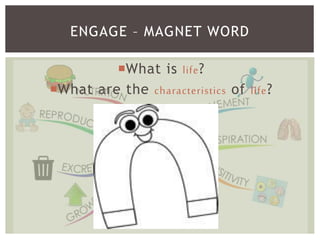
What is life?
What are the characteristics of life?
ENGAGE – MAGNET WORD
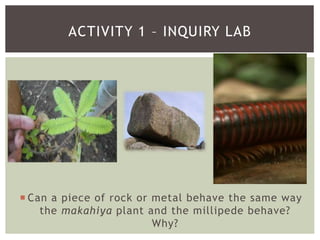
 Can a piece of rock or metal behave the same way
the makahiya plant and the millipede behave?
Why?
ACTIVITY 1 – INQUIRY LAB
[http://ed.ted.com/lessons/making-sense-of-how-life-fits-
together-bobbi-seleski]
MAKING SENSE OF HOW LIFE FITS
TOGETHER
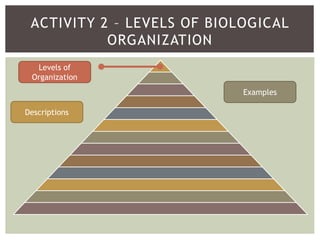
ACTIVITY 2 – LEVELS OF BIOLOGICAL
ORGANIZATION
Levels of
Organization
Descriptions
Examples
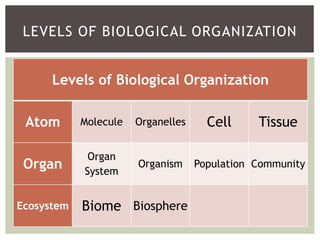
Levels of Biological Organization
Atom Molecule Organelles Cell Tissue
Organ
Organ
System
Organism Population Community
Ecosystem Biome Biosphere
LEVELS OF BIOLOGICAL ORGANIZATION
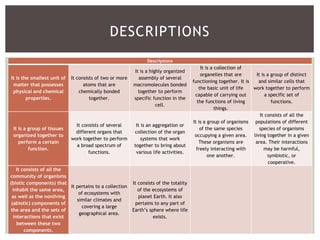
DESCRIPTIONS
Descriptions
It is the smallest unit of
matter that possesses
physical and chemical
properties.
It consists of two or more
atoms that are
chemically bonded
together.
It is a highly organized
assembly of several
macromolecules bonded
together to perform
specific function in the
cell.
It is a collection of
organelles that are
functioning together. It is
the basic unit of life
capable of carrying out
the functions of living
things.
It is a group of distinct
and similar cells that
work together to perform
a specific set of
functions.
It is a group of tissues
organized together to
perform a certain
function.
It consists of several
different organs that
work together to perform
a broad spectrum of
functions.
It is an aggregation or
collection of the organ
systems that work
together to bring about
various life activities.
It is a group of organisms
of the same species
occupying a given area.
These organisms are
freely interacting with
one another.
It consists of all the
populations of different
species of organisms
living together in a given
area. Their interactions
may be harmful,
symbiotic, or
cooperative.
It consists of all the
community of organisms
(biotic components) that
inhabit the same area,
as well as the nonliving
(abiotic) components of
the area and the sets of
interactions that exist
between these two
components.
It pertains to a collection
of ecosystems with
similar climates and
covering a large
geographical area.
It consists of the totality
of the ecosystems of
planet Earth. It also
pertains to any part of
Earth’s sphere where life
exists.
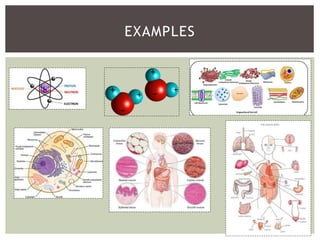
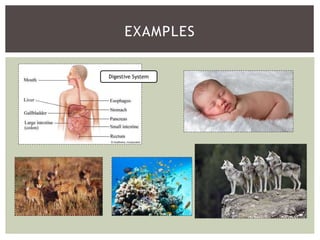
EXAMPLES
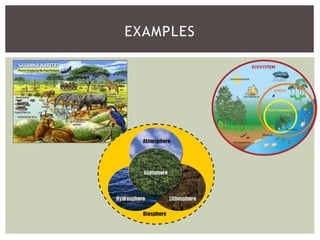
EXAMPLES
Digestive System
EXAMPLES
Share your work
Choose the best example
THINK-PAIR-SHARE
Definition of
TERMS
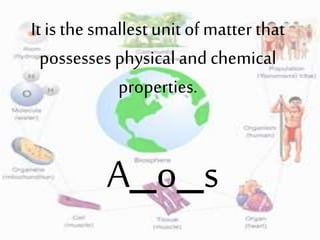
It is the smallest unit of matter that
possesses physical and chemical
properties.
A_o_s
It consists of two or more atoms that
are chemically bonded together.
_ol_ _ ul_s
It is a highly organizedassembly of
several macromolecules bonded
togetherto perform specific function
in the cell.
O_ _an_l_es
It isa collection of organelles that are
functioning together. It is the basic unit of
life capableof carrying out the functions of
living things.
Ce_ _s
It is a groupof distinct and similar cells
that work together toperform a
specific set of functions.
T_s_u_
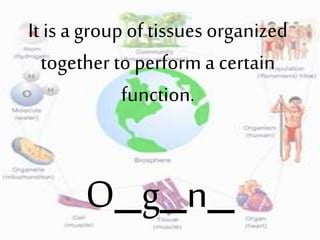
It is a group of tissues organized
together to perform a certain
function.
O_g_n_
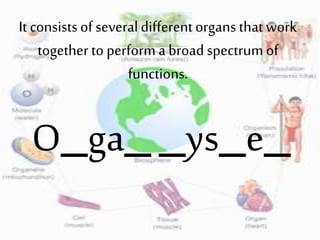
It consistsof severaldifferentorgans that work
together to perform a broad spectrum of
functions.
O_ga_ _ys_e_
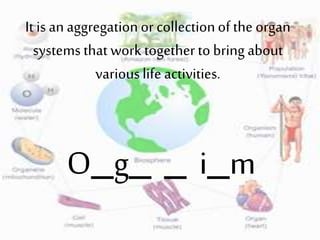
It is an aggregationor collectionof the organ
systems that work togetherto bring about
variouslife activities.
O_g_ _ i_m
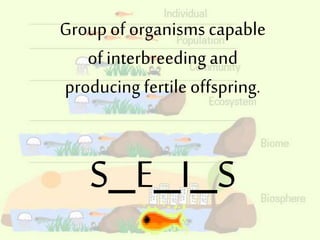
Groupof organisms capable
of interbreeding and
producing fertileoffspring.
S_E_I_S
A groupof individuals of a given species
that live ina specific geographicarea at
a given time.
P_p_ _at_o_
This includes all the
populations in a specific area
at a giventime.
_o_m_n_ _y
This includemore than a community ofliving
organisms (biotic)interactingwith the
environment(abiotic).
E_os_s_ _m
What will be the
implication if there is harm
on one of the levels of
organization?
VALUES INTEGRATION

Levels of organization

  • 1.
    Grade 7 LEVELS OFBIOLOGICAL ORGANIZATION
  • 2.
    What is life? Whatare the characteristics of life? ENGAGE – MAGNET WORD
  • 3.
     Can apiece of rock or metal behave the same way the makahiya plant and the millipede behave? Why? ACTIVITY 1 – INQUIRY LAB
  • 4.
  • 5.
    ACTIVITY 2 –LEVELS OF BIOLOGICAL ORGANIZATION Levels of Organization Descriptions Examples
  • 6.
    Levels of BiologicalOrganization Atom Molecule Organelles Cell Tissue Organ Organ System Organism Population Community Ecosystem Biome Biosphere LEVELS OF BIOLOGICAL ORGANIZATION
  • 7.
    DESCRIPTIONS Descriptions It is thesmallest unit of matter that possesses physical and chemical properties. It consists of two or more atoms that are chemically bonded together. It is a highly organized assembly of several macromolecules bonded together to perform specific function in the cell. It is a collection of organelles that are functioning together. It is the basic unit of life capable of carrying out the functions of living things. It is a group of distinct and similar cells that work together to perform a specific set of functions. It is a group of tissues organized together to perform a certain function. It consists of several different organs that work together to perform a broad spectrum of functions. It is an aggregation or collection of the organ systems that work together to bring about various life activities. It is a group of organisms of the same species occupying a given area. These organisms are freely interacting with one another. It consists of all the populations of different species of organisms living together in a given area. Their interactions may be harmful, symbiotic, or cooperative. It consists of all the community of organisms (biotic components) that inhabit the same area, as well as the nonliving (abiotic) components of the area and the sets of interactions that exist between these two components. It pertains to a collection of ecosystems with similar climates and covering a large geographical area. It consists of the totality of the ecosystems of planet Earth. It also pertains to any part of Earth’s sphere where life exists.
  • 8.
  • 9.
  • 10.
  • 11.
    Share your work Choosethe best example THINK-PAIR-SHARE
  • 12.
  • 13.
    It is thesmallest unit of matter that possesses physical and chemical properties. A_o_s
  • 14.
    It consists oftwo or more atoms that are chemically bonded together. _ol_ _ ul_s
  • 15.
    It is ahighly organizedassembly of several macromolecules bonded togetherto perform specific function in the cell. O_ _an_l_es
  • 16.
    It isa collectionof organelles that are functioning together. It is the basic unit of life capableof carrying out the functions of living things. Ce_ _s
  • 17.
    It is agroupof distinct and similar cells that work together toperform a specific set of functions. T_s_u_
  • 18.
    It is agroup of tissues organized together to perform a certain function. O_g_n_
  • 19.
    It consistsof severaldifferentorgansthat work together to perform a broad spectrum of functions. O_ga_ _ys_e_
  • 20.
    It is anaggregationor collectionof the organ systems that work togetherto bring about variouslife activities. O_g_ _ i_m
  • 21.
    Groupof organisms capable ofinterbreeding and producing fertileoffspring. S_E_I_S
  • 22.
    A groupof individualsof a given species that live ina specific geographicarea at a given time. P_p_ _at_o_
  • 23.
    This includes allthe populations in a specific area at a giventime. _o_m_n_ _y
  • 24.
    This includemore thana community ofliving organisms (biotic)interactingwith the environment(abiotic). E_os_s_ _m
  • 25.
    What will bethe implication if there is harm on one of the levels of organization? VALUES INTEGRATION

Editor's Notes

  • #5 From something as miniscule as a cell to the biosphere we all call home, living things fit together in numerous interesting ways.  This is a summary of how unicellular organisms, tissues, organs, organ systems, organisms, populations, communities, ecosystems, and our biosphere build off of each other and work together.