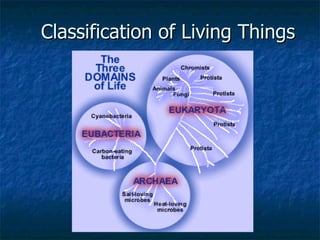
Classification of Living Things
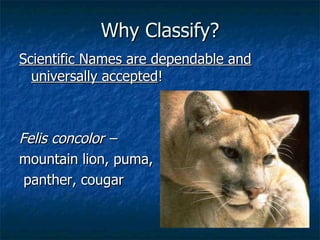
Why Classify? Scientific Names are dependable and universally accepted ! Felis concolor –  mountain lion, puma, panther, cougar
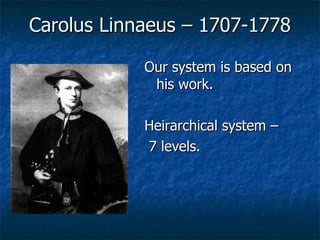
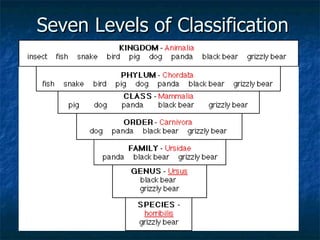
Carolus Linnaeus – 1707-1778 Our system is based on his work. Heirarchical system – 7 levels.
Seven Levels of Classification
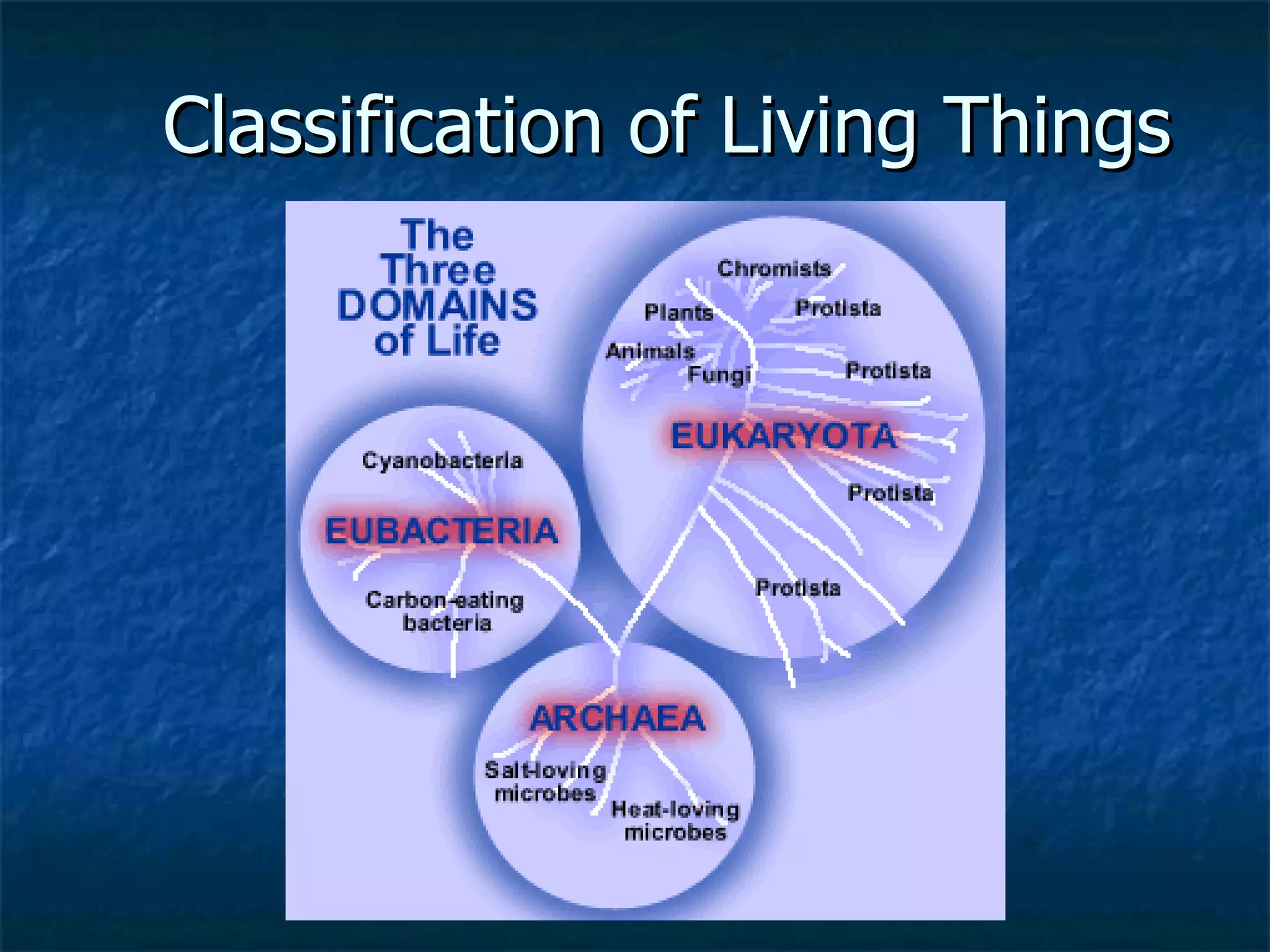
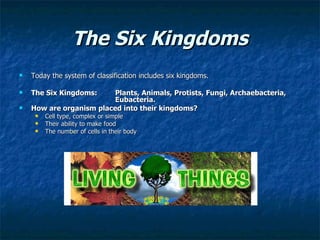
The Six Kingdoms Today the system of classification includes six kingdoms.  The Six Kingdoms: Plants, Animals, Protists, Fungi, Archaebacteria,  Eubacteria. How are organism placed into their kingdoms?  Cell type, complex or simple Their ability to make food The number of cells in their body
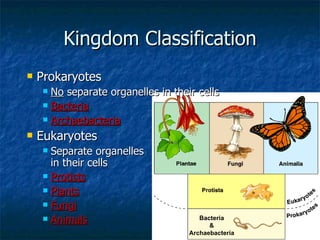
Kingdom Classification Prokaryotes No  separate organelles in their cells Bacteria Archaebacteria Eukaryotes Separate organelles  in their cells Protists Plants Fungi Animals Bacteria & Archaebacteria
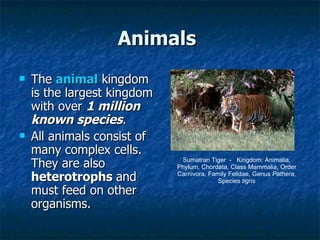
Animals   The  animal  kingdom is the largest kingdom with over  1 million known species . All animals consist of many complex cells. They are also  heterotrophs  and must feed on other organisms.  Sumatran Tiger  -  Kingdom: Animalia, Phylum, Chordata, Class Mammalia, Order Carnivora, Family Felidae, Genus  Pathera,  Species  tigris
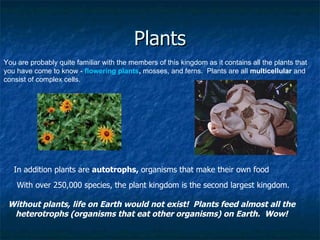
Plants You are probably quite familiar with the members of this kingdom as it contains all the plants that you have come to know -  flowering plants ,  mosses, and ferns.  Plants are all  multicellular  and consist of complex cells. In addition plants are  autotrophs,  organisms that make their own food With over 250,000 species, the plant kingdom is the second largest kingdom. Without plants, life on Earth would not exist!  Plants feed almost all the  heterotrophs (organisms that eat other organisms) on Earth.  Wow!
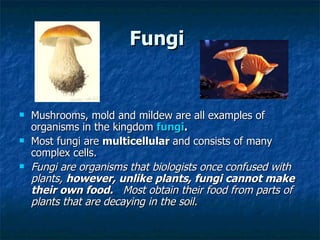
Fungi   Mushrooms, mold and mildew are all examples of organisms in the kingdom  fungi .   Most fungi are  multicellular  and   consists of many complex cells.  Fungi are organisms that biologists once confused with plants,  however, unlike plants, fungi cannot make their own food.   Most obtain their food from parts of plants that are decaying in the soil.
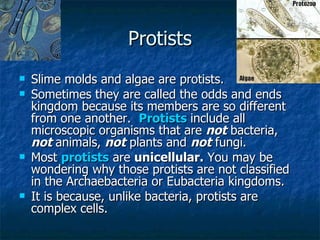
Protists Slime molds and algae are protists.  Sometimes they are called the odds and ends kingdom because its members are so different from one another.   Protists   include all microscopic organisms that are  not  bacteria,  not   animals,  not  plants and  not  fungi.  Most  protists  are  unicellular.  You may be wondering why those protists are not classified in the Archaebacteria or Eubacteria kingdoms.   It is because, unlike bacteria, protists are complex cells.
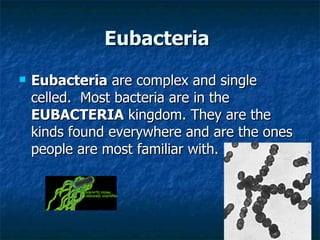
Eubacteria   Eubacteria  are complex and single celled.  Most bacteria are in the  EUBACTERIA  kingdom. They are the kinds found everywhere and are the ones people are most familiar with. 
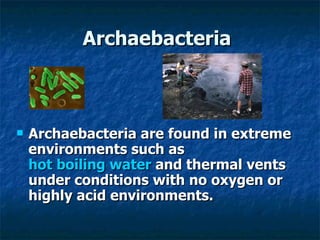
Archaebacteria   Archaebacteria are found in extreme environments such as  hot boiling water  and thermal vents under conditions with no oxygen or highly acid environments.
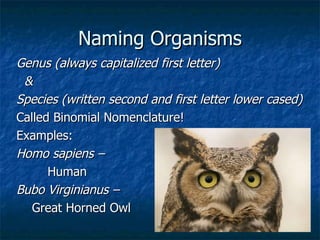
Naming Organisms Genus (always capitalized first letter)  & Species (written second and first letter lower cased) Called Binomial Nomenclature! Examples: Homo sapiens –  Human  Bubo Virginianus – Great Horned Owl
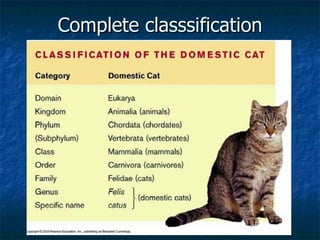
Complete classsification

Classification of living_things

  • 1.
  • 2.
    Why Classify? ScientificNames are dependable and universally accepted ! Felis concolor – mountain lion, puma, panther, cougar
  • 3.
    Carolus Linnaeus –1707-1778 Our system is based on his work. Heirarchical system – 7 levels.
  • 4.
    Seven Levels ofClassification
  • 5.
    The Six KingdomsToday the system of classification includes six kingdoms. The Six Kingdoms: Plants, Animals, Protists, Fungi, Archaebacteria, Eubacteria. How are organism placed into their kingdoms? Cell type, complex or simple Their ability to make food The number of cells in their body
  • 6.
    Kingdom Classification ProkaryotesNo separate organelles in their cells Bacteria Archaebacteria Eukaryotes Separate organelles in their cells Protists Plants Fungi Animals Bacteria & Archaebacteria
  • 7.
    Animals The animal kingdom is the largest kingdom with over 1 million known species . All animals consist of many complex cells. They are also heterotrophs and must feed on other organisms. Sumatran Tiger - Kingdom: Animalia, Phylum, Chordata, Class Mammalia, Order Carnivora, Family Felidae, Genus Pathera, Species tigris
  • 8.
    Plants You areprobably quite familiar with the members of this kingdom as it contains all the plants that you have come to know - flowering plants , mosses, and ferns. Plants are all multicellular and consist of complex cells. In addition plants are autotrophs, organisms that make their own food With over 250,000 species, the plant kingdom is the second largest kingdom. Without plants, life on Earth would not exist! Plants feed almost all the heterotrophs (organisms that eat other organisms) on Earth. Wow!
  • 9.
    Fungi Mushrooms, mold and mildew are all examples of organisms in the kingdom fungi . Most fungi are multicellular and consists of many complex cells. Fungi are organisms that biologists once confused with plants, however, unlike plants, fungi cannot make their own food. Most obtain their food from parts of plants that are decaying in the soil.
  • 10.
    Protists Slime moldsand algae are protists. Sometimes they are called the odds and ends kingdom because its members are so different from one another.  Protists include all microscopic organisms that are not bacteria, not animals, not plants and not fungi.  Most protists are unicellular. You may be wondering why those protists are not classified in the Archaebacteria or Eubacteria kingdoms.  It is because, unlike bacteria, protists are complex cells.
  • 11.
    Eubacteria Eubacteria are complex and single celled.  Most bacteria are in the EUBACTERIA kingdom. They are the kinds found everywhere and are the ones people are most familiar with. 
  • 12.
    Archaebacteria Archaebacteria are found in extreme environments such as hot boiling water and thermal vents under conditions with no oxygen or highly acid environments.
  • 13.
    Naming Organisms Genus(always capitalized first letter) & Species (written second and first letter lower cased) Called Binomial Nomenclature! Examples: Homo sapiens – Human Bubo Virginianus – Great Horned Owl
  • 14.