. , ,
, &
.
1
Anything which is grouped into
convenient category based on easily
observable characters.
Arrangement of organized information
on the basis of similarities.
WHAT IS CLASSIFICATION?
• It is the systematic grouping of organisms.
• It is also called biosystematics.
• Biosystematics deals with the identification,
nomenclature & classification of organisms based
on their similarities & differences.
WHAT IS BIOLOGICAL CLASSIFICATION?
DIFFERENT SYSTEMS OF CLASSIFICATION
1. ARTIFICIAL SYSTEMS:
It is a system of classification based on one or two easily
recognizable characters.
Example: 1 Theophrastus (370‐300 BC) classified plants into:
• Trees
• Shrubs
• Undershrubs
• Herbs
Example 2: Aristotle (384‐322 BC) classified animals into:
• Enaima (Animals with red blood)
• Anaima (Animals without red blood)
• Ovipary (Egg laying)
• Vivipary (Giving birth to young ones)
2. NATURAL SYSTEM OF CLASSIFICATION
It is a system of classification based on natural
similarities of vegetative & floral characters.
Example:
George Bentham & Joseph Dalton Hooker
classified plants into:
• Cryptogams (non flowering plants)
• Phanerogams (seed bearing plants)
3. PHYLOGENETIC SYSTEM (CLADISTICS)
It is a system of classification based on
evolutionary & genetic relationship of organisms
in addition to natural characters.
KINGDOM SYSTEMS
OF
CLASSIFICATION
TWO KINGDOM SYSTEM:
CAROLUS LINNAEUS‐1758
1. KINGDOM PLANTAE: It includes Bacteria,
Mycoplasma, fungi & photosynthetic plants.
2. KINGDOM ANIMALIA: It includes unicellular
& multicellular animals.
THREE KINGDOM SYSTEM:
(ERNEST HAECKEL‐1866)
1. KINGDOM PROTISTA: It includes unicellular &
colonial eukaryotes and prokaryotes such as
bacteria, algae, fungi & protozoans.
2. KINGDOM PLANTAE: It includes multicellular
photosynthetic plants.
3. KINGDOM ANIMALIA: It includes multicellular
animals.
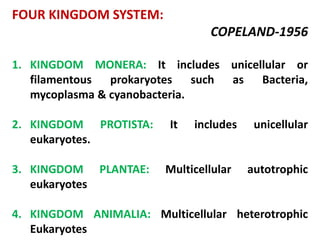
FOUR KINGDOM SYSTEM:
COPELAND‐1956
1. KINGDOM MONERA: It includes unicellular or
filamentous prokaryotes such as Bacteria,
mycoplasma & cyanobacteria.
2. KINGDOM PROTISTA: It includes unicellular
eukaryotes.
3. KINGDOM PLANTAE: Multicellular autotrophic
eukaryotes
4. KINGDOM ANIMALIA: Multicellular heterotrophic
Eukaryotes
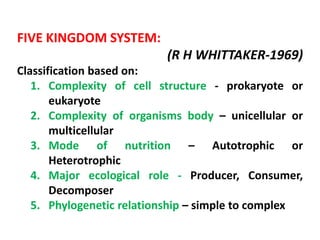
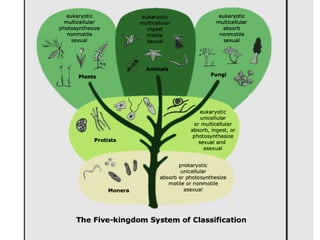
FIVE KINGDOM SYSTEM:
(R H WHITTAKER‐1969)
Classification based on:
1. Complexity of cell structure ‐ prokaryote or
eukaryote
2. Complexity of organisms body – unicellular or
multicellular
3. Mode of nutrition – Autotrophic or
Heterotrophic
4. Major ecological role - Producer, Consumer,
Decomposer
5. Phylogenetic relationship – simple to complex
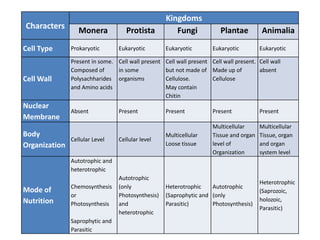
Characters
Kingdoms
Monera Protista Fungi Plantae Animalia
Cell Type Prokaryotic Eukaryotic Eukaryotic Eukaryotic Eukaryotic
Cell Wall
Present in some.
Composed of
Polysachharides
and Amino acids
Cell wall present
in some
organisms
Cell wall present
but not made of
Cellulose.
May contain
Chitin
Cell wall present.
Made up of
Cellulose
Cell wall
absent
Nuclear
Membrane
Absent Present Present Present Present
Body
Organization
Cellular Level Cellular level
Multicellular
Loose tissue
Multicellular
Tissue and organ
level of
Organization
Multicellular
Tissue, organ
and organ
system level
Mode of
Nutrition
Autotrophic and
heterotrophic
Chemosynthesis
or
Photosynthesis
Saprophytic and
Parasitic
Autotrophic
(only
Photosynthesis)
and
heterotrophic
Heterotrophic
(Saprophytic and
Parasitic)
Autotrophic
(only
Photosynthesis)
Heterotrophic
(Saprozoic,
holozoic,
Parasitic)
KINGDOM MONERA
• The bacteria are kept under the Kingdom Monera.
• They are prokaryotic and possess cell wall.
• The cell wall is composed of polysaccharides and amino
acids.
• Bacteria can be autotrophic and heterotrophic. The
autotrophic bacteria can be chemosynthetic or
photosynthetic.
• The heterotrophic bacteria can be saprophytic or
parasitic.
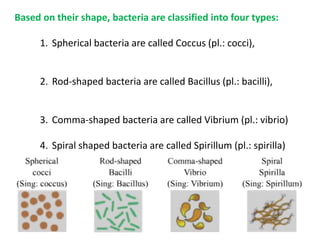
Based on their shape, bacteria are classified into four types:
1. Spherical bacteria are called Coccus (pl.: cocci),
2. Rod-shaped bacteria are called Bacillus (pl.: bacilli),
3. Comma-shaped bacteria are called Vibrium (pl.: vibrio)
4. Spiral shaped bacteria are called Spirillum (pl.: spirilla)
Archaebacteria:
• The archaebacteria live in some of the harshest habitats.
• The different structure of their cell wall helps them in
surviving in extreme conditions.
• Based on their habitats, the archaebacteria are classified as
follows:
1. Halophiles: They live in extremely salty areas.
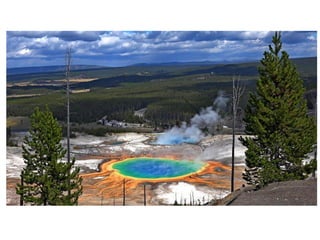
2. Thermoacidophiles: They live in hot spring.
3. Methanogens: They live in oxygen free marshy
areas. They also live in the guts of the ruminant
animals. They are responsible for the production of
methane from the dung of these animals.
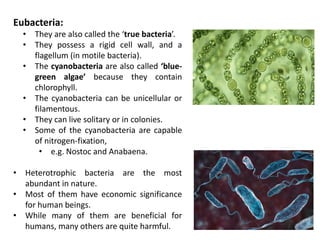
Eubacteria:
• They are also called the ‘true bacteria’.
• They possess a rigid cell wall, and a
flagellum (in motile bacteria).
• The cyanobacteria are also called ‘blue-
green algae’ because they contain
chlorophyll.
• The cyanobacteria can be unicellular or
filamentous.
• They can live solitary or in colonies.
• Some of the cyanobacteria are capable
of nitrogen-fixation,
• e.g. Nostoc and Anabaena.
• Heterotrophic bacteria are the most
abundant in nature.
• Most of them have economic significance
for human beings.
• While many of them are beneficial for
humans, many others are quite harmful.
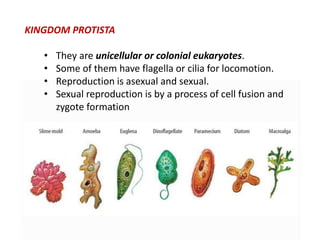
KINGDOM PROTISTA
• They are unicellular or colonial eukaryotes.
• Some of them have flagella or cilia for locomotion.
• Reproduction is asexual and sexual.
• Sexual reproduction is by a process of cell fusion and
zygote formation
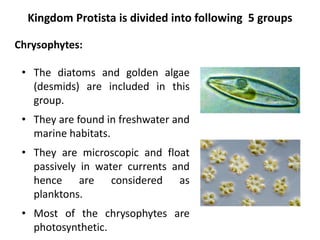
Chrysophytes:
• The diatoms and golden algae
(desmids) are included in this
group.
• They are found in freshwater and
marine habitats.
• They are microscopic and float
passively in water currents and
hence are considered as
planktons.
• Most of the chrysophytes are
photosynthetic.
Kingdom Protista is divided into following 5 groups
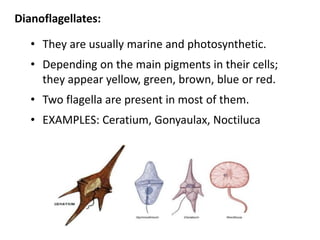
Dianoflagellates:
• They are usually marine and photosynthetic.
• Depending on the main pigments in their cells;
they appear yellow, green, brown, blue or red.
• Two flagella are present in most of them.
• EXAMPLES: Ceratium, Gonyaulax, Noctiluca
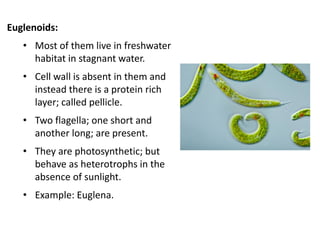
Euglenoids:
• Most of them live in freshwater
habitat in stagnant water.
• Cell wall is absent in them and
instead there is a protein rich
layer; called pellicle.
• Two flagella; one short and
another long; are present.
• They are photosynthetic; but
behave as heterotrophs in the
absence of sunlight.
• Example: Euglena.
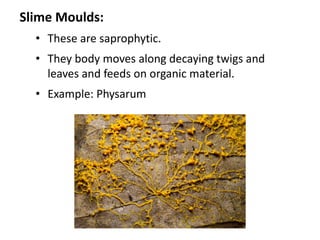
Slime Moulds:
• These are saprophytic.
• They body moves along decaying twigs and
leaves and feeds on organic material.
• Example: Physarum
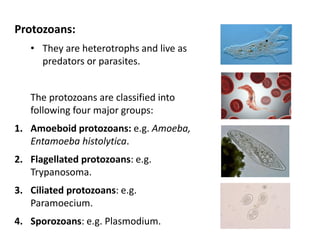
Protozoans:
• They are heterotrophs and live as
predators or parasites.
The protozoans are classified into
following four major groups:
1. Amoeboid protozoans: e.g. Amoeba,
Entamoeba histolytica.
2. Flagellated protozoans: e.g.
Trypanosoma.
3. Ciliated protozoans: e.g.
Paramoecium.
4. Sporozoans: e.g. Plasmodium.
KINGDOM FUNGI
• Unicellular or multicellular
eukaryotes
• Achlorophyllus heterotrophs
• Some are parasites (Puccinia),
• saprophytes (Yeast, Agaricus),
• Symbionts (Parmelia in lichens) &
• associated in the roots of higher
plants (mycorrhiza)
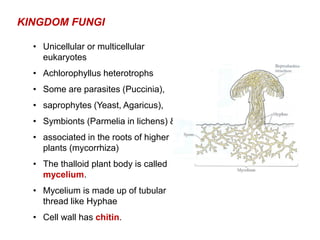
• The thalloid plant body is called
mycelium.
• Mycelium is made up of tubular
thread like Hyphae
• Cell wall has chitin.
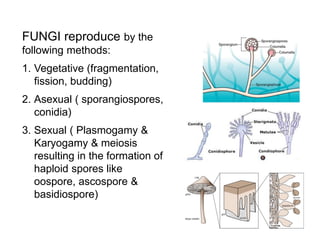
FUNGI reproduce by the
following methods:
1. Vegetative (fragmentation,
fission, budding)
2. Asexual ( sporangiospores,
conidia)
3. Sexual ( Plasmogamy &
Karyogamy & meiosis
resulting in the formation of
haploid spores like
oospore, ascospore &
basidiospore)
MAJOR GROUPS OF KINGDOM
FUNGI:
1. PHYCOMYCETES:
Mucor, Rhizopus
2. ASCOMYCETES (SAC FUNGI):
Pencillium, Yeast
3. BASIDIOMYCETES (CLUB FUNGI):
Agaricus, Puccinia
4. DEUTEROMYCETES (FUNGI
IMPERFECTI):
Cercospora, Alternaria
KINGDOM PLANTAE
• All multicellular eukaryotes which have chloroplast are kept
under this kingdom.
• Most of them are autotrophic; but some are heterotrophic.
• Cell wall is mainly composed of cellulose.
• The life cycle of plants has two distinct phases viz. the
diploid saprophytic and the haploid gametophytic phase.
• These phases alternate with each other.
• The lengths of the haploid and diploid phases vary among
different groups of plants.
• This phenomenon is called Alternation of Generation.
KINGDOM ANIMALIA:
• All multicellular eukaryotes which lack cell wall and are
heterotrophs are kept under this kingdom.
• The animals indirectly or directly depend for food on plants.
• They follow the holozoic mode of nutrition.
• Holozoic nutrition involves ingestion of food and use of
internal cavity for digestion of food.
• Most of the animals are capable of locomotion.
• Sexual reproduction is by copulation of male and female
which is followed by embryological development.
Merits:
1. Kingdom animalia become more homogenous with the
separation of protozoa.
2. Kingdom plantae also become more homogeneous with the
exclusion of bacteria, fungi and some unicellular algal forms.
3. Separation of prokaryotes into a separate kingdom – Monera
4. Separation of fungi from plants is a wise step.
5. Separation of intermediate or transitional forms of unicellular
eukaryotes into kingdom – Protista is well thought out. So
that the plant and animal kingdoms become more systematic.
6. It brings our phylogenetic relationships in the living world.
Merits and Demerits of Five Kingdom
Demerits:
1. The Monera and Protista kingdoms are still heterogenous
because both include autotrophic and heterotrophic
forms and some with or without cell wall.
2. Phyolgeny in lower organisms is not fully reflected.
3. Viruses have not been included in this system of
classification.

Five kingdom system

  • 1.
    . , , ,& . 1
  • 2.
    Anything which isgrouped into convenient category based on easily observable characters. Arrangement of organized information on the basis of similarities. WHAT IS CLASSIFICATION?
  • 3.
    • It isthe systematic grouping of organisms. • It is also called biosystematics. • Biosystematics deals with the identification, nomenclature & classification of organisms based on their similarities & differences. WHAT IS BIOLOGICAL CLASSIFICATION?
  • 4.
    DIFFERENT SYSTEMS OFCLASSIFICATION 1. ARTIFICIAL SYSTEMS: It is a system of classification based on one or two easily recognizable characters. Example: 1 Theophrastus (370‐300 BC) classified plants into: • Trees • Shrubs • Undershrubs • Herbs Example 2: Aristotle (384‐322 BC) classified animals into: • Enaima (Animals with red blood) • Anaima (Animals without red blood) • Ovipary (Egg laying) • Vivipary (Giving birth to young ones)
  • 5.
    2. NATURAL SYSTEMOF CLASSIFICATION It is a system of classification based on natural similarities of vegetative & floral characters. Example: George Bentham & Joseph Dalton Hooker classified plants into: • Cryptogams (non flowering plants) • Phanerogams (seed bearing plants)
  • 6.
    3. PHYLOGENETIC SYSTEM(CLADISTICS) It is a system of classification based on evolutionary & genetic relationship of organisms in addition to natural characters.
  • 7.
    KINGDOM SYSTEMS OF CLASSIFICATION TWO KINGDOMSYSTEM: CAROLUS LINNAEUS‐1758 1. KINGDOM PLANTAE: It includes Bacteria, Mycoplasma, fungi & photosynthetic plants. 2. KINGDOM ANIMALIA: It includes unicellular & multicellular animals.
  • 8.
    THREE KINGDOM SYSTEM: (ERNESTHAECKEL‐1866) 1. KINGDOM PROTISTA: It includes unicellular & colonial eukaryotes and prokaryotes such as bacteria, algae, fungi & protozoans. 2. KINGDOM PLANTAE: It includes multicellular photosynthetic plants. 3. KINGDOM ANIMALIA: It includes multicellular animals.
  • 9.
    FOUR KINGDOM SYSTEM: COPELAND‐1956 1.KINGDOM MONERA: It includes unicellular or filamentous prokaryotes such as Bacteria, mycoplasma & cyanobacteria. 2. KINGDOM PROTISTA: It includes unicellular eukaryotes. 3. KINGDOM PLANTAE: Multicellular autotrophic eukaryotes 4. KINGDOM ANIMALIA: Multicellular heterotrophic Eukaryotes
  • 10.
    FIVE KINGDOM SYSTEM: (RH WHITTAKER‐1969) Classification based on: 1. Complexity of cell structure ‐ prokaryote or eukaryote 2. Complexity of organisms body – unicellular or multicellular 3. Mode of nutrition – Autotrophic or Heterotrophic 4. Major ecological role - Producer, Consumer, Decomposer 5. Phylogenetic relationship – simple to complex
  • 12.
    Characters Kingdoms Monera Protista FungiPlantae Animalia Cell Type Prokaryotic Eukaryotic Eukaryotic Eukaryotic Eukaryotic Cell Wall Present in some. Composed of Polysachharides and Amino acids Cell wall present in some organisms Cell wall present but not made of Cellulose. May contain Chitin Cell wall present. Made up of Cellulose Cell wall absent Nuclear Membrane Absent Present Present Present Present Body Organization Cellular Level Cellular level Multicellular Loose tissue Multicellular Tissue and organ level of Organization Multicellular Tissue, organ and organ system level Mode of Nutrition Autotrophic and heterotrophic Chemosynthesis or Photosynthesis Saprophytic and Parasitic Autotrophic (only Photosynthesis) and heterotrophic Heterotrophic (Saprophytic and Parasitic) Autotrophic (only Photosynthesis) Heterotrophic (Saprozoic, holozoic, Parasitic)
  • 13.
    KINGDOM MONERA • Thebacteria are kept under the Kingdom Monera. • They are prokaryotic and possess cell wall. • The cell wall is composed of polysaccharides and amino acids. • Bacteria can be autotrophic and heterotrophic. The autotrophic bacteria can be chemosynthetic or photosynthetic. • The heterotrophic bacteria can be saprophytic or parasitic.
  • 14.
    Based on theirshape, bacteria are classified into four types: 1. Spherical bacteria are called Coccus (pl.: cocci), 2. Rod-shaped bacteria are called Bacillus (pl.: bacilli), 3. Comma-shaped bacteria are called Vibrium (pl.: vibrio) 4. Spiral shaped bacteria are called Spirillum (pl.: spirilla)
  • 15.
    Archaebacteria: • The archaebacterialive in some of the harshest habitats. • The different structure of their cell wall helps them in surviving in extreme conditions. • Based on their habitats, the archaebacteria are classified as follows: 1. Halophiles: They live in extremely salty areas. 2. Thermoacidophiles: They live in hot spring. 3. Methanogens: They live in oxygen free marshy areas. They also live in the guts of the ruminant animals. They are responsible for the production of methane from the dung of these animals.
  • 17.
    Eubacteria: • They arealso called the ‘true bacteria’. • They possess a rigid cell wall, and a flagellum (in motile bacteria). • The cyanobacteria are also called ‘blue- green algae’ because they contain chlorophyll. • The cyanobacteria can be unicellular or filamentous. • They can live solitary or in colonies. • Some of the cyanobacteria are capable of nitrogen-fixation, • e.g. Nostoc and Anabaena. • Heterotrophic bacteria are the most abundant in nature. • Most of them have economic significance for human beings. • While many of them are beneficial for humans, many others are quite harmful.
  • 18.
    KINGDOM PROTISTA • Theyare unicellular or colonial eukaryotes. • Some of them have flagella or cilia for locomotion. • Reproduction is asexual and sexual. • Sexual reproduction is by a process of cell fusion and zygote formation
  • 19.
    Chrysophytes: • The diatomsand golden algae (desmids) are included in this group. • They are found in freshwater and marine habitats. • They are microscopic and float passively in water currents and hence are considered as planktons. • Most of the chrysophytes are photosynthetic. Kingdom Protista is divided into following 5 groups
  • 20.
    Dianoflagellates: • They areusually marine and photosynthetic. • Depending on the main pigments in their cells; they appear yellow, green, brown, blue or red. • Two flagella are present in most of them. • EXAMPLES: Ceratium, Gonyaulax, Noctiluca
  • 21.
    Euglenoids: • Most ofthem live in freshwater habitat in stagnant water. • Cell wall is absent in them and instead there is a protein rich layer; called pellicle. • Two flagella; one short and another long; are present. • They are photosynthetic; but behave as heterotrophs in the absence of sunlight. • Example: Euglena.
  • 22.
    Slime Moulds: • Theseare saprophytic. • They body moves along decaying twigs and leaves and feeds on organic material. • Example: Physarum
  • 23.
    Protozoans: • They areheterotrophs and live as predators or parasites. The protozoans are classified into following four major groups: 1. Amoeboid protozoans: e.g. Amoeba, Entamoeba histolytica. 2. Flagellated protozoans: e.g. Trypanosoma. 3. Ciliated protozoans: e.g. Paramoecium. 4. Sporozoans: e.g. Plasmodium.
  • 24.
    KINGDOM FUNGI • Unicellularor multicellular eukaryotes • Achlorophyllus heterotrophs • Some are parasites (Puccinia), • saprophytes (Yeast, Agaricus), • Symbionts (Parmelia in lichens) & • associated in the roots of higher plants (mycorrhiza) • The thalloid plant body is called mycelium. • Mycelium is made up of tubular thread like Hyphae • Cell wall has chitin.
  • 25.
    FUNGI reproduce bythe following methods: 1. Vegetative (fragmentation, fission, budding) 2. Asexual ( sporangiospores, conidia) 3. Sexual ( Plasmogamy & Karyogamy & meiosis resulting in the formation of haploid spores like oospore, ascospore & basidiospore)
  • 26.
    MAJOR GROUPS OFKINGDOM FUNGI: 1. PHYCOMYCETES: Mucor, Rhizopus 2. ASCOMYCETES (SAC FUNGI): Pencillium, Yeast 3. BASIDIOMYCETES (CLUB FUNGI): Agaricus, Puccinia 4. DEUTEROMYCETES (FUNGI IMPERFECTI): Cercospora, Alternaria
  • 27.
    KINGDOM PLANTAE • Allmulticellular eukaryotes which have chloroplast are kept under this kingdom. • Most of them are autotrophic; but some are heterotrophic. • Cell wall is mainly composed of cellulose. • The life cycle of plants has two distinct phases viz. the diploid saprophytic and the haploid gametophytic phase. • These phases alternate with each other. • The lengths of the haploid and diploid phases vary among different groups of plants. • This phenomenon is called Alternation of Generation.
  • 28.
    KINGDOM ANIMALIA: • Allmulticellular eukaryotes which lack cell wall and are heterotrophs are kept under this kingdom. • The animals indirectly or directly depend for food on plants. • They follow the holozoic mode of nutrition. • Holozoic nutrition involves ingestion of food and use of internal cavity for digestion of food. • Most of the animals are capable of locomotion. • Sexual reproduction is by copulation of male and female which is followed by embryological development.
  • 29.
    Merits: 1. Kingdom animaliabecome more homogenous with the separation of protozoa. 2. Kingdom plantae also become more homogeneous with the exclusion of bacteria, fungi and some unicellular algal forms. 3. Separation of prokaryotes into a separate kingdom – Monera 4. Separation of fungi from plants is a wise step. 5. Separation of intermediate or transitional forms of unicellular eukaryotes into kingdom – Protista is well thought out. So that the plant and animal kingdoms become more systematic. 6. It brings our phylogenetic relationships in the living world. Merits and Demerits of Five Kingdom
  • 30.
    Demerits: 1. The Moneraand Protista kingdoms are still heterogenous because both include autotrophic and heterotrophic forms and some with or without cell wall. 2. Phyolgeny in lower organisms is not fully reflected. 3. Viruses have not been included in this system of classification.