Bellringer: Monday, March 17, 2014
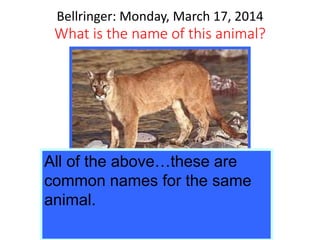
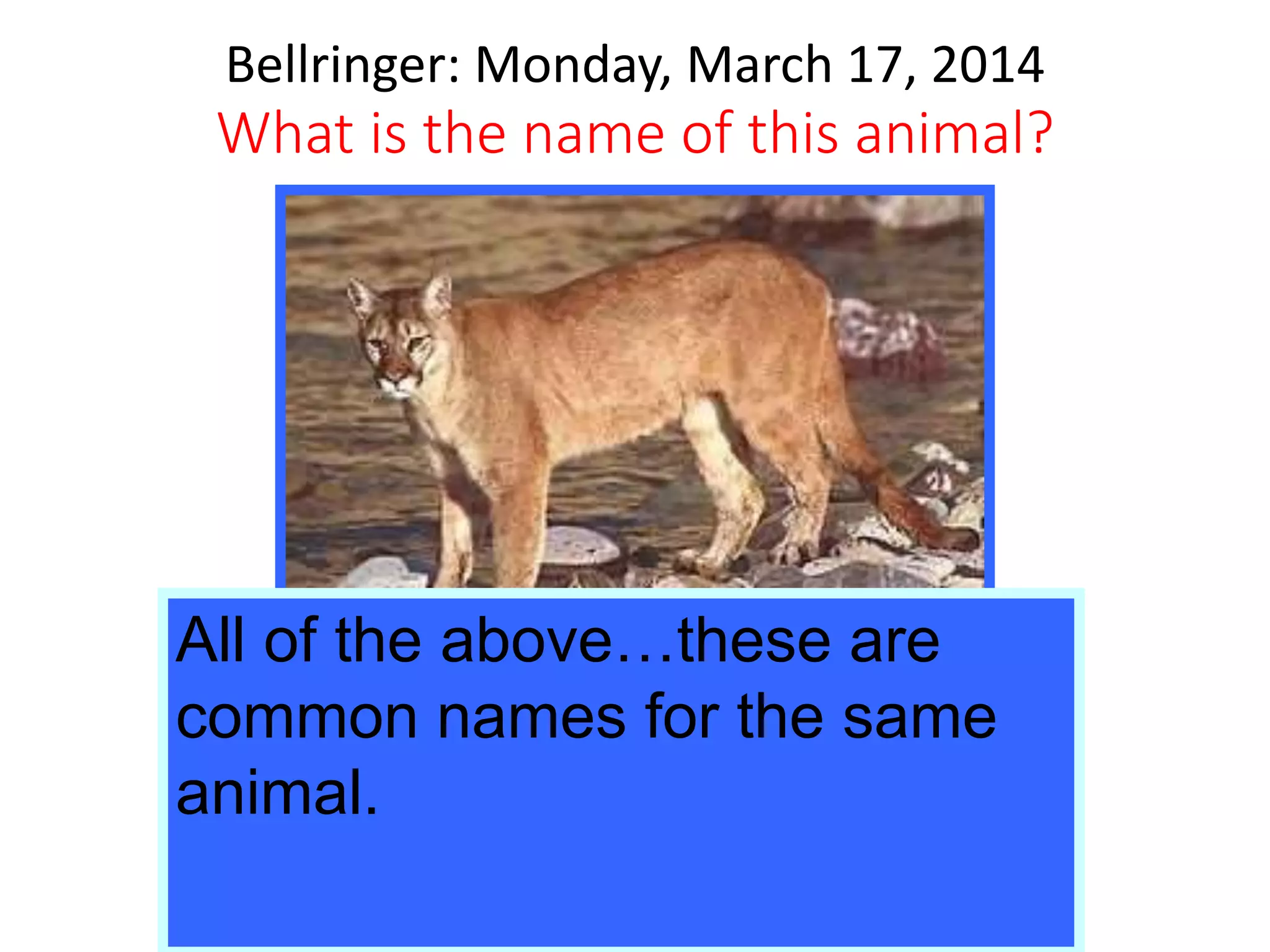
What is the name of this animal?
a. Puma
b. Cougar
c. Mountain lion
d. Panther
All of the above…these are
common names for the same
animal.
Objective
•We will define and recognize the
importance of taxonomy
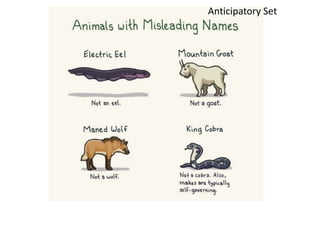
Anticipatory Set
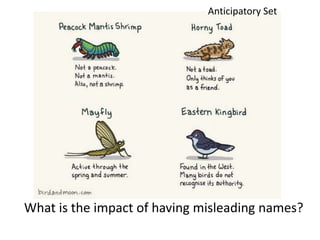
What is the impact of having misleading names?
Anticipatory Set
To avoid confusion caused by
regional names, biologists use a
classification system to group
organisms in an organized and
logical manner and to assign names.
What is taxonomy?
•It’s the science of naming
and classifying organisms.
What is Classification?
It’s the grouping of objects
or information on the basis
of similarities.
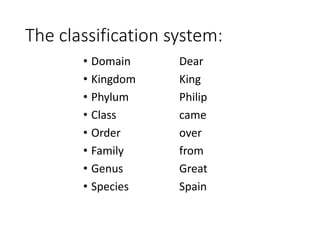
The classification system:
• Domain Dear
• Kingdom King
• Phylum Philip
• Class came
• Order over
• Family from
• Genus Great
• Species Spain
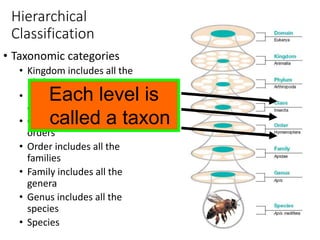
Hierarchical
Classification
• Taxonomic categories
• Kingdom includes all the
phyla
• Phylum includes all the
classes
• Class includes all the
orders
• Order includes all the
families
• Family includes all the
genera
• Genus includes all the
species
• Species
Each level is
called a taxon
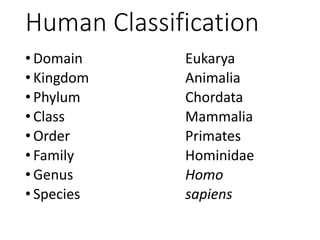
Human Classification
• Domain Eukarya
• Kingdom Animalia
• Phylum Chordata
• Class Mammalia
• Order Primates
• Family Hominidae
• Genus Homo
• Species sapiens
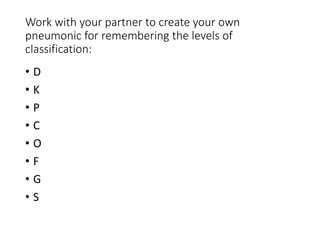
Work with your partner to create your own
pneumonic for remembering the levels of
classification:
• D
• K
• P
• C
• O
• F
• G
• S
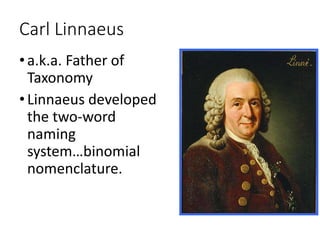
Carl Linnaeus
•a.k.a. Father of
Taxonomy
•Linnaeus developed
the two-word
naming
system…binomial
nomenclature.
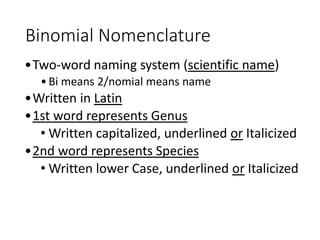
Binomial Nomenclature
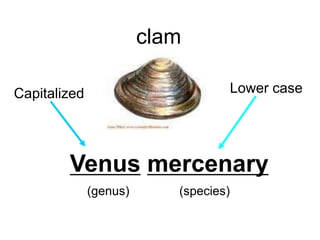
•Two-word naming system (scientific name)
•Bi means 2/nomial means name
•Written in Latin
•1st word represents Genus
• Written capitalized, underlined or Italicized
•2nd word represents Species
• Written lower Case, underlined or Italicized
Venus mercenary
(genus)
clam
Lower caseCapitalized
(species)
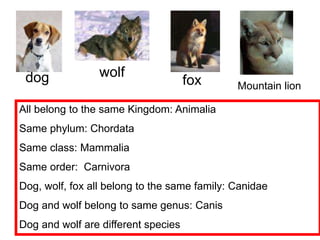
dog
Mountain lionfox
wolf
What are some ways these
animals are similar and what are
some ways they are different?
All belong to the same Kingdom: Animalia
Same phylum: Chordata
Same class: Mammalia
Same order: Carnivora
Dog, wolf, fox all belong to the same family: Canidae
Dog and wolf belong to same genus: Canis
Dog and wolf are different species
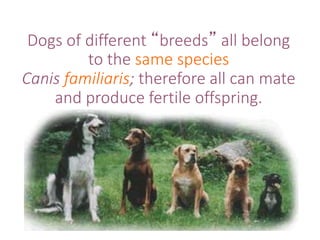
Dogs of different “breeds” all belong
to the same species
Canis familiaris; therefore all can mate
and produce fertile offspring.
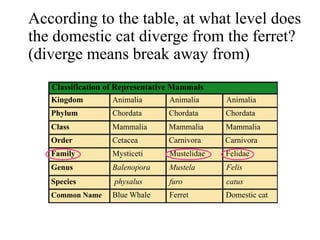
According to the table, at what level does
the domestic cat diverge from the ferret?
(diverge means break away from)
Classification of Representative Mammals
Kingdom
Phylum
Class
Order
Family
Genus
Species
Common Name
Animalia
Chordata
Mammalia
Cetacea
Mysticeti
Balenopora
physalus
Blue Whale
Animalia Animalia
Chordata Chordata
Mammalia Mammalia
Carnivora Carnivora
Mustelidae Felidae
Mustela Felis
furo catus
Ferret Domestic cat
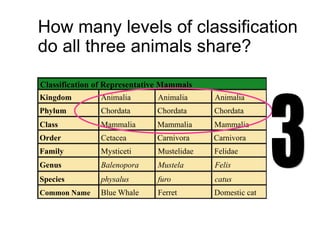
How many levels of classification
do all three animals share?
Classification of Representative Mammals
Kingdom
Phylum
Class
Order
Family
Genus
Species
Common Name
Animalia
Chordata
Mammalia
Cetacea
Mysticeti
Balenopora
physalus
Blue Whale
Animalia Animalia
Chordata Chordata
Mammalia Mammalia
Carnivora Carnivora
Mustelidae Felidae
Mustela Felis
furo catus
Ferret Domestic cat
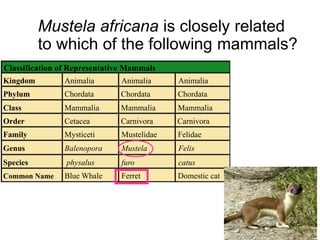
Mustela africana is closely related
to which of the following mammals?
Classification of Representative Mammals
Kingdom
Phylum
Class
Order
Family
Genus
Species
Common Name
Animalia
Chordata
Mammalia
Cetacea
Mysticeti
Balenopora
physalus
Blue Whale
Animalia Animalia
Chordata Chordata
Mammalia Mammalia
Carnivora Carnivora
Mustelidae Felidae
Mustela Felis
furo catus
Ferret Domestic cat
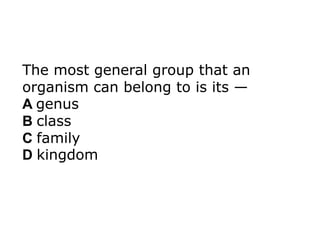
The most general group that an
organism can belong to is its —
A genus
B class
C family
D kingdom
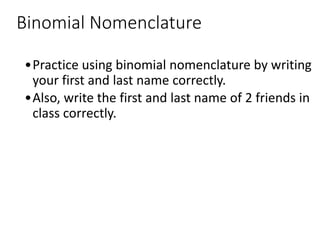
Binomial Nomenclature
•Practice using binomial nomenclature by writing
your first and last name correctly.
•Also, write the first and last name of 2 friends in
class correctly.
Binomial Nomenclature
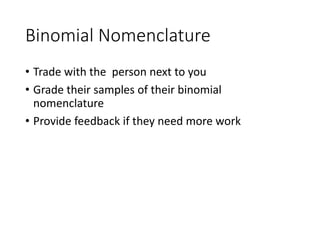
• Trade with the person next to you
• Grade their samples of their binomial
nomenclature
• Provide feedback if they need more work
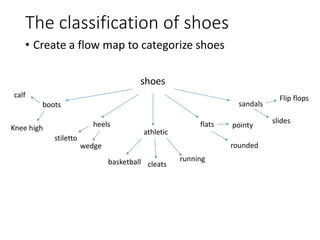
The classification of shoes
• Create a flow map to categorize shoes
shoes
boots
heels
athletic
flats
sandals
basketball running
cleats
pointy
rounded
Flip flops
slides
stiletto
wedge
Knee high
calf
Independent Practice
• Complete the worksheet provided. You have 10
minutes
Product
What would happen if there was not a
taxonomic system for classifying organisms?
Explain your answer in complete sentences.
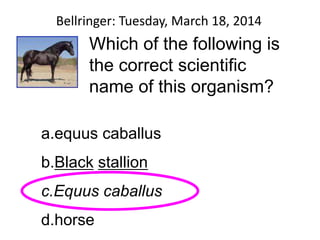
Bellringer: Tuesday, March 18, 2014
Which of the following is
the correct scientific
name of this organism?
a.equus caballus
b.Black stallion
c.Equus caballus
d.horse
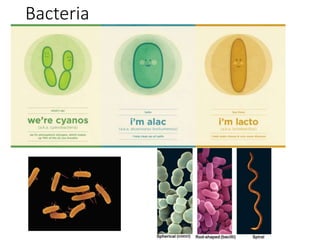
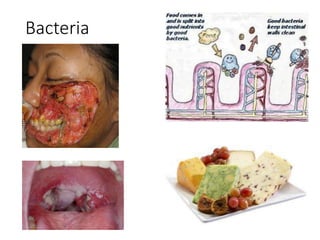
Bacteria
Bacteria
Objective
•We will identify and compare the
characteristics of Kingdoms
Archaebacteria and Eubacteria.
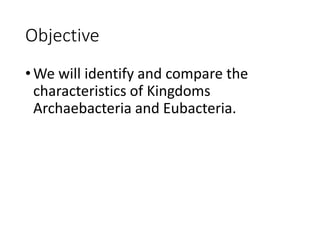
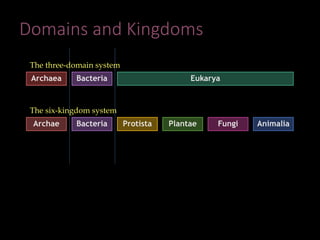
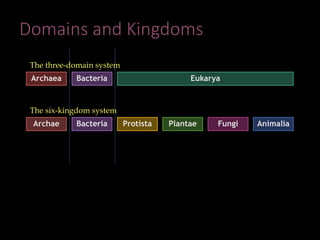
Domains and Kingdoms
BacteriaArchaea Eukarya
BacteriaArchae Protista Plantae Fungi Animalia
The three-domain system
The six-kingdom system
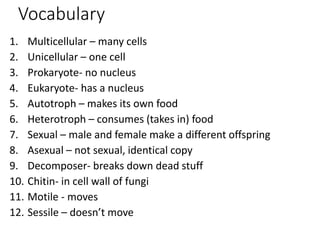
Vocabulary
1. Multicellular – many cells
2. Unicellular – one cell
3. Prokaryote- no nucleus
4. Eukaryote- has a nucleus
5. Autotroph – makes its own food
6. Heterotroph – consumes (takes in) food
7. Sexual – male and female make a different offspring
8. Asexual – not sexual, identical copy
9. Decomposer- breaks down dead stuff
10. Chitin- in cell wall of fungi
11. Motile - moves
12. Sessile – doesn’t move
Kingdom Archaebacteria
• The OLD bacteria
• Live in extreme habitats
• Unicellular
• Prokaryotic
• Heterotrophic and chemotrophic
• Asexual
Examples of Archaebacteria:
1. methanogens
-produce methane: found in intestines
and sewage plants
2. halophiles
-love and live and salt
3. thermophiles
-love and live in extreme temperatures
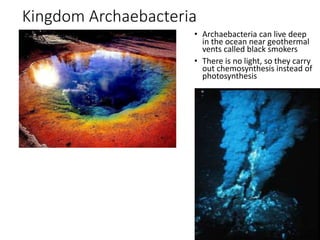
Kingdom Archaebacteria
• Archaebacteria can live deep
in the ocean near geothermal
vents called black smokers
• There is no light, so they carry
out chemosynthesis instead of
photosynthesis
Kingdom Eubacteria
• The NEW bacteria
• Live in a wide variety of habitats, including other
organisms
• Unicellular
• Prokaryotic
• Heterotrophic, autotrophic, and chemotrophic
• Asexual
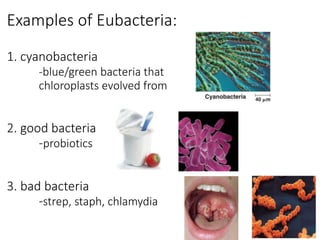
Examples of Eubacteria:
1. cyanobacteria
-blue/green bacteria that
chloroplasts evolved from
2. good bacteria
-probiotics
3. bad bacteria
-strep, staph, chlamydia
Guided practice- create a booklet
• Number each page at the bottom right corner (front and back)
• Create a cover for your 6 kingdoms booklet (pg 1)
• On page 2 do the following:
• Write “Kingdom Archaebacteria” at the top
• Include the characteristics from your chart for this kingdom
• Type of cell, feeding type, cell number, reproduction
• Give a description and draw a picture for each example
• Methanogens, halophiles, thermophiles
• Describe this kingdom in your own words
• On page 3 do the following:
• Write “Kingdom Eubacteria” at the top
• Include the characteristics from your chart for this kingdom
• Type of cell, feeding type, cell number, reproduction
• Give a description and draw a picture for each example
• Cyanobacteria, good bacteria, bad bacteria
• Describe this kingdom in your own words
Product
Compare and contrast the characteristics of
the kingdoms archaebacteria and eubacteria
Bellringer: Wednesday, March 19, 2014
Explain the similarities and
differences between the kingdoms
archaebacteria and eubacteria
Objective
•We will identify and compare the
characteristics of Kingdoms Protista and
Fungi
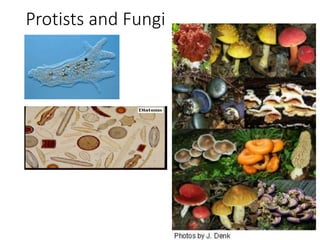
Protists and Fungi
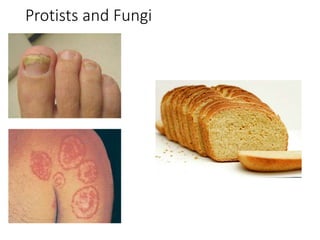
Protists and Fungi
Domains and Kingdoms
BacteriaArchaea Eukarya
BacteriaArchae Protista Plantae Fungi Animalia
The three-domain system
The six-kingdom system
Kingdom Protista
• The “leftover” group
• Similar to bacteria but are very complex
• Eukaryotic
• Mostly unicellular
• Autotrophic and heterotrophic
• Asexual
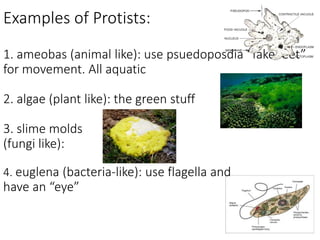
Examples of Protists:
1. ameobas (animal like): use psuedoposdia “fake feet”
for movement. All aquatic
2. algae (plant like): the green stuff
3. slime molds
(fungi like):
4. euglena (bacteria-like): use flagella and
have an “eye”
Kingdom Fungi
• Eukaryotic
• Most are multicellular
• Heterotrophic (decomposers)
• Cell walls made of chitin
• Do NOT move. Live on or in their food.
• Nutrients absorbed after extracellular digestion
• Asexual
• spores
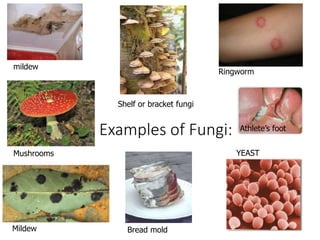
Examples of Fungi:
mildew
Bread mold
Shelf or bracket fungi
YEASTMushrooms
Mildew
Ringworm
Athlete’s foot
Guided practice- create a booklet
• On page 4 do the following:
• Write “Kingdom Protista” at the top
• Include the characteristics from your chart for this
kingdom
• Type of cell, feeding type, cell number, reproduction
• Give a description and draw a picture for each example
• Euglena, amoeba, slime molds, algae
• Describe this kingdom in your own words
• On page 5 do the following:
• Write “Kingdom Fungi” at the top
• Include the characteristics from your chart for this
kingdom
• Type of cell, feeding type, cell number, reproduction
• Give a description and draw a picture for each example
• Mushroom, yeast, mildew
• Describe this kingdom in your own words
Product
Compare and contrast the characteristics of
the kingdoms Protista and Fungi
Bellringer: Thursday, March 20, 2014
Explain the similarities and
differences between the
kingdoms Protista and Fungi
Objective
•We will identify and compare the
characteristics of Kingdoms Plantae and
Animalia
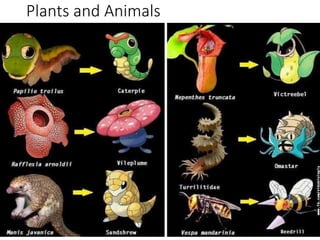
Plants and Animals
Domains and Kingdoms
BacteriaArchaea Eukarya
BacteriaArchae Protista Plantae Fungi Animalia
The three-domain system
The six-kingdom system
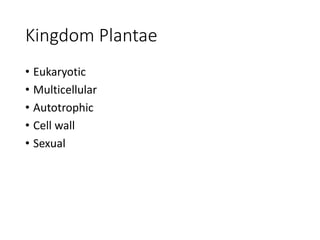
Kingdom Plantae
• Eukaryotic
• Multicellular
• Autotrophic
• Cell wall
• Sexual
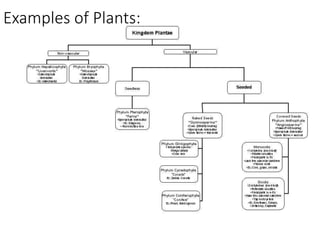
Examples of Plants:
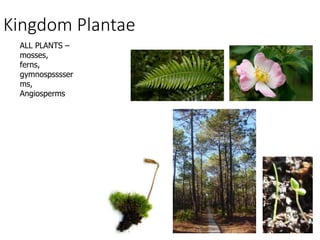
Kingdom Plantae
ALL PLANTS –
mosses,
ferns,
gymnospsssser
ms,
Angiosperms
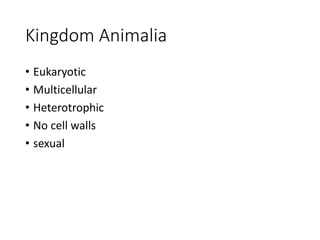
Kingdom Animalia
• Eukaryotic
• Multicellular
• Heterotrophic
• No cell walls
• sexual
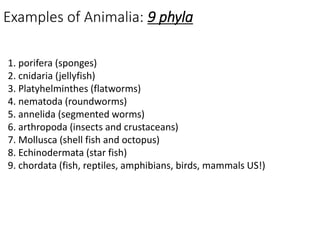
Examples of Animalia: 9 phyla
1. porifera (sponges)
2. cnidaria (jellyfish)
3. Platyhelminthes (flatworms)
4. nematoda (roundworms)
5. annelida (segmented worms)
6. arthropoda (insects and crustaceans)
7. Mollusca (shell fish and octopus)
8. Echinodermata (star fish)
9. chordata (fish, reptiles, amphibians, birds, mammals US!)
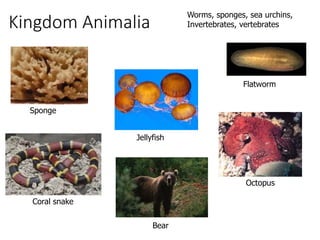
Kingdom Animalia
Coral snake
Sponge
Flatworm
Octopus
Jellyfish
Bear
Worms, sponges, sea urchins,
Invertebrates, vertebrates
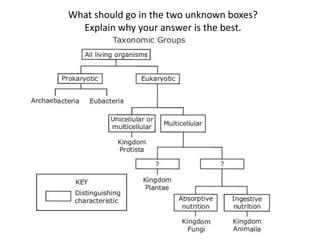
What should go in the two unknown boxes?
Explain why your answer is the best.
Guided practice- create a booklet
• On page 6 do the following:
• Write “Kingdom Plantae” at the top
• Include the characteristics from your chart for this kingdom
• Type of cell, feeding type, cell number, reproduction
• Give a description and draw a picture for each example
• Mosses, ferns, gymnosperms, angiosperms
• Describe this kingdom in your own words
• On page 7 do the following:
• Write “Kingdom Animalia” at the top
• Include the characteristics from your chart for this kingdom
• Type of cell, feeding type, cell number, reproduction
• Give a description and draw a picture for each example
• Porifera, cnidaria, Platyhelminthes, nematoda, annelida, Mollusca,
Echinodermata, arthropoda, chordata
• Describe this kingdom in your own words
Product
Compare and contrast the characteristics of
the kingdoms Plantae and Animalia
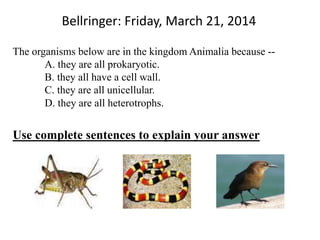
Bellringer: Friday, March 21, 2014
The organisms below are in the kingdom Animalia because --
A. they are all prokaryotic.
B. they all have a cell wall.
C. they are all unicellular.
D. they are all heterotrophs.
Use complete sentences to explain your answer
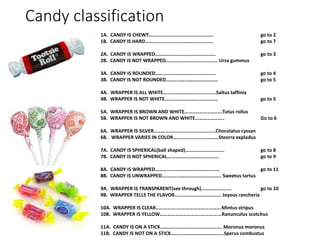
Candy classification
1A. CANDY IS CHEWY…………………………………………… go to 2
1B. CANDY IS HARD……………………………………………… go to 7
2A. CANDY IS WRAPPED………………………………………… go to 3
2B. CANDY IS NOT WRAPPED………………………………….. Ursa gummus
3A. CANDY IS ROUNDED………………………………………… go to 4
3B. CANDY IS NOT ROUNDED………………………………….. go to 5
4A. WRAPPER IS ALL WHITE……………………………………Saltus taffinia
4B. WRAPPER IS NOT WHITE…………………………………… go to 5
5A. WRAPPER IS BROWN AND WHITE…………………………Tutus rollus
5B. WRAPPER IS NOT BROWN AND WHITE………………….. Go to 6
6A. WRAPPER IS SILVER………………………………………….Chocolatus cyssan
6B. WRAPPER VARIES IN COLOR………………………………Steorra explodus
7A. CANDY IS SPHERICAL(ball shaped)…………………………. go to 8
7B. CANDY IS NOT SPHERICAL………………………………….. go to 9
8A. CANDY IS WRAPPED…………………………………………… go to 11
8B. CANDY IS UNWRAPPED……………………………………….. Sweetus tartus
9A. WRAPPER IS TRANSPARENT(see through)…………………… go to 10
9B. WRAPPER TELLS THE FLAVOR………………………………. Joyous rancheria
10A. WRAPPER IS CLEAR…………………………………………….Mintus stripus
10B. WRAPPER IS YELLOW………………………………………….Ranunculus scotchus
11A. CANDY IS ON A STICK…………………………………………. Moronus moronus
11B. CANDY IS NOT ON A STICK……………………………………Sperus combustus
Objective
•We will categorize organisms using a
dichotomous key
What is a dichotomous key
• It is a tool used to determine the identity of an
organism
• Usually asks yes or no questions
How do you use a
Dichotomous Key
• Always gives you two choices
• Examine your organism and determine which of the
2 choices it fits the best
• Follow the steps
• Keep classifying until you get to the genus and
species of the organism
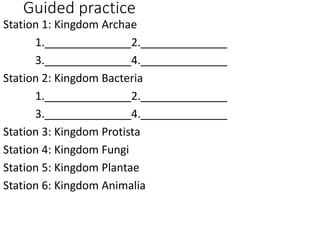
Guided practice
Station 1: Kingdom Archae
1. 2.
3. 4.
Station 2: Kingdom Bacteria
1. 2.
3. 4.
Station 3: Kingdom Protista
Station 4: Kingdom Fungi
Station 5: Kingdom Plantae
Station 6: Kingdom Animalia
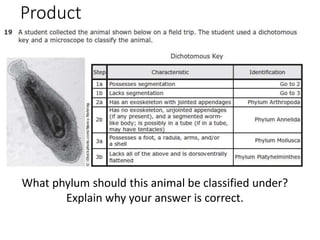
Product
What phylum should this animal be classified under?
Explain why your answer is correct.
Bellringer: Monday, March 24, 2014
Arthropods are joint-legged animals. Spiders, crabs, pill bugs,
centipedes, and millipedes are examples of the many types of
arthropods. Which of these arthropods are most closely related?
A. Arthropods of the same family
B. Arthropods of the same class
C. Arthropods of the same genus
D. Arthropods of the same species.
Use complete sentences to explain your answer.
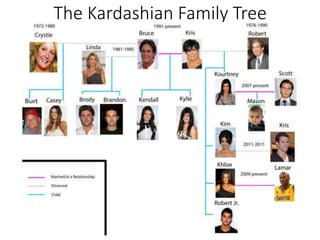
The Kardashian Family Tree
Objective
•We will categorize organisms using
cladograms and phylogenetic trees
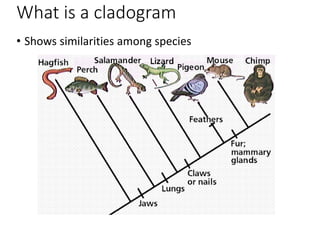
What is a cladogram
• Shows similarities among species
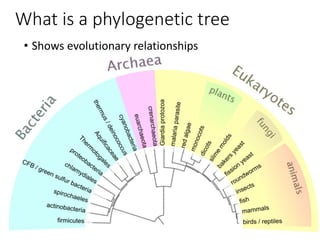
What is a phylogenetic tree
• Shows evolutionary relationships
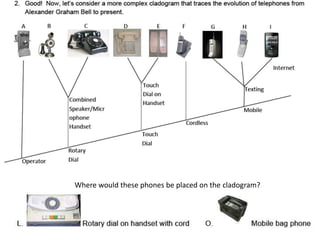
Where would these phones be placed on the cladogram?
Product
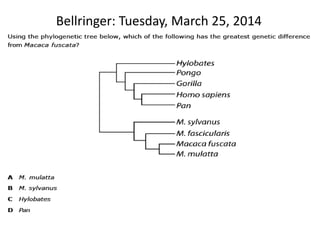
Bellringer: Tuesday, March 25, 2014
Objective
•We will take the classification unit exam.
Product
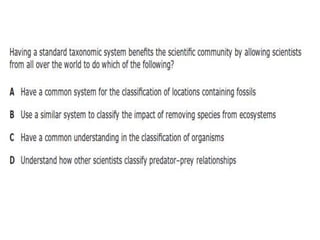
Why do scientists use a common classification
system?

Unit 10 classification

  • 1.
    Bellringer: Monday, March17, 2014 What is the name of this animal? a. Puma b. Cougar c. Mountain lion d. Panther All of the above…these are common names for the same animal.
  • 2.
    Objective •We will defineand recognize the importance of taxonomy
  • 3.
  • 4.
    What is theimpact of having misleading names? Anticipatory Set
  • 5.
    To avoid confusioncaused by regional names, biologists use a classification system to group organisms in an organized and logical manner and to assign names.
  • 6.
    What is taxonomy? •It’sthe science of naming and classifying organisms.
  • 7.
    What is Classification? It’sthe grouping of objects or information on the basis of similarities.
  • 8.
    The classification system: •Domain Dear • Kingdom King • Phylum Philip • Class came • Order over • Family from • Genus Great • Species Spain
  • 9.
    Hierarchical Classification • Taxonomic categories •Kingdom includes all the phyla • Phylum includes all the classes • Class includes all the orders • Order includes all the families • Family includes all the genera • Genus includes all the species • Species Each level is called a taxon
  • 10.
    Human Classification • DomainEukarya • Kingdom Animalia • Phylum Chordata • Class Mammalia • Order Primates • Family Hominidae • Genus Homo • Species sapiens
  • 11.
    Work with yourpartner to create your own pneumonic for remembering the levels of classification: • D • K • P • C • O • F • G • S
  • 12.
    Carl Linnaeus •a.k.a. Fatherof Taxonomy •Linnaeus developed the two-word naming system…binomial nomenclature.
  • 13.
    Binomial Nomenclature •Two-word namingsystem (scientific name) •Bi means 2/nomial means name •Written in Latin •1st word represents Genus • Written capitalized, underlined or Italicized •2nd word represents Species • Written lower Case, underlined or Italicized
  • 14.
  • 15.
    dog Mountain lionfox wolf What aresome ways these animals are similar and what are some ways they are different? All belong to the same Kingdom: Animalia Same phylum: Chordata Same class: Mammalia Same order: Carnivora Dog, wolf, fox all belong to the same family: Canidae Dog and wolf belong to same genus: Canis Dog and wolf are different species
  • 16.
    Dogs of different“breeds” all belong to the same species Canis familiaris; therefore all can mate and produce fertile offspring.
  • 17.
    According to thetable, at what level does the domestic cat diverge from the ferret? (diverge means break away from) Classification of Representative Mammals Kingdom Phylum Class Order Family Genus Species Common Name Animalia Chordata Mammalia Cetacea Mysticeti Balenopora physalus Blue Whale Animalia Animalia Chordata Chordata Mammalia Mammalia Carnivora Carnivora Mustelidae Felidae Mustela Felis furo catus Ferret Domestic cat
  • 18.
    How many levelsof classification do all three animals share? Classification of Representative Mammals Kingdom Phylum Class Order Family Genus Species Common Name Animalia Chordata Mammalia Cetacea Mysticeti Balenopora physalus Blue Whale Animalia Animalia Chordata Chordata Mammalia Mammalia Carnivora Carnivora Mustelidae Felidae Mustela Felis furo catus Ferret Domestic cat
  • 19.
    Mustela africana isclosely related to which of the following mammals? Classification of Representative Mammals Kingdom Phylum Class Order Family Genus Species Common Name Animalia Chordata Mammalia Cetacea Mysticeti Balenopora physalus Blue Whale Animalia Animalia Chordata Chordata Mammalia Mammalia Carnivora Carnivora Mustelidae Felidae Mustela Felis furo catus Ferret Domestic cat
  • 20.
    The most generalgroup that an organism can belong to is its — A genus B class C family D kingdom
  • 21.
    Binomial Nomenclature •Practice usingbinomial nomenclature by writing your first and last name correctly. •Also, write the first and last name of 2 friends in class correctly.
  • 22.
    Binomial Nomenclature • Tradewith the person next to you • Grade their samples of their binomial nomenclature • Provide feedback if they need more work
  • 23.
    The classification ofshoes • Create a flow map to categorize shoes shoes boots heels athletic flats sandals basketball running cleats pointy rounded Flip flops slides stiletto wedge Knee high calf
  • 24.
    Independent Practice • Completethe worksheet provided. You have 10 minutes
  • 25.
    Product What would happenif there was not a taxonomic system for classifying organisms? Explain your answer in complete sentences.
  • 26.
    Bellringer: Tuesday, March18, 2014 Which of the following is the correct scientific name of this organism? a.equus caballus b.Black stallion c.Equus caballus d.horse
  • 28.
  • 29.
  • 30.
    Objective •We will identifyand compare the characteristics of Kingdoms Archaebacteria and Eubacteria.
  • 31.
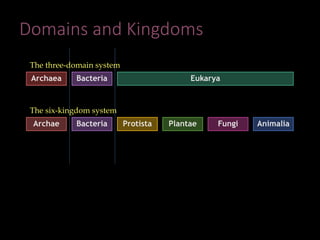
    Domains and Kingdoms BacteriaArchaeaEukarya BacteriaArchae Protista Plantae Fungi Animalia The three-domain system The six-kingdom system
  • 32.
    Vocabulary 1. Multicellular –many cells 2. Unicellular – one cell 3. Prokaryote- no nucleus 4. Eukaryote- has a nucleus 5. Autotroph – makes its own food 6. Heterotroph – consumes (takes in) food 7. Sexual – male and female make a different offspring 8. Asexual – not sexual, identical copy 9. Decomposer- breaks down dead stuff 10. Chitin- in cell wall of fungi 11. Motile - moves 12. Sessile – doesn’t move
  • 33.
    Kingdom Archaebacteria • TheOLD bacteria • Live in extreme habitats • Unicellular • Prokaryotic • Heterotrophic and chemotrophic • Asexual
  • 34.
    Examples of Archaebacteria: 1.methanogens -produce methane: found in intestines and sewage plants 2. halophiles -love and live and salt 3. thermophiles -love and live in extreme temperatures
  • 35.
    Kingdom Archaebacteria • Archaebacteriacan live deep in the ocean near geothermal vents called black smokers • There is no light, so they carry out chemosynthesis instead of photosynthesis
  • 36.
    Kingdom Eubacteria • TheNEW bacteria • Live in a wide variety of habitats, including other organisms • Unicellular • Prokaryotic • Heterotrophic, autotrophic, and chemotrophic • Asexual
  • 37.
    Examples of Eubacteria: 1.cyanobacteria -blue/green bacteria that chloroplasts evolved from 2. good bacteria -probiotics 3. bad bacteria -strep, staph, chlamydia
  • 38.
    Guided practice- createa booklet • Number each page at the bottom right corner (front and back) • Create a cover for your 6 kingdoms booklet (pg 1) • On page 2 do the following: • Write “Kingdom Archaebacteria” at the top • Include the characteristics from your chart for this kingdom • Type of cell, feeding type, cell number, reproduction • Give a description and draw a picture for each example • Methanogens, halophiles, thermophiles • Describe this kingdom in your own words • On page 3 do the following: • Write “Kingdom Eubacteria” at the top • Include the characteristics from your chart for this kingdom • Type of cell, feeding type, cell number, reproduction • Give a description and draw a picture for each example • Cyanobacteria, good bacteria, bad bacteria • Describe this kingdom in your own words
  • 39.
    Product Compare and contrastthe characteristics of the kingdoms archaebacteria and eubacteria
  • 40.
    Bellringer: Wednesday, March19, 2014 Explain the similarities and differences between the kingdoms archaebacteria and eubacteria
  • 41.
    Objective •We will identifyand compare the characteristics of Kingdoms Protista and Fungi
  • 42.
  • 43.
  • 44.
    Domains and Kingdoms BacteriaArchaeaEukarya BacteriaArchae Protista Plantae Fungi Animalia The three-domain system The six-kingdom system
  • 45.
    Kingdom Protista • The“leftover” group • Similar to bacteria but are very complex • Eukaryotic • Mostly unicellular • Autotrophic and heterotrophic • Asexual
  • 46.
    Examples of Protists: 1.ameobas (animal like): use psuedoposdia “fake feet” for movement. All aquatic 2. algae (plant like): the green stuff 3. slime molds (fungi like): 4. euglena (bacteria-like): use flagella and have an “eye”
  • 47.
    Kingdom Fungi • Eukaryotic •Most are multicellular • Heterotrophic (decomposers) • Cell walls made of chitin • Do NOT move. Live on or in their food. • Nutrients absorbed after extracellular digestion • Asexual • spores
  • 48.
    Examples of Fungi: mildew Breadmold Shelf or bracket fungi YEASTMushrooms Mildew Ringworm Athlete’s foot
  • 49.
    Guided practice- createa booklet • On page 4 do the following: • Write “Kingdom Protista” at the top • Include the characteristics from your chart for this kingdom • Type of cell, feeding type, cell number, reproduction • Give a description and draw a picture for each example • Euglena, amoeba, slime molds, algae • Describe this kingdom in your own words • On page 5 do the following: • Write “Kingdom Fungi” at the top • Include the characteristics from your chart for this kingdom • Type of cell, feeding type, cell number, reproduction • Give a description and draw a picture for each example • Mushroom, yeast, mildew • Describe this kingdom in your own words
  • 50.
    Product Compare and contrastthe characteristics of the kingdoms Protista and Fungi
  • 51.
    Bellringer: Thursday, March20, 2014 Explain the similarities and differences between the kingdoms Protista and Fungi
  • 52.
    Objective •We will identifyand compare the characteristics of Kingdoms Plantae and Animalia
  • 53.
  • 54.
    Domains and Kingdoms BacteriaArchaeaEukarya BacteriaArchae Protista Plantae Fungi Animalia The three-domain system The six-kingdom system
  • 55.
    Kingdom Plantae • Eukaryotic •Multicellular • Autotrophic • Cell wall • Sexual
  • 56.
  • 57.
    Kingdom Plantae ALL PLANTS– mosses, ferns, gymnospsssser ms, Angiosperms
  • 58.
    Kingdom Animalia • Eukaryotic •Multicellular • Heterotrophic • No cell walls • sexual
  • 59.
    Examples of Animalia:9 phyla 1. porifera (sponges) 2. cnidaria (jellyfish) 3. Platyhelminthes (flatworms) 4. nematoda (roundworms) 5. annelida (segmented worms) 6. arthropoda (insects and crustaceans) 7. Mollusca (shell fish and octopus) 8. Echinodermata (star fish) 9. chordata (fish, reptiles, amphibians, birds, mammals US!)
  • 60.
  • 61.
    What should goin the two unknown boxes? Explain why your answer is the best.
  • 62.
    Guided practice- createa booklet • On page 6 do the following: • Write “Kingdom Plantae” at the top • Include the characteristics from your chart for this kingdom • Type of cell, feeding type, cell number, reproduction • Give a description and draw a picture for each example • Mosses, ferns, gymnosperms, angiosperms • Describe this kingdom in your own words • On page 7 do the following: • Write “Kingdom Animalia” at the top • Include the characteristics from your chart for this kingdom • Type of cell, feeding type, cell number, reproduction • Give a description and draw a picture for each example • Porifera, cnidaria, Platyhelminthes, nematoda, annelida, Mollusca, Echinodermata, arthropoda, chordata • Describe this kingdom in your own words
  • 63.
    Product Compare and contrastthe characteristics of the kingdoms Plantae and Animalia
  • 64.
    Bellringer: Friday, March21, 2014 The organisms below are in the kingdom Animalia because -- A. they are all prokaryotic. B. they all have a cell wall. C. they are all unicellular. D. they are all heterotrophs. Use complete sentences to explain your answer
  • 66.
    Candy classification 1A. CANDYIS CHEWY…………………………………………… go to 2 1B. CANDY IS HARD……………………………………………… go to 7 2A. CANDY IS WRAPPED………………………………………… go to 3 2B. CANDY IS NOT WRAPPED………………………………….. Ursa gummus 3A. CANDY IS ROUNDED………………………………………… go to 4 3B. CANDY IS NOT ROUNDED………………………………….. go to 5 4A. WRAPPER IS ALL WHITE……………………………………Saltus taffinia 4B. WRAPPER IS NOT WHITE…………………………………… go to 5 5A. WRAPPER IS BROWN AND WHITE…………………………Tutus rollus 5B. WRAPPER IS NOT BROWN AND WHITE………………….. Go to 6 6A. WRAPPER IS SILVER………………………………………….Chocolatus cyssan 6B. WRAPPER VARIES IN COLOR………………………………Steorra explodus 7A. CANDY IS SPHERICAL(ball shaped)…………………………. go to 8 7B. CANDY IS NOT SPHERICAL………………………………….. go to 9 8A. CANDY IS WRAPPED…………………………………………… go to 11 8B. CANDY IS UNWRAPPED……………………………………….. Sweetus tartus 9A. WRAPPER IS TRANSPARENT(see through)…………………… go to 10 9B. WRAPPER TELLS THE FLAVOR………………………………. Joyous rancheria 10A. WRAPPER IS CLEAR…………………………………………….Mintus stripus 10B. WRAPPER IS YELLOW………………………………………….Ranunculus scotchus 11A. CANDY IS ON A STICK…………………………………………. Moronus moronus 11B. CANDY IS NOT ON A STICK……………………………………Sperus combustus
  • 67.
    Objective •We will categorizeorganisms using a dichotomous key
  • 68.
    What is adichotomous key • It is a tool used to determine the identity of an organism • Usually asks yes or no questions
  • 69.
    How do youuse a Dichotomous Key • Always gives you two choices • Examine your organism and determine which of the 2 choices it fits the best • Follow the steps • Keep classifying until you get to the genus and species of the organism
  • 70.
    Guided practice Station 1:Kingdom Archae 1. 2. 3. 4. Station 2: Kingdom Bacteria 1. 2. 3. 4. Station 3: Kingdom Protista Station 4: Kingdom Fungi Station 5: Kingdom Plantae Station 6: Kingdom Animalia
  • 71.
    Product What phylum shouldthis animal be classified under? Explain why your answer is correct.
  • 72.
    Bellringer: Monday, March24, 2014 Arthropods are joint-legged animals. Spiders, crabs, pill bugs, centipedes, and millipedes are examples of the many types of arthropods. Which of these arthropods are most closely related? A. Arthropods of the same family B. Arthropods of the same class C. Arthropods of the same genus D. Arthropods of the same species. Use complete sentences to explain your answer.
  • 73.
  • 74.
    Objective •We will categorizeorganisms using cladograms and phylogenetic trees
  • 75.
    What is acladogram • Shows similarities among species
  • 76.
    What is aphylogenetic tree • Shows evolutionary relationships
  • 77.
    Where would thesephones be placed on the cladogram?
  • 78.
  • 79.
  • 80.
    Objective •We will takethe classification unit exam.
  • 81.
    Product Why do scientistsuse a common classification system?