By : Geonyzl J. Lepiten
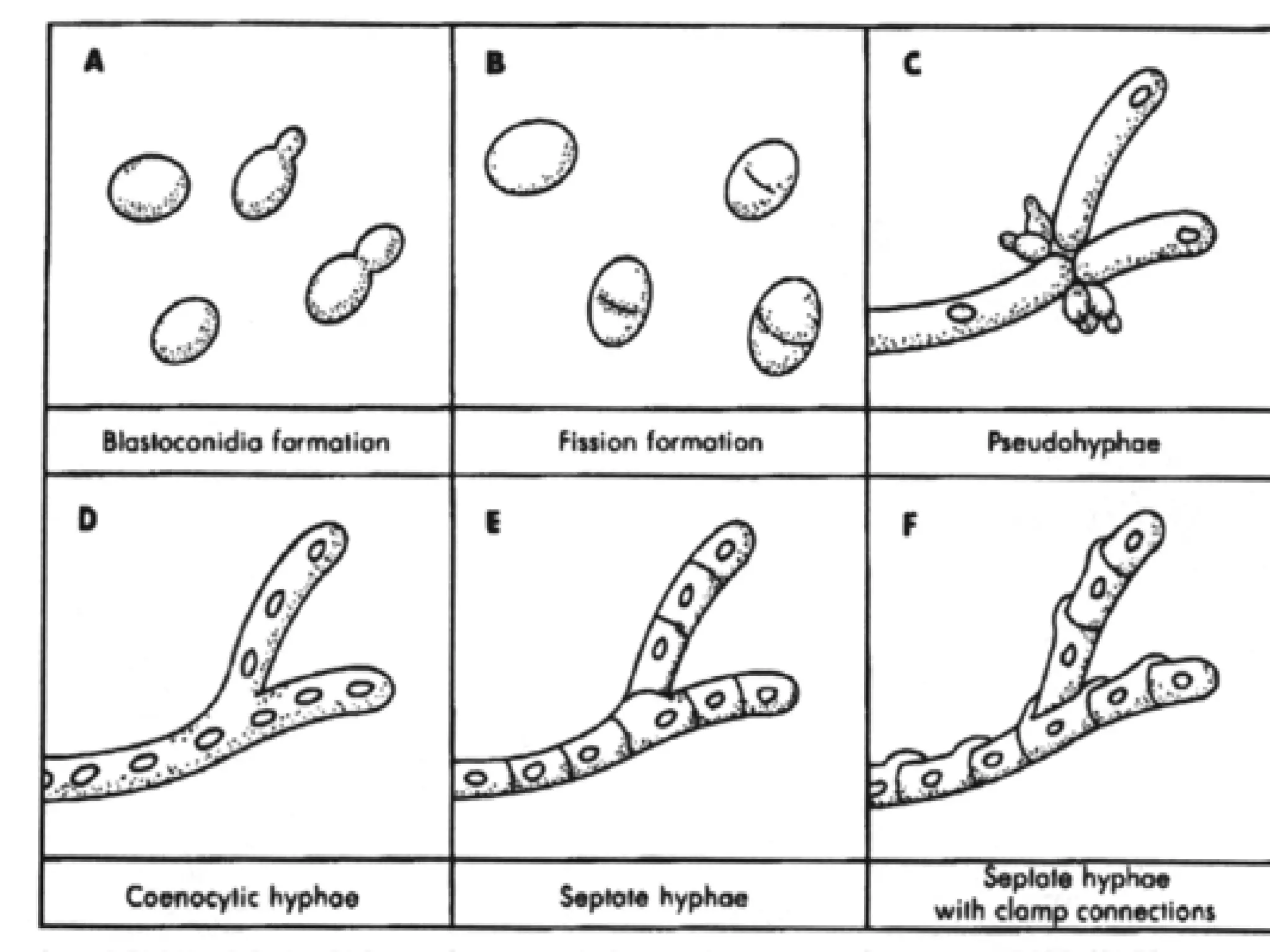
Introduction of  Fungi They are classified as  eukaryotes ,   Fungi can be divided into two basic morphological forms, yeasts and hyphae Yeasts  are unicellular fungi which reproduce asexually by  blastoconidia  formation (budding) or fission Hyphae  are multi-cellular fungi which reproduce asexually and/or sexually
Most fungi occur in the hyphae form as branching, threadlike tubular filaments.  -  lack cross walls  ( coenocytic ) -  have cross walls ( septate )  -   clamp connections  at the septa which connect the  the hyphae elements.  Coenocytic hyphae Septated Hyphae
 
COMMON CHARACTERISTICS OF FUNGI   1.  Heterotrophy  -   'other food'.   There are three major categories of  heterotrophs, which include the  saprophytes ,  symbionts , and  parasites .  Saprophytes  (feed on dead tissues or organic waste);  symbionts  (mutually beneficial relationship between a fungus and another organism);  parasites  (feeding on living tissue of a host).   Parasites that cause disease are called pathogens . Some parasites are  obligate parasites  (require a living host to survive), while others are  facultative or nonobligate  parasites  (do not require a living host in order to survive).  2.  Body form   unicellular   filamentous  (tube-like strands called hypha (singular) or hyphae (plural).  mycelium  = aggregate of hyphae  sclerotium  = hardened mass of mycelium that generally serves as an overwintering stage.  multicellular , such as mycelial cords, rhizomorphs, and fruit bodies (mushrooms)
3.  Fungus is often hidden from view . It grows through its food source (substratum), excretes extracellular digestive enzymes, and absorbs dissolved food.  4.  Indeterminate growth .  5.  Spores  - asexual (product of mitosis) or sexual (product of meiosis) in origin.        Purpose of Spores                   (a) Allows the fungus to move to new food  source.                 (b) Resistant stage - allows fungus to survive  periods of adversity.                 (c) Means of introducing new genetic  combinations into a population.  6. Vegetative phase of fungus is generally  sedentary.   7. Cell wall present, composed of cellulose and/or chitin.
8 . Food storage  - generally in the form of lipids and glycogen.  9.  Eukaryotes  - true nucleus and other organelles present.  10. All fungi require water and oxygen (no obligate anaerobes).  11. Fungi grow in almost every habitat imaginable, as long as there is some type of organic matter present and the environment is not too extreme.  12. Diverse group, number of described species is about 69,000 (estimated 1.5 million species total).
 
Phylums of Fungi Phylum Zygomycota  -  common mold found on land Reproduce by zygospores Ex:  Rhizopus  - common bread mold Contain root-like structures (rhizoids) to anchor in bread.  Stolons on surface of bread.
ASEXUAL REPRODUCTION: Sporangiospores  ( aplanospores ) or modified  sporangia  (sac-like merosporangia) functioning as  conidia . B. SEXUAL REPRODUCTION: Two morphologically similar gametangia fuse to produce a warty, thick  zygospore . Meiosis within zygospore. C. VEGETATIVE HYPHAE: Haplophase ; no  dikaryophase  except in fused gametangia;  aseptate . PHYLUM CHARACTERISTICS
 
 
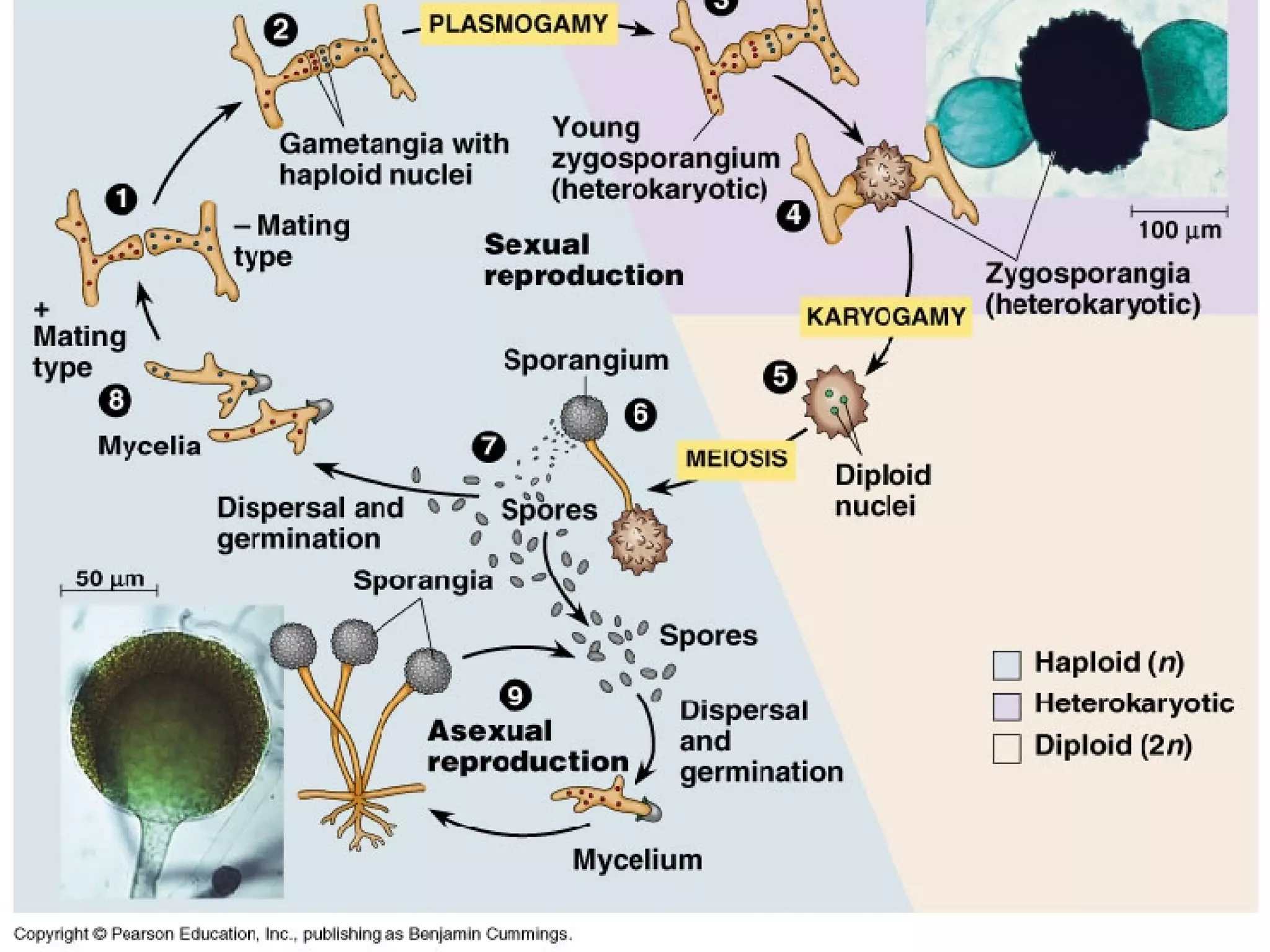
Asexual Reproduction:   -spores are produced by  sporangia  at the ends of modified, erect hyphae  Sexual Reproduction :  -two opposite mating types of hyphae join to produce  gametangia  that produce a diploid  zygospore  (thick walled spore) -the zygospore undergoes meiosis before germination and produces a haploid mycelium                                                     
D.  CELL WALLS : Chitin and chitosan. E.  ECOLOGY:  Free-living to parasitic.  Free-living forms mainly terrestrial saprobes.  Parasites mainly of insects, but of other animals, too.  Some parasitic on microbial eukaryotes.
production of  asexual aplanospores, fusion of gametangia  to produce  zygospores walls of chitin and chitosan ; asexual development seems to be from many-spored sporangia, through sporangia with a much-reduced number of spores,  to one-spored sporangiola which function as  conidia .   CLASS ZYGOMYCETES
Filamentous;  - aplanospores produced in globose, - multinucleate sporangia,  - narrow cylindrical sac-like merosporangia,  few-spored sporangiola or singly as conidia;  zygospores often thick-walled,  - black and warty resting spores;  large terminal chlamydospores common in  mycorrhizal forms.  - Saprophytic  "pin molds" . ORDER MUCORALES
Mucor
Rhizopus
Pilobolus kleinii   Hat Thrower   Chaetocladium brefeldii
Choanephora cucurbitarum   Mortierella
Phycomyces  blakesleeanus
Filamentous  coenocytic saprobic and mycorrhizal zygospores produced in underground sporocarp. ORDER ENDOGONIALES Densospora   , Endogone, Pteridiospora, Sclerogone, Youngiomyces.
Filamentous hyphae with septa which have a  lens-shaped cavity;  asexual reproduction by merosporangium of bispores.   Zygospore ornamented.  Parasites of fungi, especially Mucorales. Dimargaris, Dispira, Spinalia, Tieghemiomyces. ORDER DIMARGARITALES
Filamentous  some saprophytic, but mostly insect parasites vegetative phase tending to break up into  segments (hyphal bodies) asexual reproduction by forcibly discharged  uni- or multinucleate conidia zygospores smooth or ornamented. ORDER ENTOMOPHTHORALES Entomophthora, Condiobolus, Completoria,  Meristacrum, Neozygites..
Basidiomycota Club fungi Amanita rubrovaginata   Gymnosporangium juniperi-virginianae  Tilletia controversa
Basidiomycetes - the club fungi, about 22,300 species Includes mushrooms, toadstools, puffballs, shelf fungi,  rusts, bird's nest fungi and smuts 2. Characterized by  perforate septate hyphae  and the production of a  basidium  (club) following sexual reproduction. The basidia (pl. of basidium) occur in a mycelium called a  basidiocarp  and they produce external  basidiospores 3. See your next slide for a typical life cycle Basidiomycota
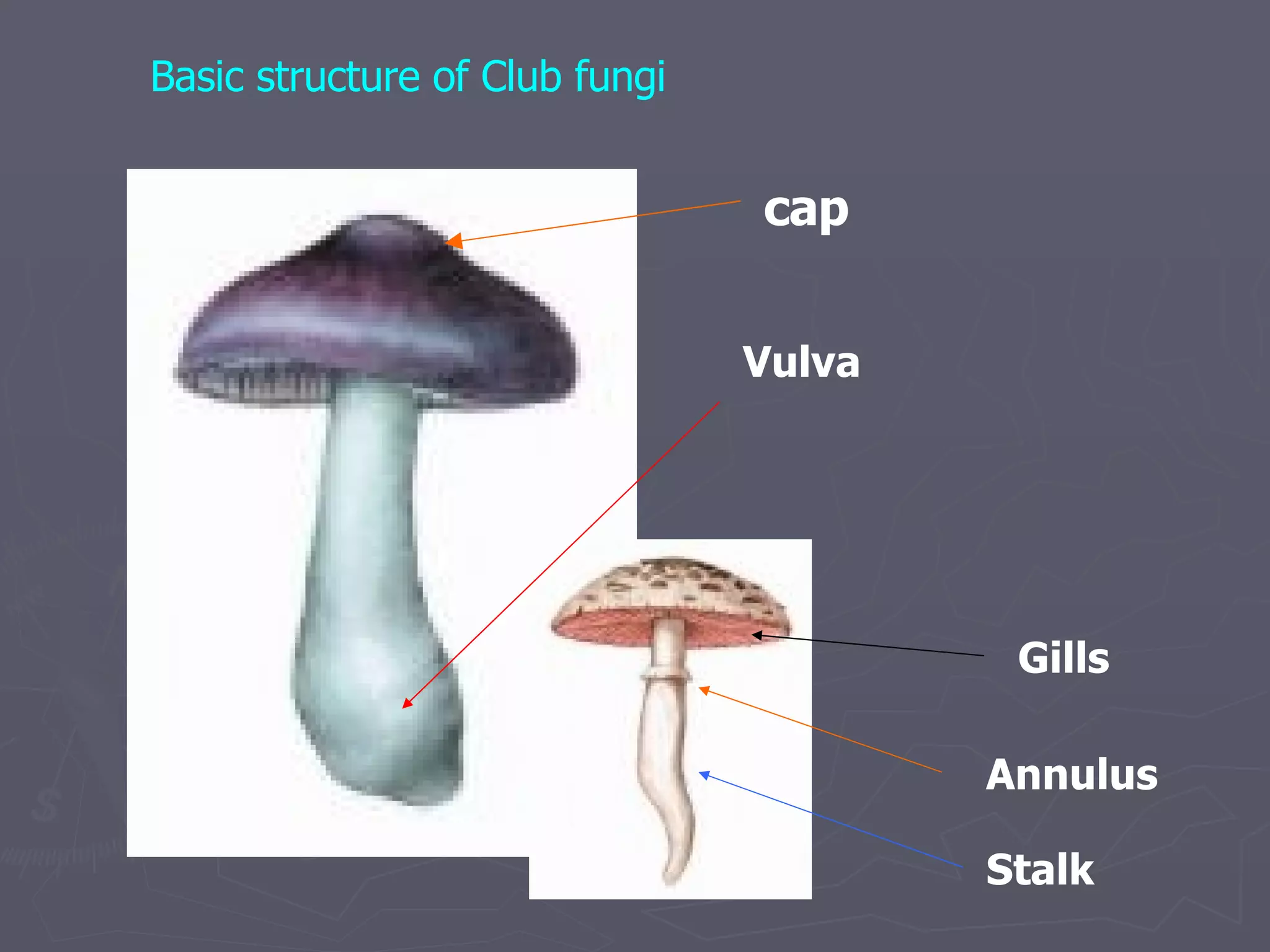
Basic structure of Club fungi cap Annulus Gills Stalk Vulva
 
Phylum ascomycota

Fungi

  • 1.
    By : GeonyzlJ. Lepiten
  • 2.
    Introduction of Fungi They are classified as  eukaryotes , Fungi can be divided into two basic morphological forms, yeasts and hyphae Yeasts are unicellular fungi which reproduce asexually by  blastoconidia formation (budding) or fission Hyphae are multi-cellular fungi which reproduce asexually and/or sexually
  • 3.
    Most fungi occurin the hyphae form as branching, threadlike tubular filaments. - lack cross walls ( coenocytic ) - have cross walls ( septate ) -   clamp connections at the septa which connect the the hyphae elements. Coenocytic hyphae Septated Hyphae
  • 4.
  • 5.
    COMMON CHARACTERISTICS OFFUNGI 1. Heterotrophy - 'other food'. There are three major categories of heterotrophs, which include the saprophytes , symbionts , and parasites . Saprophytes (feed on dead tissues or organic waste); symbionts (mutually beneficial relationship between a fungus and another organism); parasites (feeding on living tissue of a host).  Parasites that cause disease are called pathogens . Some parasites are obligate parasites (require a living host to survive), while others are facultative or nonobligate  parasites (do not require a living host in order to survive). 2. Body form unicellular filamentous (tube-like strands called hypha (singular) or hyphae (plural). mycelium = aggregate of hyphae sclerotium = hardened mass of mycelium that generally serves as an overwintering stage. multicellular , such as mycelial cords, rhizomorphs, and fruit bodies (mushrooms)
  • 6.
    3. Fungusis often hidden from view . It grows through its food source (substratum), excretes extracellular digestive enzymes, and absorbs dissolved food. 4. Indeterminate growth . 5. Spores - asexual (product of mitosis) or sexual (product of meiosis) in origin.      Purpose of Spores                (a) Allows the fungus to move to new food source.                (b) Resistant stage - allows fungus to survive periods of adversity.                (c) Means of introducing new genetic combinations into a population. 6. Vegetative phase of fungus is generally sedentary. 7. Cell wall present, composed of cellulose and/or chitin.
  • 7.
    8 . Foodstorage - generally in the form of lipids and glycogen. 9. Eukaryotes - true nucleus and other organelles present. 10. All fungi require water and oxygen (no obligate anaerobes). 11. Fungi grow in almost every habitat imaginable, as long as there is some type of organic matter present and the environment is not too extreme. 12. Diverse group, number of described species is about 69,000 (estimated 1.5 million species total).
  • 8.
  • 9.
    Phylums of FungiPhylum Zygomycota - common mold found on land Reproduce by zygospores Ex: Rhizopus - common bread mold Contain root-like structures (rhizoids) to anchor in bread. Stolons on surface of bread.
  • 10.
    ASEXUAL REPRODUCTION: Sporangiospores ( aplanospores ) or modified sporangia (sac-like merosporangia) functioning as conidia . B. SEXUAL REPRODUCTION: Two morphologically similar gametangia fuse to produce a warty, thick zygospore . Meiosis within zygospore. C. VEGETATIVE HYPHAE: Haplophase ; no dikaryophase except in fused gametangia; aseptate . PHYLUM CHARACTERISTICS
  • 11.
  • 12.
  • 13.
    Asexual Reproduction: -spores are produced by sporangia at the ends of modified, erect hyphae Sexual Reproduction :  -two opposite mating types of hyphae join to produce gametangia that produce a diploid zygospore (thick walled spore) -the zygospore undergoes meiosis before germination and produces a haploid mycelium                                                    
  • 14.
    D. CELLWALLS : Chitin and chitosan. E. ECOLOGY: Free-living to parasitic.  Free-living forms mainly terrestrial saprobes.  Parasites mainly of insects, but of other animals, too.  Some parasitic on microbial eukaryotes.
  • 15.
    production of asexual aplanospores, fusion of gametangia to produce zygospores walls of chitin and chitosan ; asexual development seems to be from many-spored sporangia, through sporangia with a much-reduced number of spores, to one-spored sporangiola which function as conidia . CLASS ZYGOMYCETES
  • 16.
    Filamentous; -aplanospores produced in globose, - multinucleate sporangia, - narrow cylindrical sac-like merosporangia, few-spored sporangiola or singly as conidia; zygospores often thick-walled, - black and warty resting spores; large terminal chlamydospores common in mycorrhizal forms. - Saprophytic "pin molds" . ORDER MUCORALES
  • 17.
  • 18.
  • 19.
    Pilobolus kleinii Hat Thrower Chaetocladium brefeldii
  • 20.
  • 21.
  • 22.
    Filamentous coenocyticsaprobic and mycorrhizal zygospores produced in underground sporocarp. ORDER ENDOGONIALES Densospora , Endogone, Pteridiospora, Sclerogone, Youngiomyces.
  • 23.
    Filamentous hyphae withsepta which have a lens-shaped cavity; asexual reproduction by merosporangium of bispores.  Zygospore ornamented. Parasites of fungi, especially Mucorales. Dimargaris, Dispira, Spinalia, Tieghemiomyces. ORDER DIMARGARITALES
  • 24.
    Filamentous somesaprophytic, but mostly insect parasites vegetative phase tending to break up into segments (hyphal bodies) asexual reproduction by forcibly discharged uni- or multinucleate conidia zygospores smooth or ornamented. ORDER ENTOMOPHTHORALES Entomophthora, Condiobolus, Completoria, Meristacrum, Neozygites..
  • 25.
    Basidiomycota Club fungiAmanita rubrovaginata Gymnosporangium juniperi-virginianae Tilletia controversa
  • 26.
    Basidiomycetes - theclub fungi, about 22,300 species Includes mushrooms, toadstools, puffballs, shelf fungi, rusts, bird's nest fungi and smuts 2. Characterized by perforate septate hyphae and the production of a basidium (club) following sexual reproduction. The basidia (pl. of basidium) occur in a mycelium called a basidiocarp and they produce external basidiospores 3. See your next slide for a typical life cycle Basidiomycota
  • 27.
    Basic structure ofClub fungi cap Annulus Gills Stalk Vulva
  • 28.
  • 29.