ACIDS AND BASES
Properties: (other than tasting sour and being corrosive)
1) React with metals
2) React with carbonates
3) Conduct electricity
4) Turn blue litmus paper red
5) Neutralize bases
ACIDS ARE CORROSIVE
ACIDS
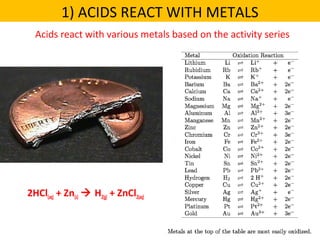
Acids react with various metals based on the activity series
1) ACIDS REACT WITH METALS
2HCl(aq) + Zn(s)  H2(g) + ZnCl2(aq)
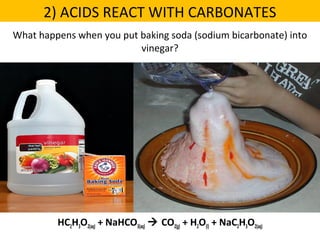
What happens when you put baking soda (sodium bicarbonate) into
vinegar?
HC2H3O2(aq) + NaHCO3(aq)  CO2(g) + H2O(l) + NaC2H3O2(aq)
2) ACIDS REACT WITH CARBONATES
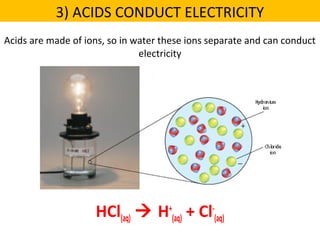
Acids are made of ions, so in water these ions separate and can conduct
electricity
HCl(aq)  H+
(aq) + Cl-
(aq)
3) ACIDS CONDUCT ELECTRICITY
H+
Cl-
H+
Cl-
H+
Cl-
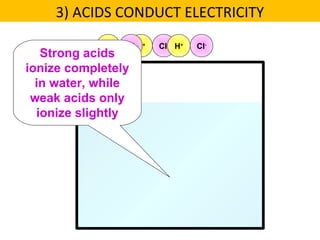
Strong acids
ionize completely
in water, while
weak acids only
ionize slightly
3) ACIDS CONDUCT ELECTRICITY
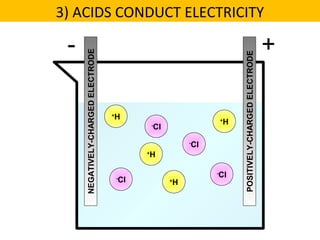
NEGATIVELY-CHARGEDELECTRODE
POSITIVELY-CHARGEDELECTRODE
H+
Cl-
H+Cl-
H+
Cl-
H+
Cl-
- +
3) ACIDS CONDUCT ELECTRICITY
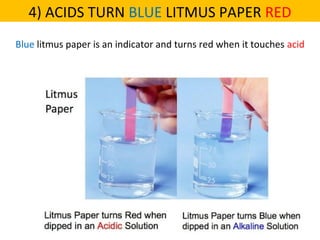
4) ACIDS TURN BLUE LITMUS PAPER RED
Blue litmus paper is an indicator and turns red when it touches acid
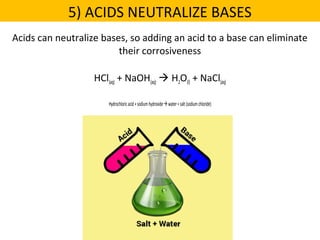
Acids can neutralize bases, so adding an acid to a base can eliminate
their corrosiveness
HCl(aq) + NaOH(aq)  H2O(l) + NaCl(aq)
Hydrochloricacid+sodiumhydroxidewater+salt(sodiumchloride)
5) ACIDS NEUTRALIZE BASES
Properties: (other than tasting bitter, feeling slippery)
1) Conduct electricity
2) Turn red litmus paper blue
3) Neutralize acids
BASES ARE CAUSTIC
BASES
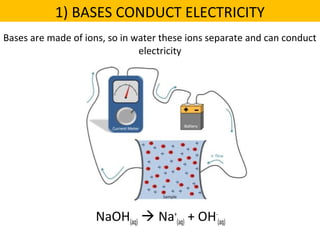
Bases are made of ions, so in water these ions separate and can conduct
electricity
NaOH(aq)  Na+
(aq) + OH-
(aq)
1) BASES CONDUCT ELECTRICITY
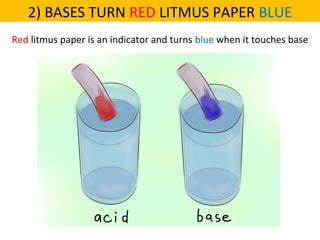
Red litmus paper is an indicator and turns blue when it touches base
2) BASES TURN RED LITMUS PAPER BLUE
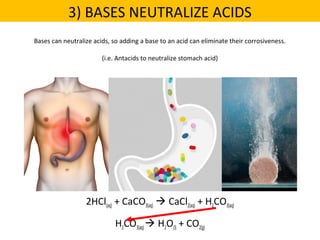
Bases can neutralize acids, so adding a base to an acid can eliminate their corrosiveness.
(i.e. Antacids to neutralize stomach acid)
2HCl(aq) + CaCO3(aq)  CaCl2(aq) + H2CO3(aq)
H2CO3(aq) H2O(l) + CO2(g)
3) BASES NEUTRALIZE ACIDS
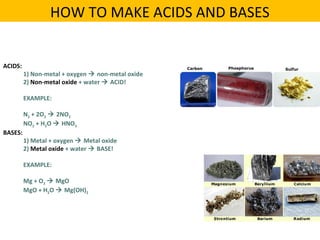
ACIDS:
1) Non-metal + oxygen  non-metal oxide
2) Non-metal oxide + water  ACID!
EXAMPLE:
N2 + 2O2  2NO2
NO2 + H2O  HNO3
BASES:
1) Metal + oxygen  Metal oxide
2) Metal oxide + water  BASE!
EXAMPLE:
Mg + O2  MgO
MgO + H2O  Mg(OH)2
HOW TO MAKE ACIDS AND BASES
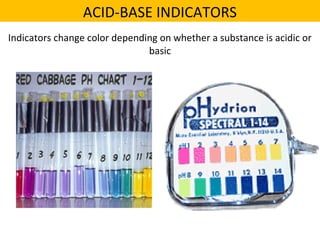
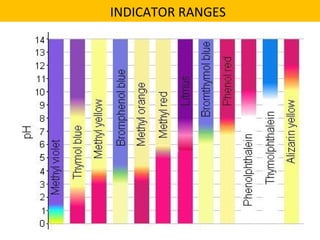
Indicators change color depending on whether a substance is acidic or
basic
ACID-BASE INDICATORS
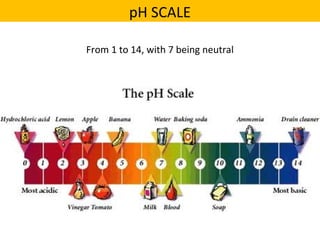
From 1 to 14, with 7 being neutral
pH SCALE
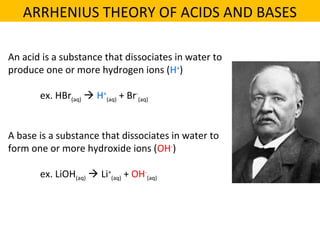
An acid is a substance that dissociates in water to
produce one or more hydrogen ions (H+
)
ex. HBr(aq)  H+
(aq) + Br-
(aq)
A base is a substance that dissociates in water to
form one or more hydroxide ions (OH-
)
ex. LiOH(aq)  Li+
(aq) + OH-
(aq)
ARRHENIUS THEORY OF ACIDS AND BASES
My theory has a
limitation…
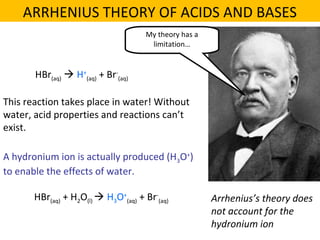
HBr(aq)  H+
(aq) + Br-
(aq)
This reaction takes place in water! Without
water, acid properties and reactions can’t
exist.
A hydronium ion is actually produced (H3O+
)
to enable the effects of water.
HBr(aq) + H2O(l)  H3O+
(aq) + Br-
(aq) Arrhenius’s theory does
not account for the
hydronium ion
ARRHENIUS THEORY OF ACIDS AND BASES
…more like 2
limitations…
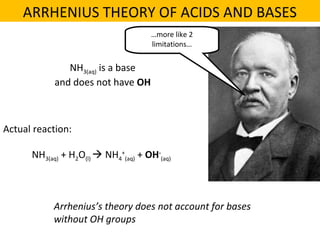
NH3(aq) is a base
and does not have OH
Actual reaction:
NH3(aq) + H2O(l)  NH4
+
(aq) + OH-
(aq)
Arrhenius’s theory does not account for bases
without OH groups
ARRHENIUS THEORY OF ACIDS AND BASES
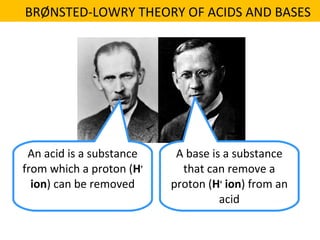
An acid is a substance
from which a proton (H+
ion) can be removed
A base is a substance
that can remove a
proton (H+
ion) from an
acid
BRØNSTED-LOWRY THEORY OF ACIDS AND BASES
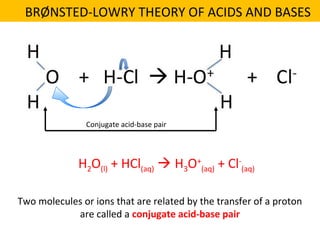
H2O(l) + HCl(aq)  H3O+
(aq) + Cl-
(aq)
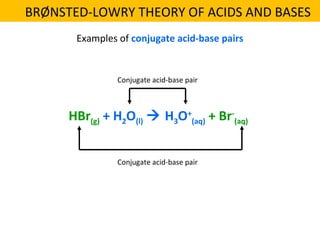
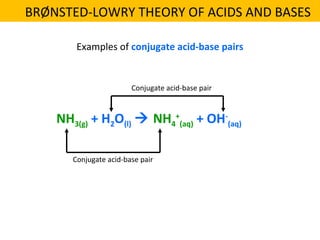
Two molecules or ions that are related by the transfer of a proton
are called a conjugate acid-base pair
Conjugate acid-base pair
BRØNSTED-LOWRY THEORY OF ACIDS AND BASES
HBr(g) + H2O(l)  H3O+
(aq) + Br-
(aq)
Examples of conjugate acid-base pairs
Conjugate acid-base pair
BRØNSTED-LOWRY THEORY OF ACIDS AND BASES
NH3(g) + H2O(l)  NH4
+
(aq) + OH-
(aq)
Examples of conjugate acid-base pairs
Conjugate acid-base pair
BRØNSTED-LOWRY THEORY OF ACIDS AND BASES
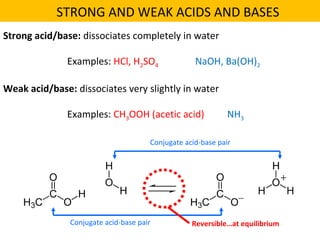
Strong acid/base: dissociates completely in water
Examples: HCl, H2SO4 NaOH, Ba(OH)2
Weak acid/base: dissociates very slightly in water
Examples: CH3OOH (acetic acid) NH3
Conjugate acid-base pair
Conjugate acid-base pair Reversible…at equilibrium
STRONG AND WEAK ACIDS AND BASES
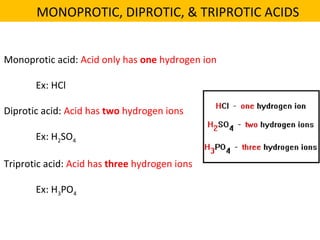
Monoprotic acid: Acid only has one hydrogen ion
Ex: HCl
Diprotic acid: Acid has two hydrogen ions
Ex: H2SO4
Triprotic acid: Acid has three hydrogen ions
Ex: H3PO4
MONOPROTIC, DIPROTIC, & TRIPROTIC ACIDS
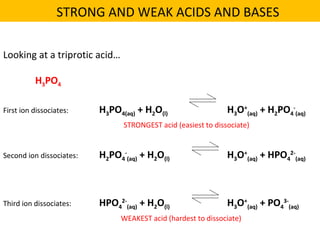
Looking at a triprotic acid…
H3PO4
First ion dissociates: H3PO4(aq) + H2O(l) H3O+
(aq) + H2PO4
-
(aq)
Second ion dissociates: H2PO4
-
(aq) + H2O(l) H3O+
(aq) + HPO4
2-
(aq)
Third ion dissociates: HPO4
2-
(aq) + H2O(l) H3O+
(aq) + PO4
3-
(aq)
STRONGEST acid (easiest to dissociate)
WEAKEST acid (hardest to dissociate)
STRONG AND WEAK ACIDS AND BASES
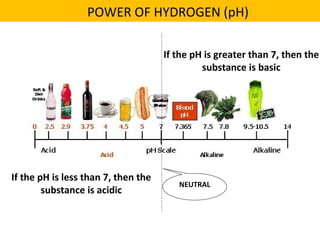
If the pH is greater than 7, then the
substance is basic
If the pH is less than 7, then the
substance is acidic
NEUTRAL
POWER OF HYDROGEN (pH)
H2O(l) + H2O(l) H3O+
(aq) + OH-
(aq)
[H3O+
] = [OH-
] = 1.0 x 10⁻⁷
mol/L
In a neutral solution at 25ºC…
Concentration of H3O+
Concentration of OH-
pH
Negative
logarithm of…
Or
-log
Concentration
of H3O+
ions (in
mol/L)
Or
[H3O+
]
POWER OF HYDROGEN (pH)
Therefore pH of water = -log [H3O+
]
= -log [1.0x10⁻⁷
]
= -(-7.00)
= 7.00
POWER OF HYDROGEN (pH)
pH = - log [H3
O+
]
pOH = - log [OH-
]
[H3
O+] = 10 –pH
[OH-] = 10-pOH
pH + pOH = 14
Formulae involving pH:
POWER OF HYDROGEN (pH)
1. Calculate the pH of a solution with [HCl(aq)] = 0.75 mol/L
POWER OF HYDROGEN (pH)
HCl(aq)  H+
(aq) + Cl-
(aq)
0.75mol/L 0.75mol/L  Due to a 1:1 mole ratio
pH = -log [H+
(aq)]
= -log [0.75 mol/L]
= 0.12
2. Calculate the pH of a solution with [H2SO4(aq)] = 0.75 mol/L
H2SO4(aq)  2H+
(aq) + SO4
2-
(aq)
0.75mol/L 1.5mol/L Due to a 1:2 mole ratio
pH = -log [H+
(aq)]
= -log [1.5 mol/L]
= -0.18
pH = 14 – pOH
= 14 – (2.42)
= 11.58
3. Calculate the pH of a solution with [NaOH(aq)] = 3.8x10⁻³
mol/L
POWER OF HYDROGEN (pH)
NaOH(aq)  Na+
(aq) + OH-
(aq)
0.0038mol/L 0.0038mol/L  Due to a 1:1 mole ratio
pOH = -log [OH-
]
= -log [3.8x10⁻³
]
= 2.42
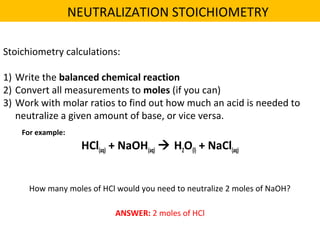
Stoichiometry calculations:
1) Write the balanced chemical reaction
2) Convert all measurements to moles (if you can)
3) Work with molar ratios to find out how much an acid is needed to
neutralize a given amount of base, or vice versa.
HCl(aq) + NaOH(aq)  H2O(l) + NaCl(aq)
For example:
How many moles of HCl would you need to neutralize 2 moles of NaOH?
ANSWER: 2 moles of HCl
NEUTRALIZATION STOICHIOMETRY
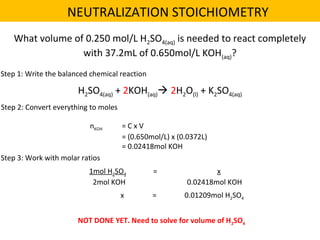
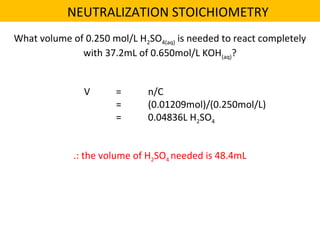
What volume of 0.250 mol/L H2SO4(aq) is needed to react completely
with 37.2mL of 0.650mol/L KOH(aq)?
H2SO4(aq) + 2KOH(aq) 2H2O(l) + K2SO4(aq)
Step 1: Write the balanced chemical reaction
Step 2: Convert everything to moles
nKOH = C x V
= (0.650mol/L) x (0.0372L)
= 0.02418mol KOH
Step 3: Work with molar ratios
1mol H2SO4 = x
2mol KOH 0.02418mol KOH
x = 0.01209mol H2SO4
NOT DONE YET. Need to solve for volume of H2SO4
NEUTRALIZATION STOICHIOMETRY
V = n/C
= (0.01209mol)/(0.250mol/L)
= 0.04836L H2SO4
.: the volume of H2SO4 needed is 48.4mL
NEUTRALIZATION STOICHIOMETRY
What volume of 0.250 mol/L H2SO4(aq) is needed to react completely
with 37.2mL of 0.650mol/L KOH(aq)?
TITRATION
TITRATION
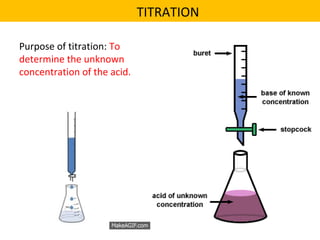
Purpose of titration: To
determine the unknown
concentration of the acid.
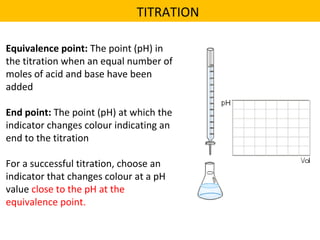
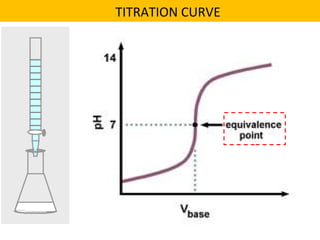
Equivalence point: The point (pH) in
the titration when an equal number of
moles of acid and base have been
added
End point: The point (pH) at which the
indicator changes colour indicating an
end to the titration
For a successful titration, choose an
indicator that changes colour at a pH
value close to the pH at the
equivalence point.
TITRATION
TITRATION CURVE
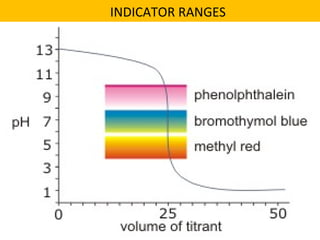
INDICATOR RANGES
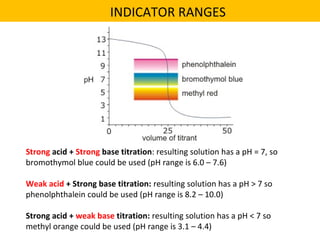
Strong acid + Strong base titration: resulting solution has a pH = 7, so
bromothymol blue could be used (pH range is 6.0 – 7.6)
Weak acid + Strong base titration: resulting solution has a pH > 7 so
phenolphthalein could be used (pH range is 8.2 – 10.0)
Strong acid + weak base titration: resulting solution has a pH < 7 so
methyl orange could be used (pH range is 3.1 – 4.4)
INDICATOR RANGES
INDICATOR RANGES
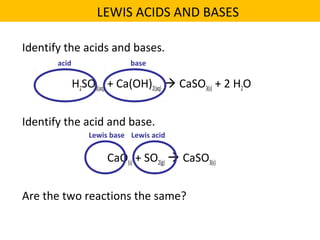
LEWIS ACIDS AND BASES
Identify the acids and bases.
H2SO3(aq) + Ca(OH)2(aq)  CaSO3(s) + 2 H2O
Identify the acid and base.
CaO(s) + SO2(g)  CaSO3(s)
Are the two reactions the same?
acid base
Lewis acidLewis base
LEWIS ACIDS AND BASES
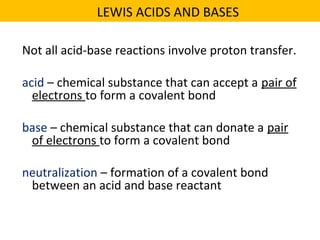
Not all acid-base reactions involve proton transfer.
acid – chemical substance that can accept a pair of
electrons to form a covalent bond
base – chemical substance that can donate a pair
of electrons to form a covalent bond
neutralization – formation of a covalent bond
between an acid and base reactant
LEWIS ACIDS AND BASES
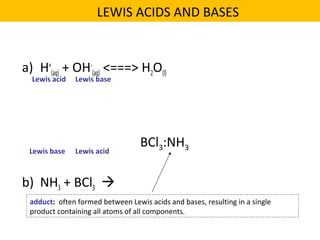
a) H+
(aq) + OH-
(aq) <===> H2O(l)
b) NH3 + BCl3 
Lewis acid Lewis base
Lewis acidLewis base
BCl3:NH3
adduct: often formed between Lewis acids and bases, resulting in a single
product containing all atoms of all components.
LEWIS ACIDS AND BASES
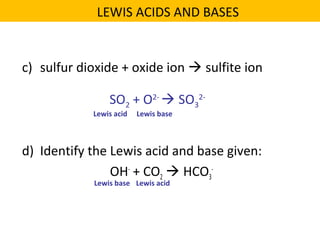
c) sulfur dioxide + oxide ion  sulfite ion
d) Identify the Lewis acid and base given:
OH-
+ CO2  HCO3
-
SO2 + O2-
 SO3
2-
Lewis acid Lewis base
Lewis acidLewis base
LEWIS ACIDS AND BASES

22 acids + bases

  • 1.
  • 2.
    Properties: (other thantasting sour and being corrosive) 1) React with metals 2) React with carbonates 3) Conduct electricity 4) Turn blue litmus paper red 5) Neutralize bases ACIDS ARE CORROSIVE ACIDS
  • 3.
    Acids react withvarious metals based on the activity series 1) ACIDS REACT WITH METALS 2HCl(aq) + Zn(s)  H2(g) + ZnCl2(aq)
  • 4.
    What happens whenyou put baking soda (sodium bicarbonate) into vinegar? HC2H3O2(aq) + NaHCO3(aq)  CO2(g) + H2O(l) + NaC2H3O2(aq) 2) ACIDS REACT WITH CARBONATES
  • 5.
    Acids are madeof ions, so in water these ions separate and can conduct electricity HCl(aq)  H+ (aq) + Cl- (aq) 3) ACIDS CONDUCT ELECTRICITY
  • 6.
    H+ Cl- H+ Cl- H+ Cl- Strong acids ionize completely inwater, while weak acids only ionize slightly 3) ACIDS CONDUCT ELECTRICITY
  • 7.
  • 8.
    4) ACIDS TURNBLUE LITMUS PAPER RED Blue litmus paper is an indicator and turns red when it touches acid
  • 9.
    Acids can neutralizebases, so adding an acid to a base can eliminate their corrosiveness HCl(aq) + NaOH(aq)  H2O(l) + NaCl(aq) Hydrochloricacid+sodiumhydroxidewater+salt(sodiumchloride) 5) ACIDS NEUTRALIZE BASES
  • 10.
    Properties: (other thantasting bitter, feeling slippery) 1) Conduct electricity 2) Turn red litmus paper blue 3) Neutralize acids BASES ARE CAUSTIC BASES
  • 11.
    Bases are madeof ions, so in water these ions separate and can conduct electricity NaOH(aq)  Na+ (aq) + OH- (aq) 1) BASES CONDUCT ELECTRICITY
  • 12.
    Red litmus paperis an indicator and turns blue when it touches base 2) BASES TURN RED LITMUS PAPER BLUE
  • 13.
    Bases can neutralizeacids, so adding a base to an acid can eliminate their corrosiveness. (i.e. Antacids to neutralize stomach acid) 2HCl(aq) + CaCO3(aq)  CaCl2(aq) + H2CO3(aq) H2CO3(aq) H2O(l) + CO2(g) 3) BASES NEUTRALIZE ACIDS
  • 14.
    ACIDS: 1) Non-metal +oxygen  non-metal oxide 2) Non-metal oxide + water  ACID! EXAMPLE: N2 + 2O2  2NO2 NO2 + H2O  HNO3 BASES: 1) Metal + oxygen  Metal oxide 2) Metal oxide + water  BASE! EXAMPLE: Mg + O2  MgO MgO + H2O  Mg(OH)2 HOW TO MAKE ACIDS AND BASES
  • 15.
    Indicators change colordepending on whether a substance is acidic or basic ACID-BASE INDICATORS
  • 16.
    From 1 to14, with 7 being neutral pH SCALE
  • 17.
    An acid isa substance that dissociates in water to produce one or more hydrogen ions (H+ ) ex. HBr(aq)  H+ (aq) + Br- (aq) A base is a substance that dissociates in water to form one or more hydroxide ions (OH- ) ex. LiOH(aq)  Li+ (aq) + OH- (aq) ARRHENIUS THEORY OF ACIDS AND BASES
  • 18.
    My theory hasa limitation… HBr(aq)  H+ (aq) + Br- (aq) This reaction takes place in water! Without water, acid properties and reactions can’t exist. A hydronium ion is actually produced (H3O+ ) to enable the effects of water. HBr(aq) + H2O(l)  H3O+ (aq) + Br- (aq) Arrhenius’s theory does not account for the hydronium ion ARRHENIUS THEORY OF ACIDS AND BASES
  • 19.
    …more like 2 limitations… NH3(aq)is a base and does not have OH Actual reaction: NH3(aq) + H2O(l)  NH4 + (aq) + OH- (aq) Arrhenius’s theory does not account for bases without OH groups ARRHENIUS THEORY OF ACIDS AND BASES
  • 20.
    An acid isa substance from which a proton (H+ ion) can be removed A base is a substance that can remove a proton (H+ ion) from an acid BRØNSTED-LOWRY THEORY OF ACIDS AND BASES
  • 21.
    H2O(l) + HCl(aq) H3O+ (aq) + Cl- (aq) Two molecules or ions that are related by the transfer of a proton are called a conjugate acid-base pair Conjugate acid-base pair BRØNSTED-LOWRY THEORY OF ACIDS AND BASES
  • 22.
    HBr(g) + H2O(l) H3O+ (aq) + Br- (aq) Examples of conjugate acid-base pairs Conjugate acid-base pair Conjugate acid-base pair BRØNSTED-LOWRY THEORY OF ACIDS AND BASES
  • 23.
    NH3(g) + H2O(l) NH4 + (aq) + OH- (aq) Examples of conjugate acid-base pairs Conjugate acid-base pair Conjugate acid-base pair BRØNSTED-LOWRY THEORY OF ACIDS AND BASES
  • 24.
    Strong acid/base: dissociatescompletely in water Examples: HCl, H2SO4 NaOH, Ba(OH)2 Weak acid/base: dissociates very slightly in water Examples: CH3OOH (acetic acid) NH3 Conjugate acid-base pair Conjugate acid-base pair Reversible…at equilibrium STRONG AND WEAK ACIDS AND BASES
  • 25.
    Monoprotic acid: Acidonly has one hydrogen ion Ex: HCl Diprotic acid: Acid has two hydrogen ions Ex: H2SO4 Triprotic acid: Acid has three hydrogen ions Ex: H3PO4 MONOPROTIC, DIPROTIC, & TRIPROTIC ACIDS
  • 26.
    Looking at atriprotic acid… H3PO4 First ion dissociates: H3PO4(aq) + H2O(l) H3O+ (aq) + H2PO4 - (aq) Second ion dissociates: H2PO4 - (aq) + H2O(l) H3O+ (aq) + HPO4 2- (aq) Third ion dissociates: HPO4 2- (aq) + H2O(l) H3O+ (aq) + PO4 3- (aq) STRONGEST acid (easiest to dissociate) WEAKEST acid (hardest to dissociate) STRONG AND WEAK ACIDS AND BASES
  • 27.
    If the pHis greater than 7, then the substance is basic If the pH is less than 7, then the substance is acidic NEUTRAL POWER OF HYDROGEN (pH)
  • 28.
    H2O(l) + H2O(l)H3O+ (aq) + OH- (aq) [H3O+ ] = [OH- ] = 1.0 x 10⁻⁷ mol/L In a neutral solution at 25ºC… Concentration of H3O+ Concentration of OH- pH Negative logarithm of… Or -log Concentration of H3O+ ions (in mol/L) Or [H3O+ ] POWER OF HYDROGEN (pH)
  • 29.
    Therefore pH ofwater = -log [H3O+ ] = -log [1.0x10⁻⁷ ] = -(-7.00) = 7.00 POWER OF HYDROGEN (pH)
  • 30.
    pH = -log [H3 O+ ] pOH = - log [OH- ] [H3 O+] = 10 –pH [OH-] = 10-pOH pH + pOH = 14 Formulae involving pH: POWER OF HYDROGEN (pH)
  • 31.
    1. Calculate thepH of a solution with [HCl(aq)] = 0.75 mol/L POWER OF HYDROGEN (pH) HCl(aq)  H+ (aq) + Cl- (aq) 0.75mol/L 0.75mol/L  Due to a 1:1 mole ratio pH = -log [H+ (aq)] = -log [0.75 mol/L] = 0.12 2. Calculate the pH of a solution with [H2SO4(aq)] = 0.75 mol/L H2SO4(aq)  2H+ (aq) + SO4 2- (aq) 0.75mol/L 1.5mol/L Due to a 1:2 mole ratio pH = -log [H+ (aq)] = -log [1.5 mol/L] = -0.18
  • 32.
    pH = 14– pOH = 14 – (2.42) = 11.58 3. Calculate the pH of a solution with [NaOH(aq)] = 3.8x10⁻³ mol/L POWER OF HYDROGEN (pH) NaOH(aq)  Na+ (aq) + OH- (aq) 0.0038mol/L 0.0038mol/L  Due to a 1:1 mole ratio pOH = -log [OH- ] = -log [3.8x10⁻³ ] = 2.42
  • 33.
    Stoichiometry calculations: 1) Writethe balanced chemical reaction 2) Convert all measurements to moles (if you can) 3) Work with molar ratios to find out how much an acid is needed to neutralize a given amount of base, or vice versa. HCl(aq) + NaOH(aq)  H2O(l) + NaCl(aq) For example: How many moles of HCl would you need to neutralize 2 moles of NaOH? ANSWER: 2 moles of HCl NEUTRALIZATION STOICHIOMETRY
  • 34.
    What volume of0.250 mol/L H2SO4(aq) is needed to react completely with 37.2mL of 0.650mol/L KOH(aq)? H2SO4(aq) + 2KOH(aq) 2H2O(l) + K2SO4(aq) Step 1: Write the balanced chemical reaction Step 2: Convert everything to moles nKOH = C x V = (0.650mol/L) x (0.0372L) = 0.02418mol KOH Step 3: Work with molar ratios 1mol H2SO4 = x 2mol KOH 0.02418mol KOH x = 0.01209mol H2SO4 NOT DONE YET. Need to solve for volume of H2SO4 NEUTRALIZATION STOICHIOMETRY
  • 35.
    V = n/C =(0.01209mol)/(0.250mol/L) = 0.04836L H2SO4 .: the volume of H2SO4 needed is 48.4mL NEUTRALIZATION STOICHIOMETRY What volume of 0.250 mol/L H2SO4(aq) is needed to react completely with 37.2mL of 0.650mol/L KOH(aq)?
  • 36.
  • 37.
    TITRATION Purpose of titration:To determine the unknown concentration of the acid.
  • 38.
    Equivalence point: Thepoint (pH) in the titration when an equal number of moles of acid and base have been added End point: The point (pH) at which the indicator changes colour indicating an end to the titration For a successful titration, choose an indicator that changes colour at a pH value close to the pH at the equivalence point. TITRATION
  • 39.
  • 40.
  • 41.
    Strong acid +Strong base titration: resulting solution has a pH = 7, so bromothymol blue could be used (pH range is 6.0 – 7.6) Weak acid + Strong base titration: resulting solution has a pH > 7 so phenolphthalein could be used (pH range is 8.2 – 10.0) Strong acid + weak base titration: resulting solution has a pH < 7 so methyl orange could be used (pH range is 3.1 – 4.4) INDICATOR RANGES
  • 42.
  • 43.
  • 44.
    Identify the acidsand bases. H2SO3(aq) + Ca(OH)2(aq)  CaSO3(s) + 2 H2O Identify the acid and base. CaO(s) + SO2(g)  CaSO3(s) Are the two reactions the same? acid base Lewis acidLewis base LEWIS ACIDS AND BASES
  • 45.
    Not all acid-basereactions involve proton transfer. acid – chemical substance that can accept a pair of electrons to form a covalent bond base – chemical substance that can donate a pair of electrons to form a covalent bond neutralization – formation of a covalent bond between an acid and base reactant LEWIS ACIDS AND BASES
  • 46.
    a) H+ (aq) +OH- (aq) <===> H2O(l) b) NH3 + BCl3  Lewis acid Lewis base Lewis acidLewis base BCl3:NH3 adduct: often formed between Lewis acids and bases, resulting in a single product containing all atoms of all components. LEWIS ACIDS AND BASES
  • 47.
    c) sulfur dioxide+ oxide ion  sulfite ion d) Identify the Lewis acid and base given: OH- + CO2  HCO3 - SO2 + O2-  SO3 2- Lewis acid Lewis base Lewis acidLewis base LEWIS ACIDS AND BASES

Editor's Notes

  • #10 http://www.youtube.com/watch?v=m55kgyApYrY