SOLUTION STOICHIOMETRY
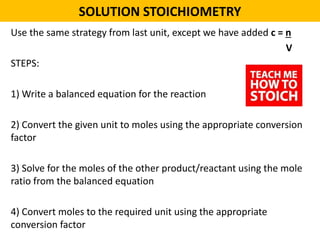
Use the same strategy from last unit, except we have added c = n
V
STEPS:
1) Write a balanced equation for the reaction
2) Convert the given unit to moles using the appropriate conversion
factor
3) Solve for the moles of the other product/reactant using the mole
ratio from the balanced equation
4) Convert moles to the required unit using the appropriate
conversion factor
SOLUTION STOICHIOMETRY
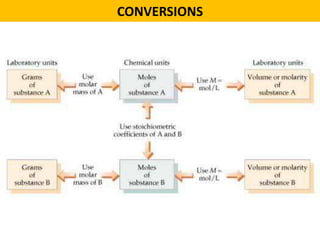
CONVERSIONS
SAMPLE PROBLEM 1
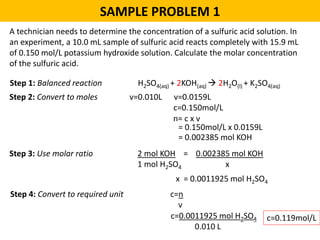
A technician needs to determine the concentration of a sulfuric acid solution. In
an experiment, a 10.0 mL sample of sulfuric acid reacts completely with 15.9 mL
of 0.150 mol/L potassium hydroxide solution. Calculate the molar concentration
of the sulfuric acid.
Step 1: Balanced reaction H2SO4(aq) + 2KOH(aq)  2H2O(l) + K2SO4(aq)
Step 2: Convert to moles v=0.010L v=0.0159L
c=0.150mol/L
n= c x v
= 0.150mol/L x 0.0159L
= 0.002385 mol KOH
Step 3: Use molar ratio 2 mol KOH = 0.002385 mol KOH
1 mol H2SO4 x
x = 0.0011925 mol H2SO4
Step 4: Convert to required unit c=n
v
c=0.0011925 mol H2SO4
0.010 L
c=0.119mol/L
SAMPLE PROBLEM 2
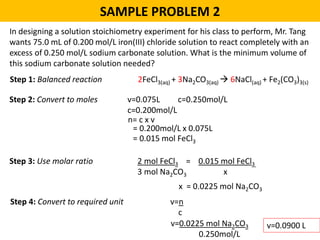
In designing a solution stoichiometry experiment for his class to perform, Mr. Tang
wants 75.0 mL of 0.200 mol/L iron(III) chloride solution to react completely with an
excess of 0.250 mol/L sodium carbonate solution. What is the minimum volume of
this sodium carbonate solution needed?
Step 1: Balanced reaction 2FeCl3(aq) + 3Na2CO3(aq)  6NaCl(aq) + Fe2(CO3)3(s)
Step 2: Convert to moles v=0.075L c=0.250mol/L
c=0.200mol/L
n= c x v
= 0.200mol/L x 0.075L
= 0.015 mol FeCl3
Step 3: Use molar ratio 2 mol FeCl3 = 0.015 mol FeCl3
3 mol Na2CO3 x
x = 0.0225 mol Na2CO3
Step 4: Convert to required unit v=n
c
v=0.0225 mol Na2CO3
0.250mol/L
v=0.0900 L
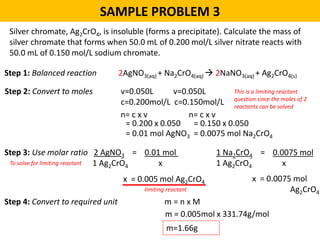
SAMPLE PROBLEM 3
Silver chromate, Ag2CrO4, is insoluble (forms a precipitate). Calculate the mass of
silver chromate that forms when 50.0 mL of 0.200 mol/L silver nitrate reacts with
50.0 mL of 0.150 mol/L sodium chromate.
Step 1: Balanced reaction 2AgNO3(aq) + Na2CrO4(aq)  2NaNO3(aq) + Ag2CrO4(s)
Step 2: Convert to moles v=0.050L v=0.050L
c=0.200mol/L c=0.150mol/L
n= c x v
= 0.200 x 0.050
= 0.01 mol AgNO3
Step 3: Use molar ratio 2 AgNO3 = 0.01 mol
1 Ag2CrO4 x
x = 0.005 mol Ag2CrO4
Step 4: Convert to required unit m = n x M
m=1.66g
This is a limiting reactant
question since the moles of 2
reactants can be solved
n= c x v
= 0.150 x 0.050
= 0.0075 mol Na2CrO4
To solve for limiting reactant
1 Na2CrO4 = 0.0075 mol
1 Ag2CrO4 x
x = 0.0075 mol
Ag2CrO4limiting reactant
m = 0.005mol x 331.74g/mol

22 solution stoichiometry new

  • 1.
  • 2.
    Use the samestrategy from last unit, except we have added c = n V STEPS: 1) Write a balanced equation for the reaction 2) Convert the given unit to moles using the appropriate conversion factor 3) Solve for the moles of the other product/reactant using the mole ratio from the balanced equation 4) Convert moles to the required unit using the appropriate conversion factor SOLUTION STOICHIOMETRY
  • 3.
  • 4.
    SAMPLE PROBLEM 1 Atechnician needs to determine the concentration of a sulfuric acid solution. In an experiment, a 10.0 mL sample of sulfuric acid reacts completely with 15.9 mL of 0.150 mol/L potassium hydroxide solution. Calculate the molar concentration of the sulfuric acid. Step 1: Balanced reaction H2SO4(aq) + 2KOH(aq)  2H2O(l) + K2SO4(aq) Step 2: Convert to moles v=0.010L v=0.0159L c=0.150mol/L n= c x v = 0.150mol/L x 0.0159L = 0.002385 mol KOH Step 3: Use molar ratio 2 mol KOH = 0.002385 mol KOH 1 mol H2SO4 x x = 0.0011925 mol H2SO4 Step 4: Convert to required unit c=n v c=0.0011925 mol H2SO4 0.010 L c=0.119mol/L
  • 5.
    SAMPLE PROBLEM 2 Indesigning a solution stoichiometry experiment for his class to perform, Mr. Tang wants 75.0 mL of 0.200 mol/L iron(III) chloride solution to react completely with an excess of 0.250 mol/L sodium carbonate solution. What is the minimum volume of this sodium carbonate solution needed? Step 1: Balanced reaction 2FeCl3(aq) + 3Na2CO3(aq)  6NaCl(aq) + Fe2(CO3)3(s) Step 2: Convert to moles v=0.075L c=0.250mol/L c=0.200mol/L n= c x v = 0.200mol/L x 0.075L = 0.015 mol FeCl3 Step 3: Use molar ratio 2 mol FeCl3 = 0.015 mol FeCl3 3 mol Na2CO3 x x = 0.0225 mol Na2CO3 Step 4: Convert to required unit v=n c v=0.0225 mol Na2CO3 0.250mol/L v=0.0900 L
  • 6.
    SAMPLE PROBLEM 3 Silverchromate, Ag2CrO4, is insoluble (forms a precipitate). Calculate the mass of silver chromate that forms when 50.0 mL of 0.200 mol/L silver nitrate reacts with 50.0 mL of 0.150 mol/L sodium chromate. Step 1: Balanced reaction 2AgNO3(aq) + Na2CrO4(aq)  2NaNO3(aq) + Ag2CrO4(s) Step 2: Convert to moles v=0.050L v=0.050L c=0.200mol/L c=0.150mol/L n= c x v = 0.200 x 0.050 = 0.01 mol AgNO3 Step 3: Use molar ratio 2 AgNO3 = 0.01 mol 1 Ag2CrO4 x x = 0.005 mol Ag2CrO4 Step 4: Convert to required unit m = n x M m=1.66g This is a limiting reactant question since the moles of 2 reactants can be solved n= c x v = 0.150 x 0.050 = 0.0075 mol Na2CrO4 To solve for limiting reactant 1 Na2CrO4 = 0.0075 mol 1 Ag2CrO4 x x = 0.0075 mol Ag2CrO4limiting reactant m = 0.005mol x 331.74g/mol