The MOLE!!!
The MOLE!!!
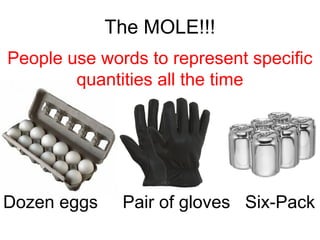
People use words to represent specific
quantities all the time
Dozen eggs Pair of gloves Six-Pack
The MOLE!!!
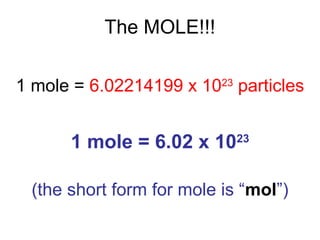
1 mole = 6.02214199 x 10²³
particles
1 mole = 6.02 x 10²³
(the short form for mole is “mol”)
The MOLE!!!
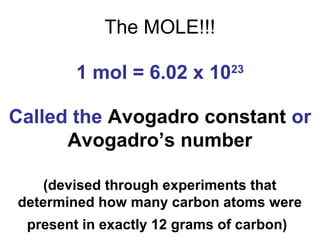
1 mol = 6.02 x 10²³
Called the Avogadro constant or
Avogadro’s number
(devised through experiments that
determined how many carbon atoms were
present in exactly 12 grams of carbon)
The MOLE!!!
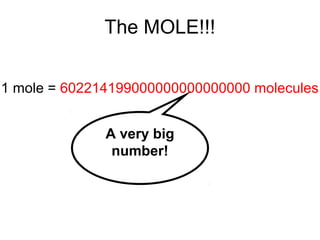
1 mole = 602214199000000000000000 molecules
A very big
number!
The MOLE!!!
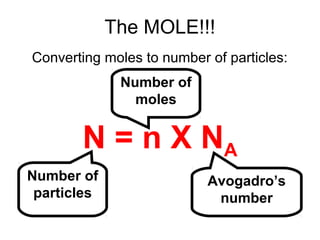
Converting moles to number of particles:
N = n X NA
Number of
particles
Number of
moles
Avogadro’s
number
The MOLE!!!
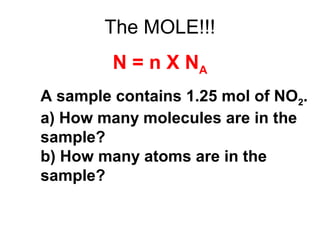
N = n X NA
A sample contains 1.25 mol of NO2.
a) How many molecules are in the
sample?
b) How many atoms are in the
sample?
The MOLE!!!
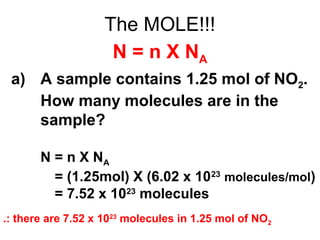
N = n X NA
a) A sample contains 1.25 mol of NO2.
How many molecules are in the
sample?
N = n X NA
N = (1.25mol) X (6.02 x 10²³
molecules/mol)
N = 7.52 x 10²³
molecules
.: there are 7.52 x 10²³
molecules in 1.25 mol of NO2
The MOLE!!!
N = n X NA
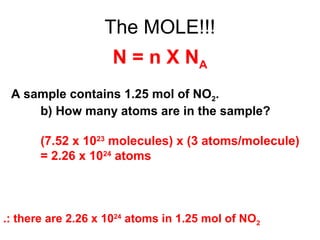
A sample contains 1.25 mol of NO2.
b) How many atoms are in the sample?
(7.52 x 10²³
molecules) x (3 atoms/molecule)
= 2.26 x 1024
atoms
.: there are 2.26 x 1024
atoms in 1.25 mol of NO2
The MOLE!!!
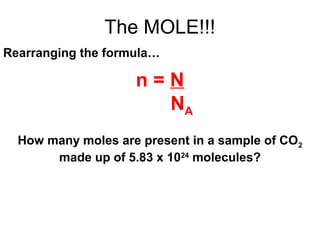
n = N
NA
Rearranging the formula…
How many moles are present in a sample of CO2
made up of 5.83 x 1024
molecules?
The MOLE!!!
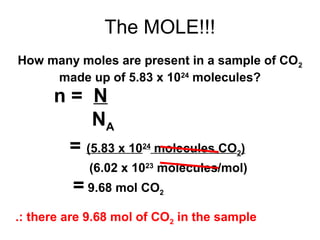
n = N
NA
= (5.83 x 1024
molecules CO2)
(6.02 x 10²³
molecules/mol)
How many moles are present in a sample of CO2
made up of 5.83 x 1024
molecules?
= 9.68 mol CO2
.: there are 9.68 mol of CO2 in the sample
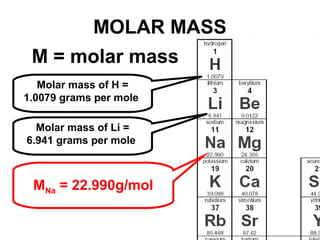
MOLAR MASS
Molar mass of H =
1.0079 grams per mole
M = molar mass
Molar mass of Li =
6.941 grams per mole
MNa = 22.990g/mol
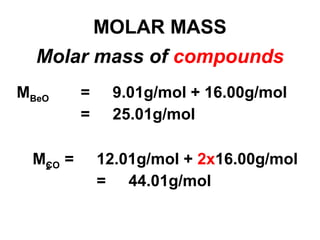
MOLAR MASS
Molar mass of compounds
MBeO = 9.01g/mol + 16.00g/mol
= 25.01g/mol
MCO = 12.01g/mol + 2x16.00g/mol
= 44.01g/mol
2
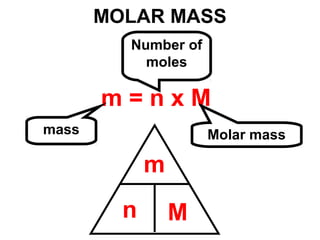
MOLAR MASS
m = n x M
m
n M
mass
Number of
moles
Molar mass
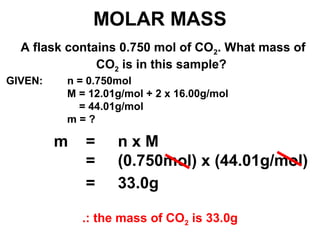
MOLAR MASS
A flask contains 0.750 mol of CO2. What mass of
CO2 is in this sample?
m = n x M
= (0.750mol) x (44.01g/mol)
GIVEN: n = 0.750mol
M = 12.01g/mol + 2 x 16.00g/mol
= 44.01g/mol
m = ?
= 33.0g
.: the mass of CO2 is 33.0g
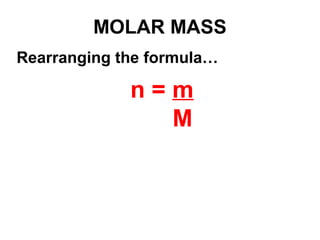
MOLAR MASS
Rearranging the formula…
n = m
M
MOLAR MASS
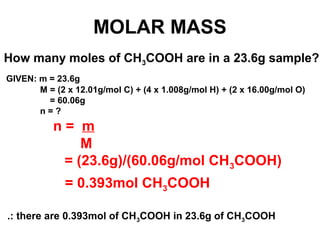
How many moles of CH3COOH are in a 23.6g sample?
n = m
M
= (23.6g)/(60.06g/mol CH3COOH)
GIVEN: m = 23.6g
M = (2 x 12.01g/mol C) + (4 x 1.008g/mol H) + (2 x 16.00g/mol O)
= 60.06g
n = ?
= 0.393mol CH3COOH
.: there are 0.393mol of CH3COOH in 23.6g of CH3COOH
PERCENTAGE COMPOSITION
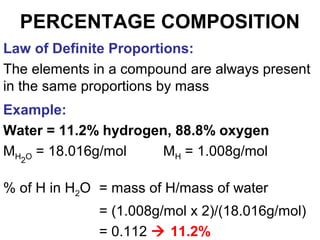
Law of Definite Proportions:
The elements in a compound are always present
in the same proportions by mass
Example:
Water = 11.2% hydrogen, 88.8% oxygen
MH2O = 18.016g/mol MH = 1.008g/mol
% of H in H2O = mass of H/mass of water
= (1.008g/mol x 2)/(18.016g/mol)
= 0.112  11.2%
PERCENTAGE COMPOSITION
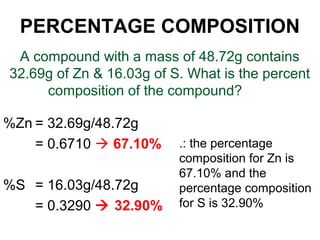
A compound with a mass of 48.72g contains
32.69g of Zn & 16.03g of S. What is the percent
composition of the compound?
%Zn = 32.69g/48.72g
= 0.6710  67.10%
%S = 16.03g/48.72g
= 0.3290  32.90%
.: the percentage
composition for Zn is
67.10% and the
percentage composition
for S is 32.90%
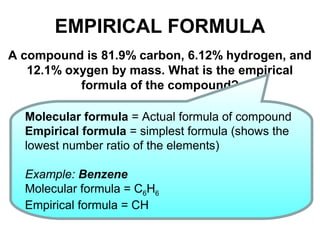
EMPIRICAL FORMULA
A compound is 81.9% carbon, 6.12% hydrogen, and
12.1% oxygen by mass. What is the empirical
formula of the compound?
Molecular formula = Actual formula of compound
Empirical formula = simplest formula (shows the
lowest number ratio of the elements)
Example: Benzene
Molecular formula = C6H6
Empirical formula = CH
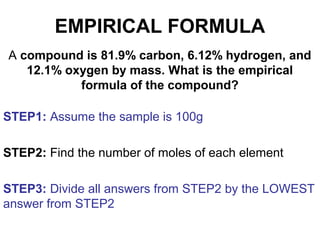
A compound is 81.9% carbon, 6.12% hydrogen, and
12.1% oxygen by mass. What is the empirical
formula of the compound?
STEP1: Assume the sample is 100g
STEP2: Find the number of moles of each element
STEP3: Divide all answers from STEP2 by the LOWEST
answer from STEP2
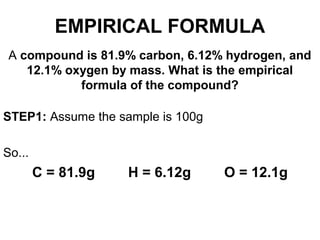
EMPIRICAL FORMULA
A compound is 81.9% carbon, 6.12% hydrogen, and
12.1% oxygen by mass. What is the empirical
formula of the compound?
STEP1: Assume the sample is 100g
So...
C = 81.9g H = 6.12g O = 12.1g
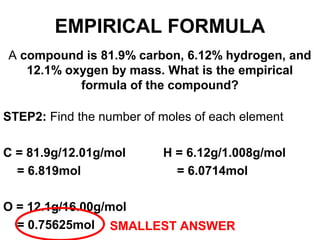
EMPIRICAL FORMULA
A compound is 81.9% carbon, 6.12% hydrogen, and
12.1% oxygen by mass. What is the empirical
formula of the compound?
STEP2: Find the number of moles of each element
C = 81.9g/12.01g/mol H = 6.12g/1.008g/mol
= 6.819mol = 6.0714mol
O = 12.1g/16.00g/mol
= 0.75625mol SMALLEST ANSWER
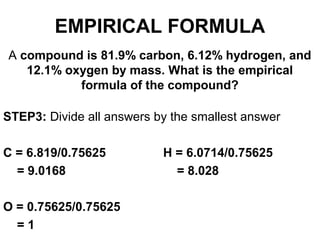
EMPIRICAL FORMULA
A compound is 81.9% carbon, 6.12% hydrogen, and
12.1% oxygen by mass. What is the empirical
formula of the compound?
STEP3: Divide all answers by the smallest answer
C = 6.819/0.75625 H = 6.0714/0.75625
= 9.0168 = 8.028
O = 0.75625/0.75625
= 1
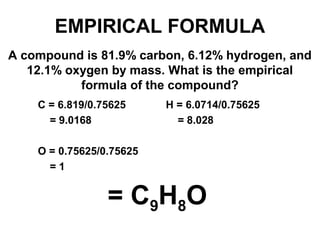
EMPIRICAL FORMULA
A compound is 81.9% carbon, 6.12% hydrogen, and
12.1% oxygen by mass. What is the empirical
formula of the compound?
= C9H8O
C = 6.819/0.75625 H = 6.0714/0.75625
= 9.0168 = 8.028
O = 0.75625/0.75625
= 1
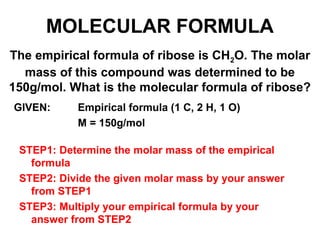
EMPIRICAL FORMULA
The empirical formula of ribose is CH2O. The molar
mass of this compound was determined to be
150g/mol. What is the molecular formula of ribose?
GIVEN: Empirical formula (1 C, 2 H, 1 O)
M = 150g/mol
MOLECULAR FORMULA
STEP1: Determine the molar mass of the empirical
formula
STEP2: Divide the given molar mass by your answer
from STEP1
STEP3: Multiply your empirical formula by your
answer from STEP2
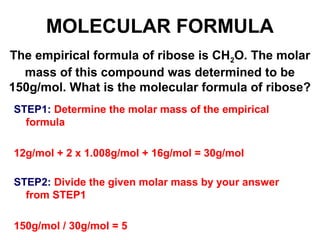
The empirical formula of ribose is CH2O. The molar
mass of this compound was determined to be
150g/mol. What is the molecular formula of ribose?
MOLECULAR FORMULA
STEP1: Determine the molar mass of the empirical
formula
12g/mol + 2 x 1.008g/mol + 16g/mol = 30g/mol
STEP2: Divide the given molar mass by your answer
from STEP1
150g/mol / 30g/mol = 5
The empirical formula of ribose is CH2O. The molar
mass of this compound was determined to be
150g/mol. What is the molecular formula of ribose?
MOLECULAR FORMULA
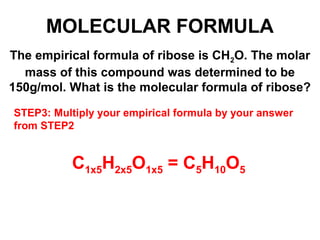
C1x5H2x5O1x5 = C5H10O5
STEP3: Multiply your empirical formula by your answer
from STEP2
ANALYTICAL MACHINES FOR
CHEMISTRY
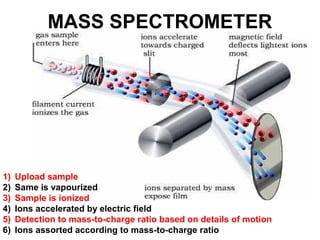
MASS SPECTROMETER
1) Upload sample
2) Same is vapourized
3) Sample is ionized
4) Ions accelerated by electric field
5) Detection to mass-to-charge ratio based on details of motion
6) Ions assorted according to mass-to-charge ratio
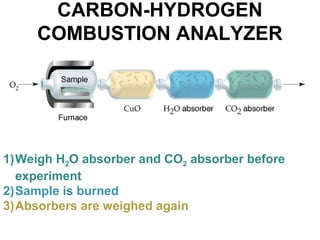
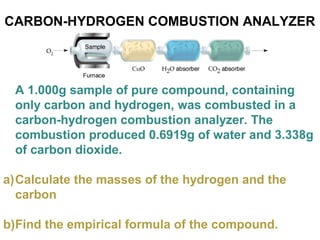
CARBON-HYDROGEN
COMBUSTION ANALYZER
1)Weigh H2O absorber and CO2 absorber before
experiment
2)Sample is burned
3)Absorbers are weighed again
CARBON-HYDROGEN COMBUSTION ANALYZER
A 1.000g sample of pure compound, containing
only carbon and hydrogen, was combusted in a
carbon-hydrogen combustion analyzer. The
combustion produced 0.6919g of water and 3.338g
of carbon dioxide.
a)Calculate the masses of the hydrogen and the
carbon
b)Find the empirical formula of the compound.
CARBON-HYDROGEN COMBUSTION ANALYZER
A 1.000g sample…The combustion produced 0.6919g of
water and 3.338g of carbon dioxide.
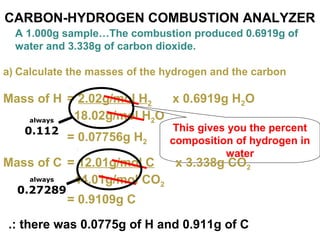
a) Calculate the masses of the hydrogen and the carbon
Mass of H = 2.02g/mol H2 x 0.6919g H2O
18.02g/mol H2O
= 0.07756g H2
This gives you the percent
composition of hydrogen in
water
Mass of C = 12.01g/mol C x 3.338g CO2
44.01g/mol CO2
= 0.9109g C
.: there was 0.0775g of H and 0.911g of C
always
0.112
always
0.27289
CARBON-HYDROGEN COMBUSTION ANALYZER
A 1.000g sample…The combustion produced 0.6919g of
water and 3.338g of carbon dioxide.
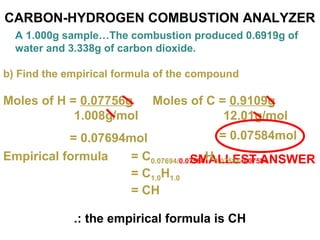
b) Find the empirical formula of the compound
Moles of H = 0.07756g
1.008g/mol
= 0.07694mol
Moles of C = 0.9109g
12.01g/mol
= 0.07584mol
SMALLEST ANSWEREmpirical formula = C0.07694/0.07584H0.07584/0.07584
= C1.0H1.0
= CH
.: the empirical formula is CH
HYDRATED SALTS
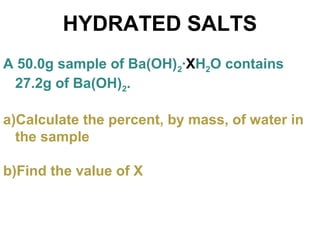
A 50.0g sample of Ba(OH)2·XH2O contains
27.2g of Ba(OH)2.
a)Calculate the percent, by mass, of water in
the sample
b)Find the value of X
HYDRATED SALTS
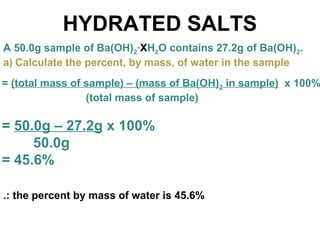
A 50.0g sample of Ba(OH)2·XH2O contains 27.2g of Ba(OH)2.
a) Calculate the percent, by mass, of water in the sample
= (total mass of sample) – (mass of Ba(OH)2 in sample) x 100%
(total mass of sample)
= 50.0g – 27.2g x 100%
50.0g
= 45.6%
.: the percent by mass of water is 45.6%
HYDRATED SALTS
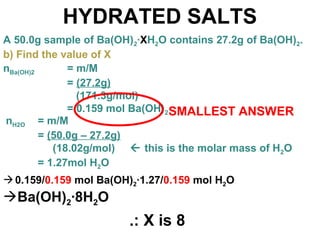
A 50.0g sample of Ba(OH)2·XH2O contains 27.2g of Ba(OH)2.
b) Find the value of X
nH2O = m/M
= (50.0g – 27.2g)
(18.02g/mol)  this is the molar mass of H2O
= 1.27mol H2O
0.159/0.159 mol Ba(OH)2·1.27/0.159 mol H2O
Ba(OH)2·8H2O
nBa(OH)2 = m/M
= (27.2g)
(171.3g/mol)
= 0.159 mol Ba(OH)2SMALLEST ANSWER
.: X is 8

14 the mole!!!

  • 1.
  • 2.
    The MOLE!!! People usewords to represent specific quantities all the time Dozen eggs Pair of gloves Six-Pack
  • 3.
    The MOLE!!! 1 mole= 6.02214199 x 10²³ particles 1 mole = 6.02 x 10²³ (the short form for mole is “mol”)
  • 4.
    The MOLE!!! 1 mol= 6.02 x 10²³ Called the Avogadro constant or Avogadro’s number (devised through experiments that determined how many carbon atoms were present in exactly 12 grams of carbon)
  • 5.
    The MOLE!!! 1 mole= 602214199000000000000000 molecules A very big number!
  • 6.
    The MOLE!!! Converting molesto number of particles: N = n X NA Number of particles Number of moles Avogadro’s number
  • 7.
    The MOLE!!! N =n X NA A sample contains 1.25 mol of NO2. a) How many molecules are in the sample? b) How many atoms are in the sample?
  • 8.
    The MOLE!!! N =n X NA a) A sample contains 1.25 mol of NO2. How many molecules are in the sample? N = n X NA N = (1.25mol) X (6.02 x 10²³ molecules/mol) N = 7.52 x 10²³ molecules .: there are 7.52 x 10²³ molecules in 1.25 mol of NO2
  • 9.
    The MOLE!!! N =n X NA A sample contains 1.25 mol of NO2. b) How many atoms are in the sample? (7.52 x 10²³ molecules) x (3 atoms/molecule) = 2.26 x 1024 atoms .: there are 2.26 x 1024 atoms in 1.25 mol of NO2
  • 10.
    The MOLE!!! n =N NA Rearranging the formula… How many moles are present in a sample of CO2 made up of 5.83 x 1024 molecules?
  • 11.
    The MOLE!!! n =N NA = (5.83 x 1024 molecules CO2) (6.02 x 10²³ molecules/mol) How many moles are present in a sample of CO2 made up of 5.83 x 1024 molecules? = 9.68 mol CO2 .: there are 9.68 mol of CO2 in the sample
  • 12.
    MOLAR MASS Molar massof H = 1.0079 grams per mole M = molar mass Molar mass of Li = 6.941 grams per mole MNa = 22.990g/mol
  • 13.
    MOLAR MASS Molar massof compounds MBeO = 9.01g/mol + 16.00g/mol = 25.01g/mol MCO = 12.01g/mol + 2x16.00g/mol = 44.01g/mol 2
  • 14.
    MOLAR MASS m =n x M m n M mass Number of moles Molar mass
  • 15.
    MOLAR MASS A flaskcontains 0.750 mol of CO2. What mass of CO2 is in this sample? m = n x M = (0.750mol) x (44.01g/mol) GIVEN: n = 0.750mol M = 12.01g/mol + 2 x 16.00g/mol = 44.01g/mol m = ? = 33.0g .: the mass of CO2 is 33.0g
  • 16.
    MOLAR MASS Rearranging theformula… n = m M
  • 17.
    MOLAR MASS How manymoles of CH3COOH are in a 23.6g sample? n = m M = (23.6g)/(60.06g/mol CH3COOH) GIVEN: m = 23.6g M = (2 x 12.01g/mol C) + (4 x 1.008g/mol H) + (2 x 16.00g/mol O) = 60.06g n = ? = 0.393mol CH3COOH .: there are 0.393mol of CH3COOH in 23.6g of CH3COOH
  • 18.
  • 19.
    PERCENTAGE COMPOSITION Law ofDefinite Proportions: The elements in a compound are always present in the same proportions by mass Example: Water = 11.2% hydrogen, 88.8% oxygen MH2O = 18.016g/mol MH = 1.008g/mol % of H in H2O = mass of H/mass of water = (1.008g/mol x 2)/(18.016g/mol) = 0.112  11.2%
  • 20.
    PERCENTAGE COMPOSITION A compoundwith a mass of 48.72g contains 32.69g of Zn & 16.03g of S. What is the percent composition of the compound? %Zn = 32.69g/48.72g = 0.6710  67.10% %S = 16.03g/48.72g = 0.3290  32.90% .: the percentage composition for Zn is 67.10% and the percentage composition for S is 32.90%
  • 21.
    EMPIRICAL FORMULA A compoundis 81.9% carbon, 6.12% hydrogen, and 12.1% oxygen by mass. What is the empirical formula of the compound? Molecular formula = Actual formula of compound Empirical formula = simplest formula (shows the lowest number ratio of the elements) Example: Benzene Molecular formula = C6H6 Empirical formula = CH
  • 22.
    A compound is81.9% carbon, 6.12% hydrogen, and 12.1% oxygen by mass. What is the empirical formula of the compound? STEP1: Assume the sample is 100g STEP2: Find the number of moles of each element STEP3: Divide all answers from STEP2 by the LOWEST answer from STEP2 EMPIRICAL FORMULA
  • 23.
    A compound is81.9% carbon, 6.12% hydrogen, and 12.1% oxygen by mass. What is the empirical formula of the compound? STEP1: Assume the sample is 100g So... C = 81.9g H = 6.12g O = 12.1g EMPIRICAL FORMULA
  • 24.
    A compound is81.9% carbon, 6.12% hydrogen, and 12.1% oxygen by mass. What is the empirical formula of the compound? STEP2: Find the number of moles of each element C = 81.9g/12.01g/mol H = 6.12g/1.008g/mol = 6.819mol = 6.0714mol O = 12.1g/16.00g/mol = 0.75625mol SMALLEST ANSWER EMPIRICAL FORMULA
  • 25.
    A compound is81.9% carbon, 6.12% hydrogen, and 12.1% oxygen by mass. What is the empirical formula of the compound? STEP3: Divide all answers by the smallest answer C = 6.819/0.75625 H = 6.0714/0.75625 = 9.0168 = 8.028 O = 0.75625/0.75625 = 1 EMPIRICAL FORMULA
  • 26.
    A compound is81.9% carbon, 6.12% hydrogen, and 12.1% oxygen by mass. What is the empirical formula of the compound? = C9H8O C = 6.819/0.75625 H = 6.0714/0.75625 = 9.0168 = 8.028 O = 0.75625/0.75625 = 1 EMPIRICAL FORMULA
  • 27.
    The empirical formulaof ribose is CH2O. The molar mass of this compound was determined to be 150g/mol. What is the molecular formula of ribose? GIVEN: Empirical formula (1 C, 2 H, 1 O) M = 150g/mol MOLECULAR FORMULA STEP1: Determine the molar mass of the empirical formula STEP2: Divide the given molar mass by your answer from STEP1 STEP3: Multiply your empirical formula by your answer from STEP2
  • 28.
    The empirical formulaof ribose is CH2O. The molar mass of this compound was determined to be 150g/mol. What is the molecular formula of ribose? MOLECULAR FORMULA STEP1: Determine the molar mass of the empirical formula 12g/mol + 2 x 1.008g/mol + 16g/mol = 30g/mol STEP2: Divide the given molar mass by your answer from STEP1 150g/mol / 30g/mol = 5
  • 29.
    The empirical formulaof ribose is CH2O. The molar mass of this compound was determined to be 150g/mol. What is the molecular formula of ribose? MOLECULAR FORMULA C1x5H2x5O1x5 = C5H10O5 STEP3: Multiply your empirical formula by your answer from STEP2
  • 30.
  • 31.
    MASS SPECTROMETER 1) Uploadsample 2) Same is vapourized 3) Sample is ionized 4) Ions accelerated by electric field 5) Detection to mass-to-charge ratio based on details of motion 6) Ions assorted according to mass-to-charge ratio
  • 32.
    CARBON-HYDROGEN COMBUSTION ANALYZER 1)Weigh H2Oabsorber and CO2 absorber before experiment 2)Sample is burned 3)Absorbers are weighed again
  • 33.
    CARBON-HYDROGEN COMBUSTION ANALYZER A1.000g sample of pure compound, containing only carbon and hydrogen, was combusted in a carbon-hydrogen combustion analyzer. The combustion produced 0.6919g of water and 3.338g of carbon dioxide. a)Calculate the masses of the hydrogen and the carbon b)Find the empirical formula of the compound.
  • 34.
    CARBON-HYDROGEN COMBUSTION ANALYZER A1.000g sample…The combustion produced 0.6919g of water and 3.338g of carbon dioxide. a) Calculate the masses of the hydrogen and the carbon Mass of H = 2.02g/mol H2 x 0.6919g H2O 18.02g/mol H2O = 0.07756g H2 This gives you the percent composition of hydrogen in water Mass of C = 12.01g/mol C x 3.338g CO2 44.01g/mol CO2 = 0.9109g C .: there was 0.0775g of H and 0.911g of C always 0.112 always 0.27289
  • 35.
    CARBON-HYDROGEN COMBUSTION ANALYZER A1.000g sample…The combustion produced 0.6919g of water and 3.338g of carbon dioxide. b) Find the empirical formula of the compound Moles of H = 0.07756g 1.008g/mol = 0.07694mol Moles of C = 0.9109g 12.01g/mol = 0.07584mol SMALLEST ANSWEREmpirical formula = C0.07694/0.07584H0.07584/0.07584 = C1.0H1.0 = CH .: the empirical formula is CH
  • 36.
    HYDRATED SALTS A 50.0gsample of Ba(OH)2·XH2O contains 27.2g of Ba(OH)2. a)Calculate the percent, by mass, of water in the sample b)Find the value of X
  • 37.
    HYDRATED SALTS A 50.0gsample of Ba(OH)2·XH2O contains 27.2g of Ba(OH)2. a) Calculate the percent, by mass, of water in the sample = (total mass of sample) – (mass of Ba(OH)2 in sample) x 100% (total mass of sample) = 50.0g – 27.2g x 100% 50.0g = 45.6% .: the percent by mass of water is 45.6%
  • 38.
    HYDRATED SALTS A 50.0gsample of Ba(OH)2·XH2O contains 27.2g of Ba(OH)2. b) Find the value of X nH2O = m/M = (50.0g – 27.2g) (18.02g/mol)  this is the molar mass of H2O = 1.27mol H2O 0.159/0.159 mol Ba(OH)2·1.27/0.159 mol H2O Ba(OH)2·8H2O nBa(OH)2 = m/M = (27.2g) (171.3g/mol) = 0.159 mol Ba(OH)2SMALLEST ANSWER .: X is 8