Warm up 2/2/2015 Monday
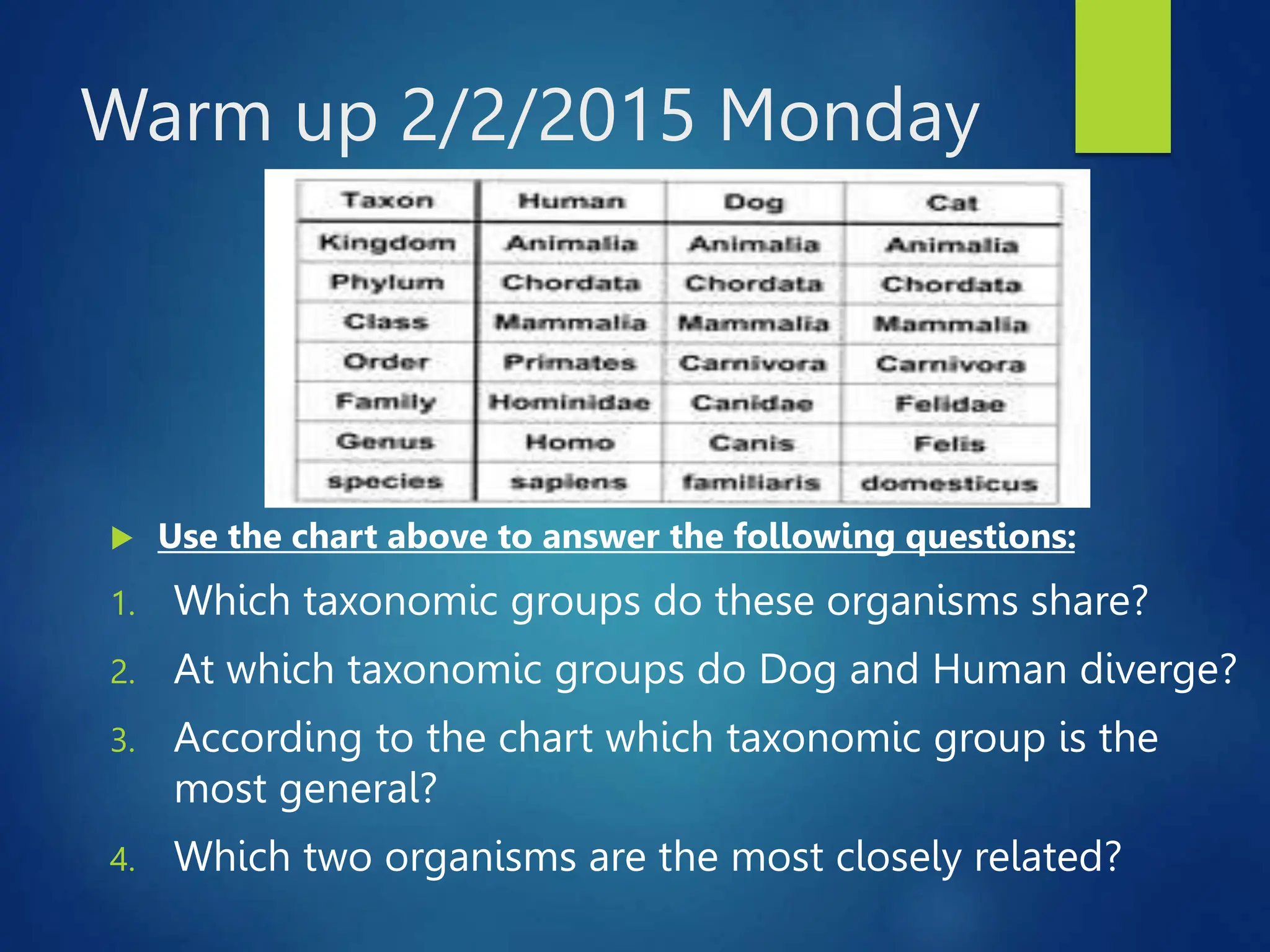
 Use the chart above to answer the following questions:
1. Which taxonomic groups do these organisms share?
2. At which taxonomic groups do Dog and Human diverge?
3. According to the chart which taxonomic group is the
most general?
4. Which two organisms are the most closely related?
Quiz tomorrow!
OVER THE 6 KINGDOMS
Record these vocabulary
words in your notebook.
 Multicellular
 Unicellular
 Prokaryote
 Eukaryote
 Heterotroph
 Autotroph
Overview of the
Six Kingdoms
Vocabulary
Which term means one-celled? Many-celled?
 multicellular
 unicellular
Which term means that the organism produces its own
food? Consumes food?
 autotroph
 heterotroph
Number of cells
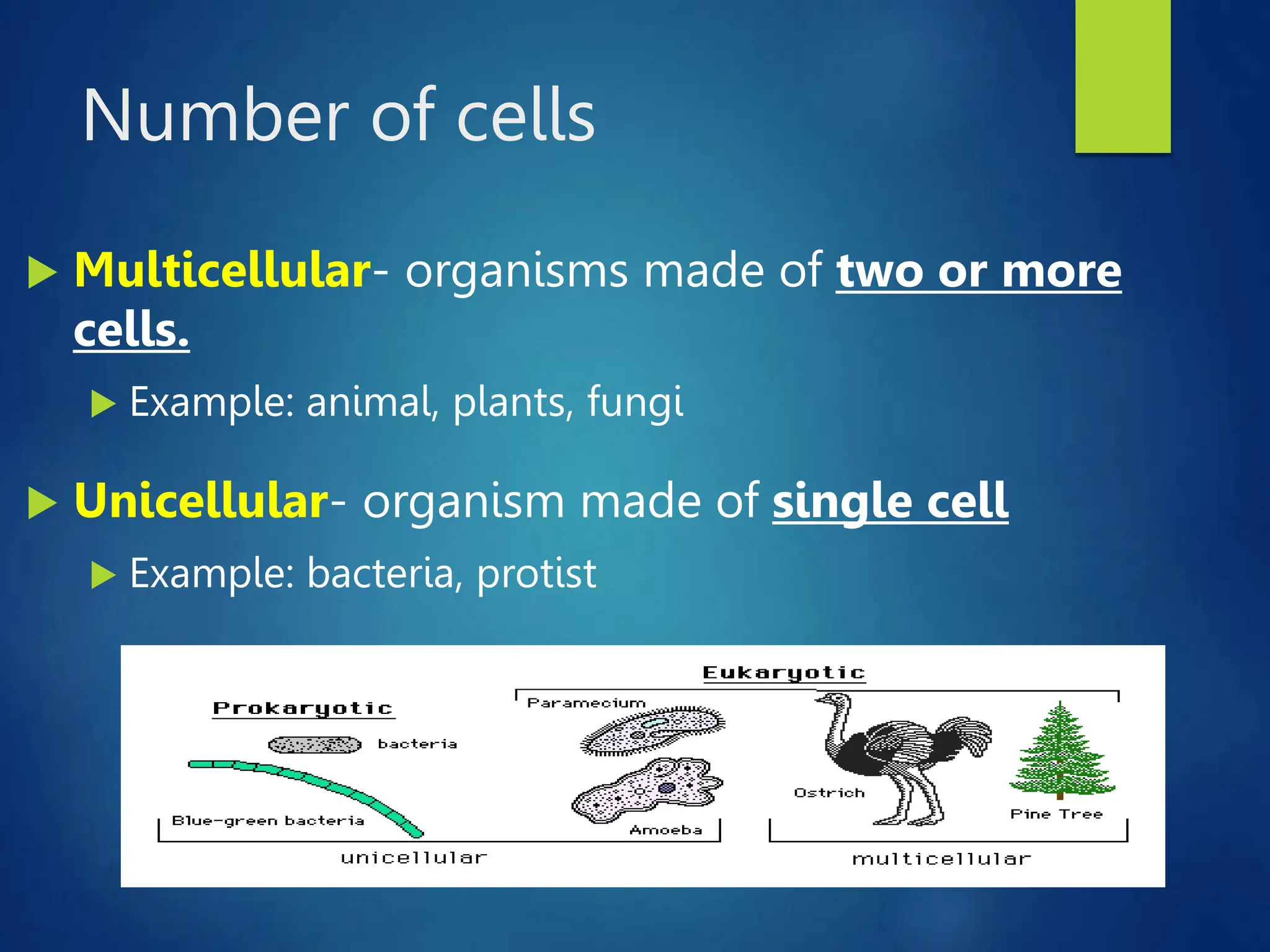
 Multicellular- organisms made of two or more
cells.
 Example: animal, plants, fungi
 Unicellular- organism made of single cell
 Example: bacteria, protist
Vocabulary
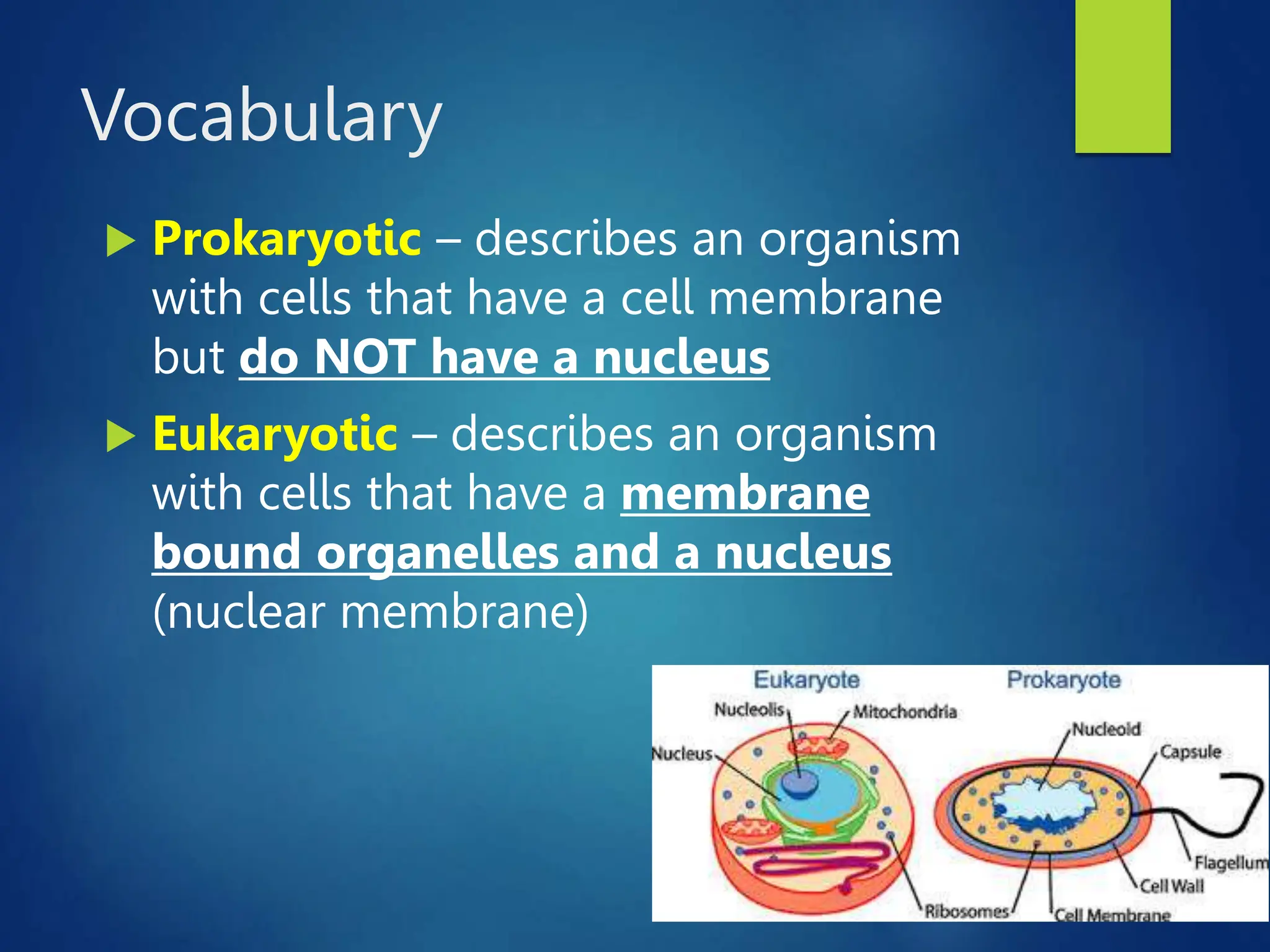
 Prokaryotic – describes an organism
with cells that have a cell membrane
but do NOT have a nucleus
 Eukaryotic – describes an organism
with cells that have a membrane
bound organelles and a nucleus
(nuclear membrane)
Vocabulary
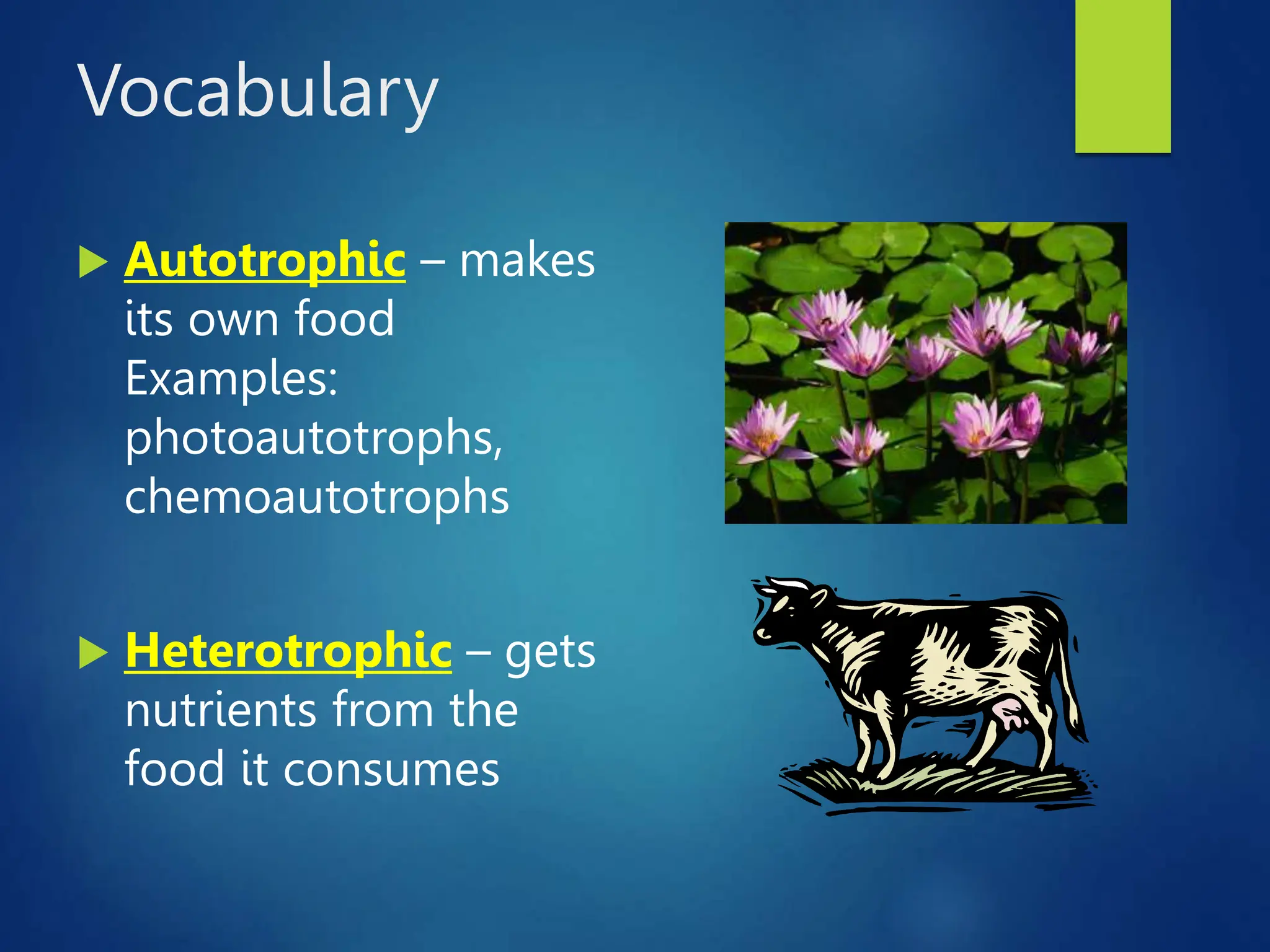
 Autotrophic – makes
its own food
Examples:
photoautotrophs,
chemoautotrophs
 Heterotrophic – gets
nutrients from the
food it consumes
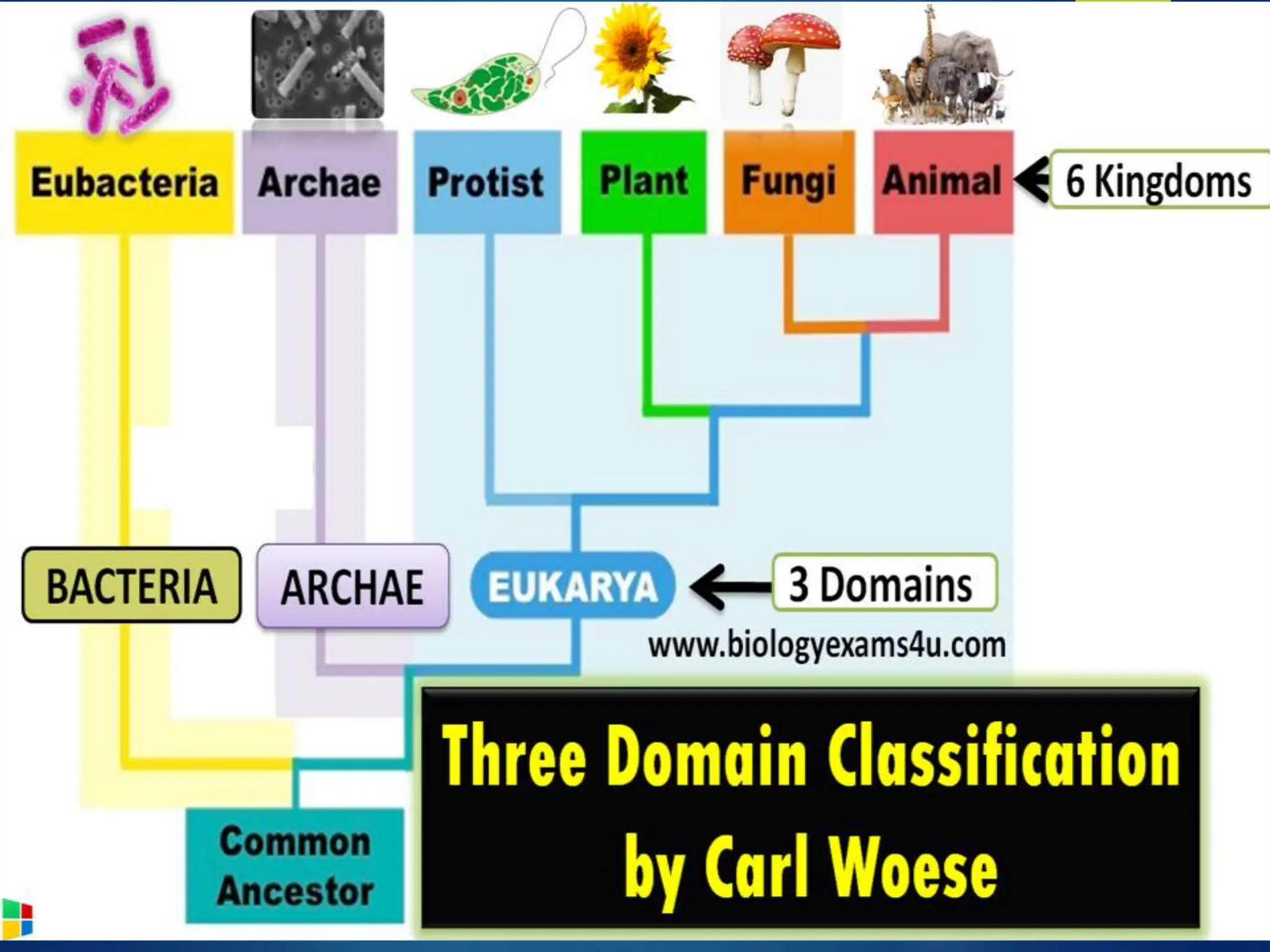
List of the Three Domains and
the Six Kingdoms
1. Domain Bacteria
 Kingdom Eubacteria
2. Domain Archaea
 Kingdom Archaebacteria
3. Domain Eukarya
 Kingdom Protista
 Kingdom Fungi
 Kingdom Plantae
 Kingdom Animalia
Environment per kingdom
(niche)
 Archaebacteria- extreme environment
 Eubacteria- everywhere in daily life (humans
large intestine)
 Protista- Pond water, land, air
 Fungi-trees, ground
 Plantae-everywhere (land and water)
 Animalia – everywhere (land, air, water)
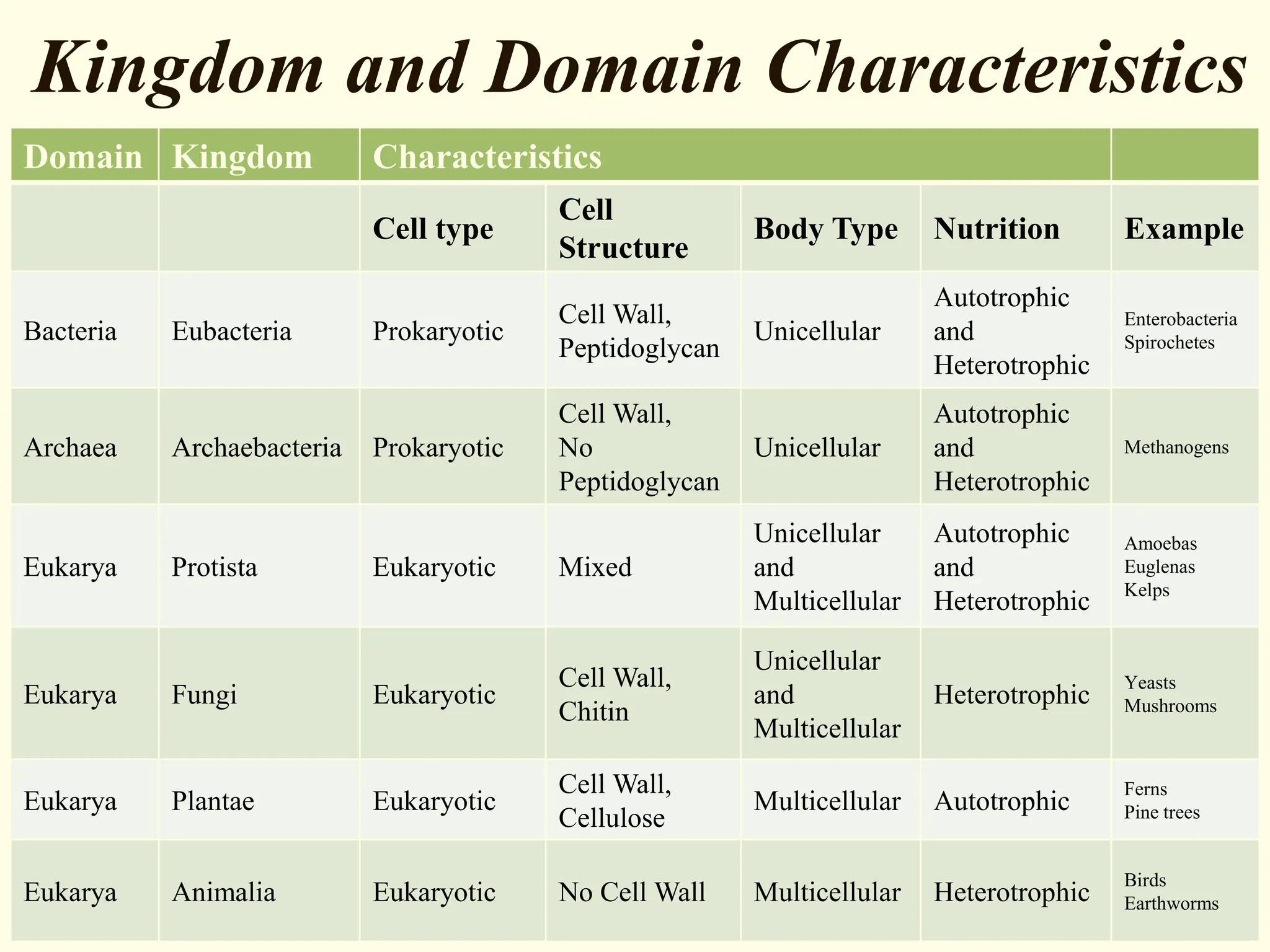
Kingdom and Domain Characteristics
Domain Kingdom Characteristics
Cell type
Cell
Structure
Body Type Nutrition Example
Bacteria Eubacteria Prokaryotic
Cell Wall,
Peptidoglycan
Unicellular
Autotrophic
and
Heterotrophic
Enterobacteria
Spirochetes
Archaea Archaebacteria Prokaryotic
Cell Wall,
No
Peptidoglycan
Unicellular
Autotrophic
and
Heterotrophic
Methanogens
Eukarya Protista Eukaryotic Mixed
Unicellular
and
Multicellular
Autotrophic
and
Heterotrophic
Amoebas
Euglenas
Kelps
Eukarya Fungi Eukaryotic
Cell Wall,
Chitin
Unicellular
and
Multicellular
Heterotrophic
Yeasts
Mushrooms
Eukarya Plantae Eukaryotic
Cell Wall,
Cellulose
Multicellular Autotrophic
Ferns
Pine trees
Eukarya Animalia Eukaryotic No Cell Wall Multicellular Heterotrophic
Birds
Earthworms
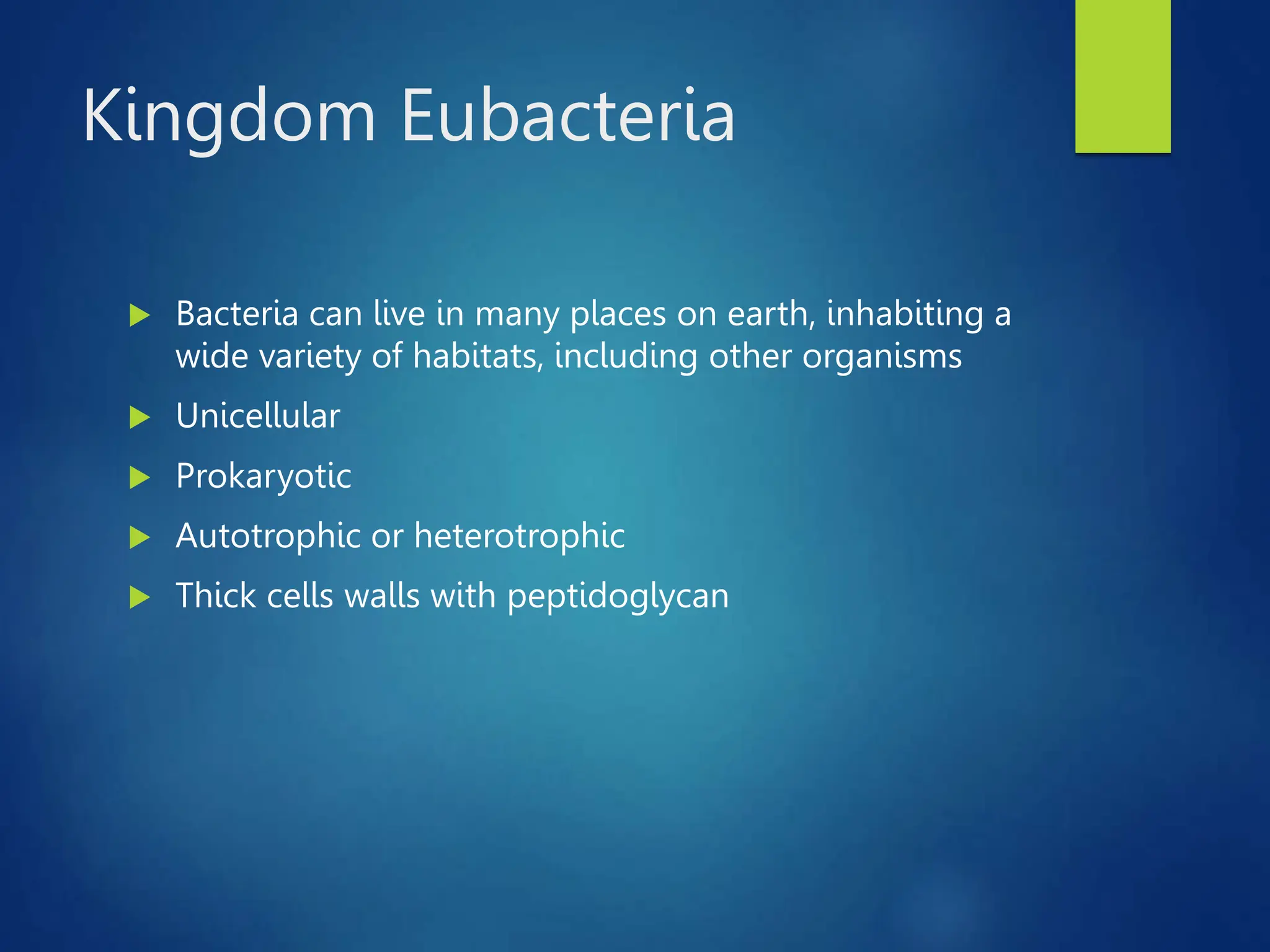
Kingdom Eubacteria
 Bacteria can live in many places on earth, inhabiting a
wide variety of habitats, including other organisms
 Unicellular
 Prokaryotic
 Autotrophic or heterotrophic
 Thick cells walls with peptidoglycan
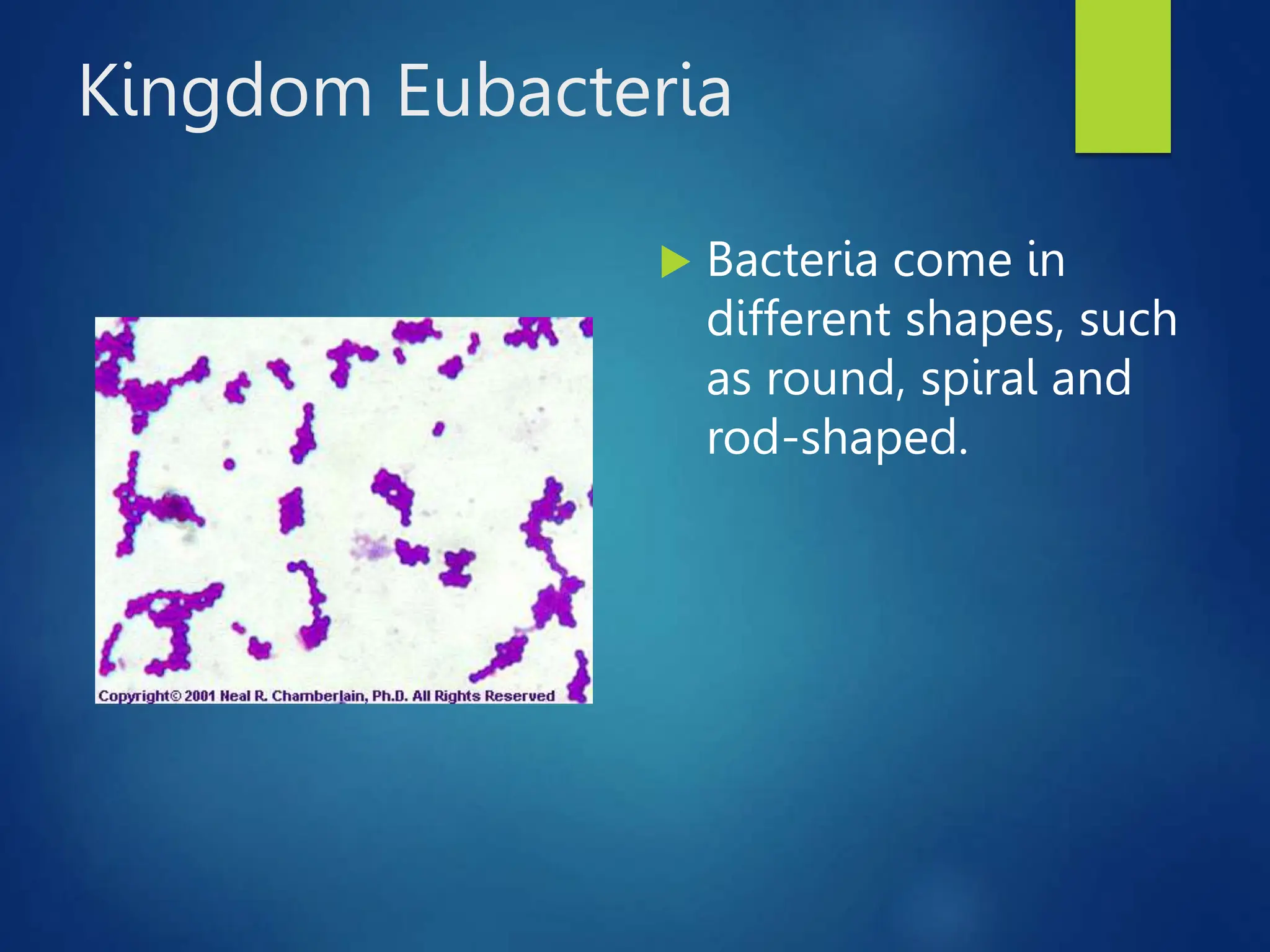
Kingdom Eubacteria
 Bacteria come in
different shapes, such
as round, spiral and
rod-shaped.
Kingdom Eubacteria
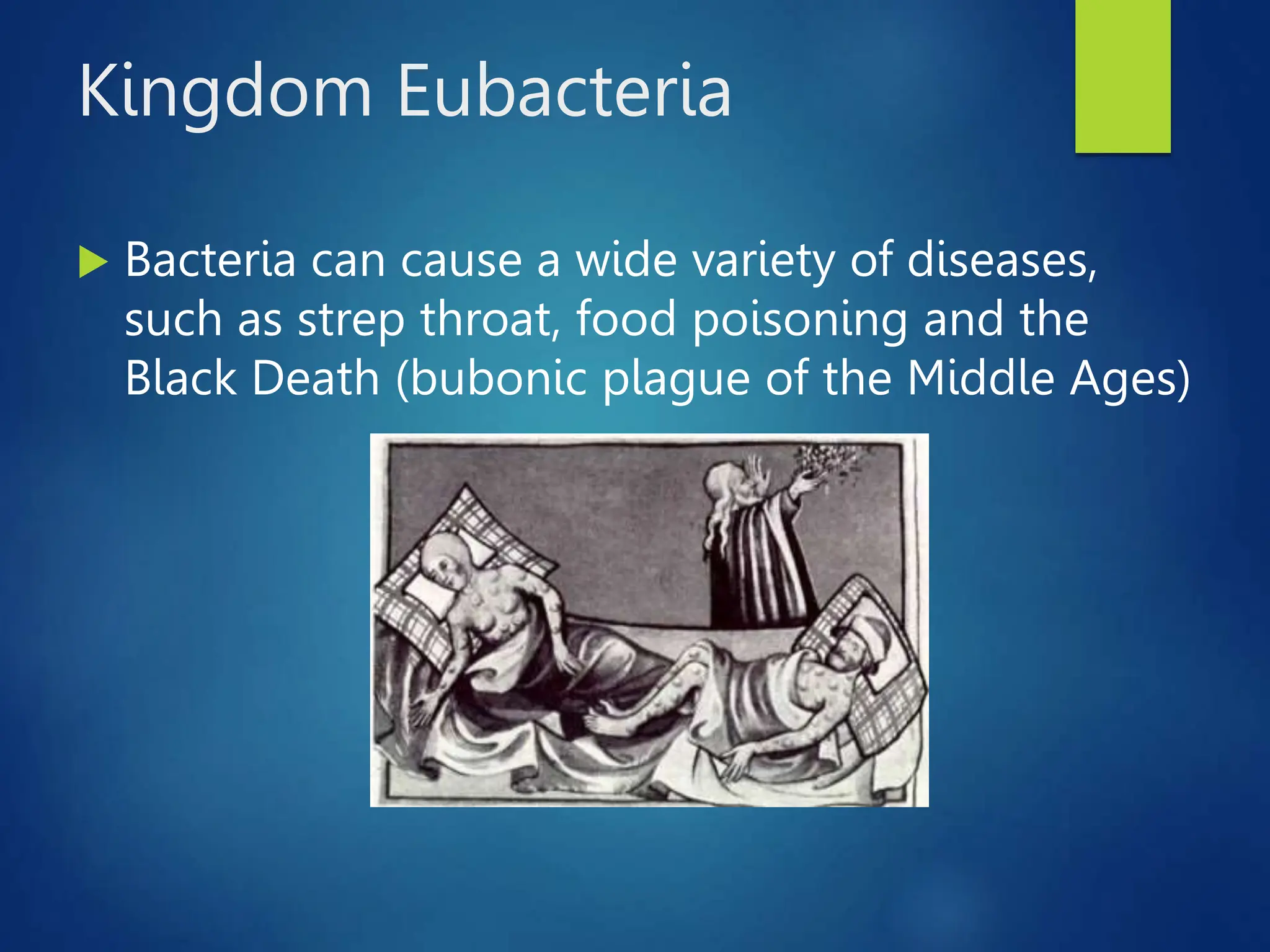
 Bacteria can cause a wide variety of diseases,
such as strep throat, food poisoning and the
Black Death (bubonic plague of the Middle Ages)
Kingdom Eubacteria
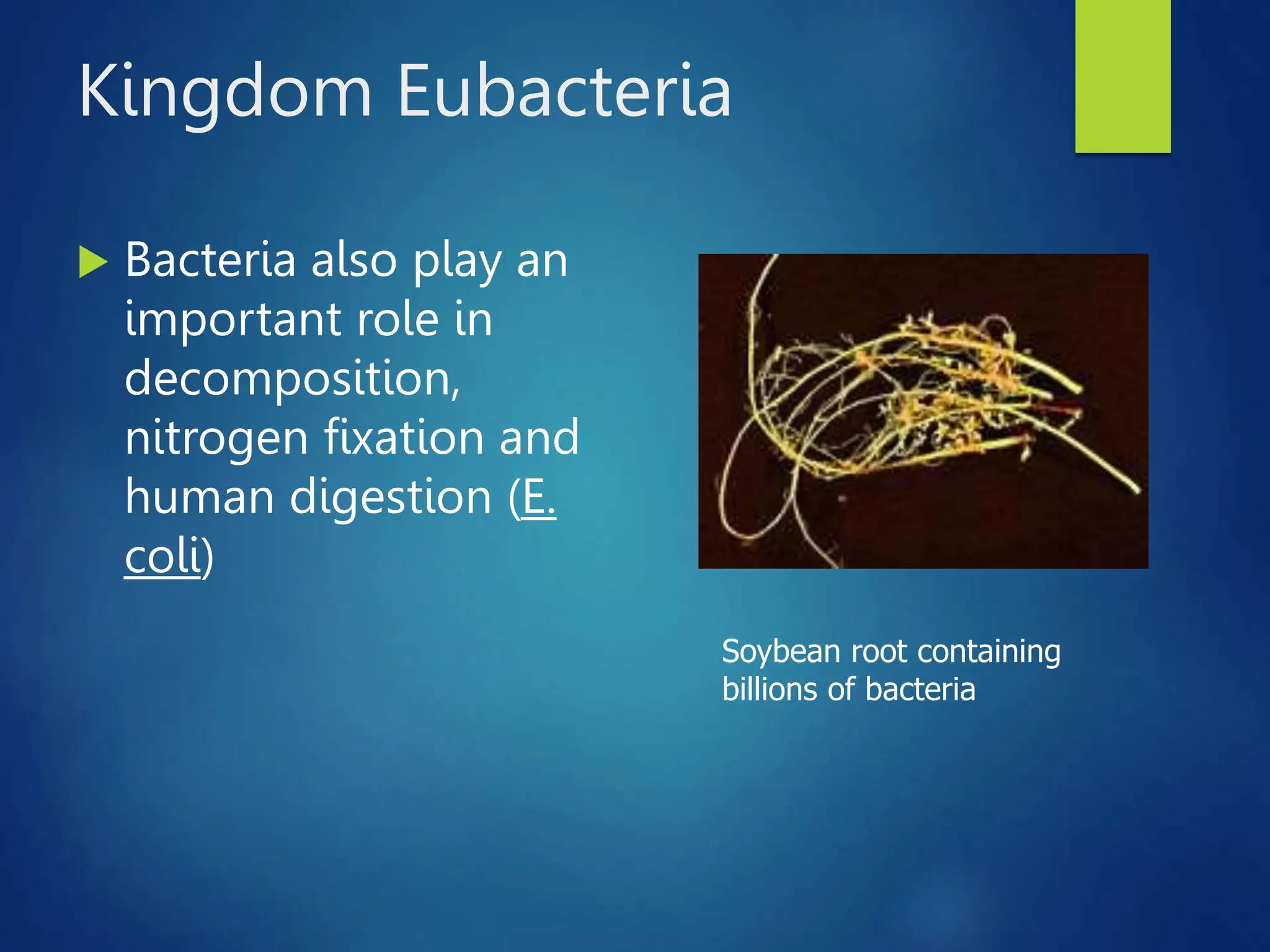
 Bacteria also play an
important role in
decomposition,
nitrogen fixation and
human digestion (E.
coli)
Soybean root containing
billions of bacteria
Kingdom Eubacteria
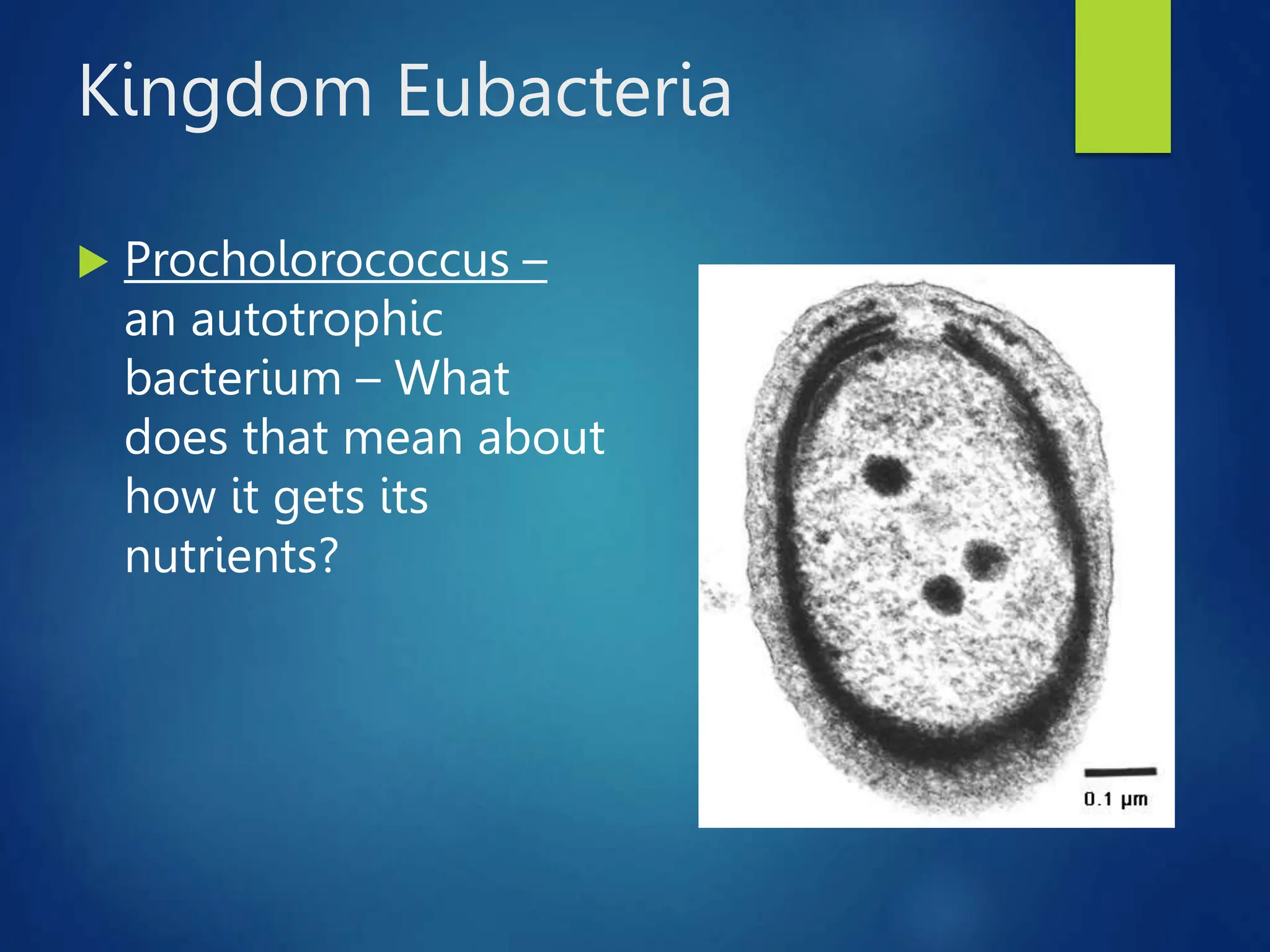
 Procholorococcus –
an autotrophic
bacterium – What
does that mean about
how it gets its
nutrients?
Kingdom Eubacteria
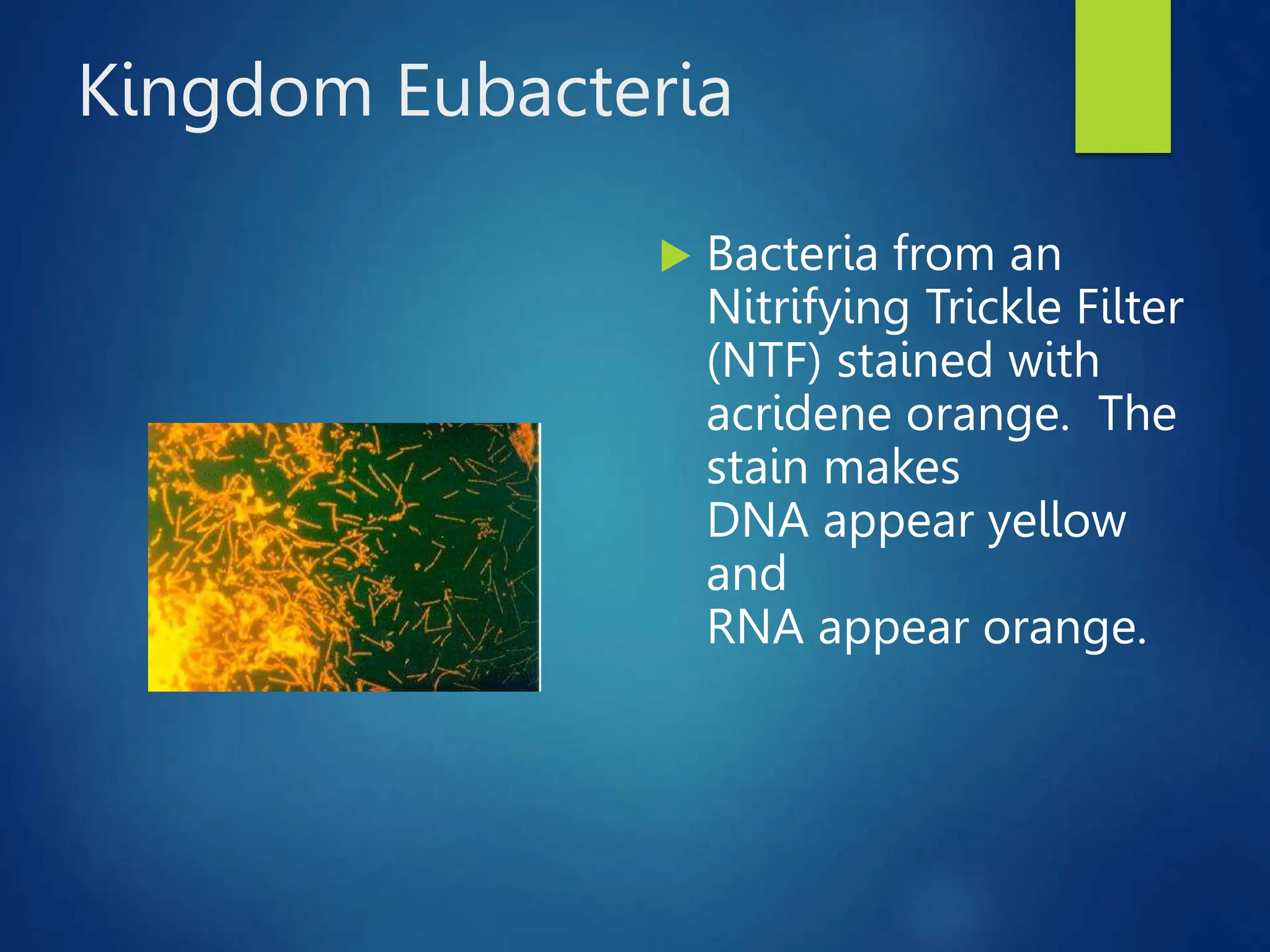
 Bacteria from an
Nitrifying Trickle Filter
(NTF) stained with
acridene orange. The
stain makes
DNA appear yellow
and
RNA appear orange.
Kingdom Archaebacteria
 Bacteria that live in extreme habitats, such as hot
springs, geysers, volcanic hot pools, brine pools, black
smokers
 Unicellular
 Prokaryotic
 Autotrophic or heterotrophic
 Cell walls without peptidoglycan
Kingdom Archaebacteria
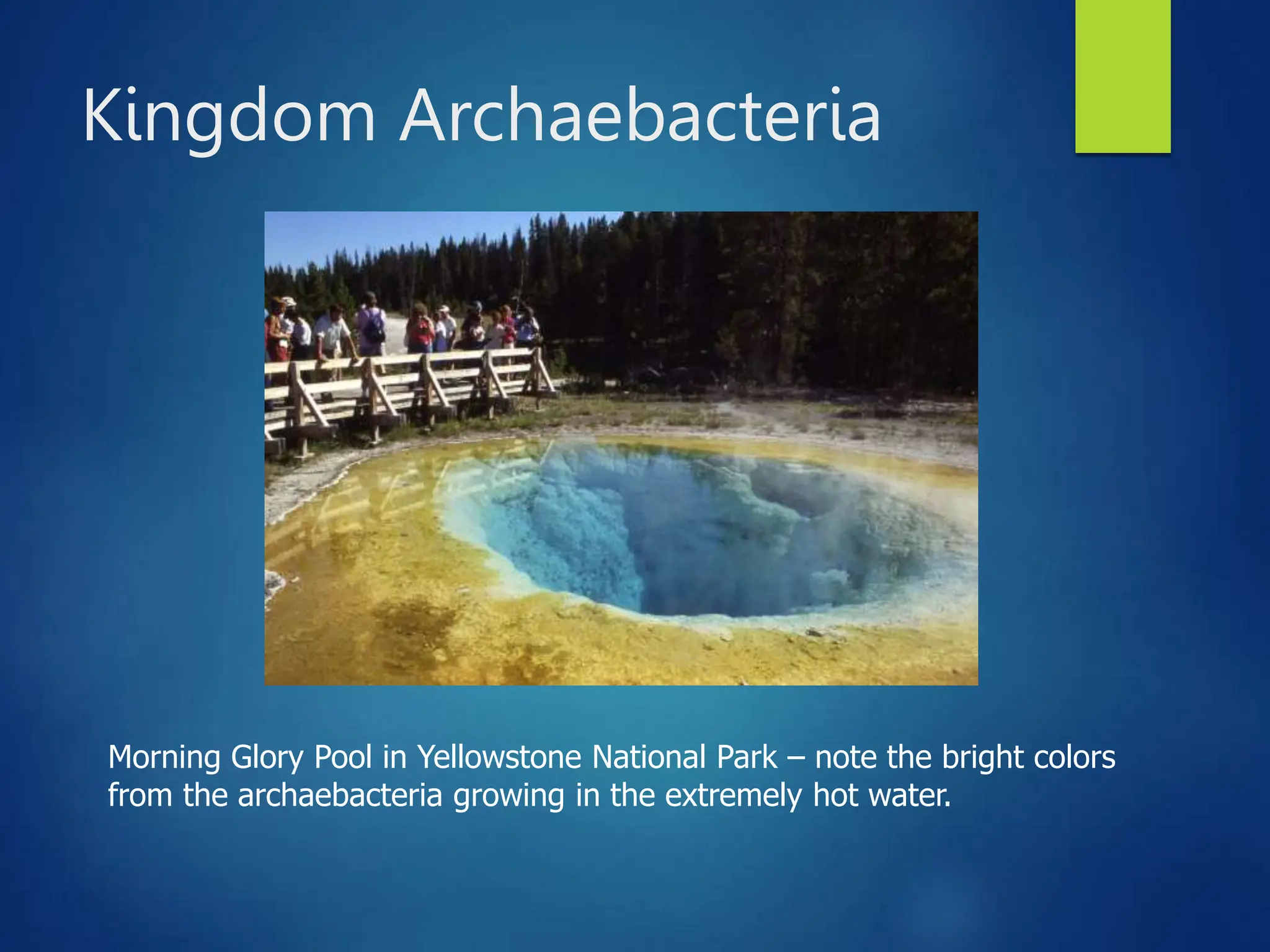
Morning Glory Pool in Yellowstone National Park – note the bright colors
from the archaebacteria growing in the extremely hot water.
Kingdom Archaebacteria
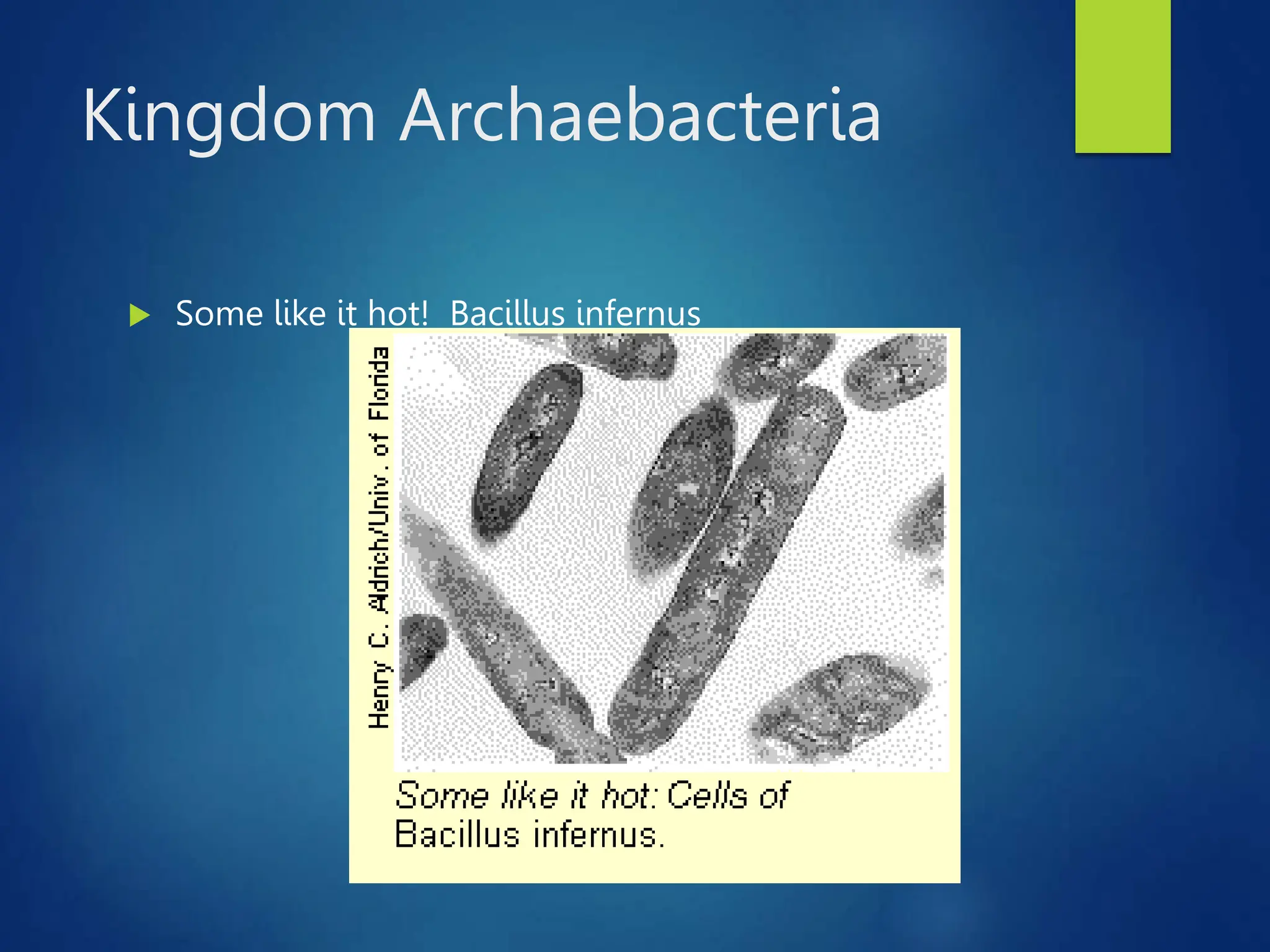
 Some like it hot! Bacillus infernus
Kingdom Archaebacteria
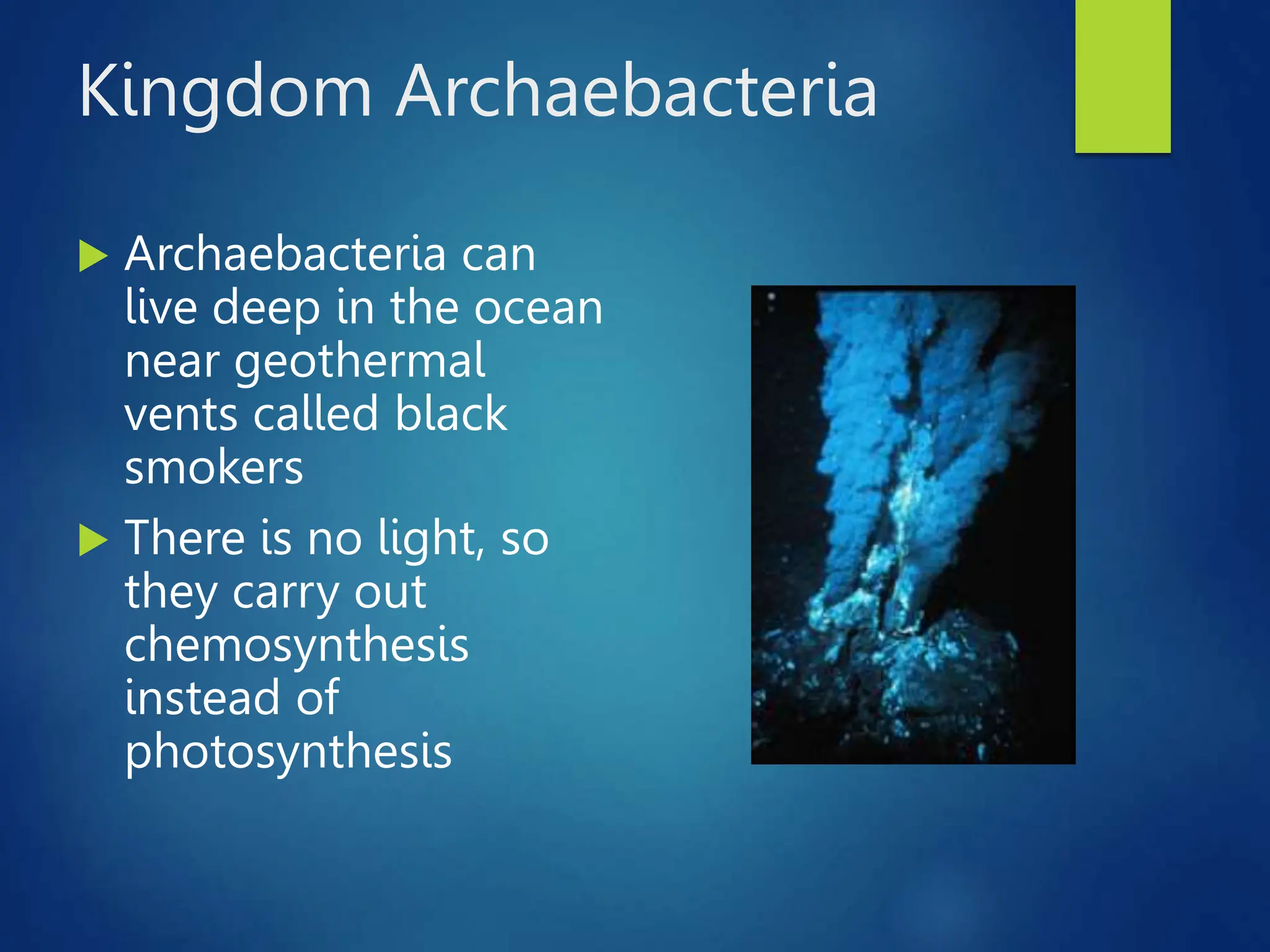
 Archaebacteria can
live deep in the ocean
near geothermal
vents called black
smokers
 There is no light, so
they carry out
chemosynthesis
instead of
photosynthesis
Kingdom Protista
 Extremely diverse group
 Eukaryotic
 Most unicellular, some colonial, some multicellular
 Autotrophic and heterotrophic
 Some with cell walls containing cellulose; some carry
out photosynthesis with chloroplasts
Kingdom Protista
Volvox – a colonial protist
Euglena - autotrophic
A slime mold
Amoeba - heterotrophic
Kingdom Fungi
 Eukaryotic
 Most are multicellular
 Heterotrophic (decomposers)
 Cell walls made of chitin
Kingdom Fungi
Stilton cheese
Bread mold
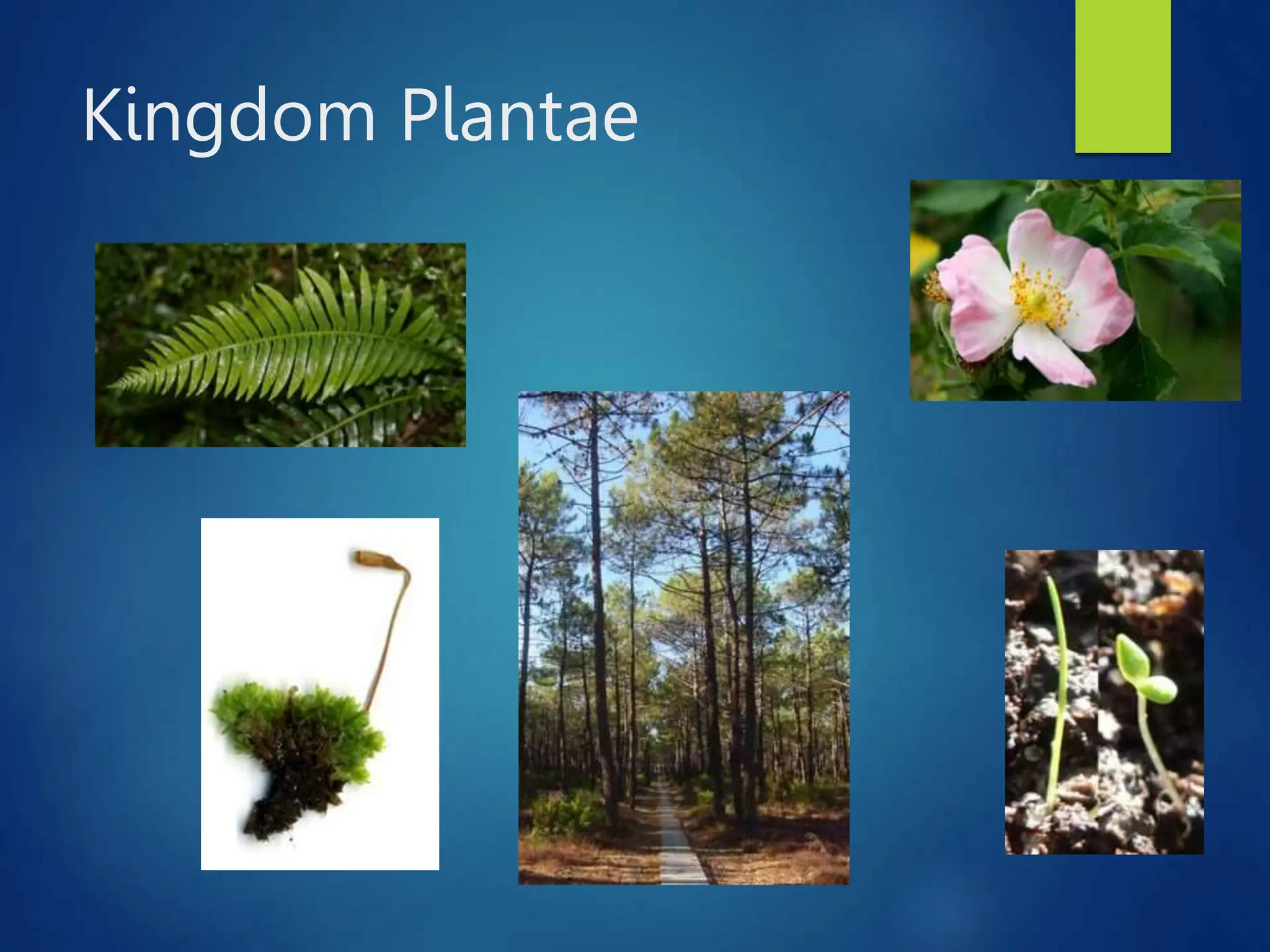
Kingdom Plantae
 Eukaryotic
 Multicellular
 Autotrophic
 Cell wall of cellulose; chloroplasts present
Kingdom Plantae
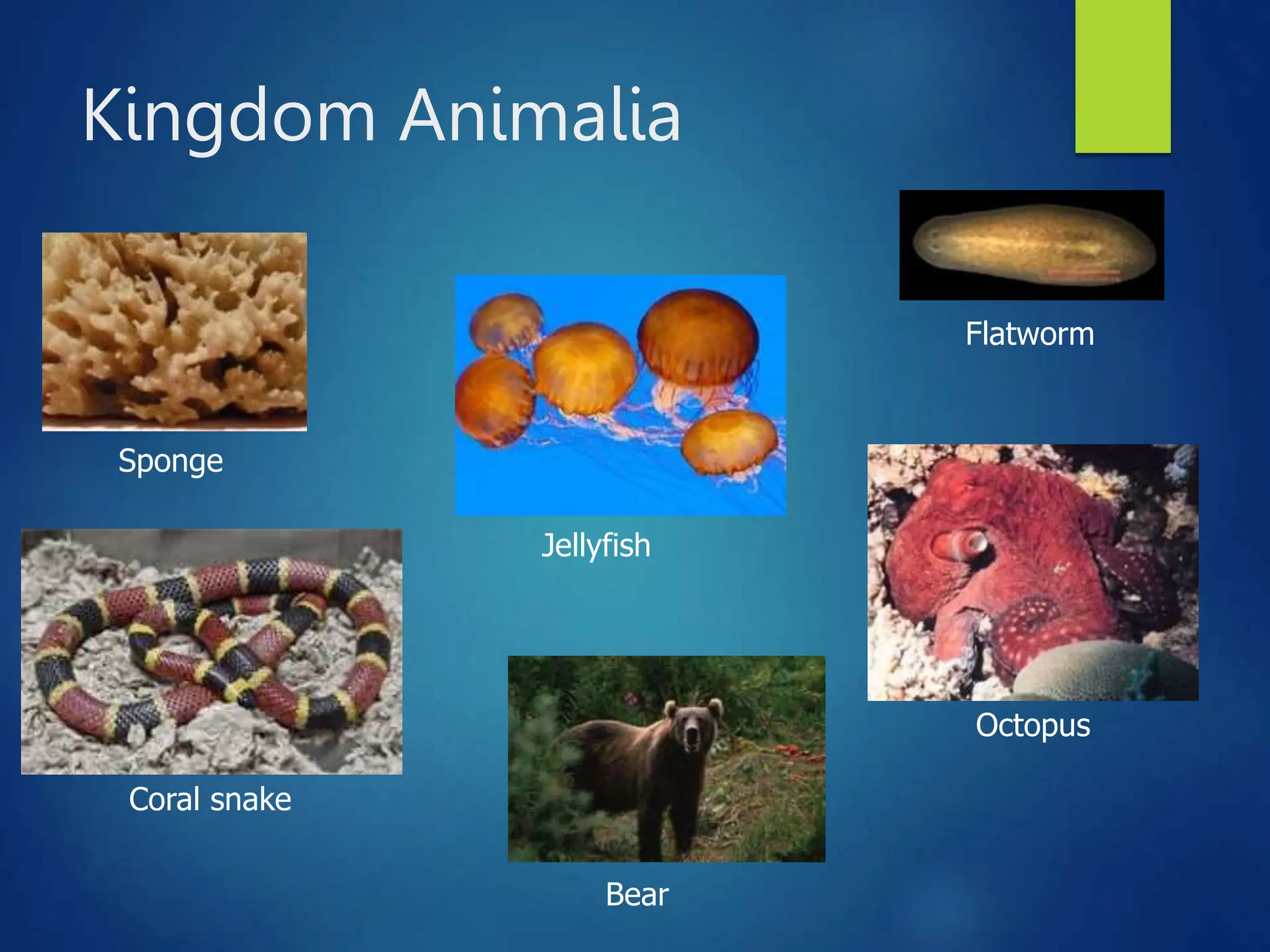
Kingdom Animalia
 Eukaryotic
 Multicellular
 Heterotrophic
 No cell walls, no chloroplasts
Kingdom Animalia
Coral snake
Sponge
Flatworm
Octopus
Jellyfish
Bear
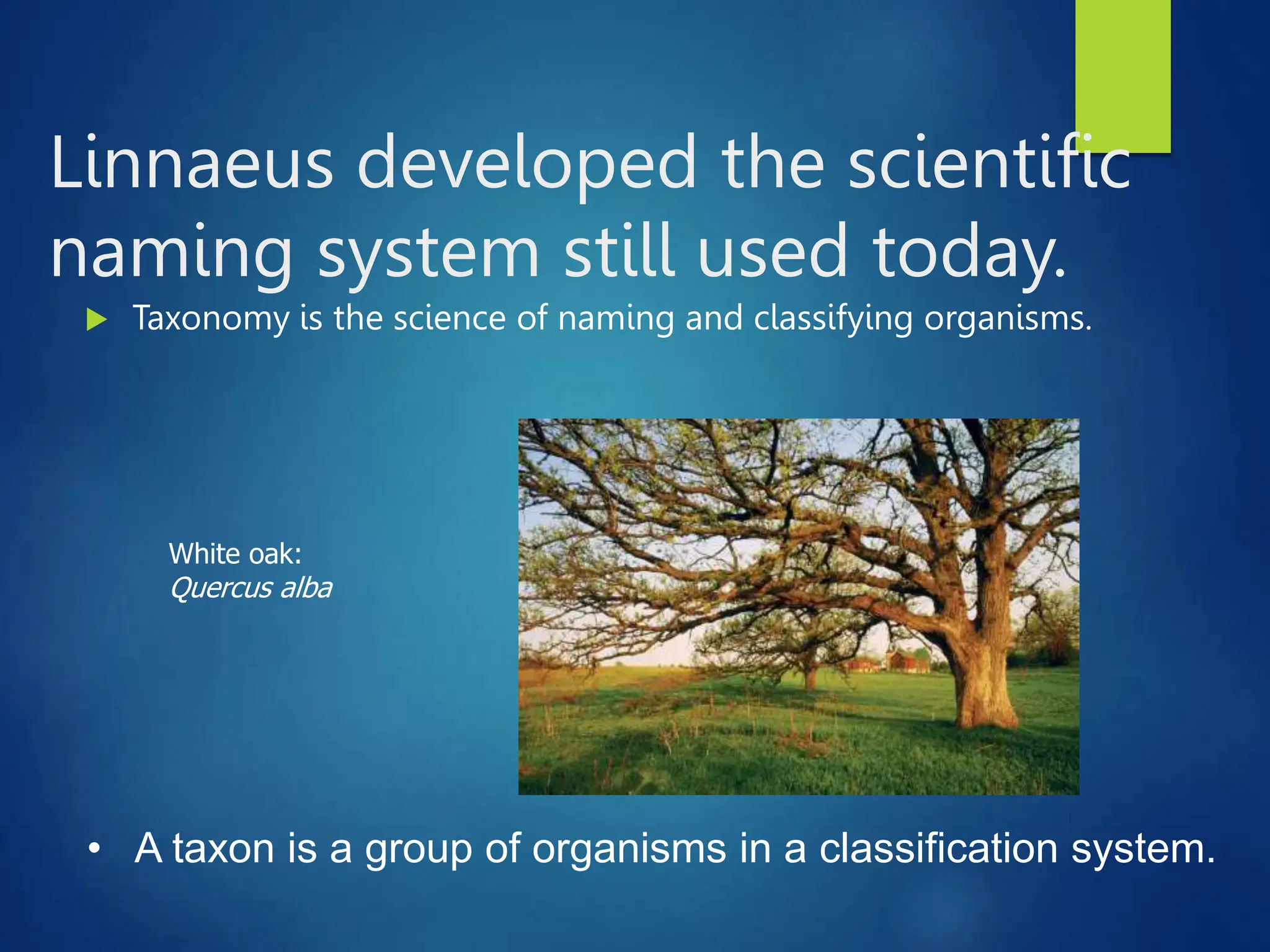
Linnaeus developed the scientific
naming system still used today.
 Taxonomy is the science of naming and classifying organisms.
• A taxon is a group of organisms in a classification system.
White oak:
Quercus alba
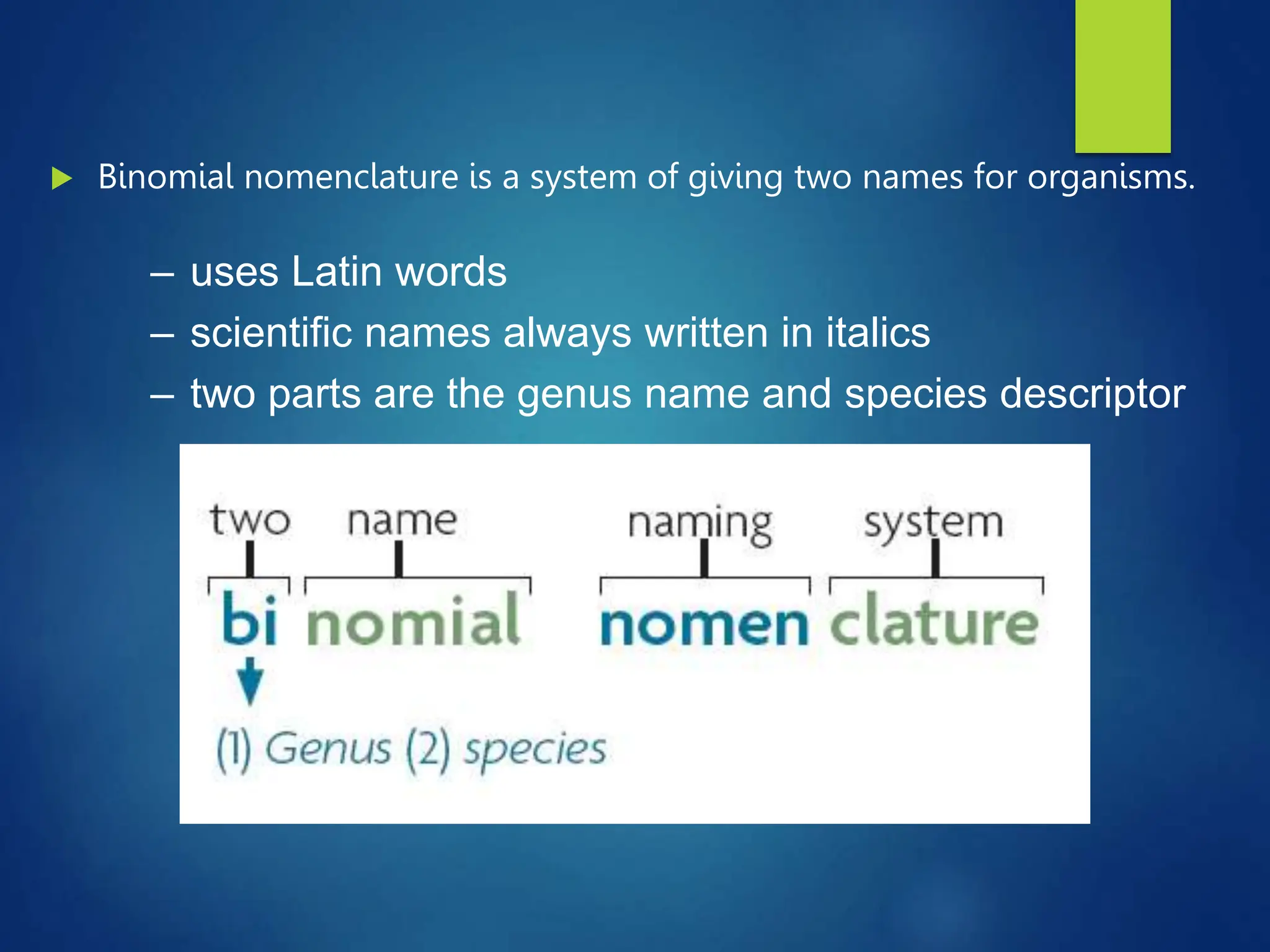
 Binomial nomenclature is a system of giving two names for organisms.
– uses Latin words
– scientific names always written in italics
– two parts are the genus name and species descriptor
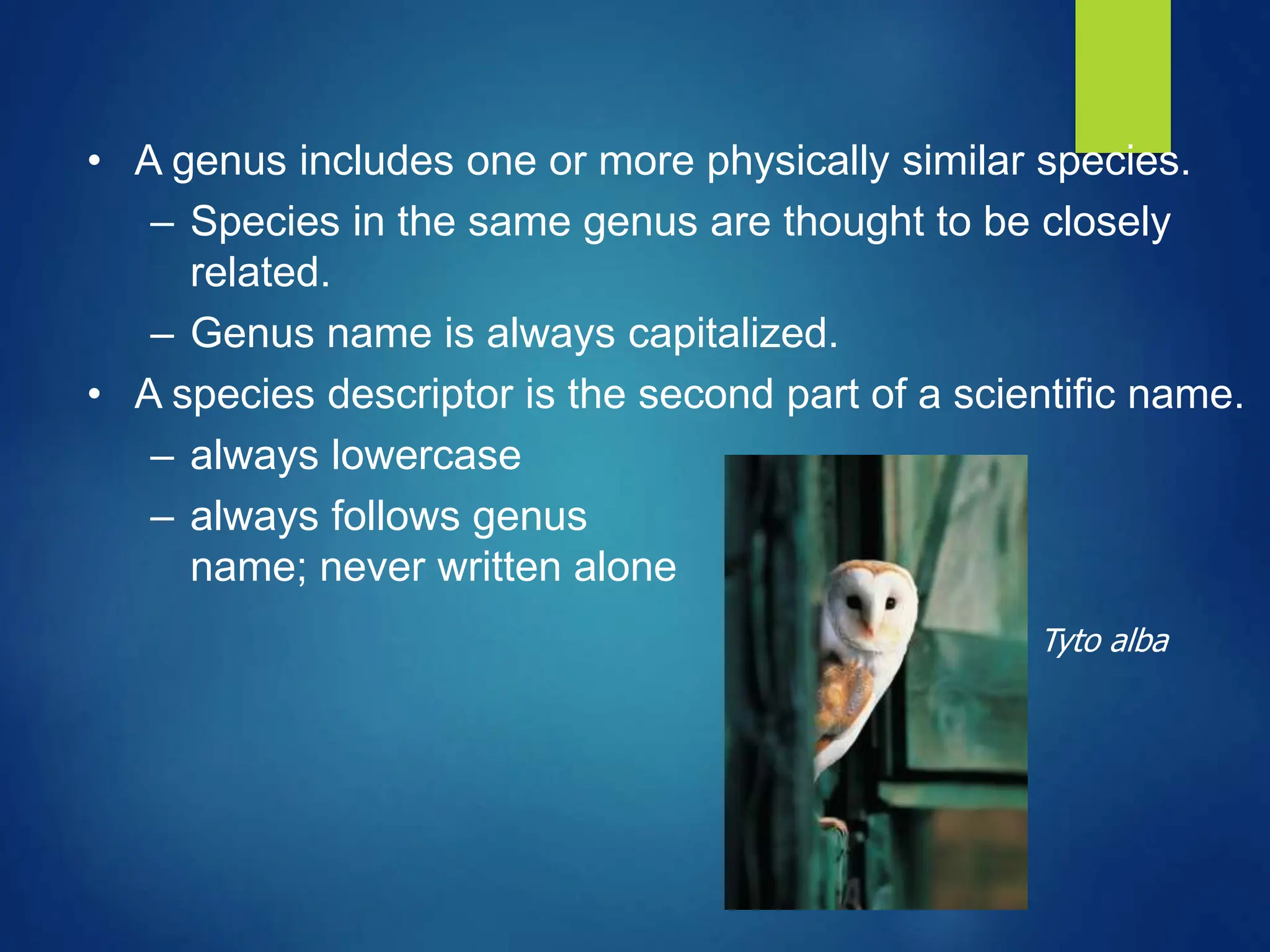
• A genus includes one or more physically similar species.
– Species in the same genus are thought to be closely
related.
– Genus name is always capitalized.
• A species descriptor is the second part of a scientific name.
– always lowercase
– always follows genus
name; never written alone
Tyto alba
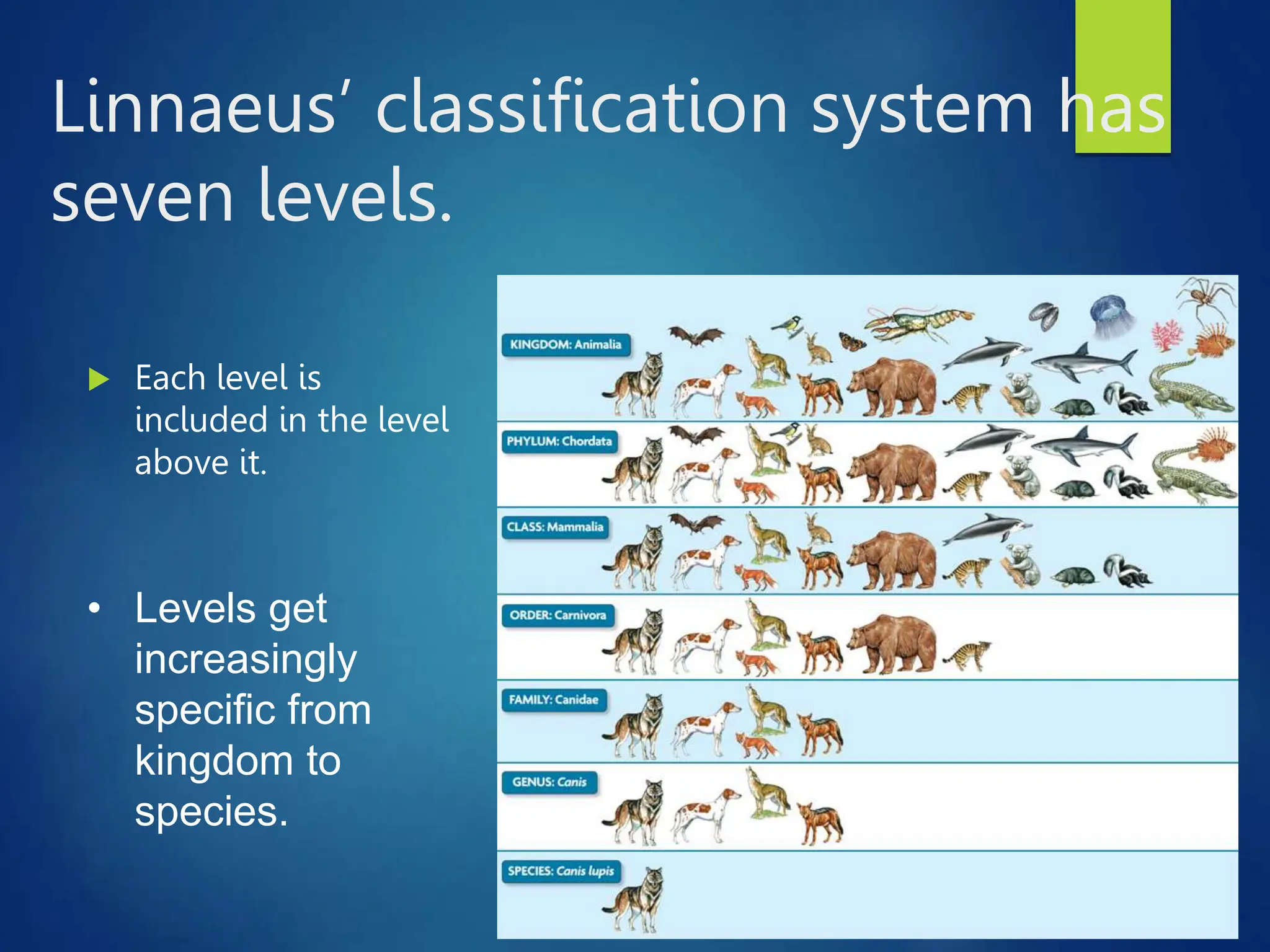
Linnaeus’ classification system has
seven levels.
 Each level is
included in the level
above it.
• Levels get
increasingly
specific from
kingdom to
species.
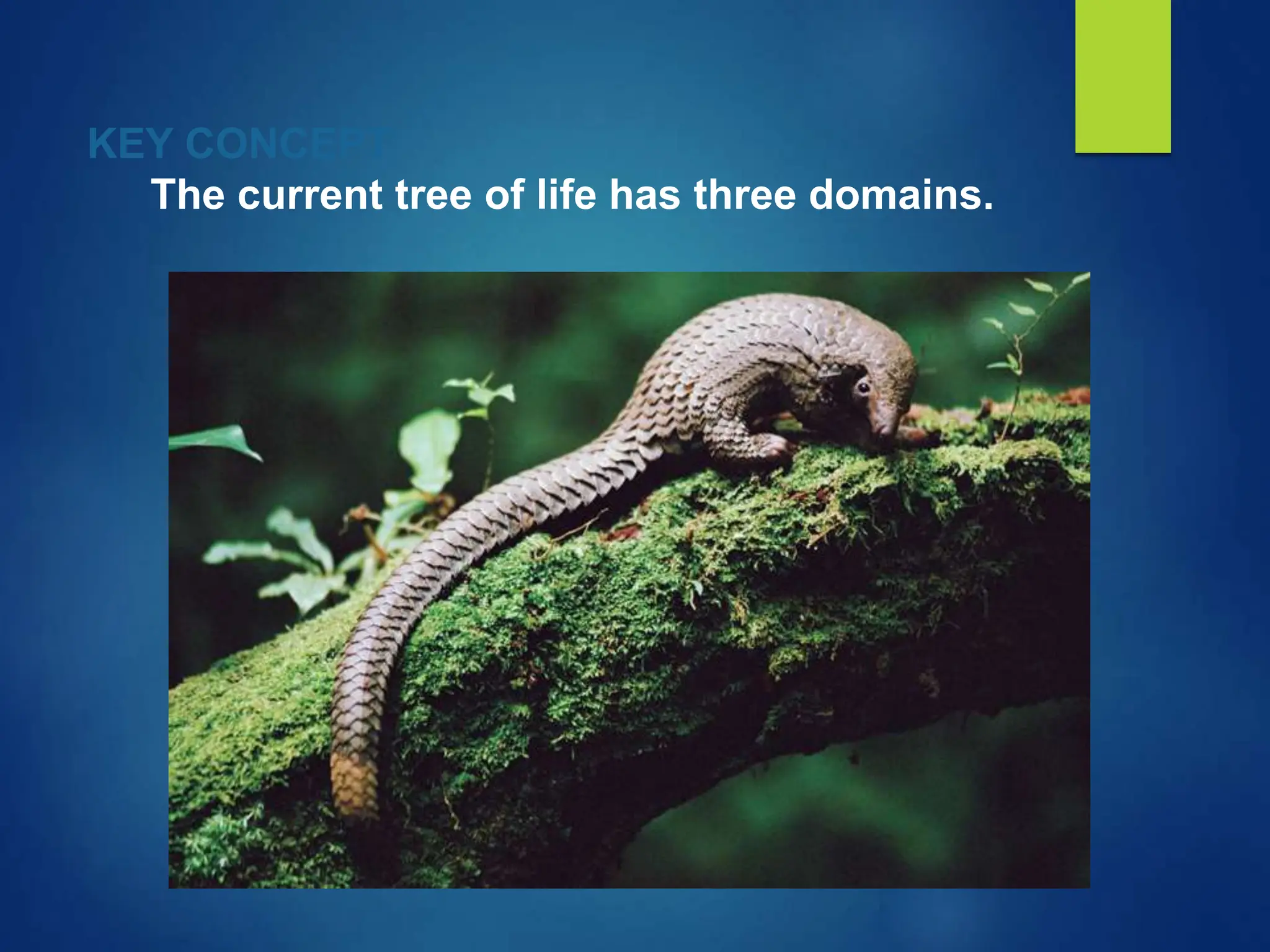
KEY CONCEPT
The current tree of life has three domains.
Classification is always a work in
progress.
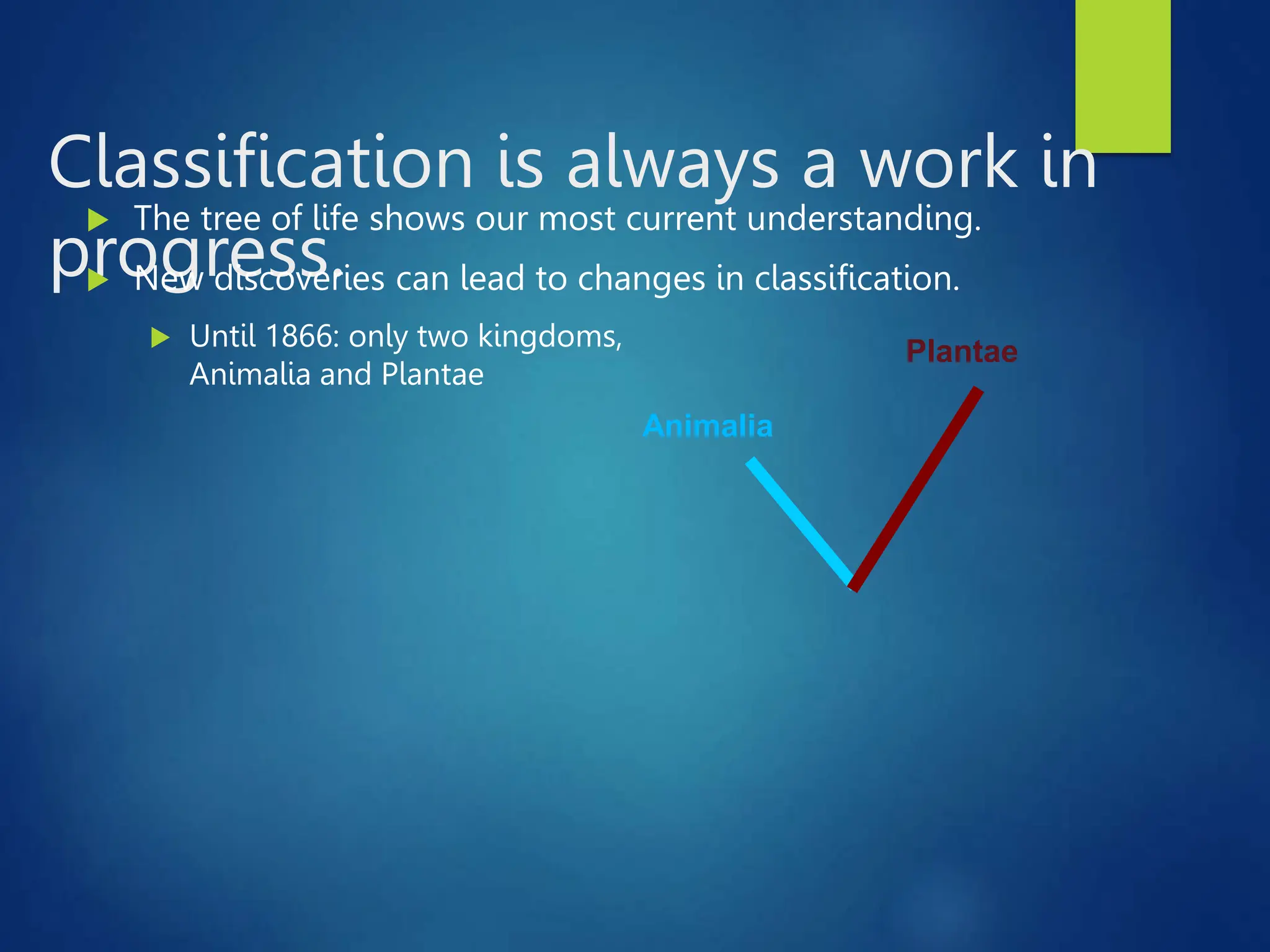
 The tree of life shows our most current understanding.
 New discoveries can lead to changes in classification.
 Until 1866: only two kingdoms,
Animalia and Plantae
Animalia
Plantae
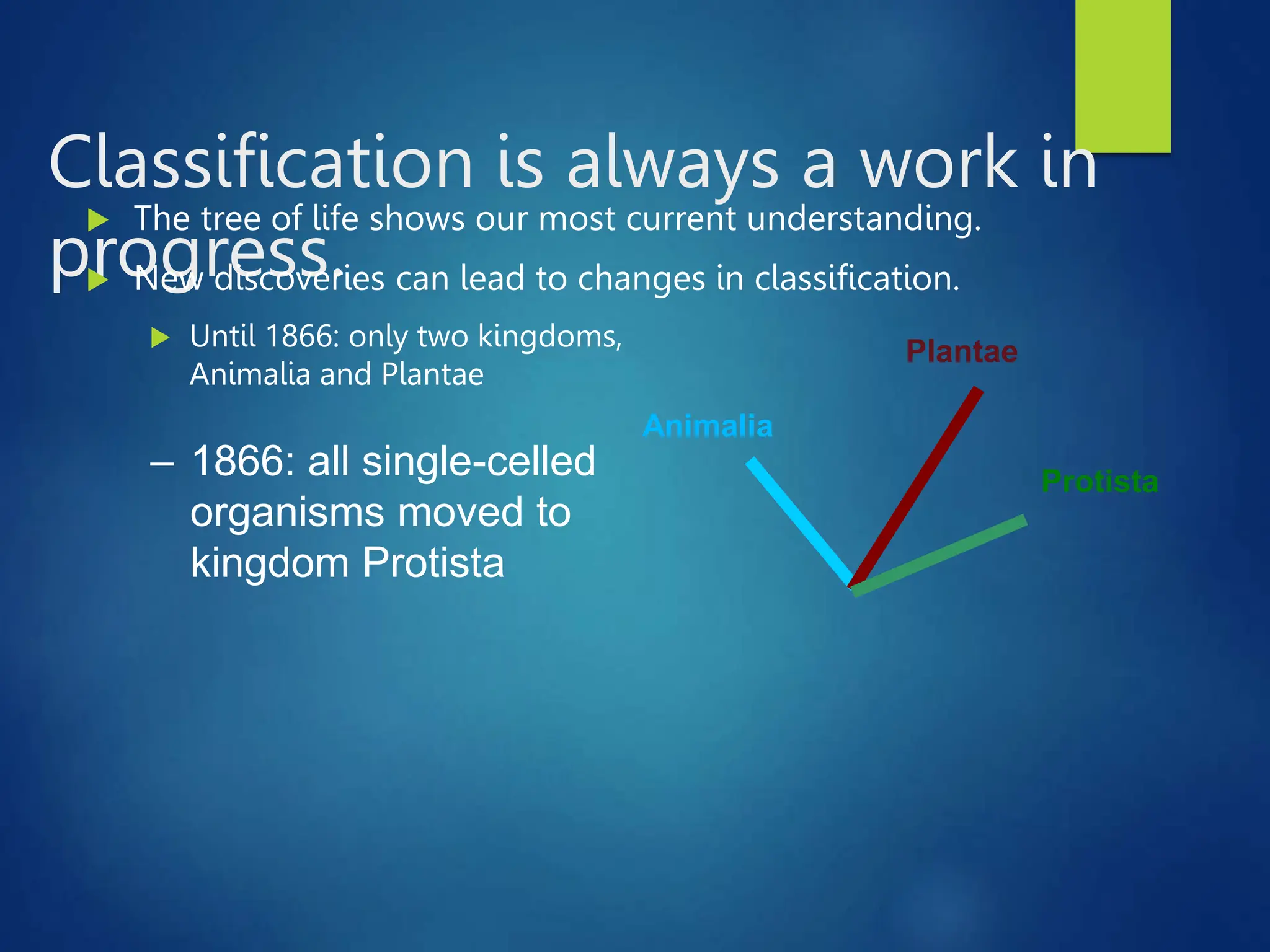
Classification is always a work in
progress.
 The tree of life shows our most current understanding.
 New discoveries can lead to changes in classification.
 Until 1866: only two kingdoms,
Animalia and Plantae
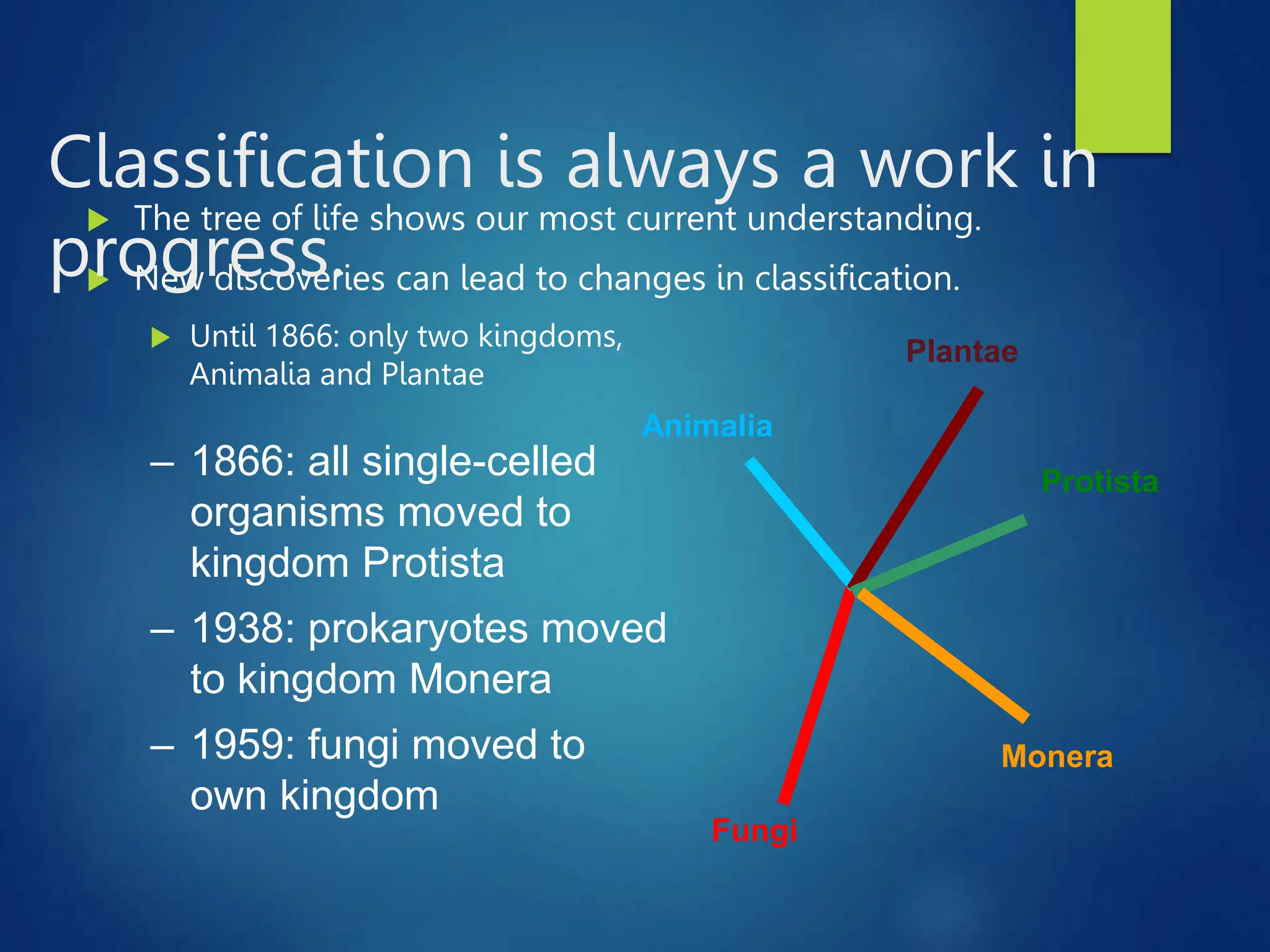
– 1866: all single-celled
organisms moved to
kingdom Protista
Animalia
Protista
Plantae
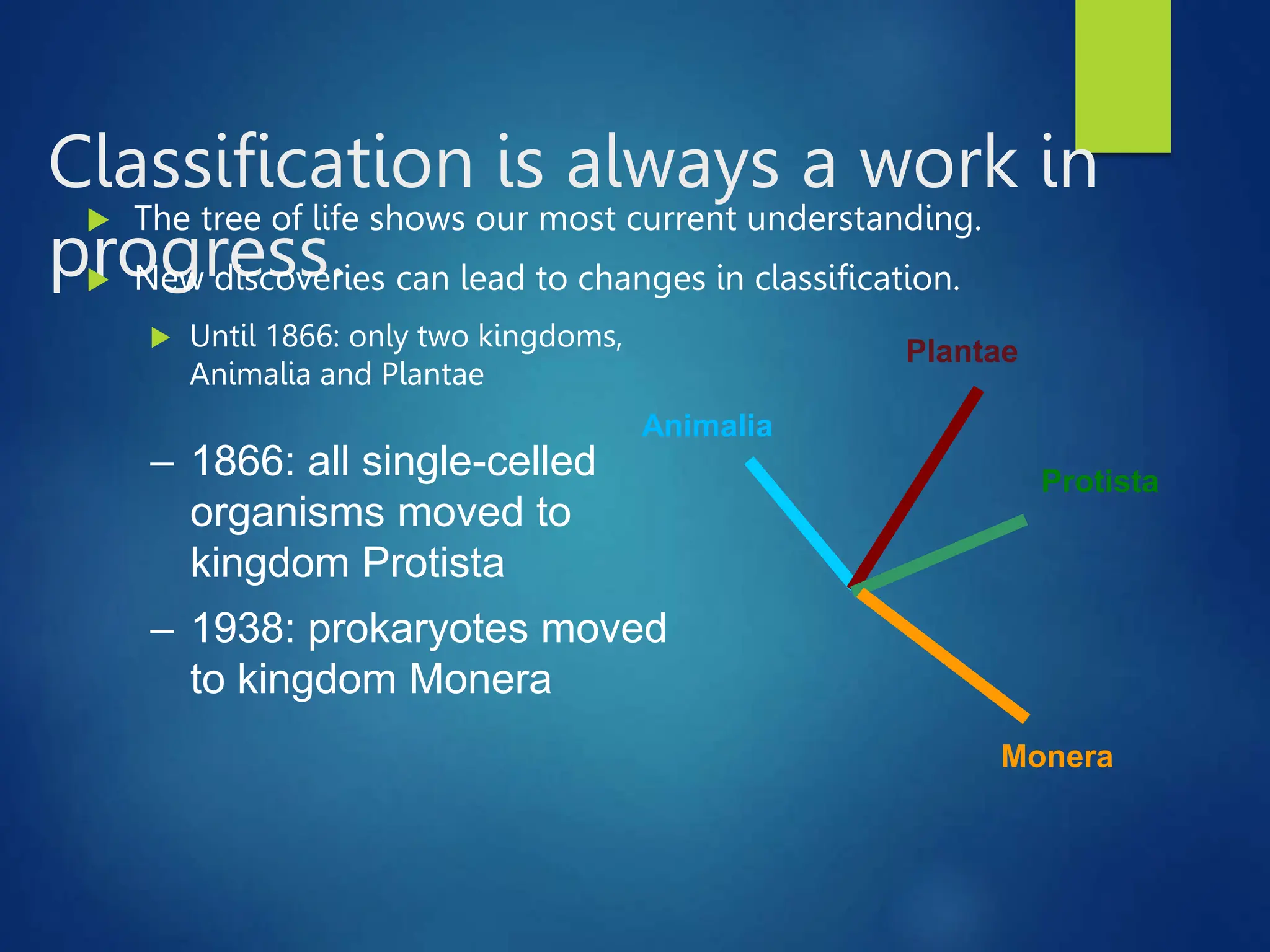
Classification is always a work in
progress.
 The tree of life shows our most current understanding.
 New discoveries can lead to changes in classification.
 Until 1866: only two kingdoms,
Animalia and Plantae
– 1938: prokaryotes moved
to kingdom Monera
– 1866: all single-celled
organisms moved to
kingdom Protista
Animalia
Protista
Plantae
Monera
 The tree of life shows our most current understanding.
 New discoveries can lead to changes in classification.
 Until 1866: only two kingdoms,
Animalia and Plantae
Classification is always a work in
progress.
– 1938: prokaryotes moved
to kingdom Monera
– 1866: all single-celled
organisms moved to
kingdom Protista
Monera
– 1959: fungi moved to
own kingdom
Fungi
Protista
Plantae
Animalia
 The tree of life shows our most current understanding.
 New discoveries can lead to changes in classification.
 Until 1866: only two kingdoms,
Animalia and Plantae
Classification is always a work in
progress.
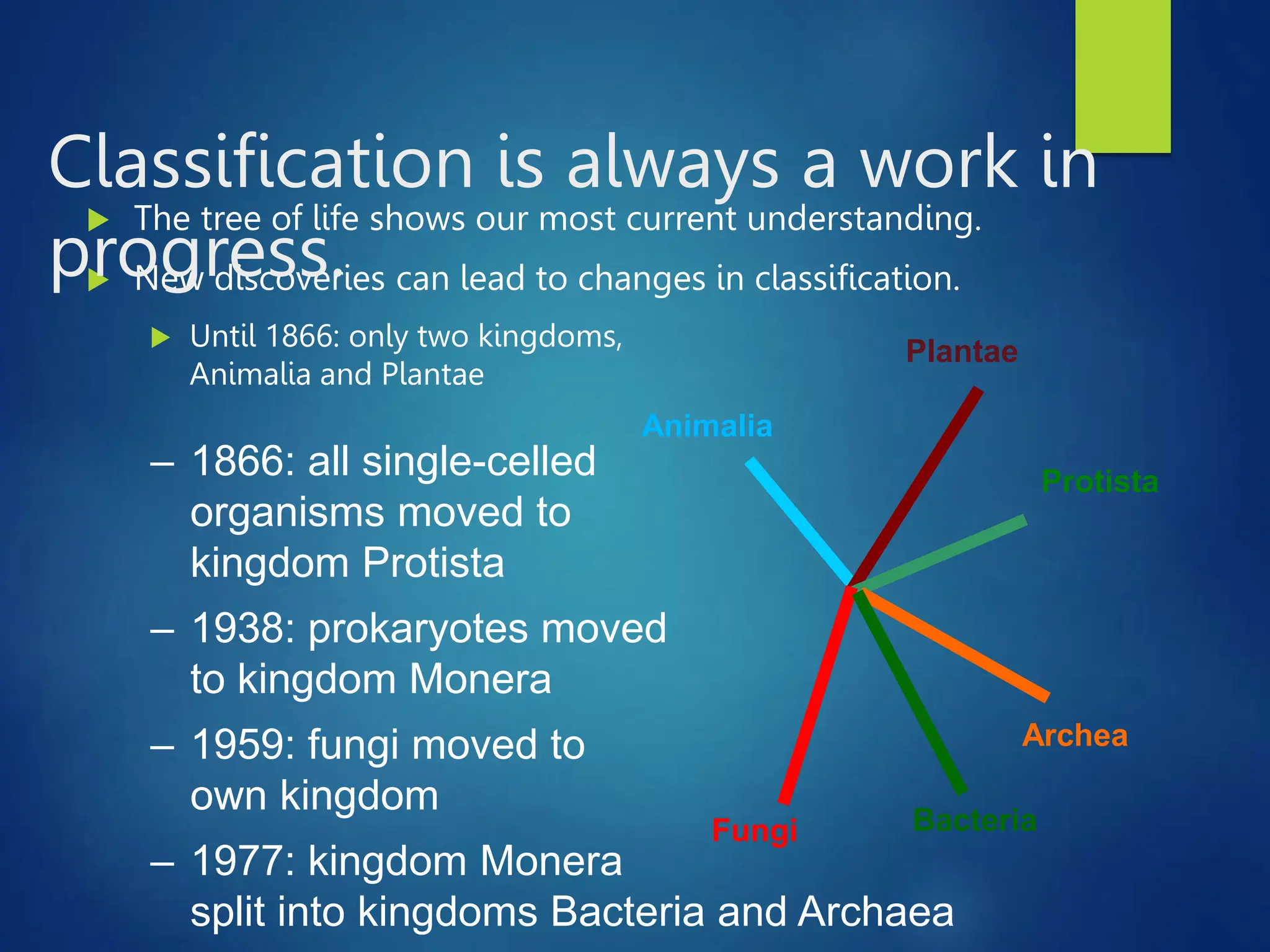
– 1938: prokaryotes moved
to kingdom Monera
– 1866: all single-celled
organisms moved to
kingdom Protista
– 1959: fungi moved to
own kingdom
– 1977: kingdom Monera
split into kingdoms Bacteria and Archaea
Animalia
Protista
Fungi
Plantae
Archea
Bacteria
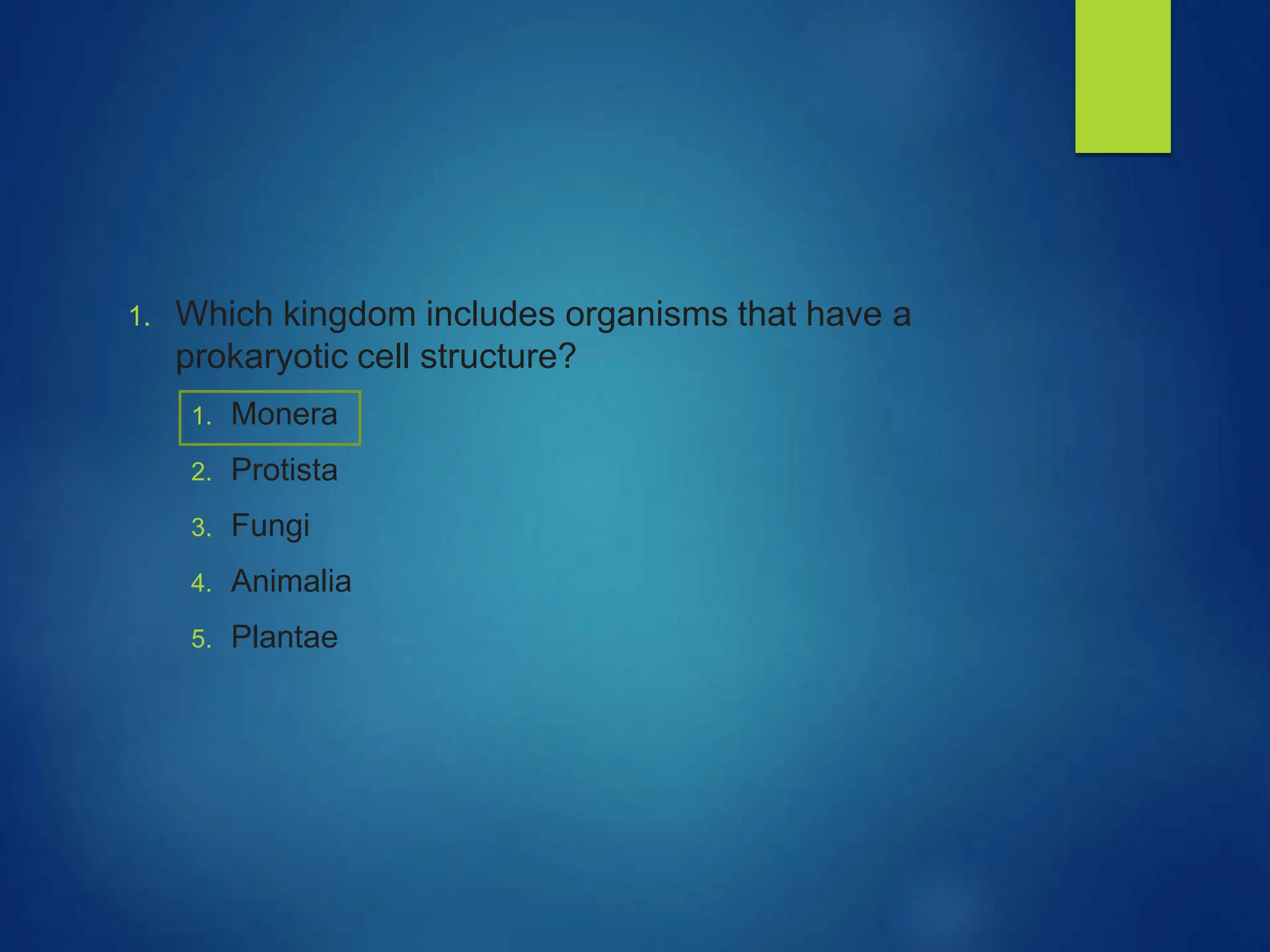
1. Which kingdom includes organisms that have a
prokaryotic cell structure?
1. Monera
2. Protista
3. Fungi
4. Animalia
5. Plantae
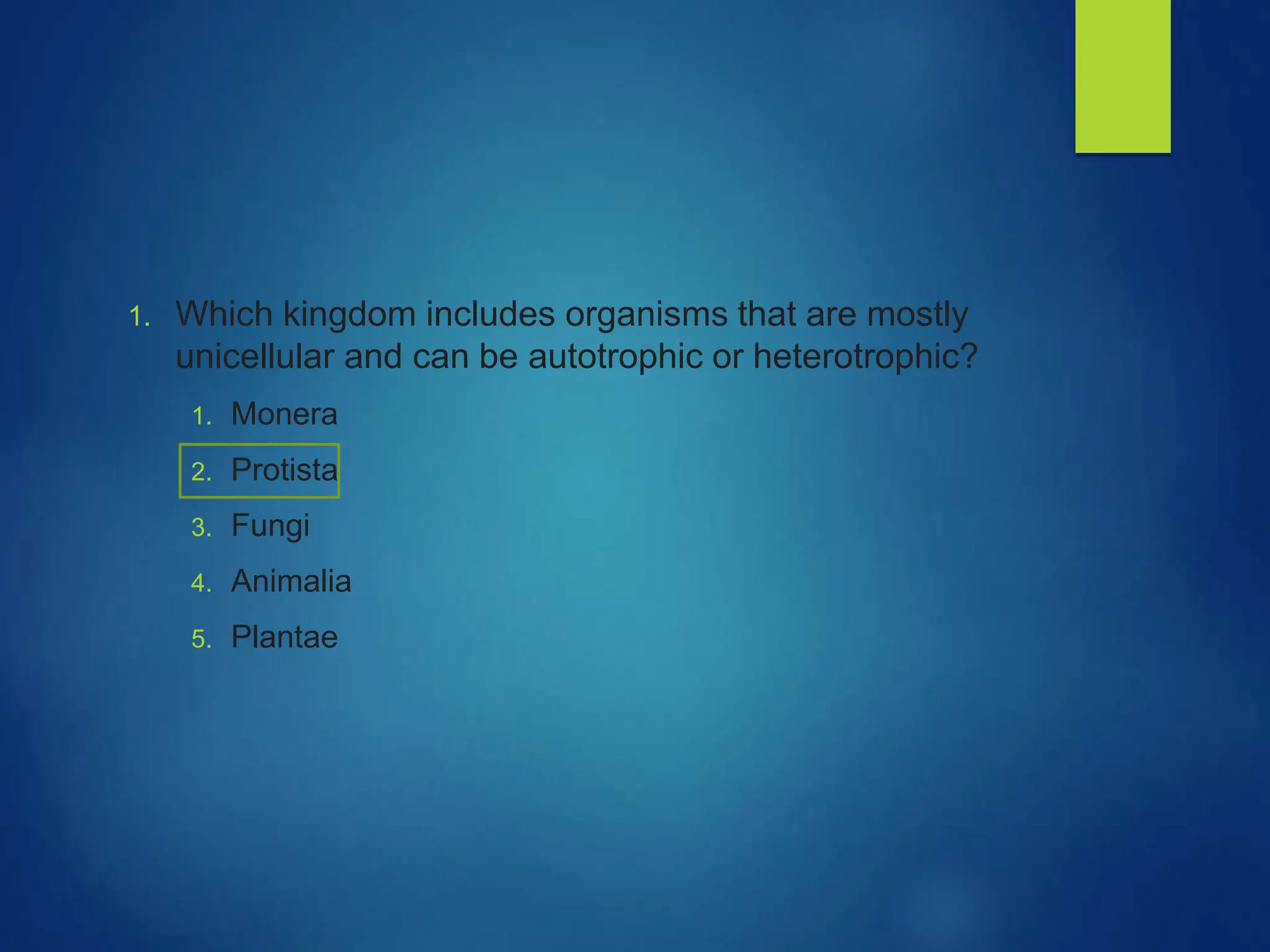
1. Which kingdom includes organisms that are mostly
unicellular and can be autotrophic or heterotrophic?
1. Monera
2. Protista
3. Fungi
4. Animalia
5. Plantae
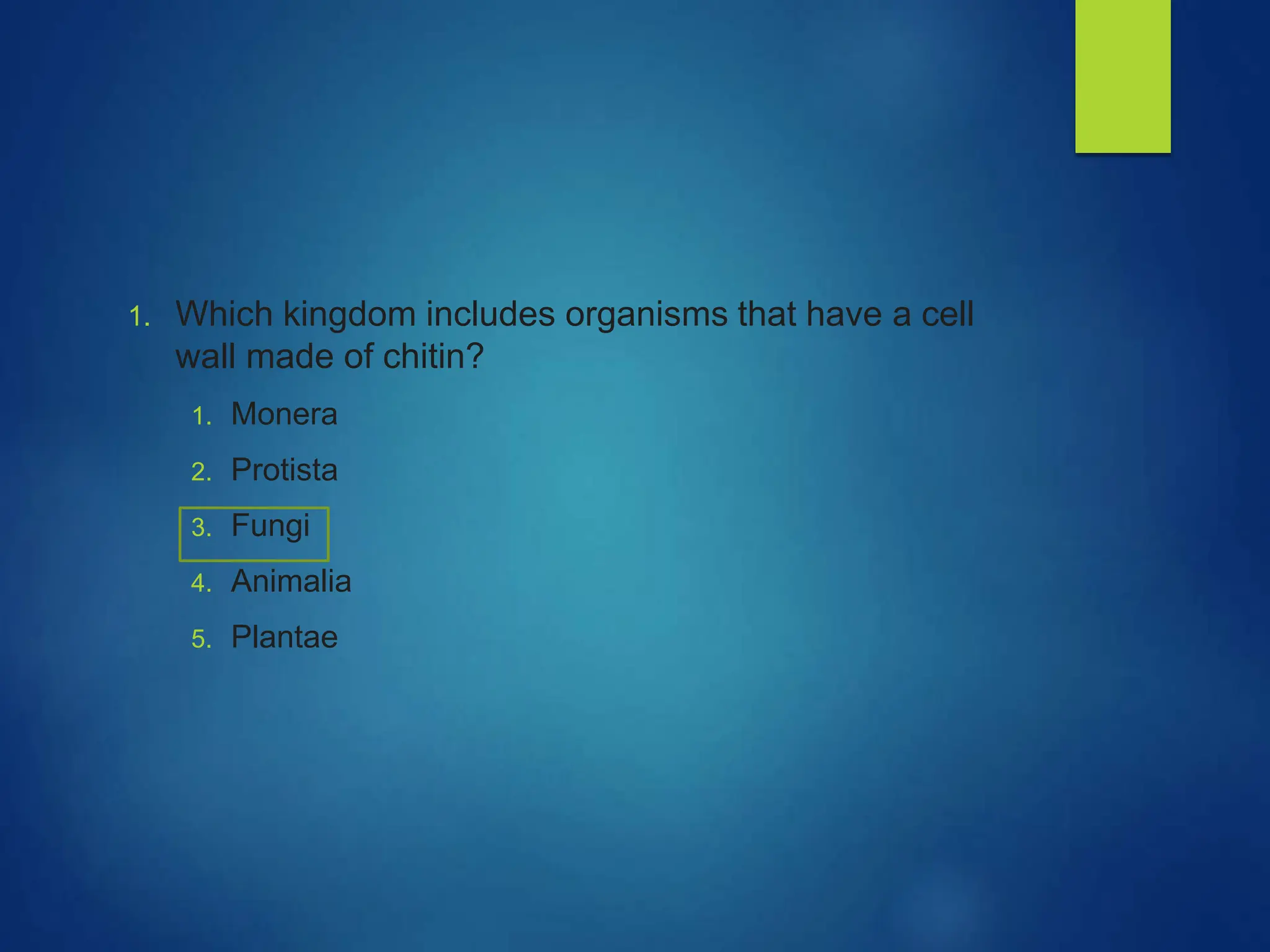
1. Which kingdom includes organisms that have a cell
wall made of chitin?
1. Monera
2. Protista
3. Fungi
4. Animalia
5. Plantae
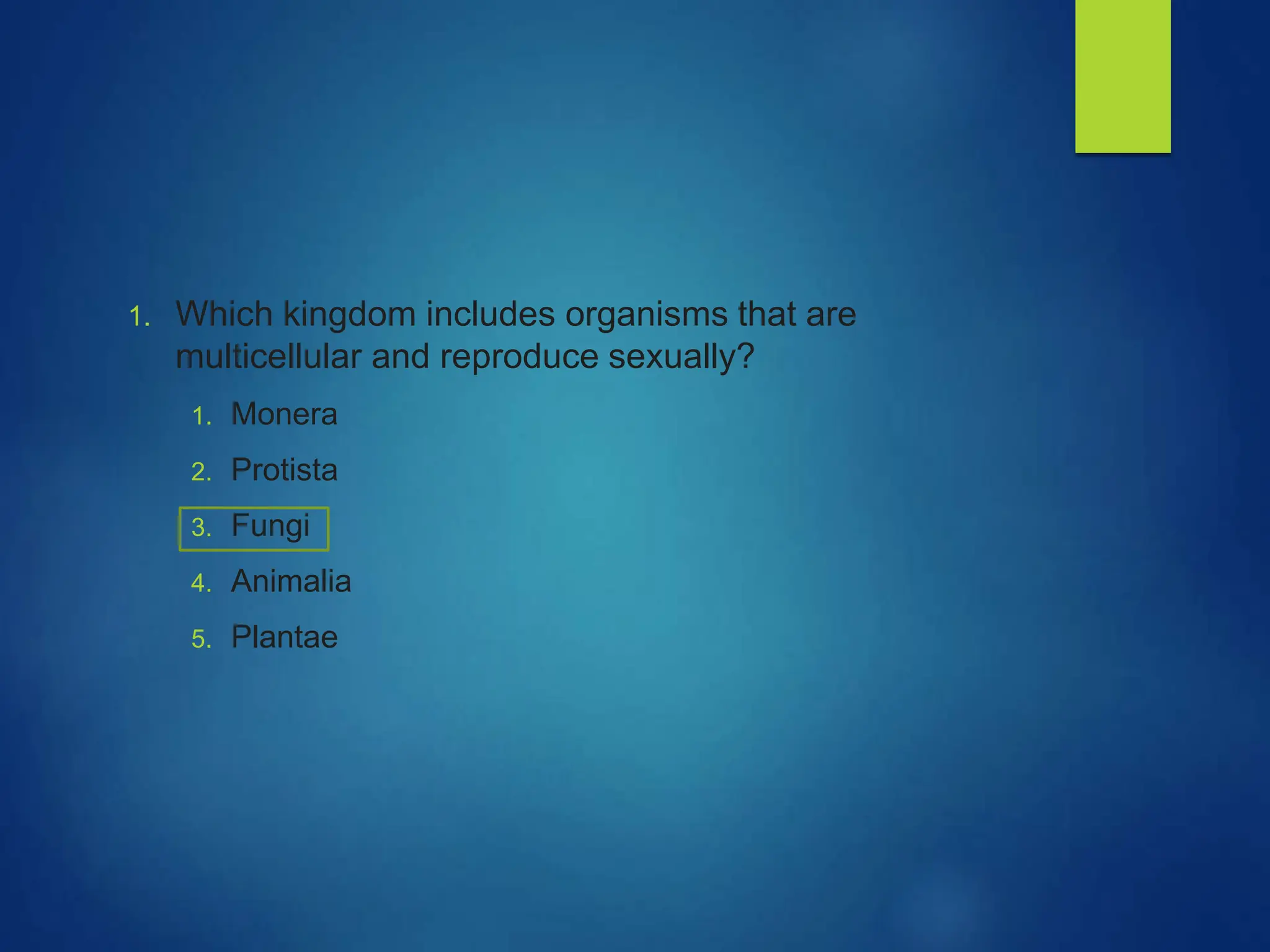
1. Which kingdom includes organisms that are
multicellular and reproduce sexually?
1. Monera
2. Protista
3. Fungi
4. Animalia
5. Plantae
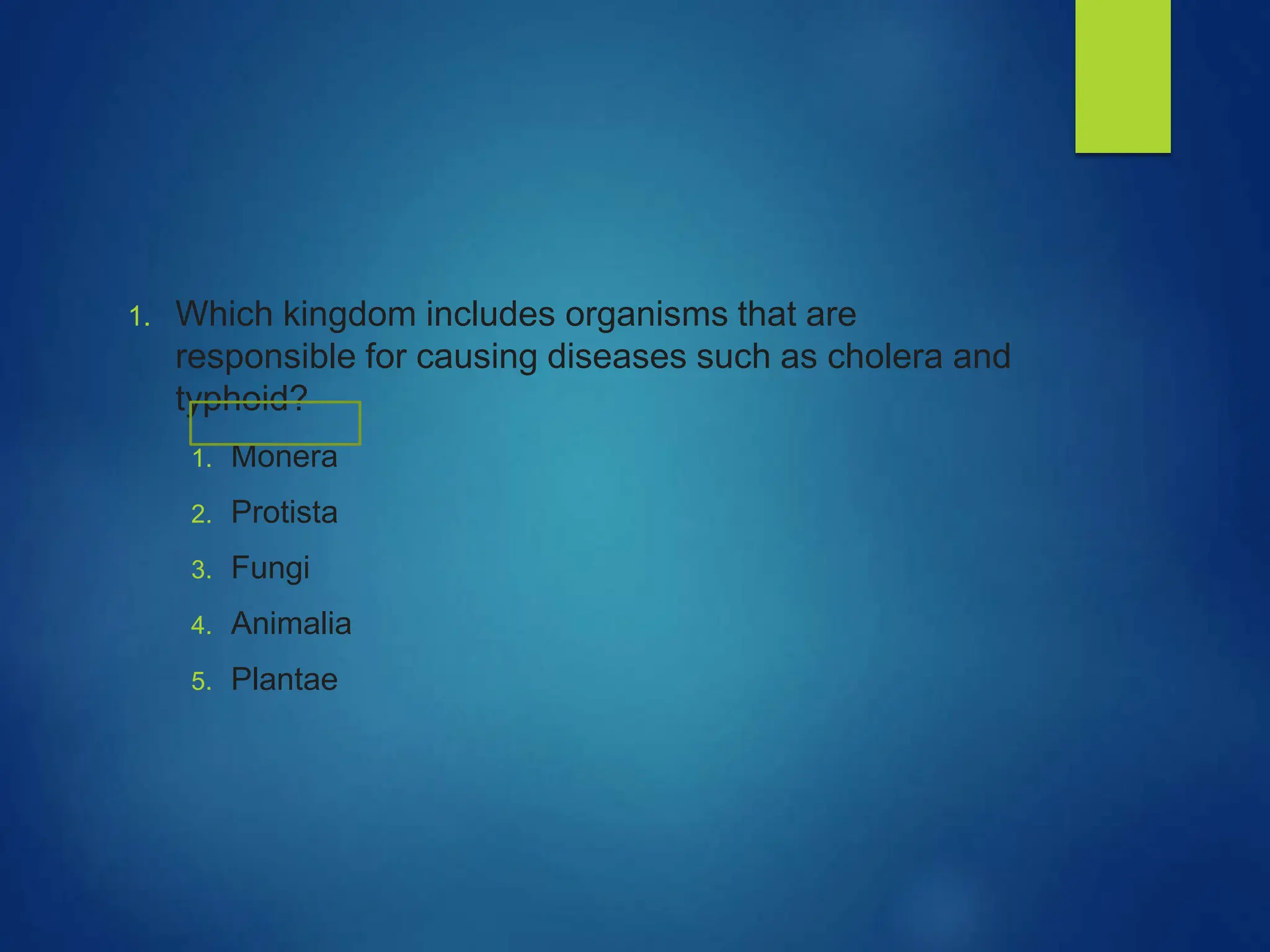
1. Which kingdom includes organisms that are
responsible for causing diseases such as cholera and
typhoid?
1. Monera
2. Protista
3. Fungi
4. Animalia
5. Plantae
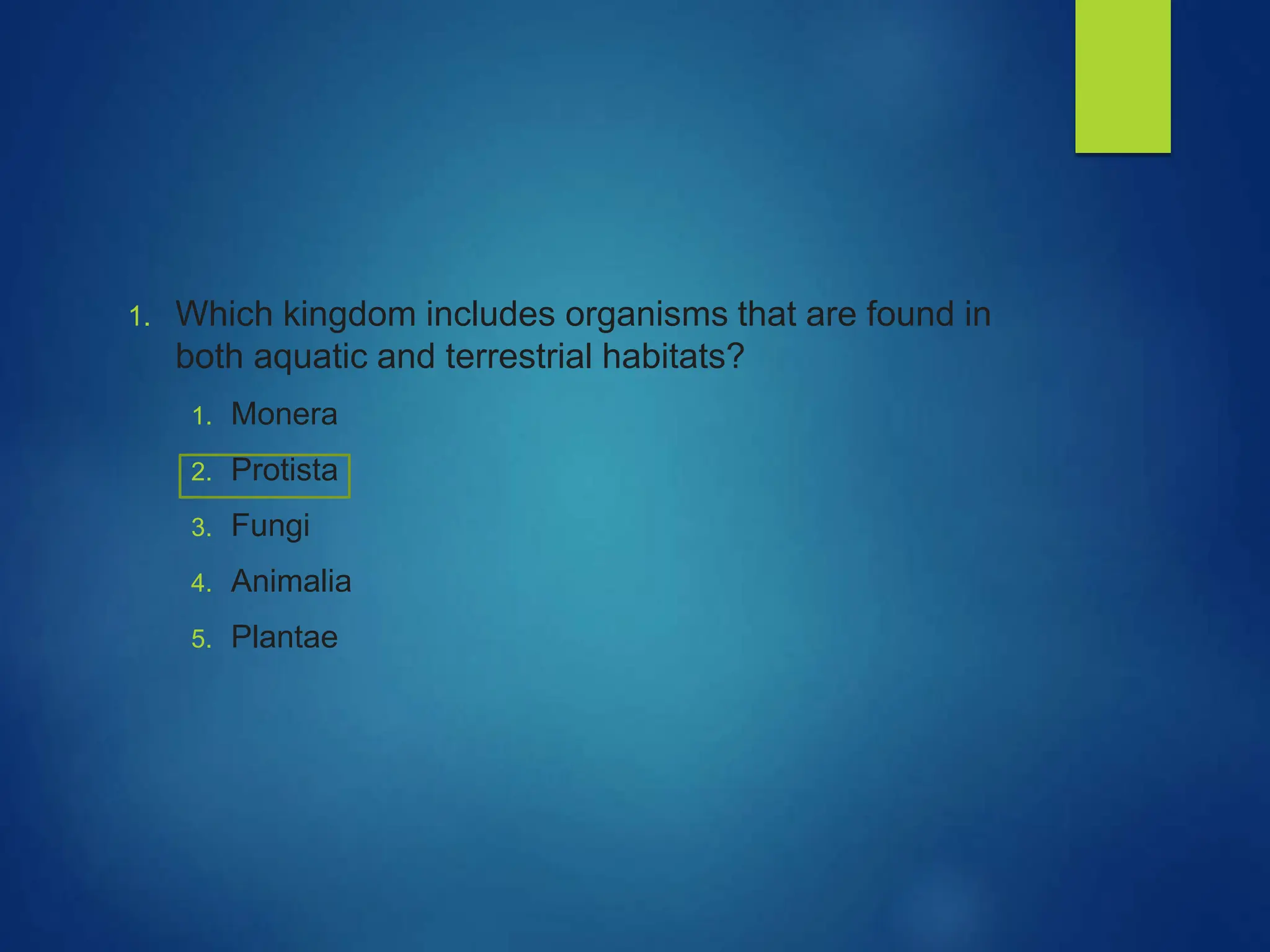
1. Which kingdom includes organisms that are found in
both aquatic and terrestrial habitats?
1. Monera
2. Protista
3. Fungi
4. Animalia
5. Plantae
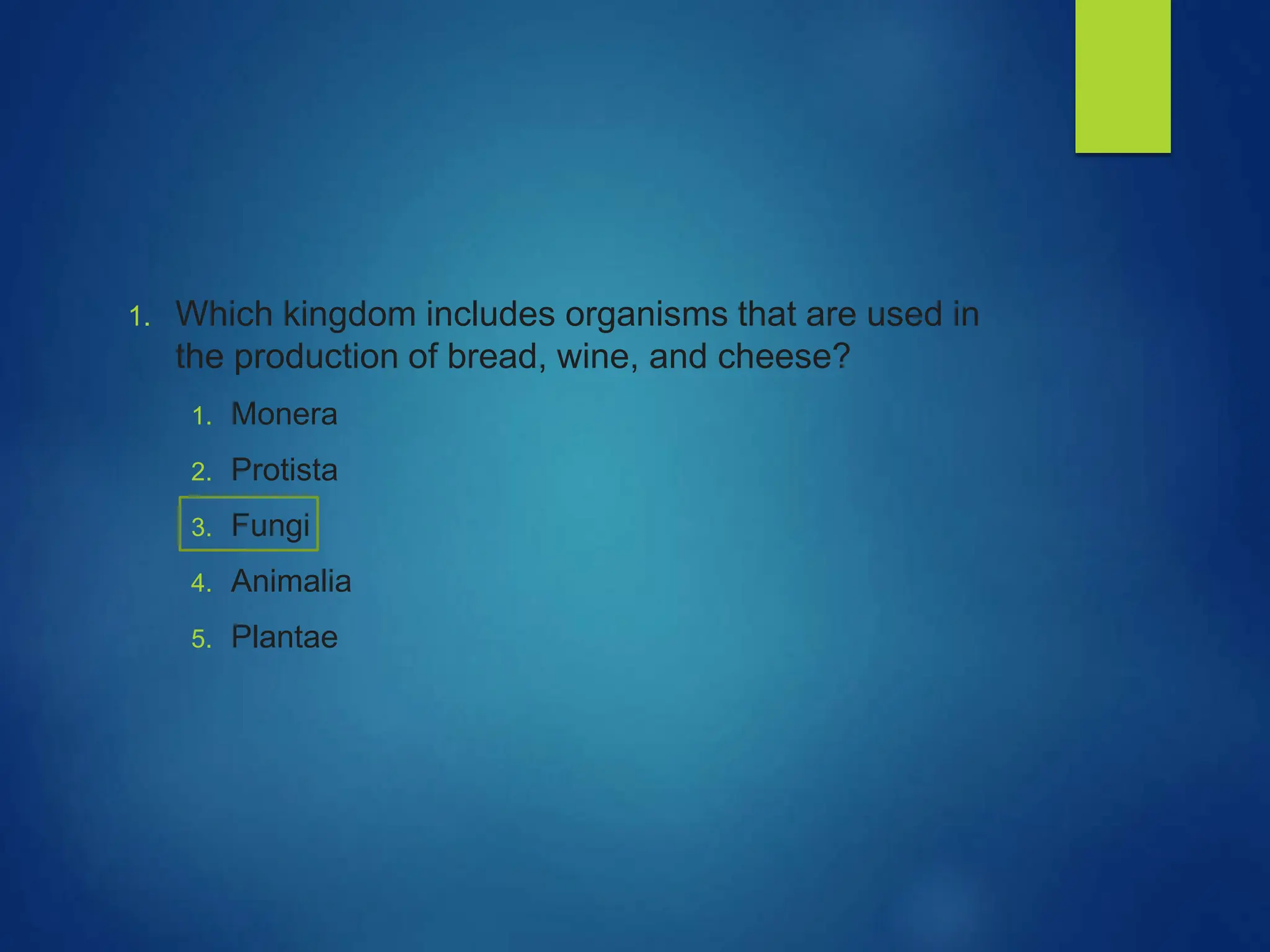
1. Which kingdom includes organisms that are used in
the production of bread, wine, and cheese?
1. Monera
2. Protista
3. Fungi
4. Animalia
5. Plantae
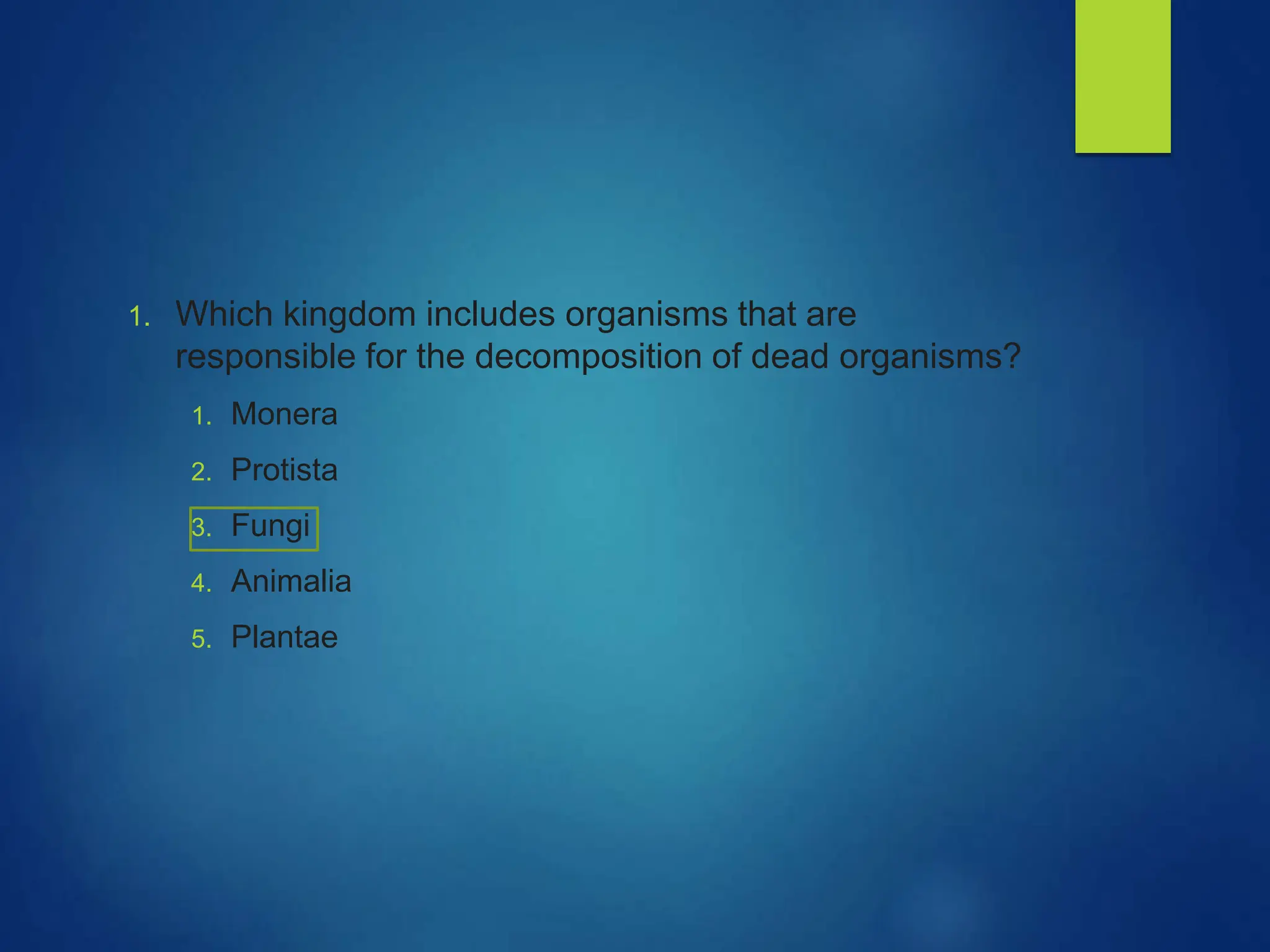
1. Which kingdom includes organisms that are
responsible for the decomposition of dead organisms?
1. Monera
2. Protista
3. Fungi
4. Animalia
5. Plantae
1. Which kingdom includes organisms that are
photosynthetic and produce their own food?
1. Monera
2. Protista
3. Fungi
4. Animalia
5. Plantae
1. Which kingdom includes organisms that are
multicellular and have a tissue organization?
1. Monera
2. Protista
3. Fungi
4. Animalia
5. Plantae
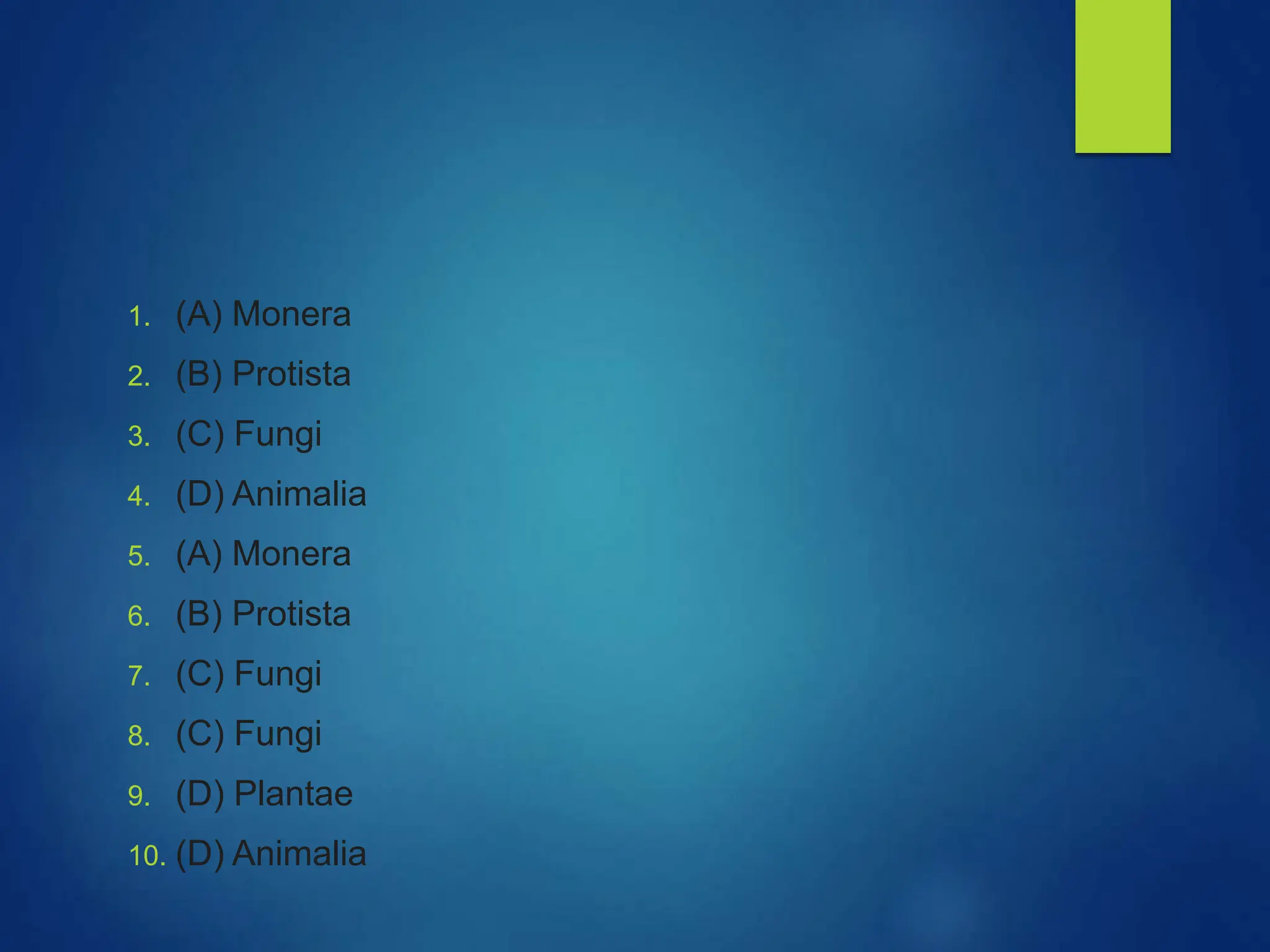
1. (A) Monera
2. (B) Protista
3. (C) Fungi
4. (D) Animalia
5. (A) Monera
6. (B) Protista
7. (C) Fungi
8. (C) Fungi
9. (D) Plantae
10. (D) Animalia
 What is the hierarchical system of classifying living
things?
 The hierarchical system of classifying living things is
called taxonomy. It is a system of grouping organisms
based on their characteristics.
 What are the three domains of life?
 The three domains of life are Bacteria, Archaea, and
Eukarya.
 What are the six kingdoms of life?
 The six kingdoms of life are Bacteria, Archaea,
Protista, Fungi, Plantae, and Animalia.
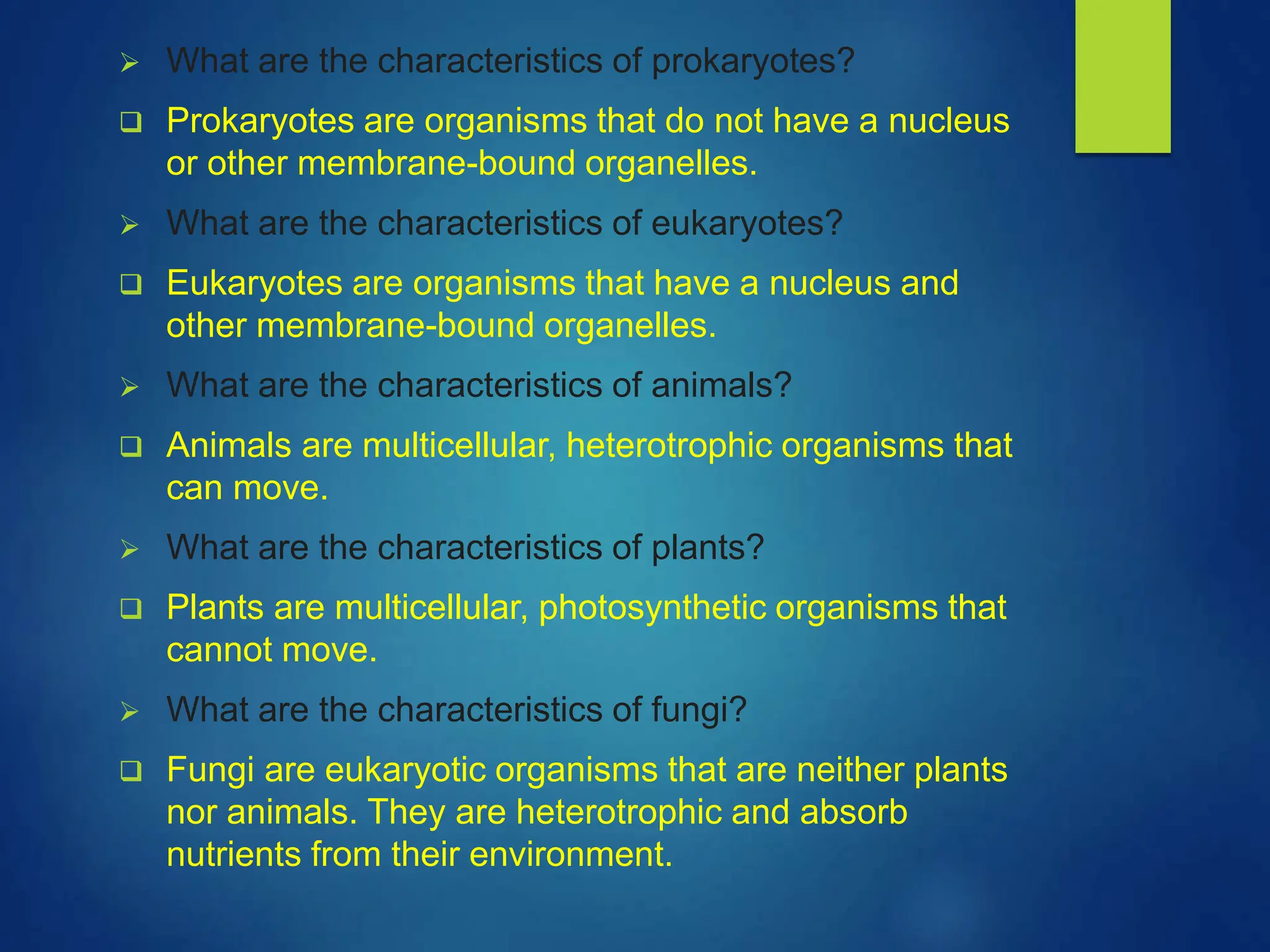
 What are the characteristics of prokaryotes?
 Prokaryotes are organisms that do not have a nucleus
or other membrane-bound organelles.
 What are the characteristics of eukaryotes?
 Eukaryotes are organisms that have a nucleus and
other membrane-bound organelles.
 What are the characteristics of animals?
 Animals are multicellular, heterotrophic organisms that
can move.
 What are the characteristics of plants?
 Plants are multicellular, photosynthetic organisms that
cannot move.
 What are the characteristics of fungi?
 Fungi are eukaryotic organisms that are neither plants
nor animals. They are heterotrophic and absorb
nutrients from their environment.
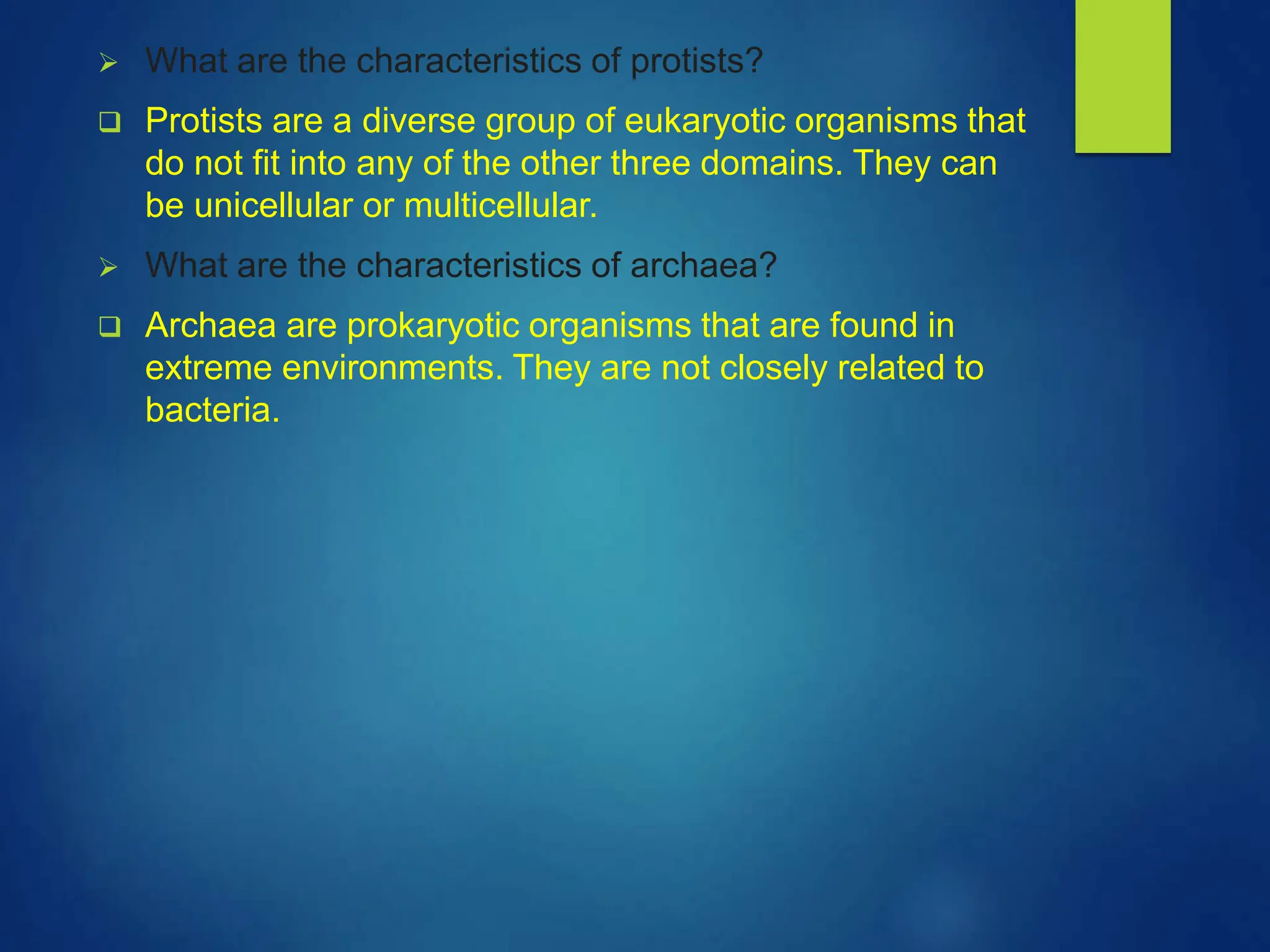
 What are the characteristics of protists?
 Protists are a diverse group of eukaryotic organisms that
do not fit into any of the other three domains. They can
be unicellular or multicellular.
 What are the characteristics of archaea?
 Archaea are prokaryotic organisms that are found in
extreme environments. They are not closely related to
bacteria.

classsifcation of living beings calss 9.ppt

  • 1.
    Warm up 2/2/2015Monday  Use the chart above to answer the following questions: 1. Which taxonomic groups do these organisms share? 2. At which taxonomic groups do Dog and Human diverge? 3. According to the chart which taxonomic group is the most general? 4. Which two organisms are the most closely related?
  • 2.
  • 3.
    Record these vocabulary wordsin your notebook.  Multicellular  Unicellular  Prokaryote  Eukaryote  Heterotroph  Autotroph
  • 4.
  • 5.
    Vocabulary Which term meansone-celled? Many-celled?  multicellular  unicellular Which term means that the organism produces its own food? Consumes food?  autotroph  heterotroph
  • 6.
    Number of cells Multicellular- organisms made of two or more cells.  Example: animal, plants, fungi  Unicellular- organism made of single cell  Example: bacteria, protist
  • 7.
    Vocabulary  Prokaryotic –describes an organism with cells that have a cell membrane but do NOT have a nucleus  Eukaryotic – describes an organism with cells that have a membrane bound organelles and a nucleus (nuclear membrane)
  • 8.
    Vocabulary  Autotrophic –makes its own food Examples: photoautotrophs, chemoautotrophs  Heterotrophic – gets nutrients from the food it consumes
  • 9.
    List of theThree Domains and the Six Kingdoms 1. Domain Bacteria  Kingdom Eubacteria 2. Domain Archaea  Kingdom Archaebacteria 3. Domain Eukarya  Kingdom Protista  Kingdom Fungi  Kingdom Plantae  Kingdom Animalia
  • 10.
    Environment per kingdom (niche) Archaebacteria- extreme environment  Eubacteria- everywhere in daily life (humans large intestine)  Protista- Pond water, land, air  Fungi-trees, ground  Plantae-everywhere (land and water)  Animalia – everywhere (land, air, water)
  • 12.
    Kingdom and DomainCharacteristics Domain Kingdom Characteristics Cell type Cell Structure Body Type Nutrition Example Bacteria Eubacteria Prokaryotic Cell Wall, Peptidoglycan Unicellular Autotrophic and Heterotrophic Enterobacteria Spirochetes Archaea Archaebacteria Prokaryotic Cell Wall, No Peptidoglycan Unicellular Autotrophic and Heterotrophic Methanogens Eukarya Protista Eukaryotic Mixed Unicellular and Multicellular Autotrophic and Heterotrophic Amoebas Euglenas Kelps Eukarya Fungi Eukaryotic Cell Wall, Chitin Unicellular and Multicellular Heterotrophic Yeasts Mushrooms Eukarya Plantae Eukaryotic Cell Wall, Cellulose Multicellular Autotrophic Ferns Pine trees Eukarya Animalia Eukaryotic No Cell Wall Multicellular Heterotrophic Birds Earthworms
  • 13.
    Kingdom Eubacteria  Bacteriacan live in many places on earth, inhabiting a wide variety of habitats, including other organisms  Unicellular  Prokaryotic  Autotrophic or heterotrophic  Thick cells walls with peptidoglycan
  • 14.
    Kingdom Eubacteria  Bacteriacome in different shapes, such as round, spiral and rod-shaped.
  • 15.
    Kingdom Eubacteria  Bacteriacan cause a wide variety of diseases, such as strep throat, food poisoning and the Black Death (bubonic plague of the Middle Ages)
  • 16.
    Kingdom Eubacteria  Bacteriaalso play an important role in decomposition, nitrogen fixation and human digestion (E. coli) Soybean root containing billions of bacteria
  • 17.
    Kingdom Eubacteria  Procholorococcus– an autotrophic bacterium – What does that mean about how it gets its nutrients?
  • 18.
    Kingdom Eubacteria  Bacteriafrom an Nitrifying Trickle Filter (NTF) stained with acridene orange. The stain makes DNA appear yellow and RNA appear orange.
  • 19.
    Kingdom Archaebacteria  Bacteriathat live in extreme habitats, such as hot springs, geysers, volcanic hot pools, brine pools, black smokers  Unicellular  Prokaryotic  Autotrophic or heterotrophic  Cell walls without peptidoglycan
  • 20.
    Kingdom Archaebacteria Morning GloryPool in Yellowstone National Park – note the bright colors from the archaebacteria growing in the extremely hot water.
  • 21.
    Kingdom Archaebacteria  Somelike it hot! Bacillus infernus
  • 22.
    Kingdom Archaebacteria  Archaebacteriacan live deep in the ocean near geothermal vents called black smokers  There is no light, so they carry out chemosynthesis instead of photosynthesis
  • 23.
    Kingdom Protista  Extremelydiverse group  Eukaryotic  Most unicellular, some colonial, some multicellular  Autotrophic and heterotrophic  Some with cell walls containing cellulose; some carry out photosynthesis with chloroplasts
  • 24.
    Kingdom Protista Volvox –a colonial protist Euglena - autotrophic A slime mold Amoeba - heterotrophic
  • 25.
    Kingdom Fungi  Eukaryotic Most are multicellular  Heterotrophic (decomposers)  Cell walls made of chitin
  • 26.
  • 27.
    Kingdom Plantae  Eukaryotic Multicellular  Autotrophic  Cell wall of cellulose; chloroplasts present
  • 28.
  • 29.
    Kingdom Animalia  Eukaryotic Multicellular  Heterotrophic  No cell walls, no chloroplasts
  • 30.
  • 32.
    Linnaeus developed thescientific naming system still used today.  Taxonomy is the science of naming and classifying organisms. • A taxon is a group of organisms in a classification system. White oak: Quercus alba
  • 33.
     Binomial nomenclatureis a system of giving two names for organisms. – uses Latin words – scientific names always written in italics – two parts are the genus name and species descriptor
  • 34.
    • A genusincludes one or more physically similar species. – Species in the same genus are thought to be closely related. – Genus name is always capitalized. • A species descriptor is the second part of a scientific name. – always lowercase – always follows genus name; never written alone Tyto alba
  • 35.
    Linnaeus’ classification systemhas seven levels.  Each level is included in the level above it. • Levels get increasingly specific from kingdom to species.
  • 36.
    KEY CONCEPT The currenttree of life has three domains.
  • 37.
    Classification is alwaysa work in progress.  The tree of life shows our most current understanding.  New discoveries can lead to changes in classification.  Until 1866: only two kingdoms, Animalia and Plantae Animalia Plantae
  • 38.
    Classification is alwaysa work in progress.  The tree of life shows our most current understanding.  New discoveries can lead to changes in classification.  Until 1866: only two kingdoms, Animalia and Plantae – 1866: all single-celled organisms moved to kingdom Protista Animalia Protista Plantae
  • 39.
    Classification is alwaysa work in progress.  The tree of life shows our most current understanding.  New discoveries can lead to changes in classification.  Until 1866: only two kingdoms, Animalia and Plantae – 1938: prokaryotes moved to kingdom Monera – 1866: all single-celled organisms moved to kingdom Protista Animalia Protista Plantae Monera
  • 40.
     The treeof life shows our most current understanding.  New discoveries can lead to changes in classification.  Until 1866: only two kingdoms, Animalia and Plantae Classification is always a work in progress. – 1938: prokaryotes moved to kingdom Monera – 1866: all single-celled organisms moved to kingdom Protista Monera – 1959: fungi moved to own kingdom Fungi Protista Plantae Animalia
  • 41.
     The treeof life shows our most current understanding.  New discoveries can lead to changes in classification.  Until 1866: only two kingdoms, Animalia and Plantae Classification is always a work in progress. – 1938: prokaryotes moved to kingdom Monera – 1866: all single-celled organisms moved to kingdom Protista – 1959: fungi moved to own kingdom – 1977: kingdom Monera split into kingdoms Bacteria and Archaea Animalia Protista Fungi Plantae Archea Bacteria
  • 42.
    1. Which kingdomincludes organisms that have a prokaryotic cell structure? 1. Monera 2. Protista 3. Fungi 4. Animalia 5. Plantae
  • 43.
    1. Which kingdomincludes organisms that are mostly unicellular and can be autotrophic or heterotrophic? 1. Monera 2. Protista 3. Fungi 4. Animalia 5. Plantae
  • 44.
    1. Which kingdomincludes organisms that have a cell wall made of chitin? 1. Monera 2. Protista 3. Fungi 4. Animalia 5. Plantae
  • 45.
    1. Which kingdomincludes organisms that are multicellular and reproduce sexually? 1. Monera 2. Protista 3. Fungi 4. Animalia 5. Plantae
  • 46.
    1. Which kingdomincludes organisms that are responsible for causing diseases such as cholera and typhoid? 1. Monera 2. Protista 3. Fungi 4. Animalia 5. Plantae
  • 47.
    1. Which kingdomincludes organisms that are found in both aquatic and terrestrial habitats? 1. Monera 2. Protista 3. Fungi 4. Animalia 5. Plantae
  • 48.
    1. Which kingdomincludes organisms that are used in the production of bread, wine, and cheese? 1. Monera 2. Protista 3. Fungi 4. Animalia 5. Plantae
  • 49.
    1. Which kingdomincludes organisms that are responsible for the decomposition of dead organisms? 1. Monera 2. Protista 3. Fungi 4. Animalia 5. Plantae
  • 50.
    1. Which kingdomincludes organisms that are photosynthetic and produce their own food? 1. Monera 2. Protista 3. Fungi 4. Animalia 5. Plantae
  • 51.
    1. Which kingdomincludes organisms that are multicellular and have a tissue organization? 1. Monera 2. Protista 3. Fungi 4. Animalia 5. Plantae
  • 52.
    1. (A) Monera 2.(B) Protista 3. (C) Fungi 4. (D) Animalia 5. (A) Monera 6. (B) Protista 7. (C) Fungi 8. (C) Fungi 9. (D) Plantae 10. (D) Animalia
  • 53.
     What isthe hierarchical system of classifying living things?  The hierarchical system of classifying living things is called taxonomy. It is a system of grouping organisms based on their characteristics.  What are the three domains of life?  The three domains of life are Bacteria, Archaea, and Eukarya.  What are the six kingdoms of life?  The six kingdoms of life are Bacteria, Archaea, Protista, Fungi, Plantae, and Animalia.
  • 54.
     What arethe characteristics of prokaryotes?  Prokaryotes are organisms that do not have a nucleus or other membrane-bound organelles.  What are the characteristics of eukaryotes?  Eukaryotes are organisms that have a nucleus and other membrane-bound organelles.  What are the characteristics of animals?  Animals are multicellular, heterotrophic organisms that can move.  What are the characteristics of plants?  Plants are multicellular, photosynthetic organisms that cannot move.  What are the characteristics of fungi?  Fungi are eukaryotic organisms that are neither plants nor animals. They are heterotrophic and absorb nutrients from their environment.
  • 55.
     What arethe characteristics of protists?  Protists are a diverse group of eukaryotic organisms that do not fit into any of the other three domains. They can be unicellular or multicellular.  What are the characteristics of archaea?  Archaea are prokaryotic organisms that are found in extreme environments. They are not closely related to bacteria.

Editor's Notes

  • #4 Place under warm up