Classification Chapter 18
18.1 Finding Order In Diversity Why do you think we would need to classify? To study the diversity of life, biologists use a classification system to name organisms and group them in a logical manner.
Why Classify? Taxonomy: A discipline where scientists classify organisms and assign each organism a universally accepted name
Why Classify? Depending on where you are this animal could be called a mountain lion, puma, cougar or a panther– all of which are common names However the scientific name is  Felis concolor
Assigning Scientific Names Using scientific names made it easier to give one name to one animal because common names have very different meanings in different areas or they are just different all around.
Binomial Nomenclature Carolus Linnaeus  A Swedish botanist  During the early 18 th  Century (1707-1778), he created a 2 word naming system
Binomial Nomenclature Each species is assigned a 2-part scientific name Always written in italic First word is capitalized Second word is lower cased Ex: Grizzly Bear is called  Ursus arcotos
Binomial Nomenclature First part of the name is the genus the animal belongs to Genus: Group of closely related species Second part of name is unique to each species within a genus
Linnaeus’ System of Classification Linnaeus’ hierarchical system of classification includes 7 levels From largest to smallest: Kingdom, Phylum, Class, Order, Family, Genus, Species
Linnaeus’ System of Classification Taxon: Each level or group of organization into which organisms are classified. Kingdom: Largest taxonomic group. Most inclusive of closely related phyla
Linnaeus’ System of Classification Phylum: Several different classes make up a phylum: they are closely related Class: Composed of similar orders, larger categories
Linnaeus’ System of Classification Order: Broad taxonomic categories composed of similar families Family: Group of genera that share the same characteristics
18.2 Evolutionary Classification Phylogeny:  Evolutionary relationship among organisms Biologists now group organisms into categories that represent lines of evolutionary descent, or phylogeny not just physical similarities.
Evolutionary Classification Evolutionary Classification Strategy of grouping organism together based on their evolutionary history The higher the level of taxon, the farther back in time is the common ancestor of all the organisms in the taxon
Classification Using Cladograms Derived characters Characteristics that appear in recent parts of a lineage but not in its order members Cladogram Diagram that shows the evolutionary relationships among a group of organisms
Characteristics/ Traits Organisms Crab Barnacle Molted External Skeleton Segmentation Limpet Tiny free flowing Larvae Items to the left: organisms has it Items to the right: organism does not have it
Similarities in DNA and RNA The gene of many organisms show important similarities at the molecular level.  Similarities in DNA can be used to help determine classification and evolutionary relationships.
18.3 Kingdom and Domains 5 Kingdoms Monera, Protista, Fungi, Plantae and Animalia 6 Kingdoms Biologists came to recognize that the Monera were composed of 2 distinct groups
Kingdoms and Domains As a result, Monera have been separated into 2 kingdoms: Eubacteria and Archeabacteria Eubacteria, Archeabacteria, Monera, Protista, Fungi, Plantae and Animalia
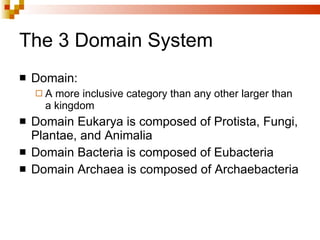
The 3 Domain System Domain: A more inclusive category than any other larger than a kingdom Domain Eukarya is composed of Protista, Fungi, Plantae, and Animalia Domain Bacteria is composed of Eubacteria Domain Archaea is composed of Archaebacteria
DOMAIN KINGDOM CELL TYPE CELL STRUCTURES NUMBER OF CELLS MODE OF NUTRITION EXAMPLES Bacteria Eubacteria Prokaryote Cell walls with peptidoglycan Unicellular Autotroph or heterotroph Streptococcus, Escherichia coli Archaea Archaebacteria Prokaryote Cell walls without peptidoglycan Unicellular Autotroph or heterotroph Methanogens, halophiles Protista Eukaryote Cell walls of cellulose in some; some have chloroplasts Most unicellular; some colonial; some multicellular Autotroph or heterotroph Amoeba, Paramecium,  slime molds, giant kelp Fungi Eukaryote Cell walls of chitin Most multicellular; some unicellular Heterotroph Mushrooms, yeasts Plantae Eukaryote Cell walls of cellulose; chloroplasts Multicellular Autotroph Mosses, ferns, flowering plants Animalia Eukaryote No cell walls or chloroplasts Multicellular Heterotroph Sponges, worms, insects, fishes, mammals Eukarya
Domain Bacteria Unicellular and prokaryotic Cell walls with peptidogylcan
Domain Archaea Unicellular and Prokaryotic Cell walls with out peptidogylcan Live in some of the most extreme environments you can imagine
Domain Eukarya Consists of all organisms that have a nucleus Protista: Composed of eukaryotic  organisms that cannot be  classified as animals,  plants or fungi Members share great  variety
Domain Eukarya Fungi: Heterotrophs: most feed on dead or decaying matter They secrete digestive enzymes on food and absorb food molecules
Domain Eukarya Plante: Multicellular, photosynthetic autotrophs Cone-bearing and flowering plants, mosses and ferns Cells have cell walls
Domain Eukarya Animalia: Multicellular heterotrophs Cell walls have no cell walls They move for part of their lives

18 Classification

  • 1.
  • 2.
    18.1 Finding OrderIn Diversity Why do you think we would need to classify? To study the diversity of life, biologists use a classification system to name organisms and group them in a logical manner.
  • 3.
    Why Classify? Taxonomy:A discipline where scientists classify organisms and assign each organism a universally accepted name
  • 4.
    Why Classify? Dependingon where you are this animal could be called a mountain lion, puma, cougar or a panther– all of which are common names However the scientific name is Felis concolor
  • 5.
    Assigning Scientific NamesUsing scientific names made it easier to give one name to one animal because common names have very different meanings in different areas or they are just different all around.
  • 6.
    Binomial Nomenclature CarolusLinnaeus A Swedish botanist During the early 18 th Century (1707-1778), he created a 2 word naming system
  • 7.
    Binomial Nomenclature Eachspecies is assigned a 2-part scientific name Always written in italic First word is capitalized Second word is lower cased Ex: Grizzly Bear is called Ursus arcotos
  • 8.
    Binomial Nomenclature Firstpart of the name is the genus the animal belongs to Genus: Group of closely related species Second part of name is unique to each species within a genus
  • 9.
    Linnaeus’ System ofClassification Linnaeus’ hierarchical system of classification includes 7 levels From largest to smallest: Kingdom, Phylum, Class, Order, Family, Genus, Species
  • 10.
    Linnaeus’ System ofClassification Taxon: Each level or group of organization into which organisms are classified. Kingdom: Largest taxonomic group. Most inclusive of closely related phyla
  • 11.
    Linnaeus’ System ofClassification Phylum: Several different classes make up a phylum: they are closely related Class: Composed of similar orders, larger categories
  • 12.
    Linnaeus’ System ofClassification Order: Broad taxonomic categories composed of similar families Family: Group of genera that share the same characteristics
  • 13.
    18.2 Evolutionary ClassificationPhylogeny: Evolutionary relationship among organisms Biologists now group organisms into categories that represent lines of evolutionary descent, or phylogeny not just physical similarities.
  • 14.
    Evolutionary Classification EvolutionaryClassification Strategy of grouping organism together based on their evolutionary history The higher the level of taxon, the farther back in time is the common ancestor of all the organisms in the taxon
  • 15.
    Classification Using CladogramsDerived characters Characteristics that appear in recent parts of a lineage but not in its order members Cladogram Diagram that shows the evolutionary relationships among a group of organisms
  • 16.
    Characteristics/ Traits OrganismsCrab Barnacle Molted External Skeleton Segmentation Limpet Tiny free flowing Larvae Items to the left: organisms has it Items to the right: organism does not have it
  • 17.
    Similarities in DNAand RNA The gene of many organisms show important similarities at the molecular level. Similarities in DNA can be used to help determine classification and evolutionary relationships.
  • 18.
    18.3 Kingdom andDomains 5 Kingdoms Monera, Protista, Fungi, Plantae and Animalia 6 Kingdoms Biologists came to recognize that the Monera were composed of 2 distinct groups
  • 19.
    Kingdoms and DomainsAs a result, Monera have been separated into 2 kingdoms: Eubacteria and Archeabacteria Eubacteria, Archeabacteria, Monera, Protista, Fungi, Plantae and Animalia
  • 20.
    The 3 DomainSystem Domain: A more inclusive category than any other larger than a kingdom Domain Eukarya is composed of Protista, Fungi, Plantae, and Animalia Domain Bacteria is composed of Eubacteria Domain Archaea is composed of Archaebacteria
  • 21.
    DOMAIN KINGDOM CELLTYPE CELL STRUCTURES NUMBER OF CELLS MODE OF NUTRITION EXAMPLES Bacteria Eubacteria Prokaryote Cell walls with peptidoglycan Unicellular Autotroph or heterotroph Streptococcus, Escherichia coli Archaea Archaebacteria Prokaryote Cell walls without peptidoglycan Unicellular Autotroph or heterotroph Methanogens, halophiles Protista Eukaryote Cell walls of cellulose in some; some have chloroplasts Most unicellular; some colonial; some multicellular Autotroph or heterotroph Amoeba, Paramecium, slime molds, giant kelp Fungi Eukaryote Cell walls of chitin Most multicellular; some unicellular Heterotroph Mushrooms, yeasts Plantae Eukaryote Cell walls of cellulose; chloroplasts Multicellular Autotroph Mosses, ferns, flowering plants Animalia Eukaryote No cell walls or chloroplasts Multicellular Heterotroph Sponges, worms, insects, fishes, mammals Eukarya
  • 22.
    Domain Bacteria Unicellularand prokaryotic Cell walls with peptidogylcan
  • 23.
    Domain Archaea Unicellularand Prokaryotic Cell walls with out peptidogylcan Live in some of the most extreme environments you can imagine
  • 24.
    Domain Eukarya Consistsof all organisms that have a nucleus Protista: Composed of eukaryotic organisms that cannot be classified as animals, plants or fungi Members share great variety
  • 25.
    Domain Eukarya Fungi:Heterotrophs: most feed on dead or decaying matter They secrete digestive enzymes on food and absorb food molecules
  • 26.
    Domain Eukarya Plante:Multicellular, photosynthetic autotrophs Cone-bearing and flowering plants, mosses and ferns Cells have cell walls
  • 27.
    Domain Eukarya Animalia:Multicellular heterotrophs Cell walls have no cell walls They move for part of their lives