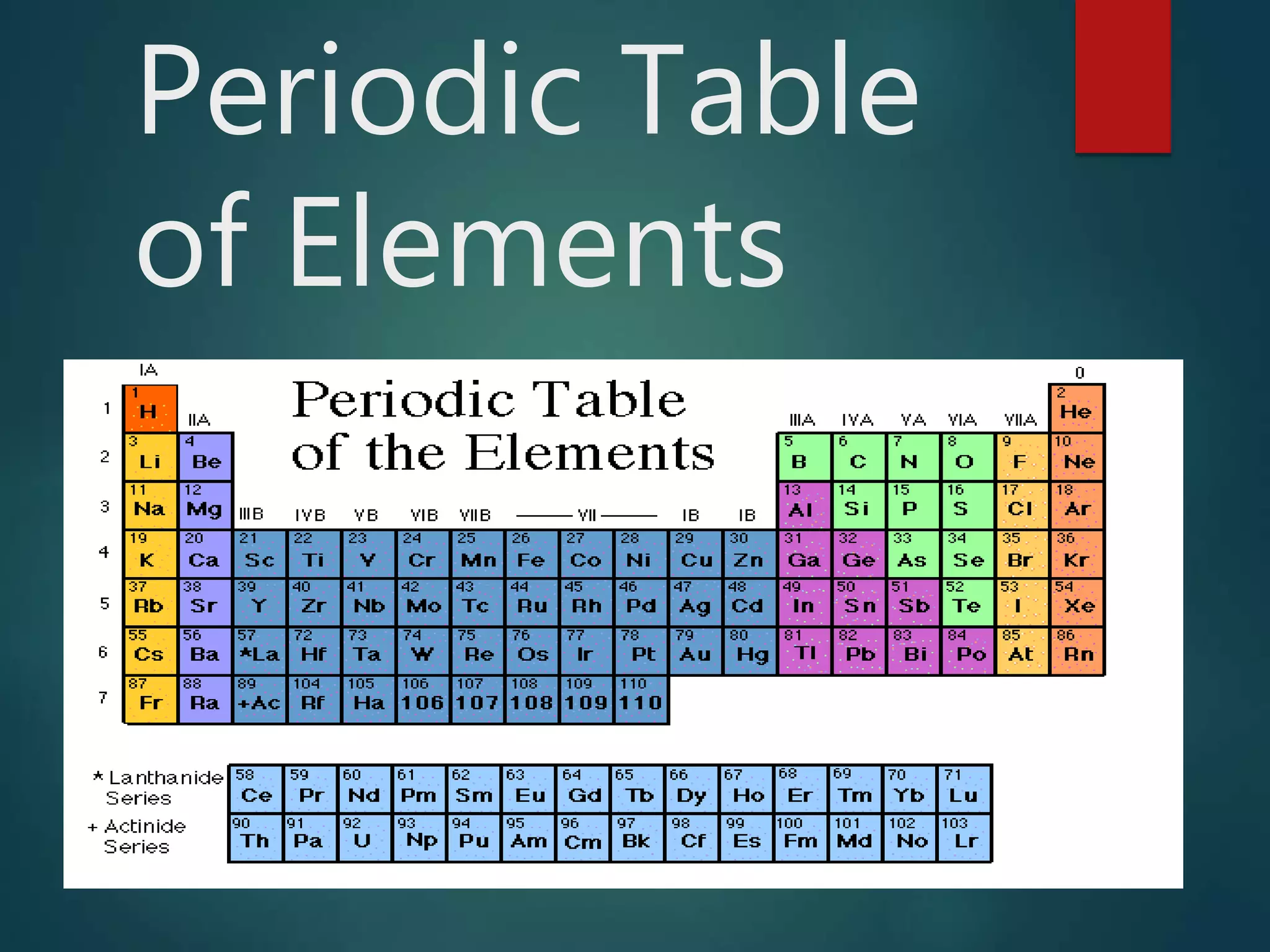
Periodic Table
of Elements
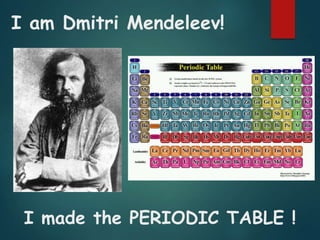
I am Dmitri Mendeleev!
I made the PERIODIC TABLE !
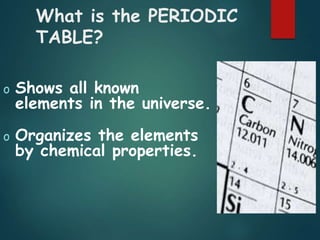
What is the PERIODIC
TABLE?
o Shows all known
elements in the universe.
o Organizes the elements
by chemical properties.
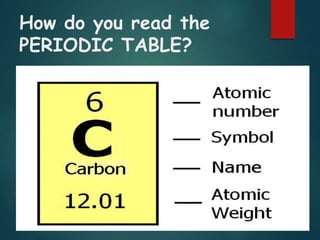
How do you read the
PERIODIC TABLE?
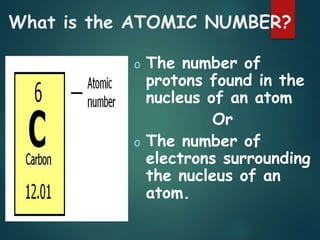
What is the ATOMIC NUMBER?
o The number of
protons found in the
nucleus of an atom
Or
o The number of
electrons surrounding
the nucleus of an
atom.
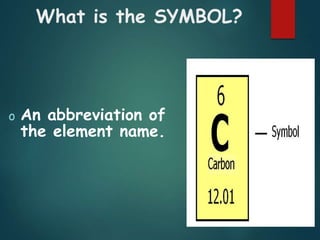
What is the SYMBOL?
o An abbreviation of
the element name.
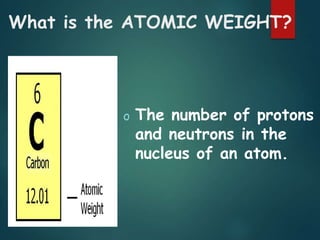
What is the ATOMIC WEIGHT?
o The number of protons
and neutrons in the
nucleus of an atom.
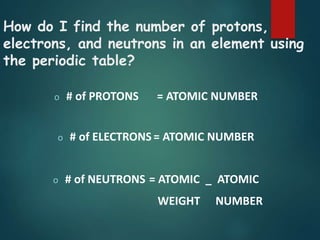
How do I find the number of protons,
electrons, and neutrons in an element using
the periodic table?
o # of PROTONS = ATOMIC NUMBER
o # of ELECTRONS = ATOMIC NUMBER
o # of NEUTRONS = ATOMIC _ ATOMIC
WEIGHT NUMBER
Elements
 The elements, alone
or in combinations,
make up our bodies,
our world, our sun,
and in fact, the
entire universe.
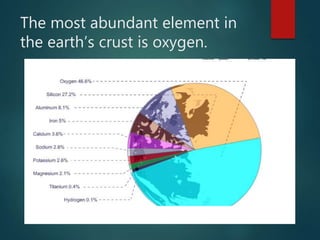
The most abundant element in
the earth’s crust is oxygen.
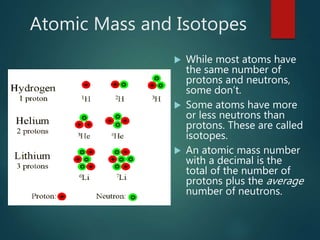
Atomic Mass and Isotopes
 While most atoms have
the same number of
protons and neutrons,
some don’t.
 Some atoms have more
or less neutrons than
protons. These are called
isotopes.
 An atomic mass number
with a decimal is the
total of the number of
protons plus the average
number of neutrons.
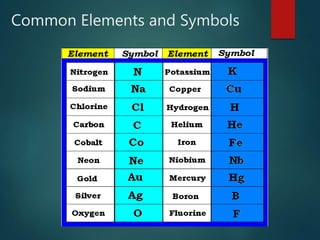
Common Elements and Symbols
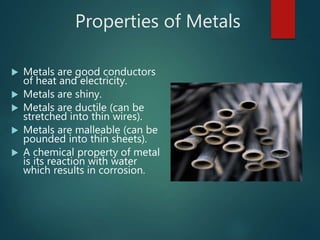
Properties of Metals
 Metals are good conductors
of heat and electricity.
 Metals are shiny.
 Metals are ductile (can be
stretched into thin wires).
 Metals are malleable (can be
pounded into thin sheets).
 A chemical property of metal
is its reaction with water
which results in corrosion.
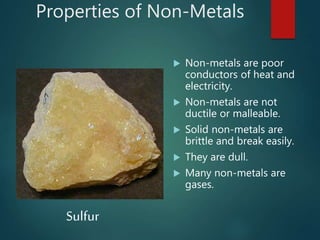
Properties of Non-Metals
 Non-metals are poor
conductors of heat and
electricity.
 Non-metals are not
ductile or malleable.
 Solid non-metals are
brittle and break easily.
 They are dull.
 Many non-metals are
gases.
Sulfur
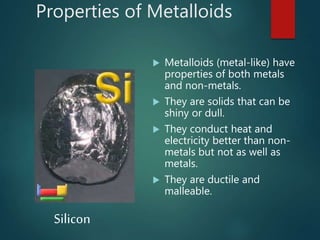
Properties of Metalloids
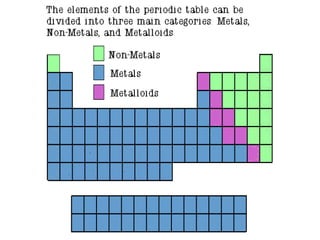
 Metalloids (metal-like) have
properties of both metals
and non-metals.
 They are solids that can be
shiny or dull.
 They conduct heat and
electricity better than non-
metals but not as well as
metals.
 They are ductile and
malleable.
Silicon
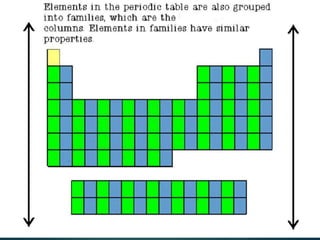
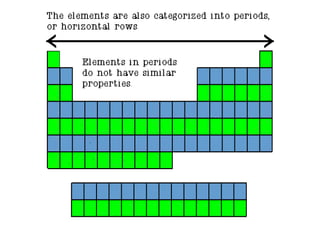
Families Periods
 Columns of elements are
called groups or families.
 Elements in each family have
similar but not identical
properties.
 For example, lithium (Li),
sodium (Na), potassium (K),
and other members of family
IA are all soft, white, shiny
metals.
 All elements in a family have
the same number of valence
electrons.
 Each horizontal row of
elements is called a period.
 The elements in a period are
not alike in properties.
 In fact, the properties
change greatly across even
given row.
 The first element in a period
is always an extremely active
solid. The last element in a
period, is always an inactive
gas.
Families in the Periodic
Table of Elements
Hydrogen
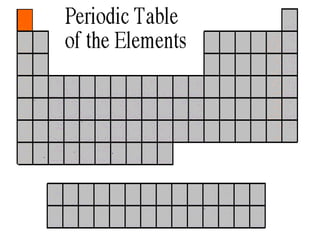
 The hydrogen square sits atop Family AI, but it is
not a member of that family. Hydrogen is in a
class of its own.
 It’s a gas at room temperature.
 It has one proton and one electron in its one
and only energy level.
 Hydrogen only needs 2 electrons to fill up its
valence shell.
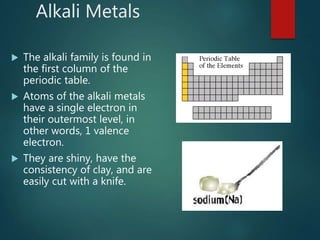
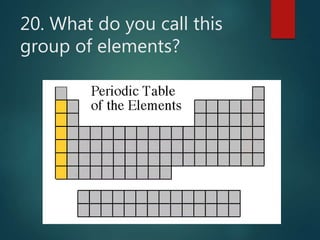
Alkali Metals
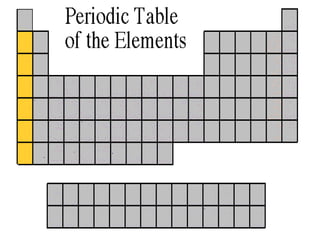
 The alkali family is found in
the first column of the
periodic table.
 Atoms of the alkali metals
have a single electron in
their outermost level, in
other words, 1 valence
electron.
 They are shiny, have the
consistency of clay, and are
easily cut with a knife.
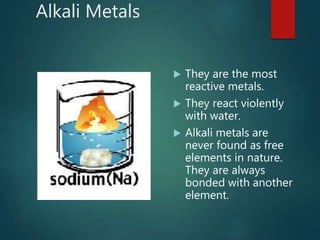
Alkali Metals
 They are the most
reactive metals.
 They react violently
with water.
 Alkali metals are
never found as free
elements in nature.
They are always
bonded with another
element.
What does it mean to be
reactive?
 We will be describing elements according to their
reactivity.
 Elements that are reactive bond easily with other
elements to make compounds.
 Some elements are only found in nature bonded
with other elements.
 What makes an element reactive?
 An incomplete valence electron level.
 All atoms (except hydrogen) want to have 8 electrons
in their very outermost energy level (This is called the
rule of octet.)
 Atoms bond until this level is complete. Atoms with
few valence electrons lose them during bonding.
Atoms with 6, 7, or 8 valence electrons gain electrons
during bonding.
Alkaline Earth Metals
 They are never found uncombined in nature.
 They have two valence electrons.
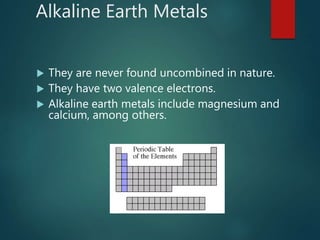
 Alkaline earth metals include magnesium and
calcium, among others.
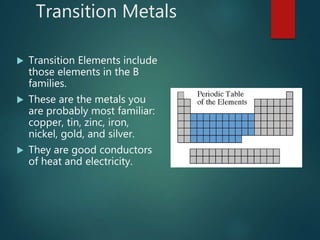
Transition Metals
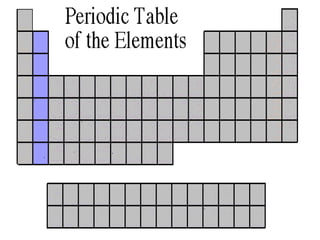
 Transition Elements include
those elements in the B
families.
 These are the metals you
are probably most familiar:
copper, tin, zinc, iron,
nickel, gold, and silver.
 They are good conductors
of heat and electricity.
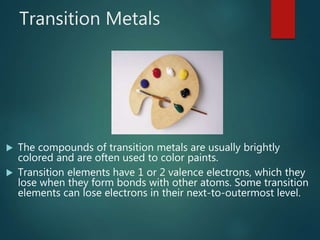
Transition Metals
 The compounds of transition metals are usually brightly
colored and are often used to color paints.
 Transition elements have 1 or 2 valence electrons, which they
lose when they form bonds with other atoms. Some transition
elements can lose electrons in their next-to-outermost level.
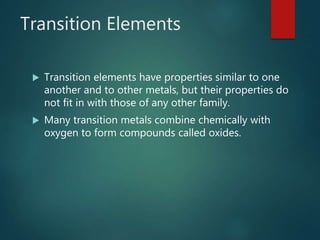
Transition Elements
 Transition elements have properties similar to one
another and to other metals, but their properties do
not fit in with those of any other family.
 Many transition metals combine chemically with
oxygen to form compounds called oxides.
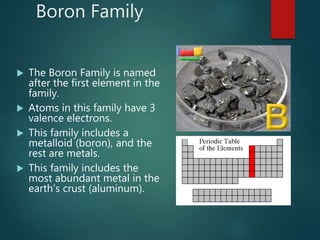
Boron Family
 The Boron Family is named
after the first element in the
family.
 Atoms in this family have 3
valence electrons.
 This family includes a
metalloid (boron), and the
rest are metals.
 This family includes the
most abundant metal in the
earth’s crust (aluminum).
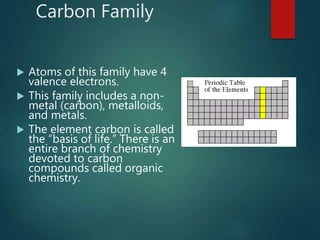
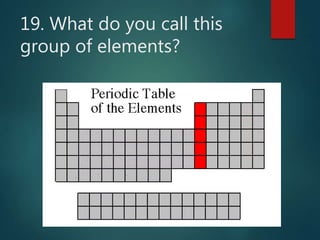
Carbon Family
 Atoms of this family have 4
valence electrons.
 This family includes a non-
metal (carbon), metalloids,
and metals.
 The element carbon is called
the “basis of life.” There is an
entire branch of chemistry
devoted to carbon
compounds called organic
chemistry.
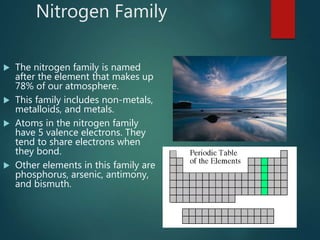
Nitrogen Family
 The nitrogen family is named
after the element that makes up
78% of our atmosphere.
 This family includes non-metals,
metalloids, and metals.
 Atoms in the nitrogen family
have 5 valence electrons. They
tend to share electrons when
they bond.
 Other elements in this family are
phosphorus, arsenic, antimony,
and bismuth.
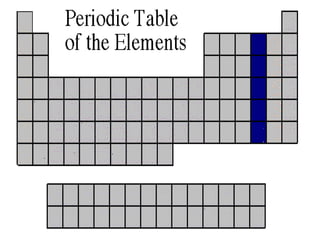
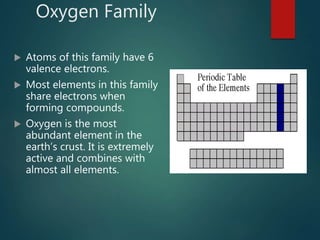
Oxygen Family
 Atoms of this family have 6
valence electrons.
 Most elements in this family
share electrons when
forming compounds.
 Oxygen is the most
abundant element in the
earth’s crust. It is extremely
active and combines with
almost all elements.
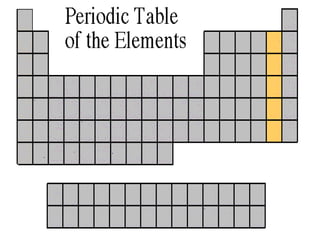
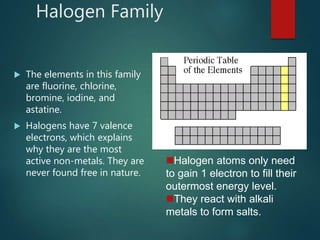
Halogen Family
 The elements in this family
are fluorine, chlorine,
bromine, iodine, and
astatine.
 Halogens have 7 valence
electrons, which explains
why they are the most
active non-metals. They are
never found free in nature.
Halogen atoms only need
to gain 1 electron to fill their
outermost energy level.
They react with alkali
metals to form salts.
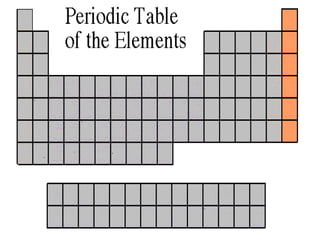
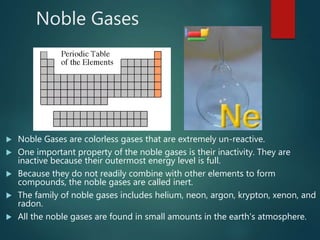
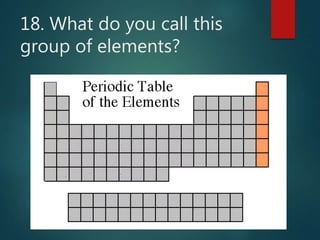
Noble Gases
 Noble Gases are colorless gases that are extremely un-reactive.
 One important property of the noble gases is their inactivity. They are
inactive because their outermost energy level is full.
 Because they do not readily combine with other elements to form
compounds, the noble gases are called inert.
 The family of noble gases includes helium, neon, argon, krypton, xenon, and
radon.
 All the noble gases are found in small amounts in the earth's atmosphere.
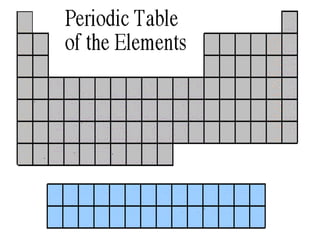
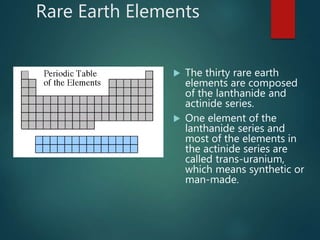
Rare Earth Elements
 The thirty rare earth
elements are composed
of the lanthanide and
actinide series.
 One element of the
lanthanide series and
most of the elements in
the actinide series are
called trans-uranium,
which means synthetic or
man-made.
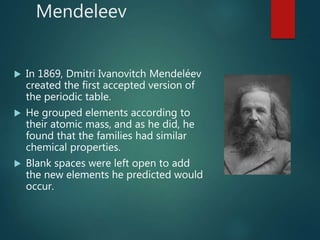
Mendeleev
 In 1869, Dmitri Ivanovitch Mendeléev
created the first accepted version of
the periodic table.
 He grouped elements according to
their atomic mass, and as he did, he
found that the families had similar
chemical properties.
 Blank spaces were left open to add
the new elements he predicted would
occur.
Quiz on the Periodic Table of
Elements
1. He created the first accepted
version of the periodic table.
2. It Shows all known elements
in the universe and organizes
the elements by chemical
properties.
3-7. What is the atomic
weight of these element?
H
Na
Au
Ag
B
8. No. of protons is equal to
the no.of .
9-11. The Periodic Table of
Elements is divided into 3
(three) main categories. These
are .
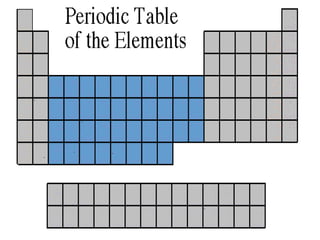
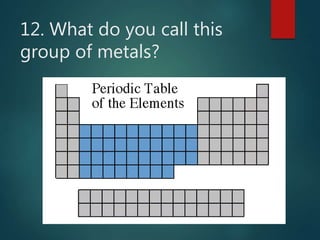
12. What do you call this
group of metals?
13-17. What is the no.of
neutrons of the following
elements?
Sn
Cu
Zn
Pb
At
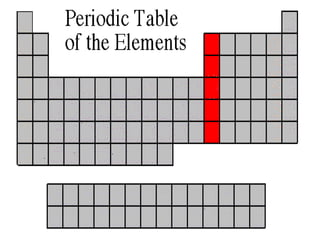
18. What do you call this
group of elements?
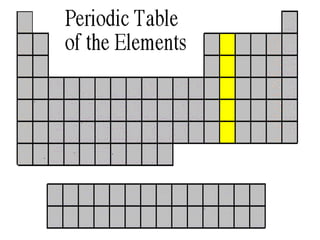
19. What do you call this
group of elements?
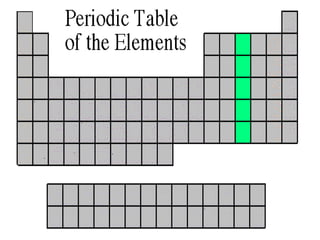
20. What do you call this
group of elements?
Answer Key:
1. Dmitri Mendeleev
2. Periodic Table of Elements
3. 1.008
4. 22.99
5. 197.0
6. 107.9
7. 10.81
8. No. of electrons or atomic no.
9. Metals
10. Nonmetals
11. Metalloids
12. Transition Metals

Periodic Table of Elements - Science 8

  • 1.
  • 3.
    I am DmitriMendeleev! I made the PERIODIC TABLE !
  • 4.
    What is thePERIODIC TABLE? o Shows all known elements in the universe. o Organizes the elements by chemical properties.
  • 5.
    How do youread the PERIODIC TABLE?
  • 6.
    What is theATOMIC NUMBER? o The number of protons found in the nucleus of an atom Or o The number of electrons surrounding the nucleus of an atom.
  • 7.
    What is theSYMBOL? o An abbreviation of the element name.
  • 8.
    What is theATOMIC WEIGHT? o The number of protons and neutrons in the nucleus of an atom.
  • 9.
    How do Ifind the number of protons, electrons, and neutrons in an element using the periodic table? o # of PROTONS = ATOMIC NUMBER o # of ELECTRONS = ATOMIC NUMBER o # of NEUTRONS = ATOMIC _ ATOMIC WEIGHT NUMBER
  • 10.
    Elements  The elements,alone or in combinations, make up our bodies, our world, our sun, and in fact, the entire universe.
  • 11.
    The most abundantelement in the earth’s crust is oxygen.
  • 12.
    Atomic Mass andIsotopes  While most atoms have the same number of protons and neutrons, some don’t.  Some atoms have more or less neutrons than protons. These are called isotopes.  An atomic mass number with a decimal is the total of the number of protons plus the average number of neutrons.
  • 13.
  • 15.
    Properties of Metals Metals are good conductors of heat and electricity.  Metals are shiny.  Metals are ductile (can be stretched into thin wires).  Metals are malleable (can be pounded into thin sheets).  A chemical property of metal is its reaction with water which results in corrosion.
  • 16.
    Properties of Non-Metals Non-metals are poor conductors of heat and electricity.  Non-metals are not ductile or malleable.  Solid non-metals are brittle and break easily.  They are dull.  Many non-metals are gases. Sulfur
  • 17.
    Properties of Metalloids Metalloids (metal-like) have properties of both metals and non-metals.  They are solids that can be shiny or dull.  They conduct heat and electricity better than non- metals but not as well as metals.  They are ductile and malleable. Silicon
  • 20.
    Families Periods  Columnsof elements are called groups or families.  Elements in each family have similar but not identical properties.  For example, lithium (Li), sodium (Na), potassium (K), and other members of family IA are all soft, white, shiny metals.  All elements in a family have the same number of valence electrons.  Each horizontal row of elements is called a period.  The elements in a period are not alike in properties.  In fact, the properties change greatly across even given row.  The first element in a period is always an extremely active solid. The last element in a period, is always an inactive gas.
  • 21.
    Families in thePeriodic Table of Elements
  • 33.
    Hydrogen  The hydrogensquare sits atop Family AI, but it is not a member of that family. Hydrogen is in a class of its own.  It’s a gas at room temperature.  It has one proton and one electron in its one and only energy level.  Hydrogen only needs 2 electrons to fill up its valence shell.
  • 34.
    Alkali Metals  Thealkali family is found in the first column of the periodic table.  Atoms of the alkali metals have a single electron in their outermost level, in other words, 1 valence electron.  They are shiny, have the consistency of clay, and are easily cut with a knife.
  • 35.
    Alkali Metals  Theyare the most reactive metals.  They react violently with water.  Alkali metals are never found as free elements in nature. They are always bonded with another element.
  • 36.
    What does itmean to be reactive?  We will be describing elements according to their reactivity.  Elements that are reactive bond easily with other elements to make compounds.  Some elements are only found in nature bonded with other elements.  What makes an element reactive?  An incomplete valence electron level.  All atoms (except hydrogen) want to have 8 electrons in their very outermost energy level (This is called the rule of octet.)  Atoms bond until this level is complete. Atoms with few valence electrons lose them during bonding. Atoms with 6, 7, or 8 valence electrons gain electrons during bonding.
  • 37.
    Alkaline Earth Metals They are never found uncombined in nature.  They have two valence electrons.  Alkaline earth metals include magnesium and calcium, among others.
  • 38.
    Transition Metals  TransitionElements include those elements in the B families.  These are the metals you are probably most familiar: copper, tin, zinc, iron, nickel, gold, and silver.  They are good conductors of heat and electricity.
  • 39.
    Transition Metals  Thecompounds of transition metals are usually brightly colored and are often used to color paints.  Transition elements have 1 or 2 valence electrons, which they lose when they form bonds with other atoms. Some transition elements can lose electrons in their next-to-outermost level.
  • 40.
    Transition Elements  Transitionelements have properties similar to one another and to other metals, but their properties do not fit in with those of any other family.  Many transition metals combine chemically with oxygen to form compounds called oxides.
  • 41.
    Boron Family  TheBoron Family is named after the first element in the family.  Atoms in this family have 3 valence electrons.  This family includes a metalloid (boron), and the rest are metals.  This family includes the most abundant metal in the earth’s crust (aluminum).
  • 42.
    Carbon Family  Atomsof this family have 4 valence electrons.  This family includes a non- metal (carbon), metalloids, and metals.  The element carbon is called the “basis of life.” There is an entire branch of chemistry devoted to carbon compounds called organic chemistry.
  • 43.
    Nitrogen Family  Thenitrogen family is named after the element that makes up 78% of our atmosphere.  This family includes non-metals, metalloids, and metals.  Atoms in the nitrogen family have 5 valence electrons. They tend to share electrons when they bond.  Other elements in this family are phosphorus, arsenic, antimony, and bismuth.
  • 44.
    Oxygen Family  Atomsof this family have 6 valence electrons.  Most elements in this family share electrons when forming compounds.  Oxygen is the most abundant element in the earth’s crust. It is extremely active and combines with almost all elements.
  • 45.
    Halogen Family  Theelements in this family are fluorine, chlorine, bromine, iodine, and astatine.  Halogens have 7 valence electrons, which explains why they are the most active non-metals. They are never found free in nature. Halogen atoms only need to gain 1 electron to fill their outermost energy level. They react with alkali metals to form salts.
  • 46.
    Noble Gases  NobleGases are colorless gases that are extremely un-reactive.  One important property of the noble gases is their inactivity. They are inactive because their outermost energy level is full.  Because they do not readily combine with other elements to form compounds, the noble gases are called inert.  The family of noble gases includes helium, neon, argon, krypton, xenon, and radon.  All the noble gases are found in small amounts in the earth's atmosphere.
  • 47.
    Rare Earth Elements The thirty rare earth elements are composed of the lanthanide and actinide series.  One element of the lanthanide series and most of the elements in the actinide series are called trans-uranium, which means synthetic or man-made.
  • 48.
    Mendeleev  In 1869,Dmitri Ivanovitch Mendeléev created the first accepted version of the periodic table.  He grouped elements according to their atomic mass, and as he did, he found that the families had similar chemical properties.  Blank spaces were left open to add the new elements he predicted would occur.
  • 49.
    Quiz on thePeriodic Table of Elements
  • 50.
    1. He createdthe first accepted version of the periodic table.
  • 51.
    2. It Showsall known elements in the universe and organizes the elements by chemical properties.
  • 52.
    3-7. What isthe atomic weight of these element? H Na Au Ag B
  • 53.
    8. No. ofprotons is equal to the no.of .
  • 54.
    9-11. The PeriodicTable of Elements is divided into 3 (three) main categories. These are .
  • 55.
    12. What doyou call this group of metals?
  • 56.
    13-17. What isthe no.of neutrons of the following elements? Sn Cu Zn Pb At
  • 57.
    18. What doyou call this group of elements?
  • 58.
    19. What doyou call this group of elements?
  • 59.
    20. What doyou call this group of elements?
  • 60.
    Answer Key: 1. DmitriMendeleev 2. Periodic Table of Elements 3. 1.008 4. 22.99 5. 197.0 6. 107.9 7. 10.81 8. No. of electrons or atomic no. 9. Metals 10. Nonmetals 11. Metalloids 12. Transition Metals