Solutions
Solubility&
SOLVEN
T
SOLUTE
Solutions
Solubility&
Solutions
Solubility&
SOLUTION
A homogenous
mixture
(looks uniform
throughout)
SOLVENT
In a solution, the
solvent is present in
the largest amount
by volume, mass, or
number of moles
SOLUTE
Other substances
present in a solution
other than the
solvent.
Solutions
Solubility&
Original state of solute Solvent Example
Gas Gas
Gas Liquid
Gas Solid
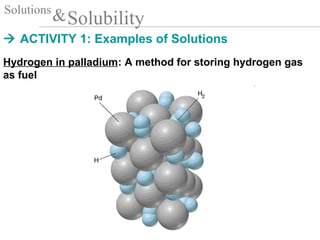
Hydrogen in palladium
Liquid Gas
Liquid Liquid
Liquid Solid
Amalgams
(i.e. mercury in silver)
Solid Gas
Solid Liquid
Solid Solid
 ACTIVITY 1: Examples of Solutions
Observe the samples of solutions and classify each solution under one category:
3
Oxygen in air
CO2 in pop
Water droplets in air
Alcohol in water
Dust in the air
Sugar in water
Copper in bronze
Solutions
Solubility&
 ACTIVITY 1: Examples of Solutions
Hydrogen in palladium: A method for storing hydrogen gas
as fuel
Solutions
Solubility&
 ACTIVITY 1: Examples of Solutions
Amalgam: A metal and mercury solution
By mass: 43% to 54% mercury,
~20-35% silver, ~10% copper,
~2% zinc, and some tin
Remains soft for a
short time and then
forms a hard and
durable compound
Solutions
Solubility&
Identify the components of these solutions:
Solutions
Solubility&
Common Types of Solutions:
Alloys: Solid solutions of metal
Stainless steel: Iron, chromium, nickel, manganese, vanadium
Solutions
Solubility&
Common Types of Solutions:
Alloys: Solid solutions of metal
Brass: Copper and zinc
Solutions
Solubility&
Common Types of Solutions:
Liquid solution: A solution with two or more miscible liquids
Miscible = Can dissolve in
one-another
Immiscible = Cannot dissolve
in one-another
Rubbing alcohol Oil and water
Solutions
Solubility&
Common Types of Solutions:
Gas solution: A solution of two or more gases
Air: 78% nitrogen, 21% oxygen, 0.9% argon, 0.03% carbon dioxide
Solutions
Solubility&
Common Types of Solutions:
Aqueous solution: A solution where water is the solvent
Tap water
Solutions
Solubility&
AQUEOUS SOLUTIONS: SOLUBLE VS. INSOLUBLE
Not all substances dissolve equally in water.
Recall the solubility table (dissolving solids in water):
Although substances are classified as
either soluble or insoluble in this table,
substances are almost never completely
insoluble or completely soluble in
water.
The solubility of a solute is the amount of
solute that dissolves in a given quantity of
solvent, at a certain temperature.
For example, the solubility of sodium
chloride in water at 20ºC is 36g per
100mL of water.
Solutions
Solubility&
AQUEOUS SOLUTIONS: SOLUBLE VS. INSOLUBLE
Soluble Partly or
slightly
soluble
Insoluble
More than 1g in
100mL
OR
greater than
0.1mol/L
Between 1g
and 0.1g in
100mL
OR
Between
0.1mol/L and
0.01mol/L
Less than 0.1g
in 100mL
OR
Less than
0.01mol/L
Solutions
Solubility&
AQUEOUS SOLUTIONS: SATURATED VS. UNSATURATED
One cannot endlessly dissolve salt in water
Solutions
Solubility&
AQUEOUS SOLUTIONS: SATURATED VS. UNSATURATED
Saturated solution:
Formed when no more solute will
dissolve in a solution, with excess
solute present.
Unsaturated solution:
A solution that is not yet saturated
Supersaturated solution:
Formed when a solution dissolves
more solute than allowed at a
specific temperature. No excess
solute is present.
Solutions
Solubility&
AQUEOUS SOLUTIONS: SATURATED VS. UNSATURATED
In a saturated solution with
excess solute present, the
rate of dissolution and
precipitation are the same
PbSO4(s) Pb2+
(aq) + SO4
2-
(aq)
precipitate dissolved ions
Solutions
Solubility&
FACTORS THAT AFFECT THE RATE OF
DISSOLVING AND SOLUBILITY
ACTIVITY 2: Who Can Dissolve the Most Salt?
Solutions
Solubility&
FACTORS THAT AFFECT THE RATE OF DISSOLVING AND SOLUBILITY
ACTIVITY 2: Who Can Dissolve the Most Salt? (10 min)
6) You must not have precipitate in your solution, and your
solution cannot be boiling.
1) Work in groups of 3-4
2) Each group will be given a graduated cylinder of salt and 250mL
of water
3) Try to dissolve as much salt as you can
4) Try to alter the physical properties of your solvent and solute to
increase the amount of salt that you can dissolve
5) You cannot add water
Solutions
Solubility&
FACTORS THAT AFFECT THE RATE OF DISSOLVING AND SOLUBILITY
ACTIVITY 2: Who Can Dissolve the Most Salt?
Factor Affect on rate of dissolving/solubility
Temperature Higher temperatures allow more
molecules to dissolve
Agitation Stirring/agitation allows more
molecules to dissolve
Surface area Increasing the surface area allows
more molecules to dissolve
At higher temperatures, solvent molecules
move faster, and collide with undissolved
solid molecules more frequently
Temperature
WARMER COOLER
Solutions
Solubility&
Agitation brings fresh solvent into contact with
undissolved solid
Agitation
MORE MOLECULES IN
CONTACT
FEWER MOLECULES IN
CONTACT
Solutions
Solubility&
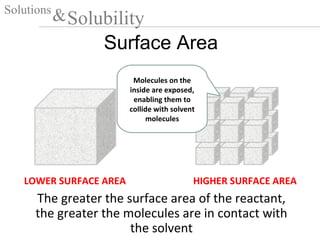
Surface Area
The greater the surface area of the reactant,
the greater the molecules are in contact with
the solvent
LOWER SURFACE AREA HIGHER SURFACE AREA
Molecules on the
inside are exposed,
enabling them to
collide with solvent
molecules
Solutions
Solubility&
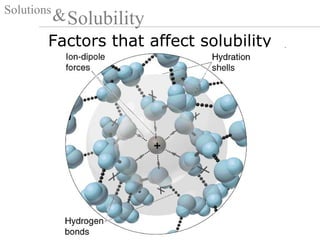
Factors that affect solubility
Solutions
Solubility&
Factors that affect solubility
Solutions
Solubility&
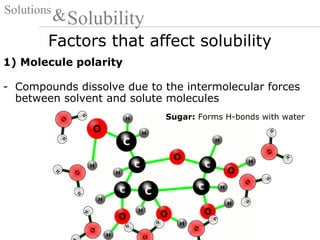
1) Molecule polarity
- Compounds dissolve due to the intermolecular forces
between solvent and solute molecules
Sugar: Forms H-bonds with water
O
H
H
OH
H
O
H
OH
H
O
H
H
O
H
H
O
H
H
Factors that affect solubility
Solutions
Solubility&
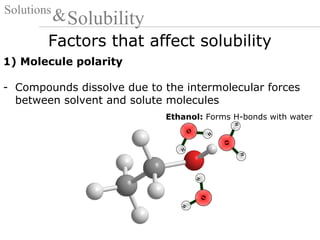
1) Molecule polarity
- Compounds dissolve due to the intermolecular forces
between solvent and solute molecules
Ethanol: Forms H-bonds with water
O
H
H
O
H
H
O
H
H
Factors that affect solubility
Solutions
Solubility&
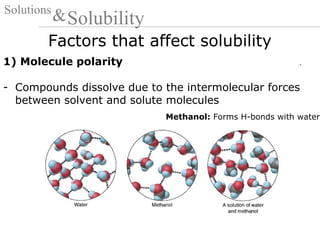
1) Molecule polarity
- Compounds dissolve due to the intermolecular forces
between solvent and solute molecules
Methanol: Forms H-bonds with water
Factors that affect solubility
Solutions
Solubility&
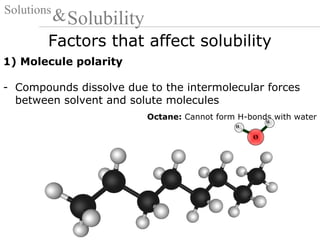
1) Molecule polarity
- Compounds dissolve due to the intermolecular forces
between solvent and solute molecules
Octane: Cannot form H-bonds with water
O
H
H
Factors that affect solubility
Solutions
Solubility&
1) Molecule polarity
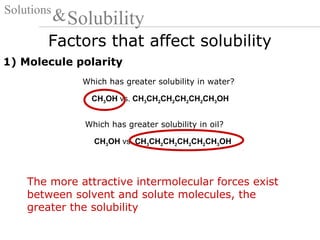
CH3OH vs. CH3CH2CH2CH2CH2CH3OH
Which has greater solubility in water?
CH3OH vs. CH3CH2CH2CH2CH2CH3OH
Which has greater solubility in oil?
The more attractive intermolecular forces exist
between solvent and solute molecules, the
greater the solubility
Factors that affect solubility
Solutions
Solubility&
1) Molecule polarity
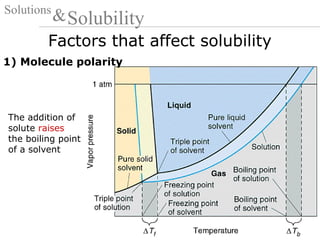
The addition of
solute raises
the boiling point
of a solvent
Factors that affect solubility
Solutions
Solubility&
2) Temperature
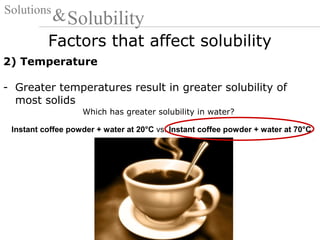
- Greater temperatures result in greater solubility of
most solids
Instant coffee powder + water at 20°C vs. Instant coffee powder + water at 70°C
Which has greater solubility in water?
Factors that affect solubility
Solutions
Solubility&
2) Temperature
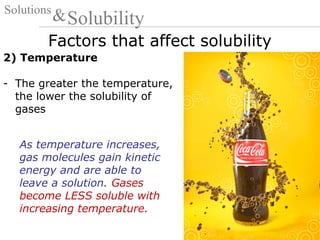
- The greater the temperature,
the lower the solubility of
gases
As temperature increases,
gas molecules gain kinetic
energy and are able to
leave a solution. Gases
become LESS soluble with
increasing temperature.
Factors that affect solubility
Solutions
Solubility&
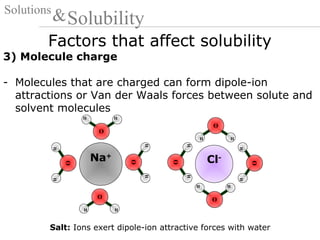
3) Molecule charge
- Molecules that are charged can form dipole-ion
attractions or Van der Waals forces between solute and
solvent molecules
Cl-Na+
Salt: Ions exert dipole-ion attractive forces with water
O
HH
O
H H
O
HH
O
HH
O
HH
O
HH
O
HH
O
H H
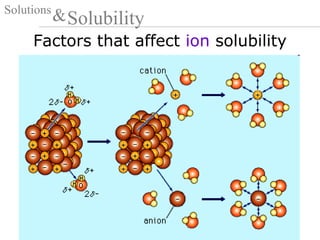
Factors that affect ion solubility
Solutions
Solubility&
Factors that affect ion solubility
Solutions
Solubility&
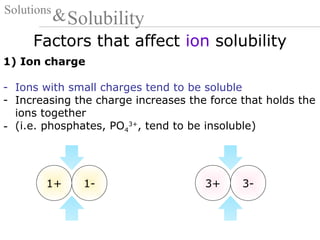
1) Ion charge
- Ions with small charges tend to be soluble
- Increasing the charge increases the force that holds the
ions together
- (i.e. phosphates, PO4
3+
, tend to be insoluble)
1+ 1- 3+ 3-
Factors that affect ion solubility
Solutions
Solubility&
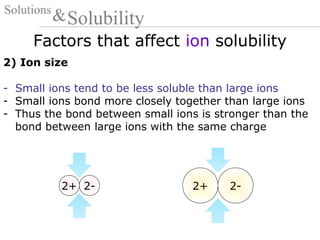
2) Ion size
- Small ions tend to be less soluble than large ions
- Small ions bond more closely together than large ions
- Thus the bond between small ions is stronger than the
bond between large ions with the same charge
2+ 2-2+ 2-
Net Ionic Equations
Solutions
Solubility&
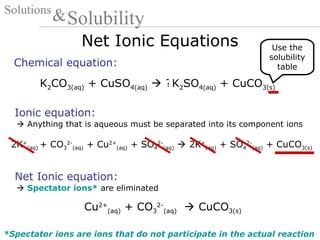
K2CO3(aq) + CuSO4(aq)  ?K2SO4(aq) + CuCO3(s)
Chemical equation:
Ionic equation:
 Anything that is aqueous must be separated into its component ions
2K+
(aq) + CO3
2-
(aq) + Cu2+
(aq) + SO4
2-
(aq)  2K+
(aq) + SO4
2-
(aq) + CuCO3(s)
Net Ionic equation:
 Spectator ions* are eliminated
Cu2+
(aq) + CO3
2-
(aq)  CuCO3(s)
*Spectator ions are ions that do not participate in the actual reaction
Use the
solubility
table
Solubility curves
Solutions
Solubility&
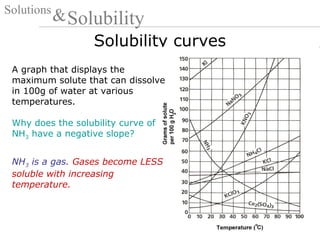
A graph that displays the
maximum solute that can dissolve
in 100g of water at various
temperatures.
Why does the solubility curve of
NH3 have a negative slope?
NH3 is a gas. Gases become LESS
soluble with increasing
temperature.
Solubility curves
Solutions
Solubility&
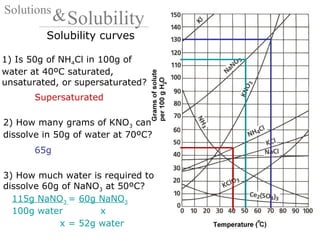
1) Is 50g of NH4Cl in 100g of
water at 40ºC saturated,
unsaturated, or supersaturated?
Supersaturated
2) How many grams of KNO3 can
dissolve in 50g of water at 70ºC?
65g
3) How much water is required to
dissolve 60g of NaNO3 at 50ºC?
115g NaNO3 = 60g NaNO3
100g water x
x = 52g water