Hydrological Cycle and Water Budget
Dr. Mohsin Siddique
Assistant Professor
Dept. of Civil & Env. Engg
1
Outcome of Today’s Lesson
2
The following are the objectives of the lesson:
1)To know the principles behind the sources of water,
2)To study about hydrologic cycle in general aspect, and
3)To further understand the hydrological components like evaporation,
precipitation, infiltration, runoff and subsurface flow.
Global Water Resources
3
[does not add to 100% due to rounding, numbers differ slightly depending on study used]
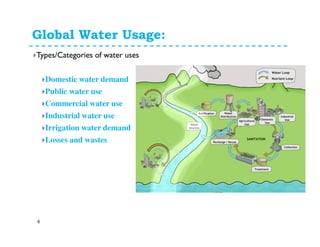
Global Water Usage:
4
Types/Categories of water uses
Domestic water demand
Public water use
Commercial water use
Industrial water use
Irrigation water demand
Losses and wastes
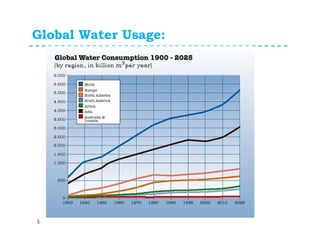
Global Water Usage:
5
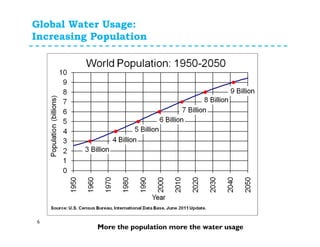
Global Water Usage:
Increasing Population
6
More the population more the water usage
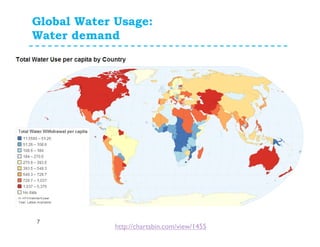
Global Water Usage:
Water demand
7
http://chartsbin.com/view/1455
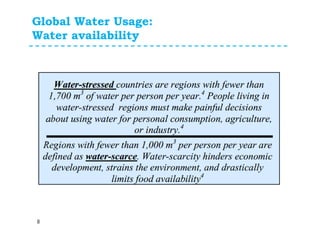
Global Water Usage:
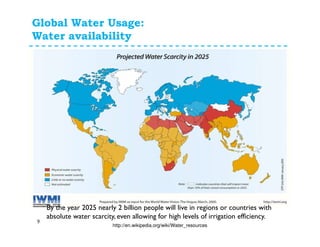
Water availability
8
Global Water Usage:
Water availability
9
http://en.wikipedia.org/wiki/Water_resources
By the year 2025 nearly 2 billion people will live in regions or countries with
absolute water scarcity, even allowing for high levels of irrigation efficiency.
Hydrological cycle (Water cycle)
10
Water never leaves the Earth. It is constantly being cycled through
the atmosphere, ocean, and land.This process, known as the water
cycle, is driven by energy from the sun.
The hydrologic cycle has a profound effect upon climate prediction.
Water is vital so we must understand where to find water and how
hydrological-cycle supplies water through the Earth.
Branch of science to study of movements and characteristics of water
under of over surface or earth is called Hydrology.
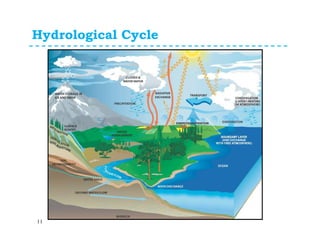
Hydrological Cycle
11
Component of Hydrological Cycle
12
Evaporation
Evapotranspiration
Condensation
Precipitation
Interception
Infiltration
Percolation
Runoff
Storage
Schematic diagram showing
components of hydrological cycle
Component of Hydrological Cycle
13
Evaporation: Heat from the sun starts the hydrologic cycle causing water
into water vapor that is held in the air of the atmosphere.
Transpiration occurs when plants take in water through the roots and
release it through the leaves, a process that can clean water by removing
contaminants and pollution.
Evapotranspiration is water evaporating from the ground and transpiration by
plants. Evapotranspiration is also the way water vapour re-enters the
atmosphere
About 90% of atmospheric water comes from evaporation, while the
remaining 10% is from transpiration
Water is evaporated from lakes, streams, oceans, and plants. In addition,
water is released by animals' breathing and perspiration.
Component of Hydrological Cycle
14
Evapotranspiration is water
evaporating from the ground and
transpiration by plants.
Evapotranspiration is also the
way water vapor re-enters the
atmosphere
Component of Hydrological Cycle
15
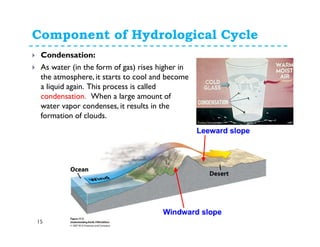
Condensation:
As water (in the form of gas) rises higher in
the atmosphere, it starts to cool and become
a liquid again. This process is called
condensation. When a large amount of
water vapor condenses, it results in the
formation of clouds.
Component of Hydrological Cycle
16
Condensation can form fog, dew, and clouds
Fog: Fog forms when air near the surface is cold and nearly saturated
with water. Now when water from the ground evaporates, it condenses
immediately forming tiny water droplets that create a low-lying cloud we
call fog.
Dew: Dew forms at night when air becomes saturated with water vapor.
When this saturated air comes in contact with plants or other objects it
condenses, leaving tiny water droplets behind on the object.
Clouds: When the air containing water vapor is heated by the sun, it
rises into the atmosphere by convection.The water vapor in the air is then
cooled by the colder air higher in the atmosphere causing the relative
humidity to increase. As the relative humidity increases, the air eventually
becomes saturated. The water vapor then condenses into tiny water
droplets around particles of dust or salt in the air. These tiny water
droplets make up clouds.
Precipitation
17
When the water in the clouds gets too heavy, the water falls back to the
earth. This is called precipitation.
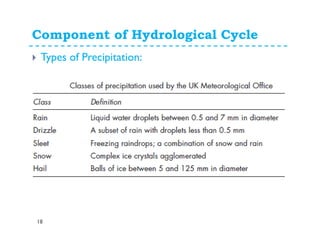
Types of Precipitation:
Drizzle
Rain
Freezing rain
Sleet
Snow
Hail
Component of Hydrological Cycle
18
Types of Precipitation:
Component of Hydrological Cycle
19
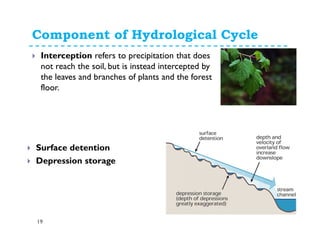
Interception refers to precipitation that does
not reach the soil, but is instead intercepted by
the leaves and branches of plants and the forest
floor.
Surface detention
Depression storage
Component of Hydrological Cycle
20
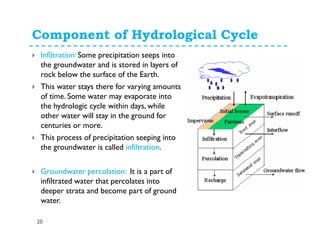
Infiltration: Some precipitation seeps into
the groundwater and is stored in layers of
rock below the surface of the Earth.
This water stays there for varying amounts
of time. Some water may evaporate into
the hydrologic cycle within days, while
other water will stay in the ground for
centuries or more.
This process of precipitation seeping into
the groundwater is called infiltration.
Groundwater percolation: It is a part of
infiltrated water that percolates into
deeper strata and become part of ground
water.
Component of Hydrological Cycle
21
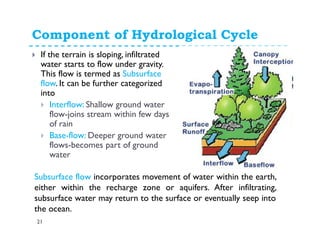
If the terrain is sloping, infiltrated
water starts to flow under gravity.
This flow is termed as Subsurface
flow. It can be further categorized
into
Interflow: Shallow ground water
flow-joins stream within few days
of rain
Base-flow: Deeper ground water
flows-becomes part of ground
water
Subsurface flow incorporates movement of water within the earth,
either within the recharge zone or aquifers. After infiltrating,
subsurface water may return to the surface or eventually seep into
the ocean.
Component of Hydrological Cycle
22
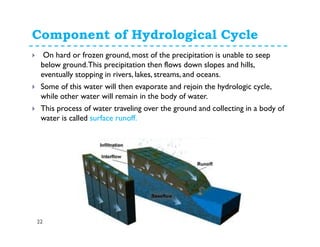
On hard or frozen ground, most of the precipitation is unable to seep
below ground.This precipitation then flows down slopes and hills,
eventually stopping in rivers, lakes, streams, and oceans.
Some of this water will then evaporate and rejoin the hydrologic cycle,
while other water will remain in the body of water.
This process of water traveling over the ground and collecting in a body of
water is called surface runoff.
Component of Hydrological Cycle
23
Storage:
Natural lakes or man-made reservoirs or ground water
Lake Geneva or Lake Léman is a lake in Switzerland and France
24
Table:Typical Resident time of water found in various reservoirs
Water Budget
25
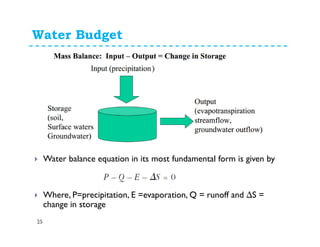
Water balance equation in its most fundamental form is given by
Where, P=precipitation, E =evaporation, Q = runoff and ∆S =
change in storage
Example Long Term Water Balance
for Estimating Evapotranspiration
26
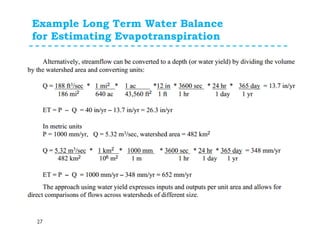
For the Embarras River at Camargo 1978 to 1998, precipitation (P) = 40
in/yr, average stream flow (Q) = 188 ft3/sec, and the watershed area = 186
mi2. Estimate the average annual evapotranspiration for this watershed and
this period, assuming net groundwater flows and changes in storage are
negligible, and the density of water is constant. Because water volume is
mass divided by density, if density is constant, a volume balance is
equivalent to a mass balance.
Solution: We can only add or subtract items of the same type, or items
with common units.The depth of annual precipitation input can be
converted to a volume by multiplying the depth by the watershed area.
Example Long Term Water Balance
for Estimating Evapotranspiration
27
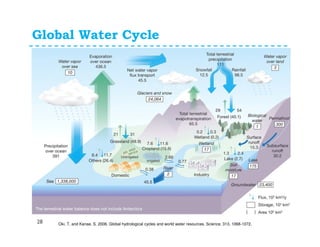
Global Water Cycle
28 Oki, T. and Kanae, S. 2006. Global hydrological cycles and world water resources. Science, 313, 1068-1072.
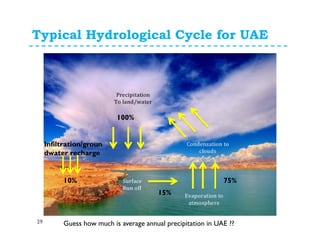
Typical Hydrological Cycle for UAE
29
100%
75%
15%
Infiltration/groun
dwater recharge
10%
Guess how much is average annual precipitation in UAE ??
Thank you
Questions….
30

Water cycle and water budget

  • 1.
    Hydrological Cycle andWater Budget Dr. Mohsin Siddique Assistant Professor Dept. of Civil & Env. Engg 1
  • 2.
    Outcome of Today’sLesson 2 The following are the objectives of the lesson: 1)To know the principles behind the sources of water, 2)To study about hydrologic cycle in general aspect, and 3)To further understand the hydrological components like evaporation, precipitation, infiltration, runoff and subsurface flow.
  • 3.
    Global Water Resources 3 [doesnot add to 100% due to rounding, numbers differ slightly depending on study used]
  • 4.
    Global Water Usage: 4 Types/Categoriesof water uses Domestic water demand Public water use Commercial water use Industrial water use Irrigation water demand Losses and wastes
  • 5.
  • 6.
    Global Water Usage: IncreasingPopulation 6 More the population more the water usage
  • 7.
    Global Water Usage: Waterdemand 7 http://chartsbin.com/view/1455
  • 8.
  • 9.
    Global Water Usage: Wateravailability 9 http://en.wikipedia.org/wiki/Water_resources By the year 2025 nearly 2 billion people will live in regions or countries with absolute water scarcity, even allowing for high levels of irrigation efficiency.
  • 10.
    Hydrological cycle (Watercycle) 10 Water never leaves the Earth. It is constantly being cycled through the atmosphere, ocean, and land.This process, known as the water cycle, is driven by energy from the sun. The hydrologic cycle has a profound effect upon climate prediction. Water is vital so we must understand where to find water and how hydrological-cycle supplies water through the Earth. Branch of science to study of movements and characteristics of water under of over surface or earth is called Hydrology.
  • 11.
  • 12.
    Component of HydrologicalCycle 12 Evaporation Evapotranspiration Condensation Precipitation Interception Infiltration Percolation Runoff Storage Schematic diagram showing components of hydrological cycle
  • 13.
    Component of HydrologicalCycle 13 Evaporation: Heat from the sun starts the hydrologic cycle causing water into water vapor that is held in the air of the atmosphere. Transpiration occurs when plants take in water through the roots and release it through the leaves, a process that can clean water by removing contaminants and pollution. Evapotranspiration is water evaporating from the ground and transpiration by plants. Evapotranspiration is also the way water vapour re-enters the atmosphere About 90% of atmospheric water comes from evaporation, while the remaining 10% is from transpiration Water is evaporated from lakes, streams, oceans, and plants. In addition, water is released by animals' breathing and perspiration.
  • 14.
    Component of HydrologicalCycle 14 Evapotranspiration is water evaporating from the ground and transpiration by plants. Evapotranspiration is also the way water vapor re-enters the atmosphere
  • 15.
    Component of HydrologicalCycle 15 Condensation: As water (in the form of gas) rises higher in the atmosphere, it starts to cool and become a liquid again. This process is called condensation. When a large amount of water vapor condenses, it results in the formation of clouds.
  • 16.
    Component of HydrologicalCycle 16 Condensation can form fog, dew, and clouds Fog: Fog forms when air near the surface is cold and nearly saturated with water. Now when water from the ground evaporates, it condenses immediately forming tiny water droplets that create a low-lying cloud we call fog. Dew: Dew forms at night when air becomes saturated with water vapor. When this saturated air comes in contact with plants or other objects it condenses, leaving tiny water droplets behind on the object. Clouds: When the air containing water vapor is heated by the sun, it rises into the atmosphere by convection.The water vapor in the air is then cooled by the colder air higher in the atmosphere causing the relative humidity to increase. As the relative humidity increases, the air eventually becomes saturated. The water vapor then condenses into tiny water droplets around particles of dust or salt in the air. These tiny water droplets make up clouds.
  • 17.
    Precipitation 17 When the waterin the clouds gets too heavy, the water falls back to the earth. This is called precipitation. Types of Precipitation: Drizzle Rain Freezing rain Sleet Snow Hail
  • 18.
    Component of HydrologicalCycle 18 Types of Precipitation:
  • 19.
    Component of HydrologicalCycle 19 Interception refers to precipitation that does not reach the soil, but is instead intercepted by the leaves and branches of plants and the forest floor. Surface detention Depression storage
  • 20.
    Component of HydrologicalCycle 20 Infiltration: Some precipitation seeps into the groundwater and is stored in layers of rock below the surface of the Earth. This water stays there for varying amounts of time. Some water may evaporate into the hydrologic cycle within days, while other water will stay in the ground for centuries or more. This process of precipitation seeping into the groundwater is called infiltration. Groundwater percolation: It is a part of infiltrated water that percolates into deeper strata and become part of ground water.
  • 21.
    Component of HydrologicalCycle 21 If the terrain is sloping, infiltrated water starts to flow under gravity. This flow is termed as Subsurface flow. It can be further categorized into Interflow: Shallow ground water flow-joins stream within few days of rain Base-flow: Deeper ground water flows-becomes part of ground water Subsurface flow incorporates movement of water within the earth, either within the recharge zone or aquifers. After infiltrating, subsurface water may return to the surface or eventually seep into the ocean.
  • 22.
    Component of HydrologicalCycle 22 On hard or frozen ground, most of the precipitation is unable to seep below ground.This precipitation then flows down slopes and hills, eventually stopping in rivers, lakes, streams, and oceans. Some of this water will then evaporate and rejoin the hydrologic cycle, while other water will remain in the body of water. This process of water traveling over the ground and collecting in a body of water is called surface runoff.
  • 23.
    Component of HydrologicalCycle 23 Storage: Natural lakes or man-made reservoirs or ground water Lake Geneva or Lake Léman is a lake in Switzerland and France
  • 24.
    24 Table:Typical Resident timeof water found in various reservoirs
  • 25.
    Water Budget 25 Water balanceequation in its most fundamental form is given by Where, P=precipitation, E =evaporation, Q = runoff and ∆S = change in storage
  • 26.
    Example Long TermWater Balance for Estimating Evapotranspiration 26 For the Embarras River at Camargo 1978 to 1998, precipitation (P) = 40 in/yr, average stream flow (Q) = 188 ft3/sec, and the watershed area = 186 mi2. Estimate the average annual evapotranspiration for this watershed and this period, assuming net groundwater flows and changes in storage are negligible, and the density of water is constant. Because water volume is mass divided by density, if density is constant, a volume balance is equivalent to a mass balance. Solution: We can only add or subtract items of the same type, or items with common units.The depth of annual precipitation input can be converted to a volume by multiplying the depth by the watershed area.
  • 27.
    Example Long TermWater Balance for Estimating Evapotranspiration 27
  • 28.
    Global Water Cycle 28Oki, T. and Kanae, S. 2006. Global hydrological cycles and world water resources. Science, 313, 1068-1072.
  • 29.
    Typical Hydrological Cyclefor UAE 29 100% 75% 15% Infiltration/groun dwater recharge 10% Guess how much is average annual precipitation in UAE ??
  • 30.