CHAPTER 3: WAVE THEORY AND
WAVE PROPAGATION
DR. MOHSIN SIDDIQUE
ASSISTANT PROFESSOR
1
0401444 - Intro. To Coastal Eng.
University of Sharjah
Dept. of Civil and Env. Engg.
WAVE THEORIES
2
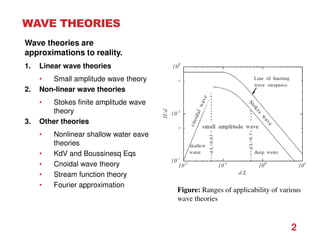
Figure: Ranges of applicability of various
wave theories
Wave theories are
approximations to reality.
1. Linear wave theories
• Small amplitude wave theory
2. Non-linear wave theories
• Stokes finite amplitude wave
theory
3. Other theories
• Nonlinear shallow water eave
theories
• KdV and Boussinesq Eqs
• Cnoidal wave theory
• Stream function theory
• Fourier approximation
WAVE THEORIES
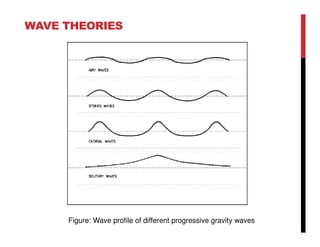
Figure: Wave profile of different progressive gravity waves
4
SMALL AMPLITUDE WAVE THEORY
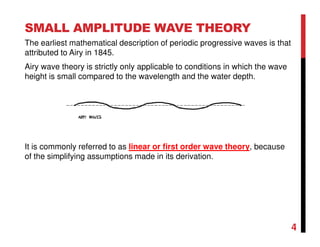
The earliest mathematical description of periodic progressive waves is that
attributed to Airy in 1845.
Airy wave theory is strictly only applicable to conditions in which the wave
height is small compared to the wavelength and the water depth.
It is commonly referred to as linear or first order wave theory, because
of the simplifying assumptions made in its derivation.
SMALL AMPLITUDE WAVE THEORY
5
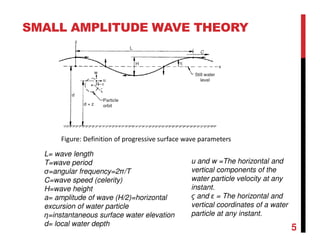
L= wave length
T=wave period
σ=angular frequency=2π/T
C=wave speed (celerity)
H=wave height
a= amplitude of wave (H/2)=horizontal
excursion of water particle
η=instantaneous surface water elevation
d= local water depth
Figure: Definition of progressive surface wave parameters
u and w =The horizontal and
vertical components of the
water particle velocity at any
instant.
ς and ε = The horizontal and
vertical coordinates of a water
particle at any instant.
6
SMALL AMPLITUDE WAVE THEORY
Assumptions:
The basic assumptions for linear wave theory are as follows:
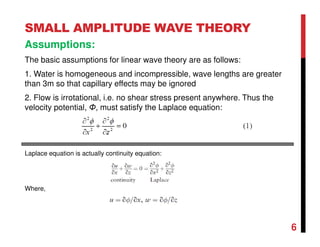
1. Water is homogeneous and incompressible, wave lengths are greater
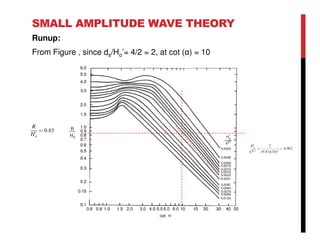
than 3m so that capillary effects may be ignored
2. Flow is irrotational, i.e. no shear stress present anywhere. Thus the
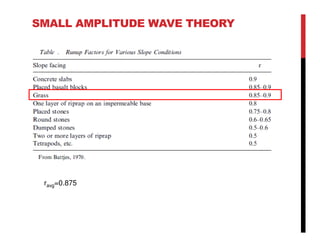
velocity potential, Φ, must satisfy the Laplace equation:
Laplace equation is actually continuity equation:
Where,
7
SMALL AMPLITUDE WAVE THEORY
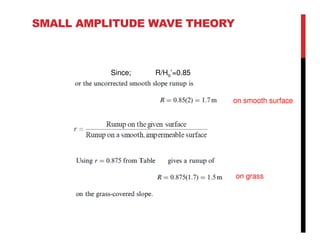
Assumptions:
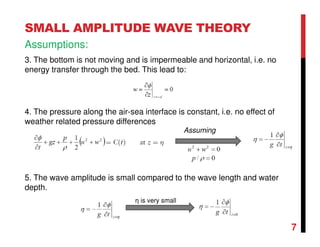
3. The bottom is not moving and is impermeable and horizontal, i.e. no
energy transfer through the bed. This lead to:
4. The pressure along the air-sea interface is constant, i.e. no effect of
weather related pressure differences
5. The wave amplitude is small compared to the wave length and water
depth.
Assuming
η is very small
SMALL AMPLITUDE WAVE THEORY
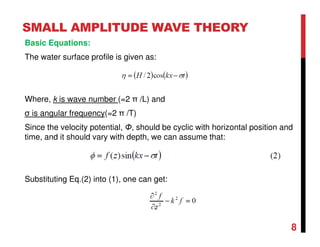
Where, k is wave number (=2 π /L) and
σ is angular frequency(=2 π /T)
Since the velocity potential, Φ, should be cyclic with horizontal position and
time, and it should vary with depth, we can assume that:
Substituting Eq.(2) into (1), one can get:
8
Basic Equations:
The water surface profile is given as:
SMALL AMPLITUDE WAVE THEORY
9
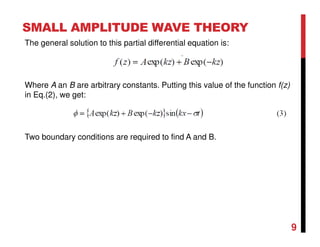
The general solution to this partial differential equation is:
Where A an B are arbitrary constants. Putting this value of the function f(z)
in Eq.(2), we get:
Two boundary conditions are required to find A and B.
SMALL AMPLITUDE WAVE THEORY
10
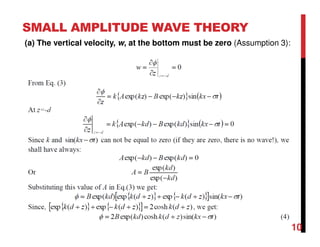
(a) The vertical velocity, w, at the bottom must be zero (Assumption 3):
SMALL AMPLITUDE WAVE THEORY
11
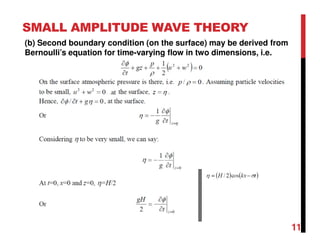
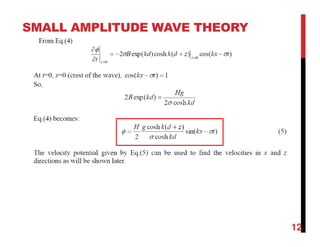
(b) Second boundary condition (on the surface) may be derived from
Bernoulli’s equation for time-varying flow in two dimensions, i.e.
SMALL AMPLITUDE WAVE THEORY
12
SMALL AMPLITUDE WAVE THEORY
13
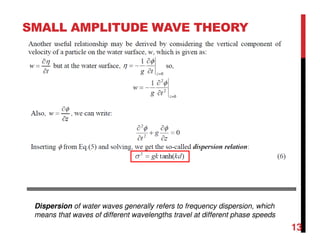
Dispersion of water waves generally refers to frequency dispersion, which
means that waves of different wavelengths travel at different phase speeds
SMALL AMPLITUDE WAVE THEORY
14
SMALL AMPLITUDE WAVE THEORY
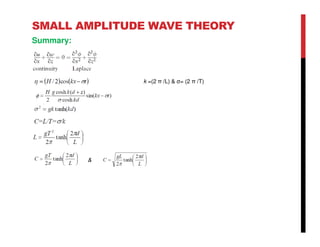
Summary:
k =(2 π /L) & σ= (2 π /T)
&
16
SMALL AMPLITUDE WAVE THEORY
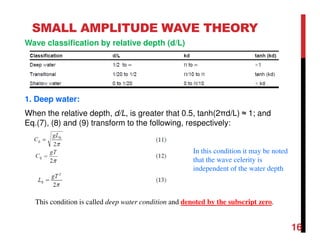
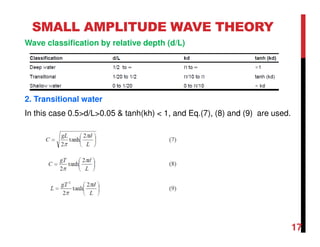
Wave classification by relative depth (d/L)
1. Deep water:
When the relative depth, d/L, is greater that 0.5, tanh(2πd/L) ≈ 1; and
Eq.(7), (8) and (9) transform to the following, respectively:
This condition is called deep water condition and denoted by the subscript zero.
In this condition it may be noted
that the wave celerity is
independent of the water depth
17
SMALL AMPLITUDE WAVE THEORY
Wave classification by relative depth (d/L)
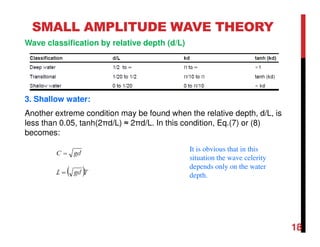
2. Transitional water
In this case 0.5>d/L>0.05 & tanh(kh) < 1, and Eq.(7), (8) and (9) are used.
18
SMALL AMPLITUDE WAVE THEORY
Wave classification by relative depth (d/L)
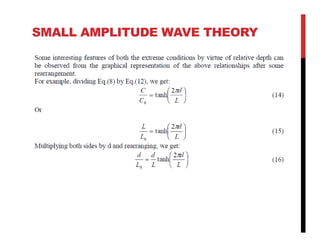
3. Shallow water:
Another extreme condition may be found when the relative depth, d/L, is
less than 0.05, tanh(2πd/L) ≈ 2πd/L. In this condition, Eq.(7) or (8)
becomes:
It is obvious that in this
situation the wave celerity
depends only on the water
depth.
SMALL AMPLITUDE WAVE THEORY
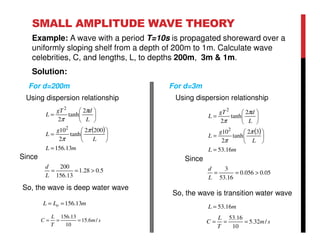
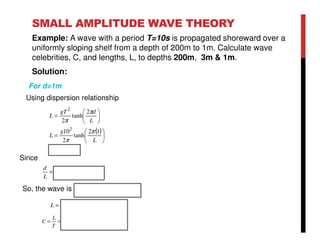
Example: A wave with a period T=10s is propagated shoreward over a
uniformly sloping shelf from a depth of 200m to 1m. Calculate wave
celebrities, C, and lengths, L, to depths 200m, 3m & 1m.
Solution:
( )
mL
L
g
L
L
dgT
L
13.156
2002
tanh
2
10
2
tanh
2
2
2
=






=






=
π
π
π
π
5.028.1
13.156
200
>==
L
d
Since
So, the wave is deep water wave
For d=200m
( )
mL
L
g
L
L
dgT
L
16.53
32
tanh
2
10
2
tanh
2
2
2
=






=






=
π
π
π
π
05.0056.0
16.53
3
>==
L
d
Since
So, the wave is transition water wave
For d=3m
sm
T
L
C /6.15
10
13.156
===
mLL o 13.156==
sm
T
L
C /32.5
10
16.53
===
mL 16.53=
Using dispersion relationship Using dispersion relationship
SMALL AMPLITUDE WAVE THEORY
Example: A wave with a period T=10s is propagated shoreward over a
uniformly sloping shelf from a depth of 200m to 1m. Calculate wave
celebrities, C, and lengths, L, to depths 200m, 3m & 1m.
Solution:
( )
mL
L
g
L
L
dgT
L
11.31
12
tanh
2
10
2
tanh
2
2
2
=






=






=
π
π
π
π
05.0032.0
11.31
1
<==
L
d
Since
So, the wave is shallow water wave
For d=1m
sm
T
L
C /11.3
10
11.31
===
mL 11.31=
Using dispersion relationship
SMALL AMPLITUDE WAVE THEORY
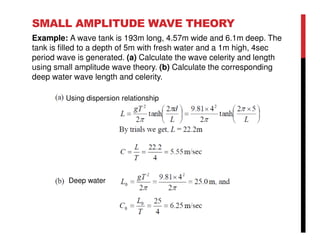
Example: A wave tank is 193m long, 4.57m wide and 6.1m deep. The
tank is filled to a depth of 5m with fresh water and a 1m high, 4sec
period wave is generated. (a) Calculate the wave celerity and length
using small amplitude wave theory. (b) Calculate the corresponding
deep water wave length and celerity.
Deep water
Using dispersion relationship
SMALL AMPLITUDE WAVE THEORY
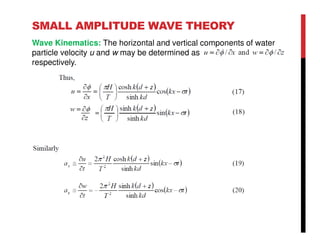
Wave Kinematics: The horizontal and vertical components of water
particle velocity u and w may be determined as
respectively.
SMALL AMPLITUDE WAVE THEORY
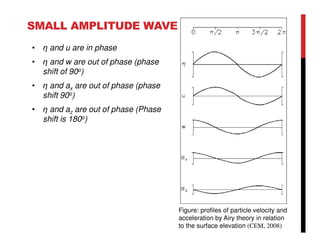
• η and u are in phase
• η and w are out of phase (phase
shift of 90o)
• η and ax are out of phase (phase
shift 90o)
• η and az are out of phase (Phase
shift is 180o)
Figure: profiles of particle velocity and
acceleration by Airy theory in relation
to the surface elevation (CEM, 2008)
SMALL AMPLITUDE WAVE THEORY
Example: A wave with a period, T, =8sec, in a water depth, d, =15m
and a wave height, H,= 5.5m is propagating. Find local horizonal and
vertical velocities , u & w, and acceleration ax, & az at an elevation of
z=-5m below the still water level (SWL) when kx-σt=π/3 (60 degrees)
Solution:
Given: T=8s; d=15m; H=5.5
Find: u, w, ax, az =? @ z=-5m
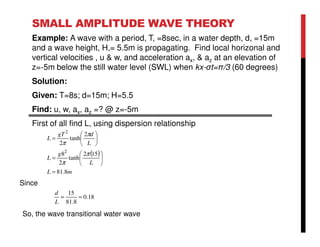
First of all find L, using dispersion relationship
( )
mL
L
g
L
L
dgT
L
8.81
152
tanh
2
8
2
tanh
2
2
2
=






=






=
π
π
π
π
18.0
8.81
15
==
L
d
Since
So, the wave transitional water wave
SMALL AMPLITUDE WAVE THEORY
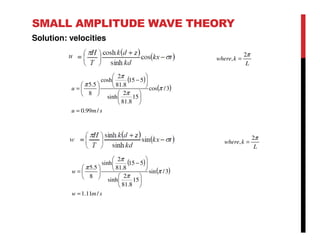
Solution: velocities
L
kwhere
π2
, =
( )
( )
smu
u
/99.0
3/cos
15
8.81
2
sinh
515
8.81
2
cosh
8
5.5
=












−






= π
π
π
π
( )
( )
smw
w
/11.1
3/sin
15
8.81
2
sinh
515
8.81
2
sinh
8
5.5
=












−






= π
π
π
π
L
kwhere
π2
, =
SMALL AMPLITUDE WAVE THEORY
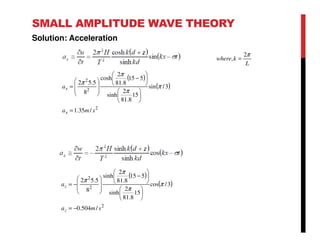
Solution: Acceleration
L
kwhere
π2
, =
( )
( )
2
2
2
/35.1
3/sin
15
8.81
2
sinh
515
8.81
2
cosh
8
5.52
sma
a
x
x
=












−








= π
π
π
π
( )
( )
2
2
2
/504.0
3/cos
15
8.81
2
sinh
515
8.81
2
sinh
8
5.52
sma
a
z
z
−=












−








−= π
π
π
π
SMALL AMPLITUDE WAVE THEORY
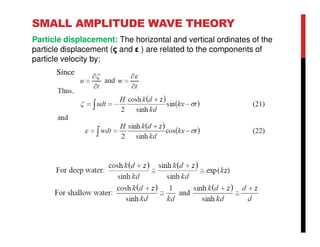
Particle displacement: The horizontal and vertical ordinates of the
particle displacement (ς and ε ) are related to the components of
particle velocity by:
Since
SMALL AMPLITUDE WAVE THEORY
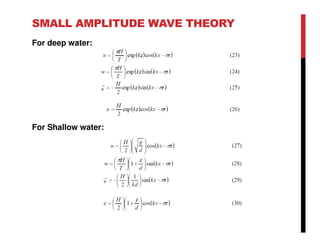
For deep water:
For Shallow water:
SMALL AMPLITUDE WAVE THEORY
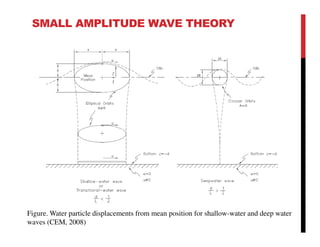
Figure. Water particle displacements from mean position for shallow-water and deep water
waves (CEM, 2008)
SMALL AMPLITUDE WAVE THEORY
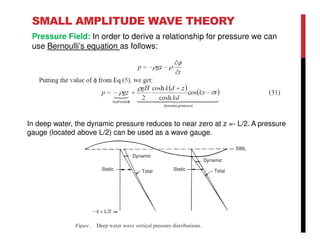
Pressure Field: In order to derive a relationship for pressure we can
use Bernoulli’s equation as follows:
In deep water, the dynamic pressure reduces to near zero at z =- L/2. A pressure
gauge (located above L/2) can be used as a wave gauge.
SMALL AMPLITUDE WAVE THEORY
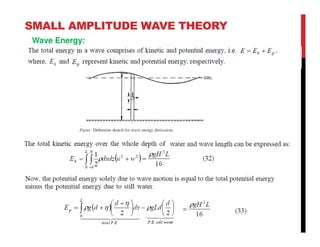
Wave Energy:
SMALL AMPLITUDE WAVE THEORY
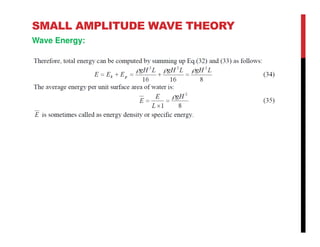
Wave Energy:
SMALL AMPLITUDE WAVE THEORY
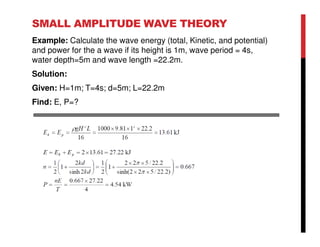
Example: Calculate the wave energy (total, Kinetic, and potential)
and power for the a wave if its height is 1m, wave period = 4s,
water depth=5m and wave length =22.2m.
Solution:
Given: H=1m; T=4s; d=5m; L=22.2m
Find: E, P=?
SMALL AMPLITUDE WAVE THEORY
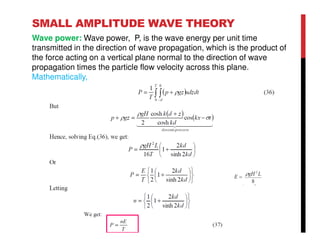
Wave power: Wave power, P, is the wave energy per unit time
transmitted in the direction of wave propagation, which is the product of
the force acting on a vertical plane normal to the direction of wave
propagation times the particle flow velocity across this plane.
Mathematically,
SMALL AMPLITUDE WAVE THEORY
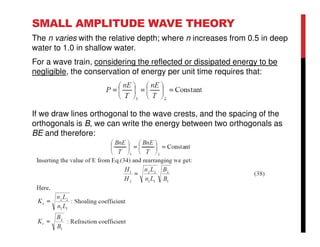
The n varies with the relative depth; where n increases from 0.5 in deep
water to 1.0 in shallow water.
For a wave train, considering the reflected or dissipated energy to be
negligible, the conservation of energy per unit time requires that:
If we draw lines orthogonal to the wave crests, and the spacing of the
orthogonals is B, we can write the energy between two orthogonals as
BE and therefore:
SMALL AMPLITUDE WAVE THEORY
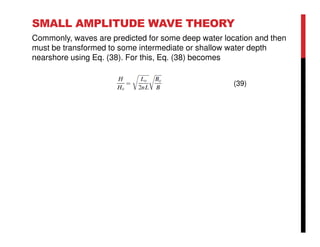
Commonly, waves are predicted for some deep water location and then
must be transformed to some intermediate or shallow water depth
nearshore using Eq. (38). For this, Eq. (38) becomes
(39)
SMALL AMPLITUDE WAVE THEORY
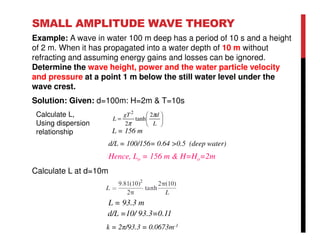
Example: A wave in water 100 m deep has a period of 10 s and a height
of 2 m. When it has propagated into a water depth of 10 m without
refracting and assuming energy gains and losses can be ignored.
Determine the wave height, power and the water particle velocity
and pressure at a point 1 m below the still water level under the
wave crest.
Solution: Given: d=100m: H=2m & T=10s
Calculate L at d=10m
L = 93.3 m
d/L =10/ 93.3=0.11
k = 2π/93.3 = 0.0673m-1
L = 156 m
d/L = 100/156= 0.64 >0.5 (deep water)
Hence, Lo = 156 m & H=Ho=2m






=
L
dgT
L
π
π
2
tanh
2
2
Calculate L,
Using dispersion
relationship
SMALL AMPLITUDE WAVE THEORY
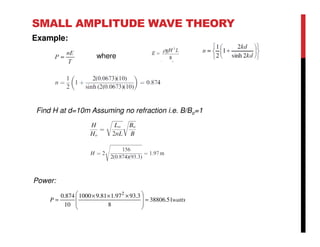
Example:
where
Find H at d=10m Assuming no refraction i.e. B/Bo=1
Power:
wattsP 51.38806
8
3.9397.181.91000
10
874.0 2
=







 ×××
=
SMALL AMPLITUDE WAVE THEORY
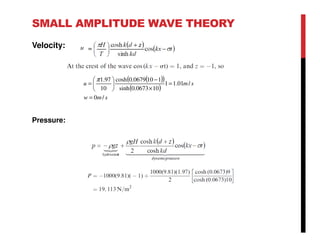
Velocity:
( )( )
( )
smw
smu
/0
/01.11
100673.0sinh
1100679.0cosh
10
97.1
=
=
×
−






=
π
Pressure:
SMALL AMPLITUDE WAVE THEORY
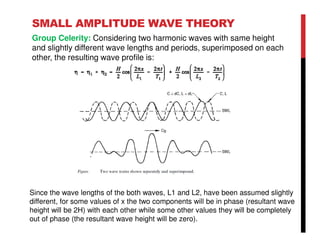
Group Celerity: Considering two harmonic waves with same height
and slightly different wave lengths and periods, superimposed on each
other, the resulting wave profile is:
Since the wave lengths of the both waves, L1 and L2, have been assumed slightly
different, for some values of x the two components will be in phase (resultant wave
height will be 2H) with each other while some other values they will be completely
out of phase (the resultant wave height will be zero).
SMALL AMPLITUDE WAVE THEORY
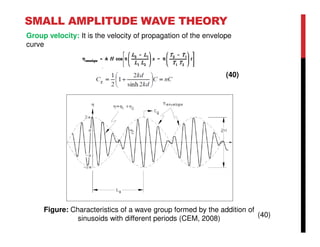
Figure: Characteristics of a wave group formed by the addition of
sinusoids with different periods (CEM, 2008)
(40)
(40)
Group velocity: It is the velocity of propagation of the envelope
curve
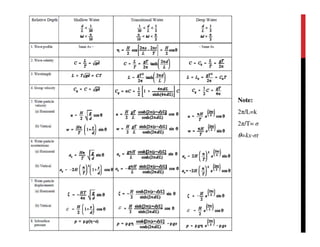
Note:
2π/L=k
2π/T= σ
θ=kx-σt
SMALL AMPLITUDE WAVE THEORY
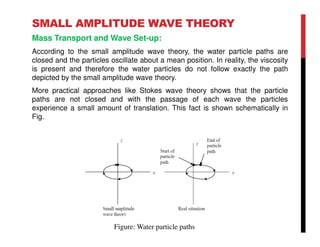
Mass Transport and Wave Set-up:
According to the small amplitude wave theory, the water particle paths are
closed and the particles oscillate about a mean position. In reality, the viscosity
is present and therefore the water particles do not follow exactly the path
depicted by the small amplitude wave theory.
More practical approaches like Stokes wave theory shows that the particle
paths are not closed and with the passage of each wave the particles
experience a small amount of translation. This fact is shown schematically in
Fig.
Figure: Water particle paths
SMALL AMPLITUDE WAVE THEORY
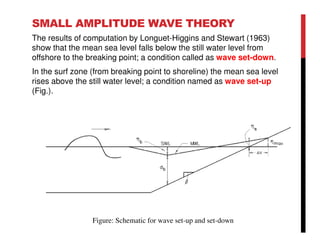
The results of computation by Longuet-Higgins and Stewart (1963)
show that the mean sea level falls below the still water level from
offshore to the breaking point; a condition called as wave set-down.
In the surf zone (from breaking point to shoreline) the mean sea level
rises above the still water level; a condition named as wave set-up
(Fig.).
Figure: Schematic for wave set-up and set-down
SMALL AMPLITUDE WAVE THEORY
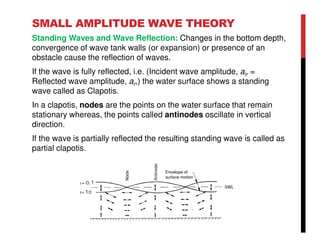
Standing Waves and Wave Reflection: Changes in the bottom depth,
convergence of wave tank walls (or expansion) or presence of an
obstacle cause the reflection of waves.
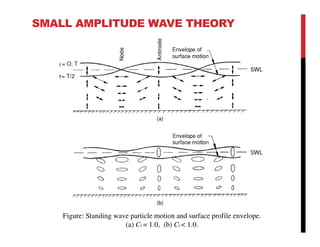
If the wave is fully reflected, i.e. (Incident wave amplitude, ai, =
Reflected wave amplitude, ar,) the water surface shows a standing
wave called as Clapotis.
In a clapotis, nodes are the points on the water surface that remain
stationary whereas, the points called antinodes oscillate in vertical
direction.
If the wave is partially reflected the resulting standing wave is called as
partial clapotis.
SMALL AMPLITUDE WAVE THEORY
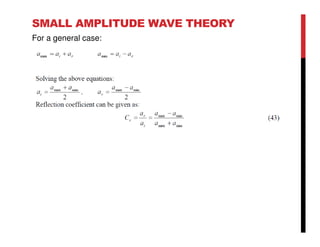
For a general case:
SMALL AMPLITUDE WAVE THEORY
Figure: Standing wave particle motion and surface profile envelope.
(a) Cr = 1.0, (b) Cr < 1.0.
SMALL AMPLITUDE WAVE THEORY
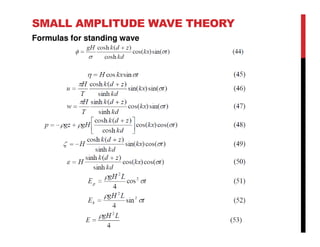
Formulas for standing wave
SMALL AMPLITUDE WAVE THEORY
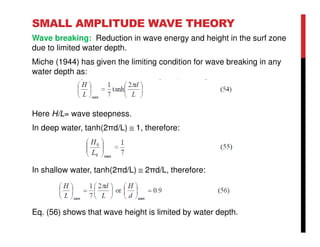
Wave breaking: Reduction in wave energy and height in the surf zone
due to limited water depth.
Miche (1944) has given the limiting condition for wave breaking in any
water depth as:
Here H/L= wave steepness.
In deep water, tanh(2πd/L) ≅ 1, therefore:
In shallow water, tanh(2πd/L) ≅ 2πd/L, therefore:
Eq. (56) shows that wave height is limited by water depth.
SMALL AMPLITUDE WAVE THEORY
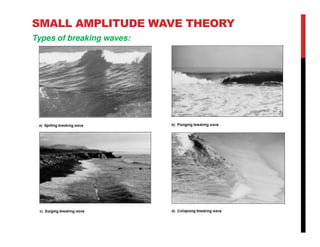
Types of breaking waves:
SMALL AMPLITUDE WAVE THEORY
Types of breaking waves:
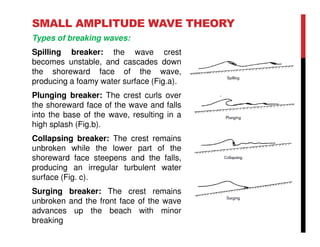
Spilling breaker: the wave crest
becomes unstable, and cascades down
the shoreward face of the wave,
producing a foamy water surface (Fig.a).
Plunging breaker: The crest curls over
the shoreward face of the wave and falls
into the base of the wave, resulting in a
high splash (Fig.b).
Collapsing breaker: The crest remains
unbroken while the lower part of the
shoreward face steepens and the falls,
producing an irregular turbulent water
surface (Fig. c).
Surging breaker: The crest remains
unbroken and the front face of the wave
advances up the beach with minor
breaking
SMALL AMPLITUDE WAVE THEORY
Types of breaking waves:
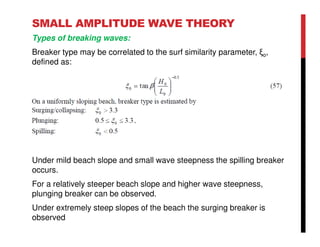
Breaker type may be correlated to the surf similarity parameter, ξo,
defined as:
Under mild beach slope and small wave steepness the spilling breaker
occurs.
For a relatively steeper beach slope and higher wave steepness,
plunging breaker can be observed.
Under extremely steep slopes of the beach the surging breaker is
observed
SMALL AMPLITUDE WAVE THEORY
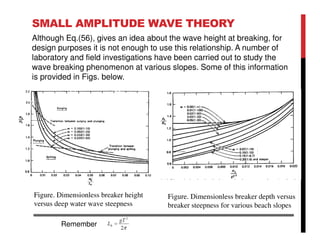
Although Eq.(56), gives an idea about the wave height at breaking, for
design purposes it is not enough to use this relationship. A number of
laboratory and field investigations have been carried out to study the
wave breaking phenomenon at various slopes. Some of this information
is provided in Figs. below.
Figure. Dimensionless breaker height
versus deep water wave steepness
Figure. Dimensionless breaker depth versus
breaker steepness for various beach slopes
Remember
SMALL AMPLITUDE WAVE THEORY
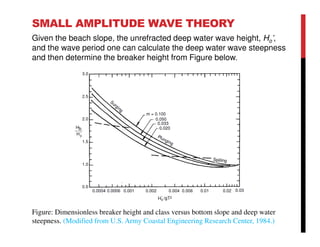
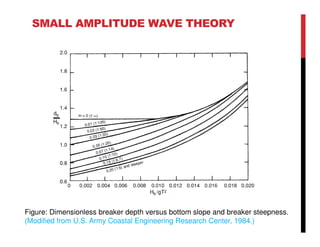
Given the beach slope, the unrefracted deep water wave height, Ho’,
and the wave period one can calculate the deep water wave steepness
and then determine the breaker height from Figure below.
Figure: Dimensionless breaker height and class versus bottom slope and deep water
steepness. (Modified from U.S. Army Coastal Engineering Research Center, 1984.)
SMALL AMPLITUDE WAVE THEORY
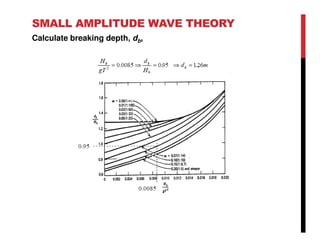
Figure: Dimensionless breaker depth versus bottom slope and breaker steepness.
(Modified from U.S. Army Coastal Engineering Research Center, 1984.)
SMALL AMPLITUDE WAVE THEORY
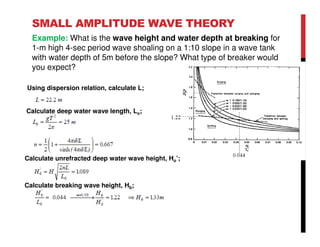
Example: What is the wave height and water depth at breaking for
1-m high 4-sec period wave shoaling on a 1:10 slope in a wave tank
with water depth of 5m before the slope? What type of breaker would
you expect?
Using dispersion relation, calculate L;
Calculate deep water wave length, Lo;
Calculate unrefracted deep water wave height, Ho’;
Calculate breaking wave height, Hb;
SMALL AMPLITUDE WAVE THEORY
Calculate breaking depth, db,
SMALL AMPLITUDE WAVE THEORY
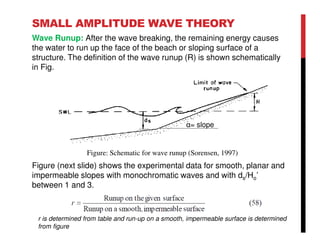
Wave Runup: After the wave breaking, the remaining energy causes
the water to run up the face of the beach or sloping surface of a
structure. The definition of the wave runup (R) is shown schematically
in Fig.
Figure (next slide) shows the experimental data for smooth, planar and
impermeable slopes with monochromatic waves and with ds/Ho’
between 1 and 3.
Figure: Schematic for wave runup (Sorensen, 1997)
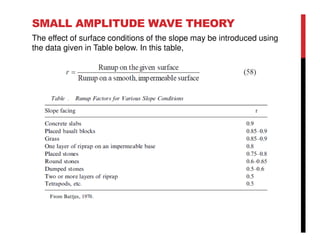
r is determined from table and run-up on a smooth, impermeable surface is determined
from figure
α= slope
SMALL AMPLITUDE WAVE THEORY
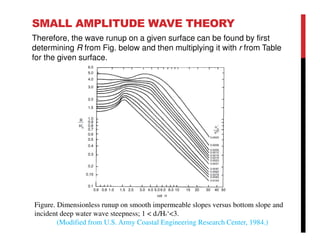
Therefore, the wave runup on a given surface can be found by first
determining R from Fig. below and then multiplying it with r from Table
for the given surface.
Figure. Dimensionless runup on smooth impermeable slopes versus bottom slope and
incident deep water wave steepness; 1 < ds/H0‘<3.
(Modified from U.S. Army Coastal Engineering Research Center, 1984.)
SMALL AMPLITUDE WAVE THEORY
The effect of surface conditions of the slope may be introduced using
the data given in Table below. In this table,
SMALL AMPLITUDE WAVE THEORY
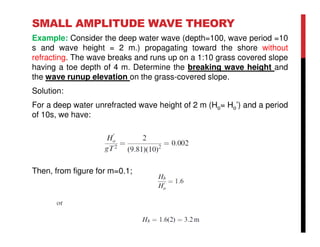
Example: Consider the deep water wave (depth=100, wave period =10
s and wave height = 2 m.) propagating toward the shore without
refracting. The wave breaks and runs up on a 1:10 grass covered slope
having a toe depth of 4 m. Determine the breaking wave height and
the wave runup elevation on the grass-covered slope.
Solution:
For a deep water unrefracted wave height of 2 m (Ho= Ho’) and a period
of 10s, we have:
Then, from figure for m=0.1;
SMALL AMPLITUDE WAVE THEORY
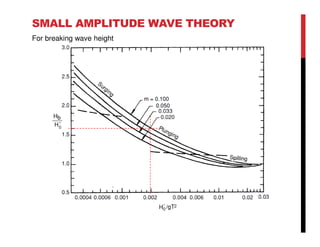
For breaking wave height
SMALL AMPLITUDE WAVE THEORY
Runup:
From Figure , since ds/Ho’= 4/2 = 2, at cot (α) = 10
SMALL AMPLITUDE WAVE THEORY
ravg=0.875
SMALL AMPLITUDE WAVE THEORY
Since; R/Ho’=0.85
on smooth surface
on grass
WAVE PROPAGATION
68
WAVE PROPAGATION
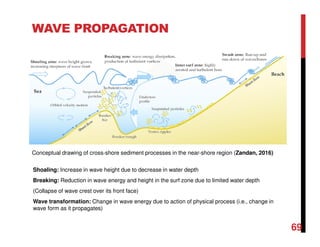
Conceptual drawing of cross‐shore sediment processes in the near‐shore region (Zandan, 2016)
Shoaling: Increase in wave height due to decrease in water depth
Breaking: Reduction in wave energy and height in the surf zone due to limited water depth
(Collapse of wave crest over its front face)
Wave transformation: Change in wave energy due to action of physical process (i.e., change in
wave form as it propagates)
69
WAVE TRANSFORMATION
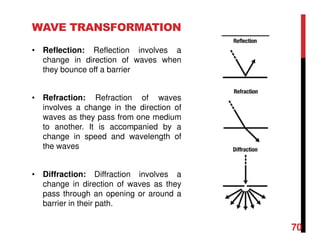
• Reflection: Reflection involves a
change in direction of waves when
they bounce off a barrier
• Refraction: Refraction of waves
involves a change in the direction of
waves as they pass from one medium
to another. It is accompanied by a
change in speed and wavelength of
the waves
• Diffraction: Diffraction involves a
change in direction of waves as they
pass through an opening or around a
barrier in their path.
70
WAVE PROPAGATION
71
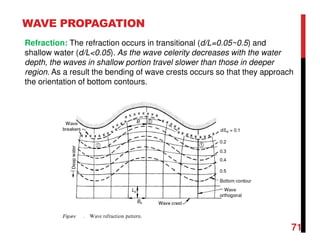
Refraction: The refraction occurs in transitional (d/L=0.05~0.5) and
shallow water (d/L<0.05). As the wave celerity decreases with the water
depth, the waves in shallow portion travel slower than those in deeper
region. As a result the bending of wave crests occurs so that they approach
the orientation of bottom contours.
WAVE PROPAGATION
72
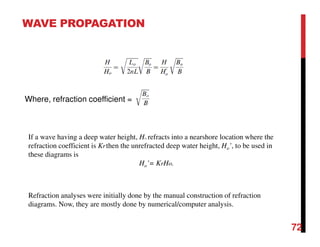
Where, refraction coefficient =
Refraction analyses were initially done by the manual construction of refraction
diagrams. Now, they are mostly done by numerical/computer analysis.
If a wave having a deep water height, Ho, refracts into a nearshore location where the
refraction coefficient is Krthen the unrefracted deep water height, Ho’, to be used in
these diagrams is
Ho’= KrHo.
WAVE PROPAGATION
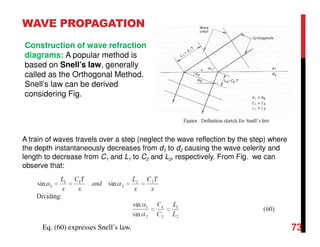
73
Construction of wave refraction
diagrams: A popular method is
based on Snell’s law, generally
called as the Orthogonal Method.
Snell’s law can be derived
considering Fig.
A train of waves travels over a step (neglect the wave reflection by the step) where
the depth instantaneously decreases from d1 to d2 causing the wave celerity and
length to decrease from C1 and L1 to C2 and L2, respectively. From Fig. we can
observe that:
Eq. (60) expresses Snell’s law.
WAVE PROPAGATION
74
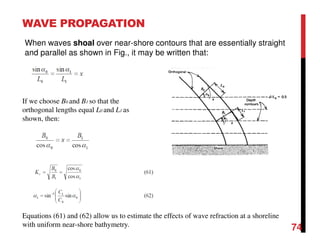
When waves shoal over near-shore contours that are essentially straight
and parallel as shown in Fig., it may be written that:
If we choose B0 and B1 so that the
orthogonal lengths equal L0 and L1 as
shown, then:
Equations (61) and (62) allow us to estimate the effects of wave refraction at a shoreline
with uniform near-shore bathymetry.
WAVE PROPAGATION
75
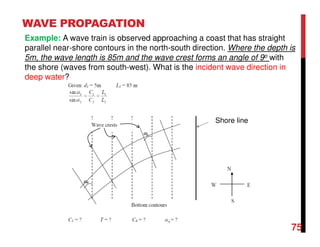
Example: A wave train is observed approaching a coast that has straight
parallel near-shore contours in the north-south direction. Where the depth is
5m, the wave length is 85m and the wave crest forms an angle of 9o with
the shore (waves from south-west). What is the incident wave direction in
deep water?
Shore line
WAVE PROPAGATION
76
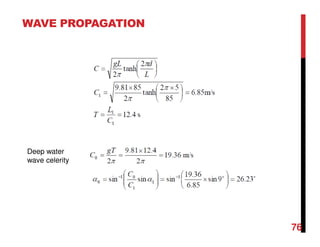
Deep water
wave celerity
WAVE PROPAGATION
77
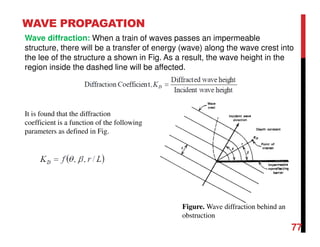
Wave diffraction: When a train of waves passes an impermeable
structure, there will be a transfer of energy (wave) along the wave crest into
the lee of the structure a shown in Fig. As a result, the wave height in the
region inside the dashed line will be affected.
Figure. Wave diffraction behind an
obstruction
It is found that the diffraction
coefficient is a function of the following
parameters as defined in Fig.
WAVE PROPAGATION
78
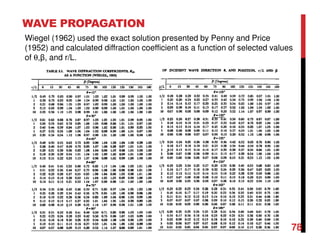
Wiegel (1962) used the exact solution presented by Penny and Price
(1952) and calculated diffraction coefficient as a function of selected values
of θ,β, and r/L.
WAVE PROPAGATION
79
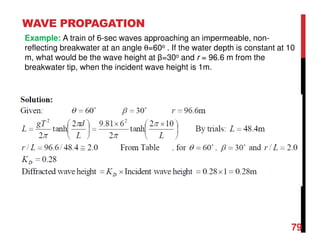
Example: A train of 6-sec waves approaching an impermeable, non-
reflecting breakwater at an angle θ=60o . If the water depth is constant at 10
m, what would be the wave height at β=30o and r = 96.6 m from the
breakwater tip, when the incident wave height is 1m.
WAVE PROPAGATION
80
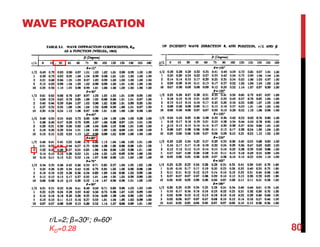
r/L=2; β=30o; θ=60o
KD=0.28
WAVE PROPAGATION
81
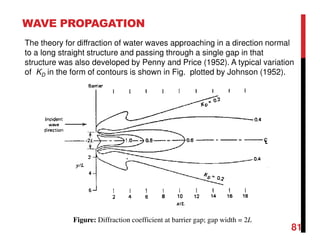
The theory for diffraction of water waves approaching in a direction normal
to a long straight structure and passing through a single gap in that
structure was also developed by Penny and Price (1952). A typical variation
of KD in the form of contours is shown in Fig. plotted by Johnson (1952).
Figure: Diffraction coefficient at barrier gap; gap width = 2L
WAVE PROPAGATION
82
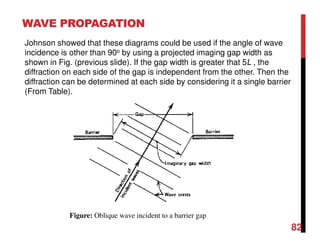
Johnson showed that these diagrams could be used if the angle of wave
incidence is other than 90o by using a projected imaging gap width as
shown in Fig. (previous slide). If the gap width is greater that 5L , the
diffraction on each side of the gap is independent from the other. Then the
diffraction can be determined at each side by considering it a single barrier
(From Table).
Figure: Oblique wave incident to a barrier gap
WAVE PROPAGATION
83
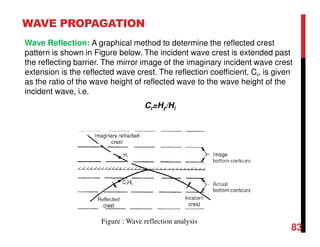
Wave Reflection: A graphical method to determine the reflected crest
pattern is shown in Figure below. The incident wave crest is extended past
the reflecting barrier. The mirror image of the imaginary incident wave crest
extension is the reflected wave crest. The reflection coefficient, Cr, is given
as the ratio of the wave height of reflected wave to the wave height of the
incident wave, i.e.
Cr=Hr/Hi
Figure : Wave reflection analysis
WAVE PROPAGATION
84
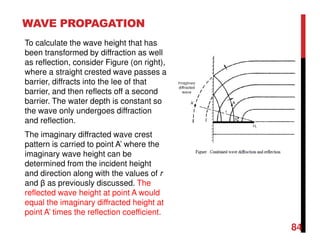
To calculate the wave height that has
been transformed by diffraction as well
as reflection, consider Figure (on right),
where a straight crested wave passes a
barrier, diffracts into the lee of that
barrier, and then reflects off a second
barrier. The water depth is constant so
the wave only undergoes diffraction
and reflection.
The imaginary diffracted wave crest
pattern is carried to point A’ where the
imaginary wave height can be
determined from the incident height
and direction along with the values of r
and β as previously discussed. The
reflected wave height at point A would
equal the imaginary diffracted height at
point A’ times the reflection coefficient.
THANK YOU
85

Chapter 3 linear wave theory and wave propagation

  • 1.
    CHAPTER 3: WAVETHEORY AND WAVE PROPAGATION DR. MOHSIN SIDDIQUE ASSISTANT PROFESSOR 1 0401444 - Intro. To Coastal Eng. University of Sharjah Dept. of Civil and Env. Engg.
  • 2.
    WAVE THEORIES 2 Figure: Rangesof applicability of various wave theories Wave theories are approximations to reality. 1. Linear wave theories • Small amplitude wave theory 2. Non-linear wave theories • Stokes finite amplitude wave theory 3. Other theories • Nonlinear shallow water eave theories • KdV and Boussinesq Eqs • Cnoidal wave theory • Stream function theory • Fourier approximation
  • 3.
    WAVE THEORIES Figure: Waveprofile of different progressive gravity waves
  • 4.
    4 SMALL AMPLITUDE WAVETHEORY The earliest mathematical description of periodic progressive waves is that attributed to Airy in 1845. Airy wave theory is strictly only applicable to conditions in which the wave height is small compared to the wavelength and the water depth. It is commonly referred to as linear or first order wave theory, because of the simplifying assumptions made in its derivation.
  • 5.
    SMALL AMPLITUDE WAVETHEORY 5 L= wave length T=wave period σ=angular frequency=2π/T C=wave speed (celerity) H=wave height a= amplitude of wave (H/2)=horizontal excursion of water particle η=instantaneous surface water elevation d= local water depth Figure: Definition of progressive surface wave parameters u and w =The horizontal and vertical components of the water particle velocity at any instant. ς and ε = The horizontal and vertical coordinates of a water particle at any instant.
  • 6.
    6 SMALL AMPLITUDE WAVETHEORY Assumptions: The basic assumptions for linear wave theory are as follows: 1. Water is homogeneous and incompressible, wave lengths are greater than 3m so that capillary effects may be ignored 2. Flow is irrotational, i.e. no shear stress present anywhere. Thus the velocity potential, Φ, must satisfy the Laplace equation: Laplace equation is actually continuity equation: Where,
  • 7.
    7 SMALL AMPLITUDE WAVETHEORY Assumptions: 3. The bottom is not moving and is impermeable and horizontal, i.e. no energy transfer through the bed. This lead to: 4. The pressure along the air-sea interface is constant, i.e. no effect of weather related pressure differences 5. The wave amplitude is small compared to the wave length and water depth. Assuming η is very small
  • 8.
    SMALL AMPLITUDE WAVETHEORY Where, k is wave number (=2 π /L) and σ is angular frequency(=2 π /T) Since the velocity potential, Φ, should be cyclic with horizontal position and time, and it should vary with depth, we can assume that: Substituting Eq.(2) into (1), one can get: 8 Basic Equations: The water surface profile is given as:
  • 9.
    SMALL AMPLITUDE WAVETHEORY 9 The general solution to this partial differential equation is: Where A an B are arbitrary constants. Putting this value of the function f(z) in Eq.(2), we get: Two boundary conditions are required to find A and B.
  • 10.
    SMALL AMPLITUDE WAVETHEORY 10 (a) The vertical velocity, w, at the bottom must be zero (Assumption 3):
  • 11.
    SMALL AMPLITUDE WAVETHEORY 11 (b) Second boundary condition (on the surface) may be derived from Bernoulli’s equation for time-varying flow in two dimensions, i.e.
  • 12.
  • 13.
    SMALL AMPLITUDE WAVETHEORY 13 Dispersion of water waves generally refers to frequency dispersion, which means that waves of different wavelengths travel at different phase speeds
  • 14.
  • 15.
    SMALL AMPLITUDE WAVETHEORY Summary: k =(2 π /L) & σ= (2 π /T) &
  • 16.
    16 SMALL AMPLITUDE WAVETHEORY Wave classification by relative depth (d/L) 1. Deep water: When the relative depth, d/L, is greater that 0.5, tanh(2πd/L) ≈ 1; and Eq.(7), (8) and (9) transform to the following, respectively: This condition is called deep water condition and denoted by the subscript zero. In this condition it may be noted that the wave celerity is independent of the water depth
  • 17.
    17 SMALL AMPLITUDE WAVETHEORY Wave classification by relative depth (d/L) 2. Transitional water In this case 0.5>d/L>0.05 & tanh(kh) < 1, and Eq.(7), (8) and (9) are used.
  • 18.
    18 SMALL AMPLITUDE WAVETHEORY Wave classification by relative depth (d/L) 3. Shallow water: Another extreme condition may be found when the relative depth, d/L, is less than 0.05, tanh(2πd/L) ≈ 2πd/L. In this condition, Eq.(7) or (8) becomes: It is obvious that in this situation the wave celerity depends only on the water depth.
  • 19.
  • 20.
  • 21.
    SMALL AMPLITUDE WAVETHEORY Example: A wave with a period T=10s is propagated shoreward over a uniformly sloping shelf from a depth of 200m to 1m. Calculate wave celebrities, C, and lengths, L, to depths 200m, 3m & 1m. Solution: ( ) mL L g L L dgT L 13.156 2002 tanh 2 10 2 tanh 2 2 2 =       =       = π π π π 5.028.1 13.156 200 >== L d Since So, the wave is deep water wave For d=200m ( ) mL L g L L dgT L 16.53 32 tanh 2 10 2 tanh 2 2 2 =       =       = π π π π 05.0056.0 16.53 3 >== L d Since So, the wave is transition water wave For d=3m sm T L C /6.15 10 13.156 === mLL o 13.156== sm T L C /32.5 10 16.53 === mL 16.53= Using dispersion relationship Using dispersion relationship
  • 22.
    SMALL AMPLITUDE WAVETHEORY Example: A wave with a period T=10s is propagated shoreward over a uniformly sloping shelf from a depth of 200m to 1m. Calculate wave celebrities, C, and lengths, L, to depths 200m, 3m & 1m. Solution: ( ) mL L g L L dgT L 11.31 12 tanh 2 10 2 tanh 2 2 2 =       =       = π π π π 05.0032.0 11.31 1 <== L d Since So, the wave is shallow water wave For d=1m sm T L C /11.3 10 11.31 === mL 11.31= Using dispersion relationship
  • 23.
    SMALL AMPLITUDE WAVETHEORY Example: A wave tank is 193m long, 4.57m wide and 6.1m deep. The tank is filled to a depth of 5m with fresh water and a 1m high, 4sec period wave is generated. (a) Calculate the wave celerity and length using small amplitude wave theory. (b) Calculate the corresponding deep water wave length and celerity. Deep water Using dispersion relationship
  • 24.
    SMALL AMPLITUDE WAVETHEORY Wave Kinematics: The horizontal and vertical components of water particle velocity u and w may be determined as respectively.
  • 25.
    SMALL AMPLITUDE WAVETHEORY • η and u are in phase • η and w are out of phase (phase shift of 90o) • η and ax are out of phase (phase shift 90o) • η and az are out of phase (Phase shift is 180o) Figure: profiles of particle velocity and acceleration by Airy theory in relation to the surface elevation (CEM, 2008)
  • 26.
    SMALL AMPLITUDE WAVETHEORY Example: A wave with a period, T, =8sec, in a water depth, d, =15m and a wave height, H,= 5.5m is propagating. Find local horizonal and vertical velocities , u & w, and acceleration ax, & az at an elevation of z=-5m below the still water level (SWL) when kx-σt=π/3 (60 degrees) Solution: Given: T=8s; d=15m; H=5.5 Find: u, w, ax, az =? @ z=-5m First of all find L, using dispersion relationship ( ) mL L g L L dgT L 8.81 152 tanh 2 8 2 tanh 2 2 2 =       =       = π π π π 18.0 8.81 15 == L d Since So, the wave transitional water wave
  • 27.
    SMALL AMPLITUDE WAVETHEORY Solution: velocities L kwhere π2 , = ( ) ( ) smu u /99.0 3/cos 15 8.81 2 sinh 515 8.81 2 cosh 8 5.5 =             −       = π π π π ( ) ( ) smw w /11.1 3/sin 15 8.81 2 sinh 515 8.81 2 sinh 8 5.5 =             −       = π π π π L kwhere π2 , =
  • 28.
    SMALL AMPLITUDE WAVETHEORY Solution: Acceleration L kwhere π2 , = ( ) ( ) 2 2 2 /35.1 3/sin 15 8.81 2 sinh 515 8.81 2 cosh 8 5.52 sma a x x =             −         = π π π π ( ) ( ) 2 2 2 /504.0 3/cos 15 8.81 2 sinh 515 8.81 2 sinh 8 5.52 sma a z z −=             −         −= π π π π
  • 29.
    SMALL AMPLITUDE WAVETHEORY Particle displacement: The horizontal and vertical ordinates of the particle displacement (ς and ε ) are related to the components of particle velocity by: Since
  • 30.
    SMALL AMPLITUDE WAVETHEORY For deep water: For Shallow water:
  • 31.
    SMALL AMPLITUDE WAVETHEORY Figure. Water particle displacements from mean position for shallow-water and deep water waves (CEM, 2008)
  • 32.
    SMALL AMPLITUDE WAVETHEORY Pressure Field: In order to derive a relationship for pressure we can use Bernoulli’s equation as follows: In deep water, the dynamic pressure reduces to near zero at z =- L/2. A pressure gauge (located above L/2) can be used as a wave gauge.
  • 33.
    SMALL AMPLITUDE WAVETHEORY Wave Energy:
  • 34.
    SMALL AMPLITUDE WAVETHEORY Wave Energy:
  • 35.
    SMALL AMPLITUDE WAVETHEORY Example: Calculate the wave energy (total, Kinetic, and potential) and power for the a wave if its height is 1m, wave period = 4s, water depth=5m and wave length =22.2m. Solution: Given: H=1m; T=4s; d=5m; L=22.2m Find: E, P=?
  • 36.
    SMALL AMPLITUDE WAVETHEORY Wave power: Wave power, P, is the wave energy per unit time transmitted in the direction of wave propagation, which is the product of the force acting on a vertical plane normal to the direction of wave propagation times the particle flow velocity across this plane. Mathematically,
  • 37.
    SMALL AMPLITUDE WAVETHEORY The n varies with the relative depth; where n increases from 0.5 in deep water to 1.0 in shallow water. For a wave train, considering the reflected or dissipated energy to be negligible, the conservation of energy per unit time requires that: If we draw lines orthogonal to the wave crests, and the spacing of the orthogonals is B, we can write the energy between two orthogonals as BE and therefore:
  • 38.
    SMALL AMPLITUDE WAVETHEORY Commonly, waves are predicted for some deep water location and then must be transformed to some intermediate or shallow water depth nearshore using Eq. (38). For this, Eq. (38) becomes (39)
  • 39.
    SMALL AMPLITUDE WAVETHEORY Example: A wave in water 100 m deep has a period of 10 s and a height of 2 m. When it has propagated into a water depth of 10 m without refracting and assuming energy gains and losses can be ignored. Determine the wave height, power and the water particle velocity and pressure at a point 1 m below the still water level under the wave crest. Solution: Given: d=100m: H=2m & T=10s Calculate L at d=10m L = 93.3 m d/L =10/ 93.3=0.11 k = 2π/93.3 = 0.0673m-1 L = 156 m d/L = 100/156= 0.64 >0.5 (deep water) Hence, Lo = 156 m & H=Ho=2m       = L dgT L π π 2 tanh 2 2 Calculate L, Using dispersion relationship
  • 40.
    SMALL AMPLITUDE WAVETHEORY Example: where Find H at d=10m Assuming no refraction i.e. B/Bo=1 Power: wattsP 51.38806 8 3.9397.181.91000 10 874.0 2 =         ××× =
  • 41.
    SMALL AMPLITUDE WAVETHEORY Velocity: ( )( ) ( ) smw smu /0 /01.11 100673.0sinh 1100679.0cosh 10 97.1 = = × −       = π Pressure:
  • 42.
    SMALL AMPLITUDE WAVETHEORY Group Celerity: Considering two harmonic waves with same height and slightly different wave lengths and periods, superimposed on each other, the resulting wave profile is: Since the wave lengths of the both waves, L1 and L2, have been assumed slightly different, for some values of x the two components will be in phase (resultant wave height will be 2H) with each other while some other values they will be completely out of phase (the resultant wave height will be zero).
  • 43.
    SMALL AMPLITUDE WAVETHEORY Figure: Characteristics of a wave group formed by the addition of sinusoids with different periods (CEM, 2008) (40) (40) Group velocity: It is the velocity of propagation of the envelope curve
  • 44.
  • 45.
    SMALL AMPLITUDE WAVETHEORY Mass Transport and Wave Set-up: According to the small amplitude wave theory, the water particle paths are closed and the particles oscillate about a mean position. In reality, the viscosity is present and therefore the water particles do not follow exactly the path depicted by the small amplitude wave theory. More practical approaches like Stokes wave theory shows that the particle paths are not closed and with the passage of each wave the particles experience a small amount of translation. This fact is shown schematically in Fig. Figure: Water particle paths
  • 46.
    SMALL AMPLITUDE WAVETHEORY The results of computation by Longuet-Higgins and Stewart (1963) show that the mean sea level falls below the still water level from offshore to the breaking point; a condition called as wave set-down. In the surf zone (from breaking point to shoreline) the mean sea level rises above the still water level; a condition named as wave set-up (Fig.). Figure: Schematic for wave set-up and set-down
  • 47.
    SMALL AMPLITUDE WAVETHEORY Standing Waves and Wave Reflection: Changes in the bottom depth, convergence of wave tank walls (or expansion) or presence of an obstacle cause the reflection of waves. If the wave is fully reflected, i.e. (Incident wave amplitude, ai, = Reflected wave amplitude, ar,) the water surface shows a standing wave called as Clapotis. In a clapotis, nodes are the points on the water surface that remain stationary whereas, the points called antinodes oscillate in vertical direction. If the wave is partially reflected the resulting standing wave is called as partial clapotis.
  • 48.
    SMALL AMPLITUDE WAVETHEORY For a general case:
  • 49.
    SMALL AMPLITUDE WAVETHEORY Figure: Standing wave particle motion and surface profile envelope. (a) Cr = 1.0, (b) Cr < 1.0.
  • 50.
    SMALL AMPLITUDE WAVETHEORY Formulas for standing wave
  • 51.
    SMALL AMPLITUDE WAVETHEORY Wave breaking: Reduction in wave energy and height in the surf zone due to limited water depth. Miche (1944) has given the limiting condition for wave breaking in any water depth as: Here H/L= wave steepness. In deep water, tanh(2πd/L) ≅ 1, therefore: In shallow water, tanh(2πd/L) ≅ 2πd/L, therefore: Eq. (56) shows that wave height is limited by water depth.
  • 52.
    SMALL AMPLITUDE WAVETHEORY Types of breaking waves:
  • 53.
    SMALL AMPLITUDE WAVETHEORY Types of breaking waves: Spilling breaker: the wave crest becomes unstable, and cascades down the shoreward face of the wave, producing a foamy water surface (Fig.a). Plunging breaker: The crest curls over the shoreward face of the wave and falls into the base of the wave, resulting in a high splash (Fig.b). Collapsing breaker: The crest remains unbroken while the lower part of the shoreward face steepens and the falls, producing an irregular turbulent water surface (Fig. c). Surging breaker: The crest remains unbroken and the front face of the wave advances up the beach with minor breaking
  • 54.
    SMALL AMPLITUDE WAVETHEORY Types of breaking waves: Breaker type may be correlated to the surf similarity parameter, ξo, defined as: Under mild beach slope and small wave steepness the spilling breaker occurs. For a relatively steeper beach slope and higher wave steepness, plunging breaker can be observed. Under extremely steep slopes of the beach the surging breaker is observed
  • 55.
    SMALL AMPLITUDE WAVETHEORY Although Eq.(56), gives an idea about the wave height at breaking, for design purposes it is not enough to use this relationship. A number of laboratory and field investigations have been carried out to study the wave breaking phenomenon at various slopes. Some of this information is provided in Figs. below. Figure. Dimensionless breaker height versus deep water wave steepness Figure. Dimensionless breaker depth versus breaker steepness for various beach slopes Remember
  • 56.
    SMALL AMPLITUDE WAVETHEORY Given the beach slope, the unrefracted deep water wave height, Ho’, and the wave period one can calculate the deep water wave steepness and then determine the breaker height from Figure below. Figure: Dimensionless breaker height and class versus bottom slope and deep water steepness. (Modified from U.S. Army Coastal Engineering Research Center, 1984.)
  • 57.
    SMALL AMPLITUDE WAVETHEORY Figure: Dimensionless breaker depth versus bottom slope and breaker steepness. (Modified from U.S. Army Coastal Engineering Research Center, 1984.)
  • 58.
    SMALL AMPLITUDE WAVETHEORY Example: What is the wave height and water depth at breaking for 1-m high 4-sec period wave shoaling on a 1:10 slope in a wave tank with water depth of 5m before the slope? What type of breaker would you expect? Using dispersion relation, calculate L; Calculate deep water wave length, Lo; Calculate unrefracted deep water wave height, Ho’; Calculate breaking wave height, Hb;
  • 59.
    SMALL AMPLITUDE WAVETHEORY Calculate breaking depth, db,
  • 60.
    SMALL AMPLITUDE WAVETHEORY Wave Runup: After the wave breaking, the remaining energy causes the water to run up the face of the beach or sloping surface of a structure. The definition of the wave runup (R) is shown schematically in Fig. Figure (next slide) shows the experimental data for smooth, planar and impermeable slopes with monochromatic waves and with ds/Ho’ between 1 and 3. Figure: Schematic for wave runup (Sorensen, 1997) r is determined from table and run-up on a smooth, impermeable surface is determined from figure α= slope
  • 61.
    SMALL AMPLITUDE WAVETHEORY Therefore, the wave runup on a given surface can be found by first determining R from Fig. below and then multiplying it with r from Table for the given surface. Figure. Dimensionless runup on smooth impermeable slopes versus bottom slope and incident deep water wave steepness; 1 < ds/H0‘<3. (Modified from U.S. Army Coastal Engineering Research Center, 1984.)
  • 62.
    SMALL AMPLITUDE WAVETHEORY The effect of surface conditions of the slope may be introduced using the data given in Table below. In this table,
  • 63.
    SMALL AMPLITUDE WAVETHEORY Example: Consider the deep water wave (depth=100, wave period =10 s and wave height = 2 m.) propagating toward the shore without refracting. The wave breaks and runs up on a 1:10 grass covered slope having a toe depth of 4 m. Determine the breaking wave height and the wave runup elevation on the grass-covered slope. Solution: For a deep water unrefracted wave height of 2 m (Ho= Ho’) and a period of 10s, we have: Then, from figure for m=0.1;
  • 64.
    SMALL AMPLITUDE WAVETHEORY For breaking wave height
  • 65.
    SMALL AMPLITUDE WAVETHEORY Runup: From Figure , since ds/Ho’= 4/2 = 2, at cot (α) = 10
  • 66.
    SMALL AMPLITUDE WAVETHEORY ravg=0.875
  • 67.
    SMALL AMPLITUDE WAVETHEORY Since; R/Ho’=0.85 on smooth surface on grass
  • 68.
  • 69.
    WAVE PROPAGATION Conceptual drawingof cross‐shore sediment processes in the near‐shore region (Zandan, 2016) Shoaling: Increase in wave height due to decrease in water depth Breaking: Reduction in wave energy and height in the surf zone due to limited water depth (Collapse of wave crest over its front face) Wave transformation: Change in wave energy due to action of physical process (i.e., change in wave form as it propagates) 69
  • 70.
    WAVE TRANSFORMATION • Reflection:Reflection involves a change in direction of waves when they bounce off a barrier • Refraction: Refraction of waves involves a change in the direction of waves as they pass from one medium to another. It is accompanied by a change in speed and wavelength of the waves • Diffraction: Diffraction involves a change in direction of waves as they pass through an opening or around a barrier in their path. 70
  • 71.
    WAVE PROPAGATION 71 Refraction: Therefraction occurs in transitional (d/L=0.05~0.5) and shallow water (d/L<0.05). As the wave celerity decreases with the water depth, the waves in shallow portion travel slower than those in deeper region. As a result the bending of wave crests occurs so that they approach the orientation of bottom contours.
  • 72.
    WAVE PROPAGATION 72 Where, refractioncoefficient = Refraction analyses were initially done by the manual construction of refraction diagrams. Now, they are mostly done by numerical/computer analysis. If a wave having a deep water height, Ho, refracts into a nearshore location where the refraction coefficient is Krthen the unrefracted deep water height, Ho’, to be used in these diagrams is Ho’= KrHo.
  • 73.
    WAVE PROPAGATION 73 Construction ofwave refraction diagrams: A popular method is based on Snell’s law, generally called as the Orthogonal Method. Snell’s law can be derived considering Fig. A train of waves travels over a step (neglect the wave reflection by the step) where the depth instantaneously decreases from d1 to d2 causing the wave celerity and length to decrease from C1 and L1 to C2 and L2, respectively. From Fig. we can observe that: Eq. (60) expresses Snell’s law.
  • 74.
    WAVE PROPAGATION 74 When wavesshoal over near-shore contours that are essentially straight and parallel as shown in Fig., it may be written that: If we choose B0 and B1 so that the orthogonal lengths equal L0 and L1 as shown, then: Equations (61) and (62) allow us to estimate the effects of wave refraction at a shoreline with uniform near-shore bathymetry.
  • 75.
    WAVE PROPAGATION 75 Example: Awave train is observed approaching a coast that has straight parallel near-shore contours in the north-south direction. Where the depth is 5m, the wave length is 85m and the wave crest forms an angle of 9o with the shore (waves from south-west). What is the incident wave direction in deep water? Shore line
  • 76.
  • 77.
    WAVE PROPAGATION 77 Wave diffraction:When a train of waves passes an impermeable structure, there will be a transfer of energy (wave) along the wave crest into the lee of the structure a shown in Fig. As a result, the wave height in the region inside the dashed line will be affected. Figure. Wave diffraction behind an obstruction It is found that the diffraction coefficient is a function of the following parameters as defined in Fig.
  • 78.
    WAVE PROPAGATION 78 Wiegel (1962)used the exact solution presented by Penny and Price (1952) and calculated diffraction coefficient as a function of selected values of θ,β, and r/L.
  • 79.
    WAVE PROPAGATION 79 Example: Atrain of 6-sec waves approaching an impermeable, non- reflecting breakwater at an angle θ=60o . If the water depth is constant at 10 m, what would be the wave height at β=30o and r = 96.6 m from the breakwater tip, when the incident wave height is 1m.
  • 80.
  • 81.
    WAVE PROPAGATION 81 The theoryfor diffraction of water waves approaching in a direction normal to a long straight structure and passing through a single gap in that structure was also developed by Penny and Price (1952). A typical variation of KD in the form of contours is shown in Fig. plotted by Johnson (1952). Figure: Diffraction coefficient at barrier gap; gap width = 2L
  • 82.
    WAVE PROPAGATION 82 Johnson showedthat these diagrams could be used if the angle of wave incidence is other than 90o by using a projected imaging gap width as shown in Fig. (previous slide). If the gap width is greater that 5L , the diffraction on each side of the gap is independent from the other. Then the diffraction can be determined at each side by considering it a single barrier (From Table). Figure: Oblique wave incident to a barrier gap
  • 83.
    WAVE PROPAGATION 83 Wave Reflection:A graphical method to determine the reflected crest pattern is shown in Figure below. The incident wave crest is extended past the reflecting barrier. The mirror image of the imaginary incident wave crest extension is the reflected wave crest. The reflection coefficient, Cr, is given as the ratio of the wave height of reflected wave to the wave height of the incident wave, i.e. Cr=Hr/Hi Figure : Wave reflection analysis
  • 84.
    WAVE PROPAGATION 84 To calculatethe wave height that has been transformed by diffraction as well as reflection, consider Figure (on right), where a straight crested wave passes a barrier, diffracts into the lee of that barrier, and then reflects off a second barrier. The water depth is constant so the wave only undergoes diffraction and reflection. The imaginary diffracted wave crest pattern is carried to point A’ where the imaginary wave height can be determined from the incident height and direction along with the values of r and β as previously discussed. The reflected wave height at point A would equal the imaginary diffracted height at point A’ times the reflection coefficient.
  • 85.