HYDROLOGICAL CYCLE
PREPARED BY :
itiscivilengineering
There are five processes at work in the hydrologic cycle:
• Condensation
• Precipitation
• Infiltration
• Runoff
• Evapotranspiration
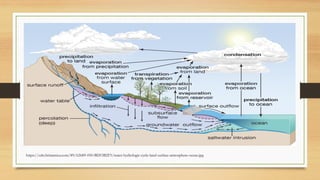
• Water vapor condenses to form clouds, which result in precipitation when
the conditions are suitable.
• Precipitation falls to the surface and infiltrates the soil or flows to the
ocean as runoff.
• Surface water (e.g., lakes, streams, oceans, etc.), evaporates, returning
moisture to the atmosphere, while plants return water to the atmosphere
by transpiration.
https://cdn.britannica.com/89/62689-050-BD53B2F5/water-hydrologic-cycle-land-surface-atmosphere-ocean.jpg
• The hydrologic cycle begins with the evaporation of water from the surface
of the ocean.
• As moist air is lifted, it cools and water vapor condenses to form clouds.
• Moisture is transported around the globe until it returns to the surface as
precipitation.
EVAPORATION
• Evaporation occurs when the physical state of water is changed from a
liquid state to a gaseous state.
• Typically, solar radiation and other factors such as air temperature, vapor
pressure, wind, and atmospheric pressure affect the amount of natural
evaporation that takes place in any geographic area.
• Evaporation can occur on raindrops, and on free water surfaces such as
seas and lakes and it can even occur from water settled on vegetation, soil,
rocks and snow and also evaporation is caused by human activities.
• Condensation is the process by which water vapor changes it's physical
state from a vapor, most commonly, to a liquid.
• Water vapor condenses onto small airborne particles to form dew, fog, or
clouds.
• Condensation is brought about by cooling of the air or by increasing the
amount of vapor in the air to its saturation point.
CONDENSATION
• Precipitation is used to denote all forms of water that reach the earth from
the atmosphere as Rainfall, Snowfall, Hail, Glaze, Dew, etc.
• Most of the precipitation is in the form of rainfall or snowfall.
• Precipitated water may fall into a waterbody or it may fall onto land. It is then
dispersed several ways :The water can adhere to objects on or near the planet
surface or it can be carried over and through the land into stream channels, or
it may penetrate into the soil, or it may be intercepted by plants.
PRECIPITATION
• A part of precipitation is intercepted by the trees and other obstructions
and this part is interception.
• The remaining part of the precipitation that reaches the ground and is
used for feeling the small depressions in the ground is known as
depression storage.
INFILTRATION
• Infiltration is the downward entry of water into the soil.
• A part of infiltrated water is held by capillarity at or near the ground
surface and is ultimately evaporated from the surface.
• Another portion is used by vegetation and returned to the atmosphere as
Transpiration.
https://agcrops.osu.edu/sites/agcrops/files/newsletter_article/image/infiltation.PNG
https://www.google.com/imgresimgurl
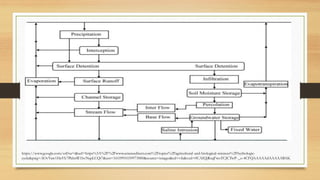
• Some part of Infiltrated water moves through the unsaturated zone and
meets the stream which is known as Interflow.
• Some portion of the Infiltrated water percolates deep into the ground.
• Percolation is the movement of water though the soil, and it's layers, by
gravity and capillary forces. The prime moving force of groundwater is
gravity.
• Water that is in the zone of aeration where air exists is called vadose water.
Water that is in the zone of saturation is called groundwater. The boundary
that separates the vadose and the saturation zones is called the water table.
• Groundwater discharges into a stream forms the base flow of the stream
during dry periods.
• The portion of precipitation that appears in surface streams is called runoff.
• Runoff may consist of component contributions from such sources as
surface runoff, subsurface runoff, or ground water runoff.
• Surface runoff travels over the ground surface and through surface channels
to leave a catchment area called a drainage basin or watershed and the
portion of the surface runoff that flows over the land surface towards the
stream channels is called overland flow and the total runoff confined in the
stream channels is called the streamflow.
RUNOFF
https://www.google.com/url?sa=i&url=https%3A%2F%2Fwww.sciencedirect.com%2Ftopics%2Fagricultural-and-biological-sciences%2Fhydrologic-
cycle&psig=AOvVaw1HeVk7PklmW1hvNqsLCQt7&ust=1610991039973000&source=images&cd=vfe&ved=0CAIQjRxqFwoTCJCTwP-_o-4CFQAAAAAdAAAAABAK
REFERENCES
https://www.nwrfc.noaa.gov/info/water_cycle/hydrology.cgi
https://www.britannica.com/science/water-cycle
https://www.nasa.gov/audience/forstudents/5-8/features/Observatorium_Feat_5-8.html

Hydrological cycle

  • 1.
    HYDROLOGICAL CYCLE PREPARED BY: itiscivilengineering
  • 2.
    There are fiveprocesses at work in the hydrologic cycle: • Condensation • Precipitation • Infiltration • Runoff • Evapotranspiration
  • 3.
    • Water vaporcondenses to form clouds, which result in precipitation when the conditions are suitable. • Precipitation falls to the surface and infiltrates the soil or flows to the ocean as runoff. • Surface water (e.g., lakes, streams, oceans, etc.), evaporates, returning moisture to the atmosphere, while plants return water to the atmosphere by transpiration.
  • 4.
  • 5.
    • The hydrologiccycle begins with the evaporation of water from the surface of the ocean. • As moist air is lifted, it cools and water vapor condenses to form clouds. • Moisture is transported around the globe until it returns to the surface as precipitation.
  • 6.
    EVAPORATION • Evaporation occurswhen the physical state of water is changed from a liquid state to a gaseous state. • Typically, solar radiation and other factors such as air temperature, vapor pressure, wind, and atmospheric pressure affect the amount of natural evaporation that takes place in any geographic area. • Evaporation can occur on raindrops, and on free water surfaces such as seas and lakes and it can even occur from water settled on vegetation, soil, rocks and snow and also evaporation is caused by human activities.
  • 7.
    • Condensation isthe process by which water vapor changes it's physical state from a vapor, most commonly, to a liquid. • Water vapor condenses onto small airborne particles to form dew, fog, or clouds. • Condensation is brought about by cooling of the air or by increasing the amount of vapor in the air to its saturation point. CONDENSATION
  • 8.
    • Precipitation isused to denote all forms of water that reach the earth from the atmosphere as Rainfall, Snowfall, Hail, Glaze, Dew, etc. • Most of the precipitation is in the form of rainfall or snowfall. • Precipitated water may fall into a waterbody or it may fall onto land. It is then dispersed several ways :The water can adhere to objects on or near the planet surface or it can be carried over and through the land into stream channels, or it may penetrate into the soil, or it may be intercepted by plants. PRECIPITATION
  • 9.
    • A partof precipitation is intercepted by the trees and other obstructions and this part is interception. • The remaining part of the precipitation that reaches the ground and is used for feeling the small depressions in the ground is known as depression storage.
  • 10.
    INFILTRATION • Infiltration isthe downward entry of water into the soil. • A part of infiltrated water is held by capillarity at or near the ground surface and is ultimately evaporated from the surface. • Another portion is used by vegetation and returned to the atmosphere as Transpiration.
  • 11.
  • 12.
    • Some partof Infiltrated water moves through the unsaturated zone and meets the stream which is known as Interflow. • Some portion of the Infiltrated water percolates deep into the ground. • Percolation is the movement of water though the soil, and it's layers, by gravity and capillary forces. The prime moving force of groundwater is gravity.
  • 13.
    • Water thatis in the zone of aeration where air exists is called vadose water. Water that is in the zone of saturation is called groundwater. The boundary that separates the vadose and the saturation zones is called the water table. • Groundwater discharges into a stream forms the base flow of the stream during dry periods.
  • 14.
    • The portionof precipitation that appears in surface streams is called runoff. • Runoff may consist of component contributions from such sources as surface runoff, subsurface runoff, or ground water runoff. • Surface runoff travels over the ground surface and through surface channels to leave a catchment area called a drainage basin or watershed and the portion of the surface runoff that flows over the land surface towards the stream channels is called overland flow and the total runoff confined in the stream channels is called the streamflow. RUNOFF
  • 15.
  • 16.