http://www.wvdhhr.org/phs/disaster/flood2.asp

eegallega.blogspot.com/2009/10/evaporation-condensation-precipitation.html


                        The Hydrologic Cycle
                                             By: Kayleigh Wiehaus & Amelia Young
Brief Description

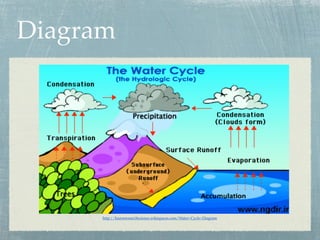
The hydrologic cycle begins with water evaporating from the oceans surface.
Moist air is then lifted up and cools and then condenses to form clouds. The
moisture is transported all around the globe until it comes back to the surface as
precipitation. The water then reaches the earths surface and either evaporates
back or becomes groundwater. If if becomes groundwater then it goes into oceans,
rivers, etc. or it goes back into the atmosphere through the transpiration process.
The leftover water on the earth is known as runoff, which then empties into lakes
rivers, oceans, etc. where the cycle starts again.
Diagram


      http://huronroom18science.wikispaces.com/Water+Cycle+Diagram
Steps

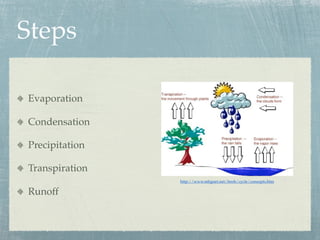
Evaporation

Condensation

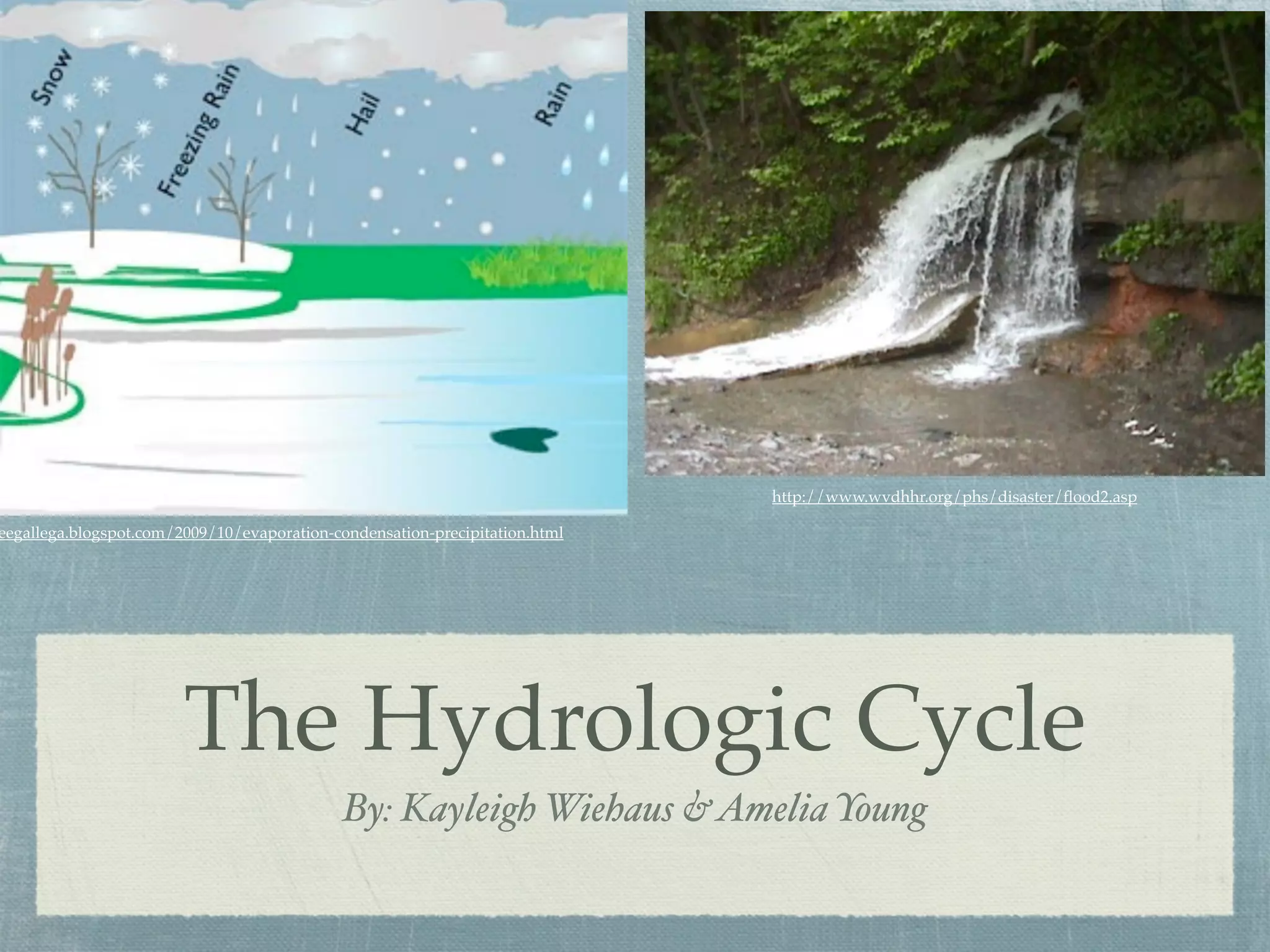
Precipitation

Transpiration
                http://www.mbgnet.net/fresh/cycle/concepts.htm

Runoff
Evaporation

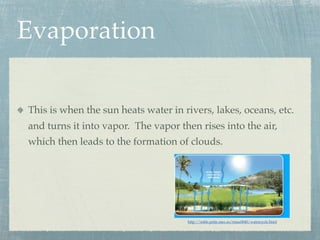
This is when the sun heats water in rivers, lakes, oceans, etc.
and turns it into vapor. The vapor then rises into the air,
which then leads to the formation of clouds.


                                     http://roble.pntic.mec.es/rmac0040/watercycle.html
Condensation

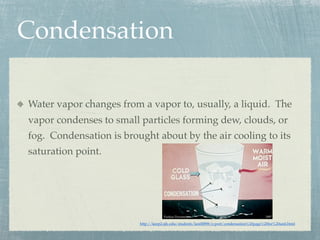
Water vapor changes from a vapor to, usually, a liquid. The
vapor condenses to small particles forming dew, clouds, or
fog. Condensation is brought about by the air cooling to its
saturation point.


                         http://keep2.sjfc.edu/students/kes00898/e-port/condensation%20page%20for%20unit.html
Precipitation

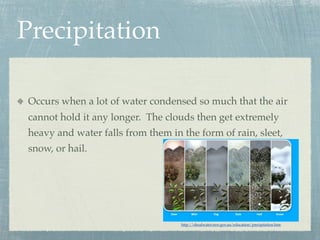
Occurs when a lot of water condensed so much that the air
cannot hold it any longer. The clouds then get extremely
heavy and water falls from them in the form of rain, sleet,
snow, or hail.


                                   http://shoalwater.nsw.gov.au/education/precipitation.htm
Transpiration

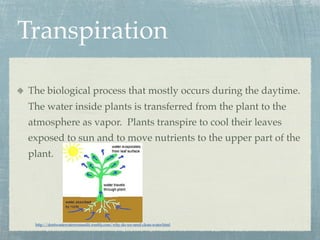
The biological process that mostly occurs during the daytime.
The water inside plants is transferred from the plant to the
atmosphere as vapor. Plants transpire to cool their leaves
exposed to sun and to move nutrients to the upper part of the
plant.


 http://dontwastewaterweneedit.weebly.com/why-do-we-need-clean-water.html
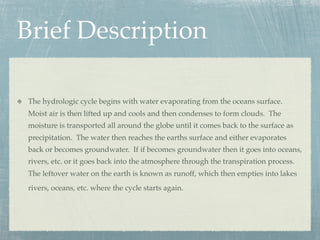
Runoff

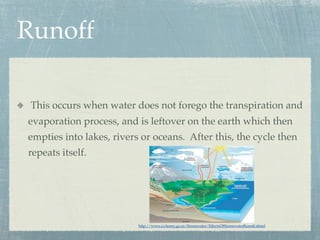
 This occurs when water does not forego the transpiration and
evaporation process, and is leftover on the earth which then
empties into lakes, rivers or oceans. After this, the cycle then
repeats itself.


                          http://www.co.henry.ga.us/Stormwater/EffectsOfStormwaterRunoff.shtml
Sinks

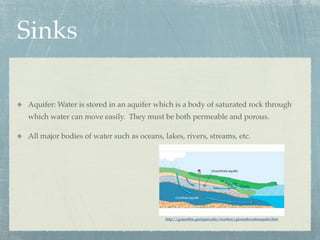
Aquifer: Water is stored in an aquifer which is a body of saturated rock through
which water can move easily. They must be both permeable and porous.

All major bodies of water such as oceans, lakes, rivers, streams, etc.


                                           http://gcuonline.georgian.edu/wootton/groundewateraquifer.htm
Significance

Water is one of the most important necessities of life, we cannot live without
water. There is approximately 1 percent of fresh water on earth, so it is very
helpful that the water we use and its continuous replacement is a result of the
hydrologic cycle. The cycling of all other elements is dependent upon water.


                  http://www.colourbox.com/image/man-drinking-water-after-the-gym-image-3594146
Ways humans affect it

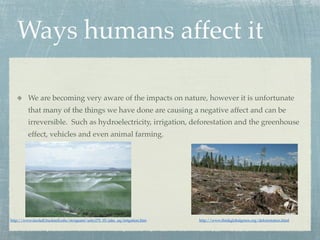
         We are becoming very aware of the impacts on nature, however it is unfortunate
         that many of the things we have done are causing a negative affect and can be
         irreversible. Such as hydroelectricity, irrigation, deforestation and the greenhouse
         effect, vehicles and even animal farming.


http://www.facstaff.bucknell.edu/mvigeant/univ270_05/jake_aq/irrigation.htm   http://www.thinkglobalgreen.org/deforestation.html
Works Cited

Bramer. "A Summary of the Hydrologic Cycle: Bringing all the pieces together." A Summary of the Hydrologic Cycle: Bringing all the
pieces together. 08 Sept. 2012 <http://ww2010.atmos.uiuc.edu/(Gh)/guides/mtr/hyd/smry.rxml>

Engineers. "Description of Hydrologic Cycle." Description of Hydrologic Cycle. 08 Sept. 2012 <http://www.nwrfc.noaa.gov/info/
water_cycle/hydrology.cgi>

"Humans and the water cycle." Humans and the water cycle. 08 Sept. 2012 <http://www.sciencelearn.org.nz/Contexts/H2O-On-the-Go/
Science-Ideas-and-Concepts/Humans-and-the-water-cycle>

"The Water Cycle." Sorry, Page Does Not Exist. 08 Sept. 2012 <http://www.kidzone.ws/water/>

"JEA The water cycle." JEA. 08 Sept. 2012 <https://www.jea.com/community/education/efficiency/wisely/cycle.html>

"The Water Cycle: Groundwater Storage." The Water Cycle. 08 Sept. 2012 <http://ga.water.usgs.gov/edu/watercyclegwstorage.html>

"ThinkQuest : 404." ThinkQuest. Oracle Foundation. 08 Sept. 2012 <http://library.thinkquest.org/C004240/important.htm>

Hydorologic cycle

  • 1.
  • 2.
    Brief Description The hydrologiccycle begins with water evaporating from the oceans surface. Moist air is then lifted up and cools and then condenses to form clouds. The moisture is transported all around the globe until it comes back to the surface as precipitation. The water then reaches the earths surface and either evaporates back or becomes groundwater. If if becomes groundwater then it goes into oceans, rivers, etc. or it goes back into the atmosphere through the transpiration process. The leftover water on the earth is known as runoff, which then empties into lakes rivers, oceans, etc. where the cycle starts again.
  • 3.
    Diagram http://huronroom18science.wikispaces.com/Water+Cycle+Diagram
  • 4.
    Steps Evaporation Condensation Precipitation Transpiration http://www.mbgnet.net/fresh/cycle/concepts.htm Runoff
  • 5.
    Evaporation This is whenthe sun heats water in rivers, lakes, oceans, etc. and turns it into vapor. The vapor then rises into the air, which then leads to the formation of clouds. http://roble.pntic.mec.es/rmac0040/watercycle.html
  • 6.
    Condensation Water vapor changesfrom a vapor to, usually, a liquid. The vapor condenses to small particles forming dew, clouds, or fog. Condensation is brought about by the air cooling to its saturation point. http://keep2.sjfc.edu/students/kes00898/e-port/condensation%20page%20for%20unit.html
  • 7.
    Precipitation Occurs when alot of water condensed so much that the air cannot hold it any longer. The clouds then get extremely heavy and water falls from them in the form of rain, sleet, snow, or hail. http://shoalwater.nsw.gov.au/education/precipitation.htm
  • 8.
    Transpiration The biological processthat mostly occurs during the daytime. The water inside plants is transferred from the plant to the atmosphere as vapor. Plants transpire to cool their leaves exposed to sun and to move nutrients to the upper part of the plant. http://dontwastewaterweneedit.weebly.com/why-do-we-need-clean-water.html
  • 9.
    Runoff This occurswhen water does not forego the transpiration and evaporation process, and is leftover on the earth which then empties into lakes, rivers or oceans. After this, the cycle then repeats itself. http://www.co.henry.ga.us/Stormwater/EffectsOfStormwaterRunoff.shtml
  • 10.
    Sinks Aquifer: Water isstored in an aquifer which is a body of saturated rock through which water can move easily. They must be both permeable and porous. All major bodies of water such as oceans, lakes, rivers, streams, etc. http://gcuonline.georgian.edu/wootton/groundewateraquifer.htm
  • 11.
    Significance Water is oneof the most important necessities of life, we cannot live without water. There is approximately 1 percent of fresh water on earth, so it is very helpful that the water we use and its continuous replacement is a result of the hydrologic cycle. The cycling of all other elements is dependent upon water. http://www.colourbox.com/image/man-drinking-water-after-the-gym-image-3594146
  • 12.
    Ways humans affectit We are becoming very aware of the impacts on nature, however it is unfortunate that many of the things we have done are causing a negative affect and can be irreversible. Such as hydroelectricity, irrigation, deforestation and the greenhouse effect, vehicles and even animal farming. http://www.facstaff.bucknell.edu/mvigeant/univ270_05/jake_aq/irrigation.htm http://www.thinkglobalgreen.org/deforestation.html
  • 13.
    Works Cited Bramer. "ASummary of the Hydrologic Cycle: Bringing all the pieces together." A Summary of the Hydrologic Cycle: Bringing all the pieces together. 08 Sept. 2012 <http://ww2010.atmos.uiuc.edu/(Gh)/guides/mtr/hyd/smry.rxml> Engineers. "Description of Hydrologic Cycle." Description of Hydrologic Cycle. 08 Sept. 2012 <http://www.nwrfc.noaa.gov/info/ water_cycle/hydrology.cgi> "Humans and the water cycle." Humans and the water cycle. 08 Sept. 2012 <http://www.sciencelearn.org.nz/Contexts/H2O-On-the-Go/ Science-Ideas-and-Concepts/Humans-and-the-water-cycle> "The Water Cycle." Sorry, Page Does Not Exist. 08 Sept. 2012 <http://www.kidzone.ws/water/> "JEA The water cycle." JEA. 08 Sept. 2012 <https://www.jea.com/community/education/efficiency/wisely/cycle.html> "The Water Cycle: Groundwater Storage." The Water Cycle. 08 Sept. 2012 <http://ga.water.usgs.gov/edu/watercyclegwstorage.html> "ThinkQuest : 404." ThinkQuest. Oracle Foundation. 08 Sept. 2012 <http://library.thinkquest.org/C004240/important.htm>

Editor's Notes