POINTS AND CROSSINGS
Submitted to:
Prof.Hemanth Kamplimath
Prepared by:
Hiran Rathva(13BCL093)
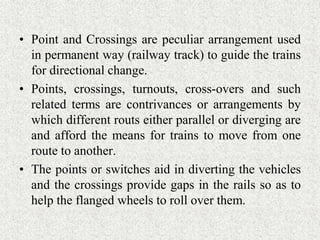
• Point and Crossings are peculiar arrangement used
in permanent way (railway track) to guide the trains
for directional change.
• Points, crossings, turnouts, cross-overs and such
related terms are contrivances or arrangements by
which different routs either parallel or diverging are
and afford the means for trains to move from one
route to another.
• The points or switches aid in diverting the vehicles
and the crossings provide gaps in the rails so as to
help the flanged wheels to roll over them.
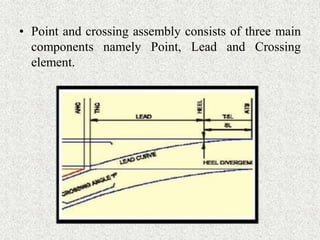
• Point and crossing assembly consists of three main
components namely Point, Lead and Crossing
element.
Important terms
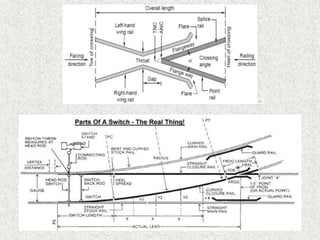
• Points: A pair of tongue rail with their stock rails
are termed as points.
• Crossing: A crossing is a device introduced at the
junction where two rails cross to permit the wheel
flange of railway vehicle to pass from one track to
another track.
• Turnout: The term denotes points and crossing
with the lead rails.
• Tongue rail: It is tapered moveable rail, connected
at its thickest end to running rail.
• Stock rail: It is the running rail, against which a
tongue rail functions.
• Switch: A pair of tongue with stock rail with
necessary connections and fittings.
• Heel of switch: It is an imaginary point on the
gauge line midway between the end of lead rail and
the tongue rail in case of loose heel switches In case
of fixed heel switches, it is a point on the gauge line
of tongue rail opposite the centre of heel block.
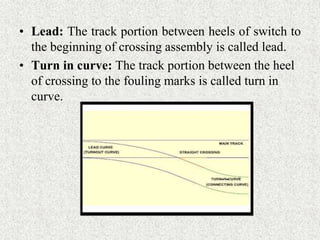
• Lead: The track portion between heels of switch to
the beginning of crossing assembly is called lead.
• Turn in curve: The track portion between the heel
of crossing to the fouling marks is called turn in
curve.
Necessity of points and crossing
• Because of the wheels of railway vehicles are
provided with inside flanges therefore, they require
special arrangement of points and crossing in order
to navigate their way on the rails.
• Giving precedence to faster trains in the same
direction, giving passage to a train moving in the
opposite direction or for connecting places not on
the direct line of track.
• To switch from one track to other and to change
direction.
• To diverge or converge the tracks.
Crossings
• A crossing or frog is a device introduced at the
point where two gauge faces cross each other to
permit the flanges of a railway vehicle to pass from
one track to another.
• A gap is provided from throw to the nose of
crossing.
• Check rails assures the correct movement and
guides the wheels properly.
Types of Crossings
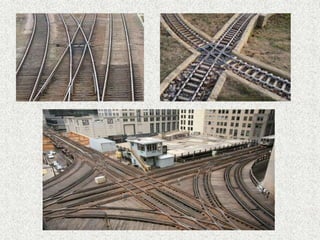
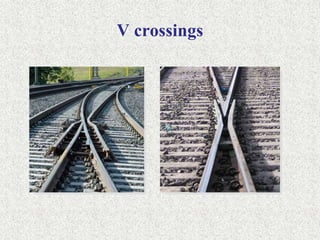
• An acute angle crossing or ‘V’ crossing: In this
type the intersection of the two gauge faces forms
an acute angle. For example, when a right rail
crosses a left rail, it makes an acute crossing.
Thus, unlike rail crossings form an acute crossing.
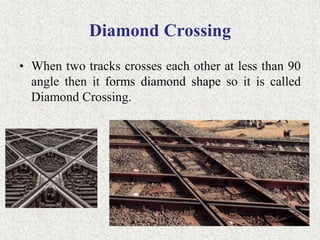
• Obtuse or diamond crossing: In which the two
gauge faces meet at an obtuse angle. When a right
or left rail crosses a similar rail, it makes an obtuse
crossing.
• Square crossing: In which two tracks cross at
right angles. Such crossings are.rarely used in
actual practice.
Diamond Crossing
• When two tracks crosses each other at less than 90
angle then it forms diamond shape so it is called
Diamond Crossing.
V crossings

Points and crossings

  • 1.
    POINTS AND CROSSINGS Submittedto: Prof.Hemanth Kamplimath Prepared by: Hiran Rathva(13BCL093)
  • 2.
    • Point andCrossings are peculiar arrangement used in permanent way (railway track) to guide the trains for directional change. • Points, crossings, turnouts, cross-overs and such related terms are contrivances or arrangements by which different routs either parallel or diverging are and afford the means for trains to move from one route to another. • The points or switches aid in diverting the vehicles and the crossings provide gaps in the rails so as to help the flanged wheels to roll over them.
  • 4.
    • Point andcrossing assembly consists of three main components namely Point, Lead and Crossing element.
  • 5.
    Important terms • Points:A pair of tongue rail with their stock rails are termed as points. • Crossing: A crossing is a device introduced at the junction where two rails cross to permit the wheel flange of railway vehicle to pass from one track to another track. • Turnout: The term denotes points and crossing with the lead rails.
  • 6.
    • Tongue rail:It is tapered moveable rail, connected at its thickest end to running rail. • Stock rail: It is the running rail, against which a tongue rail functions. • Switch: A pair of tongue with stock rail with necessary connections and fittings. • Heel of switch: It is an imaginary point on the gauge line midway between the end of lead rail and the tongue rail in case of loose heel switches In case of fixed heel switches, it is a point on the gauge line of tongue rail opposite the centre of heel block.
  • 7.
    • Lead: Thetrack portion between heels of switch to the beginning of crossing assembly is called lead. • Turn in curve: The track portion between the heel of crossing to the fouling marks is called turn in curve.
  • 8.
    Necessity of pointsand crossing • Because of the wheels of railway vehicles are provided with inside flanges therefore, they require special arrangement of points and crossing in order to navigate their way on the rails. • Giving precedence to faster trains in the same direction, giving passage to a train moving in the opposite direction or for connecting places not on the direct line of track. • To switch from one track to other and to change direction. • To diverge or converge the tracks.
  • 9.
    Crossings • A crossingor frog is a device introduced at the point where two gauge faces cross each other to permit the flanges of a railway vehicle to pass from one track to another. • A gap is provided from throw to the nose of crossing. • Check rails assures the correct movement and guides the wheels properly.
  • 11.
    Types of Crossings •An acute angle crossing or ‘V’ crossing: In this type the intersection of the two gauge faces forms an acute angle. For example, when a right rail crosses a left rail, it makes an acute crossing. Thus, unlike rail crossings form an acute crossing. • Obtuse or diamond crossing: In which the two gauge faces meet at an obtuse angle. When a right or left rail crosses a similar rail, it makes an obtuse crossing. • Square crossing: In which two tracks cross at right angles. Such crossings are.rarely used in actual practice.
  • 12.
    Diamond Crossing • Whentwo tracks crosses each other at less than 90 angle then it forms diamond shape so it is called Diamond Crossing.
  • 13.